
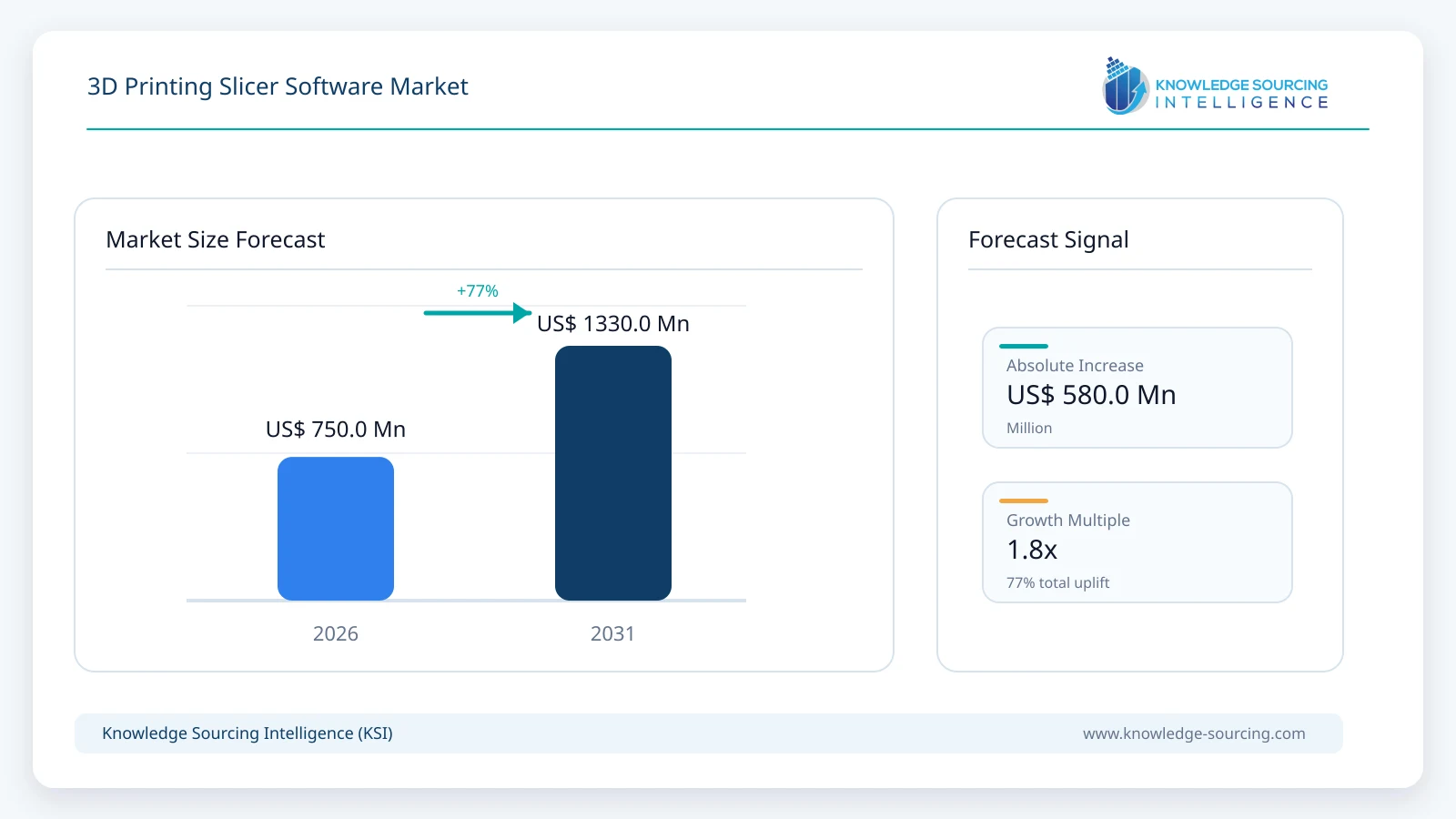
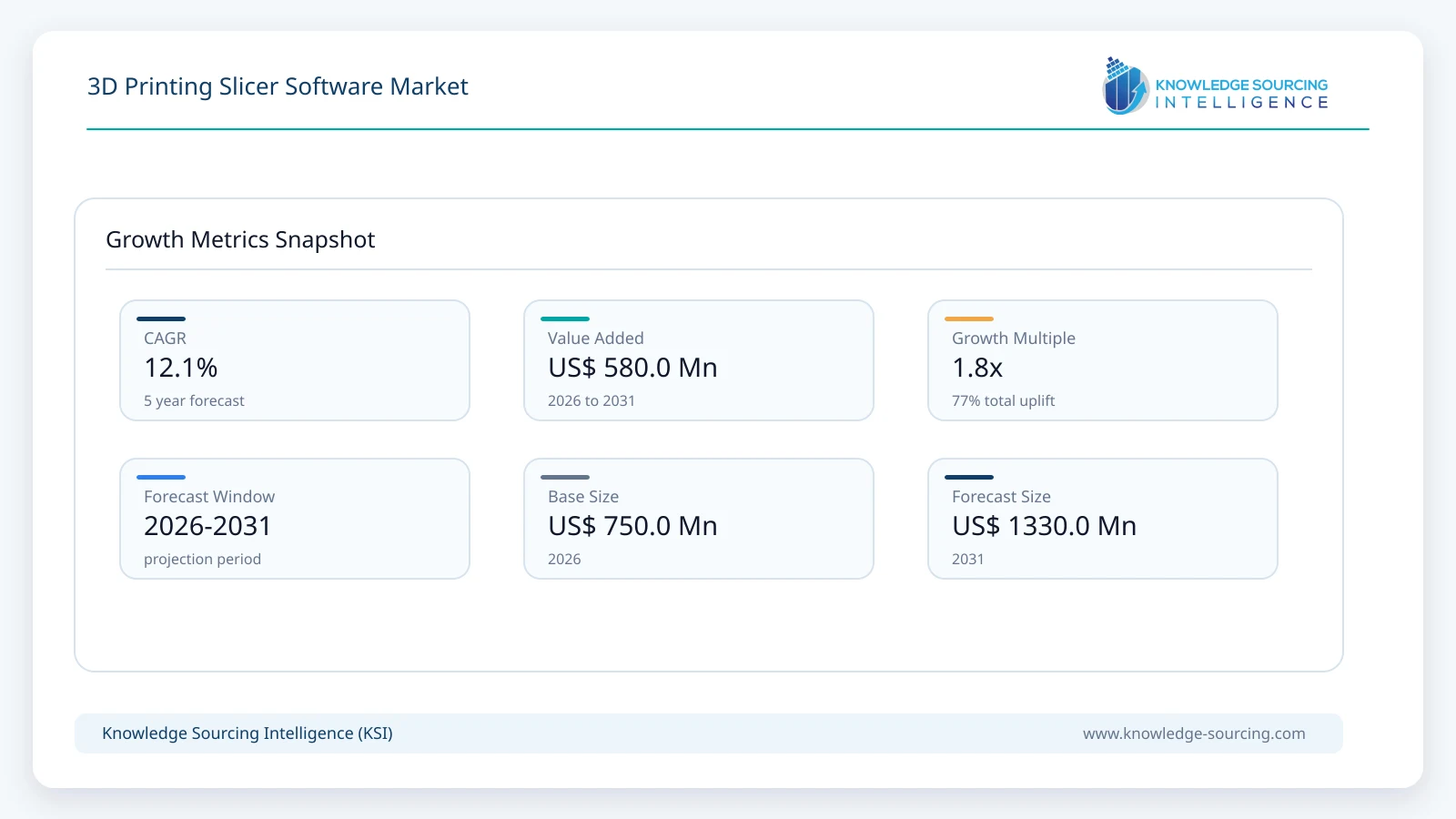
The 3D Printing Slicer Software Market is forecast to grow at a CAGR of 12.1%, reaching USD 1,330.00 million in 2031 from USD 750.00 million in 2026.
Highlights:
- 1Rising industrial additive manufacturing increases demand for workflow-oriented slicer software with process automation.
- 2Enterprise buyers prioritise software interoperability, traceability, security, and machine compatibility over standalone features.
- 3Cloud-enabled slicing and AI-assisted print optimisation are reshaping software purchasing decisions across industrial users.
- 4Healthcare, aerospace, and industrial manufacturing continue to expand the demand for validated, application-specific slicing capabilities.
- 5Open material ecosystems and multi-printer support increasingly influence software selection and long-term customer retention.
As additive manufacturing moves beyond prototyping toward serial production and regulated industrial applications, slicer software increasingly influences print quality, production efficiency, material utilisation, repeatability, and manufacturing cost rather than serving only as a preparation tool.
Industrial buyers are purchasing software differently than they did several years ago. Instead of evaluating slicing capability alone, manufacturers increasingly assess software according to compatibility with heterogeneous printer fleets, workflow automation, cybersecurity, quality assurance, production monitoring, and integration with product lifecycle management (PLM), manufacturing execution systems (MES), and computer-aided design (CAD) platforms. Large organisations also seek software that simplifies operations across multiple production sites while reducing dependence on operator experience.
Printer manufacturers continue expanding proprietary software ecosystems to strengthen customer retention, while independent software providers compete by supporting broader hardware compatibility and advanced optimisation capabilities. This has created a market where commercial value extends beyond licence sales into software subscriptions, cloud services, maintenance contracts, application libraries, and production analytics.
Demand is also becoming more application-specific. Medical device manufacturers require validated workflows and documentation, aerospace suppliers emphasise repeatability and certification, while industrial manufacturers focus on production throughput, machine utilisation, and reduced scrap. Educational institutions remain important adopters, although their purchasing decisions generally emphasise affordability, ease of use, and compatibility with multiple printer platforms rather than advanced production capabilities.
Rather than competing solely on user interface improvements, software developers increasingly differentiate through artificial intelligence-assisted parameter optimisation, simulation capabilities, remote print management, material databases, and automated quality control, reflecting broader changes across the additive manufacturing value chain.
Key Market Indicators
Indicator | Latest Evidence | Commercial Meaning |
Industrial additive manufacturing standards | ISO/ASTM 52900 framework continues to guide additive manufacturing terminology and process standardisation | Standardised workflows increase demand for software capable of supporting compliant production environments. |
Healthcare regulation | FDA continues expanding technical guidance for additively manufactured medical devices | Medical manufacturers increasingly require validated slicing workflows with complete process documentation. |
Aerospace qualification | NASA and aerospace organisations continue qualifying additively manufactured flight components | Greater certification requirements increase demand for repeatable slicing parameters and process validation. |
Enterprise software integration | Autodesk, Materialise, and Stratasys continue expanding cloud-based manufacturing workflow capabilities | Buyers increasingly prefer integrated software environments over standalone slicing applications. |
Industrial printer ecosystems | Multi-material and multi-printer production environments continue expanding across industrial manufacturing | Cross-platform compatibility has become an important purchasing criterion for enterprise customers. |
Market Drivers
Expansion of industrial additive manufacturing requires production-grade workflow software
Industrial deployment has become one of the strongest commercial drivers for slicer software demand. Manufacturers are increasingly using additive manufacturing for production tooling, customised components, spare parts, and selected end-use products rather than limiting adoption to prototype development. According to ISO and ASTM additive manufacturing standards, repeatability and controlled production workflows are essential for industrial implementation. As production volumes increase, buyers require software capable of automatically generating consistent print parameters, reducing operator intervention, and maintaining quality across multiple machines. Software vendors are responding by investing in automation, production management tools, and enterprise connectivity instead of relying solely on traditional slicing functionality.
Healthcare and regulated manufacturing increase demand for validated digital workflows
Medical device producers and healthcare institutions require extensive documentation throughout the manufacturing process because patient safety and regulatory compliance remain central procurement requirements. The U.S. Food and Drug Administration continues publishing technical guidance supporting additively manufactured medical devices while emphasising process validation, design controls, material traceability, and manufacturing consistency. These requirements increase the commercial importance of slicer software capable of documenting build parameters, recording production history, and maintaining repeatable manufacturing conditions. Software suppliers have consequently expanded validation features, secure data management capabilities, and compatibility with quality management systems used by regulated industries.
Growth of heterogeneous printer fleets strengthens demand for hardware-independent software
Many industrial facilities now operate printers from multiple manufacturers to accommodate different materials, production speeds, and application requirements. This diversification has increased demand for slicer software that supports broad hardware compatibility without requiring separate workflows for every printer model. Official product announcements from Autodesk, Materialise, Raise3D, and UltiMaker indicate continued investment in software interoperability, cloud connectivity, and broader machine support to simplify enterprise operations. Buyers increasingly value software that reduces employee training requirements, enables centralised production management, and minimises workflow disruption when additional printers are introduced into existing manufacturing environments.
Artificial intelligence and cloud connectivity improve operational efficiency
Artificial intelligence is gradually becoming a practical feature within slicing software rather than an experimental capability. Developers are incorporating automated orientation selection, support generation, parameter recommendations, print simulation, and predictive optimisation to reduce failed builds and improve material utilisation. At the same time, cloud-based management platforms allow manufacturers to monitor distributed printer fleets, manage digital inventories, and coordinate production across multiple facilities. These capabilities align with broader manufacturing digitalisation initiatives, particularly among organisations seeking higher equipment utilisation, lower operating costs, and improved production planning. Software differentiation is therefore increasingly driven by workflow intelligence instead of conventional print preparation functions.
Market Restraints and Challenges
Proprietary software ecosystems limit interoperability across printer platforms. Many printer manufacturers continue developing software that is closely linked to their own hardware, firmware, and material portfolios. While this approach helps vendors optimise print quality and strengthen customer retention, it can restrict operational flexibility for organisations operating mixed printer fleets. Industrial manufacturers increasingly seek software that supports multiple machine brands through a single workflow, yet compatibility gaps remain common for advanced machine functions and newly released printers. Independent software developers continue expanding hardware support, although maintaining compatibility with rapidly evolving printer technologies requires sustained engineering investment and frequent software updates.
Qualification and validation requirements lengthen software adoption in regulated industries. Healthcare, aerospace, and defence organisations cannot implement new slicing software without demonstrating that process changes do not compromise product quality or regulatory compliance. The U.S. Food and Drug Administration and aerospace qualification frameworks require documented manufacturing controls, process validation, and traceable production records for many critical applications. As a result, software upgrades often require extensive internal testing before deployment. These longer qualification cycles slow commercial adoption, particularly for smaller software developers that must demonstrate reliability before securing contracts from highly regulated manufacturers.
Rapid material and printer innovation increases software development complexity. Additive manufacturing technologies continue expanding beyond conventional thermoplastics into engineering polymers, metal powders, ceramics, composites, and bio-based materials. New printer architectures also introduce unique process parameters that cannot always be supported through existing slicing algorithms. Software suppliers therefore face continuous development requirements to maintain compatibility with emerging hardware and materials while ensuring stable performance across legacy systems. Companies unable to respond quickly risk losing customers seeking support for recently introduced production technologies.
Cybersecurity and protection of digital manufacturing data remain growing concerns. Manufacturing files contain valuable intellectual property, product specifications, and production parameters that increasingly move through cloud-connected software platforms. Industrial customers, particularly those serving aerospace, defence, and medical sectors, require secure user authentication, encrypted data transfer, controlled access rights, and comprehensive audit trails. Software providers must therefore balance remote accessibility with increasingly stringent cybersecurity expectations. Compliance with customer security requirements has become a purchasing criterion rather than simply an information technology consideration.
Major Segment Analysis
Healthcare End-user Segment
Healthcare represents one of the most commercially important end-user segments because additive manufacturing increasingly supports patient-specific medical devices, surgical guides, dental products, orthopaedic implants, and anatomical models. Unlike general prototyping applications, healthcare workflows require consistent dimensional accuracy, comprehensive documentation, and repeatable manufacturing processes. These requirements increase the value of slicer software that can generate validated build parameters while maintaining complete production records for regulatory review.
Purchasing decisions within this segment extend well beyond print quality. Hospitals, dental laboratories, contract manufacturers, and medical device companies evaluate software according to workflow validation, compatibility with certified materials, cybersecurity, and integration with design and quality management systems. Suppliers also compete through application-specific libraries, automated support generation for complex geometries, and production traceability. Although educational and consumer applications continue supporting software adoption, healthcare customers generally place greater emphasis on reliability, documentation, and long-term software support because manufacturing errors can directly affect patient safety and regulatory compliance.
Regional Analysis
Region | Main Demand Signal | Principal Constraint |
North America | Aerospace, healthcare, industrial digital manufacturing investment | Stringent qualification and cybersecurity requirements |
Europe | Strong industrial engineering base and regulatory-driven quality standards | High compliance costs and fragmented manufacturing landscape |
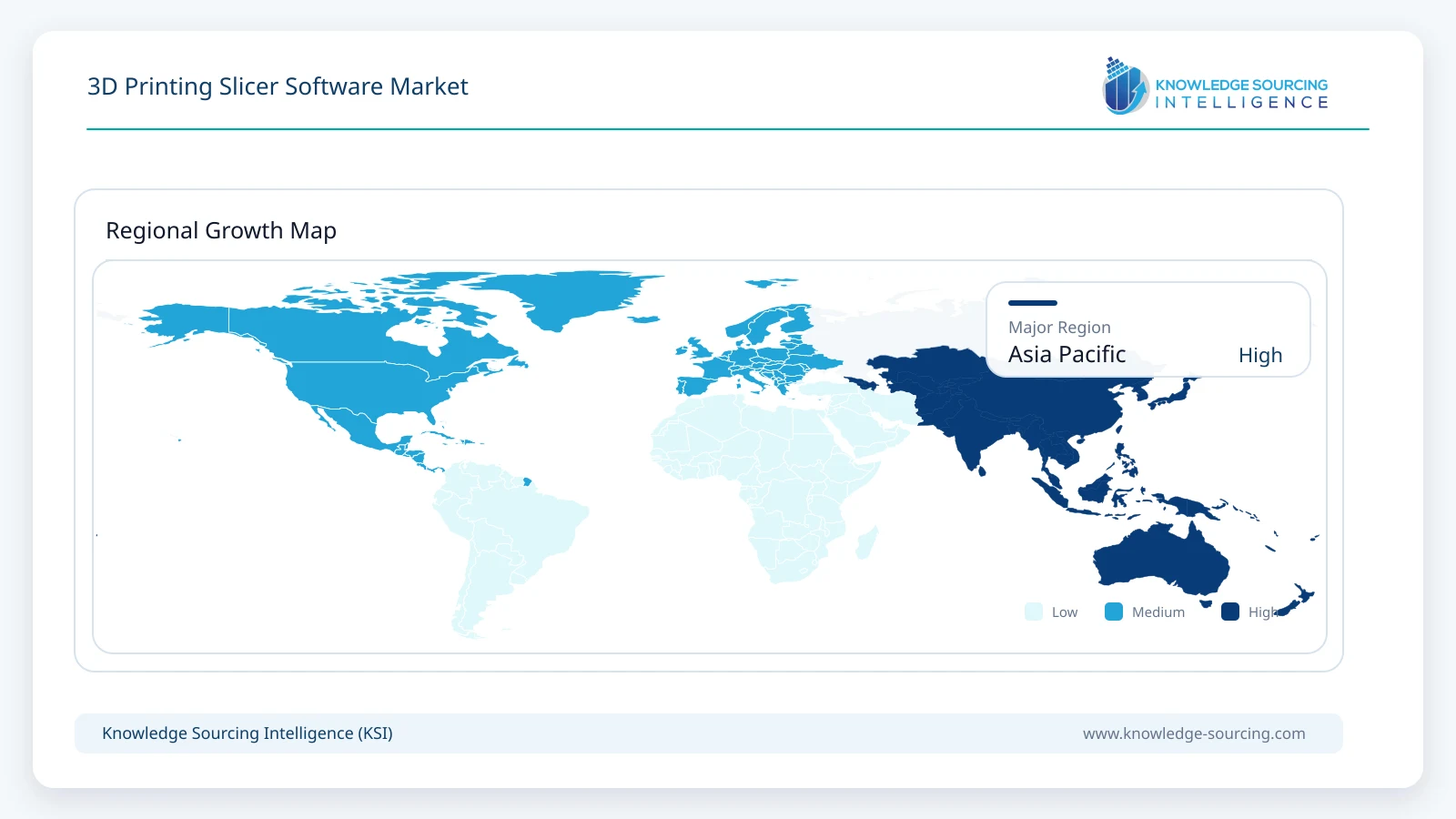
Asia Pacific | Expanding manufacturing capacity and domestic printer production | Diverse standards and varying software adoption maturity |
South America | Growing educational and industrial adoption | Limited industrial-scale additive manufacturing investment |
Middle East and Africa | Government-backed advanced manufacturing programmes | Smaller installed manufacturing base and skilled workforce gaps |
North America
North America continues to represent a mature market for industrial additive manufacturing software because the United States combines advanced aerospace production, medical device manufacturing, automotive engineering, and software development capabilities. Government agencies such as the National Institute of Standards and Technology (NIST) continue supporting additive manufacturing research and standardisation, while the U.S. Food and Drug Administration provides guidance for additively manufactured medical products. Enterprise buyers increasingly prioritise secure digital workflows, validated production records, and integration with broader manufacturing software platforms, encouraging suppliers to expand cloud-based production management and compliance capabilities.
Europe
European demand is supported by established automotive, aerospace, industrial equipment, and medical technology industries, particularly in Germany, France, the United Kingdom, Italy, and the Netherlands. European manufacturers increasingly incorporate additive manufacturing into broader Industry 4.0 programmes that connect digital design, production planning, and quality assurance. Compliance with ISO and ASTM standards, together with demanding customer quality requirements, encourages investment in software capable of maintaining process consistency across distributed production facilities. Buyers also favour solutions that support multiple printer technologies because industrial operations often include equipment from several manufacturers.
Asia Pacific
Asia Pacific continues expanding both printer manufacturing capacity and industrial adoption of additive manufacturing technologies. China remains a major production centre for 3D printing equipment, while Japan and South Korea maintain strong positions in industrial automation and precision manufacturing. India is increasing investment in additive manufacturing through government-supported initiatives and expanding engineering capabilities, whereas Taiwan contributes through electronics manufacturing and precision engineering. As manufacturing capacity broadens across the region, enterprises increasingly require scalable slicing software that supports diverse printer fleets, multilingual workflows, and cloud-enabled production management.
South America
Brazil and Argentina account for much of the region's commercial activity, supported by growing adoption within education, industrial engineering, healthcare, and product development. Investment levels remain lower than those observed in North America and Europe, leading many organisations to prioritise cost-effective software with broad hardware compatibility. Software vendors increasingly serve these markets through regional distributors, cloud licensing, and remote technical support, reducing barriers associated with local implementation resources.
Middle East and Africa
Government diversification strategies continue encouraging adoption of advanced manufacturing technologies across several Middle Eastern economies, particularly the United Arab Emirates and Saudi Arabia. Additive manufacturing supports construction, healthcare, aerospace maintenance, and education initiatives, creating opportunities for enterprise software providers. Adoption across much of Africa remains comparatively limited because industrial infrastructure, skilled personnel, and installed printer capacity are still developing. Nevertheless, universities, research institutions, and specialised industrial projects continue expanding the regional user base for professional slicing software.
Competitive Landscape
Competition in the 3D printing slicer software market is shaped by a combination of printer manufacturers offering proprietary software and independent software developers providing hardware-agnostic solutions. Autodesk Inc., Materialise N.V., and Stratasys Ltd. continue strengthening their software portfolios through workflow integration, cloud connectivity, simulation capabilities, and production management tools that extend beyond basic slicing functions. Meanwhile, UltiMaker, Bambu Lab, Raise3D Technologies Inc., Prusa Research a.s., and Zortrax S.A. use software to improve user experience, optimise printer performance, and reinforce customer loyalty within their respective hardware ecosystems.
Competition increasingly centres on interoperability, automation, cybersecurity, and enterprise integration rather than software licensing alone. Vendors are expanding support for multiple printer technologies, introducing AI-assisted parameter optimisation, and improving compatibility with CAD, PLM, and manufacturing execution systems. The market presents moderate barriers to entry because reliable slicing algorithms, continuous software maintenance, regulatory expectations in industrial applications, and long-term compatibility with evolving printer hardware require sustained investment in software engineering and application expertise.
Recent Developments
June 2026: Orca Slicer rolled out its stable v2.4.2 update, providing expanded calibration test suites, deep multi-printer profile integration, and performance improvements for Klipper-driven hardware without requiring cloud sign-ins.
May 2026: Snapmaker hired community developer Ratdoux to officially integrate his experimental Full Spectrum multicolor slicing engine directly into the custom software build designated as Snapmaker Orca.
March 2026: CHITUBOX introduced Version 3.3.0, enhancing its resin-printing slicer with UI improvements, workflow optimisation, feature enhancements, and bug fixes, strengthening its professional SLA/DLP software ecosystem for industrial and desktop users.
Regulatory and Policy Environment
Regulation increasingly influences software selection because additive manufacturing is expanding into sectors where manufacturing documentation and product traceability are mandatory. International standards developed jointly by ISO and ASTM International, including the ISO/ASTM 52900 series, provide common terminology and technical frameworks that software developers increasingly incorporate into production workflows. Compliance with these standards supports process consistency across industrial manufacturing, supplier qualification, and international supply chains.
Medical applications remain subject to additional oversight. The U.S. Food and Drug Administration has issued technical guidance covering the technical considerations for additively manufactured medical devices, encouraging manufacturers to maintain validated production processes, documented build parameters, and comprehensive quality records. These expectations increase demand for slicer software capable of recording process data throughout the manufacturing cycle.
Cybersecurity is also becoming more important as cloud-connected manufacturing platforms expand. Industrial customers increasingly expect secure authentication, controlled user access, encrypted file transfer, and audit capabilities that align with broader enterprise information security policies. For software developers serving aerospace, defence, healthcare, and other regulated industries, compliance with customer security requirements has become a prerequisite for commercial adoption rather than an optional product feature.
Outlook and Strategic Implications
Demand for 3D printing slicer software during the 2026 to 2031 forecast period is expected to be shaped more by industrial workflow requirements than by growth in desktop printer installations. As additive manufacturing becomes part of mainstream production, buyers are likely to evaluate software according to its ability to improve machine utilisation, reduce print failures, support distributed manufacturing, and integrate with enterprise software environments. Artificial intelligence, cloud-based production management, and automated process optimisation are expected to become standard purchasing considerations across industrial deployments.
Software suppliers are also expected to invest more heavily in interoperability as manufacturers expand mixed printer fleets across different production sites. Vendors capable of supporting multiple printer technologies while maintaining validated workflows, cybersecurity controls, and seamless integration with CAD, PLM, and manufacturing execution systems are likely to strengthen their competitive position. At the same time, continued advances in printer hardware and material science will require frequent software updates, making long-term development capability an important differentiator.
For industry participants, several strategic priorities are becoming increasingly evident:
Software vendors should prioritise AI-assisted optimisation, cloud-native workflow management, and broad hardware compatibility to meet evolving industrial requirements.
Printer manufacturers are likely to continue balancing proprietary software ecosystems with growing customer demand for interoperability and open manufacturing workflows.
Healthcare, aerospace, and industrial manufacturers should evaluate software based on validation capability, cybersecurity, process traceability, and enterprise integration rather than slicing performance alone.
Investors and technology partners should monitor software providers that expand recurring subscription revenue, strengthen enterprise service offerings, and develop capabilities aligned with industrial digital manufacturing strategies.
Regulators and standards organisations will continue influencing software development through evolving guidance on quality management, digital traceability, cybersecurity, and additive manufacturing standards.
The market is therefore progressing from a software category centred on print preparation to one that supports digital manufacturing operations across increasingly complex production environments. Future competitive differentiation is expected to depend less on individual slicing features and more on software's ability to connect design, production, quality assurance, and factory management within a secure and scalable manufacturing ecosystem.
3D Printing Slicer Software Market Scope:
| Report Metric | Details |
|---|---|
| Total Market Size in 2026 | USD 750.00 million |
| Total Market Size in 2031 | USD 1,330.00 million |
| Forecast Unit | Million |
| Growth Rate | 12.1% |
| Study Period | 2021 to 2031 |
| Historical Data | 2021 to 2024 |
| Base Year | 2025 |
| Forecast Period | 2026 – 2031 |
| Segmentation | End User, Printer Technology, Application, Geography |
| Companies |
|
Market Segmentation
By End-User
Healthcare
Automotive
Aerospace and Defense
Industrial Manufacturing
Consumer Goods
Education and Research
Others
By Printer Technology
FDM/FFF
SLA
SLS
DLP
Multi Jet Fusion (MJF)
Others
By Application
Prototyping
Functional Parts Manufacturing
Tooling
Educational Use
Research and Development
By Geography
North America
USA
Canada
Mexico
South America
Brazil
Argentina
Others
Europe
Germany
France
United Kingdom
Spain
Italy
Netherlands
Others
Middle East and Africa
Saudi Arabia
UAE
Israel
Others
Asia Pacific
China
Japan
India
South Korea
Indonesia
Taiwan
Others
Table of Contents
1. INTRODUCTION
1.1. Market Overview
1.2. Market Definition
1.3. Scope of the Study
1.4. Market Segmentation
1.5. Currency
1.6. Assumptions
1.7. Base and Forecast Years Timeline
2. RESEARCH METHODOLOGY
2.1. Research Data
2.2. Assumptions
3. EXECUTIVE SUMMARY
3.1. Research Highlights
4. MARKET DYNAMICS
4.1. Market Drivers
4.2. Market Restraints
4.3. Porter’s Five Forces Analysis
4.3.1. Bargaining Power of Suppliers
4.3.2. Bargaining Power of Buyers
4.3.3. Threat of New Entrants
4.3.4. Threat of Substitutes
4.3.5. Competitive Rivalry in the Industry
4.4. Industry Value Chain Analysis
5. 3D PRINTING SLICER SOFTWARE MARKET, BY END-USER
5.1. Introduction
5.2. Healthcare
5.3. Automotive
5.4. Aerospace and Defense
5.5. Industrial Manufacturing
5.6. Consumer Goods
5.7. Education and Research
5.8. Others
6. 3D PRINTING SLICER SOFTWARE MARKET, BY PRINTER TECHNOLOGY
6.1. Introduction
6.2. FDM/FFF
6.3. SLA
6.4. SLS
6.5. DLP
6.6. Multi Jet Fusion (MJF)
6.7. Others
7. 3D PRINTING SLICER SOFTWARE MARKET, BY APPLICATION
7.1. Introduction
7.2. Prototyping
7.3. Functional Parts Manufacturing
7.4. Tooling
7.5. Educational Use
7.6. Research and Development
8. 3D PRINTING SLICER SOFTWARE MARKET, BY GEOGRAPHY
8.1. Introduction
8.2. North America
8.2.1. USA
8.2.2. Canada
8.2.3. Mexico
8.3. South America
8.3.1. Brazil
8.3.2. Argentina
8.3.3. Others
8.4. Europe
8.4.1. Germany
8.4.2. France
8.4.3. United Kingdom
8.4.4. Spain
8.4.5. Italy
8.4.6. Netherlands
8.4.7. Others
8.5. Middle East and Africa
8.5.1. Saudi Arabia
8.5.2. UAE
8.5.3. Israel
8.5.4. Others
8.6. Asia Pacific
8.6.1. China
8.6.2. Japan
8.6.3. India
8.6.4. South Korea
8.6.5. Indonesia
8.6.6. Taiwan
8.6.7. Others
9. COMPETITIVE ENVIRONMENT AND ANALYSIS
9.1. Major Players and Strategy Analysis
9.2. Emerging Players and Market Lucrativeness
9.3. Mergers, Acquisitions, Agreements, and Collaborations
9.4. Vendor Competitiveness Matrix
10. COMPANY PROFILES
10.1. Autodesk Inc.
10.2. Stratasys Ltd.
10.3. UltiMaker
10.4. Materialise N.V.
10.5. Bambu Lab
10.6. Raise 3D Technologies Inc.
10.7. Zortrax S.A.
10.8. Prusa Research a.s.
LIST OF FIGURES
LIST OF TABLES
Navigate
Trusted by the world's leading organizations











