
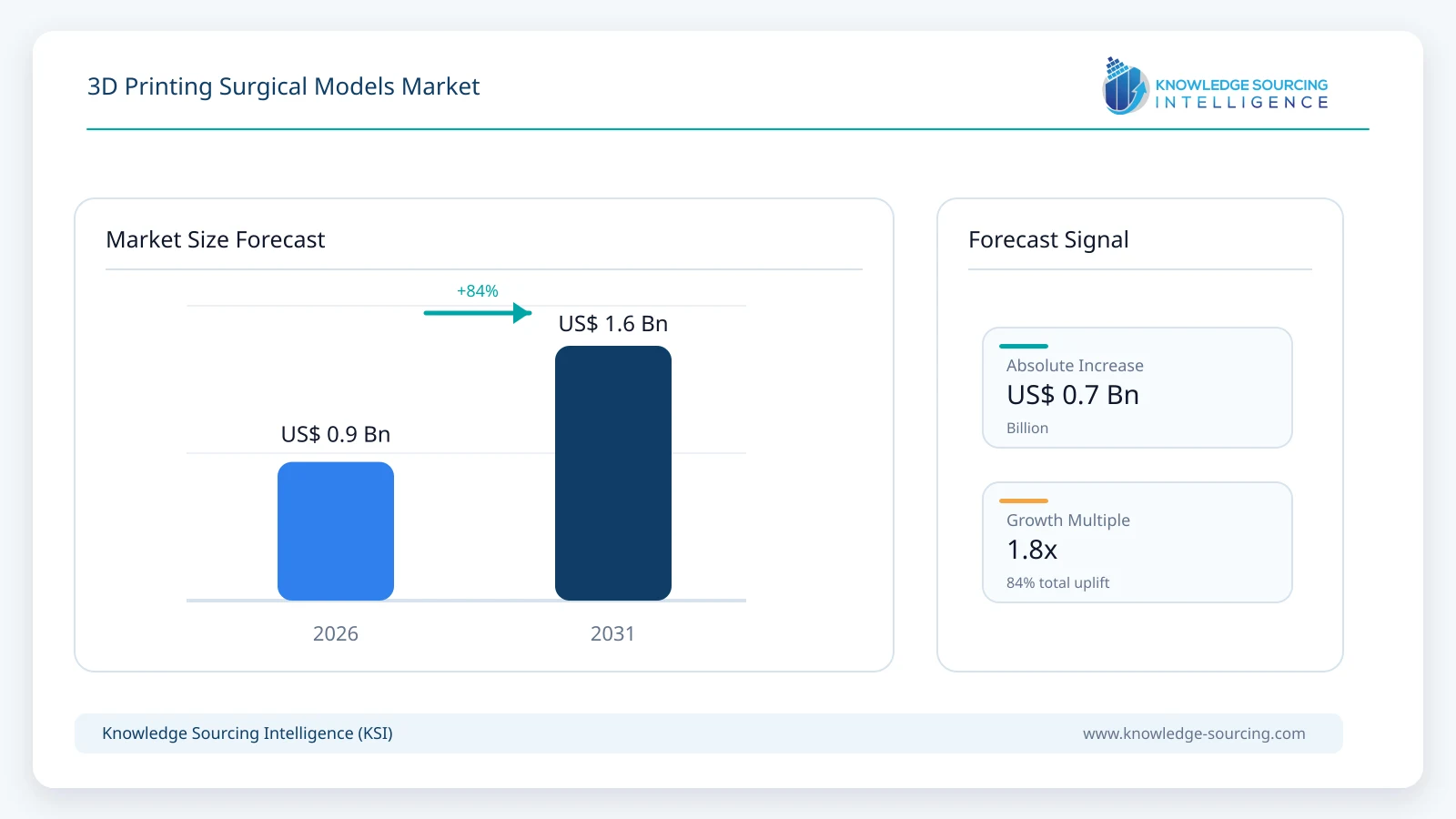
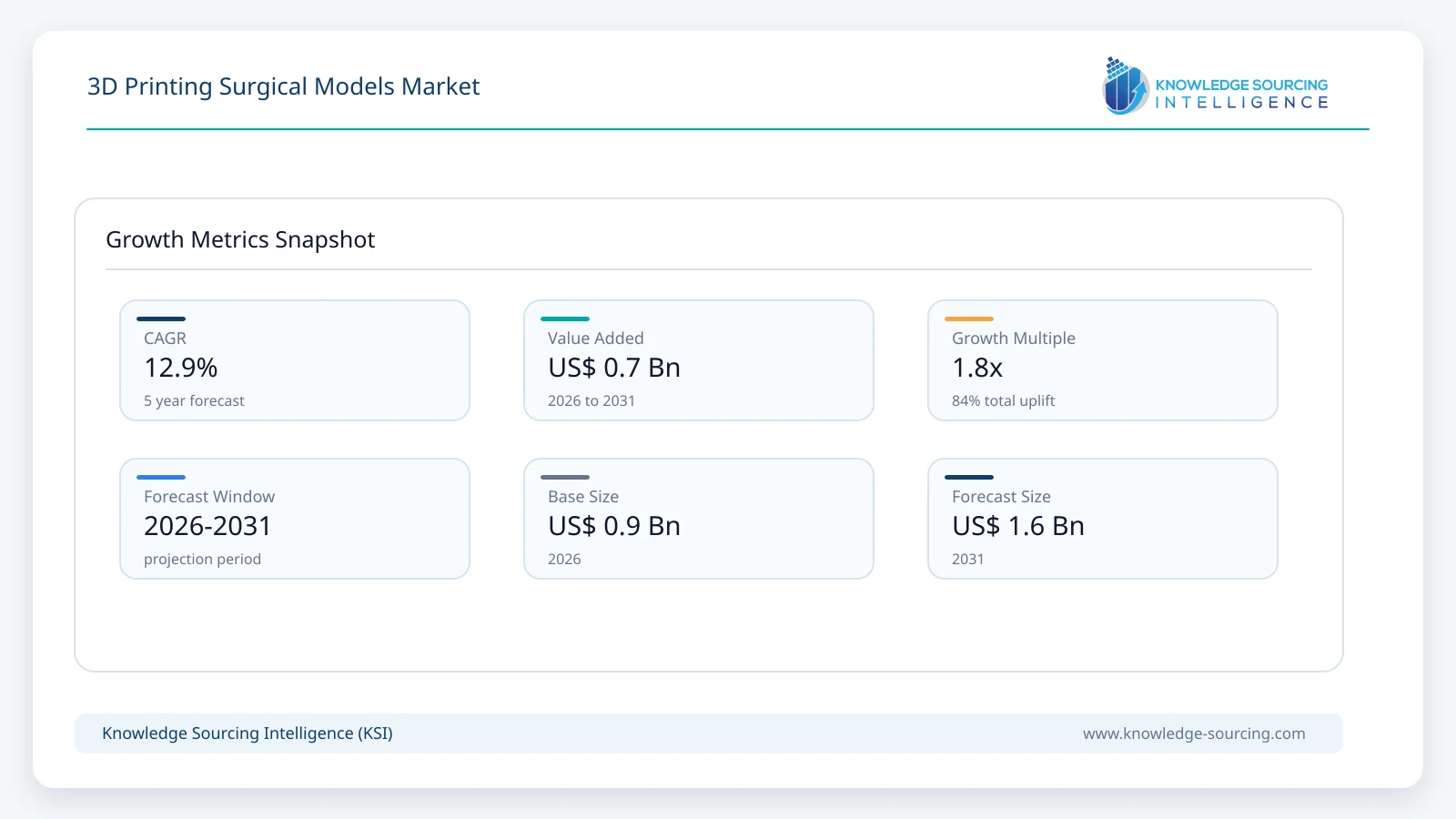
The global 3D printing surgical models market is forecast to grow at a CAGR of 12.9%, reaching USD 1.58 billion in 2031 from USD 0.86 billion in 2026.
Highlights:
- 1Orthopedic and spine applications account for approximately 30.0% of 2026 revenue, equivalent to about USD 258.0 million, supported by complex fracture, deformity and reconstruction planning.
- 2Vat photopolymerization technologies, including SLA and DLP, represent approximately 38.0% of 2026 revenue, or about USD 326.8 million, due to accuracy, surface quality and broad point-of-care availability.
- 3Outsourced and certified specialist model services account for approximately 48.0% of 2026 revenue, while hospital point-of-care production is the faster-growing workflow as regulated in-house printing expands.
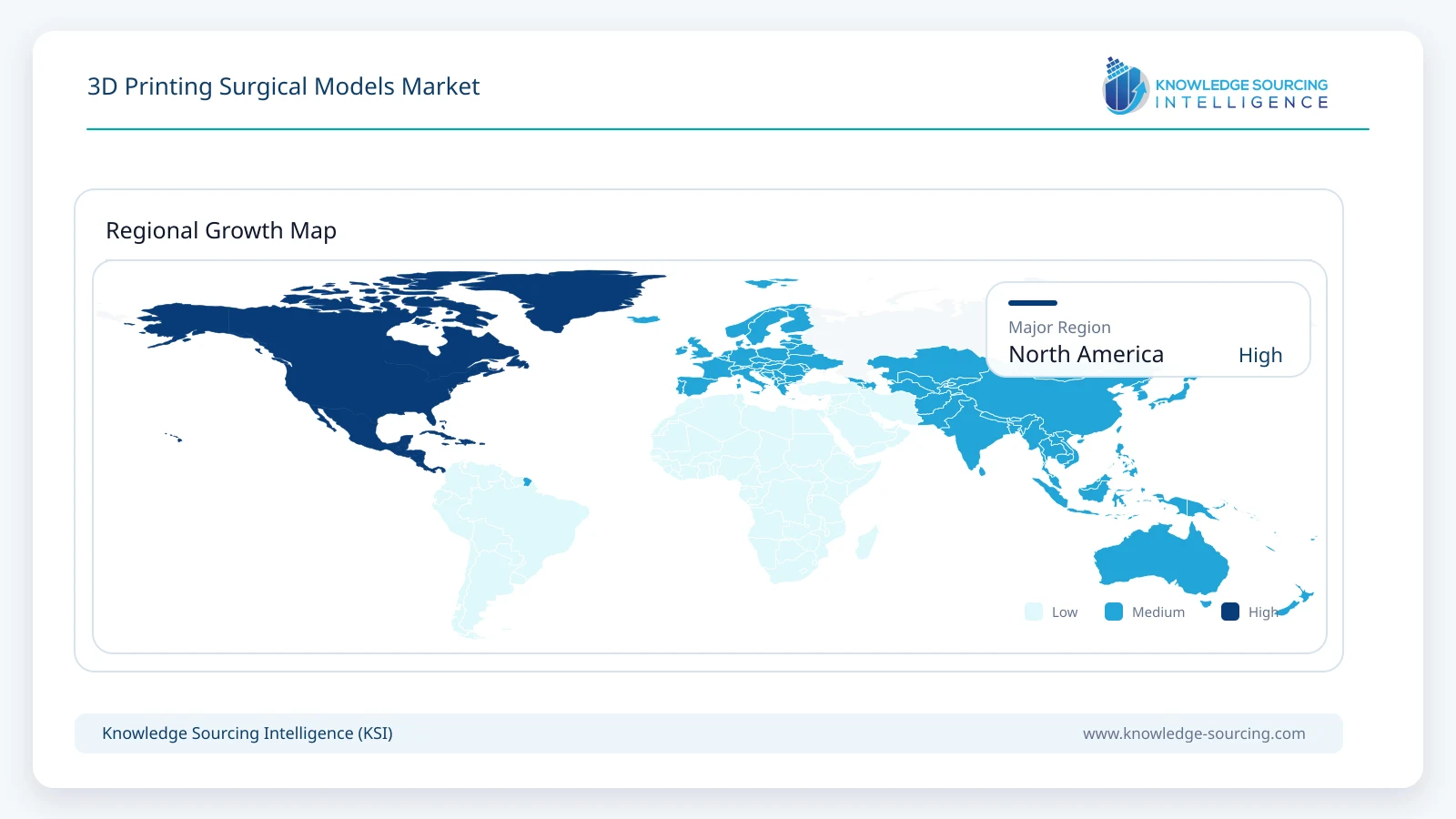
- 4North America accounts for approximately 40.0% of global 2026 revenue, equivalent to about USD 344.0 million, reflecting a large installed additive-manufacturing base, advanced imaging infrastructure and growing hospital-based 3D printing programs.
- 5Flexible and multi-material models are gaining value share because surgeons increasingly require tissue-like behavior, color differentiation and vascular or tumor visualization rather than rigid geometry alone.
- 6Market growth is increasingly tied to regulated DICOM-to-model workflows, automated segmentation and repeatable clinical production rather than printer hardware adoption alone.
Market Overview
3D-printed surgical models are patient-specific physical replicas generated from CT, MRI or other clinical imaging datasets. The workflow typically includes image acquisition, segmentation, anatomical reconstruction, print preparation, additive manufacturing, post-processing and clinical review. The model may represent bone, vascular structures, tumors, organs or multiple tissue classes in one physical object. Its economic value lies in converting two-dimensional imaging into a tactile representation that can support preoperative planning, rehearsal, patient communication and multidisciplinary discussion.
The market definition used in this report is narrower than the overall medical additive-manufacturing market. Revenue is included only when it is attributable to patient-specific anatomical models or the directly associated software, service, printing and material content required to produce those models. Patient-specific implants, prostheses, standalone surgical guides, dental models used only for restorative workflows, generic teaching models and virtual-reality-only planning are excluded. This avoids double counting broader 3D printing hardware and medical-device markets.
The current KSI page reports USD 473.03 million for 2026. That figure does not pass a current scale check against external market evidence. Grand View Research reported a global 3D-printed surgical models market of USD 530.9 million as early as 2022, while multiple 2026 industry estimates place the market near USD 0.9-1.0 billion. The revised 2026 estimate of USD 860.0 million is therefore based on a narrower but contemporary patient-specific model definition and is triangulated against specialist-service activity, point-of-care adoption, installed medical printers, supplier case volumes and independent market benchmarks.
The forecast is modeled as a non-uniform path rather than a mechanically repeated CAGR. Revenue is estimated at approximately USD 860.0 million in 2026, USD 960.0 million in 2027, USD 1.08 billion in 2028, USD 1.22 billion in 2029, USD 1.39 billion in 2030 and USD 1.58 billion in 2031. Growth accelerates as regulated hospital programs expand and automated segmentation lowers workflow cost, while the rate is moderated by reimbursement uncertainty, validation requirements and the fact that many models remain concentrated in complex cases rather than routine procedures.
Competitive differentiation is moving beyond printer resolution. Medical users increasingly evaluate segmentation traceability, regulatory status, anatomical accuracy, tissue simulation, materials, turnaround time, cybersecurity, integration with radiology systems and the ability to standardize production across hospitals. Materialise, Stratasys and 3D Systems compete through integrated platforms, while Axial3D, Myrava, Lazarus3D, Osteo3D, MedCAD and other specialists compete through workflow automation, clinical services and patient-specific expertise.
3D Printing Surgical Models Market Trends
Point-of-Care Printing Moves from Pilot Programs to Regulated Clinical Infrastructure
Hospital-based 3D printing is shifting from isolated engineering labs toward validated clinical production. Myrava, formerly Ricoh 3D for Healthcare, supports FDA-cleared patient-specific anatomical models and point-of-care programs, while IU Health announced an FDA-cleared 3D Print Studio in June 2026. This model shortens clinical feedback loops and can reduce outsourcing time for complex cases, although hospitals must maintain software validation, quality systems and trained personnel.
Automated Segmentation Reduces the Cost of Converting Imaging into Printable Anatomy
Segmentation remains one of the most labor-intensive stages of patient-specific model production. Software vendors are increasing automation for bone, vessel, organ and tumor extraction from DICOM datasets. Materialise Mimics inPrint is designed around clinical image-to-model workflows, while specialist providers increasingly use AI-assisted segmentation to reduce turnaround time. Faster segmentation expands the addressable case pool because the economics become less dependent on manual engineering hours.
Multi-Material and Tissue-Mimicking Models Gain Clinical Relevance
Rigid bone models remain important, but higher-value demand is moving toward models that reproduce differences in tissue stiffness, vessel compliance, tumor boundaries and soft anatomy. Stratasys Digital Anatomy systems support physician-tested tissue presets and patient-specific anatomical models. Osteo3D and Lazarus3D also offer flexible or tissue-representative models. These capabilities are particularly relevant to cardiovascular, oncologic and complex reconstructive procedures.
Hybrid Outsourced and In-House Workflows Become Common
Hospitals do not need to choose entirely between internal printing and external services. A hybrid model is emerging in which routine geometry may be segmented or reviewed in-house while complex production, regulatory documentation or specialized materials remain outsourced. This allows health systems to build internal clinical expertise without immediately investing in every printer technology and material platform.
Models Expand Beyond Planning into Training, Device Development and Patient Communication
Patient-specific models increasingly support several workflows around one imaging dataset. Surgeons use them for planning and rehearsal, device companies use them for fit testing and procedural development, and clinical teams use them to explain anatomy to patients. This broader utility improves the economic case for models in complex cases, although the report does not count generic training models that are not patient-specific.
Segment Analysis
By Specialty - Orthopedic and Spine Surgery
Orthopedic and spine applications are estimated at approximately USD 258.0 million in 2026, representing about 30.0% of the global market. The segment benefits from CT-based imaging, rigid anatomy and frequent need to understand complex three-dimensional relationships in fractures, deformity, tumor resection, revision surgery and reconstruction. Models can support implant sizing, osteotomy planning, surgical approach selection and multidisciplinary review.
Cardiovascular applications are estimated at approximately USD 154.8 million, or 18.0% of 2026 revenue, and are among the fastest-growing high-value uses because congenital defects, structural heart interventions and complex vascular anatomy benefit from flexible, transparent or multi-material models. Cranio-maxillofacial and reconstructive surgery accounts for approximately USD 163.4 million, while surgical oncology represents about USD 120.4 million. Neurosurgery contributes about USD 86.0 million and transplant, gastrointestinal and other specialties account for the remaining USD 77.4 million.
By Printing Technology - Vat photopolymerization
SLA and DLP-based vat photopolymerization are estimated at approximately USD 326.8 million in 2026, or 38.0% of global revenue. The technology combines high geometric accuracy, relatively smooth surfaces and an accessible printer footprint for hospital laboratories and service bureaus. The availability of biocompatible and specialty resins also broadens its role across bone, dental and soft-tissue model workflows.
Material jetting technologies, including PolyJet and MultiJet systems, account for approximately USD 232.2 million, or 27.0% of the market. Their principal advantage is multi-color and multi-material printing, which supports realistic representation of tissues and anatomical boundaries. FDM and related extrusion systems represent about USD 137.6 million, powder-bed technologies about USD 77.4 million, and other technologies approximately USD 86.0 million.
By Model Construction - Rigid Single-Material Models
Rigid single-material models are estimated at approximately USD 378.4 million in 2026, representing about 44.0% of global revenue. Bone-dominant orthopedic, craniofacial and dental-maxillofacial models can often deliver substantial planning value without complex material combinations, keeping this category the largest installed workflow.
Full-color or multi-material models account for approximately USD 283.8 million, or 33.0%, while flexible and tissue-mimicking models represent about USD 197.8 million, or 23.0%. Flexible and multi-material models are expected to grow faster because cardiovascular, oncology and soft-tissue procedures benefit from visual and mechanical differentiation that cannot be delivered by a simple rigid replica.
By Production Model - Outsourced Specialist and Certified Service
Outsourced specialist and certified services account for approximately USD 412.8 million in 2026, or 48.0% of market revenue. Outsourcing remains important because segmentation, printer validation, medical quality systems and post-processing expertise are not yet economical for every hospital. Providers such as Axial3D, Myrava, Lazarus3D, Osteo3D, MedCAD, Graft3D and 3D LifePrints support patient-specific workflows without requiring the hospital to own the full manufacturing stack.
Hospital point-of-care and in-house production is estimated at approximately USD 318.2 million, or 37.0% of revenue, and is the faster-growing workflow. The remaining USD 129.0 million is associated with OEM, medical-device development and other clinical production workflows. Point-of-care growth depends on repeatable quality systems, regulatory clarity and sufficient case volume to justify internal capability.
By Geography - North America
North America is estimated at approximately USD 344.0 million in 2026, representing about 40.0% of global revenue. The United States combines advanced radiology infrastructure, large academic medical centers, additive-manufacturing expertise and an active regulatory pathway for patient-specific anatomical models. Hospital-based programs and specialist service providers also make the region an important launch market for new clinical workflows.
Europe is estimated at approximately USD 240.8 million, or 28.0% of global revenue, while Asia Pacific represents about USD 215.0 million, or 25.0%, and is expected to grow fastest as advanced hospitals expand personalized-surgery capabilities. South America accounts for approximately USD 34.4 million and the Middle East and Africa about USD 25.8 million.
Market Drivers
Expansion of Patient-Specific Surgical Planning
Complex procedures increasingly use patient-specific planning where standard anatomical references are insufficient. Physical models can improve spatial understanding of deformity, tumor margins, vessels and surgical access.
Growth of Point-of-Care Additive Manufacturing
Hospitals are building internal printing programs as software and printer workflows become easier to validate. Point-of-care production can reduce turnaround time and improve direct collaboration between radiology, engineering and surgery.
Improved Medical Imaging and Segmentation Software
Higher-resolution CT and MRI, better segmentation algorithms and automated DICOM workflows make it easier to create accurate models. Software improvement expands the market even without a major change in printer hardware.
Demand for Realistic Simulation Before High-Risk Procedures
Tissue-mimicking and multi-material models allow clinicians to rehearse selected steps of complex procedures. This is particularly important in cardiovascular, oncology, reconstructive and pediatric surgery.
Medical-Device Development and Procedure Optimization
Anatomical models are also used by device companies for fit testing, procedural development and clinician training. This creates demand outside direct hospital planning while remaining connected to patient-specific anatomy.
Market Restraints
Reimbursement and Budget Uncertainty
Reimbursement for patient-specific models remains inconsistent across health systems. Hospitals may therefore need to justify models through operating-room efficiency, training value or clinical complexity rather than a dedicated reimbursement line.
Segmentation and Quality-System Cost
Clinical-grade models require traceable segmentation, dimensional validation, documented materials and controlled production. These activities can make low-volume programs expensive.
Limited Evidence for Routine Cases
The strongest value proposition is in anatomically complex procedures. Routine procedures may not generate enough incremental benefit to justify a patient-specific physical model.
Interoperability and Data Governance Requirements
DICOM handling, protected health information, cybersecurity and integration with hospital systems create additional workflow requirements, particularly for outsourced services and cloud-based segmentation.
Printer and Material Constraints
No single print technology reproduces every tissue property. Highly realistic multi-material models may require expensive equipment, specialized materials and substantial post-processing.
Competitive Environment
The competitive environment includes integrated medical-software and additive-manufacturing vendors, printer manufacturers, specialist anatomical-model services and point-of-care workflow providers. Materialise combines Mimics software with medical engineering and validated print workflows. Stratasys competes through Digital Anatomy printers and tissue presets. 3D Systems integrates additive manufacturing with its Virtual Surgical Planning and patient-specific healthcare capabilities.
Specialist providers compete on turnaround time, clinical support and the ability to convert imaging into validated patient-specific models. Axial3D emphasizes automated segmentation and medical 3D printing services. Myrava operates the former Ricoh 3D for Healthcare platform and supports FDA-cleared anatomical models and point-of-care programs. Lazarus3D, Osteo3D, MedCAD, Graft3D and 3D LifePrints provide model and surgical-planning workflows across orthopedic, cardiovascular, oncologic and other specialties.
Competition is therefore workflow-specific rather than purely printer-specific. A vendor with lower hardware cost can still lose a clinical project if segmentation, regulatory documentation, tissue realism or turnaround time is weaker. The most defensible positions combine software, clinical expertise, printer and material validation, quality systems and direct surgeon support.
Recent Developments
August 2026: Onkos Surgical announced its 1,000th personalized My3D pelvic case, illustrating the growing use of patient-specific 3D anatomical modeling in complex orthopedic oncology and reconstruction.
July 2026: Ricoh announced the sale of Ricoh 3D for Healthcare to Myrava, transferring a platform focused on FDA-cleared patient-specific anatomic models and point-of-care manufacturing.
June 2026: IU Health announced an enhanced 3D Print Studio at 16 Tech in collaboration with the former Ricoh 3D for Healthcare platform, supporting patient-specific anatomical models for diagnostic and pre-surgical planning.
June 2026: 3D Systems highlighted that its healthcare additive-manufacturing workflows had supported more than 200,000 patient-specific surgical-planning cases, reinforcing the commercial maturity of personalized medical modeling.
2026: Stratasys expanded Digital Anatomy software and preset capabilities, including additional anatomical and tissue workflows designed for realistic medical models and procedural simulation.
2025-2026: Axial3D continued publishing clinical applications of patient-specific models in cardiovascular, oncologic, pelvic and complex nerve-related procedures, demonstrating broader specialty adoption.
Market Outlook
The 3D printing surgical models market is expected to remain a double-digit-growth niche within medical additive manufacturing through 2031. Growth will be driven less by simple printer penetration and more by standardized clinical workflows that reduce segmentation time, improve traceability and make patient-specific modeling practical for a larger number of cases.
Orthopedic and spine procedures will remain the largest specialty, while cardiovascular, oncologic and reconstructive applications will contribute disproportionate value growth as flexible and multi-material models improve. Hospital point-of-care production should gain share, but outsourced specialists will remain important for complex anatomy, low-volume institutions and regulated workflows.
The strongest suppliers will combine imaging software, validated printing, medical quality systems and application support. Companies that sell only generic 3D printing hardware are less likely to capture the full value of the market than providers that can demonstrate anatomical accuracy, clinical integration and repeatable patient-specific production.
3D Printing Surgical Models Market Scope:
| Report Metric | Details |
|---|---|
| Total Market Size in 2026 | USD 0.86 billion |
| Total Market Size in 2031 | USD 1.58 billion |
| Forecast Unit | Billion |
| Growth Rate | 12.9% |
| Study Period | 2021 to 2031 |
| Historical Data | 2021 to 2024 |
| Base Year | 2025 |
| Forecast Period | 2026 – 2031 |
| Segmentation | Specialty, Printing Technology, Model Construction, Production Model, Geography |
| Companies |
|
Market Segmentation
By Specialty
Orthopedic and Spine Surgery
Cranio-Maxillofacial and Reconstructive Surgery
Cardiovascular and Interventional Cardiology
Surgical Oncology
Neurosurgery
Transplant, Gastrointestinal and Other Specialties
By Printing Technology
Vat Photopolymerization - SLA and DLP
Material Jetting - PolyJet and MultiJet
Material Extrusion - FDM and FFF
Powder Bed and Sintering Technologies
Others
By Model Construction
Rigid Single-Material Models
Full-Color and Multi-Material Models
Flexible and Tissue-Mimicking Models
By Production Model
Outsourced Specialist and Certified Services
Hospital Point-of-Care / In-House Production
OEM, Medical-Device Development and Other Clinical Workflows
By Geography
North America
United States
Canada
Mexico
South America
Brazil
Argentina
Others
Europe
Germany
United Kingdom
France
Italy
Spain
Others
Middle East and Africa
Saudi Arabia
UAE
South Africa
Others
Asia Pacific
China
Japan
India
South Korea
Australia
Others
Table of Contents
1. INTRODUCTION
1.1. Market Overview
1.2. Market Definition
1.3. Scope of the Study
1.4. Market Segmentation
1.5. Currency
1.6. Assumptions
1.7. Base and Forecast Years Timeline
2. RESEARCH METHODOLOGY
2.1. Research Design
2.2. Secondary Research
2.3. Primary Validation
2.4. Market Estimation and Forecasting
2.5. Data Triangulation and Quality Control
3. EXECUTIVE SUMMARY
3.1. Key Findings
3.2. Global Market Size, 2026-2031
3.3. Segment Summary
3.4. Regional Summary
4. MARKET DYNAMICS
4.1. Market Drivers
4.1.1. Expansion of Patient-Specific Surgical Planning
4.1.2. Growth of Point-of-Care Additive Manufacturing
4.1.3. Improved Medical Imaging and Segmentation Software
4.1.4. Demand for Realistic Simulation Before High-Risk Procedures
4.1.5. Medical-Device Development and Procedure Optimization
4.2. Market Restraints
4.2.1. Reimbursement and Budget Uncertainty
4.2.2. Segmentation and Quality-System Cost
4.2.3. Limited Evidence for Routine Cases
4.2.4. Interoperability and Data Governance Requirements
4.2.5. Printer and Material Constraints
5. 3D PRINTING SURGICAL MODELS MARKET BY SPECIALTY
5.1. Orthopedic and Spine Surgery
5.2. Cranio-Maxillofacial and Reconstructive Surgery
5.3. Cardiovascular and Interventional Cardiology
5.4. Surgical Oncology
5.5. Neurosurgery
5.6. Transplant, Gastrointestinal and Other Specialties
6. 3D PRINTING SURGICAL MODELS MARKET BY PRINTING TECHNOLOGY
6.1. Vat Photopolymerization - SLA and DLP
6.2. Material Jetting - PolyJet and MultiJet
6.3. Material Extrusion - FDM and FFF
6.4. Powder Bed and Sintering Technologies
6.5. Others
7. 3D PRINTING SURGICAL MODELS MARKET BY MODEL CONSTRUCTION
7.1. Rigid Single-Material Models
7.2. Full-Color and Multi-Material Models
7.3. Flexible and Tissue-Mimicking Models
8. 3D PRINTING SURGICAL MODELS MARKET BY PRODUCTION MODEL
8.1. Outsourced Specialist and Certified Services
8.2. Hospital Point-of-Care / In-House Production
8.3. OEM, Medical-Device Development and Other Clinical Workflows
9. 3D PRINTING SURGICAL MODELS MARKET BY GEOGRAPHY
9.1. North America
9.1.1. United States
9.1.2. Canada
9.1.3. Mexico
9.2. South America
9.2.1. Brazil
9.2.2. Argentina
9.2.3. Others
9.3. Europe
9.3.1. Germany
9.3.2. United Kingdom
9.3.3. France
9.3.4. Italy
9.3.5. Spain
9.3.6. Others
9.4. Middle East and Africa
9.4.1. Saudi Arabia
9.4.2. UAE
9.4.3. South Africa
9.4.4. Others
9.5. Asia Pacific
9.5.1. China
9.5.2. Japan
9.5.3. India
9.5.4. South Korea
9.5.5. Australia
9.5.6. Others
10. COMPETITIVE ENVIRONMENT AND ANALYSIS
10.1. Major Players and Strategy Analysis
10.2. DICOM-to-Model Workflow Positioning
10.3. Point-of-Care and Outsourced Production Models
10.4. Tissue Simulation and Multi-Material Capability
10.5. Regulatory and Quality-System Positioning
10.6. Recent Developments
10.7. Competitive Dashboard
11. COMPANY PROFILES
11.1. Materialise NV
11.2. Stratasys Ltd.
11.3. 3D Systems Corporation
11.4. Myrava, Inc.
11.5. Formlabs Inc.
11.6. Axial3D
11.7. Lazarus 3D LLC
11.8. Osteo3D
11.9. MedCAD LLC
11.10. Onkos Surgical
11.11. 3D LifePrints UK Ltd.
11.12. 3D Medical Support B.V.
11.13. Graft3D Healthcare Solutions Pvt. Ltd.
11.14. Anatomics Pty Ltd.
11.15. WhiteClouds Inc.
11.16. Anatomiz3D Medtech Pvt. Ltd.
12. APPENDIX
12.1. Currency
12.2. Assumptions
12.3. Base and Forecast Years Timeline
12.4. Abbreviations
Navigate
Trusted by the world's leading organizations











