
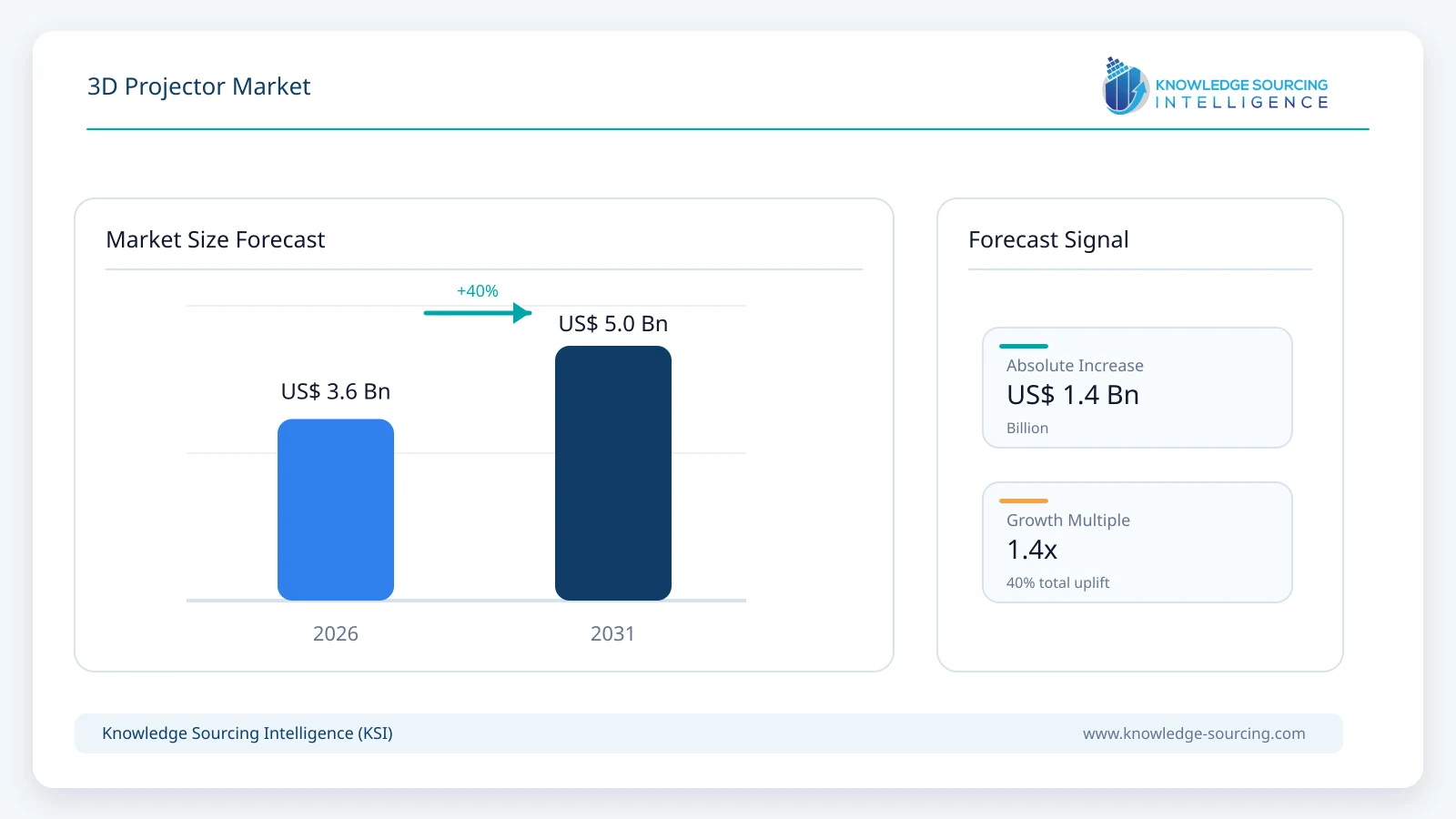
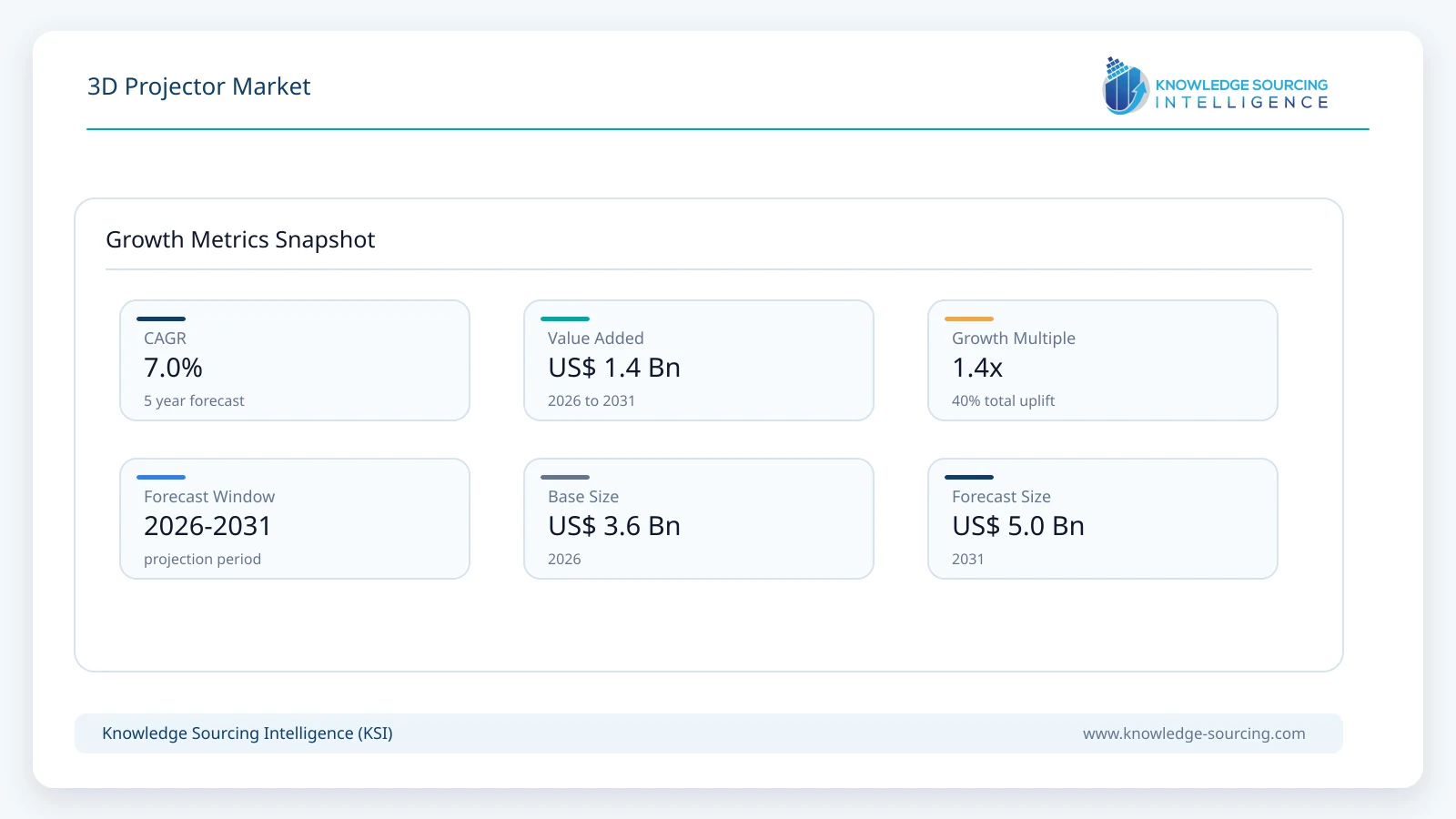
The 3D Projector Market is expected to expand at a CAGR of approximately 7.0%, reaching an estimated USD 5.01 billion in 2031 from USD 3.57 billion in 2026.
Highlights:
- 13D capability is most commercially significant when it accompanies equipment upgrades that improve everyday image quality, light-source longevity and operational reliability.
- 2DLP systems are estimated to represent approximately 78% of 2026 revenue, reflecting their use in cinema and mainstream 3D-ready projection.
- 3Cinema is estimated to account for 33% of 2026 market value, supported by high-equipment content and recurring fleet modernization.
- 4Projectors rated above 10,000 lumens are projected to increase their revenue share from 28% in 2026 to 34% in 2031.
- 54K/UHD-capable devices are projected to gain from 34% to 46% of market value as premium equipment replaces legacy HD units.
- 6North America represents an estimated 30% in 2026; Asia Pacific is expected to become the largest regional market by 2031 as its share reaches 32%.
Stereoscopic projection systems produce separate images for the two eyes, using synchronized active-shutter glasses, polarization or wavelength-selective techniques. Suppliers sell complete consumer and professional projectors, cinema-specific projection systems and, where specified, compatible optics and media interfaces. A projector being marketed as three-chip DLP or showing a three-dimensional projection-mapping effect does not itself establish stereoscopic image capability. Actual compatibility depends on input formats, frame-rate processing, light output, emitter interfaces and viewing accessories.
Cinema operators buy 3D-capable equipment principally within scheduled projection upgrades, while residential buyers usually purchase a general-purpose projector that also supports 3D media. Professional simulation and training users have a stronger functional requirement for depth cues, multi-projector synchronization and calibrated stereoscopic imagery. Consequently, replacement economics, optical performance and system integration influence revenue more consistently than the mere availability of a 3D playback setting.
Market Overview
Commercial 3D projection is sustained by two distinct purchasing environments. Cinema exhibitors deploy comparatively expensive, DCI-compliant projectors that must perform across ordinary 2D schedules and stereoscopic film screenings. Consumer buyers usually assess a 3D-enabled unit against competing 4K home entertainment and gaming products, making brightness, price, streaming compatibility and placement flexibility decisive even when 3D playback remains occasional. That mixture supports a broad equipment market but makes 3D content consumption a poor direct proxy for projector sales.
Texas Instruments' DLP ecosystem underpins much of the market's hardware architecture, from single-chip consumer models to the three-chip DLP equipment used in commercial cinema. Barco's Series 4 SP4K-12C supports active-glasses and polarization-based 3D systems, while Christie's CineLife+ CP4420m-RGBH can support high-frame-rate 3D when paired with a specified integrated media block. These details matter because higher spatial resolution does not eliminate the timing and brightness losses associated with separate left- and right-eye image channels.
Other supplier approaches occupy more specialized positions. JVC uses reflective D-ILA architecture in premium home theater models such as the 3D-capable DLA-NZ900, while BenQ's TK710 and Optoma's professional laser ranges provide format support in lower-priced or middle-brightness platforms. Projector manufacturers compete through light sources, imaging engines, optics, signal compatibility and channel service; cinemas and sophisticated simulation buyers additionally evaluate calibration, spare equipment and the reliability of 3D viewing accessories.
Market Trends
Laser Illumination Is Changing the Cost of Maintaining 3D-Capable Cinema Screens
Digital cinema operators increasingly specify laser-lit equipment when projectors approach replacement age. Laser light sources offer stable output and longer scheduled service life than legacy lamp systems, although the achievable brightness at the audience's eyes also depends on the selected 3D separation method. Barco's Series 4 and Christie's CineLife+ portfolios combine high-output optical engines with cinema-grade media processing, allowing an exhibitor to renew both 2D quality and optional stereoscopic capability within the same capital cycle.
Cinema procurement therefore tends to favor energy consumption, laser lifetime, optical uniformity and serviceability rather than a standalone 3D feature. Barco's 2026 agreement with Germany's Kinopolis for more than 70 Series 4 units illustrates this equipment-renewal mechanism; the announcement establishes a laser rollout, not a separately disclosed purchase of projectors exclusively for 3D screenings.
Stereo-Format Support and Synchronization Define Professional Usability
Professional buyers need stable left-eye/right-eye timing rather than simply a resolution badge. Christie demonstrated a dual-Sapphire 4K40-RGBH stereoscopic installation with Infitec color separation at InfoComm China in April 2026, illustrating how projectors, filters and a viewing system operate together. For multi-wall visualization or simulation, synchronization and image alignment can be more consequential to the purchasing decision than peak published lumens.
Consumer compatibility is less demanding but still fragmented by input format. BenQ identifies frame packing, frame sequential, side-by-side and top-and-bottom support for the TK710, while some other product families support a narrower subset. Retailers and integrators must qualify source devices and glasses compatibility before promising a working 3D installation.
4K-Capable Hardware Is Displacing Legacy Resolution Tiers
4K digital cinema and premium home theater projectors increase fine-detail reproduction in the ordinary 2D viewing that occupies most daily screen time. Barco's native 4K cinema lineup and JVC's D-ILA home equipment provide different implementations of that move. Stereo performance remains format-dependent: a device advertised as 4K does not necessarily deliver two simultaneous 4K-per-eye images at every supported frame rate.
The commercial effect is a higher-value premium mix rather than an automatic increase in 3D viewing hours. Manufacturers can protect average selling prices through laser brightness, lenses, contrast and processing, while lower-resolution devices remain relevant to budget-constrained meeting rooms and classrooms.
High-Brightness Systems Are Expanding Beyond Conventional Cinema
Specialist visualization venues use projection where large images, shared sightlines or immersive depth cannot easily be reproduced by a personal headset. Theme-park attractions, fixed-base simulators and research laboratories may install multiple projectors with calibrated overlap and active or passive stereo viewing. The Christie Sapphire stereoscopic demonstration shows a commercially relevant capability, but it is evidence of integration readiness rather than measured fleet-wide penetration.
Event rental operators typically assess output stability, installation time and hardware reuse across different shows. The resulting procurement economics favor versatile, high-brightness projectors that can handle stereoscopic work when required alongside conventional high-resolution content.
Segment Analysis
By Technology: DLP (Digital Light Processing)
DLP is estimated to account for approximately 78% of global 3D projector value in 2026. The category combines single-chip machines for homes, classrooms and corporate facilities with three-chip DLP cinema and premium professional systems. Fast micromirror switching supports sequential left- and right-eye image presentation, while the availability of projectors across a wide brightness and price range extends the addressable purchaser base.
Barco's native 4K Series 4 cinema systems and BenQ's 3D-ready TK710 represent opposite ends of the DLP equipment spectrum. DLP share is expected to remain high through 2031, although reflective LCoS systems retain a premium home-theater niche where buyers emphasize black levels and optical contrast.
By End User: Cinema
Cinema is the highest-value end-user group in the 2026 structure, representing an estimated 33% of revenue. A cinema-grade 3D-capable projector carries substantially higher per-unit equipment value than a household product, and premium auditoriums often require specialized media processing and integration. Exhibitors' spending decisions are anchored to screen economics, maintenance requirements and the quality of ordinary film presentation rather than 3D titles alone.
Cinema United reported more than USD 2.7 billion of North American cinema reinvestment over a recent two-year period, demonstrating the scale of wider theater upgrades without implying that the full expenditure went to projectors. Cinema’s market share is expected to moderate slightly by 2031 as consumer and event-system spending expands.
By Product: More than 10000 Lumens
Projectors above 10,000 lumens are estimated to rise from 28% of market value in 2026 to 34% in 2031. High-output optical engines address the brightness loss created by 3D eyewear and large screen dimensions, while high-frame-rate 3D processing increases the complexity of premium projection. Commercial cinema and specialist immersive venues account for much of the category's equipment value.
Christie's CP4420m-RGBH provides 20,000-lumen-class 4K projection, while Barco's SP4K-12C delivers 12,500 lumens with explicit 3D system compatibility. Purchasers pay for optical stability and support obligations alongside brightness, so project economics are not explained by lumens per dollar alone.
By Application: Professional Simulation & Training
Professional simulation and training accounts for an estimated 16% of global 3D projector value in 2026. Flight and vehicle simulators, industrial-design review suites and specialist medical training environments can require several image channels to render stable, stereoscopic depth at a shared viewing surface. Their procurement priorities differ from conventional entertainment: predictable latency, edge blending, projector alignment, calibrated color and dependable eyewear synchronization can determine whether a system meets the training objective. Replacement may also be linked to simulator maintenance cycles, where hardware changes must be validated against existing software and control systems.
This application is projected to reach approximately 18% of market value by 2031, supported by higher-brightness laser platforms and more capable multi-projector integration. Christie's April 2026 demonstration using two Sapphire 4K40-RGBH projectors with Infitec color separation illustrates a workable architecture for shared-view stereo experiences. A demonstration is not evidence of widespread orders, but it indicates the specifications that system integrators can offer to attraction operators and visualization facilities. Suppliers able to combine optical consistency with installation support and long-term calibration services have an advantage where downtime is expensive.
By Resolution: 4K / UHD
4K/UHD-capable 3D projectors are estimated to represent 34% of market value in 2026 and 46% by 2031. Greater spatial detail and stronger premium positioning support higher invoice values in cinema and residential installations, even if the actual 3D viewing channel uses a lower resolution or different frame rate. Standard HD/2K equipment remains important for budget and installed-base compatibility.
JVC's native 4K D-ILA home models and Barco's Series 4 4K cinema products show how this resolution shift spans different price tiers. The revenue migration follows premium replacement cycles, new screen construction and improved availability of laser 4K systems rather than a requirement that every customer watches native 4K stereoscopic material.
Market Drivers
Cinema Projection Replacement and Premium-Screen Investment
Cinema exhibitors periodically replace digital projectors as lamp maintenance, brightness loss and integration constraints affect presentation reliability. Laser-based platforms offer longer planned illumination life and more consistent image output, preserving the usefulness of a screen for 2D films and compatible 3D releases alike.
Barco's 2026 Kinopolis equipment agreement and its separate supply program with Saudi Arabia's muvi Cinemas demonstrate real fleet decisions involving 3D-capable cinema families. Such deployments support equipment demand, although each installation's stereoscopic usage and system configuration differ.
Wider Availability of 3D-Ready Home and Gaming Projectors
Consumers can purchase stereo-compatible DLP projectors without investing in dedicated professional visualization hardware. BenQ's TH575 and TK710 support multiple 3D input standards, combining home playback features with mainstream gaming or home-cinema functionality.
This dual-purpose positioning helps manufacturers sell devices chiefly for larger everyday screens while preserving occasional 3D movie and PC content support. Revenue growth depends on successful competition with televisions and larger flat panels, not an assumption that 3D games or films become the predominant viewing format.
Improving Laser Efficiency and Optical Longevity
Laser phosphor and RGB laser systems reduce some operational burdens associated with repeated lamp replacement, particularly in cinemas and professional installations. Brightness stability improves equipment utilization where a venue runs for long periods and serves both normal and stereoscopic events.
Optoma's AZU617TST illustrates the migration of Full 3D functionality into 6,400-lumen professional laser equipment, while cinema suppliers offer still higher-output platforms. These features can strengthen capital replacement cases when service contracts, energy use and venue downtime are considered together.
Demand for Shared-View Simulation and Specialist Visualization
Industrial design teams, simulator operators and technical teaching facilities sometimes require several participants to inspect a depth-rich image simultaneously. Multi-projector stereoscopic walls permit shared interaction with 3D models in ways that differ from individualized headsets.
Christie's April 2026 Infitec demonstration showed stereoscopic projection configured for dark rides and visualization powerwalls. Investment decisions depend on the value of spatial perception, simulation accuracy and collaborative review, making this a smaller but technically demanding source of higher-value equipment.
Growing Installed Base of Compatible 4K Cinema Equipment
Cinema and premium home theater hardware increasingly combine 4K presentation with supported 3D formats and improved image processing. Barco's 2026 Freya mFusion specification includes 4K 3D playback up to 30 frames per second, demonstrating how stereoscopy remains supported in premium systems.
When purchasers replace aging HD or lamp machines, a higher invoice value can be justified by laser illumination and better 2D quality while maintaining compatibility with existing stereoscopic libraries. The market benefits from hardware upgrading even where actual 3D viewing frequency remains modest.
Market Restraints
Limited Supply of New Stereoscopic Entertainment Content
3D film screenings and consumer stereoscopic video libraries occupy a narrower part of daily viewing than conventional 2D programming. Owners of compatible home projectors may therefore use the 3D function only occasionally, restricting a customer's willingness to pay a large incremental premium for it.
Cinema operators require persuasive attendance economics before installing specialized stereo accessories in every auditorium. General projector renewal can continue, but a weak stereoscopic release slate reduces the case for treating 3D playback alone as an equipment demand driver.
Brightness Loss and Viewing-Accessory Complexity
Active shutter systems, polarization filters and color-separation optics can reduce available light at the viewer compared with ordinary 2D presentation. The actual loss depends on the specific projector, screen, eyewear and optical arrangement, making headline lumen figures an incomplete guide to 3D quality.
Operators must also maintain glasses, emitters and calibration settings. In a multi-projector immersive venue, these requirements can add installation labor and ongoing quality-control obligations, particularly when different viewers need consistent depth perception across the screen.
High Installed Cost of Cinema-Grade and Stereo Visualization Systems
Premium cinema projectors require compatible media servers, optics, power and cooling, and often a specialized projection booth. A 3D-capable simulator may additionally need synchronized channels, blending software and motion-tracking integration, raising the total installed expenditure well beyond a consumer projector's purchase price.
This equipment burden makes some buyers extend existing asset lifetimes or choose lower-brightness architectures. Higher pricing can raise recognized equipment revenue per installation but constrain unit adoption at smaller venues and institutions.
Competition from Direct-View Displays and Head-Mounted Systems
High-brightness LED walls, large televisions and near-eye VR headsets compete with projected images in selected environments. Flat panels avoid dark-room requirements in many business settings, while headsets deliver individual stereoscopic experiences without a large, calibrated projection surface.
Projectors remain better suited to certain cinema, shared-view and large-room applications, but system integrators increasingly compare the whole experience, room geometry and service model rather than treating projected stereoscopy as the only immersive option.
Fragmented 3D Formats and Compatibility Requirements
A projector that supports frame-packing may not automatically accept every side-by-side, top-and-bottom or high-frame-rate stereoscopic source. Consumer Blu-ray, PC and cinema workflows also differ in synchronization and protected playback requirements.
BenQ documents explicit format support by model, while Christie's high-frame-rate 3D capability depends on specified integrated media-block configurations. Incomplete interoperability can increase presales qualification, after-sales support and equipment return risk across distributors and installers.
Regional Outlook
North America
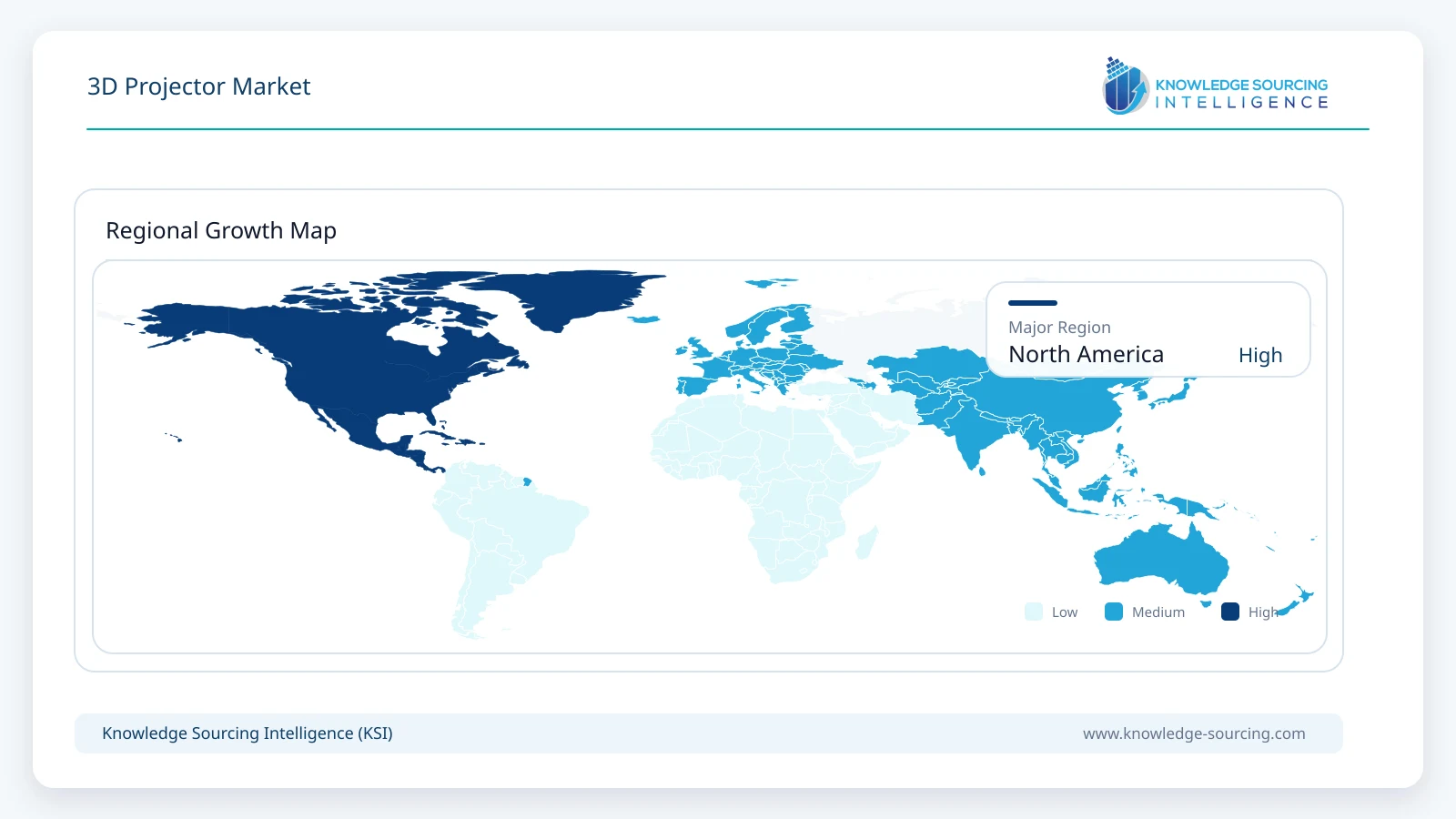
North America is estimated to account for approximately 30% of 3D projector value in 2026, the leading initial regional position. Extensive cinema infrastructure, premium home-theater purchasing and established professional audiovisual distribution support replacement demand. The region also contains specialist simulation, theme-park and visualization customers who assess depth-enabled projectors as integrated equipment rather than consumer accessories.
Cinema United's 2026 reporting on theater reinvestment offers evidence of ongoing capital renewal, although the reported sums cover considerably more than projection hardware. Regional growth is expected to depend on selective laser upgrades and premium professional projects instead of rapid expansion in the number of 3D-only screens.
Asia Pacific
Asia Pacific is projected to rise from approximately 29% of global market value in 2026 to 32% in 2031, overtaking North America. China, Japan, South Korea and India combine cinema investment with significant manufacturing and distribution ecosystems for home and professional projection equipment. Premium multiplex modernization coexists with varied price sensitivity in educational and residential channels.
Christie's 2026 China demonstration of Infitec stereoscopic visualization illustrates the region's demand for specialist immersive systems, while cinema-screen additions and installed-fleet upgrades influence larger equipment pools. Hardware modernization and local supplier capacity support growth in the region, although investment decisions still depend on screening economics and the availability of suitable stereoscopic content.
Competitive Landscape
Competition spans cinema-system suppliers, professional audiovisual manufacturers and residential projector brands. Barco and Christie differentiate through high-brightness optical architecture, digital cinema integration, site support and long-life laser platforms. Barco specifies active and passive 3D compatibility in its Series 4 products, while Christie's offering extends into dual-projector stereoscopic installations and higher-frame-rate media processing. These capabilities can influence system integrators and theater chains even where vendors do not disclose 3D-only revenue.
Optoma and BenQ compete across more accessible professional and home equipment, balancing stereo compatibility with gaming response, optics, brightness and retail pricing. JVC's D-ILA platform occupies a narrower premium home segment. Optical engines and imaging components are critical parts of the supply chain, while end-product differentiation also depends on integration, software compatibility and service availability.
Projector vendors generally report sales across broader cinema, professional or consumer ranges rather than isolating stereoscopic-capable models. The commercial competitive distinction is therefore better framed through genuine product capability, channel depth, installation services and optical performance rather than invented 3D market-share percentages.
Recent Developments
June 2026: Barco and Kinopolis agreed to deploy more than 70 Series 4 2K/4K laser cinema projectors across 11 German theaters. The agreement supports cinema renewals; actual stereo usage was not disclosed.
June 2026: Barco and muvi Cinemas announced deployment of more than 50 Series 4 laser projectors at six Saudi Arabian venues. The program concerns compatible cinema platforms, not confirmed 3D-only screenings.
April 2026: Christie demonstrated two Sapphire 4K40-RGBH projectors with Infitec stereo color-comb technology at InfoComm China for attractions and professional visualization.
20 July 2026: Christie reported that Proyecfilm had added its CP4420m-RGBH 4K hybrid laser projector and used it at temporary hospital screenings in Madrid. The deployment demonstrates a commercial installation of 3D-capable hardware, although the reported screenings were not identified as stereoscopic.
7 April 2026: Christie announced its CP4410m-RGBH hybrid laser cinema projector for launch at CinemaCon 2026, broadening its 4K cinema portfolio for smaller screens. The announcement establishes a projector product introduction rather than confirmed 3D screen installations.
Market Outlook
The next equipment replacement cycle will favor 3D-capable projectors that remain commercially competitive for everyday 2D presentation. Cinema operators are expected to prioritize laser lifetime, energy use, frame-rate flexibility and premium-screen reliability, with stereoscopic compatibility retained where it creates revenue or protects existing content options. High-brightness cinema and specialist projection systems should gain value share, while households compare capable laser and 4K models against steadily improving television alternatives.
Asia Pacific's growing cinema and visualization infrastructure is expected to support above-average value growth, although North America should remain an important premium-projector buyer. Technology differentiation will shift toward optical efficiency, compatibility and integration simplicity. Suppliers offering demonstrably usable stereo workflows, rather than merely advertising 3D as a generic feature, will be better positioned in professional installations.
3D Projector Market Scope
| Report Metric | Details |
|---|---|
| Total Market Size in 2026 | USD 3.57 billion |
| Total Market Size in 2031 | USD 5.01 billion |
| Forecast Unit | Billion |
| Growth Rate | 7.0% |
| Study Period | 2021 to 2031 |
| Historical Data | 2021 to 2024 |
| Base Year | 2025 |
| Forecast Period | 2026 – 2031 |
| Segmentation | Product, End User, Technology, Application, Resolution, Geography |
| Companies |
|
| Customization Scope | 15% Free Customization included with purchase — Request Custom Breakdown → |
| Sample & Data Access | PDF Sample, Excel Databook & Analyst Briefing — Download Free Sample → |
Market Segmentation
By Product
Less than 2000 Lumens
2000 to 4000 Lumens
4000 to 10000 Lumens
More than 10000 Lumens
By End User
Education
Live Events
Business
Cinema
Home
By Technology
DLP
LCD / 3LCD
LCoS
By Application
Gaming
Virtual Reality (VR)
Professional Simulation & Training
Other Applications
By Resolution
VGA / Legacy
HD / 2K
4K / UHD
By Geography
North America
United States
Canada
Mexico
South America
Brazil
Argentina
Others
Europe
Germany
United Kingdom
France
Italy
Spain
Others
Middle East and Africa
Saudi Arabia
UAE
South Africa
Others
Asia Pacific
China
India
Japan
South Korea
Taiwan
Thailand
Indonesia
Others
Table of Contents
1. EXECUTIVE SUMMARY
1.1. Market Size and Growth Outlook
1.2. Key Market Findings
1.3. Technology and Regional Priorities
2. MARKET SNAPSHOT
2.1. Market Overview
2.2. Market Definition
2.3. Scope of the Study
2.4. Market Segmentation
3. BUSINESS LANDSCAPE
3.1. Market Drivers
3.1.1. Cinema Projection Replacement and Premium-Screen Investment
3.1.2. Wider Availability of 3D-Ready Home and Gaming Projectors
3.1.3. Improving Laser Efficiency and Optical Longevity
3.1.4. Demand for Shared-View Simulation and Specialist Visualization
3.1.5. Growing Installed Base of Compatible 4K Cinema Equipment
3.2. Market Restraints
3.2.1. Limited Supply of New Stereoscopic Entertainment Content
3.2.2. Brightness Loss and Viewing-Accessory Complexity
3.2.3. High Installed Cost of Cinema-Grade and Stereo Visualization Systems
3.2.4. Competition from Direct-View Displays and Head-Mounted Systems
3.2.5. Fragmented 3D Formats and Compatibility Requirements
3.3. Market Opportunities
3.4. Porter’s Five Forces Analysis
3.5. Industry Value Chain Analysis
3.6. Policies and Regulations
3.7. Strategic Recommendations
4. TECHNOLOGICAL OUTLOOK
4.1. Stereoscopic 3D Image Separation and Eyewear
4.2. DLP and Three-Chip Cinema Projection
4.3. 3LCD and Reflective LCoS Architectures
4.4. Laser Illumination and Optical Efficiency
4.5. High-Frame-Rate Stereo Processing and Media Servers
4.6. Multi-Projector Alignment and Simulation Systems
5. 3D PROJECTOR MARKET BY PRODUCT
5.1. Introduction
5.2. Less than 2000 Lumens
5.3. 2000 to 4000 Lumens
5.4. 4000 to 10000 Lumens
5.5. More than 10000 Lumens
6. 3D PROJECTOR MARKET BY END USER
6.1. Introduction
6.2. Education
6.3. Live Events
6.4. Business
6.5. Cinema
6.6. Home
7. 3D PROJECTOR MARKET BY TECHNOLOGY
7.1. Introduction
7.2. DLP
7.3. LCD / 3LCD
7.4. LCoS
8. 3D PROJECTOR MARKET BY APPLICATION
8.1. Introduction
8.2. Gaming
8.3. Virtual Reality (VR)
8.4. Professional Simulation & Training
8.5. Other Applications
9. 3D PROJECTOR MARKET BY RESOLUTION
9.1. Introduction
9.2. VGA / Legacy
9.3. HD / 2K
9.4. 4K / UHD
10. 3D PROJECTOR MARKET BY GEOGRAPHY
10.1. Introduction
10.2. North America
10.2.1. United States
10.2.2. Canada
10.2.3. Mexico
10.3. South America
10.3.1. Brazil
10.3.2. Argentina
10.3.3. Others
10.4. Europe
10.4.1. Germany
10.4.2. United Kingdom
10.4.3. France
10.4.4. Italy
10.4.5. Spain
10.4.6. Others
10.5. Middle East and Africa
10.5.1. Saudi Arabia
10.5.2. UAE
10.5.3. South Africa
10.5.4. Others
10.6. Asia Pacific
10.6.1. China
10.6.2. India
10.6.3. Japan
10.6.4. South Korea
10.6.5. Taiwan
10.6.6. Thailand
10.6.7. Indonesia
10.6.8. Others
11. COMPETITIVE ENVIRONMENT AND ANALYSIS
11.1. Major Players and Strategy Analysis
11.2. Market Share Analysis
11.3. Mergers, Acquisitions, Agreements and Collaborations
11.4. Competitive Dashboard
12. COMPANY PROFILES
12.1. Barco NV
12.2. Christie Digital Systems USA, Inc.
12.3. Optoma Corporation
12.4. BenQ Corporation
12.5. JVCKENWOOD Corporation
12.6. Vivitek Corporation
12.7. Acer Incorporated
12.8. ViewSonic Corporation
12.9. Digital Projection Limited
12.10. Sharp Corporation
13. APPENDIX
13.1. Currency
13.2. Assumptions
13.3. Base and Forecast Years Timeline
13.4. Key Benefits for Stakeholders
13.5. Research Methodology
13.6. Abbreviations





Frequently asked questions
What is the projected market size of the 3D projector market by 2031?
The 3D Projector Market is projected to reach USD 5.01 billion by 2031.
What is the forecasted CAGR for the 3D projector market?
The 3D Projector Market is expected to grow at approximately a 7.0% CAGR.
Which region is projected to lead the 3D projector market by 2031?
Asia Pacific is expected to become the largest regional market by 2031.
Which technology dominates 3D projector revenue share in 2026?
DLP systems are estimated to represent 78% of 2026 revenue.
Which industry holds the largest 3D projector market value?
Cinema is estimated to account for 33% of 2026 market value.
What premium segments are forecast to increase revenue share?
4K/UHD and projectors above 10,000 lumens are projected to gain share.
Cite this report
Knowledge Sourcing Intelligence. (Oct 2026). 3D Projector Market - Strategic Insights and Forecasts (2026-2031). https://www.knowledge-sourcing.com/report/3d-projector-market