
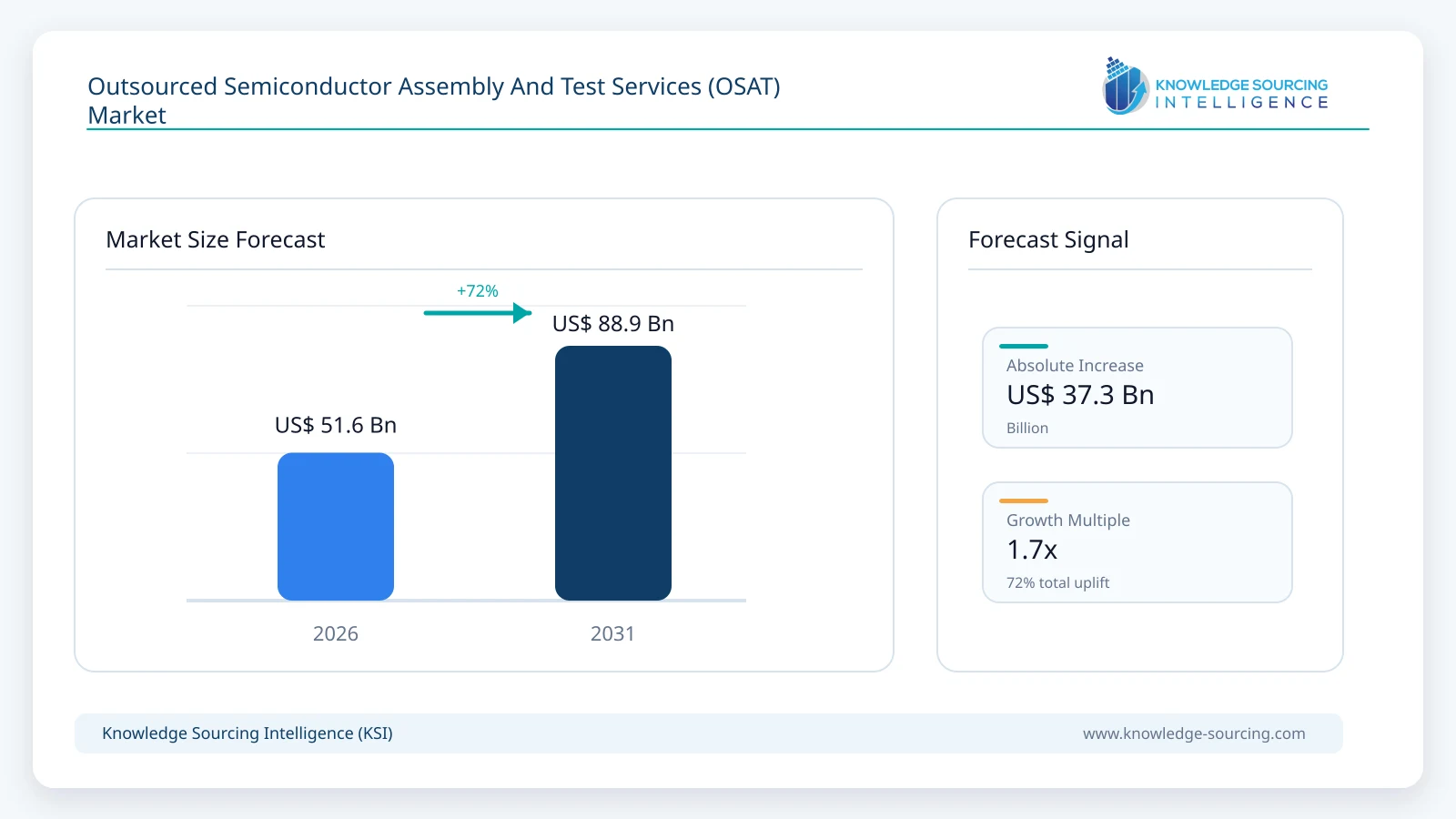
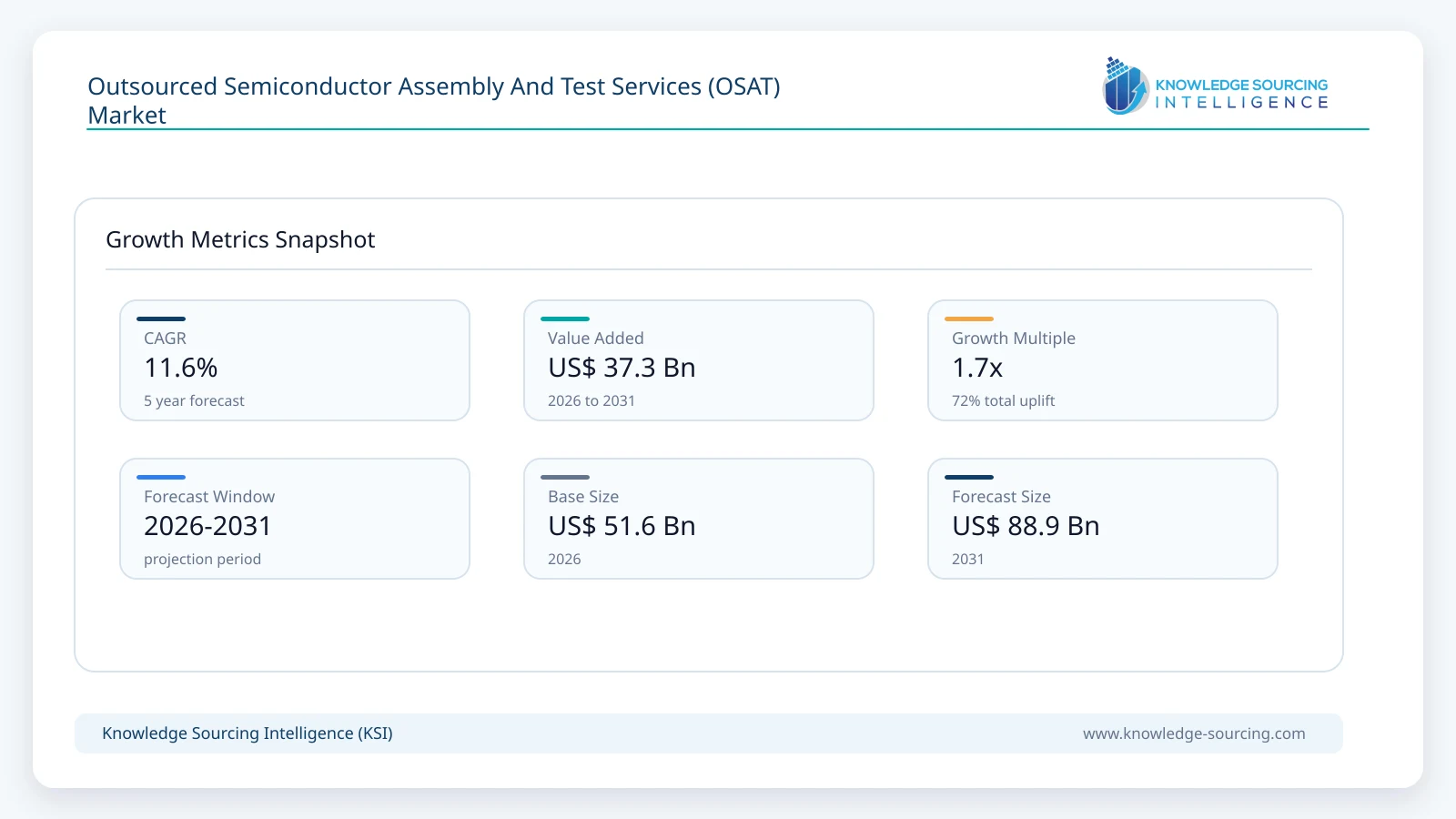
The Outsourced Semiconductor Assembly and Test (OSAT) market is forecast to grow at a CAGR of 11.5%, reaching USD 88.9 billion in 2031 from USD 51.6 billion in 2026.
Highlights:
- 1Leading service segmentPackaging continues to form the backbone of the OSAT industry, accounting for 84.6% of total market revenue in 2026, with an estimated value of USD 43.63 billion, highlighting its critical role in advanced semiconductor manufacturing and integration.
- 2Highest-growth categoryAmong the major segments analyzed, Logic Devices are forecast to expand at the fastest rate, advancing at a 12.2% CAGR through 2031, driven by rising demand for AI processors, data center chips, and high-performance computing applications.
- 3Dominant packaging technologyBall Grid Array (BGA) Packaging secures the largest share within packaging types, representing 27.0% of the global market in 2026, equivalent to approximately USD 13.93 billion, reflecting its widespread adoption in consumer electronics and communication devices.
- 4Market trajectoryThe Outsourced Semiconductor Assembly and Test Services (OSAT) Market is projected to climb from USD 51.6 billion in 2026 to USD 88.9 billion by 2031. Within the industry, the Americas are expected to post a robust 12.0% CAGR, slightly outpacing overall market growth and strengthening their position in the global semiconductor value chain.
- 5Asia Pacific remains the global production hubTaiwan, China, South Korea, and Southeast Asia dominate OSAT capacity due to dense semiconductor supply chains and foundry proximity.
- 6Supply chain restructuring is strengthening regional OSAT ecosystemsGovernments and semiconductor firms are investing in localized assembly and test capacity to reduce geopolitical and logistics risks.
Outsourced Semiconductor Assembly and Test (OSAT) services comprise the post-wafer-fabrication stage of the semiconductor value chain, covering semiconductor assembly, advanced packaging, and testing before chips are integrated into electronic systems. OSAT providers increasingly influence semiconductor performance beyond conventional packaging by addressing interconnect density, signal integrity, thermal management, power delivery, reliability, and form-factor requirements. Recent industry developments demonstrate this shift toward more sophisticated packaging architectures. In May 2025, ASE introduced its FOCoS-Bridge with Through-Silicon Via (TSV), designed to increase I/O density, shorten signal paths, improve thermal dissipation, and support the integration of chiplets and high-bandwidth memory (HBM) for AI and high-performance computing (HPC) applications.
The OSAT ecosystem is deeply integrated with the broader semiconductor manufacturing chain and serves fabless semiconductor companies, integrated device manufacturers (IDMs), foundries, and system companies. As semiconductor architectures evolve from monolithic designs toward chiplets, heterogeneous integration, 2.5D/3D integration, and system-in-package (SiP) configurations, OSAT providers are becoming technology and manufacturing partners rather than conventional assembly vendors. ASE's 2025 advanced-packaging work highlights how chiplet-based designs require substantially greater interconnect density and more complex package-level electrical, thermal, and manufacturing validation. TSMC likewise continues to develop CoWoS, SoIC, and other advanced packaging and 3D chip-stacking technologies to support next-generation HPC, AI, and mobile applications.
Artificial intelligence is emerging as a particularly important demand driver for advanced OSAT capabilities. AI accelerators, GPUs, ASICs, and HBM-based architectures require high-bandwidth, low-latency interconnections between processing and memory components, increasing the importance of advanced packaging. TSMC reports that demand for its CoWoS advanced 2.5D packaging has grown strongly with AI, while its CoWoS technologies integrate multiple system-on-chip devices and HBM stacks to support high-performance computing and AI workloads. ASE is also developing high-density packaging platforms specifically for AI and HPC, including FOCoS-Bridge, 2.5D/3D IC, and other heterogeneous-integration technologies.
The expansion of advanced packaging is also creating new investment and capacity requirements across the OSAT industry. In October 2025, ASE announced a NT$17.6 billion investment in its K18B facility in Kaohsiung, Taiwan, with completion targeted for the first quarter of 2028. The facility is planned to support advanced packaging processes including CoWoS, system-in-package, copper-pillar bumping, FOCoS, and FC BGA for AI, automotive electronics, HPC, and chiplet applications. In the United States, Amkor has been expanding its advanced packaging and test footprint through a planned Arizona campus, with total investment expected to reach $7 billion across two phases. The company states that the facilities will support advanced packaging and testing for AI, HPC, mobile communications, and automotive applications.
Beyond AI infrastructure, automotive electronics are sustaining demand for sophisticated semiconductor assembly and testing. Increasing semiconductor content in vehicles, particularly through advanced driver-assistance systems (ADAS), electrification, sensing, connectivity, and computing platforms, is raising requirements for reliable automotive-grade packages. OSAT capabilities are therefore expanding toward solutions that can withstand demanding thermal, electrical, mechanical, and reliability conditions. At the same time, system-in-package technologies enable processors, sensors, wireless components, and power-related devices to be integrated into compact modules for applications spanning automotive, industrial automation, consumer electronics, IoT, and other connected systems.
Technology development is also moving toward larger-format and higher-throughput packaging. In June 2025, ASE reported successful development of a 300 mm panel-level fan-out packaging approach for chiplet-integrated HPC applications, with testing demonstrating reliable interlayer adhesion and support for larger module sizes and higher-density architectures. In 2026, ASE further advanced this direction by launching an automated 310 mm panel-level packaging platform intended to improve throughput, material utilization, and scalability for increasingly complex AI and chiplet-based architectures. These developments indicate that OSAT services are increasingly becoming a critical enabler of system-level semiconductor scaling, particularly where conventional transistor-level scaling alone cannot deliver the required performance, bandwidth, power efficiency, and integration density.
OSAT Market Segment Analysis:
By Service Type: The market is segmented into assembly services and testing services. Testing services accounted for 13.5% of the market in 2026, representing USD 6.966 billion, and are projected to reach a 13.9% share by 2031, expanding at a 12.1% CAGR. Demand for testing services is strengthening as semiconductor devices become increasingly complex, with higher transistor densities, advanced architectures, and tighter performance and reliability requirements. Automotive, industrial, computing, and other high-reliability applications are increasing the need for comprehensive wafer and final-device testing, including electrical, functional, and reliability testing.
By Packaging Type: The market is segmented into Ball Grid Array (BGA), Chip Scale Package (CSP), Multi-Chip Module (MCM), System-in-Package (SiP), Flip-Chip, and advanced 2.5D/3D packaging solutions. Ball Grid Array (BGA) packaging is projected to account for 26.0% of the market by 2031. BGA remains important because of its high interconnection density, compact footprint, thermal performance, and suitability for a broad range of semiconductor applications. At the same time, advanced packaging technologies are gaining strategic importance as chiplet architectures, heterogeneous integration, high-bandwidth computing, and AI processors increase demand for sophisticated packaging capabilities.
By Device Type: The market is segmented into memory devices, logic devices, analog and mixed-signal ICs, and power semiconductors. Memory devices represented 28.0% of the market in 2026, equivalent to USD 14.448 billion, and are expected to reach a 28.6% share by 2031. Memory remains a major OSAT demand generator due to expanding data center infrastructure, AI workloads, high-performance computing, smartphones, and other data-intensive electronic systems. Increasing memory density and performance requirements are also supporting demand for advanced assembly, packaging, and testing capabilities.
By Application: The market is segmented into consumer electronics, automotive, industrial, telecommunications, and computing. Consumer electronics accounted for 22.0% of the market in 2026, valued at USD 11.352 billion, and is projected to hold a 21.3% share by 2031. Automotive represented 14.0% of the market in 2026. Consumer electronics remains a major volume contributor because of continued semiconductor integration across smartphones, personal devices, and connected electronics. Automotive is emerging as an increasingly important value contributor as electric vehicles, advanced driver-assistance systems, vehicle electrification, and software-defined vehicles require greater semiconductor content and stringent reliability standards.
By Region: The market is segmented into the Americas, Europe, Asia Pacific (APAC), and the Middle East & Africa. Asia Pacific (APAC) dominated the market with a 79.0% share in 2026. The region's leadership is supported by its extensive semiconductor manufacturing and electronics production ecosystem, established OSAT capabilities, skilled workforce, supply-chain depth, and significant investments in advanced packaging. The Americas accounted for 12.0% of the market in 2026, equivalent to USD 6.192 billion, and are projected to reach a 12.2% share by 2031. Growing investments in semiconductor manufacturing, packaging, testing, and supply-chain localization are supporting regional OSAT opportunities.
Top Trends Shaping the OSAT Market:
Acceleration of advanced packaging adoption
The semiconductor industry is undergoing a structural transition from traditional scaling (Moore’s Law) toward heterogeneous integration and advanced packaging. Technologies such as fan-out wafer-level packaging (FOWLP), chiplet integration, and 3D stacking are increasingly central to performance improvement strategies. This transition is significantly increasing the technical intensity and capital requirements of OSAT providers.
Advanced packaging enables higher bandwidth density, lower latency, and improved power efficiency, making it essential for AI accelerators, high-performance GPUs, and data center processors.
OSAT Market Growth Drivers vs. Challenges:
Drivers:
Rising semiconductor content per device: The increasing complexity of electronic systems across automotive, industrial, and consumer sectors is driving higher semiconductor integration levels, boosting demand for packaging and testing services.
Expansion of AI and data center infrastructure: AI workloads and hyperscale data centers require advanced semiconductor packaging solutions such as high-bandwidth memory integration and chiplet-based architectures, strengthening OSAT demand.
Automotive semiconductor growth: Electrification and autonomous driving technologies are increasing demand for high-reliability, automotive-grade packaging and rigorous testing standards.
Challenges:
High capital intensity and technology barriers: Transition to advanced packaging requires substantial investment in equipment, R&D, and cleanroom infrastructure, limiting entry for new players.
Supply chain and geopolitical risks: Concentration of OSAT capacity in Asia Pacific exposes the industry to geopolitical tensions, trade restrictions, and supply chain disruptions.
Pricing pressure from integrated semiconductor players: Large IDM and foundry ecosystems are increasingly internalizing advanced packaging capabilities, creating competitive pressure for pure-play OSAT providers.
OSAT Market Regional Analysis:
Asia Pacific: Asia Pacific dominates the global OSAT market due to dense semiconductor ecosystems across Taiwan, China, South Korea, Malaysia, and Singapore. The region benefits from proximity to leading foundries, cost advantages, skilled labor availability, and strong government support for semiconductor manufacturing expansion.
Taiwan remains a critical hub for advanced packaging technologies, while China continues to expand domestic OSAT capacity to strengthen semiconductor self-sufficiency. Southeast Asia is emerging as a strategic extension for assembly and testing operations due to favorable investment conditions and supply chain diversification trends.
North America and Europe are increasingly investing in localized semiconductor packaging and testing infrastructure to reduce dependency on Asia-based supply chains and strengthen technological sovereignty in advanced semiconductor manufacturing.
OSAT Market Competitive Landscape:
The OSAT market is moderately consolidated at the top and fragmented in mid-tier segments. Leading players focus on advanced packaging innovation, geographic expansion, and capacity scaling to support AI-driven semiconductor demand. Key companies include ASE Technology Holding Co., Ltd., Amkor Technology, Inc., Powertech Technology Inc., JCET Group Co., Ltd., Tongfu Microelectronics Co., Ltd., ChipMOS Technologies Inc., and UTAC Holdings Ltd.
Competitive differentiation is increasingly based on advanced packaging capabilities, technology partnerships with foundries, automotive qualification standards, and long-term capacity agreements with fabless semiconductor companies.
OSAT Market Developments (Verified Industry-Level Events):
June 2026: Amkor Technology and TSMC announced a long-term partnership to accelerate advanced semiconductor packaging in the United States, strengthening domestic OSAT capabilities and supporting next-generation AI and high-performance computing semiconductor production.
May 2026: ASE announced the industry's first automated 310 mm × 310 mm panel-level packaging production line, enabling higher manufacturing efficiency and scalable heterogeneous integration for AI, HPC, networking, and chiplet-based semiconductor devices.
April 2026: CG Semi confirmed operational ramp-up of its OSAT facility in Sanand, Gujarat, targeting commercial production during 2026. The project is part of a ?7,600 crore investment across two facilities (G1 and G2), significantly expanding India’s semiconductor assembly, packaging, and testing ecosystem.
March 2026: Kaynes Semicon inaugurated and began commercial production at its Outsourced Semiconductor Assembly and Test (OSAT) facility in Sanand, Gujarat, on March 31, 2026. The plant, developed under India Semiconductor Mission support, delivers ~6.3 million chips per day.
February 2026: Micron Technology inaugurated its semiconductor assembly and test facility in Sanand, Gujarat, India on February 28, 2026. The site processes DRAM and NAND wafers into finished memory products, strengthening global OSAT capacity. The project represents a $2.75 billion investment expanding advanced packaging and testing operations.
OSAT Market Scope:
| Report Metric | Details |
|---|---|
| Total Market Size in 2026 | USD 51.6 billion |
| Total Market Size in 2031 | USD 88.9 billion |
| Forecast Unit | USD Billion |
| Growth Rate | 11.5% |
| Study Period | 2021 to 2031 |
| Historical Data | 2021 to 2024 |
| Base Year | 2025 |
| Forecast Period | 2026 – 2031 |
| Segmentation | Service Type, Packaging Type, Device Type, Application, Geography |
| Companies |
|
Market Segmentation
BY SERVICE TYPE
Packaging
Testing
Other
BY PACKAGING TYPE
Ball Grid Array (BGA) Packaging
Chip-scale Packaging (CSP)
Stacked Die Packaging
Multi-Chip Packaging
Quad Flat and Dual-inline Packaging
BY DEVICE TYPE
Logic Devices
Memory Devices
Analog and Mixed-Signal Devices
Others
BY APPLICATION
Communication
Consumer Electronics
Automotive
Computing and Networking
Industrial
Others
BY GEOGRAPHY
Americas
USA
Europe Middle East and Africa (EMEA)
Germany
Netherlands
Others
Asia Pacific (APAC)
China
Japan
Taiwan
South Korea
Others
Table of Contents
1. EXECUTIVE SUMMARY
2. MARKET SNAPSHOT
2.1. Market Overview
2.2. Market Definition
2.3. Scope of the Study
2.4. Market Segmentation
3. BUSINESS LANDSCAPE
3.1. Market Drivers
3.2. Market Restraints
3.3. Market Opportunities
3.4. Porter’s Five Forces Analysis
3.5. Industry Value Chain Analysis
3.6. Policies and Regulations
3.7. Strategic Recommendations
4. TECHNOLOGICAL OUTLOOK
5. OSAT MARKET BY SERVICE TYPE
5.1. Introduction
5.2. Packaging
5.3. Testing
5.4. Other
6. OSAT MARKET BY PACKAGING TYPE
6.1. Introduction
6.2. Ball Grid Array (BGA) Packaging
6.3. Chip-scale Packaging (CSP)
6.4. Stacked Die Packaging
6.5. Multi-Chip Packaging
6.6. Quad Flat and Dual-inline Packaging
7. OSAT MARKET BY DEVICE TYPE
7.1. Introduction
7.2. Logic Devices
7.3. Memory Devices
7.4. Analog and Mixed-Signal Devices
7.5. Others
8. OSAT MARKET BY APPLICATION
8.1. Introduction
8.2. Communication
8.3. Consumer Electronics
8.4. Automotive
8.5. Computing and Networking
8.6. Industrial
8.7. Others
9. OSAT MARKET BY GEOGRAPHY
9.1. Introduction
9.2. Americas
9.2.1. USA
9.3. Europe Middle East and Africa (EMEA)
9.3.1. Germany
9.3.2. Netherlands
9.3.3. Others
9.4. Asia Pacific (APAC)
9.4.1. China
9.4.2. Japan
9.4.3. Taiwan
9.4.4. South Korea
9.4.5. Others
10. COMPETITIVE ENVIRONMENT AND ANALYSIS
10.1. Major Players and Strategy Analysis
10.2. Market Share Analysis
10.3. Mergers, Acquisitions, Agreements, and Collaborations
10.4. Competitive Dashboard
11. COMPANY PROFILES
11.1. ASE Group (ASE Technology Holdings)
11.2. Amkor Technology Inc.
11.3. Powertech Technology Inc.
11.4. ChipMOS Technologies Inc.
11.5. King Yuan Electronics Co., Ltd.
11.6. Jiangsu Changjiang Electronics Technology Co., Ltd.
11.7. UTAC Holdings Ltd.
11.8. Lingsen Precision Industries Ltd.
11.9. Tongfu Microelectronics Co.
12. APPENDIX
12.1. Currency
12.2. Assumptions
12.3. Base and Forecast Years Timeline
12.4. Key benefits for the stakeholders
12.5. Research Methodology
12.6. Abbreviations
Navigate
Trusted by the world's leading organizations











