
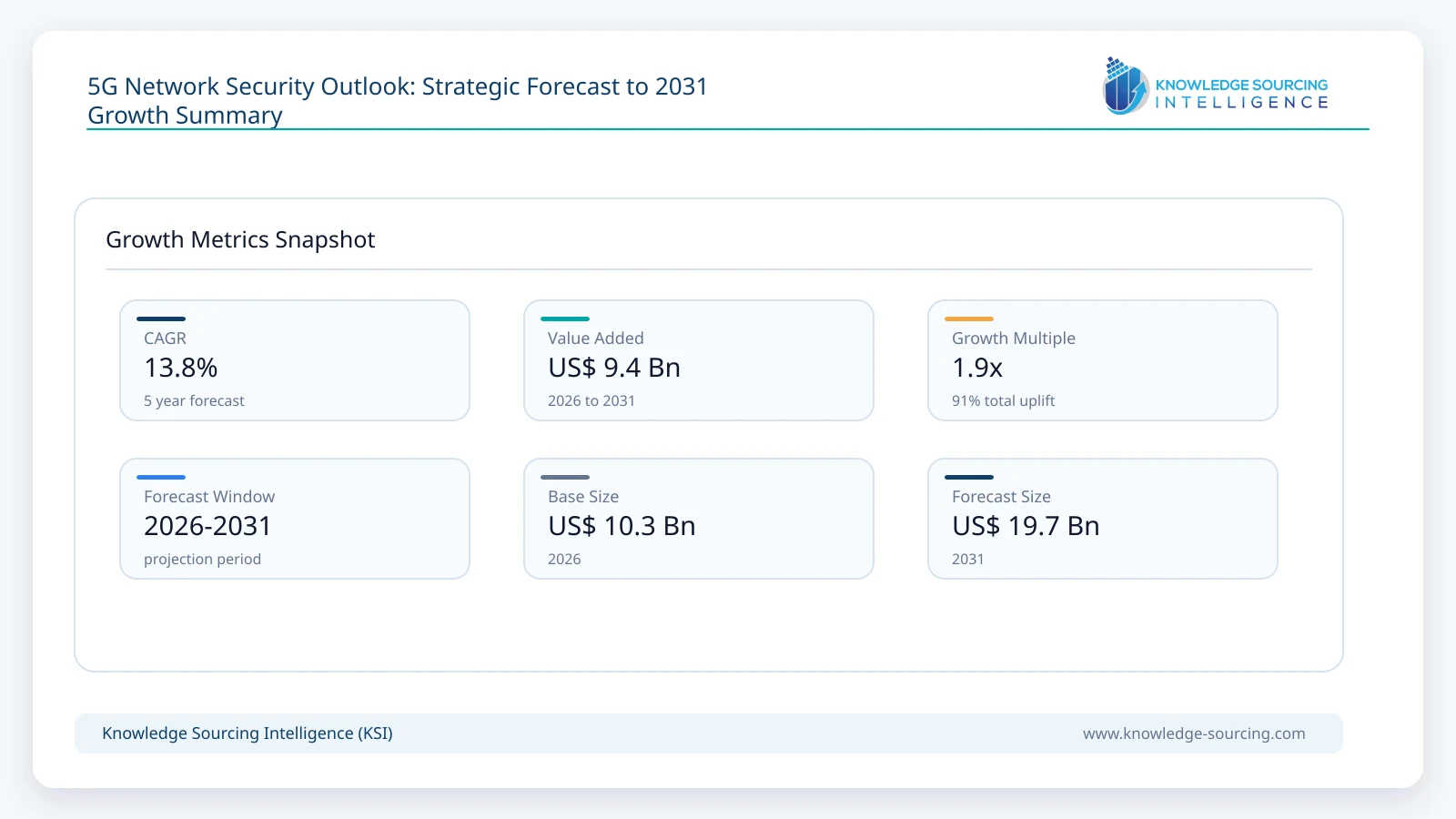
The 5G Network Security Market is projected to expand at a CAGR of 13.8%, reaching USD 19.7 billion in 2031 from USD 10.3 billion in 2026.
Highlights:
- 1Security solutions account for approximately 72% of market revenue in 2026, reflecting continuing investment in firewalls, DDoS protection, analytics, identity and cloud-native network security.
- 2Cloud-based security is the fastest-growing deployment model at approximately 18.9% annually through 2031, supported by virtualized cores and distributed edge infrastructure.
- 35G core security represents approximately 38% of the market in 2026, as Standalone deployment shifts critical network functions into service-based and cloud-native architectures.
- 4Enterprise and private 5G networks are the fastest-growing major end-user group, supported by manufacturing, utilities, transportation, defense and other mission-critical deployments.
- 5North America remains the largest market in 2026, while Asia Pacific records the strongest growth among the major regions as 5G SA and private-network deployment broaden.
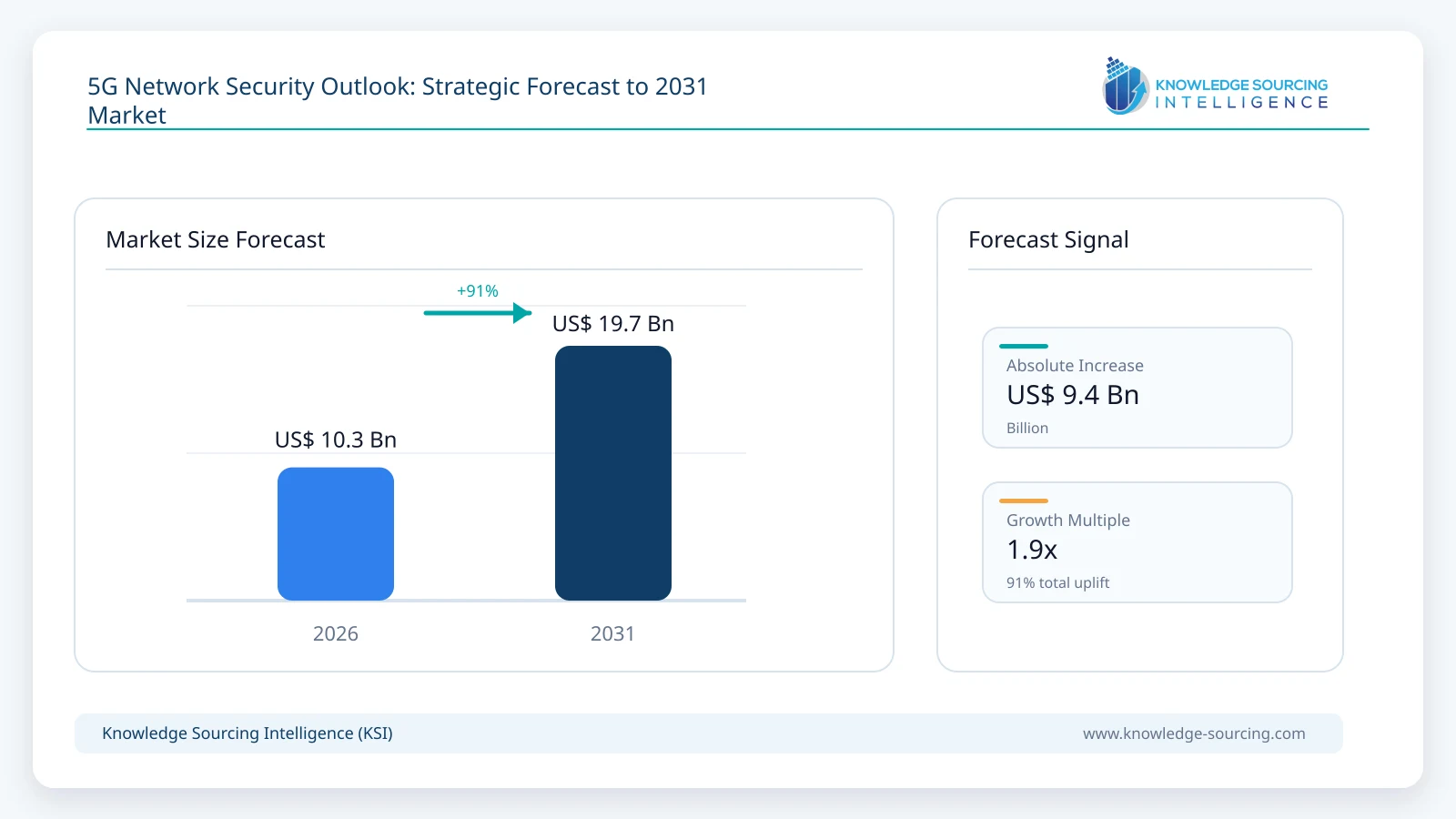
Growth is supported by the transition toward 5G Standalone networks, cloud-native mobile cores, private 5G adoption, increasing edge deployment, stronger protection requirements for operational technology and the rising volume and sophistication of attacks targeting telecommunications infrastructure.
5G network security includes security software, appliances and associated services deployed specifically to protect 5G network infrastructure and traffic. The market covers 5G core security, RAN and backhaul protection, DDoS mitigation, signaling and GTP security, subscriber and device identity security, edge and MEC security, network-slice protection, cloud-native workload security, threat analytics and managed security services. General enterprise cybersecurity expenditure that does not directly protect public or private 5G infrastructure is excluded.
The security architecture differs from conventional perimeter-centric enterprise cybersecurity because 5G distributes network functionality across cloud-native core systems, radio infrastructure, edge compute and multiple service interfaces. 3GPP Technical Specification 33.501 establishes the security architecture and procedures for the 5G System and continues to evolve through later releases. NIST’s 2026 implementation guidance similarly emphasizes separation and protection of control-plane, data-plane and operations traffic across commercial and private 5G infrastructure.
5G introduces security requirements that extend beyond simply increasing firewall capacity. The architecture is service based, highly virtualized and increasingly distributed across central clouds, regional data centers and edge locations. Individual network functions communicate through APIs, while private networks bring cellular connectivity directly into operational environments that previously relied on wired industrial networks or Wi-Fi. Security controls therefore need visibility into mobile-specific identifiers, protocols and network slices in addition to conventional IP traffic.
NIST’s March 2026 5G cybersecurity guidance highlights the practical importance of isolating user-plane, control-plane and operations traffic rather than relying on a single network perimeter. Its wider 5G cybersecurity series addresses subscriber-identity protection, platform integrity and other security capabilities that operators need to implement correctly rather than assuming that standards compliance automatically produces a secure deployment.
The commercial market consequently includes several different security layers. Palo Alto Networks supports subscriber-, equipment- and network-slice-aware policy enforcement through its 5G-native security platform. Fortinet addresses RAN, core, MEC and enterprise environments using physical and virtual security functions. Nokia combines network security with DDoS detection and automation, while A10 Networks concentrates strongly on mobile-core firewall, GTP, DDoS and carrier-scale traffic requirements.
Security is also becoming increasingly important to the commercial proposition of private 5G. A manufacturing site or utility network may use cellular connectivity precisely because it requires deterministic, mission-critical communications. Security failure in these environments can affect physical operations rather than only digital information, increasing demand for segmentation, identity-based access, edge inspection and continuous threat monitoring.
Market Drivers
5G Standalone changes the security perimeter
The migration from Non-Standalone to Standalone 5G represents one of the most important security transitions during the forecast period. NSA networks retain substantial dependency on the 4G core, while SA introduces the cloud-native 5G Core and service-based interfaces required for advanced features such as network slicing.
This creates new security requirements around network functions, APIs, containers, orchestration and east-west traffic between services. Security needs to be applied within the architecture rather than concentrated only at the external network boundary.
Palo Alto Networks’ 5G security architecture reflects this requirement through policy controls using mobile identifiers such as subscriber ID, equipment ID and network-slice information. These controls allow security policies to follow mobile users and devices rather than relying entirely on IP addresses that can change during operation.
The move toward Standalone networks therefore expands demand for cloud-native firewalls, signaling protection, workload security, API security and continuous monitoring of the mobile core.
DDoS attacks are becoming a carrier-scale security problem
Telecommunications networks are attractive targets for DDoS attacks because disrupting a carrier or service provider can affect a very large user population at once. 5G increases available network capacity, while compromised IoT and edge devices can themselves become sources of malicious traffic.
Nokia introduced Deepfield Genome Shield in June 2026 specifically to provide continuously updated, automated DDoS protection for telecommunications providers and other network operators. The platform is designed to identify both inbound attacks and malicious outbound traffic originating from compromised subscriber devices.
The shift is important because carrier security increasingly needs to detect attacks before they overwhelm centralized mitigation infrastructure. Automated filtering, distributed detection and continuously updated threat intelligence therefore become increasingly valuable as network traffic grows.
Private 5G is creating security demand inside industrial networks
Private cellular networks are moving 5G infrastructure into factories, utility sites, ports, mines and transportation systems. These deployments frequently connect operational technology that cannot run conventional endpoint-security software and may remain in service for many years.
Palo Alto Networks identifies core security, edge security, AI ecosystem protection and governance as key security layers for private mobile networks used by utilities and other critical infrastructure operators. Its architecture combines mobile-network visibility with Zero Trust policies extending between cellular, IT and OT environments.
The requirement becomes particularly important where cellular networks replace previously isolated OT connections. A compromised industrial device can potentially create a route between operational systems and wider enterprise or cloud infrastructure unless policies enforce segmentation and traffic inspection.
Enterprise 5G therefore creates a security market extending beyond traditional mobile operators and increases demand for products capable of protecting both cellular protocols and conventional enterprise traffic.
Distributed edge architecture expands the number of enforcement points
Multi-access edge computing brings application processing closer to the radio network to reduce latency and avoid transporting every workload to a centralized cloud. The same distribution creates a larger security perimeter because applications and network functions may operate across many physically separate sites.
Security platforms need to protect communication between the 5G Core, edge workloads, enterprise applications and external networks without introducing enough latency to undermine the purpose of edge deployment.
This supports increased adoption of virtual security functions capable of running on cloud infrastructure rather than relying entirely on centralized appliances. Physical security hardware remains important for high-throughput and mission-critical locations, but cloud-native enforcement points increasingly accompany it.
AI increases both security capability and threat complexity
Telecom operators are introducing AI into network operations, customer services and edge applications while attackers increasingly use automated techniques to identify vulnerabilities and scale attacks.
Palo Alto Networks positions its 5G-native security architecture around AI-driven threat prevention spanning the 5G core, edge, IoT and AI workloads. Nokia is similarly incorporating automation into DDoS detection and mitigation.
AI therefore affects the market from both sides. It increases the sophistication of security products while creating additional workloads, APIs and autonomous agents that need to be protected. This favors security platforms capable of correlating mobile-network context with application and cloud security rather than operating as isolated network appliances.
Critical infrastructure and government requirements increase non-discretionary spending
5G is increasingly being used for public safety, defense, energy and other critical infrastructure. Security expenditure in these applications is less discretionary because network compromise can affect operational continuity and national security.
Nokia and Lockheed Martin introduced a modular 5G solution for U.S. defense applications in May 2026 built around secure and resilient communications and open military architecture standards. The deployment direction illustrates how 5G security requirements increasingly extend into government and mission-critical environments rather than only commercial mobile networks.
Regulatory guidance reinforces the same trend. NIST’s 2026 5G publications provide operators with implementation guidance for security capabilities already defined by standards, demonstrating that secure configuration and validation remain ongoing operational requirements.
Market Restraints and Challenges
5G already includes significant native security capabilities
5G introduces stronger subscriber privacy, authentication and integrity mechanisms than earlier mobile generations. This means third-party security products need to address vulnerabilities and operational risks beyond the protections already embedded within the standard.
The market opportunity consequently does not equal all cybersecurity spending associated with every 5G-connected device. Dedicated 5G security products need to provide additional functions such as DDoS mitigation, mobile-aware firewalling, cloud workload security, threat analytics or enterprise network segmentation.
This is particularly important when sizing the market because conventional enterprise cybersecurity products used by a company that happens to operate over 5G should not automatically be counted as 5G network security.
Security cannot introduce unacceptable latency
5G is used for applications where low latency and predictable performance are part of the value proposition. Security processing that significantly delays traffic can therefore undermine the network service itself.
Mobile-network security platforms need to inspect very large traffic volumes while maintaining carrier-grade performance. Fortinet and A10 Networks both emphasize high-throughput security architectures specifically because mobile-core and RAN traffic can exceed the capacity of conventional enterprise security systems.
The performance requirement creates higher technical barriers and can increase deployment costs, especially where operators require redundant security infrastructure.
Multi-vendor architectures complicate security operations
A modern 5G network can combine radios, core software, cloud infrastructure, edge platforms and security products from several suppliers. Private networks can add enterprise IT and OT systems to the same environment.
Security teams therefore need to correlate alerts and identities across systems using different management tools and data models. The challenge becomes larger as Open RAN and cloud-native deployment increase infrastructure disaggregation.
Platforms that consolidate visibility and policy control gain an advantage, but large operators are unlikely to replace their complete security environments with a single vendor. Integration remains an important component of overall market spending.
Cybersecurity skills remain constrained
5G security requires knowledge spanning telecom signaling, cloud architecture, cybersecurity, identity and increasingly operational technology. Few enterprises maintain all these capabilities internally.
The shortage increases demand for managed security and professional services but can also slow project deployment. Operators and private-network owners need staff capable of understanding both mobile-network behavior and security operations rather than treating 5G as another conventional IP network.
Major Segment Analysis
Security Solutions: Largest Market Component
Security solutions remain the largest component of market revenue as operators and enterprises deploy firewalls, threat prevention, DDoS protection, security analytics, identity management and cloud-native security controls throughout their 5G infrastructure.
The category is projected to approach USD 13.4 billion by 2031. Growth increasingly comes from integrated platforms rather than standalone perimeter products because 5G security needs to correlate traffic with subscriber, device, slice and application context.
Managed and professional services grow faster than security products as private-network owners and smaller operators increasingly outsource specialized cellular cybersecurity functions.
Cloud-Based Security: Fastest-Growing Deployment Model
Cloud-based security expands substantially faster than conventional on-premise deployment as 5G Core, edge and network functions become virtualized. The category is projected to exceed USD 14 billion by 2031, although hybrid deployment remains common in carrier networks.
Virtual firewalls and cloud-native security functions allow capacity to scale alongside workloads and can be deployed across distributed edge environments without installing a dedicated physical appliance at every location.
Physical security remains important where very high throughput, deterministic performance or local operational control is required. The market therefore evolves toward a combination of cloud-native and appliance-based protection rather than the complete replacement of physical security infrastructure.
5G Core Security: Largest Network Architecture Segment
The 5G Core remains the largest security domain because it contains subscriber authentication, session management, user-plane processing and the service-based interfaces connecting network functions.
Core security expenditure is projected to approach USD 6.7 billion by 2031 as SA networks become more widespread and operators protect APIs, cloud workloads, subscriber traffic and network slicing.
The market increasingly shifts from conventional Gi/SGi perimeter protection toward security controls embedded between cloud-native network functions and service interfaces.
Edge/MEC Security: Fastest-Growing Architecture Segment
Edge and MEC security records the strongest growth among the principal network domains at approximately 22% annually through 2031. The expansion reflects both the increasing number of distributed edge sites and the migration of enterprise workloads closer to the mobile network.
Edge nodes require local protection because sending all security inspection back to a centralized site can increase latency and create bandwidth overhead. Distributed firewalls, workload protection and identity-based segmentation therefore become important parts of the edge architecture.
Private 5G strengthens this opportunity because industrial applications often place user-plane and application workloads directly on-site.
Telecom Operators: Largest End-User Group
Mobile network operators remain the largest buyers because they operate the public 5G infrastructure requiring protection across RAN, transport, core and roaming interfaces.
The segment remains dominant through 2031, but its market share gradually declines as private-network adoption moves security spending directly into enterprises and government organizations.
Operators also increasingly commercialize security themselves by packaging secure 5G connectivity for enterprise customers, turning network security from an infrastructure cost into a potential managed-service revenue stream.
Enterprise & Private 5G: Fastest-Growing End-User Segment
Enterprise and private-network security spending grows at approximately 20.6% annually through 2031, supported by manufacturing, utilities, logistics, mining and other environments where cellular networks connect critical operational assets.
The security architecture often combines mobile-network controls with IT and OT cybersecurity. This creates opportunities for vendors that can enforce consistent policy from 5G-connected devices through enterprise applications and cloud infrastructure.
Regional Analysis
North America remains the largest market in 2026, supported by substantial telecom cybersecurity expenditure, early private 5G deployment and a large domestic security-vendor ecosystem. U.S. operators and government organizations are also investing in secure 5G for defense and critical infrastructure applications.
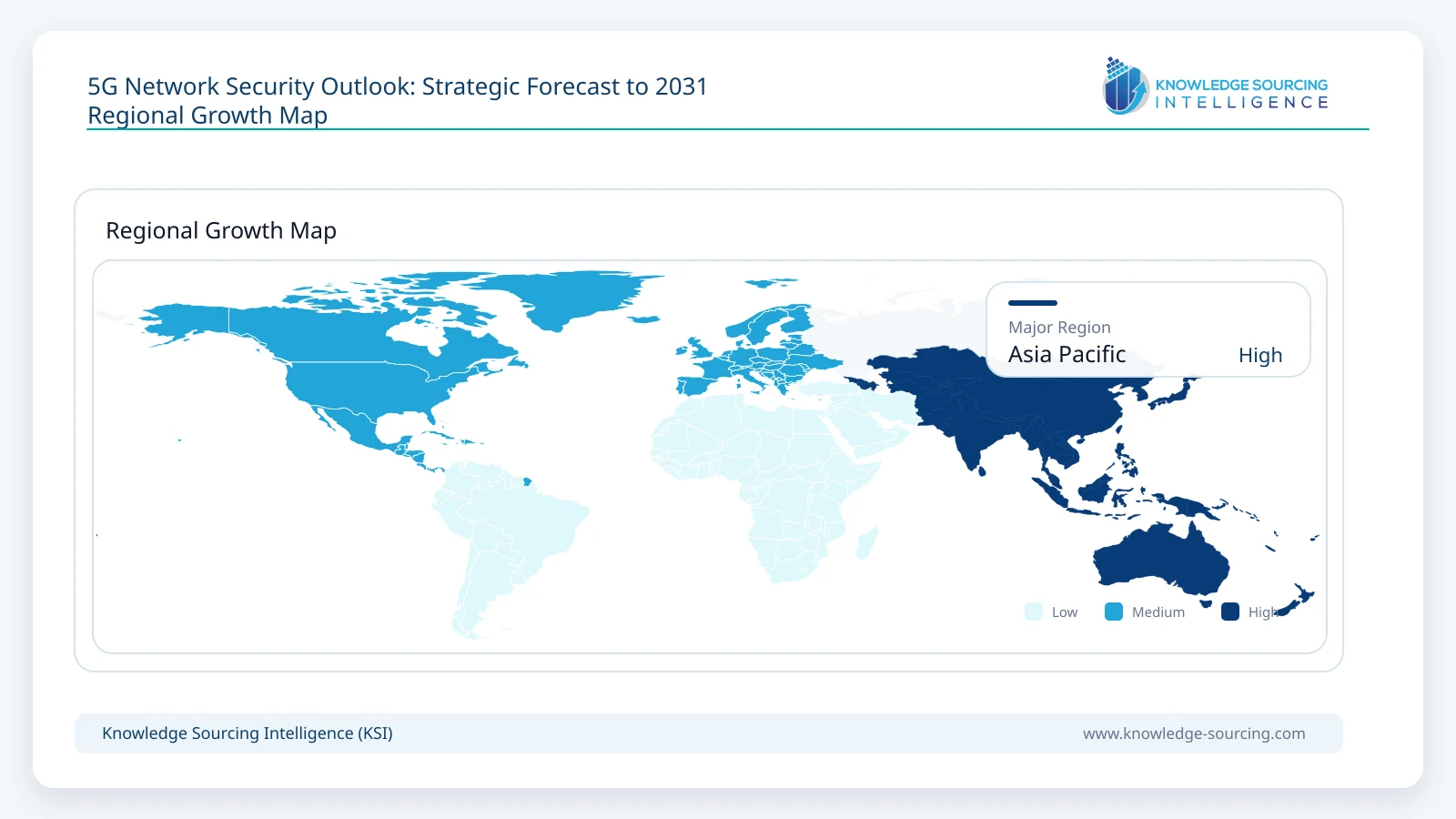
Asia Pacific records the strongest growth among the major regions and is projected to become increasingly comparable with North America by 2031. China operates the world’s largest 5G infrastructure base, while India continues rapidly expanding its network and enterprise 5G ecosystem. South Korea and Japan combine mature 5G infrastructure with advanced industrial applications.
The region is projected to exceed USD 7 billion in market revenue by 2031, with demand increasingly shifting from basic rollout security toward Standalone core, edge and industrial-network protection.
Europe maintains a substantial market through telecom-security regulation, network modernization and private industrial connectivity, while Middle East and Africa and South America record faster percentage growth from smaller bases as 5G deployment broadens.
Technology Outlook
Mobile-Aware Zero Trust
Zero Trust security is increasingly being adapted to cellular environments. Instead of defining policies only around IP addresses, 5G-aware platforms can use subscriber identities, SIM information, equipment identifiers and network slices.
This allows security policies to follow a device as its IP address or physical location changes and is particularly valuable in private networks containing mobile industrial equipment.
AI-Driven DDoS and Threat Automation
Security platforms increasingly use automated analytics to distinguish legitimate traffic changes from attacks and update mitigation policies without waiting for manual intervention.
Nokia’s Deepfield Genome Shield represents this direction through continuous threat detection and automated DDoS policy updates designed for carrier-scale networks.
The technology becomes increasingly important as attack volumes increase faster than security teams can manually analyze individual events.
Security Convergence Across 5G, IT and OT
Private 5G reduces the traditional separation between cellular security and enterprise cybersecurity. Industrial devices can communicate through a private mobile network while accessing edge applications, enterprise systems and cloud services.
Security architectures therefore increasingly combine mobile-specific controls with NGFW, SASE, OT protection and cloud-security capabilities. Palo Alto Networks’ current 5G portfolio reflects this convergence through common policy and threat-prevention capabilities spanning core, edge and connected assets.
Recent Developments
August 2026: Palo Alto Networks introduced the PA-50R family of ruggedized, 5G-enabled next-generation firewalls for critical infrastructure environments including utilities, ports, transportation, public safety and defense. The platform is designed to provide security directly at distributed operational locations connected through private 5G and LTE networks.
June 2026: Nokia launched Deepfield Genome Shield, a network-security automation platform providing proactive, continuously updated DDoS protection for telecommunications providers and other large network operators.
May 2026: Fortinet introduced the FortiExtender WAN 50G, an ultra-high-performance 5G gateway designed to extend FortiGate secure networking into distributed locations using 5G connectivity.
March 2026: NIST released the final Applying 5G Cybersecurity and Privacy Capabilities publication series, providing implementation guidance covering subscriber-identity protection, platform integrity and 5G network-security design principles.
Competitive Landscape
Palo Alto Networks holds a strong position through 5G-native NGFW capabilities, subscriber- and device-aware policy enforcement and integration with broader cloud, AI, IoT and OT security. Its platform strategy is increasingly relevant to service providers seeking to secure both their own infrastructure and enterprise 5G services.
Fortinet combines telecom security with its wider Security Fabric architecture. FortiGate supports RAN, core, MEC and enterprise environments using physical and virtual form factors, allowing carriers and enterprises to apply common security technology across different deployment layers.
Nokia participates through network-infrastructure security, DDoS protection and automation. Deepfield strengthens its position in traffic analytics and large-scale attack mitigation, while its broader telecom installed base provides integration opportunities within carrier networks.
F5 has a strong role in service-provider application and API security, including protection of the APIs through which operators increasingly expose network functionality to enterprise applications and AI agents. The company is positioning BIG-IP Next for Kubernetes as a carrier-grade security and governance layer for cloud-native mobile-network APIs.
A10 Networks remains particularly relevant to mobile-core security through carrier firewalls, GTP protection, DDoS mitigation and CGNAT. Its solutions are designed around the throughput and session scale required in large mobile networks.
Cisco combines network security, identity, cloud security and telecom infrastructure, while Ericsson embeds security throughout its RAN and core architectures. SecurityGen, Allot, Radware and Mobileum provide more specialized telecom-security capabilities including signaling protection, DDoS, roaming security, threat analytics and managed security.
Check Point, Thales and HPE / Juniper Networking broaden competition through cloud, network and critical-infrastructure security capabilities. Akamai participates particularly strongly where DDoS, API and distributed edge protection intersect with telecom infrastructure.
The competitive market increasingly rewards vendors able to provide mobile-specific visibility without creating a separate security silo from the operator’s wider cloud, enterprise and operational-security environment.
Analyst View
5G network security should be treated as a distinct telecom cybersecurity market rather than as a percentage of the entire global cybersecurity industry. The relevant spending is the security directly protecting mobile infrastructure, cellular traffic, private 5G environments and the cloud and edge platforms on which 5G network functions operate.
The most important structural shift is the transition toward Standalone and cloud-native architecture. Security controls need to move inside the mobile network because the traditional external perimeter no longer surrounds all critical functions. Subscriber identities, network slices, service APIs and cloud workloads increasingly become part of the security context.
Private 5G creates the second major growth pool. Enterprises deploying cellular networks in factories, utilities and transportation systems need security that understands both telecom protocols and operational technology. This gives established cybersecurity vendors a larger role alongside traditional telecom suppliers.
DDoS protection remains commercially significant because the scale of carrier networks creates attack conditions that conventional enterprise appliances cannot economically handle. AI-assisted detection and distributed mitigation become increasingly important as both legitimate traffic and attack capacity rise.
The strongest incremental opportunities through 2031 are concentrated in cloud-native security, Edge/MEC protection, private 5G security, mobile-aware Zero Trust, DDoS automation and platforms that converge cellular security with enterprise and OT cybersecurity.
5G Network Security Market Scope
| Report Metric | Details |
|---|---|
| Total Market Size in 2026 | USD 10.3 billion |
| Total Market Size in 2031 | USD 19.7 billion |
| Forecast Unit | Billion |
| Growth Rate | 13.8% |
| Study Period | 2021 to 2031 |
| Historical Data | 2021 to 2024 |
| Base Year | 2025 |
| Forecast Period | 2026 – 2031 |
| Segmentation | Solutions & Services, Deployment, Network Architecture, End User, Geography |
| Companies |
|
Market Segmentation
By Solutions & Services
Solutions
Firewalls & Threat Protection
DDoS Protection
Identity & Access Management
Network Encryption & VPN
Security Analytics & Monitoring
Cloud & Virtualization Security
Services
Managed Security Services
Consulting & Integration
Security Testing & Compliance
By Deployment
Cloud-Based
On-Premise
By Network Architecture
5G Core Security
RAN Security
Edge/MEC Security
Transport Network Security
By End User
Telecom Operators
Enterprise & Private 5G Networks
Government & Defense Networks
By Geography
North America
South America
Europe
Middle East and Africa
Asia Pacific
Table of Contents
1. EXECUTIVE SUMMARY
2. MARKET SNAPSHOT
2.1. Market Overview
2.2. Market Definition and Scope
2.3. Scope Exclusions
2.4. Market Segmentation
2.5. Key Market Indicators
3. BUSINESS LANDSCAPE
3.1. Market Drivers
3.2. Market Restraints and Challenges
3.3. Market Opportunities
3.4. 5G Standalone Security Requirements
3.5. Private 5G and Critical Infrastructure Security
3.6. DDoS and Mobile-Core Threat Environment
3.7. 5G Security Standards and Regulatory Requirements
3.8. Security Integration Across Telco Cloud, Edge and OT
3.9. Porter’s Five Forces Analysis
3.10. Strategic Recommendations
4. TECHNOLOGY OUTLOOK
4.1. Mobile-Aware Zero Trust
4.2. AI-Driven DDoS and Threat Automation
4.3. Security Convergence Across 5G, IT and OT
5. 5G NETWORK SECURITY MARKET BY SOLUTIONS & SERVICES
5.1. Introduction
5.2. Solutions
5.2.1. Firewalls & Threat Protection
5.2.2. DDoS Protection
5.2.3. Identity & Access Management
5.2.4. Network Encryption & VPN
5.2.5. Security Analytics & Monitoring
5.2.6. Cloud & Virtualization Security
5.3. Services
5.3.1. Managed Security Services
5.3.2. Consulting & Integration
5.3.3. Security Testing & Compliance
6. 5G NETWORK SECURITY MARKET BY DEPLOYMENT
6.1. Introduction
6.2. Cloud-Based
6.3. On-Premise
7. 5G NETWORK SECURITY MARKET BY NETWORK ARCHITECTURE
7.1. Introduction
7.2. 5G Core Security
7.3. RAN Security
7.4. Edge/MEC Security
7.5. Transport Network Security
8. 5G NETWORK SECURITY MARKET BY END USER
8.1. Introduction
8.2. Telecom Operators
8.3. Enterprise & Private 5G Networks
8.4. Government & Defense Networks
9. 5G NETWORK SECURITY MARKET BY GEOGRAPHY
9.1. North America
9.2. South America
9.3. Europe
9.4. Middle East and Africa
9.5. Asia Pacific
10. COMPETITIVE ENVIRONMENT AND ANALYSIS
10.1. Competitive Positioning
10.2. Mobile Core & Signaling Security Capability
10.3. DDoS Protection Capability
10.4. Private 5G & Edge Security
10.5. Cloud-Native Security
10.6. Mobile-Aware Zero Trust & Identity
10.7. Managed Security Capability
10.8. Strategic Developments
10.9. Competitive Dashboard
11. COMPANY PROFILES
11.1. Palo Alto Networks, Inc.
11.2. Fortinet, Inc.
11.3. Nokia Corporation
11.4. F5, Inc.
11.5. A10 Networks, Inc.
11.6. Cisco Systems, Inc.
11.7. Ericsson
11.8. SecurityGen
11.9. Allot Ltd.
11.10. Radware Ltd.
11.11. Mobileum Inc.
11.12. Check Point Software Technologies Ltd.
11.13. Thales Group
11.14. Hewlett Packard Enterprise
11.15. Akamai Technologies, Inc.
12. ANALYST VIEW
13. APPENDIX
13.1. Research Methodology
13.2. Market Estimation and Assumptions
13.3. Scope and Double-Counting Controls
13.4. Definitions and Abbreviations
Navigate
Trusted by the world's leading organizations











