
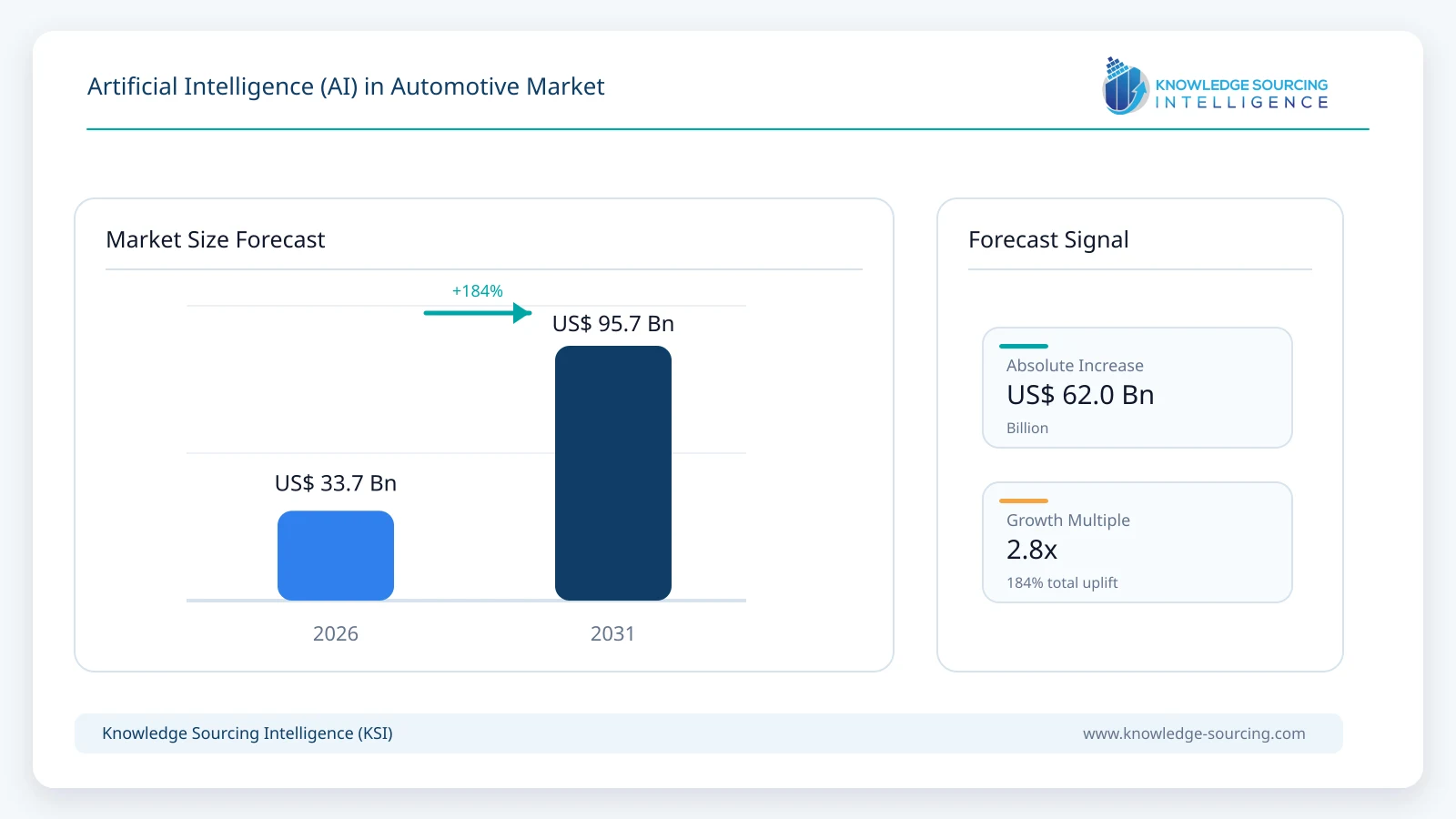
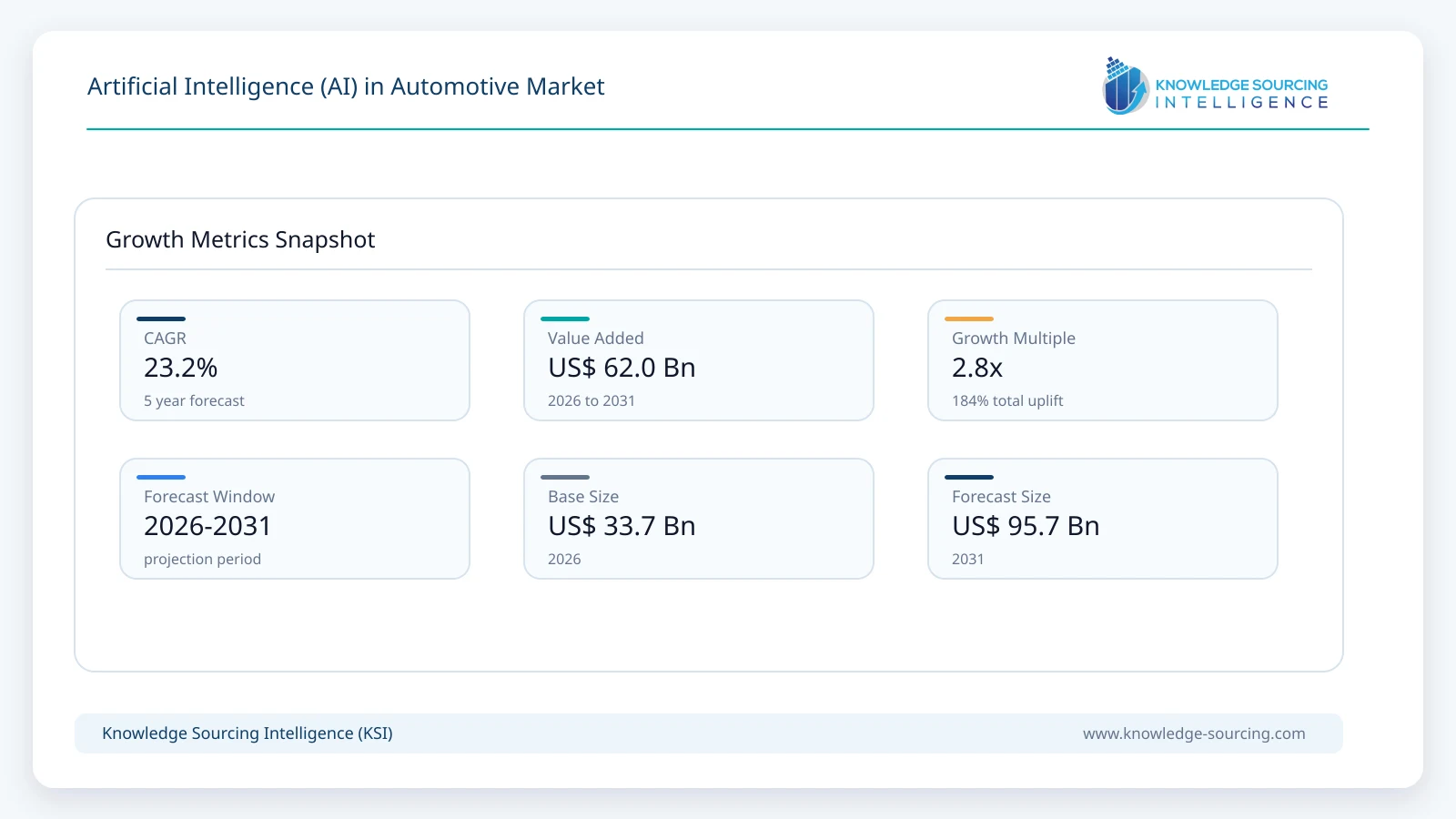
The Artificial Intelligence (AI) in Automotive Market is forecast to grow at a CAGR of 23.20%, reaching USD 95.70 billion in 2031 from USD 33.72 billion in 2026.
Highlights:
- 1Growing regulatory emphasis on vehicle safety continues to accelerate investment in AI-powered Advanced Driver Assistance Systems.
- 2AI-enabled manufacturing represents a major productivity opportunity as automakers modernize production facilities with intelligent automation.
- 3Asia Pacific remains an important investment destination due to strong vehicle production capacity and expanding semiconductor capabilities.
- 4Computer vision and sensor fusion technologies continue improving vehicle perception accuracy across increasingly complex driving environments.
- 5Functional safety, cybersecurity, and AI governance regulations are becoming major purchasing considerations for automotive manufacturers.
- 6Competition increasingly centers on software ecosystems, AI computing platforms, strategic partnerships, and scalable autonomous driving architectures.
The Artificial Intelligence (AI) in Automotive Market encompasses software platforms, semiconductor hardware, sensors, edge computing systems, cloud-based analytics, and engineering services that enable vehicles and automotive manufacturing facilities to perform perception, prediction, decision-making, and autonomous functions. AI technologies are now embedded across the automotive value chain, extending from vehicle design and production to in-vehicle safety, predictive maintenance, autonomous driving, fleet management, and customer interaction.
Demand is primarily driven by vehicle manufacturers, Tier-1 suppliers, commercial fleet operators, mobility service providers, and industrial manufacturers seeking measurable improvements in vehicle safety, manufacturing productivity, operating efficiency, and software-enabled revenue streams. Purchasing decisions increasingly depend on algorithm accuracy, computing efficiency, functional safety compliance, software scalability, cybersecurity capabilities, and integration with existing electronic control unit (ECU) architectures rather than hardware performance alone.
The industry structure has shifted toward software-defined vehicles, where continuous software updates extend vehicle functionality throughout its operational life. This transition has altered procurement practices, encouraging automakers to establish long-term partnerships with semiconductor vendors, cloud infrastructure providers, AI software developers, and autonomous driving specialists. Investment priorities increasingly emphasize centralized computing architectures, high-performance AI processors, simulation environments, and data management platforms capable of processing billions of driving scenarios before commercial deployment.
Commercial revenue originates from multiple sources, including AI-enabled driver assistance systems, autonomous vehicle platforms, manufacturing automation, predictive diagnostics, digital cockpit solutions, and fleet optimization software. Manufacturers are also generating recurring revenue through subscription-based software features, remote diagnostics, and over-the-air software upgrades, strengthening the business case for AI integration beyond initial vehicle sales.
Industry adoption differs considerably across applications. Advanced Driver Assistance Systems (ADAS) have achieved broad commercial deployment due to regulatory support and consumer demand for enhanced safety features. Autonomous driving remains concentrated within premium passenger vehicles, robotaxi programs, and commercial logistics applications where controlled operating environments improve deployment economics. AI-enabled manufacturing is expanding steadily as vehicle producers seek greater production flexibility, lower defect rates, and improved supply chain visibility.
Growing investment in electric vehicles further accelerates AI adoption because electric platforms rely heavily on software-based control systems for battery management, energy optimization, thermal control, predictive maintenance, and intelligent charging strategies. Consequently, AI has become an essential enabling technology supporting both vehicle intelligence and operational efficiency throughout the automotive ecosystem.
Market Drivers
Expansion of Software-Defined Vehicle Architectures
Vehicle manufacturers are redesigning electrical and electronic architectures around centralized computing platforms capable of supporting multiple AI applications throughout a vehicle's lifecycle. Buyers increasingly prefer software-upgradable vehicles because new capabilities can be introduced without replacing hardware components. This purchasing trend encourages suppliers to develop scalable AI software stacks that support continuous feature enhancement. The commercial result is stronger recurring software revenue alongside traditional hardware sales.
Regulatory Emphasis on Vehicle Safety
Governments and transportation safety authorities continue introducing stricter vehicle safety requirements covering emergency braking, lane-keeping assistance, driver monitoring, and collision avoidance technologies. These regulations encourage manufacturers to integrate AI-powered perception systems into both passenger and commercial vehicles. Suppliers capable of delivering certified, standards-compliant AI solutions benefit from longer supply agreements and stronger competitive positioning across global automotive programs.
Rising Data Availability Supporting Machine Learning
Modern connected vehicles continuously generate operational, environmental, diagnostic, and behavioral data that improve AI model performance. Automakers increasingly invest in cloud infrastructure and simulation environments capable of training algorithms using both real-world and synthetic driving scenarios. Buyers prioritize suppliers with extensive data validation capabilities because algorithm reliability directly influences vehicle safety certification and customer acceptance.
Manufacturing Productivity and Quality Optimization
Automotive manufacturers continue adopting AI to improve production efficiency amid labor shortages, rising production costs, and increasing model complexity. Machine learning supports predictive maintenance, automated quality inspection, production scheduling, and robotic process optimization. These applications reduce equipment downtime, improve yield rates, and strengthen profitability while enabling manufacturers to accommodate higher levels of vehicle customization.
Market Restraints and Challenges
High Validation and Certification Requirements
AI systems intended for safety-critical automotive functions require extensive testing under highly diverse operating conditions. Automakers must validate millions of driving scenarios before commercial deployment, significantly increasing engineering costs and development timelines. Suppliers increasingly address this challenge through advanced simulation platforms and virtual validation technologies that reduce physical testing requirements.
Semiconductor Supply Constraints
High-performance AI processors, advanced sensors, and specialized automotive semiconductors remain subject to cyclical supply disruptions and long qualification periods. Limited component availability affects vehicle production schedules and increases procurement costs. Manufacturers respond by diversifying supplier networks, redesigning computing architectures, and expanding strategic semiconductor partnerships.
Cybersecurity and Data Governance Risks
Connected vehicles process large volumes of operational and personal data, creating additional cybersecurity obligations. Buyers increasingly require compliance with international cybersecurity regulations alongside secure software update mechanisms. Suppliers must continuously invest in secure software development practices, encryption technologies, and vulnerability monitoring, increasing development expenditure while supporting long-term customer confidence.
Consumer Acceptance and Liability Considerations
Although driver assistance technologies have gained broad acceptance, higher levels of autonomous driving continue facing public scrutiny regarding safety, accountability, and legal responsibility. Insurance frameworks and liability allocation remain under development across many jurisdictions. These uncertainties influence commercial deployment schedules and encourage manufacturers to prioritize incremental automation rather than immediate full autonomy.
Major Segment Analysis
Advanced Driver Assistance Systems (ADAS)
Advanced Driver Assistance Systems represent the most commercially significant application segment because they deliver measurable safety benefits while satisfying evolving regulatory requirements across major automotive markets. Demand extends beyond premium vehicles as mass-market manufacturers increasingly include AI-enabled safety features to strengthen product differentiation and comply with mandatory safety standards.
Automotive buyers prioritize systems capable of delivering consistent performance across varying weather, lighting, and traffic conditions. AI-powered computer vision, sensor fusion, and machine learning algorithms enable accurate object detection, lane recognition, pedestrian identification, and driver behavior analysis. Reliability under real-world operating conditions remains the principal purchasing criterion, followed closely by ease of integration with existing vehicle architectures.
Competition within this segment increasingly emphasizes software performance rather than sensor quantity alone. Suppliers differentiate themselves through algorithm accuracy, computational efficiency, validation capabilities, and software update support. The shift toward centralized vehicle computing further encourages integrated AI platforms capable of supporting multiple driver assistance functions from a shared hardware architecture.
Commercially, ADAS generates recurring revenue opportunities through software feature upgrades, subscription services, and expanded functionality delivered via over-the-air updates. This business model enhances manufacturer profitability while extending customer engagement beyond vehicle purchase.
Regional Analysis
North America
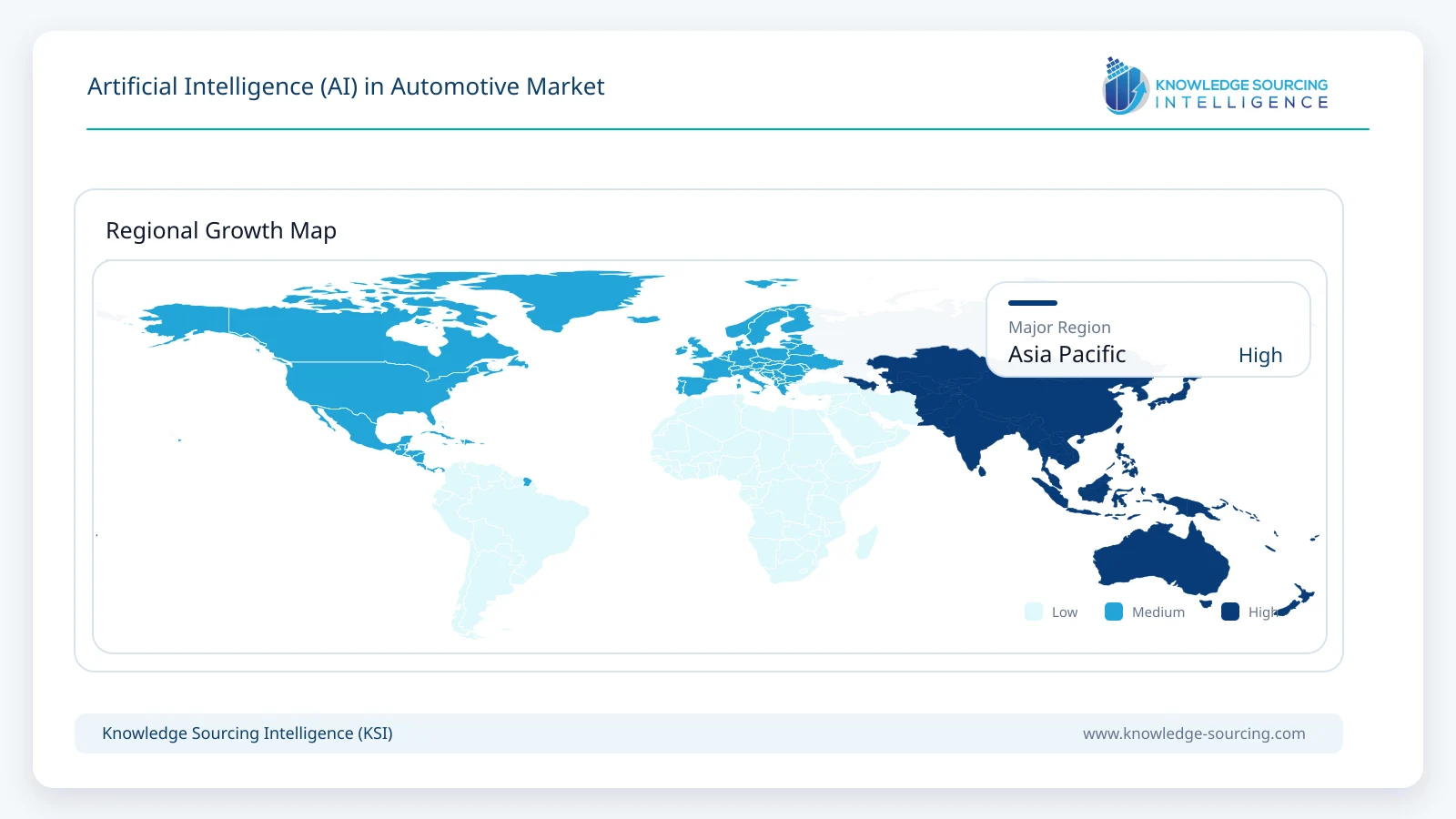
North America maintains strong demand due to substantial investment in autonomous vehicle development, advanced semiconductor technologies, connected mobility platforms, and commercial fleet modernization. Vehicle manufacturers actively collaborate with AI software developers and cloud service providers to accelerate software-defined vehicle deployment. Regulatory oversight continues encouraging safety technology adoption while supporting structured autonomous vehicle testing programs.
Europe
European demand is supported by stringent vehicle safety regulations, premium automotive manufacturing, and strong industrial automation capabilities. Manufacturers prioritize AI applications that improve safety compliance, production efficiency, and vehicle sustainability. Investment increasingly targets software engineering, battery optimization, and intelligent manufacturing while cybersecurity requirements influence supplier selection.
Asia Pacific
Asia Pacific represents the largest production ecosystem for automobiles and automotive electronics. China, Japan, South Korea, and India continue investing heavily in electric mobility, semiconductor manufacturing, intelligent transportation systems, and AI research. Domestic manufacturers increasingly integrate AI capabilities into mainstream vehicle platforms while government initiatives support autonomous driving trials and connected mobility infrastructure.
Middle East & Africa
Regional adoption remains concentrated in intelligent transportation initiatives, premium vehicle imports, logistics modernization, and smart city investments. Gulf countries continue evaluating autonomous mobility for urban transportation, while broader market expansion depends on digital infrastructure, regulatory development, and skilled engineering resources.
South America
Automotive manufacturers increasingly introduce AI-enabled safety features into regional vehicle portfolios as consumer expectations evolve. Commercial fleet operators also adopt predictive maintenance and telematics solutions to improve operating efficiency. Economic volatility and uneven digital infrastructure continue moderating investment across several countries despite improving long-term prospects.
Competitive Landscape
Competition within the Artificial Intelligence (AI) in Automotive Market combines established automotive suppliers, semiconductor manufacturers, autonomous driving specialists, cloud computing providers, and software developers. Market participants compete through integrated hardware-software platforms, scalable AI development frameworks, functional safety certification, and long-term engineering partnerships with vehicle manufacturers.
Competitive differentiation increasingly depends on computing performance, algorithm accuracy, software validation capabilities, simulation environments, and compatibility with centralized vehicle architectures. Strategic alliances between semiconductor companies, automotive manufacturers, cloud providers, and autonomous technology developers continue expanding because no single participant controls the complete software-defined vehicle ecosystem.
Product development increasingly emphasizes modular AI platforms capable of supporting multiple vehicle applications, reducing engineering complexity while improving scalability across global vehicle programs. Geographic expansion remains focused on major automotive manufacturing hubs where engineering collaboration, testing infrastructure, and semiconductor supply chains provide commercial advantages.
The competitive environment includes NVIDIA Corporation, Mobileye Global Inc., Waymo LLC, Motional, Inc., Tesla, Inc., Qualcomm Technologies, Inc., Aptiv PLC, Robert Bosch GmbH, Continental AG, and Microsoft Corporation.
Recent Developments
April 2026: BMW i Ventures launched Fund III, a US$300 million investment fund on April 29, 2026, focused on AI startups developing physical AI, agentic AI, industrial software, and manufacturing technologies for the automotive ecosystem.
April 2026: Volkswagen Group announced its "Agentic AI for All" roadmap during Auto China 2026 on April 21, 2026, confirming deployment of onboard AI agents with locally trained large language models across its China-developed vehicle portfolio.
January 2026: NVIDIA Corporation announced expanded automotive AI collaborations supporting next-generation autonomous vehicle computing platforms. The initiative strengthens scalable AI infrastructure for future software-defined vehicle programs.
Regulatory and Policy Environment
The regulatory framework continues shifting toward mandatory implementation of intelligent vehicle safety technologies while strengthening cybersecurity and software governance requirements. Standards such as ISO 26262 guide functional safety throughout automotive electronics development, while ISO/SAE 21434 establishes cybersecurity engineering requirements for connected vehicles. UNECE regulations governing cybersecurity management systems and software update management systems have become increasingly influential for vehicle certification across participating markets.
Governments continue supporting connected and autonomous mobility through public testing programs, intelligent transportation infrastructure investment, and electric vehicle incentives. Data governance regulations require manufacturers to establish transparent data collection, storage, and processing practices, particularly for connected vehicle applications utilizing AI-based driver monitoring and behavioral analytics.
Compliance requirements increasingly influence supplier qualification because automakers prioritize technology partners capable of meeting global certification standards while supporting secure software lifecycle management.
Outlook and Strategic Implications
Over the next five years, commercial investment is expected to concentrate on AI computing platforms, centralized vehicle architectures, simulation technologies, and software engineering capabilities that support continuous vehicle improvement throughout operational life. Procurement strategies will increasingly favor suppliers capable of delivering integrated hardware, software, cloud connectivity, cybersecurity, and lifecycle management rather than standalone components.
Technology development is expected to emphasize efficient edge AI processing, multimodal sensor fusion, foundation AI models for autonomous driving, and expanded use of synthetic data for algorithm validation. AI-enabled manufacturing will continue improving production economics while predictive analytics strengthens aftermarket service revenues.
Competition is likely to intensify around software ecosystems, proprietary datasets, validation capabilities, and strategic partnerships spanning semiconductor manufacturers, cloud providers, automotive suppliers, and vehicle manufacturers. Organizations capable of combining regulatory compliance, scalable software architectures, and high-performance AI computing will be better positioned to secure long-term automotive production programs.
The principal risks remain semiconductor supply resilience, evolving regulatory requirements, cybersecurity obligations, and public acceptance of higher automation levels. Nevertheless, sustained investment in software-defined vehicles, intelligent manufacturing, connected mobility, and vehicle safety technologies is expected to reinforce AI's role as a core enabling technology across the global automotive industry.
AI in Automotive Market Scope
| Report Metric | Details |
|---|---|
| Total Market Size in 2026 | USD 33.72 billion |
| Total Market Size in 2031 | USD 95.70 billion |
| Forecast Unit | Billion |
| Growth Rate | 23.20% |
| Study Period | 2021 to 2031 |
| Historical Data | 2021 to 2024 |
| Base Year | 2025 |
| Forecast Period | 2026 – 2031 |
| Segmentation | Application, Offering, Technology, Geography |
| Companies |
|
Market Segmentation
By Application
- Autonomous Vehicles
- Conditional Automation
- Full Automation
- Driver Monitoring Systems (DMS)
- Advanced Driver Assistance Systems (ADAS)
- Predictive Maintenance
- Autonomous Vehicle Testing & Simulation
- AI-enabled Manufacturing
- Emotion Detection and Risk Identification
- Others
By Offering
- Hardware
- Software
- Services
By Technology
- Machine Learning
- Deep Learning
- Computer Vision
- Natural Language Processing
- Sensor Fusion
- Others
By Geography
- North America
- United States
- Canada
- Mexico
- South America
- Brazil
- Argentina
- Others
- Europe
- Germany
- France
- United Kingdom
- Spain
- Others
- Middle East and Africa
- Saudi Arabia
- UAE
- Israel
- Others
- Asia Pacific
- China
- Japan
- India
- South Korea
- Indonesia
- Taiwan
- Others
Table of Contents
1. INTRODUCTION
1.1. Market Overview
1.2. Market Definition
1.3. Scope of the Study
1.4. Market Segmentation
1.5. Currency
1.6. Assumptions
1.7. Base Year, Historical Year, and Forecast Period
2. RESEARCH METHODOLOGY
2.1. Research Data
2.2. Research Process
3. EXECUTIVE SUMMARY
3.1. Research Highlights
4. MARKET DYNAMICS
4.1. Market Drivers
4.2. Market Restraints
4.3. Porter's Five Forces Analysis
4.3.1. Bargaining Power of Suppliers
4.3.2. Bargaining Power of Buyers
4.3.3. Threat of New Entrants
4.3.4. Threat of Substitutes
4.3.5. Competitive Rivalry in the Industry
4.4. Industry Value Chain Analysis
5. AI IN AUTOMOTIVE MARKET BY APPLICATION
5.1. Introduction
5.2. Autonomous Vehicles
5.2.1. Conditional Automation
5.2.2. Full Automation
5.3. Driver Monitoring Systems (DMS)
5.4. Advanced Driver Assistance Systems (ADAS)
5.5. Predictive Maintenance
5.6. Autonomous Vehicle Testing & Simulation
5.7. AI-enabled Manufacturing
5.8. Emotion Detection and Risk Identification
5.9. Others
6. AI IN AUTOMOTIVE MARKET BY OFFERING
6.1. Introduction
6.2. Hardware
6.3. Software
6.4. Services
7. AI IN AUTOMOTIVE MARKET BY TECHNOLOGY
7.1. Introduction
7.2. Machine Learning
7.3. Deep Learning
7.4. Computer Vision
7.5. Natural Language Processing
7.6. Sensor Fusion
7.7. Others
8. AI IN AUTOMOTIVE MARKET BY GEOGRAPHY
8.1. Introduction
8.2. North America
8.2.1. United States
8.2.2. Canada
8.2.3. Mexico
8.3. South America
8.3.1. Brazil
8.3.2. Argentina
8.3.3. Others
8.4. Europe
8.4.1. Germany
8.4.2. France
8.4.3. United Kingdom
8.4.4. Spain
8.4.5. Others
8.5. Middle East and Africa
8.5.1. Saudi Arabia
8.5.2. UAE
8.5.3. Israel
8.5.4. Others
8.6. Asia Pacific
8.6.1. China
8.6.2. Japan
8.6.3. India
8.6.4. South Korea
8.6.5. Indonesia
8.6.6. Taiwan
8.6.7. Others
9. COMPETITIVE ENVIRONMENT AND ANALYSIS
9.1. Major Players and Strategy Analysis
9.2. Emerging Players and Market Attractiveness
9.3. Mergers, Acquisitions, Agreements, and Collaborations
9.4. Vendor Competitiveness Matrix
10. COMPANY PROFILES
10.1. NVIDIA Corporation
10.2. Mobileye Global Inc.
10.3. Waymo LLC
10.4. Motional, Inc.
10.5. Tesla, Inc.
10.6. Qualcomm Technologies, Inc.
10.7. Aptiv PLC
10.8. Robert Bosch GmbH
10.9. Continental AG
10.10. Microsoft Corporation
Navigate
Trusted by the world's leading organizations











