
The AI in clinical settings market is expected to witness robust growth over the forecast period.
Highlights:
- 1Growing clinician shortages and rising patient volumes are accelerating investment in workflow automation and clinical decision support.
- 2Machine learning remains a commercially important technology because of its broad deployment across diagnostics, predictive analytics, and hospital operations.
- 3North America represents a leading revenue contributor due to mature digital healthcare infrastructure and favorable investment activity.
- 4Generative AI is expanding from administrative documentation toward clinical knowledge assistance and physician workflow support.
- 5Regulatory oversight for AI-enabled medical software is encouraging greater emphasis on explainability, validation, and lifecycle monitoring.
- 6Competition increasingly centers on interoperability, clinical evidence, cybersecurity, and long-term enterprise partnerships rather than standalone algorithms.
The AI in Clinical Settings Market comprises software platforms, embedded algorithms, clinical decision support tools, workflow automation systems, and intelligent robotics designed to improve healthcare delivery across diagnosis, treatment planning, patient monitoring, clinical documentation, and hospital operations. Unlike administrative healthcare AI, clinical AI directly influences patient care by assisting clinicians with medical interpretation, risk assessment, image analysis, therapeutic recommendations, and workflow optimization. Adoption is expanding as healthcare providers seek measurable improvements in clinical productivity, diagnostic consistency, and resource utilization while managing growing patient volumes and workforce shortages.
Demand is being driven by hospitals, integrated delivery networks, diagnostic laboratories, pharmaceutical companies, medical device manufacturers, and academic research institutions. Buyers increasingly evaluate AI platforms based on clinical validation, interoperability with electronic health record (EHR) systems, cybersecurity, regulatory approval, explainability, and post-deployment support rather than algorithmic performance alone. Procurement decisions are commonly led by multidisciplinary committees that include clinicians, information technology teams, compliance officers, and financial executives, reflecting the operational and regulatory implications of AI implementation.
Commercial activity has shifted from pilot deployments toward enterprise-scale adoption. Healthcare providers increasingly prefer modular AI platforms that integrate with existing imaging equipment, laboratory information systems, radiology workflows, and hospital information systems without requiring extensive infrastructure replacement. Subscription licensing, cloud deployment, and software-as-a-service delivery models are becoming more common because they reduce capital expenditure while allowing continuous model updates and regulatory compliance management.
The industry structure includes multinational healthcare technology companies, specialized clinical AI developers, semiconductor providers supporting AI computing infrastructure, speech recognition vendors, and medical imaging software companies. Revenue generation extends beyond software licensing to implementation services, clinical validation, workflow integration, cybersecurity, staff training, and lifecycle maintenance. Vendors increasingly compete on measurable clinical outcomes, deployment speed, interoperability, and evidence demonstrating reductions in reporting time, diagnostic variability, or administrative burden.
Growing availability of structured and unstructured clinical data is expanding AI use cases across radiology, pathology, cardiology, oncology, emergency medicine, intensive care, and hospital operations. At the same time, governments and healthcare regulators continue to strengthen oversight for software used in clinical decision-making, encouraging vendors to invest in transparency, documentation, post-market monitoring, and continuous quality management.
Market Drivers
Growing pressure on healthcare workforce efficiency
Healthcare systems continue to face shortages of physicians, nurses, radiologists, and clinical support personnel while patient demand continues to increase. AI enables providers to automate repetitive documentation, prioritize urgent examinations, summarize patient histories, and support clinical decision-making. Healthcare organizations increasingly invest in technologies that reduce clinician workload without compromising care quality. Vendors respond by integrating AI into existing clinical workflows instead of requiring major operational redesign, improving purchasing confidence and accelerating deployment.
Expansion of medical imaging and diagnostic data
The volume of diagnostic imaging and laboratory testing continues to rise across oncology, cardiovascular disease, neurology, and emergency medicine. Manual interpretation creates reporting bottlenecks and contributes to variability in clinical outcomes. AI assists clinicians by identifying abnormalities, quantifying disease progression, and prioritizing critical cases. Buyers seek solutions that demonstrate validated improvements in reporting efficiency while integrating with existing picture archiving and communication systems (PACS), creating recurring software revenue opportunities.
Increasing digital maturity of healthcare providers
Large healthcare organizations continue investing in electronic health records, cloud infrastructure, and connected medical devices. These digital assets provide the data foundation necessary for AI deployment. Procurement increasingly favors vendors capable of integrating with multiple hospital information systems through standardized interfaces and secure data exchange protocols. Companies offering scalable enterprise deployment and continuous software updates gain competitive advantages in long-term contracts.
Pharmaceutical and clinical research adoption
Drug developers increasingly use AI to support patient recruitment, clinical trial monitoring, biomarker identification, and protocol optimization. Clinical AI also improves analysis of real-world evidence collected from hospitals and healthcare networks. Pharmaceutical companies prioritize platforms capable of supporting regulatory documentation while accelerating clinical development timelines. This broadens the commercial customer base beyond traditional healthcare providers.
Market Restraints and Challenges
Regulatory complexity for clinical AI
Clinical AI products used in diagnosis or treatment recommendations require extensive regulatory review in many jurisdictions. Developers must continuously document algorithm performance, software modifications, cybersecurity controls, and post-market surveillance activities. Compliance requirements increase development costs and lengthen commercialization timelines, particularly for smaller software companies. Many suppliers mitigate these challenges by implementing quality management systems early in product development.
Data privacy and cybersecurity concerns
Healthcare organizations manage highly sensitive patient information subject to strict privacy regulations. AI implementation requires secure data governance, encryption, identity management, and continuous monitoring against cyber threats. Buyers increasingly evaluate cybersecurity capabilities alongside clinical performance. Vendors unable to demonstrate secure architecture may encounter slower procurement cycles and reduced customer confidence.
Clinical acceptance and workflow integration
Healthcare professionals require evidence that AI recommendations are reliable, explainable, and compatible with existing clinical workflows. Limited transparency or poor user experience may reduce clinician adoption despite technical capability. Suppliers increasingly conduct multicenter validation studies and collaborate with healthcare institutions to improve usability, physician confidence, and workflow integration before commercial expansion.
Infrastructure disparities across healthcare systems
Advanced AI deployment requires computing resources, high-quality clinical data, digital imaging infrastructure, and reliable connectivity. Smaller hospitals and resource-constrained healthcare systems may delay implementation due to budget limitations or incomplete digital infrastructure. Cloud-based deployment and subscription pricing partially reduce these barriers but cannot fully overcome infrastructure gaps.
Major Segment Analysis
Machine Learning
Machine learning represents one of the most commercially important technology segments because it supports a broad range of clinical applications across diagnostics, predictive analytics, patient risk stratification, treatment optimization, and operational efficiency. Its flexibility allows healthcare providers to address multiple clinical challenges using a common analytical framework while integrating with existing digital infrastructure.
Demand originates primarily from hospitals, imaging centers, and integrated healthcare systems seeking measurable improvements in diagnostic accuracy and operational productivity. Buyers prioritize validated algorithms capable of demonstrating consistent clinical performance across diverse patient populations while meeting regulatory requirements for transparency and traceability.
Competition within this segment extends beyond predictive accuracy. Vendors differentiate through interoperability with electronic health records, scalability across clinical departments, implementation services, and continuous model monitoring. Enterprise customers increasingly prefer suppliers capable of supporting organization-wide deployment rather than isolated departmental solutions, creating recurring software, maintenance, and service revenues.
Regional Analysis
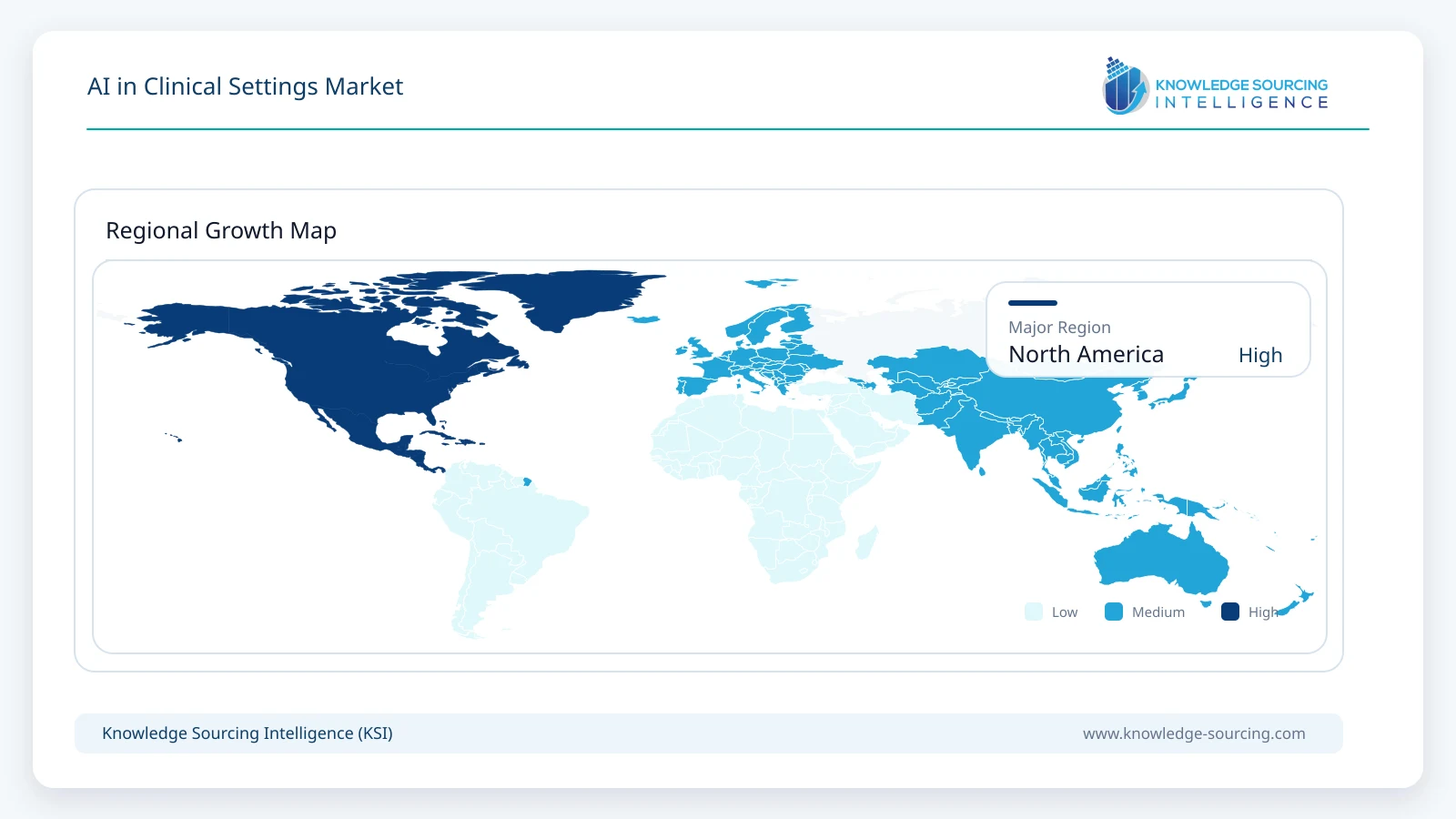
North America remains the largest regional market due to advanced healthcare digitization, widespread electronic health record adoption, substantial healthcare expenditure, and active investment in clinical AI innovation. Academic medical centers, integrated healthcare systems, and pharmaceutical companies continue adopting AI across diagnostic imaging, documentation, clinical trials, and hospital operations. Regulatory clarity and strong venture investment further support commercialization.
Europe demonstrates steady adoption supported by national digital health initiatives, expanding healthcare interoperability programs, and increasing emphasis on responsible AI governance. Hospitals prioritize clinically validated solutions that comply with medical device regulations and data protection requirements. Budget constraints within some public healthcare systems continue influencing procurement timelines.
Asia-Pacific represents one of the fastest-expanding adoption regions due to growing healthcare infrastructure investment, expanding hospital capacity, increasing diagnostic imaging volumes, and government support for artificial intelligence development. China, Japan, South Korea, India, and Australia continue strengthening digital healthcare capabilities, although implementation maturity varies considerably between countries.
Middle East & Africa and South America continue expanding adoption through hospital modernization initiatives, public healthcare digitization, and investment in specialized medical facilities. Large urban healthcare providers lead procurement while broader adoption remains influenced by healthcare funding, workforce availability, and digital infrastructure development.
Competitive Landscape
Competition within the AI in Clinical Settings Market combines established healthcare technology companies with specialized AI software developers addressing specific clinical workflows. Suppliers compete through regulatory approvals, clinical validation studies, interoperability with hospital information systems, deployment flexibility, cybersecurity capabilities, and long-term customer support.
Strategic partnerships between AI developers, healthcare providers, cloud infrastructure companies, and medical device manufacturers continue expanding commercialization opportunities. Integration with imaging equipment, electronic health records, and speech recognition systems strengthens customer retention while increasing switching costs. Geographic expansion increasingly depends on regulatory expertise, local clinical partnerships, and region-specific implementation capabilities rather than product localization alone.
Companies including IQVIA, AiCure, Google Health, DeepScribe, Siemens Healthineers, Nuance Communications, Care.ai, Qure.ai, NVIDIA, and GE HealthCare continue investing in clinical validation, enterprise integration, cloud-enabled deployment, and healthcare ecosystem partnerships to strengthen competitive positioning.
Recent Developments
June 2026: UpDoc announced FDA clearance for its clinical AI platform using patient-facing large language models as Software as a Medical Device (SaMD), alongside initial deployments across multiple U.S. health systems for real-time care coordination.
March 2026: GE HealthCare expanded AI-enabled imaging workflow capabilities across multiple diagnostic platforms, improving workflow standardization and supporting broader enterprise deployment. Commercial relevance: strengthens integrated imaging software adoption.
March 2026: Butterfly Network secured U.S. FDA clearance for an AI-powered ultrasound application that automatically estimates gestational age in under two minutes, expanding access to prenatal clinical assessments across hospitals and underserved care settings.
January 2026: John Snow Labs introduced its Patient Journey Intelligence (PJI) platform, the first FDA-ready real-world evidence platform designed to combine structured and unstructured clinical data for regulatory-grade clinical research and decision support.
Regulatory and Policy Environment
Clinical AI operates within evolving medical device, healthcare data privacy, cybersecurity, and software quality regulations. Authorities increasingly classify many AI-enabled clinical decision support systems as software medical devices requiring documented validation, quality management, risk assessment, and lifecycle monitoring.
Healthcare providers also evaluate compliance with privacy regulations governing patient information, cybersecurity frameworks protecting connected medical systems, and interoperability standards supporting secure data exchange across healthcare organizations. Governments continue promoting responsible AI adoption through digital health strategies while encouraging evidence-based deployment, transparency, and post-market performance monitoring. These regulatory developments increase commercialization costs but improve buyer confidence by establishing clearer expectations for clinical safety and accountability.
Outlook and Strategic Implications
Commercial opportunities over the forecast period will increasingly depend on suppliers demonstrating measurable clinical outcomes rather than algorithmic novelty. Healthcare organizations are expected to prioritize enterprise platforms capable of integrating imaging, documentation, predictive analytics, and workflow optimization within unified clinical environments.
Procurement strategies are likely to emphasize interoperability, cybersecurity, explainable AI, regulatory compliance, and long-term vendor support. Cloud deployment, subscription licensing, and continuous software updates will remain preferred purchasing models because they reduce implementation complexity while supporting evolving regulatory requirements.
Investment activity is expected to focus on multimodal AI combining imaging, clinical notes, laboratory data, genomics, and physiological monitoring to support more comprehensive clinical decision-making. Generative AI will continue expanding physician documentation, clinical summarization, and knowledge assistance, although adoption will remain subject to stringent validation and governance requirements.
Competitive differentiation will increasingly depend on clinical evidence, enterprise integration capabilities, strategic healthcare partnerships, and global regulatory expertise. Organizations capable of demonstrating operational efficiency improvements, workflow compatibility, and sustained clinical performance across diverse healthcare settings will be better positioned to secure long-term contracts as healthcare providers transition from isolated AI pilots toward organization-wide implementation strategies.
AI in Clinical Settings Market Scope
| Report Metric | Details |
|---|---|
| Forecast Unit | Billion |
| Study Period | 2021 to 2031 |
| Historical Data | 2021 to 2024 |
| Base Year | 2025 |
| Forecast Period | 2026 – 2031 |
| Segmentation | Technology, End-User, Geography |
| Companies |
|
Market Segmentation
By Technology
- Machine Learning
- Deep Learning
- Natural Language Processing
- Computer Vision
- Generative AI
- Robotics
By End-User
- Hospitals and Clinics
- Diagnostic Centers
- Pharmaceutical and Biotechnology Companies
- Medical Device Companies
- Research Institutions
By Geography
- North America
- United States
- Canada
- Mexico
- South America
- Brazil
- Argentina
- Rest of South America
- Europe
- United Kingdom
- Germany
- France
- Italy
- Spain
- Rest of Europe
- Middle East and Africa
- Saudi Arabia
- United Arab Emirates
- Rest of the Middle East and Africa
- Asia-Pacific
- China
- India
- Japan
- South Korea
- Taiwan
- Thailand
- Indonesia
- Australia
- Rest of Asia-Pacific
Table of Contents
1. INTRODUCTION
1.1. Market Overview
1.2. Market Definition
1.3. Scope of the Study
1.4. Market Segmentation
1.5. Currency
1.6. Assumptions
1.7. Base and Forecast Years Timeline
1.8. Key Benefits for Stakeholders
2. RESEARCH METHODOLOGY
2.1. Research Design
2.2. Research Process
3. EXECUTIVE SUMMARY
3.1. Key Findings
3.2. Analyst View
4. MARKET DYNAMICS
4.1. Market Drivers
4.2. Market Restraints
4.3. Porter’s Five Forces Analysis
4.3.1. Bargaining Power of Suppliers
4.3.2. Bargaining Power of Buyers
4.3.3. Threat of New Entrants
4.3.4. Threat of Substitutes
4.3.5. Competitive Rivalry in the Industry
4.4. Industry Value Chain Analysis
5. AI IN CLINICAL SETTINGS MARKET BY TECHNOLOGY
5.1. Introduction
5.2. Machine Learning
5.3. Deep Learning
5.4. Natural Language Processing
5.5. Computer Vision
5.6. Generative AI
5.7. Robotics
6. AI IN CLINICAL SETTINGS MARKET BY END-USER
6.1. Introduction
6.2. Hospitals and Clinics
6.3. Diagnostic Centers
6.4. Pharmaceutical and Biotechnology Companies
6.5. Medical Device Companies
6.6. Research Institutions
7. AI IN CLINICAL SETTINGS MARKET BY GEOGRAPHY
7.1. Global Overview
7.2. North America
7.2.1. United States
7.2.2. Canada
7.2.3. Mexico
7.3. South America
7.3.1. Brazil
7.3.2. Argentina
7.3.3. Rest of South America
7.4. Europe
7.4.1. United Kingdom
7.4.2. Germany
7.4.3. France
7.4.4. Italy
7.4.5. Spain
7.4.6. Rest of Europe
7.5. Middle East and Africa
7.5.1. Saudi Arabia
7.5.2. United Arab Emirates
7.5.3. Rest of the Middle East and Africa
7.6. Asia-Pacific
7.6.1. China
7.6.2. India
7.6.3. Japan
7.6.4. South Korea
7.6.5. Taiwan
7.6.6. Thailand
7.6.7. Indonesia
7.6.8. Australia
7.6.9. Rest of Asia-Pacific
8. COMPETITIVE ENVIRONMENT AND ANALYSIS
8.1. Major Players and Strategy Analysis
8.2. Market Share Analysis
8.3. Mergers, Acquisitions, Agreements, and Collaborations
8.4. Competitive Dashboard
9. COMPANY PROFILES
9.1. IQVIA
9.2. AiCure
9.3. Google Health
9.4. DeepScribe
9.5. Siemens Healthineers
9.6. Nuance Communications
9.7. Care.ai
9.8. Qure.ai
9.9. NVIDIA
9.10. GE HealthCare
Navigate
Trusted by the world's leading organizations











