
The AI-based clinical decision support system market is expected to grow steadily over the projected period.
Highlights:
- 1Rising clinical complexity and physician workload are increasing demand for AI-assisted diagnostic and therapeutic decision support.
- 2Integrated clinical decision support systems represent the leading commercial product category due to seamless EHR integration and enterprise-wide deployment.
- 3North America remains the largest regional market because of advanced digital healthcare infrastructure and supportive reimbursement initiatives.
- 4Cloud-based deployment is gaining procurement preference among healthcare providers seeking scalability, remote access, and lower infrastructure costs.
- 5Regulatory oversight of AI-enabled medical software is encouraging greater emphasis on algorithm transparency, validation, and post-market monitoring.
- 6Competition is shifting toward workflow integration, clinical outcome validation, and interoperability rather than standalone AI functionality.
The AI-based Clinical Decision Support System (CDSS) market comprises software platforms that combine artificial intelligence, machine learning, natural language processing, and clinical knowledge bases to assist healthcare professionals in diagnosis, treatment planning, medication management, and workflow optimization. Unlike conventional rule-based systems, AI-enabled CDSS continuously analyzes structured and unstructured clinical information, medical literature, imaging data, laboratory results, and electronic health records (EHRs) to generate context-specific recommendations that support evidence-based clinical decisions.
Demand is primarily driven by healthcare providers seeking measurable improvements in clinical quality, operational efficiency, and resource utilization. Hospitals, integrated delivery networks, specialty clinics, academic medical centers, and outpatient healthcare organizations represent the largest purchasing groups. Procurement decisions increasingly emphasize interoperability with existing EHR infrastructure, regulatory compliance, cybersecurity, explainable AI capabilities, implementation support, and measurable clinical outcomes rather than software functionality alone.
Healthcare organizations continue to experience mounting pressure from aging populations, rising chronic disease prevalence, clinician shortages, and growing administrative complexity. These factors have expanded the need for decision support systems capable of reducing diagnostic uncertainty, minimizing medication-related errors, prioritizing high-risk patients, and improving consistency across clinical workflows. AI-based CDSS solutions are therefore becoming operational tools that support both clinical quality initiatives and financial performance under value-based reimbursement models.
The competitive structure reflects a combination of established healthcare information technology vendors, specialized AI developers, and imaging-focused software providers. Large enterprise suppliers benefit from existing hospital relationships and integrated EHR ecosystems, while emerging AI companies differentiate themselves through disease-specific algorithms, workflow automation capabilities, and faster innovation cycles. Partnerships between healthcare providers, technology firms, and cloud infrastructure providers have become an important commercialization strategy as customers increasingly prefer scalable deployment models and continuous software improvements.
Commercial adoption varies across healthcare settings. Large hospital systems generally prioritize enterprise-wide integration with clinical workflows, whereas smaller healthcare organizations often favor cloud-based deployment to reduce infrastructure investment and accelerate implementation. Buyers increasingly evaluate vendors according to clinical validation studies, regulatory approvals, cybersecurity credentials, implementation timelines, physician acceptance, and long-term return on investment. These purchasing criteria are reshaping competitive positioning throughout the industry.
Market Drivers
Rising Complexity of Clinical Decision-Making
Healthcare professionals increasingly manage patients with multiple chronic conditions requiring coordinated treatment decisions across specialties. Clinical teams must evaluate extensive patient histories, laboratory findings, imaging results, genomic information, and updated medical guidelines within limited consultation time. AI-based CDSS assists clinicians by synthesizing diverse data sources and presenting evidence-supported recommendations that improve decision consistency.
Healthcare providers purchasing these systems seek measurable reductions in diagnostic variation, avoidable complications, and unnecessary procedures. Vendors continue expanding disease-specific algorithms while strengthening integration with hospital information systems, enabling AI recommendations to become part of routine clinical workflows rather than separate analytical tools.
Expansion of Electronic Health Record Infrastructure
Widespread implementation of electronic health records has substantially increased the volume of digital clinical data available for analysis. AI-based CDSS converts these large datasets into actionable recommendations by identifying clinical patterns that may not be readily apparent during routine patient consultations.
Hospitals investing heavily in digital infrastructure increasingly prefer decision support platforms capable of integrating laboratory systems, pharmacy records, radiology platforms, and physician documentation. Suppliers therefore emphasize interoperability standards, application programming interfaces, and standardized healthcare data exchange frameworks to simplify enterprise deployment.
Growing Focus on Patient Safety and Medication Accuracy
Medication errors remain a major concern for healthcare systems worldwide due to their clinical and financial consequences. AI-supported medication management systems assist clinicians by evaluating drug interactions, allergy histories, dosage recommendations, renal function, and patient-specific risk factors before prescriptions are finalized.
Healthcare organizations view these capabilities as investments supporting quality improvement initiatives, accreditation requirements, and liability reduction. Pharmaceutical decision support therefore represents an important procurement criterion, particularly among large hospital networks managing high prescription volumes.
Workforce Shortages Across Healthcare Systems
Many healthcare systems continue experiencing shortages of physicians, nurses, and specialist clinicians while patient demand continues to rise. AI-enabled decision support improves productivity by reducing administrative workload, prioritizing high-risk patients, and supporting less experienced clinicians with evidence-based recommendations.
Healthcare executives increasingly evaluate AI investments according to measurable workforce efficiency gains, shorter clinical documentation time, and improved patient throughput, making workforce optimization an important commercial driver.
Market Restraints and Challenges
Clinical Trust and Algorithm Transparency
Healthcare professionals remain cautious about relying on AI recommendations when algorithm logic cannot be clearly explained. Limited transparency reduces physician confidence, particularly for complex diagnoses involving multiple clinical variables.
Software developers increasingly address this concern by incorporating explainable AI features, clinical evidence references, and confidence scoring. Nevertheless, establishing clinician trust continues to require substantial validation and physician engagement.
Data Quality and Interoperability Limitations
AI performance depends heavily on complete, standardized, and accurate clinical data. Many healthcare organizations continue operating fragmented information systems with inconsistent coding standards, incomplete documentation, and varying data quality.
These limitations increase implementation costs and extend deployment timelines. Vendors therefore invest significantly in interoperability tools, data normalization technologies, and integration services to improve system performance.
Regulatory Compliance Requirements
AI-enabled clinical software increasingly falls under medical device regulations in numerous jurisdictions. Vendors must demonstrate algorithm performance, cybersecurity resilience, clinical validation, and ongoing post-market monitoring before commercialization.
Compliance activities increase development costs and lengthen product approval timelines, particularly for smaller technology companies with limited regulatory resources.
Cybersecurity and Patient Data Protection
Healthcare organizations remain frequent targets of cyberattacks due to the high value of medical information. Procurement teams therefore place substantial emphasis on encryption, identity management, secure cloud architecture, audit capabilities, and compliance with healthcare privacy regulations.
Suppliers unable to demonstrate strong cybersecurity practices may encounter longer sales cycles and greater customer scrutiny during procurement evaluations.
Major Segment Analysis
Integrated Clinical Decision Support Systems
Integrated CDSS represents the most commercially important product segment because healthcare providers increasingly prefer decision support capabilities embedded directly within electronic health record workflows. Physicians are more likely to adopt recommendations presented during routine patient care rather than switching between multiple software applications.
Enterprise healthcare organizations favor integrated platforms because they improve workflow continuity, reduce duplicate data entry, and support standardized clinical protocols across departments. Integration also enables real-time access to laboratory results, imaging studies, medication histories, and physician documentation, improving recommendation accuracy.
Vendor competition within this segment increasingly centers on interoperability, implementation efficiency, physician usability, and measurable improvements in clinical outcomes. Suppliers capable of integrating seamlessly with enterprise healthcare infrastructure often achieve stronger customer retention due to high switching costs and long implementation cycles.
Revenue opportunities extend beyond software licensing to implementation consulting, system integration, clinical content updates, cloud hosting, cybersecurity services, and ongoing algorithm improvements. Consequently, integrated CDSS remains the primary revenue contributor across enterprise healthcare deployments.
Regional Analysis
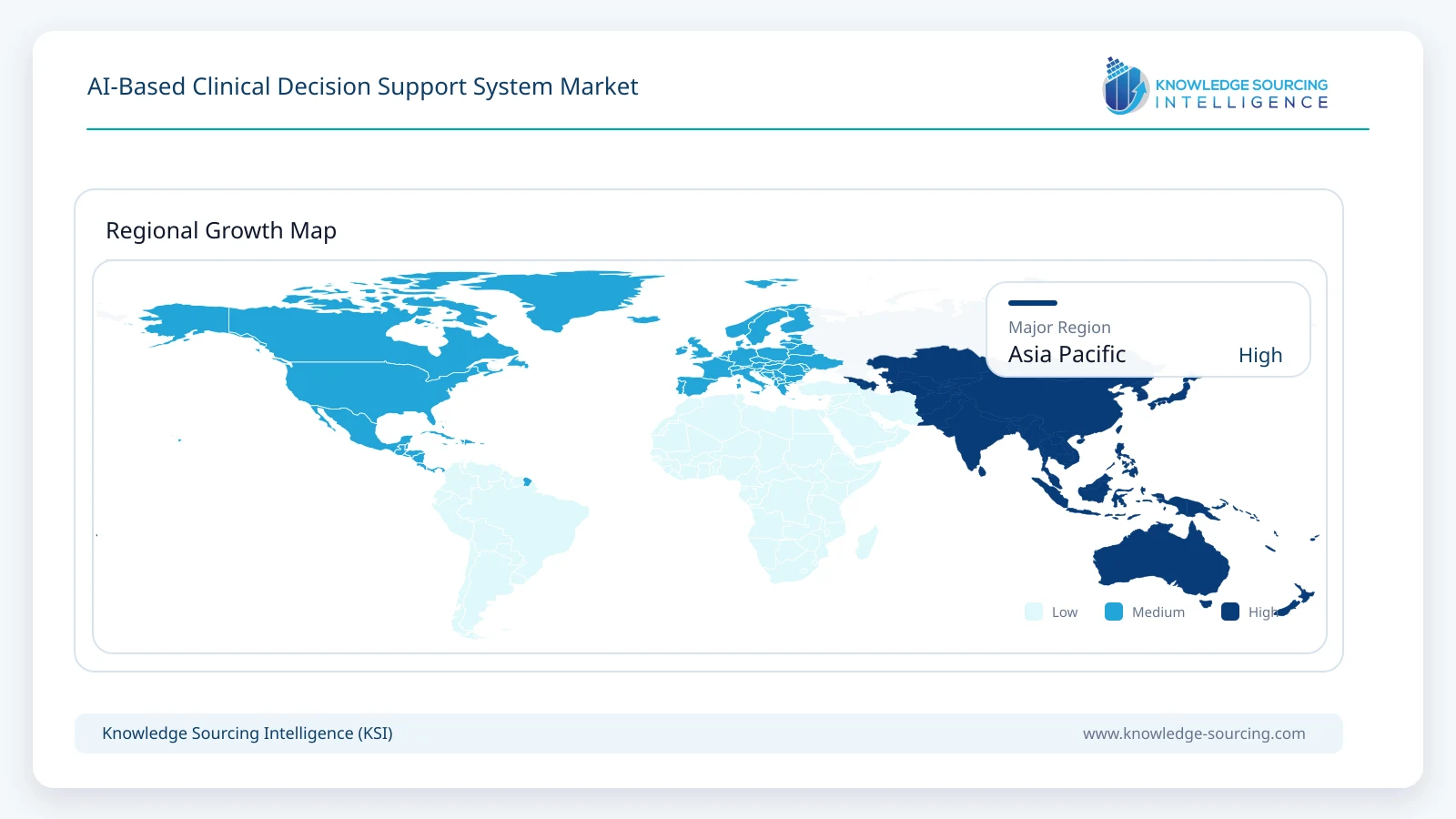
North America
North America maintains the strongest commercial position due to extensive EHR adoption, favorable healthcare IT investment, and established reimbursement frameworks supporting quality improvement initiatives. Healthcare providers actively evaluate AI investments according to measurable reductions in clinical variation, operational costs, and patient safety incidents. Large integrated delivery networks continue driving enterprise-scale procurement.
Europe
European demand is supported by government investment in healthcare digitization, cross-border interoperability initiatives, and expanding use of electronic patient records. Procurement decisions increasingly prioritize regulatory compliance, data privacy, and clinically validated AI solutions. Public healthcare procurement processes often lengthen implementation timelines but provide stable long-term contracts.
Asia Pacific
Asia Pacific represents an expanding opportunity as governments invest in hospital modernization, digital health infrastructure, and AI research initiatives. Large population bases, physician shortages, and rising chronic disease burdens encourage healthcare providers to adopt decision support technologies. However, varying levels of healthcare infrastructure create uneven adoption across countries.
Middle East and Africa
Healthcare modernization programs, hospital expansion projects, and national digital health strategies support market development across several Middle Eastern countries. Large tertiary hospitals increasingly procure AI-enabled clinical software as part of broader smart hospital initiatives. Infrastructure disparities and workforce limitations continue affecting adoption across many African healthcare systems.
South America
Healthcare providers in South America are gradually increasing investment in digital clinical infrastructure despite budget constraints. Large private hospital groups generally lead AI adoption, while public healthcare organizations remain more selective due to procurement limitations. Regulatory development and interoperability improvements will influence future purchasing decisions.
Competitive Landscape
Competition combines multinational healthcare technology providers with specialized AI software developers offering disease-specific clinical applications. Suppliers differentiate themselves through clinical validation, workflow integration, interoperability capabilities, regulatory approvals, cybersecurity, implementation expertise, and long-term customer support.
Strategic partnerships between software developers, hospital systems, cloud service providers, and academic institutions continue expanding product capabilities and accelerating commercialization. Vendors increasingly compete by demonstrating measurable improvements in clinical quality, physician productivity, patient safety, and operational efficiency rather than relying solely on algorithm performance.
Enterprise relationships, recurring software subscription models, cloud deployment capabilities, and continuous software enhancements strengthen customer retention while creating opportunities for expanded clinical applications across healthcare organizations.
Recent Developments
August 2026: Epic expanded AI-supported clinical workflows through Ergo Visit, helping clinicians prepare for outpatient visits while anticipating needs and lining up documentation and orders for review.
August 2026: Oracle Health expanded its Clinical AI Agent with automated coding, physician dictation, and chart-review capabilities, surfacing relevant patient context across clinical records for clinician decision-making.
June 2026: Mayo Clinic and Microsoft announced collaboration to develop a healthcare-specific frontier AI model supporting clinical reasoning, earlier diagnoses, personalized treatment decisions, and complex clinical decision-making.
May 2026: The U.S. FDA announced expanded deployment of its AI infrastructure, including Elsa 4.0 and the HALO data platform, enhancing AI-assisted scientific review and clinical evaluation workflows to improve regulatory decision support across the agency.
April 2026: The U.S. FDA, together with AstraZeneca, Amgen, and Paradigm Health, launched proof-of-concept initiatives using AI to automate real-time extraction of clinical trial data from electronic health records, supporting faster clinical decision-making and regulatory review processes.
February 2026: Aidoc expanded its AI-powered clinical workflow platform with additional care coordination capabilities supporting hospital-wide patient management. The enhancement increases the commercial value of AI beyond diagnostic imaging by improving operational efficiency.
Regulatory and Policy Environment
Regulatory oversight continues expanding as AI-based clinical decision support systems increasingly qualify as Software as a Medical Device (SaMD) under several jurisdictions. Regulatory authorities require evidence supporting algorithm performance, risk management, cybersecurity, clinical validation, software lifecycle management, and post-market surveillance.
Healthcare providers also evaluate compliance with patient privacy regulations governing electronic health information, including secure storage, controlled access, encryption, audit logging, and data governance. International interoperability standards, including HL7 FHIR, continue supporting standardized healthcare data exchange between clinical systems.
Government-supported digital health initiatives, national AI strategies, hospital modernization programs, and public investment in healthcare digitization further encourage adoption while establishing stronger governance for responsible AI implementation. Vendors demonstrating regulatory readiness and transparent clinical validation generally achieve stronger commercial acceptance among institutional buyers.
Outlook and Strategic Implications
Investment priorities over the coming years are expected to emphasize enterprise-wide AI integration rather than isolated clinical applications. Healthcare organizations increasingly seek platforms capable of supporting diagnosis, medication management, workflow optimization, population health management, and clinical documentation within unified digital ecosystems.
Procurement strategies are likely to prioritize vendors offering scalable cloud deployment, seamless interoperability, explainable AI, cybersecurity assurance, and measurable clinical outcomes. Buyers are also expected to require stronger evidence demonstrating improvements in physician productivity, patient safety, and operational efficiency before approving large-scale deployments.
Competition will increasingly depend on long-term customer relationships, continuous algorithm refinement, clinical validation, regulatory compliance, and integration with evolving healthcare information systems. Organizations capable of combining AI innovation with trusted clinical workflows and strong implementation capabilities are expected to strengthen their competitive position as healthcare providers continue expanding evidence-based digital decision support across clinical practice.
AI-Based Clinical Decision Support System Market Scope
| Report Metric | Details |
|---|---|
| Forecast Unit | Billion |
| Study Period | 2021 to 2031 |
| Historical Data | 2021 to 2024 |
| Base Year | 2025 |
| Forecast Period | 2026 – 2031 |
| Segmentation | Product Type, Delivery Mode, Application, Geography |
| Companies |
|
Market Segmentation
By Product Type
- Integrated CDSS
- Standalone CDSS
By Delivery Mode
- On-Premises
- Cloud-Based
By Application
- Diagnostic Decision Support
- Therapeutic Decision Support
- Medication Management
- Clinical Workflow Optimization
- Others
By Geography
- North America
- United States
- Canada
- Mexico
- South America
- Brazil
- Argentina
- Rest of South America
- Europe
- United Kingdom
- Germany
- France
- Italy
- Spain
- Rest of Europe
- Middle East and Africa
- Saudi Arabia
- United Arab Emirates
- Rest of Middle East and Africa
- Asia-Pacific
- China
- India
- Japan
- South Korea
- Thailand
- Indonesia
- Rest of Asia-Pacific
Table of Contents
1. INTRODUCTION
1.1. Market Overview
1.2. Market Definition
1.3. Scope of the Study
1.4. Market Segmentation
1.5. Currency
1.6. Assumptions
1.7. Base and Forecast Years Timeline
1.8. Key Benefits for Stakeholders
2. RESEARCH METHODOLOGY
2.1. Research Design
2.2. Research Process
3. EXECUTIVE SUMMARY
3.1. Key Findings
3.2. Analyst View
4. MARKET DYNAMICS
4.1. Market Drivers
4.1.1. Advancements in AI and Machine Learning Technologies
4.1.2. Increasing Adoption of Personalized Medicine
4.2. Market Restraints
4.2.1. Concerns Over Data Privacy and Security
4.2.2. Integration Challenges with Existing Healthcare Systems
4.3. Market Opportunities
4.3.1. Growing Adoption of AI-Powered Clinical Workflows
4.3.2. Expansion of Value-Based Healthcare Models
4.4. Porter’s Five Forces Analysis
4.4.1. Bargaining Power of Suppliers
4.4.2. Bargaining Power of Buyers
4.4.3. Threat of New Entrants
4.4.4. Threat of Substitutes
4.4.5. Competitive Rivalry in the Industry
4.5. Industry Value Chain Analysis
4.6. Policies and Regulations
4.7. Strategic Recommendations
5. AI-BASED CLINICAL DECISION SUPPORT SYSTEM MARKET BY PRODUCT TYPE
5.1. Introduction
5.2. Integrated CDSS
5.3. Standalone CDSS
6. AI-BASED CLINICAL DECISION SUPPORT SYSTEM MARKET BY DELIVERY MODE
6.1. Introduction
6.2. On-Premises
6.3. Cloud-Based
7. AI-BASED CLINICAL DECISION SUPPORT SYSTEM MARKET BY APPLICATION
7.1. Introduction
7.2. Diagnostic Decision Support
7.3. Therapeutic Decision Support
7.4. Medication Management
7.5. Clinical Workflow Optimization
7.6. Others
8. AI-BASED CLINICAL DECISION SUPPORT SYSTEM MARKET BY GEOGRAPHY
8.1. Global Overview
8.2. North America
8.2.1. By Product Type
8.2.2. By Delivery Mode
8.2.3. By Application
8.2.4. By Country
8.2.4.1. United States
8.2.4.2. Canada
8.2.4.3. Mexico
8.3. South America
8.3.1. By Product Type
8.3.2. By Delivery Mode
8.3.3. By Application
8.3.4. By Country
8.3.4.1. Brazil
8.3.4.2. Argentina
8.3.4.3. Rest of South America
8.4. Europe
8.4.1. By Product Type
8.4.2. By Delivery Mode
8.4.3. By Application
8.4.4. By Country
8.4.4.1. United Kingdom
8.4.4.2. Germany
8.4.4.3. France
8.4.4.4. Italy
8.4.4.5. Spain
8.4.4.6. Rest of Europe
8.5. Middle East and Africa
8.5.1. By Product Type
8.5.2. By Delivery Mode
8.5.3. By Application
8.5.4. By Country
8.5.4.1. Saudi Arabia
8.5.4.2. United Arab Emirates
8.5.4.3. Rest of Middle East and Africa
8.6. Asia-Pacific
8.6.1. By Product Type
8.6.2. By Delivery Mode
8.6.3. By Application
8.6.4. By Country
8.6.4.1. China
8.6.4.2. India
8.6.4.3. Japan
8.6.4.4. South Korea
8.6.4.5. Thailand
8.6.4.6. Indonesia
8.6.4.7. Rest of Asia-Pacific
9. COMPETITIVE ENVIRONMENT AND ANALYSIS
9.1. Major Players and Strategy Analysis
9.2. Market Share Analysis
9.3. Mergers, Acquisitions, Agreements, and Collaborations
9.4. Competitive Dashboard
10. COMPANY PROFILES
10.1. Wolters Kluwer N.V.
10.2. Elsevier B.V.
10.3. Epic Systems Corporation
10.4. Oracle Health
10.5. Siemens Healthineers AG
10.6. GE HealthCare Technologies Inc.
10.7. Koninklijke Philips N.V.
10.8. MEDITECH
10.9. Veradigm LLC
10.10. Health Catalyst, Inc.
10.11. Aidoc Medical Ltd.
10.12. Qventus, Inc.
10.13. VisualDx
10.14. Infermedica
10.15. Tempus AI, Inc.
10.16. Microsoft Corporation (Nuance Communications)
10.17. Nanox AI
Navigate
Trusted by the world's leading organizations











