
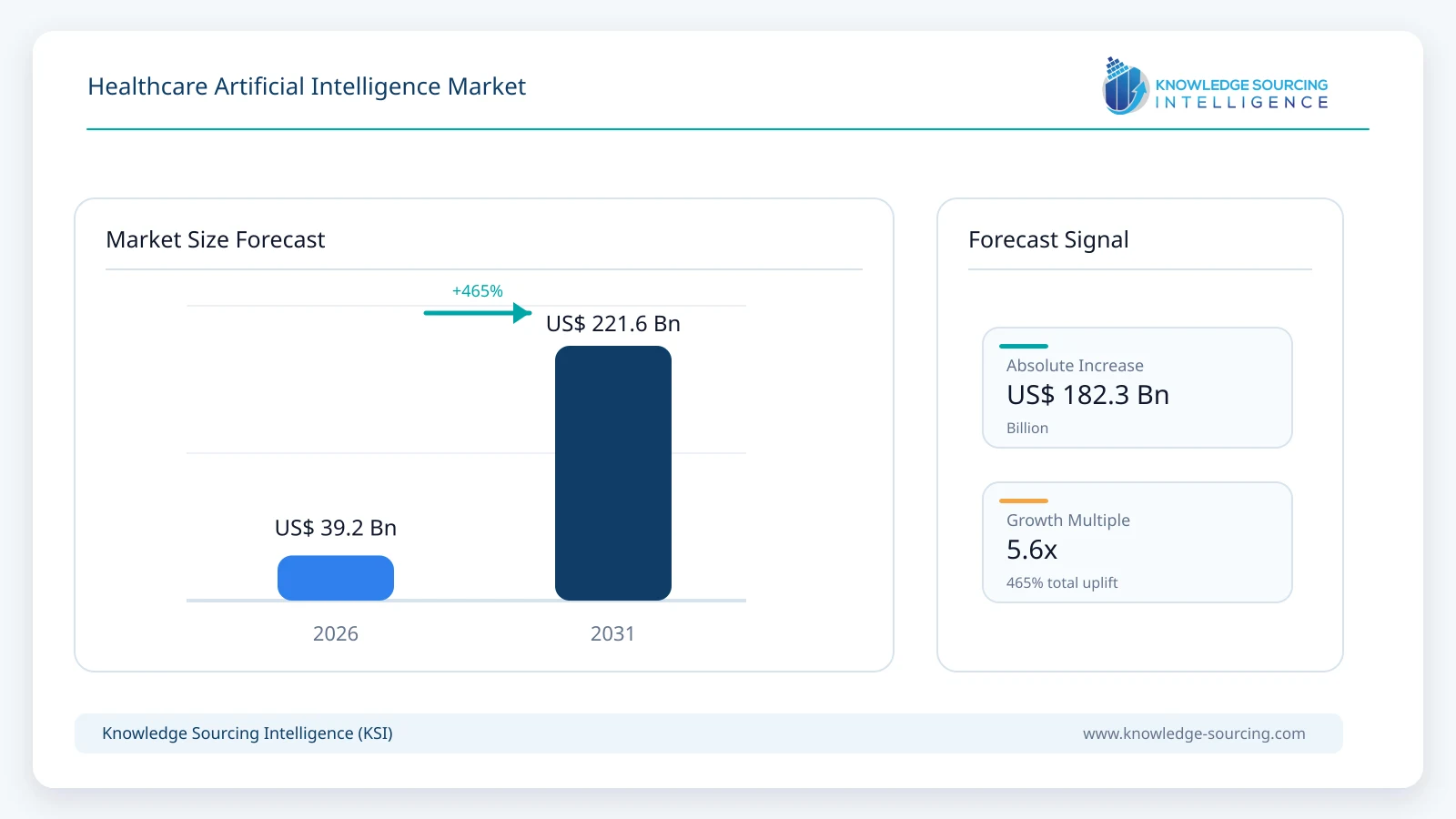
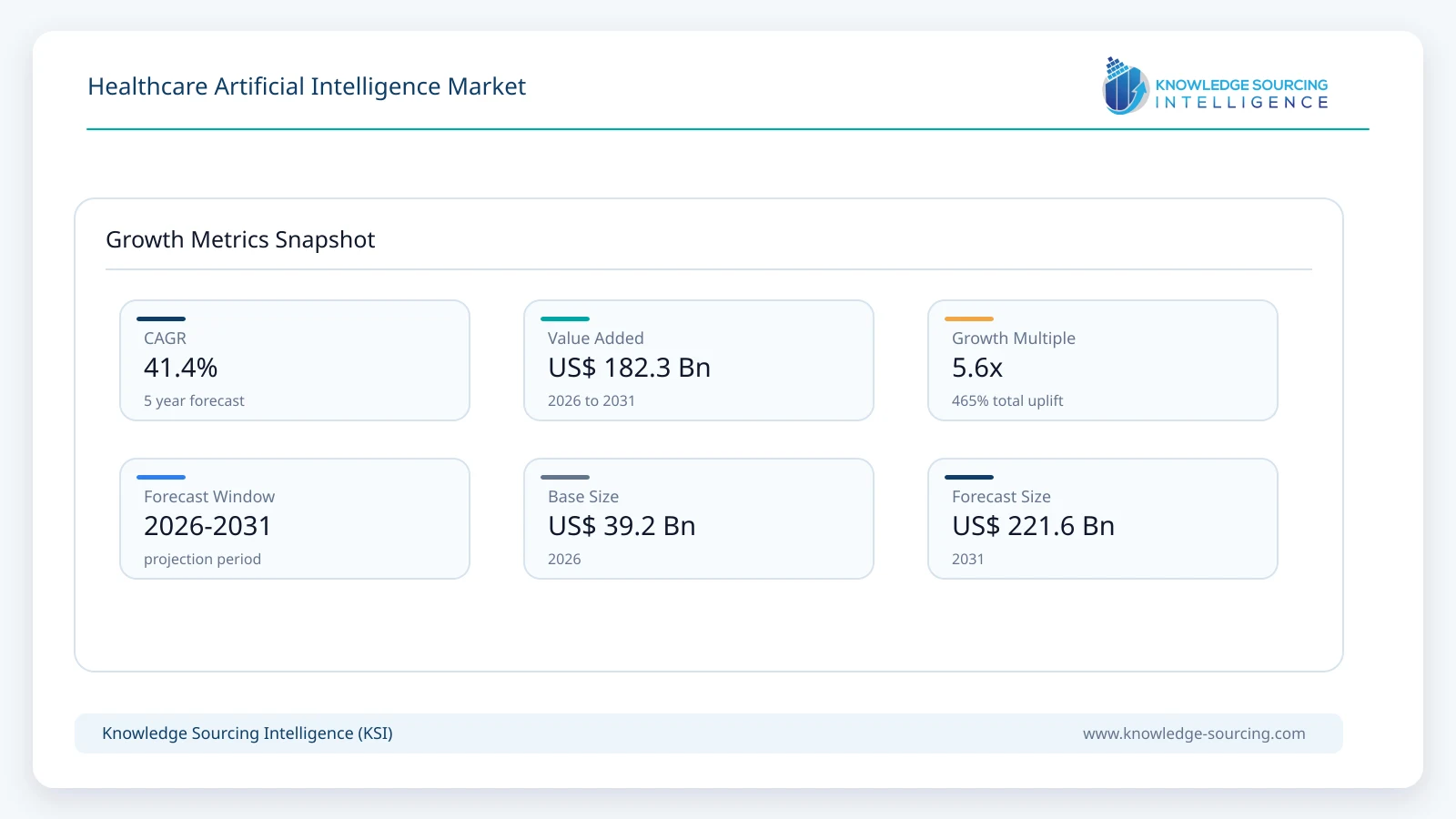
The Healthcare Artificial Intelligence Market is forecast to grow at a CAGR of 41.37%, reaching USD 221.59 billion in 2031 from USD 39.24 billion in 2026.
Highlights:
- 1Rising imaging volumes and clinician shortages continue to accelerate procurement of AI-assisted diagnostic solutions.
- 2Medical imaging and diagnostics remains the largest commercial application because of established reimbursement pathways and regulatory approvals.
- 3North America maintains the strongest commercial demand due to mature digital healthcare infrastructure and AI investment.
- 4Generative AI is expanding from administrative documentation toward clinical decision support and biomedical research.
- 5Regulatory agencies are strengthening oversight for AI-enabled medical devices while supporting responsible innovation.
- 6Competition increasingly centers on integrated healthcare ecosystems combining cloud infrastructure, AI models, and clinical workflows.
The Healthcare Artificial Intelligence (AI) market comprises software platforms, specialized hardware, and professional services that apply machine learning, deep learning, natural language processing, computer vision, and generative AI to clinical and administrative healthcare workflows. Healthcare providers, pharmaceutical companies, medical device manufacturers, diagnostic laboratories, research organizations, health insurers, and public health agencies are adopting AI to improve diagnostic accuracy, optimize resource utilization, accelerate research, and enhance patient engagement. Unlike general-purpose enterprise AI, healthcare AI solutions must operate within stringent regulatory, privacy, and clinical validation frameworks, making product reliability, interoperability, and evidence generation central purchasing criteria.
Commercial demand is supported by mounting pressure on healthcare systems to manage aging populations, rising chronic disease prevalence, workforce shortages, and increasing diagnostic workloads. Hospital procurement teams increasingly evaluate AI solutions according to measurable clinical outcomes, workflow integration with electronic health record (EHR) platforms, cybersecurity capabilities, regulatory approvals, and total cost of ownership. Buyers are moving beyond pilot deployments toward enterprise-scale implementations where solutions demonstrate sustained operational value.
Technology adoption is broadening across radiology, pathology, cardiology, oncology, genomics, drug discovery, hospital operations, and remote patient monitoring. Cloud computing and high-performance graphics processing units (GPUs) continue to lower computational barriers for model training and inference, while multimodal foundation models enable analysis across medical images, clinical notes, laboratory results, and genomic datasets. Pharmaceutical companies are also expanding AI investments to improve target identification, biomarker discovery, and clinical trial optimization.
The competitive environment combines global technology providers, healthcare equipment manufacturers, cloud platform vendors, and specialized clinical AI developers. Suppliers increasingly compete through ecosystem partnerships with health systems, research institutions, imaging vendors, and pharmaceutical companies rather than through standalone software offerings. Regulatory approvals, validated clinical evidence, interoperability with established hospital information systems, and continuous model monitoring have become major differentiators in supplier selection. Regulatory agencies, including the U.S. Food and Drug Administration (FDA), continue to refine oversight of AI-enabled medical devices while encouraging innovation supported by appropriate clinical validation.
Market Drivers
Healthcare providers continue to experience growing diagnostic workloads while facing shortages of radiologists, pathologists, nurses, and administrative staff. AI systems reduce repetitive tasks by prioritizing urgent imaging findings, automating documentation, and supporting clinical decision-making. Hospitals increasingly procure solutions demonstrating measurable reductions in reporting turnaround times and clinician workload, allowing suppliers with validated clinical evidence to secure larger enterprise contracts.
Precision medicine initiatives are expanding demand for AI-enabled analysis of genomic, imaging, and clinical datasets. Oncology centers, academic hospitals, and pharmaceutical companies require computational platforms capable of identifying biomarkers, predicting treatment response, and supporting individualized therapies. Vendors therefore invest heavily in multimodal AI architectures that combine molecular and clinical information into unified analytical workflows.
Drug discovery organizations are integrating AI into target identification, molecular design, and clinical development. Pharmaceutical companies seek shorter development timelines and improved research productivity while controlling escalating research expenditures. AI platforms capable of integrating biomedical literature, genomic information, and real-world evidence have become attractive procurement priorities for research organizations.
Cloud infrastructure investment has reduced barriers to enterprise AI deployment. Healthcare organizations increasingly favor scalable cloud environments that support secure model development, federated learning, and high-performance computing without substantial on-premises infrastructure expansion. Strategic collaborations between cloud providers and healthcare technology companies are broadening solution availability while supporting compliance requirements.
Market Restraints and Challenges
Clinical validation remains a major commercial challenge. Healthcare organizations require extensive evidence demonstrating diagnostic performance across diverse patient populations before enterprise deployment. Vendors must invest considerable resources in prospective clinical studies, post-market surveillance, and regulatory documentation, extending commercialization timelines.
Data governance presents another important constraint. Healthcare data remain fragmented across multiple hospital systems, imaging archives, laboratory platforms, and national privacy jurisdictions. Compliance with regulations governing patient privacy, cybersecurity, and cross-border data transfers increases implementation complexity and raises deployment costs.
Integration with legacy hospital information systems also affects purchasing decisions. Many healthcare providers operate heterogeneous electronic health record platforms and imaging systems developed over decades. AI vendors must provide seamless interoperability without disrupting established clinical workflows, often requiring customized implementation services that increase project costs.
Healthcare organizations also remain cautious regarding algorithm transparency and clinical accountability. Physicians require understandable recommendations supported by explainable decision pathways rather than opaque outputs. Suppliers increasingly address these concerns through explainable AI capabilities, continuous model monitoring, and clinician oversight mechanisms that preserve physician responsibility for final clinical decisions.
Major Segment Analysis
Medical Imaging and Diagnostics represents the most commercially established application within the Healthcare Artificial Intelligence market. Radiology departments face sustained increases in imaging volumes while specialist workforce growth remains comparatively limited. AI addresses this imbalance by automating image prioritization, identifying suspected abnormalities, supporting quantitative measurements, and assisting structured reporting.
Hospital procurement decisions emphasize demonstrated improvements in workflow efficiency rather than replacement of clinical expertise. Buyers prefer AI platforms integrated directly into picture archiving and communication systems (PACS), radiology information systems, and electronic health records. Regulatory clearances, peer-reviewed validation studies, and compatibility with existing imaging equipment strongly influence purchasing decisions.
Competition within this segment increasingly depends upon expanding clinical indication coverage instead of providing isolated diagnostic algorithms. Vendors offering comprehensive imaging portfolios spanning neurology, cardiology, oncology, pulmonary disease, and emergency medicine gain stronger enterprise adoption because healthcare systems prefer consolidated procurement and simplified platform management. As reimbursement mechanisms mature and regulatory approvals expand, imaging applications continue generating a substantial share of commercial AI revenues.
Regional Analysis
North America remains the largest regional market owing to advanced healthcare digitization, extensive cloud infrastructure, favorable venture capital investment, and widespread deployment of electronic health records. Large integrated delivery networks increasingly invest in enterprise AI platforms supporting diagnostics, revenue cycle management, and clinical documentation. FDA regulatory pathways for AI-enabled medical devices continue providing greater clarity for commercial deployment.
Europe demonstrates steady adoption supported by digital health strategies, academic research collaboration, and increasing investment in precision medicine. Healthcare providers emphasize compliance with privacy legislation and ethical AI deployment, encouraging suppliers to strengthen governance, transparency, and cybersecurity capabilities. Public procurement processes generally prioritize long-term clinical evidence and interoperability.
Asia Pacific represents the fastest-expanding opportunity due to healthcare infrastructure modernization, growing diagnostic demand, government-supported AI initiatives, and expanding pharmaceutical research capacity. China, Japan, South Korea, India, and Singapore continue investing in medical AI research, digital hospitals, and national innovation programs. Large patient populations also provide valuable clinical datasets supporting algorithm development, although regulatory requirements differ substantially across countries.
Middle East & Africa and South America are gradually expanding adoption through investments in digital health infrastructure, telemedicine, and hospital modernization. Gulf countries continue supporting national AI strategies alongside healthcare transformation programs, while Brazil leads adoption within South America through large hospital networks and growing digital health investments. Budget limitations, workforce availability, and infrastructure disparities continue influencing implementation pace across several emerging markets.
Competitive Landscape
Competition combines global cloud providers, semiconductor companies, healthcare equipment manufacturers, enterprise software providers, and specialized clinical AI developers. NVIDIA Corporation, Microsoft Corporation, Alphabet Inc., Amazon Web Services, Oracle Corporation, GE HealthCare Technologies, Siemens Healthineers, Koninklijke Philips, Tempus AI, and Aidoc Medical compete by integrating computing infrastructure, clinical software, imaging systems, and data platforms into comprehensive healthcare ecosystems.
Product differentiation increasingly depends upon regulatory approvals, clinical validation, scalability, cybersecurity, interoperability, and ecosystem partnerships rather than algorithm performance alone. Strategic collaborations between cloud providers, healthcare systems, pharmaceutical companies, and imaging equipment manufacturers continue expanding solution portfolios. Geographic expansion focuses on regions strengthening digital healthcare infrastructure while maintaining compliance with national regulatory requirements.
Recent Developments
June 2026: Aidoc received FDA Breakthrough Device Designation for its AI technology that drafts radiology reports, supporting accelerated regulatory review and broader clinical deployment opportunities.
June 2026: RVO Health launched Healthline AI, a clinically guided conversational AI agent providing medically reviewed health information, triage support, and evidence-based recommendations with built-in clinical guardrails and privacy protections for consumers.
February 2026: India's Ministry of Health and Family Welfare, together with the National Health Authority and IIT Kanpur, launched SAHI (Strategy for Artificial Intelligence in Healthcare for India) and BODH, a national AI benchmarking platform for evaluating healthcare AI models using anonymized real-world datasets before deployment.
Regulatory and Policy Environment
Healthcare AI operates within one of the most regulated technology environments globally. In the United States, the FDA regulates AI-enabled medical devices using risk-based frameworks while continuing to refine oversight for adaptive machine learning technologies. Developers must demonstrate safety, effectiveness, software quality, cybersecurity, and post-market monitoring capabilities before commercialization.
European deployment is influenced by the Medical Device Regulation (MDR), the In Vitro Diagnostic Regulation (IVDR), the General Data Protection Regulation (GDPR), and the European Union AI Act, which introduces risk-based governance requirements for healthcare AI. These frameworks emphasize transparency, clinical evidence, data quality, human oversight, and lifecycle monitoring.
Many Asia-Pacific governments are introducing national AI strategies alongside digital health initiatives, promoting innovation while establishing guidance for privacy protection, medical software validation, and responsible AI deployment. Procurement increasingly favors suppliers demonstrating compliance across multiple regulatory jurisdictions.
Outlook and Strategic Implications
Commercial investment over the next five years will increasingly prioritize enterprise AI platforms capable of supporting multiple clinical and operational functions from a common infrastructure. Healthcare organizations are expected to favor scalable procurement models combining cloud services, foundation models, workflow automation, cybersecurity, and continuous regulatory compliance.
Procurement decisions will increasingly emphasize measurable return on investment through productivity gains, diagnostic accuracy improvements, reduced administrative burden, and stronger clinical outcomes. Vendors capable of demonstrating validated evidence across diverse healthcare environments will be better positioned to secure long-term enterprise agreements.
Competition is expected to shift toward integrated ecosystems combining advanced computing infrastructure, multimodal foundation models, healthcare-specific datasets, and seamless interoperability with existing clinical systems. Strategic partnerships among technology providers, healthcare organizations, pharmaceutical companies, and research institutions will remain central to commercial expansion. Organizations that balance innovation with regulatory compliance, clinical evidence generation, and responsible AI governance are likely to strengthen their competitive position as healthcare AI adoption continues to mature.
Healthcare Artificial Intelligence Market Scope
| Report Metric | Details |
|---|---|
| Total Market Size in 2026 | USD 39.24 billion |
| Total Market Size in 2031 | USD 221.59 billion |
| Forecast Unit | Billion |
| Growth Rate | 41.37% |
| Study Period | 2021 to 2031 |
| Historical Data | 2021 to 2024 |
| Base Year | 2025 |
| Forecast Period | 2026 – 2031 |
| Segmentation | Application, Offering, Geography |
| Companies |
|
Market Segmentation
By Application
- Medical Imaging and Diagnostics
- Precision Medicine
- Virtual Health Assistants
- Remote Patient Monitoring
- Clinical Decision Support
- Drug Discovery and Development
- Hospital Workflow and Administrative Management
- Clinical Research
By Offering
- Hardware
- Software
- Services
By Geography
- North America
- United States
- Canada
- Mexico
- South America
- Brazil
- Argentina
- Others
- Europe
- United Kingdom
- Germany
- France
- Others
- Middle East and Africa
- Saudi Arabia
- United Arab Emirates
- Others
- Asia Pacific
- China
- Japan
- India
- South Korea
- Taiwan
- Thailand
- Indonesia
- Others
Table of Contents
1. INTRODUCTION
1.1. Market Overview
1.2. Market Definition
1.3. Scope of the Study
1.4. Market Segmentation
1.5. Currency
1.6. Assumptions
1.7. Base and Forecast Years Timeline
1.8. Key Benefits to the Stakeholder
2. RESEARCH METHODOLOGY
2.1. Research Design
2.2. Research Processes
3. EXECUTIVE SUMMARY
3.1. Key Findings
3.2. CXO Perspective
4. MARKET DYNAMICS
4.1. Market Drivers
4.2. Market Restraints
4.3. Porter’s Five Forces Analysis
4.3.1. Bargaining Power of Suppliers
4.3.2. Bargaining Power of Buyers
4.3.3. Threat of New Entrants
4.3.4. Threat of Substitutes
4.3.5. Competitive Rivalry in the Industry
4.4. Industry Value Chain Analysis
4.5. Analyst View
5. HEALTHCARE ARTIFICIAL INTELLIGENCE MARKET BY APPLICATION
5.1. Introduction
5.2. Medical Imaging and Diagnostics
5.3. Precision Medicine
5.4. Virtual Health Assistants
5.5. Remote Patient Monitoring
5.6. Clinical Decision Support
5.7. Drug Discovery and Development
5.8. Hospital Workflow and Administrative Management
5.9. Clinical Research
6. HEALTHCARE ARTIFICIAL INTELLIGENCE MARKET BY OFFERING
6.1. Introduction
6.2. Hardware
6.3. Software
6.4. Services
7. HEALTHCARE ARTIFICIAL INTELLIGENCE MARKET BY GEOGRAPHY
7.1. Introduction
7.2. North America
7.2.1. By Application
7.2.2. By Offering
7.2.3. By Country
7.2.3.1. United States
7.2.3.2. Canada
7.2.3.3. Mexico
7.3. South America
7.3.1. By Application
7.3.2. By Offering
7.3.3. By Country
7.3.3.1. Brazil
7.3.3.2. Argentina
7.3.3.3. Others
7.4. Europe
7.4.1. By Application
7.4.2. By Offering
7.4.3. By Country
7.4.3.1. United Kingdom
7.4.3.2. Germany
7.4.3.3. France
7.4.3.4. Others
7.5. Middle East and Africa
7.5.1. By Application
7.5.2. By Offering
7.5.3. By Country
7.5.3.1. Saudi Arabia
7.5.3.2. United Arab Emirates
7.5.3.3. Others
7.6. Asia Pacific
7.6.1. By Application
7.6.2. By Offering
7.6.3. By Country
7.6.3.1. China
7.6.3.2. Japan
7.6.3.3. India
7.6.3.4. South Korea
7.6.3.5. Taiwan
7.6.3.6. Thailand
7.6.3.7. Indonesia
7.6.3.8. Others
8. COMPETITIVE ENVIRONMENT AND ANALYSIS
8.1. Major Players and Strategy Analysis
8.2. Market Share Analysis
8.3. Mergers, Acquisitions, Agreements, and Collaborations
8.4. Competitive Dashboard
9. COMPANY PROFILES
9.1. NVIDIA Corporation
9.2. Microsoft Corporation
9.3. Alphabet Inc.
9.4. Amazon Web Services, Inc.
9.5. Oracle Corporation
9.6. GE HealthCare Technologies Inc.
9.7. Siemens Healthineers AG
9.8. Koninklijke Philips N.V.
9.9. Tempus AI, Inc.
9.10. Aidoc Medical Ltd.
Navigate
Trusted by the world's leading organizations











