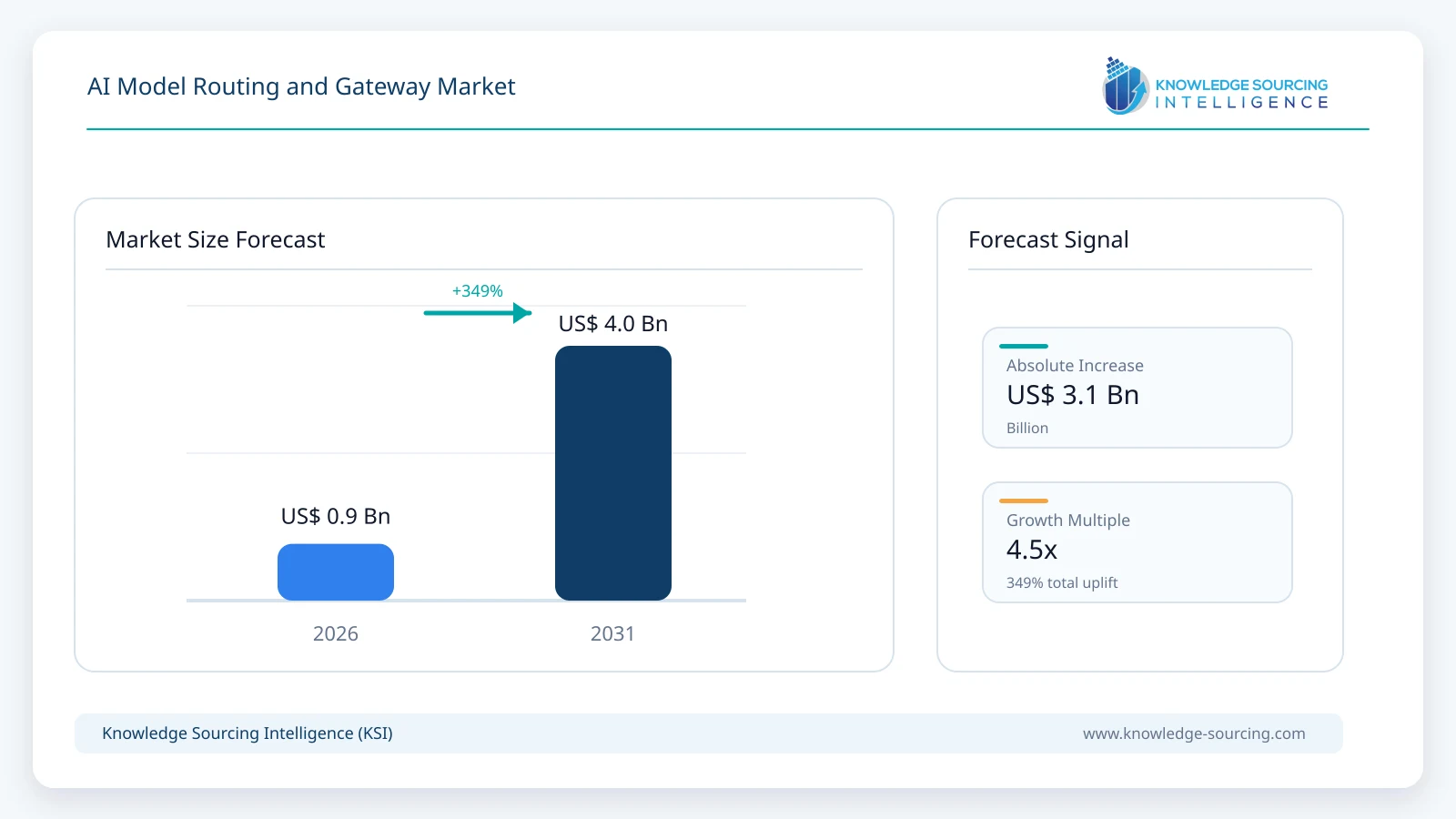
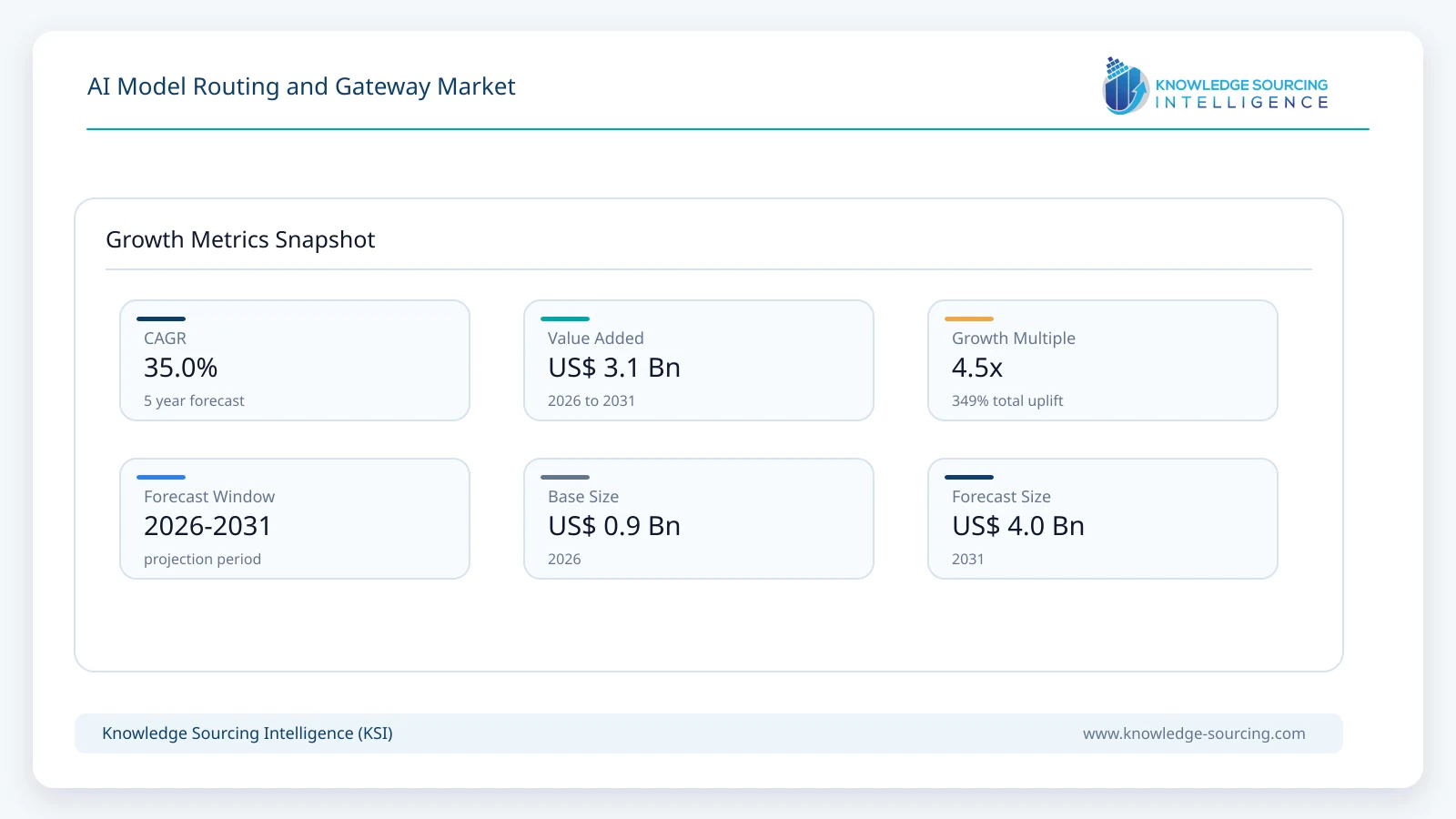
The AI Model Routing and Gateway Market is projected to grow from USD 0.88 billion in 2026 to USD 3.95 billion by 2031, at a CAGR of 35.03% during the forecast period.
Highlights:
- 1Cloud-managed gateways represent approximately 45% of global revenue in 2026 and are projected to reach 52% in 2031.
- 2Quality-, cost- and task-aware routing accounts for approximately 31% of market value in 2026 and is expected to reach 49% in 2031.
- 3Technology and SaaS organizations constitute the leading end-user industry, with an estimated 35% of market revenue in 2026.
- 4North America leads with an estimated 39% global share in 2026, supported by high enterprise API adoption and major platform suppliers.
- 5Asia Pacific is projected to increase its global share from 22% in 2026 to 28% in 2031 as enterprise AI operations expand.
AI model routing and gateway services provide a common connection between applications and the language models they use. They support provider abstraction, API translation, request-level policy enforcement, fallback selection, cost controls and usage measurement. Enterprises can therefore adjust model suppliers and operating policies without rewriting every application integration.
The market includes independently supplied AI gateways, commercial enterprise tiers of open-source proxies and identifiable routing or gateway functionality sold within broader cloud and API platforms. AWS Bedrock, Microsoft Foundry, Google Cloud, Kong, Cloudflare and specialist vendors show how diverse the commercial delivery models have become. Customers evaluate the gateway not only as a networking component but as a way to make AI application operation consistent across teams.
AI model gateways sit between calling applications and model providers, translating requests into common formats while applying routing, authentication and cost policies. A gateway may route requests to different model vendors, versions or regional endpoints. More sophisticated systems estimate the complexity of a prompt and choose a model that can meet an agreed quality requirement at an appropriate cost.
Cloud providers increasingly incorporate routing into managed model platforms. Amazon Bedrock Intelligent Prompt Routing predicts response quality between supported models in a family, and Microsoft Foundry offers Balanced, Cost and Quality modes. Google Cloud introduced managed model routing in API Gateway during August 2026. These offerings lower the deployment burden for customers already using cloud AI services, although buyers may need more independent provider choice than a single platform allows.
Independent gateways compete through cross-provider reach and deployment flexibility. LiteLLM provides a self-hosted open-source proxy with an enterprise tier, while Kong applies enterprise API policies to AI model traffic. Cloudflare combines AI Gateway analytics, dynamic routes and model-selection functions with its developer platform. Supplier differentiation increasingly depends on measured reliability, routing intelligence, policy integration and practical implementation support rather than on basic endpoint forwarding alone.
Market Trends
Adaptive Routing Is Moving Beyond Static Provider Rules
Model gateways increasingly evaluate the request before selecting the model, rather than sending every prompt to a fixed endpoint. Microsoft Foundry offers Balanced, Cost and Quality routing modes, while AWS Bedrock predicts response quality between eligible models in the same family. Cloudflare Auto Router checks format compatibility, spend limits and provider health before ranking models. Together these product capabilities shift part of model selection from application code to a centrally managed service.
Enterprises can reduce the frequency of application changes when newer models arrive, provided the gateway is tested against task-specific quality targets. The commercial benefit is strongest for repeated, high-volume work such as classification, retrieval answers and support interactions. Quality-sensitive workloads still require policy exceptions, traceability and direct model access.
Centralized AI Control Is Becoming a Procurement Requirement
Security and platform teams increasingly require one place to issue model credentials, set budgets and preserve request records. Kong AI Gateway provides policy enforcement and provider routing, while Palo Alto Networks integrated Portkey technology into Prisma AIRS AI Gateway. These offerings make routing part of a broader enterprise control point covering access, inspection, usage visibility and policy.
This consolidation can favor established API management and cybersecurity vendors during enterprise procurement, even when specialist gateways are faster to deploy. The purchasing decision increasingly depends on whether an AI gateway integrates with existing identity, logging, incident response and financial management systems.
Usage-Based and Open-Source Models Are Changing Monetization
Cloudflare currently provides core AI Gateway features without a separate software fee, and LiteLLM makes its open-source gateway available for self-hosting with a commercial enterprise tier. Conversely, Amazon Bedrock identifies a distinct USD 1 per 1,000 requests charge for Intelligent Prompt Routing. Buyers can therefore compare zero-license deployments, bundled cloud functionality and metered optimization services against one another.
Providers with free entry products increasingly have to earn enterprise spending through governance, support, dedicated hosting, routing intelligence or stronger operating guarantees. This competitive structure supports adoption but keeps effective gateway revenue well below the gross value of tokens flowing through model platforms.
Routing Resilience Is Moving Into Production AI Operations
Production applications need model gateways that recognize rate limits, backend failures and unstable latency before user-facing requests fail. Databricks Unity Gateway supports traffic splitting and ordered fallback destinations, and OpenRouter markets routing based on provider errors and response times. Operational teams can shift traffic without changing every consuming application.
The economics become material when a customer support bot, agent service or embedded copilot has a strict availability target. However, switching models can alter answer quality, tool-call behavior and context handling, so engineering teams require evaluations, session controls and observability alongside the failover mechanism.
Regional Control and Private Endpoints Are Expanding
Regulated model traffic may need to remain within an approved cloud region or pass only through providers meeting defined privacy requirements. Microsoft Foundry documents policy-aware routing boundaries, and OpenRouter expanded enterprise private endpoints in October 2026. Google Cloud introduced managed API Gateway model routing in August 2026, adding another native deployment choice.
Financial institutions, public sector buyers and multinational enterprises will favor gateways that combine provider choice with enforceable regional restrictions. Asia Pacific adoption is supported by expanding enterprise API use and local cloud deployments, although data residency requirements can lead customers to prefer hybrid or self-hosted gateways.
AI Model Routing and Gateway Market Segment Analysis
By Deployment Environment
Cloud-managed
Cloud-managed AI gateways account for approximately 45% of 2026 market revenue because managed control planes remove much of the operational work associated with running high-availability proxies. AWS, Microsoft, Google Cloud and Cloudflare connect routing services to their own identity, billing and infrastructure systems, reducing the integration burden for customers already operating in their ecosystems.
Cloud-managed gateway revenue is projected to reach approximately USD 2.054 billion in 2031, equivalent to 52% of the market. Expansion is driven by centrally deployed AI applications, usage-based purchasing and providers introducing more selective model routing. Large customers will nevertheless retain hybrid options where privacy controls and existing on-premises model investments affect procurement.
By Primary Purchased Capability
Unified Model Access and Proxy
Unified model access and proxy platforms represent the largest primary purchase category, with revenue projected to reach approximately USD 1.659 billion by 2031, because developers need consistent API formats, key management and endpoint substitution across a growing list of models. OpenRouter and LiteLLM address that integration need through standardized interfaces, while Kong and Databricks add enterprise-scale policy control around the model service endpoint.
Intelligent model selection should take a larger share of spending through 2031 as customers move from simple provider abstraction to workload-aware decisions on cost, quality and latency. Providers that can demonstrate reliable routing outcomes and measurable savings will have stronger opportunities to charge beyond the core proxy function.
By Routing Method
Quality-, Cost- and Task-Aware Routing
Quality-, cost- and task-aware routing represents approximately 31% of market value in 2026 and is projected to reach USD 1.936 billion by 2031, equivalent to about 49% of global revenue. These systems evaluate prompt class, service targets, price, quality or historical performance before forwarding the request. Cloudflare Auto Router and Microsoft Foundry Model Router illustrate the transition from fixed model names to model-selection policies.
Customers do not buy optimization solely because it is technically sophisticated. They need evidence that routing reduces spending without increasing errors, latency or compliance risk. The growth outlook therefore favors tested decision engines with model evaluation, audit trails and override rules rather than opaque routing scores.
By End-User Industry
Technology and SaaS
Technology companies and SaaS providers are projected to account for approximately USD 1.304 billion in gateway spending by 2031, building on their leading 35% market share in 2026 as AI capabilities are embedded directly into customer-facing products. These firms face high volumes of API requests, frequent model substitutions and cost exposure that changes with token consumption and traffic peaks. An independent gateway can also keep applications portable across model providers.
BFSI, healthcare and other regulated buyers will account for a growing part of incremental purchases as enterprise AI adoption spreads. Their contracts often involve centralized identity controls, request inspection and regional endpoint selection, making governance and deployment flexibility as important as basic request routing.
Market Drivers
Growth of Enterprise Model API Traffic
Organizations are embedding language models into support, search, document processing and software development, increasing the number of inference calls routed through shared infrastructure. OpenAI reported in December 2025 that API reasoning-token consumption per organization had increased sharply during the year, indicating greater intensity of enterprise use rather than just more experimental users.
More recurring traffic increases the return on a gateway that centralizes service management and optimizes model selection. The largest opportunity comes from production applications where a small per-request saving or a modest reduction in failed calls can justify recurring gateway fees.
Need to Control Inference Cost and Quality
Model price gaps are widening across fast, compact systems and larger reasoning models, giving enterprises an incentive to direct simpler work toward cheaper capacity. AWS prices Intelligent Prompt Routing separately, and Microsoft Foundry offers cost-focused routing alongside quality and balanced settings.
Cost-based routing becomes commercially useful only when measured against accepted answer quality and operational latency. Procurement teams increasingly ask for traceable decisions, comparative evaluations and controls that prevent optimization from routing sensitive or complex tasks to unsuitable models.
Demand for High Availability Across Providers
Production AI systems face provider rate limits, model maintenance and unpredictable burst traffic, especially when multiple applications share credentials or billing accounts. Gateways with weighted traffic splitting, health checks and ordered fallbacks reduce dependence on one service endpoint.
Databricks and OpenRouter demonstrate how traffic policies can sit outside the application, simplifying operations during incidents. Enterprises running revenue-linked assistants and agentic services are more willing to pay for this reliability than teams using non-critical internal experiments.
Enterprise AI Governance and Auditability
Security teams need centralized records of which models received requests, which user or workload submitted them and whether data-handling policies were enforced. Palo Alto Networks, Kong and Databricks now position AI gateway capabilities inside wider security, API and data governance offerings.
The combination of routing with policy enforcement can strengthen enterprise contract values, particularly for large organizations managing multiple development teams. Integrated authorization and spend ceilings also reduce the risk of individual applications operating with uncontrolled provider credentials.
Expansion of Multi-Model and Agentic Architectures
Agentic applications and coding tools can generate repeated model requests across planning, retrieval, coding and review stages, each with different latency and quality requirements. A centralized model gateway makes it possible to use different model classes within the same workflow while preserving common budgets and endpoint policies.
Growth in multimodal input formats and private model endpoints adds further pressure for consistent traffic handling. This supports demand for gateways that understand tool calls, streaming sessions and modality compatibility rather than treating every AI request like a conventional REST API call.
Market Restraints
Free Gateways and Bundled Cloud Functions Compress Pricing
Open-source LiteLLM installations, free Cloudflare gateway features and embedded hyperscaler capabilities place a ceiling on what enterprises will pay for basic request forwarding. A supplier selling only key abstraction, retry rules or simple load balancing can be displaced by built-in alternatives.
Paid vendors must demonstrate better controls, support, deployment options or measurable optimization outcomes. A larger share of traffic using gateways does not automatically translate into an equal increase in separately recognized gateway revenue.
Cross-Model Output Variability Limits Automatic Switching
Different language models can interpret instructions, tool schemas and long context differently, so routing to a cheaper or more available endpoint may change the final answer. Enterprises using structured extraction, code execution or regulated workflows need repeatable behavior and detailed evaluation before relying on autonomous model selection.
Gateway providers must invest in testing, policy exceptions and explainability. These controls slow adoption where contractual or safety requirements favor a fixed approved model over a more flexible routing pool.
Privacy and Data Residency Constraints Restrict Provider Choice
Model traffic may contain customer records, source code or confidential prompts that cannot pass through an unapproved provider or region. Organizations therefore need clear rules about data retention, logging, endpoint geography and the treatment of failed requests.
Regional and private deployments can solve some of these requirements, but they add operating expense and reduce the number of models available to the router. Security approval may take longer than basic technical integration.
Operational Complexity and Added Request Latency
A gateway introduces another service on the critical path between an application and the inference provider. Routing classification, logging, payload conversion and additional retries can increase first-token latency or create a shared failure point if capacity is not engineered properly.
Enterprises must size the gateway for peak token streams and long-lived connections, then monitor response paths during incidents. Teams with limited platform engineering resources may prefer a native cloud endpoint rather than operate a sophisticated independent proxy.
Provider API Changes and Multimodal Compatibility
Foundation-model providers add features such as structured outputs, tool calling and new audio or image formats on different timelines. Gateways have to translate these interfaces without silently dropping parameters or changing model behavior.
Compatibility work creates continuous development expense, particularly for independent vendors supporting many upstream APIs. It can also delay customer upgrades when a gateway lacks the newest model feature, encouraging direct access for specialized workloads.
Regional Outlook
North America
North America is estimated to represent approximately 39% of the AI Model Routing and Gateway Market in 2026, supported by the concentration of cloud platforms, AI software providers and large enterprise API buyers in the United States. AWS, Microsoft, Google, Cloudflare, Kong and other suppliers all serve customers requiring provider choice, rate controls and reliable access to inference services. Procurement increasingly involves security and platform teams rather than only application developers.
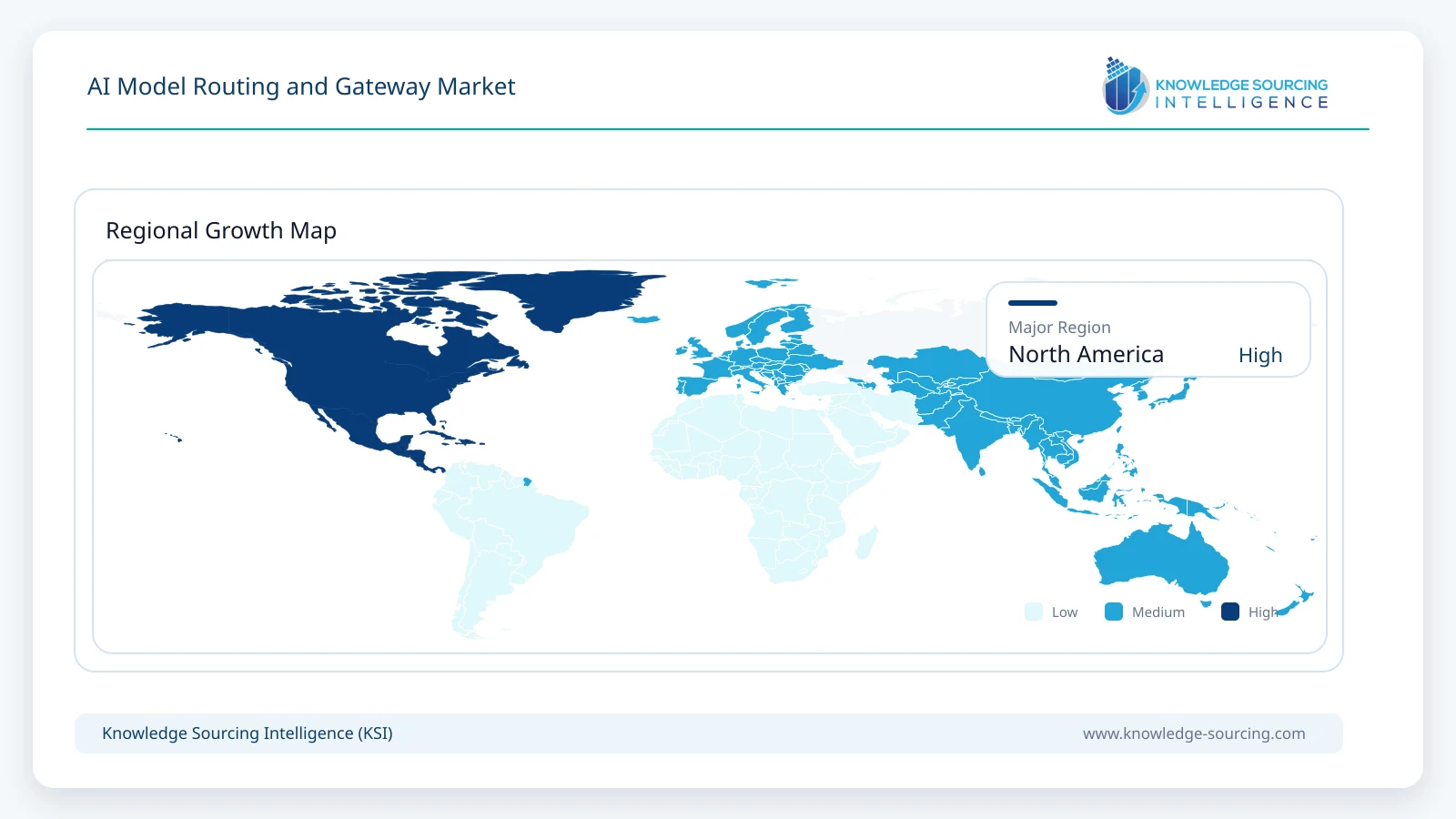
North American gateway revenue is projected to reach approximately USD 1.383 billion by 2031, retaining the largest regional position even as its share eases with wider global AI adoption. Large U.S. technology and financial services buyers should continue purchasing managed gateways and enterprise policy layers, with Canada contributing from regulated industries and Mexico from growing digital service delivery.
Asia Pacific
Asia Pacific is positioned for the fastest expansion among the major regions as cloud-native AI applications grow across China, India, Japan, South Korea, Singapore and Australia. Buyers often operate across different model ecosystems, creating demand for consistent API access, workload-cost controls and regional endpoint policies. Multinational firms also need routing configurations that accommodate country-specific hosting requirements.
Asia Pacific gateway revenue is projected to reach approximately USD 1.106 billion by 2031, representing 28% of global spending compared with 22% in 2026. India and Southeast Asia provide additional adoption opportunities for digital services, while Japan and South Korea support enterprise deployments requiring reliability and established governance processes. Local open-source gateways and public-cloud bundles will remain important competitive alternatives.
Competitive Landscape
The competitive environment spans hyperscale cloud providers, independent AI gateways, API management vendors and cybersecurity platforms. AWS, Microsoft and Google can package routing with model hosting, identity services and existing customer contracts, improving distribution. Cloudflare brings developer-scale deployment and request analytics. Kong and Solo.io draw on API gateway infrastructure, offering routing controls for enterprises with existing networking and platform engineering teams.
Specialists such as LiteLLM provide a vendor-neutral abstraction layer that organizations can run in private environments, while OpenRouter combines model aggregation and provider selection with enterprise contract options. Palo Alto Networks uses the Prisma AIRS platform to position AI gateway functionality alongside security controls and governance. Databricks connects routing decisions with data platform identities, usage reporting and model service management.
Price competition is shaped by free or low-cost entry products and the difficulty of separating gateway charges from gross model inference bills. Enterprise contracts can still support value-added revenue through enhanced access controls, auditability, service guarantees, private deployment and routing optimization. Supplier competitiveness will increasingly depend on the quality of model selection and operational integration rather than the number of model endpoints advertised.
Recent Developments
October 2026: OpenRouter introduced enterprise Private Endpoints for routing proprietary fine-tuned models and dedicated capacity alongside public models, expanding the gateway role in hybrid inference.
October 2026: Cloudflare documented Auto Router with task classification, eligibility checks and failover, illustrating commercial movement toward intelligent selection rather than static proxy rules.
September 2026: Kong released AI Gateway 2.2, continuing independent AI traffic management and enterprise deployment support.
August 2026: OpenRouter announced an agreement to be acquired by Stripe, subject to customary closing conditions, linking model-routing infrastructure with a payments platform.
August 2026: Cloudflare announced plans to unify Workers AI and AI Gateway under a common control plane; smart routing was described as planned or under internal testing, not a completed general release.
August 2026: Google Cloud introduced model routing in API Gateway as a preview, enabling managed OpenAI-compatible forwarding to supported model services.
Market Outlook
Model gateways are expected to become a routine infrastructure component for organizations operating multiple AI applications, especially where cost, reliability and security decisions must be consistent across teams. Task-aware routing should gain share as evaluation quality improves and more models become suitable for different stages of a workload. Production agents add requirements for long-running sessions, tool-use compatibility and multi-step request governance.
Cloud-managed products will gain spending share because customers can add routing without maintaining standalone proxy fleets. Independent vendors retain opportunities in model neutrality, private deployment and advanced controls. The competitive pressure from free and bundled platforms is likely to keep basic routing inexpensive and move paid value toward enterprise governance, adaptive selection and higher service levels.
North America should remain the largest revenue region in 2031, while Asia Pacific narrows the gap through faster enterprise adoption and regional cloud development. Vendors that quantify inference savings, preserve application quality and meet location restrictions will be better positioned to convert growing model traffic into recurring commercial gateway revenue.
AI Model Routing and Gateway Market Scope:
| Report Metric | Details |
|---|---|
| Total Market Size in 2026 | USD 0.88 billion |
| Total Market Size in 2031 | USD 3.95 billion |
| Forecast Unit | USD Billion |
| Growth Rate | 35.03% |
| Study Period | 2021 to 2031 |
| Historical Data | 2021 to 2024 |
| Base Year | 2025 |
| Forecast Period | 2026 – 2031 |
| Segmentation | Deployment Environment, Primary Purchased Capability, Routing Method, End-User Industry, Revenue Model, Primary AI Workload, Customer Organization Size, Geography |
| Companies |
|
Market Segmentation
By Deployment Environment
Cloud-Managed
Self-Hosted
Hybrid
By Primary Purchased Capability
Unified Model Access and Proxy
Intelligent Model Selection and Optimization
Policy-Led AI Gateway Control
By Routing Method
Rules, Policy and Weighted Distribution
Quality-, Cost- and Task-Aware Routing
Availability and Latency-Based Fallback
By End-User Industry
Technology and SaaS
Banking, Financial Services and Insurance
Retail and E-Commerce
Healthcare and Life Sciences
Manufacturing and Industrial
Others
By Revenue Model
Subscription and Allocated Platform Fees
Usage-Based Routing and Gateway Fees
Implementation, Support and Integration
By Primary AI Workload
Conversational AI and Enterprise Assistants
Agentic Workflows and Coding Tools
Multimodal and Specialized AI Applications
By Customer Organization Size
Large Enterprises
Small and Medium Enterprises
By Geography
North America
United States
Canada
Mexico
South America
Brazil
Argentina
Chile
Rest of South America
Europe
Germany
United Kingdom
France
Netherlands
Italy
Spain
Nordic Countries
Rest of Europe
Middle East and Africa
United Arab Emirates
Saudi Arabia
Israel
South Africa
Rest of Middle East and Africa
Asia Pacific
China
India
Japan
South Korea
Australia
Singapore
Rest of Asia Pacific
Table of Contents
1. EXECUTIVE SUMMARY
1.1. Market Opportunity and Key Findings
1.2. Global Market Forecast, 2026–2031
1.3. Technology and Geographic Highlights
2. MARKET SNAPSHOT
2.1. Market Overview
2.2. Market Definition
2.3. Scope of the Study
2.4. Market Segmentation
3. BUSINESS LANDSCAPE
3.1. Market Drivers
3.1.1. Growth of Enterprise Model API Traffic
3.1.2. Need to Control Inference Cost and Quality
3.1.3. Demand for High Availability Across Providers
3.1.4. Enterprise AI Governance and Auditability
3.1.5. Expansion of Multi-Model and Agentic Architectures
3.2. Market Restraints
3.2.1. Free Gateways and Bundled Cloud Functions Compress Pricing
3.2.2. Cross-Model Output Variability Limits Automatic Switching
3.2.3. Privacy and Data Residency Constraints Restrict Provider Choice
3.2.4. Operational Complexity and Added Request Latency
3.2.5. Provider API Changes and Multimodal Compatibility
3.3. Market Opportunities
3.4. Porter’s Five Forces Analysis
3.5. Industry Value Chain Analysis
3.6. AI Security and Data Governance Policies
3.7. Pricing Architecture and Cost Optimization
3.8. Strategic Recommendations
4. TECHNOLOGICAL OUTLOOK
4.1. Unified LLM Proxy and API Translation
4.2. Static and Policy-Based Routing
4.3. Task-Aware and Quality-Aware Model Selection
4.4. Provider Health, Load Balancing and Fallback
4.5. Caching, Budget Control and FinOps
4.6. Multimodal and Agent Traffic Governance
4.7. Private Endpoints and Regional Routing
5. AI MODEL ROUTING AND GATEWAY MARKET BY DEPLOYMENT ENVIRONMENT
5.1. Introduction
5.2. Cloud-managed
5.3. Self-hosted
5.4. Hybrid
6. AI MODEL ROUTING AND GATEWAY MARKET BY PRIMARY PURCHASED CAPABILITY
6.1. Introduction
6.2. Unified model access and proxy
6.3. Intelligent model selection and optimization
6.4. Policy-led AI gateway control
7. AI MODEL ROUTING AND GATEWAY MARKET BY ROUTING METHOD
7.1. Introduction
7.2. Rules, policy and weighted distribution
7.3. Quality-, cost- and task-aware routing
7.4. Availability and latency-based fallback
8. AI MODEL ROUTING AND GATEWAY MARKET BY END-USER INDUSTRY
8.1. Introduction
8.2. Technology and SaaS
8.3. Banking, financial services and insurance
8.4. Retail and e-commerce
8.5. Healthcare and life sciences
8.6. Manufacturing and industrial
8.7. Others
9. AI MODEL ROUTING AND GATEWAY MARKET BY REVENUE MODEL
9.1. Introduction
9.2. Subscription and allocated platform fees
9.3. Usage-based routing and gateway fees
9.4. Implementation, support and integration
10. AI MODEL ROUTING AND GATEWAY MARKET BY PRIMARY AI WORKLOAD
10.1. Introduction
10.2. Conversational AI and enterprise assistants
10.3. Agentic workflows and coding tools
10.4. Multimodal and specialized AI applications
11. AI MODEL ROUTING AND GATEWAY MARKET BY CUSTOMER ORGANIZATION SIZE
11.1. Introduction
11.2. Large enterprises
11.3. Small and medium enterprises
12. AI MODEL ROUTING AND GATEWAY MARKET BY GEOGRAPHY
12.1. North America
12.1.1. United States
12.1.2. Canada
12.1.3. Mexico
12.2. South America
12.2.1. Brazil
12.2.2. Argentina
12.2.3. Chile
12.2.4. Rest of South America
12.3. Europe
12.3.1. Germany
12.3.2. United Kingdom
12.3.3. France
12.3.4. Netherlands
12.3.5. Italy
12.3.6. Spain
12.3.7. Nordic Countries
12.3.8. Rest of Europe
12.4. Middle East and Africa
12.4.1. United Arab Emirates
12.4.2. Saudi Arabia
12.4.3. Israel
12.4.4. South Africa
12.4.5. Rest of Middle East and Africa
12.5. Asia Pacific
12.5.1. China
12.5.2. India
12.5.3. Japan
12.5.4. South Korea
12.5.5. Australia
12.5.6. Singapore
12.5.7. Rest of Asia Pacific
13. COMPETITIVE ENVIRONMENT AND ANALYSIS
13.1. Major Players and Strategy Analysis
13.2. Market Share Analysis
13.3. Mergers, Acquisitions, Agreements and Collaborations
13.4. Competitive Dashboard
14. COMPANY PROFILES
14.1. Amazon Web Services, Inc.
14.2. Microsoft Corporation
14.3. Google LLC
14.4. Cloudflare, Inc.
14.5. Kong Inc.
14.6. Palo Alto Networks, Inc.
14.7. OpenRouter, Inc.
14.8. Databricks, Inc.
14.9. Berrie AI Incorporated
14.10. Solo.io, Inc.
14.11. Tyk Technologies Ltd.
14.12. Gravitee, Inc.
15. APPENDIX
15.1. Currency
15.2. Assumptions
15.3. Base and Forecast Years
15.4. Key Benefits for Stakeholders
15.5. Research Methodology
15.6. Abbreviations
Navigate
Trusted by the world's leading organizations