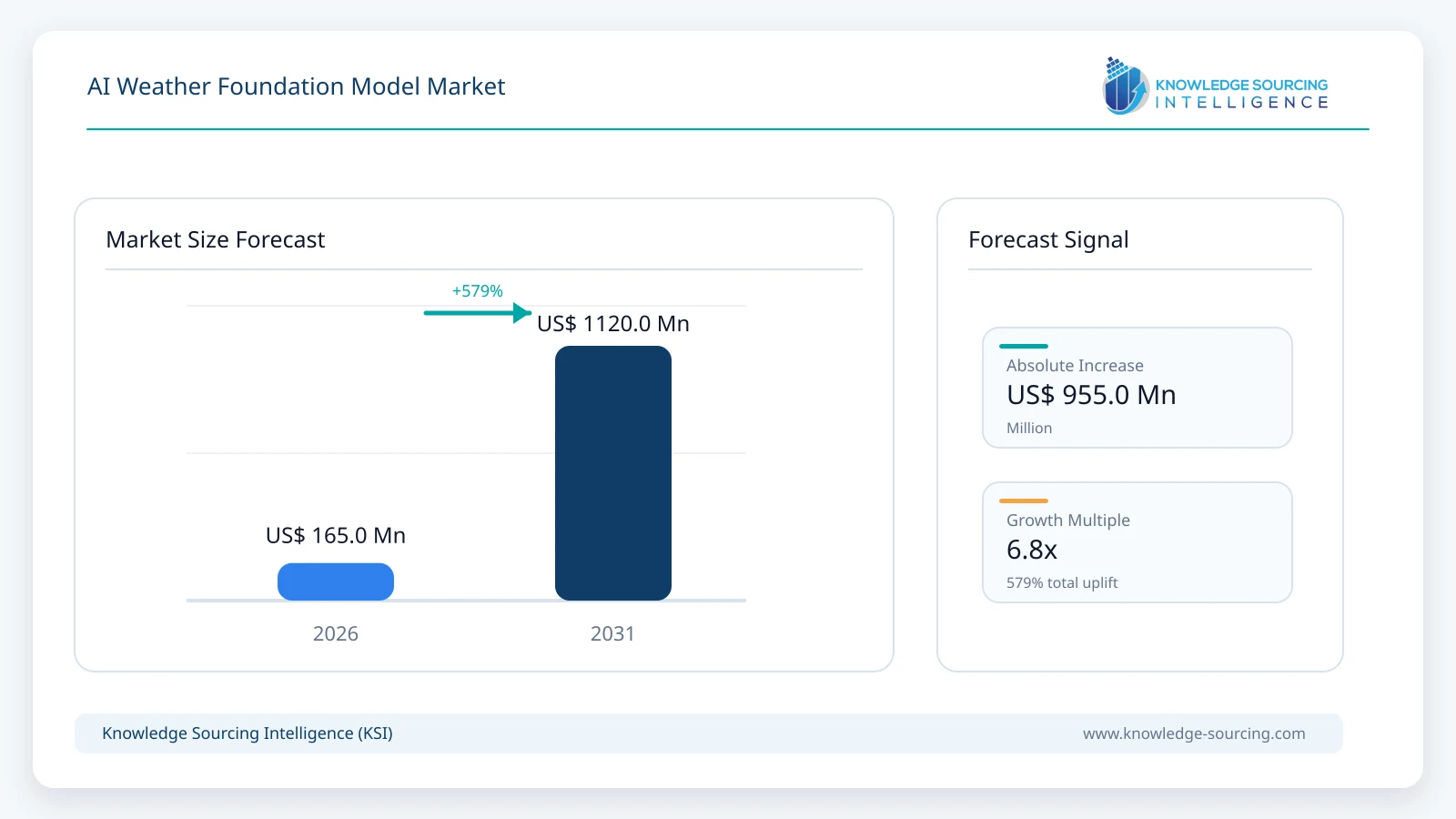
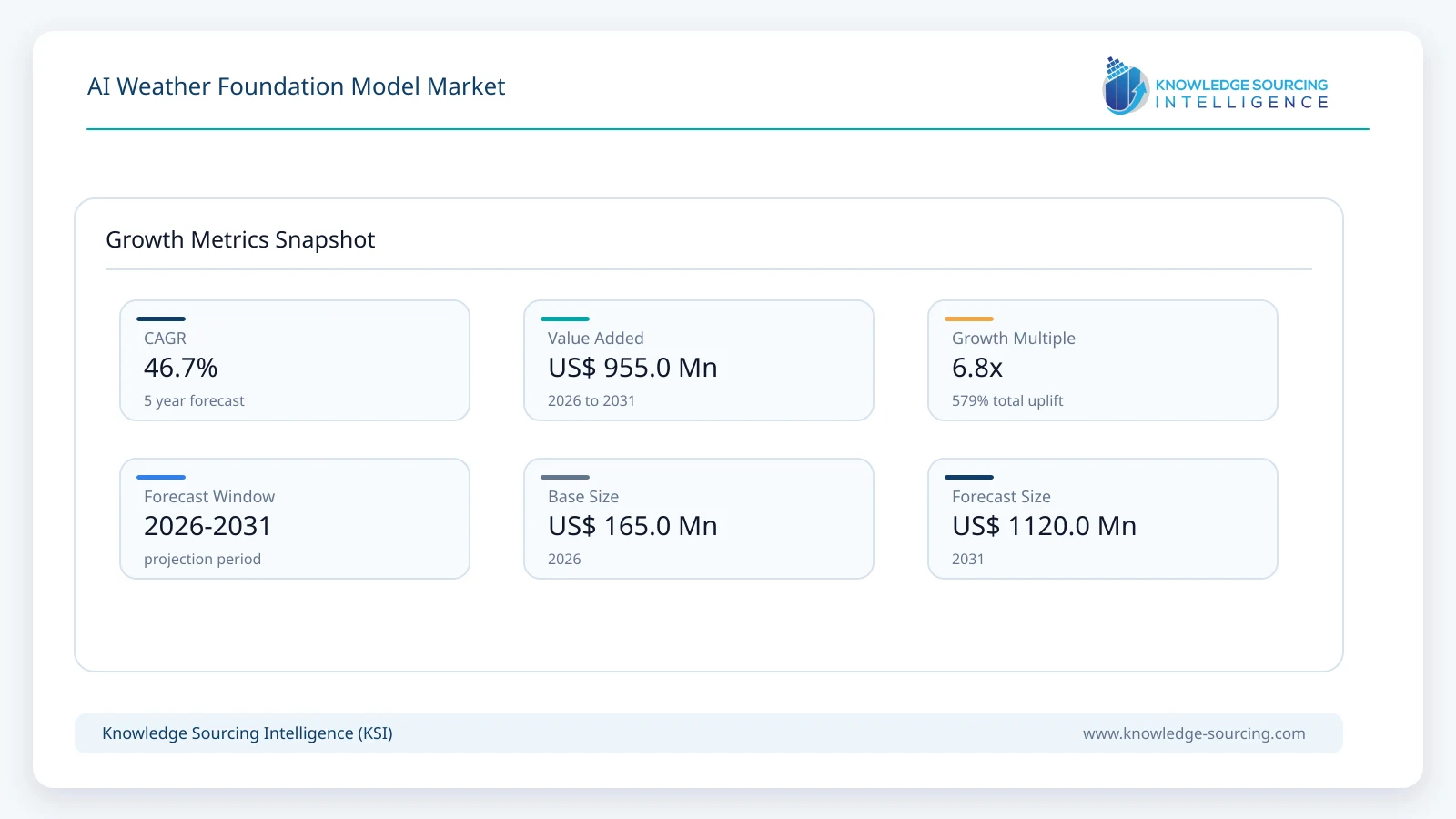
The AI Weather Foundation Model Market is forecast to grow at a CAGR of 46.7%, reaching USD 1,120 million in 2031 from approximately USD 165 million in 2026.
Highlights:
- 1Managed enterprise weather foundation-model services represent approximately 54.5% of modeled 2026 market value, reflecting the importance of reliable operational delivery and support.
- 2Forecasts with a 4-to-15-day horizon account for approximately 41.2% of 2026 market value, supporting energy planning, transport operations and medium-range risk assessment.
- 3Energy and utility applications contribute approximately 27.9% of 2026 spending as wind, solar, load and market-exposure decisions require localized weather forecasts.
- 4North America accounts for approximately 41.0% of the global market in 2026, supported by weather technology companies, cloud infrastructure and enterprise software budgets.
- 5Asia Pacific is projected to achieve the fastest regional growth through 2031, supported by expanding weather-sensitive power systems, agriculture, logistics and enterprise forecast adoption.
The market covers commercially sold foundation-model forecasting services, model API subscriptions, hosted or private model deployments, and model-specific customization and integration for weather and closely related Earth-system prediction. It includes global and regional AI forecast models, probabilistic ensembles, nowcasting, and high-resolution downscaling when the revenue can be traced to the model capability.
Weather foundation models transform learned atmospheric relationships into repeatedly updated predictions rather than depending entirely on the expensive time-stepping methods of conventional numerical weather prediction. ECMWF operates its Artificial Intelligence Forecasting System alongside physics-based models, Google provides WeatherNext outputs through cloud and product channels, and Microsoft has extended Aurora into managed weather applications. Commercial suppliers including Jua, WindBorne and Meteomatics are developing distribution and adaptation offerings that convert these capabilities into paid operational intelligence.
Market Overview
AI weather foundation models learn from long observational records, atmospheric reanalysis and forecast simulations to support multiple prediction tasks using a shared pretrained representation. A user can adapt a model for wind speed, rainfall, air quality or local weather risk without having to develop a new global system for every application. Microsoft’s Aurora, NVIDIA’s Earth-2 models and IBM’s Prithvi WxC demonstrate different approaches to this shared-model architecture, while Google’s WeatherNext and ECMWF’s AIFS show how data-driven forecasting can operate alongside established meteorological systems.
ECMWF has operated AIFS Single since February 2025 and AIFS ENS since July 2025, with both upgraded in May 2026. AIFS products are available on defined open-data terms, so operational deployment by a public weather agency does not itself imply a commercial software sale. Private providers create revenue by packaging additional resolution, guaranteed availability, domain customization, specialized observations, tailored forecast variables, APIs and integration into customer decisions.
Weather-dependent businesses increasingly demand more than a single deterministic forecast. Grid operators need probability distributions for renewable generation and outages, insurers monitor the likelihood of extreme events, and airlines require updates at operational timescales. The resulting opportunity covers probabilistic ensembles, regional downscaling, fast refresh cycles and post-processing that transforms global atmospheric information into location-specific parameters with measurable economic value.
Market Trends
Probabilistic Weather Models Are Becoming Operational Products
Google’s WeatherNext 2, introduced in November 2025, generates multiple realistic weather scenarios and is distributed through Earth Engine and BigQuery, with custom inference access introduced through Google Cloud. ECMWF’s AIFS ENS entered operations in July 2025, demonstrating that ensembles learned from data can form part of routine forecasting rather than remain solely in laboratory evaluations.
Probabilistic outputs are particularly valuable for energy trading and weather-sensitive capital allocation because the range of plausible results often matters more than the median forecast. Commercial implementation requires calibration, consistent model updates, verification records and probabilistic variables that users can translate into operating thresholds.
Downscaling and Nowcasting Are Extending Commercial Use Cases
NVIDIA’s Earth-2 portfolio includes CorrDiff downscaling, nowcasting and medium-range models, enabling more localized information from atmospheric-scale predictions. In January 2026 the company introduced additional open models including Atlas, StormScope and HealDA, covering global forecasting, short-range storms and data assimilation. These capabilities support targeted applications where local wind, rainfall intensity and heat exposure influence near-term decisions.
High-resolution outputs require more than increasing image detail. Terrain, coastal conditions, radar coverage and local observations affect forecast reliability; users must also distinguish genuinely new predictive information from interpolated global fields. Suppliers that combine verification with local observational data may capture differentiated contracts despite the availability of open model weights.
Enterprise Deployment Is Moving Beyond Research Access
Microsoft’s July 2026 Aurora 1.5 release added weather variables, hourly resolution and ensemble forecasting, with pathways into managed Microsoft weather services. The company also described an enterprise energy use case with BKW, illustrating how a foundation model can be linked to operating systems rather than used only to generate experimental benchmark plots.
Meteomatics distributes AI forecasts from models including FourCastNet, GraphCast and ECMWF AIFS through its weather API, while Jua offers its Earth Physics Transformer models and third-party forecasts in the same customer environment. Such multi-model delivery creates a commercial layer for access controls, service continuity, model selection and domain-specific post-processing, without implying ownership of every underlying model.
Frequent Observation Assimilation and Longer Horizons Are Expanding Value
WindBorne’s WeatherMesh-6 combines proprietary atmospheric observations with AI data assimilation, and its global ensemble is updated hourly. NVIDIA also reported September 2026 progress in assimilating newly observed conditions into Earth-2 weather predictions. These developments address the operating need for refreshed forecasts after rapidly changing atmospheric events.
Brightband introduced its SUBS model in September 2026 for subseasonal temperature outlooks covering weeks three and four. Longer-range forecasting may support energy scheduling, supply-chain planning and agricultural decisions, although forecast skill generally varies with region, season, variable and lead time. Reliable local validation will be essential before the strongest experimental results translate into recurring customer commitments.
Segment Analysis
By Offering: Managed Enterprise Forecast Services
Managed enterprise weather-model services combine inference, reliable hosting, operational forecast production and agreed delivery standards for users that cannot rely on intermittent research access. They represent the largest 2026 offering category and are projected to reach approximately USD 770 million by 2031. High-value customers increasingly require uptime arrangements, historical consistency, security controls, validation results and service integration rather than a model checkpoint alone.
Google Cloud and Microsoft provide enterprise pathways for proprietary and open model outputs, while Jua, WindBorne and Silurian AI focus on targeted forecasts, custom deployments or industry workflows. This delivery model benefits from repeat subscriptions and higher revenue per deployment, but open releases from public organizations and technology companies can constrain the standalone price of unmodified base forecasts.
By Model Function: Probabilistic and Ensemble Forecasting
Probabilistic and ensemble forecasting is projected to reach approximately USD 280 million in 2031, compared with USD 36 million in 2026. Risk-aware decisions in electricity markets, aviation, underwriting and disaster preparedness depend on the probabilities of threshold outcomes and the dispersion of possible weather events. ECMWF AIFS ENS, Google WeatherNext 2, Microsoft Aurora 1.5 and WindBorne WeatherMesh-6 indicate increasing attention to uncertainty representation across public and commercial models.
Commercial demand will depend on whether ensembles remain calibrated for rare events and local conditions, particularly where a false warning triggers costly action or an undetected event creates material losses. Customers may pay premiums for measured probabilistic skill, location-specific thresholds and decision tools built around the model outputs.
By Application: Energy and Utilities
Energy and utilities are projected to generate approximately USD 330 million of 2031 market revenue, compared with USD 46 million in 2026. Electricity systems with greater renewable capacity require weather forecasts for hub-height wind, solar irradiance, heating and cooling demand, and network exposure. The commercial case is strongest where more accurate predictions reduce imbalance charges, improve dispatch decisions or provide earlier warning of weather-related faults.
Jua’s Earth Physics Transformer is positioned for weather-sensitive energy applications, while Microsoft has reported enterprise work linking Aurora outputs with energy operations. Model buyers also require data lineage, historical backtests and stable forecast versions so that changes in model architecture do not disrupt trading or operational validation.
Market Drivers
Expansion of Weather-Sensitive Renewable Generation
Growing shares of solar and wind generation make meteorological uncertainty an operating and financial exposure for utilities, traders and large power consumers. Forecast-model services that produce localized probabilistic wind, irradiance and temperature estimates can improve short-term dispatch, forward planning and asset maintenance. Revenue develops where these forecasts connect directly to traded volumes, imbalance management or grid resilience workflows.
Faster Forecast Production and More Frequent Updates
Deep learning models can generate weather scenarios faster than many conventional numerical simulations once trained, enabling additional ensembles and more frequent updates. WindBorne’s hourly global runs and model-based observation assimilation illustrate the value of refreshing the starting atmospheric state. Customers in aviation, transport and emergency management benefit when a new forecast arrives early enough to change an operating decision.
Rising Demand for Local Weather Risk Information
Industrial sites, insurers and transport operators increasingly require rainfall, wind gust, heat and storm forecasts at a finer scale than global atmospheric grids. Downscaling, radar-informed nowcasting and tailored local models provide incremental value when paired with observation-based verification. This increases opportunities for specialist adaptation services and premium managed models.
Cloud Distribution and Model Accessibility
Google WeatherNext 2, Microsoft Aurora, NVIDIA Earth-2 and ECMWF AIFS are available through cloud, open-model or operational-data channels that lower the cost of evaluation. Easier access expands the number of organizations able to test weather foundation models; commercial suppliers can then sell supported inference, integration, private deployment and specialized service levels.
Broader Enterprise Use of Probabilistic Decision Support
Energy planning, insurance underwriting, logistics scheduling and agricultural operations increasingly incorporate probabilistic thresholds rather than a single forecast point. Calibrated ensembles help businesses consider costly low-frequency outcomes and quantify the likelihood of operational limits being exceeded. Model providers can earn recurring fees when these capabilities are embedded in decision platforms.
Market Restraints
Abundant Open Models and Public Forecast Data
ECMWF distributes AIFS information under open-data conditions, while NVIDIA Earth-2 and Microsoft Aurora include publicly available model components. Free access limits the value of an undifferentiated forecast feed and raises the importance of service reliability, private data, local accuracy and industry-specific workflows for commercial monetization.
Rare-Event Accuracy and Model Verification
Forecast models can perform strongly on aggregate benchmarks yet still miss local extremes, rare precipitation patterns and sharp intensity changes. Different variables and lead times require separate verification, and customers may require performance comparisons against numerical forecasting systems. Inadequate calibration can slow adoption in aviation, disaster management and other safety-critical applications.
Observation Quality and Geographic Coverage
Foundation models depend on reliable reanalysis, satellite, surface and atmospheric measurement histories. Sparse observation networks and changing sensor quality can weaken performance in certain regions. Suppliers must invest in quality control, data assimilation and domain evaluation, increasing the cost of developing credible region-specific services.
Integration and Operational Assurance Requirements
Weather intelligence often feeds established dispatch, route optimization, planning or insurance systems that expect stable schemas, documented updates and clear service responsibilities. Organizations may retain conventional forecasts in parallel until AI-model performance, retraining controls and reproducibility have been verified. This extends procurement and implementation timelines.
Attribution and Procurement Budget Constraints
Weather models are frequently distributed alongside broader data subscriptions, public products and enterprise analytics software, making the incremental fee for the AI model difficult to isolate. Cost-conscious users may choose freely accessible model outputs and perform post-processing internally. Suppliers therefore face pressure to demonstrate measurable economic gains rather than relying on the novelty of the underlying architecture.
Regional Outlook
North America
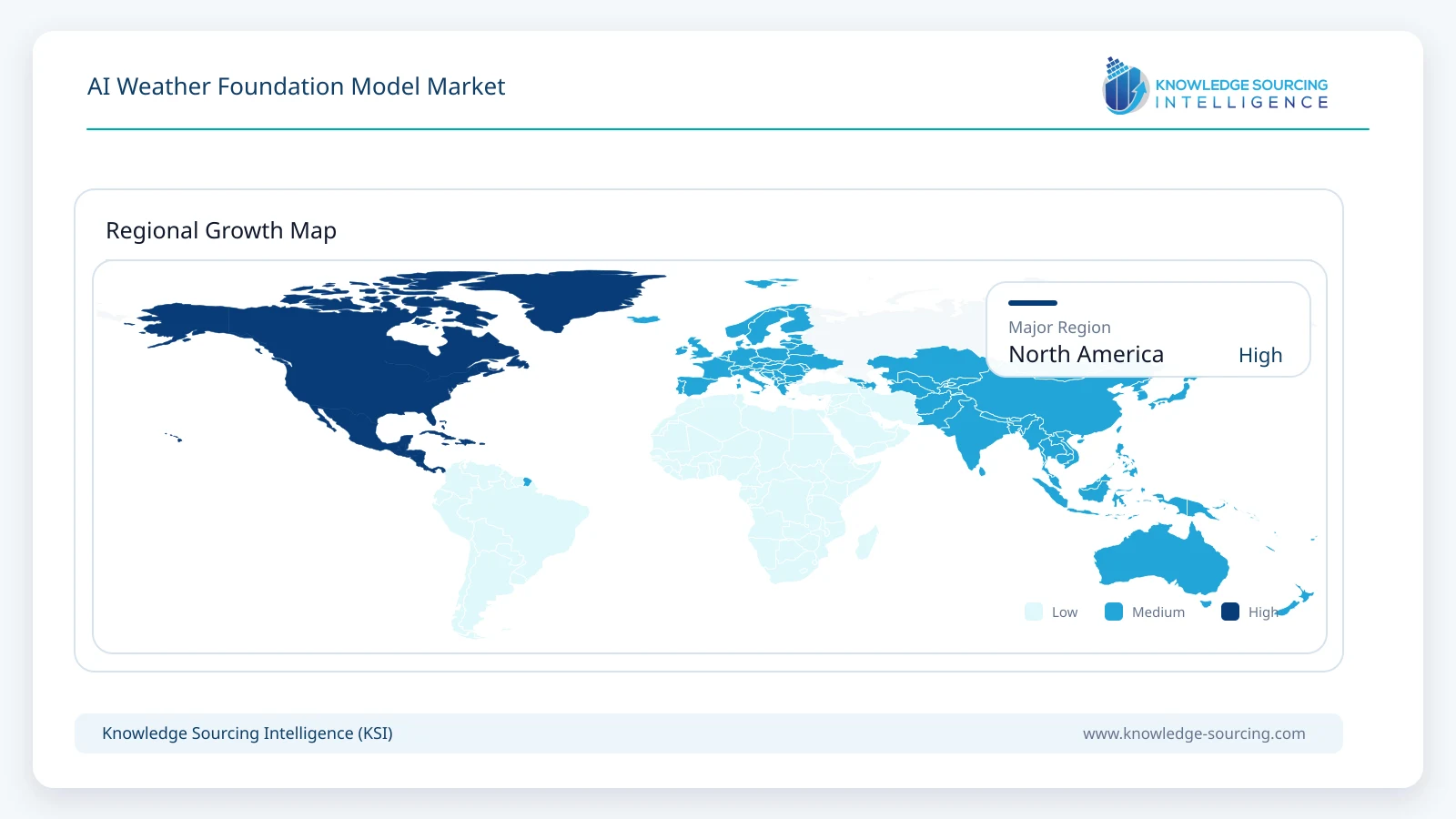
North America accounts for approximately 41% of the global AI weather foundation-model market in 2026, supported by strong hyperscale cloud capabilities, a mature commercial weather-information industry and significant demand from energy, insurance, aviation and technology customers. The United States is the principal regional market, with Canada contributing through renewable-energy forecasting, insurance risk analysis and public meteorological activity.
Regional revenue is projected to reach approximately USD 403.2 million by 2031 as proprietary observation networks, model API businesses and enterprise cloud delivery expand. Google, Microsoft, NVIDIA and WindBorne have relevant U.S.-based capabilities, while commercial value depends on adaptation and service commitments rather than counting freely available model releases as sales.
Asia Pacific
Asia Pacific is expected to record the fastest regional growth, rising from approximately USD 38.0 million in 2026 to USD 313.6 million in 2031. China, Japan, India, South Korea, Australia and Singapore have substantial exposure to monsoons, typhoons, solar and wind generation, agriculture, coastal logistics and high-density urban weather risk. Demand differs substantially by national weather-service infrastructure and access to regional observations.
AI forecast models can support localized rainfall, wind, temperature and energy-generation predictions when reliable observational inputs and regional evaluation are available. The commercial opportunity will be strongest in high-value enterprise contracts and supported model deployment, while many research and public-warning applications may continue to use freely shared model outputs and meteorological agency services.
Competitive Landscape
The competitive landscape combines hyperscale AI platforms, public operational meteorological models, weather-technology specialists and API distribution businesses. Google offers WeatherNext forecasting through cloud and product channels; Microsoft is developing Aurora-based enterprise pathways; NVIDIA publishes Earth-2 model frameworks; and IBM contributes Prithvi WxC research. ECMWF is a critical operational and open-data benchmark but should not be treated as a private software seller in competitive revenue assessments.
WindBorne and Jua differentiate through proprietary AI model development and delivery, Brightband is extending subseasonal models, and Silurian AI promotes tailored foundation-model solutions. Meteomatics distributes multiple AI and traditional forecasting sources through an integrated API, while Tomorrow.io participates through AI-enabled weather intelligence and observational infrastructure. The comparison therefore separates original model developers, supported model operators, distributors and adjacent service providers to avoid inflated supplier shares.
Recent Developments
September 2026: Brightband introduced Brightband-SUBS, a model aimed at subseasonal temperature prediction in weeks three and four, expanding the range of commercially relevant forecast horizons.
September 2026: NVIDIA presented Earth-2 observation-assimilation approaches, including HealDA and methods for incorporating new point observations into model-based weather predictions.
July 2026: Microsoft introduced Aurora 1.5 with additional weather variables, hourly forecasting and probabilistic ensembles, together with managed-service pathways for enterprise applications.
June 2026: WindBorne released WeatherMesh-6, combining its proprietary atmospheric observations with AI data assimilation and a 128-member global ensemble.
May 2026: ECMWF implemented AIFS Single v2 and AIFS ENS v2 alongside an upgrade to its conventional Integrated Forecasting System, extending operational AI forecasting capabilities.
January 2026: NVIDIA introduced a broader open Earth-2 model family, including medium-range, nowcasting and global data-assimilation models that can be adapted for weather applications.
Market Outlook
Weather foundation models are expected to expand from the research and early-commercial stage toward supported operational services as cloud providers and specialist companies improve forecast reliability, ensemble calibration and delivery frequency. Managed services and model APIs will account for much of the revenue opportunity, particularly where weather-informed decisions influence energy costs, transport disruptions, insurance losses and asset protection.
Open-model availability will continue to challenge standalone model licensing, encouraging suppliers to differentiate through unique observations, regional tuning, historical verification and customer integration. Global ensemble forecasting, radar-informed nowcasting, and specialized high-resolution output are likely to become more important as users connect atmospheric predictions to business thresholds and operating decisions.
North America is expected to retain the largest regional revenue base through 2031, while Asia Pacific gains share as renewable-energy investment, weather-sensitive industries and digital forecast procurement expand. Competition will increasingly depend on measurable forecast skill, service continuity, localized performance and the ease with which model outputs become actionable enterprise information.
AI Weather Foundation Model Market Scope
| Report Metric | Details |
|---|---|
| Total Market Size in 2026 | USD 165 million |
| Total Market Size in 2031 | USD 1,120 million |
| Forecast Unit | Million |
| Growth Rate | 46.7% |
| Study Period | 2021 to 2031 |
| Historical Data | 2021 to 2024 |
| Base Year | 2025 |
| Forecast Period | 2026 – 2031 |
| Segmentation | Offering, Model Function, Deployment Model, Application, Customer Type, Forecast Horizon, Model Architecture, Geography |
| Companies |
|
Market Segmentation
By Offering
Managed Enterprise Forecast Services
Weather Model APIs and Data Subscriptions
Model Customization and Integration Services
By Model Function
Global Deterministic Forecasting
Probabilistic and Ensemble Forecasting
High-Resolution Downscaling
Short-Range Nowcasting
Subseasonal and Multivariate Forecasting
By Deployment Model
Public Cloud and Managed APIs
Private and Hybrid Cloud
On-Premises and Sovereign Deployment
By Application
Energy and Utilities
Aviation and Transportation
Agriculture and Food Supply
Insurance and Financial Risk
Government and Disaster Management
Other Industrial Applications
By Customer Type
Commercial Enterprises
National and Public Weather Agencies
Weather and Technology Platforms
Small Businesses and Developers
By Forecast Horizon
0 to 6 Hours
6 to 72 Hours
4 to 15 Days
Beyond 15 Days
By Model Architecture
Transformer-Based Models
Graph Neural Networks
Diffusion and Other Generative Models
Hybrid and Other Architectures
By Geography
North America
United States
Canada
Mexico
South America
Brazil
Argentina
Rest of South America
Europe
Germany
United Kingdom
France
Netherlands
Italy
Spain
Rest of Europe
Middle East and Africa
United Arab Emirates
Saudi Arabia
Israel
South Africa
Rest of Middle East and Africa
Asia Pacific
China
Japan
India
South Korea
Australia
Singapore
Rest of Asia Pacific
Table of Contents
1. EXECUTIVE SUMMARY
1.1. Market Opportunity and Key Findings
1.2. AI Weather Foundation Model Market Size, 2026-2031
1.3. Technology and Regional Outlook
2. MARKET SNAPSHOT
2.1. Market Overview
2.2. Market Definition
2.3. Scope of the Study
2.4. Market Segmentation
3. BUSINESS LANDSCAPE
3.1. Market Drivers
3.1.1. Expansion of Weather-Sensitive Renewable Generation
3.1.2. Faster Forecast Production and More Frequent Updates
3.1.3. Rising Demand for Local Weather Risk Information
3.1.4. Cloud Distribution and Model Accessibility
3.1.5. Broader Enterprise Use of Probabilistic Decision Support
3.2. Market Restraints
3.2.1. Abundant Open Models and Public Forecast Data
3.2.2. Rare-Event Accuracy and Model Verification
3.2.3. Observation Quality and Geographic Coverage
3.2.4. Integration and Operational Assurance Requirements
3.2.5. Attribution and Procurement Budget Constraints
3.3. Market Opportunities
3.4. Porter’s Five Forces Analysis
3.5. Industry Value Chain Analysis
3.6. Policies and Regulations
3.7. Strategic Recommendations
4. TECHNOLOGICAL OUTLOOK
4.1. Atmospheric Foundation-Model Pretraining
4.2. Global Deterministic and Ensemble Forecasting
4.3. Data Assimilation and Observation Networks
4.4. High-Resolution Downscaling and Nowcasting
4.5. Probabilistic Calibration and Extreme-Weather Evaluation
4.6. Domain Adaptation and Model Deployment
5. AI WEATHER FOUNDATION MODEL MARKET BY OFFERING
5.1. Introduction
5.2. Managed Enterprise Forecast Services
5.3. Weather Model APIs and Data Subscriptions
5.4. Model Customization and Integration Services
6. AI WEATHER FOUNDATION MODEL MARKET BY MODEL FUNCTION
6.1. Introduction
6.2. Global Deterministic Forecasting
6.3. Probabilistic and Ensemble Forecasting
6.4. High-Resolution Downscaling
6.5. Short-Range Nowcasting
6.6. Subseasonal and Multivariate Forecasting
7. AI WEATHER FOUNDATION MODEL MARKET BY DEPLOYMENT MODEL
7.1. Introduction
7.2. Public Cloud and Managed APIs
7.3. Private and Hybrid Cloud
7.4. On-Premises and Sovereign Deployment
8. AI WEATHER FOUNDATION MODEL MARKET BY APPLICATION
8.1. Introduction
8.2. Energy and Utilities
8.3. Aviation and Transportation
8.4. Agriculture and Food Supply
8.5. Insurance and Financial Risk
8.6. Government and Disaster Management
8.7. Other Industrial Applications
9. AI WEATHER FOUNDATION MODEL MARKET BY CUSTOMER TYPE
9.1. Introduction
9.2. Commercial Enterprises
9.3. National and Public Weather Agencies
9.4. Weather and Technology Platforms
9.5. Small Businesses and Developers
10. AI WEATHER FOUNDATION MODEL MARKET BY FORECAST HORIZON
10.1. Introduction
10.2. 0 to 6 Hours
10.3. 6 to 72 Hours
10.4. 4 to 15 Days
10.5. Beyond 15 Days
11. AI WEATHER FOUNDATION MODEL MARKET BY MODEL ARCHITECTURE
11.1. Introduction
11.2. Transformer-Based Models
11.3. Graph Neural Networks
11.4. Diffusion and Other Generative Models
11.5. Hybrid and Other Architectures
12. AI WEATHER FOUNDATION MODEL MARKET BY GEOGRAPHY
12.1. North America
12.1.1. United States
12.1.2. Canada
12.1.3. Mexico
12.2. South America
12.2.1. Brazil
12.2.2. Argentina
12.2.3. Rest of South America
12.3. Europe
12.3.1. Germany
12.3.2. United Kingdom
12.3.3. France
12.3.4. Netherlands
12.3.5. Italy
12.3.6. Spain
12.3.7. Rest of Europe
12.4. Middle East and Africa
12.4.1. United Arab Emirates
12.4.2. Saudi Arabia
12.4.3. Israel
12.4.4. South Africa
12.4.5. Rest of Middle East and Africa
12.5. Asia Pacific
12.5.1. China
12.5.2. Japan
12.5.3. India
12.5.4. South Korea
12.5.5. Australia
12.5.6. Singapore
12.5.7. Rest of Asia Pacific
13. COMPETITIVE ENVIRONMENT AND ANALYSIS
13.1. Major Players and Strategy Analysis
13.2. Market Share Analysis
13.3. Mergers, Acquisitions, Agreements and Collaborations
13.4. Competitive Dashboard
14. COMPANY PROFILES
14.1. Google LLC
14.2. Microsoft Corporation
14.3. NVIDIA Corporation
14.4. IBM Corporation
14.5. Jua
14.6. WindBorne Systems
14.7. Brightband
14.8. Silurian AI
14.9. Meteomatics AG
14.10. Tomorrow.io
15. APPENDIX
15.1. Currency
15.2. Assumptions
15.3. Base and Forecast Years
15.4. Research Methodology
15.5. Abbreviations
Navigate
Trusted by the world's leading organizations