
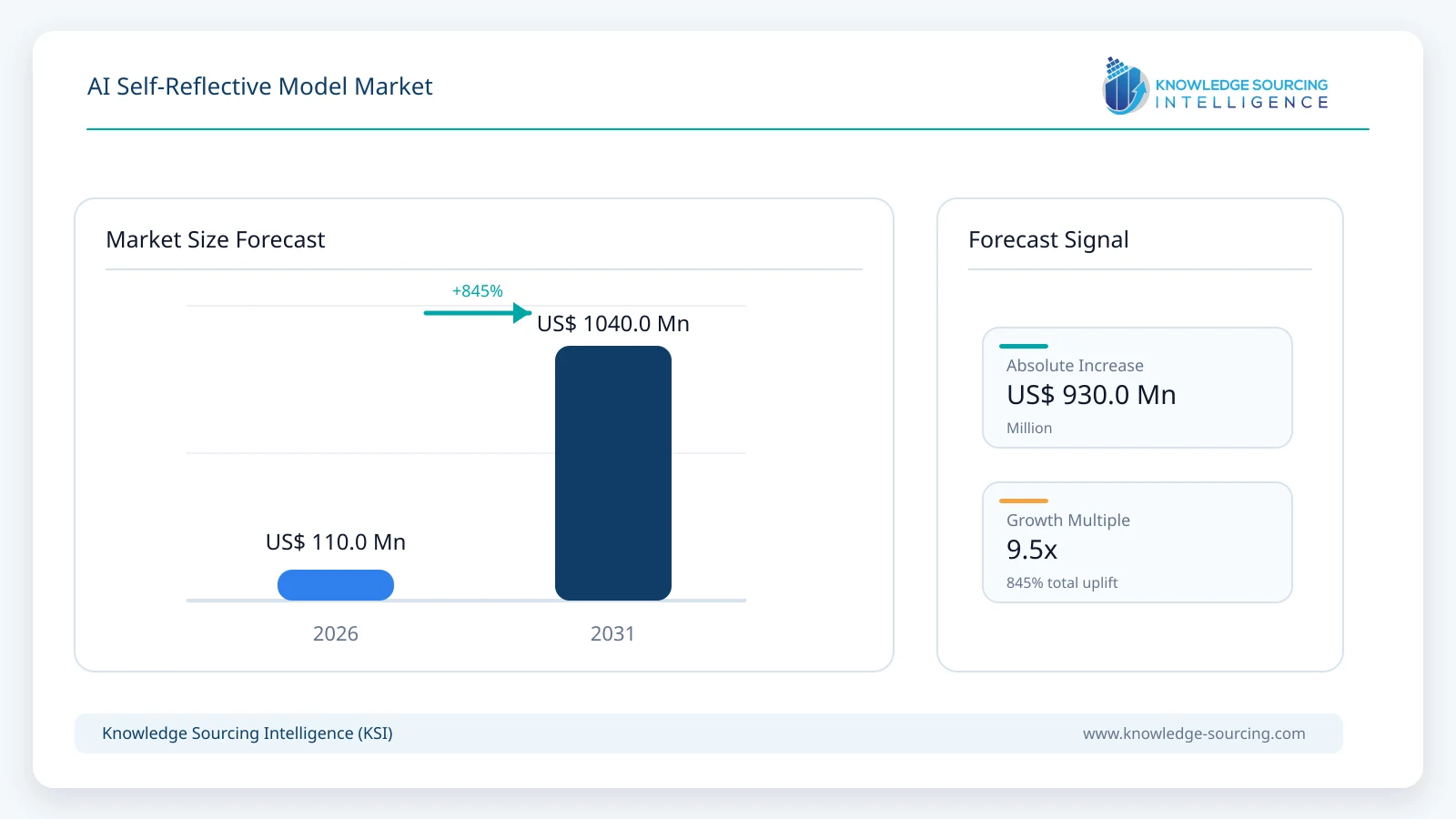
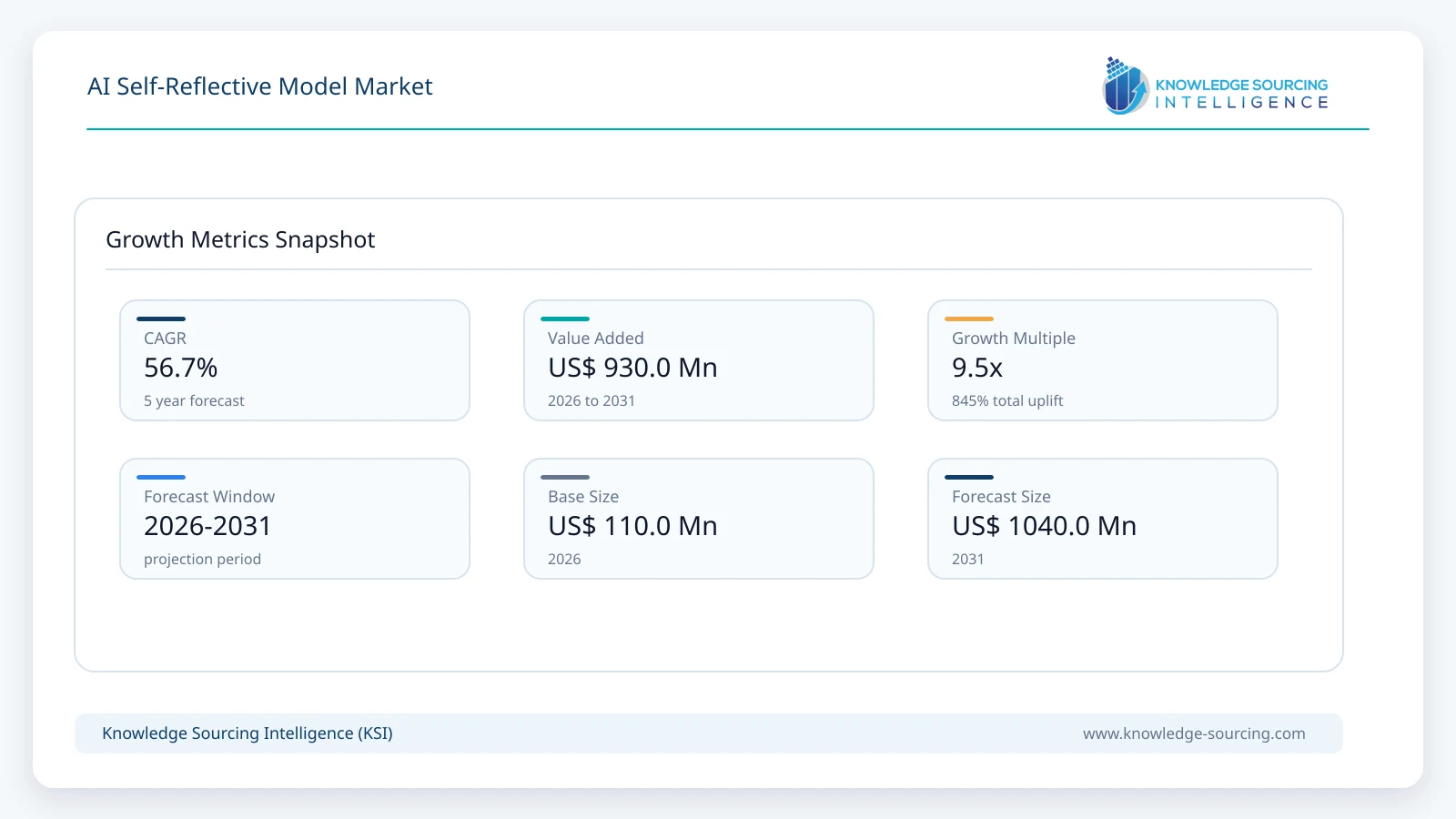
The AI Self-Reflective Model Market is forecast to grow at a CAGR of 56.7%, reaching USD 1,040.0 million in 2031 from USD 110.0 million in 2026.
Highlights:
- 1Self-critique and iterative revision is estimated to account for 35% of 2026 revenue; the segment reaches approximately USD 312 million by 2031 as feedback loops move into software and analytical workflows.
- 2Metered reflective inference contributes USD 65 million in 2026 and is forecast to reach USD 600 million by 2031, with usage tied to additional attributable critique-and-revision passes.
- 3North America leads the market with USD 46.2 million in 2026 and is projected to reach USD 405.6 million in 2031, supported by cloud model providers and enterprise development teams.
- 4Asia Pacific grows from USD 27.5 million in 2026 to USD 322.4 million in 2031, reflecting adoption across engineering, software services and rapidly expanding model-development ecosystems.
- 5The market remains an overlapping subset of AI Reasoning Engine and is not additive with Inference-Time Scaling AI, Recursive Reasoning, or standalone AI Verification Engine revenue.
Revenue is generated by paid reflection-related model processing, dedicated critique-and-revision runtimes, structured self-assessment and specialized enterprise integrations. Customers purchase these functions to improve the share of tasks completed correctly on the first accepted submission, rather than simply to generate more model output.
The central commercial change is that model outputs can be treated as candidates for inspection rather than final answers. In self-refining workflows, an initial response is tested against instructions, available evidence, or observed task outcomes, and a second attempt incorporates a specific critique. AWS documents evaluator-refine loops, while LangChain provides reflection patterns in which an agent revises work using feedback. These designs are especially relevant where manual review consumes substantial engineering or specialist time.
The growth forecast depends on customers recognizing and paying for incremental reflection functions that are separable from baseline reasoning and inference. Anthropic has demonstrated model-based self-assessment for misuse monitoring, Microsoft Research has examined experience-reflection-consolidation learning, and OpenAI has researched self-reporting when models violate instructions. Such research supports the technical direction, although not all demonstrated reflection functions are available as separately priced products.
Market Overview
Self-reflective AI models and systems combine output generation with one or more mechanisms that diagnose failure and initiate a targeted revision. Reflection can occur in the model’s reasoning process, through a separate critique prompt, or in an agent runtime that reads tool results and prior failures. The technology is distinct from unlimited retries because a useful reflective loop creates structured evidence about what needs to change. The most practical deployments specify a stopping rule and measure improvement against the extra processing cost.
Commercial implementations vary by workload. Coding systems can analyze a failed test and revise the proposed change; analytical agents can identify unsupported assumptions before submitting a research result; enterprise assistants can compare an output with a task-specific rubric. Microsoft Research described an experience-reflection-consolidation process in February 2026, while LangChain’s established reflection patterns show how a generator and critic can exchange feedback without changing model weights. These approaches create more options for customers, but also intensify pricing competition.
Reflection must remain distinguishable from adjacent AI categories. AI Verification Engine charges for checking whether a result satisfies defined criteria, while the present market includes the corrective feedback loop and accepted revised output. Inference-Time Scaling AI concerns added deliberative compute, and Recursive Reasoning concerns nested execution architectures. One integrated transaction is assigned to its dominant paid function; it is not booked as full revenue in several markets.
Market Trends
Reflection Loops Are Becoming More Structured
Enterprise AI developers are moving from open-ended instructions such as asking a model to check its answer toward explicit generator, critic, and refiner stages. LangChain’s reflection-agent patterns and AWS evaluator-refine guidance show how evaluations can trigger targeted revisions, with limits on iterations and acceptability thresholds. Clearer stage separation allows buyers to monitor correction quality, track incremental cost, and avoid unnecessary repeated inference on tasks already meeting the required standard.
Outcome Feedback Is Informing Model Improvement
Reflective behavior is increasingly tied to observed results rather than only a model’s own confidence. Microsoft Research described experiential reinforcement learning in February 2026, using environmental feedback to generate a reflection and refine subsequent action. Research into ReflexiCoder similarly examines how reflection and correction can be internalized into a model for coding tasks. For commercial buyers, the more important question is whether these methods improve successful task completion with fewer expensive retries.
Self-Assessment Is Expanding Beyond Answer Quality
Model-generated self-assessments are also being studied for policy compliance and monitoring. Anthropic reported in October 2026 that Claude self-assessment could help prioritize certain potentially harmful conversations, while OpenAI described training agents to signal their own misbehavior in March 2026. These are evidence of useful self-reporting capabilities, not proof of a standalone reflection product in every deployment. Paid revenue emerges only where customers buy a distinct monitoring and correction service.
Cost-Aware Reflection Is Replacing Indiscriminate Deliberation
Longer reasoning sequences do not consistently create better results, especially on routine prompts. Google DeepMind research published in July 2026 identified over-verification and over-exploration as common sources of overthinking in evaluated reasoning models. Commercial reflective systems therefore increasingly need selective review, short critique stages, caching, early termination and meaningful quality thresholds. Providers able to show lower cost per accepted result will have a stronger basis for differentiated pricing.
Segment Analysis
By Reflection Mechanism: Self-Critique and Iterative Revision
Self-critique and iterative revision is the largest modeled mechanism, with USD 38.5 million in 2026 and approximately USD 312 million in 2031. The workflow evaluates an initial answer against instructions, expected results, or a quality rubric, then issues a targeted revision. Software engineering, research synthesis, and enterprise content workflows provide practical demand because an improved accepted outcome can reduce downstream manual review. LangChain and AWS document different implementations of these loops.
By Commercial Offering: Metered Reflective Inference
Metered reflective inference is estimated at USD 65 million in 2026 and USD 600 million in 2031. Revenue represents additional paid reflection-specific model processing, not ordinary tokens consumed to produce the initial output. Service providers can charge for an extra critic pass or an adaptive refiner stage where the additional call is identifiable. Economics depend on reflection being reserved for complex, consequential requests rather than automatically applied to every transaction.
By Deployment Model: Multitenant APIs
Multitenant model APIs account for an estimated 53% of 2026 market value and reach about USD 489 million in 2031. Shared APIs are convenient for developers who want to add critique and revision without managing dedicated clusters. However, enterprises working with confidential code, research data, and regulated decisions are expected to increase deployment through customer-controlled environments, supporting faster growth in private cloud and on-premises systems.
By Primary Application: Software Engineering and Code Review
Software engineering and code review are estimated at USD 33 million in 2026 and USD 260 million in 2031. The most valuable reflective activity identifies a failed test, security concern, or architectural weakness and proposes a revised code change, rather than simply restating a warning. Enterprise adoption will depend on integrating these cycles with tests, repository policies and developer approval so that reflective actions can be independently validated.
By Customer Type: Large Enterprises
Large enterprises account for 29% of 2026 demand and are projected to reach approximately USD 343 million by 2031. These buyers favor policy-controlled reflection and auditable revisions because unexpected agent decisions can create commercial exposure. Implementation increasingly combines model APIs with private runtimes, company-specific acceptance criteria, and traceable outcome metrics. Purchasing decisions consequently favor demonstrated improvement in completed tasks over generic claims of autonomous self-correction.
Market Drivers
Greater Automation of Multi-Step Knowledge Work
AI assistants are increasingly being used for activities in which one missed assumption or incorrect intermediate step can invalidate the final result. Reflection loops introduce a review stage before code is merged, research is submitted, or a business recommendation is accepted. Developers can measure the value through reduced rework, fewer manual escalations, and higher task acceptance. This link to operational performance supports paid deployment of selective critique-and-revision functions.
Improved Tool Feedback and External Evaluation
Code execution results, database queries, and other tools provide signals that help models diagnose why an initial attempt failed. A reflective agent can incorporate this evidence into a revised response instead of repeating the same attempt. Microsoft’s experiential reinforcement learning work reinforces the importance of structured feedback in revision, while commercial agent frameworks make staged checks easier to implement. These capabilities broaden reflection beyond static prompt-based self-criticism.
Commercial Interest in Reliable Coding Agents
Software engineering agents increasingly handle longer changes that involve multiple files, dependencies, and tests. Reflection can help a system interpret failed checks, identify a more appropriate modification, and present a stronger revision to human reviewers. Buyers are willing to spend additional inference resources when the revised outcome reduces the cost of developer rework. Integration with existing repositories and development pipelines gives specialist runtime suppliers clear implementation opportunities.
More Configurable Reasoning APIs and Agent Runtimes
Model APIs now offer more choice over computational effort, while agent frameworks provide explicit control of evaluation and revision steps. These capabilities let application developers direct reflection toward work requiring additional assurance, rather than applying maximum reasoning to every message. Selective operation improves the chance that incremental reflection expenditure is commercially justified and allows software vendors to package premium reliability levels for high-value tasks.
Demand for Measurable AI Governance
Enterprises adopting autonomous workflows need evidence about how models respond to mistakes and unexpected behavior. Structured self-assessment and corrective logs can identify flawed decisions or policy concerns before later actions compound them. Anthropic’s 2026 self-assessment research illustrates one monitoring route, although internal safeguarding costs are not automatically market revenue. Commercial demand is strongest where an attributable product combines reflection with audit trails, customer controls, and remedial actions.
Market Restraints
Additional Inference Expense and Response Latency
Critique and revision add model calls or internal deliberation after the initial output, increasing expenditure and sometimes delaying the answer. When tasks are routine or low consequence, the incremental compute is unlikely to create a measurable return. Providers must offer stopping rules, adaptive triggers, and caching to avoid charging customers for revisions that produce negligible improvement.
Self-Criticism Does Not Guarantee Correctness
A model can confidently endorse an incorrect response or generate a plausible but misleading critique, particularly when no external evidence or test outcome is available. Reflective systems therefore need reliable evaluators and measurable acceptance criteria. Customers may hesitate to pay for extra review if it merely replaces one unverified answer with another and creates false assurance.
Overlap with Bundled Reasoning and Verification
Foundation-model vendors can embed critique and revision inside existing reasoning APIs, while agent vendors can bundle it into broader workflow subscriptions. When separate prices are unavailable, customers have little reason to license another reflective runtime. This bundling limits market transparency and puts pressure on specialist providers to demonstrate distinct, attributable value.
Private Data and Audit Requirements
Reflective loops sometimes repeat sensitive prompts, proprietary code, or confidential evidence through additional execution stages. Enterprises must control where these stages run, which model can examine intermediate outputs and how revision logs are retained. Private deployment and governance requirements can lengthen procurement cycles and raise implementation costs.
Unstable Evaluation and Feedback Quality
A reflective model improves most when task feedback is meaningful and consistently interpretable. Sparse outcomes, shifting rubrics and unreliable automated judges can lead to unnecessary loops or distorted optimization. Maintaining good feedback datasets and stopping thresholds requires specialist engineering, limiting adoption among organizations without mature AI evaluation practices.
Regional Outlook
North America
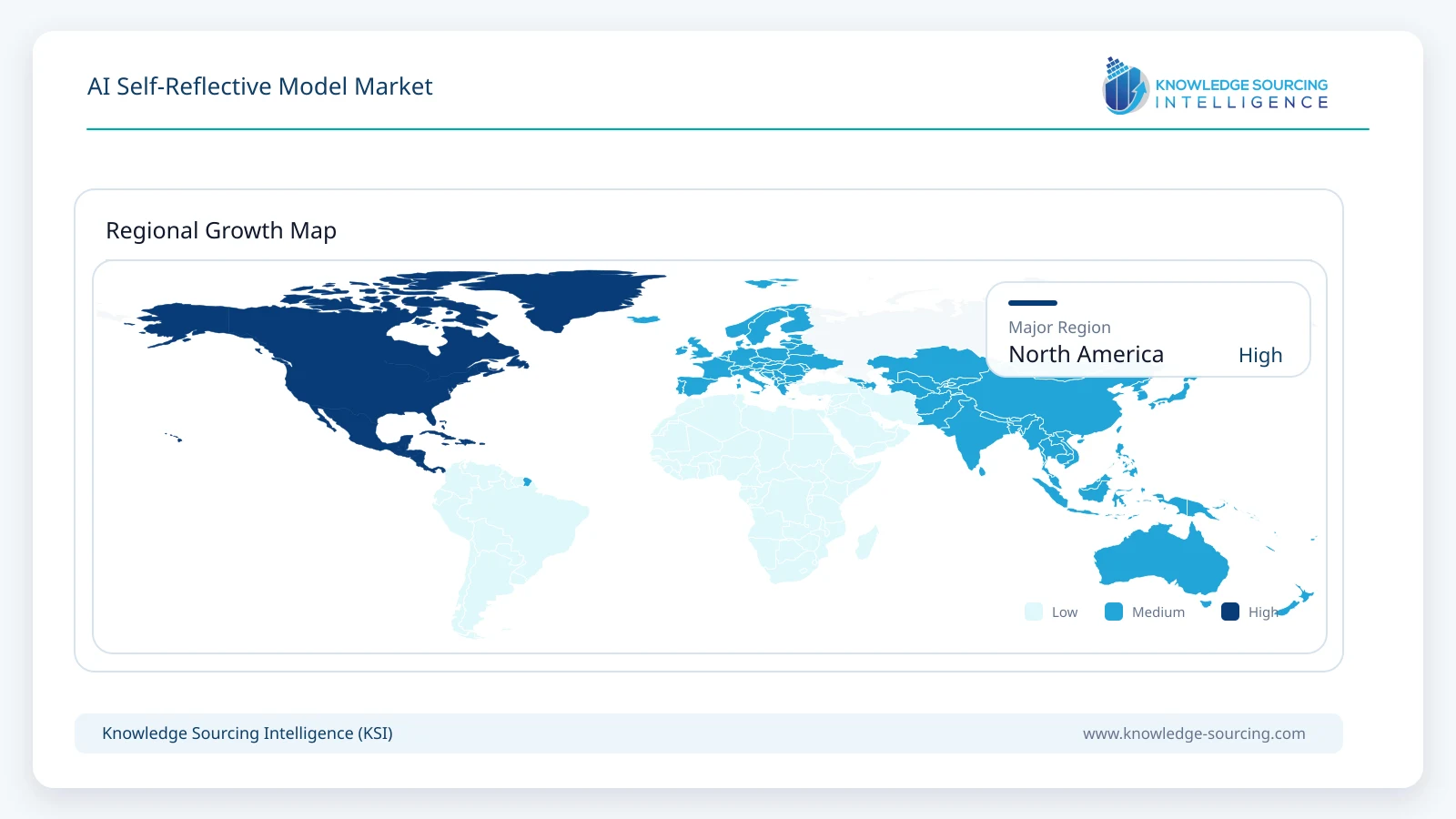
North America holds the leading estimated position at USD 46.2 million in 2026, with a projected market value of USD 405.6 million in 2031. The United States accounts for most regional demand because of the concentration of foundation-model developers, enterprise software producers and cloud infrastructure providers. Reflective correction is particularly relevant to corporate software agents, technical research assistants and high-volume professional services where costly incorrect outputs create a measurable reason to use additional evaluation stages.
The United States also hosts research and product activity across OpenAI, Anthropic, Microsoft and cloud software ecosystems, helping enterprises experiment with structured critique, revision and self-reporting. Commercial growth will depend on moving from prototypes to contracts that isolate the cost and value of reflection. Canadian AI and software companies provide a smaller but growing demand base, while Mexican adoption is concentrated in multinational engineering and software-service operations.
Asia Pacific
Asia Pacific is expected to be the fastest-growing meaningful regional market, expanding from USD 27.5 million in 2026 to USD 322.4 million in 2031. The region benefits from large software engineering workforces, active open-weight model communities, and growing demand for multilingual enterprise automation. China, India, Japan and South Korea provide important developer and corporate markets for task-aware reflection, while Singapore supports regional cloud and financial-technology deployments.
India is projected to increase its weight within Asia Pacific as software exporters integrate feedback-controlled code improvement and analytical workflows. China supports local model and platform development, while Japan and South Korea emphasize high-reliability engineering applications. A combination of hosted open-weight models and enterprise-managed deployments may allow reflective capability to grow without relying exclusively on expensive frontier APIs, although pricing competition is likely to remain strong.
Competitive Landscape
Competition spans foundation-model providers, enterprise cloud platforms and specialist agent-framework vendors rather than a settled class of pure-play reflective-model companies. OpenAI, Anthropic and Google offer reasoning environments and have published relevant work on evaluation, thinking control or self-assessment. Microsoft Research has contributed reflection-based learning techniques, while AWS, LangChain and n8n document practical reflective workflows. Many capabilities are bundled with broader products, so the scope of direct standalone revenue remains limited.
Supplier differentiation is expected to depend on the quality of feedback, control of iteration cost, reliability of stopping decisions and evidence that revisions improve accepted outcomes. Framework suppliers can compete through portability and deployment flexibility; model-service providers through integrated performance and token economics. Enterprises will increasingly compare the net cost per corrected task, the auditability of revision steps and the ability to deploy within existing governance boundaries.
Recent Developments
October 16, 2026: Anthropic introduced research on Claude self-assessment for misuse detection, demonstrating model-generated review signals after a response and highlighting the efficiency of reusing existing conversational context.
September 11, 2026: n8n published a production-focused reflection-pattern guide detailing generate, critique and revise stages with quality gates and operating-cost controls.
July 2, 2026: Google DeepMind published research on overthinking in reasoning models, identifying over-verification and over-exploration patterns that strengthen the case for selective reflection.
March 21, 2026: OpenAI released research on training agents to self-report misbehavior through a reporting tool, extending the technical basis for model self-monitoring.
March 6, 2026: Researchers introduced ReflexiCoder, a model-training framework designed to internalize code reflection and correction rather than relying entirely on separate inference calls.
February 20, 2026: Microsoft Research presented experiential reinforcement learning, incorporating explicit reflection and revised attempts into model learning from task feedback.
Market Outlook
Self-reflective model revenue is projected to expand as commercial AI applications require measurable improvement rather than more output volume. Enterprise buyers are expected to use reflection selectively on complex development, research, and agent tasks where an accepted revision can replace expensive human rework. Dedicated runtime and structured feedback offerings will grow alongside metered model processing, but price pressure will keep many basic reflection patterns bundled within larger services.
Commercial providers will increasingly connect reflective outputs to real tests, retrieval evidence, and task-specific acceptance rules. These mechanisms should outperform ungrounded self-criticism by giving the system clear information about what failed. Private and hybrid deployments will also gain share as enterprises seek tighter controls over intermediate data, corrective decisions, and audit records.
The most sustainable opportunities will come from products that demonstrate lower cost per completed task, explain why a revision occurred, and stop when added scrutiny no longer improves the outcome. Suppliers unable to separate paid reflection from general-purpose reasoning and verification may struggle to maintain distinct pricing, despite broader adoption of reflective techniques.
AI Self-Reflective Model Market Scope:
| Report Metric | Details |
|---|---|
| Total Market Size in 2026 | USD 110.0 million |
| Total Market Size in 2031 | USD 1,040.0 million |
| Forecast Unit | USD Million |
| Growth Rate | 56.7% |
| Study Period | 2021 to 2031 |
| Historical Data | 2021 to 2024 |
| Base Year | 2025 |
| Forecast Period | 2026 – 2031 |
| Segmentation | Reflection Mechanism, Commercial Offering, Deployment Model, Model Foundation |
| Companies |
|
Market Segmentation
By Reflection Mechanism
Self-critique and iterative revision
Outcome-feedback reflection
Intrinsic reflection and correction
Self-assessment and reporting
Reflection memory and experience reuse
By Commercial Offering
Metered reflective inference API
Dedicated reflective runtime licences
Structured feedback and self-assessment
Specialist integration and optimization
By Deployment Model
Multitenant model APIs
Customer-controlled private cloud
On-premises deployment
Hybrid and managed private deployment
By Model Foundation
Proprietary frontier models
Hosted open-weight models
Domain-adapted specialist models
By Primary Application
Software engineering and code review
Research and analytical workflows
Long-horizon agent correction
Scientific and technical reasoning
Safety and compliance self-review
By Customer Type
AI developers and ISVs
Large enterprises
Cloud and model service providers
Research institutions and public buyers
By End-user Industry
Information technology and software
Banking and financial services
Professional and scientific services
Healthcare and life sciences
Manufacturing and engineering
Other industries
By Geography
North America
United States
Canada
Mexico
South America
Brazil
Argentina
Rest of South America
Europe
United Kingdom
Germany
France
Netherlands
Italy
Spain
Rest of Europe
Middle East and Africa
United Arab Emirates
Saudi Arabia
Israel
South Africa
Rest of Middle East and Africa
Asia Pacific
China
India
Japan
South Korea
Australia
Singapore
Rest of Asia Pacific
Table of Contents
1. EXECUTIVE SUMMARY
1.1. Research Highlights
1.2. Market Size and Forecast, 2026-2031
1.3. Strategic Market Outlook
2. MARKET SNAPSHOT
2.1. Definition and Scope
2.2. Market Dynamics
2.3. Commercial Adoption and Pricing
3. BUSINESS LANDSCAPE
3.1. Market Drivers
3.1.1. Greater Automation of Multi-Step Knowledge Work
3.1.2. Improved Tool Feedback and External Evaluation
3.1.3. Commercial Interest in Reliable Coding Agents
3.1.4. More Configurable Reasoning APIs and Agent Runtimes
3.1.5. Demand for Measurable AI Governance
3.2. Market Restraints
3.2.1. Additional Inference Expense and Response Latency
3.2.2. Self-Criticism Does Not Guarantee Correctness
3.2.3. Overlap with Bundled Reasoning and Verification
3.2.4. Private Data and Audit Requirements
3.2.5. Unstable Evaluation and Feedback Quality
3.3. Market Opportunities
3.4. Porter’s Five Forces Analysis
3.5. Industry Value Chain Analysis
3.6. Policies and Regulations
3.7. Strategic Recommendations
4. TECHNOLOGICAL OUTLOOK
4.1. Feedback-Based Iterative Refinement
4.2. Self-Critique and Corrective Reasoning
4.3. Experience-Driven Reflection
4.4. Self-Assessment and Monitoring
4.5. Adaptive Reflection Budgets
5. AI SELF-REFLECTIVE MODEL MARKET BY REFLECTION MECHANISM
5.1. Self-critique and iterative revision
5.2. Outcome-feedback reflection
5.3. Intrinsic reflection and correction
5.4. Self-assessment and reporting
5.5. Reflection memory and experience reuse
6. AI SELF-REFLECTIVE MODEL MARKET BY COMMERCIAL OFFERING
6.1. Metered reflective inference API
6.2. Dedicated reflective runtime licences
6.3. Structured feedback and self-assessment
6.4. Specialist integration and optimization
7. AI SELF-REFLECTIVE MODEL MARKET BY DEPLOYMENT MODEL
7.1. Multitenant model APIs
7.2. Customer-controlled private cloud
7.3. On-premises deployment
7.4. Hybrid and managed private deployment
8. AI SELF-REFLECTIVE MODEL MARKET BY MODEL FOUNDATION
8.1. Proprietary frontier models
8.2. Hosted open-weight models
8.3. Domain-adapted specialist models
9. AI SELF-REFLECTIVE MODEL MARKET BY PRIMARY APPLICATION
9.1. Software engineering and code review
9.2. Research and analytical workflows
9.3. Long-horizon agent correction
9.4. Scientific and technical reasoning
9.5. Safety and compliance self-review
10. AI SELF-REFLECTIVE MODEL MARKET BY CUSTOMER TYPE
10.1. AI developers and ISVs
10.2. Large enterprises
10.3. Cloud and model service providers
10.4. Research institutions and public buyers
11. AI SELF-REFLECTIVE MODEL MARKET BY END-USER INDUSTRY
11.1. Information technology and software
11.2. Banking and financial services
11.3. Professional and scientific services
11.4. Healthcare and life sciences
11.5. Manufacturing and engineering
11.6. Other industries
12. AI SELF-REFLECTIVE MODEL MARKET BY GEOGRAPHY
12.1. North America
12.1.1. United States
12.1.2. Canada
12.1.3. Mexico
12.2. South America
12.2.1. Brazil
12.2.2. Argentina
12.2.3. Rest of South America
12.3. Europe
12.3.1. United Kingdom
12.3.2. Germany
12.3.3. France
12.3.4. Netherlands
12.3.5. Italy
12.3.6. Spain
12.3.7. Rest of Europe
12.4. Middle East and Africa
12.4.1. United Arab Emirates
12.4.2. Saudi Arabia
12.4.3. Israel
12.4.4. South Africa
12.4.5. Rest of Middle East and Africa
12.5. Asia Pacific
12.5.1. China
12.5.2. India
12.5.3. Japan
12.5.4. South Korea
12.5.5. Australia
12.5.6. Singapore
12.5.7. Rest of Asia Pacific
13. COMPETITIVE ENVIRONMENT AND ANALYSIS
13.1. Market Share Analysis
13.2. Competitive Strategies and Partnerships
14. COMPANY PROFILES
14.1. OpenAI
14.2. Anthropic
14.3. Google (Alphabet)
14.4. Microsoft Corporation
14.5. Amazon Web Services (Amazon)
14.6. LangChain
14.7. n8n
14.8. International Business Machines Corporation
14.9. NVIDIA Corporation
14.10. Hugging Face
15. APPENDIX
15.1. Research Methodology
15.2. Assumptions and Definitions
15.3. Abbreviations
Navigate
Trusted by the world's leading organizations











