
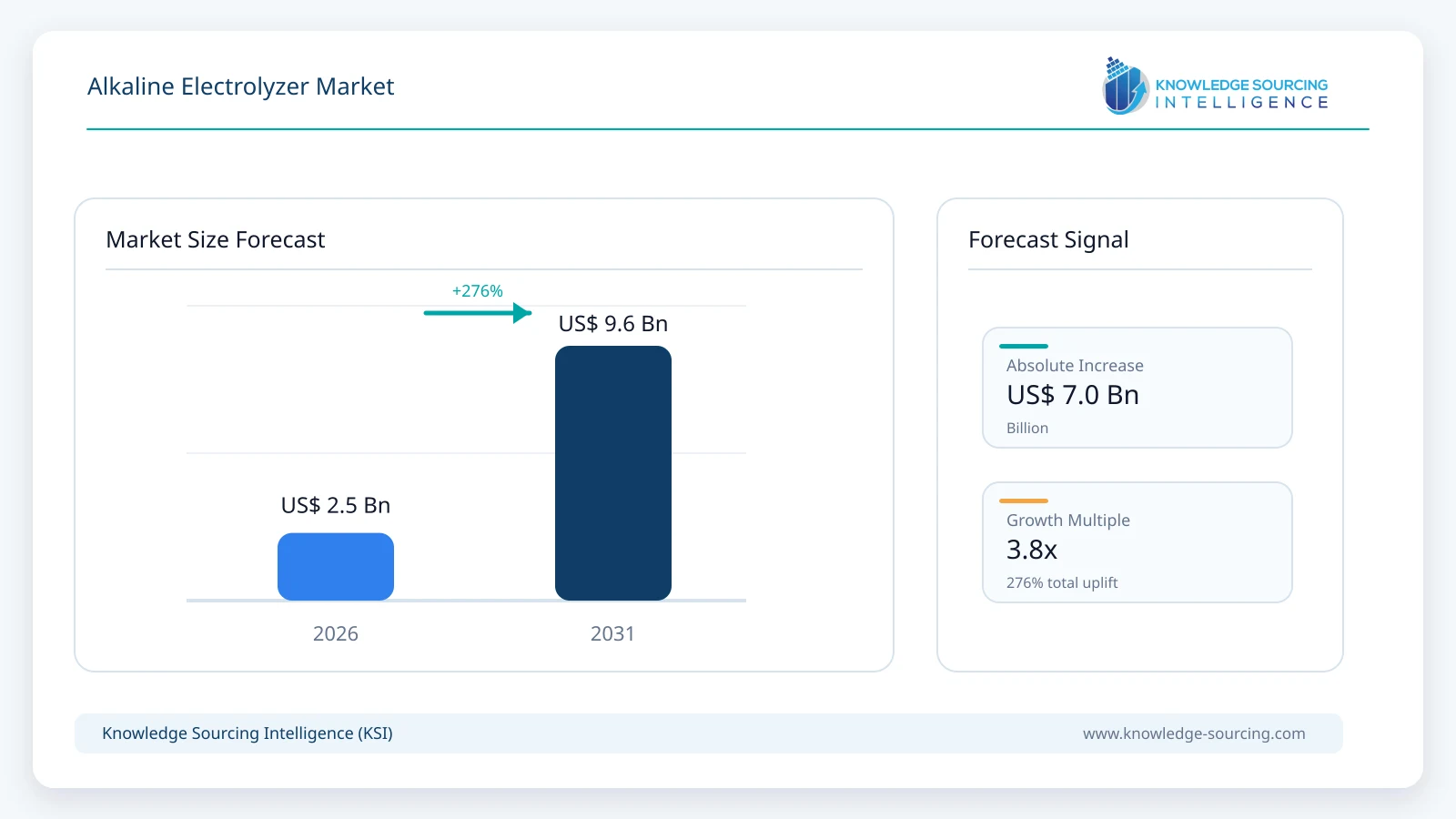
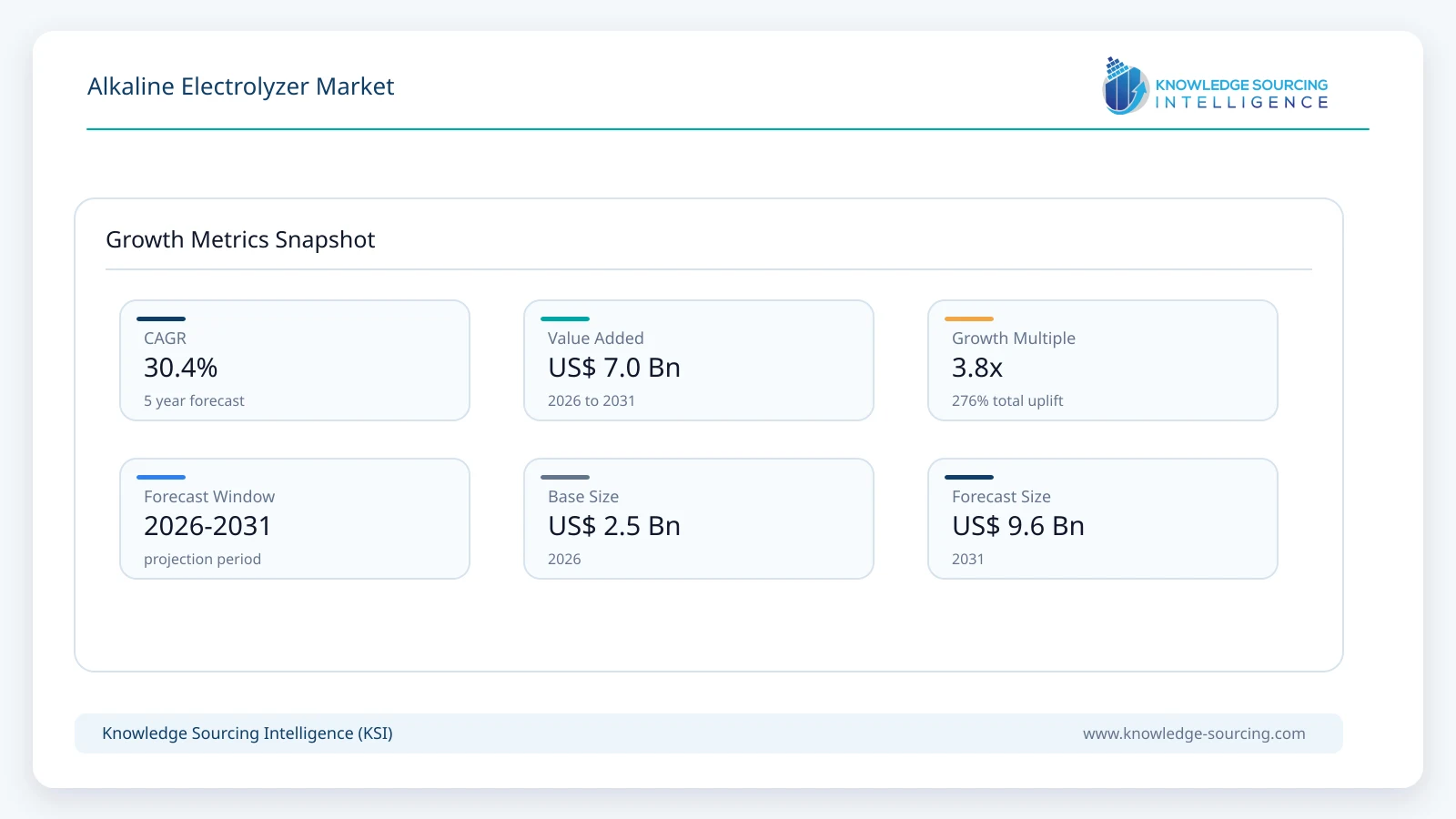
The Alkaline Electrolyzer Market is forecast to grow at a CAGR of 30.4%, reaching USD 9.60 billion in 2031 from USD 2.55 billion in 2026.
Highlights:
- 1Technology leaderPressurized alkaline electrolyzers command 65.0% of the market in 2026, generating approximately USD 1.66 billion in market value.
- 2Preferred electrolytePotassium Hydroxide (KOH) continues to dominate electrolyte demand, capturing an 88.0% share in 2026 and rising to USD 8.64 billion by 2031.
- 3High-growth applicationGreen Hydrogen Production is set for strong expansion, registering a 31.0% CAGR from 2026 to 2031 as hydrogen projects increasingly adopt alkaline electrolysis technologies.
- 4Regional outlookNorth America is valued at USD 0.46 billion in 2026 and is projected to reach USD 1.63 billion by 2031, reflecting continued investment in hydrogen production and supporting infrastructure.
An alkaline electrolyser is based on an electrochemical system to split water into hydrogen and oxygen using an alkaline electrolyte. Hydroxide moves between the electrodes, while hydrogen and oxygen are produced separately when electricity is fed through the immersed electrodes using an alkaline solution.
The alkaline electrolysis technology has an extensive industrial history, because it is closely related to the established chlor-alkali and other electrochemical processes. This provides manufacturers with a key building block to scale electrolyzer systems for renewable hydrogen generation.
Companies are also becoming more focused on bigger common systems. thyssenkrupp nucera's scalum platform integrates about 300 cells into one 20 MW unit, and its modular system enables the interconnection between multiple units for hundreds of megawatts or gigawatt-scale projects.
Standardized alkaline systems are also being developed by Nel. NEXTracker is currently offering pressurized alkaline systems, atmospheric alkaline systems, and modular configurations for large-scale industrial hydrogen production through the AWE-20 platform as well.
Additionally, the competitive landscape is transitioning from electrolyzer projects to modularization, factory manufacturing, digital monitoring, automation & integrated balance-of-plant solutions.
The market is also more closely tied to renewable sources. Alkaline systems of modern design are being developed to operate stably on variable electricity from solar and wind. According to thyssenkrupp nucera, its scalum platform can run from around 10% to 100% load and enables the integration of variable renewable generation.
Market Dynamics
Market Drivers
Increasing Demand for Green Hydrogen: As industries look for alternatives to hydrogen made from natural gas and coal, low-emission hydrogen is in increasing demand. With existing hydrogen consumption for refining, ammonia, chemicals, and other industrial processes offers a huge decarbonisation opportunity for renewable or low-carbon hydrogen to replace fossil-derived feedstocks. The alkaline electrolyzer is especially appropriate for this transition, using scalable manufacturing and decades of industrial operating experience.
Lower Cost and Mature Technology: Established materials, manufacturing, and decades of operating experience benefit alkaline electrolysis. Alkaline systems, compared to PEM technology, typically avoid the reliance on large amounts of costly platinum-group metals in their fundamental electrochemical structure.
Expansion of Renewable Energy: With solar and wind capacity continuing to grow globally, it has also become possible to generate hydrogen using renewable electricity. Alkaline electrolyzers can directly use renewable electricity to create hydrogen when power is available, enabling hydrogen to function as an energy carrier and storage medium.
Growth of Green Ammonia Production: One of the most significant applications for renewable hydrogen is ammonia. An example of this integration is Asahi Kasei's demonstration in January 2026, where hydrogen from its Fukushima alkaline electrolyzer was planned to be supplied to a green-ammonia production facility operated as part of the project led by JGC.
Increasing Industrial Decarbonization: Hydrogen is being assessed as a decarbonisation pathway in steel, chemicals, refining and other hard-to-abate sectors, including shipping fuels. The large-scale alkaline electrolyzers can be installed near an industrial site, generating hydrogen without the needs of transporting by pipeline over long distances.
Market Restraints & Opportunities
The alkaline electrolyzer market is experiencing high electricity requirements since electricity remains one of the highest operating costs in hydrogen production. Inherently, this means that projects need to have access to competitively priced renewable or low-carbon electricity in order to optimize hydrogen economics.
Hydrogen infrastructure is another constraint. Alongside the development of electrolyzer capacity, there needs to be development of pipelines, storage facilities, compression systems, hydrogen refueling stations, export terminals and ammonia or methanol conversion facilities.
In addition, dynamic operation introduces a further technical challenge. Traditionally, alkaline systems operated only under relatively stable conditions, but renewable energy can cause frequent variations and shutdowns of the system.
This is creating possibilities for manufacturers working on advanced electrodes, zero-gap setups, improved diaphragms, higher current densities, dynamic operating systems, digital controls, pressurized systems, modular skids, and automated manufacturing.
The other opportunity is a direct project with green-ammonia, methanol, e-fuel, and steel-making plants. These arrangements could also provide stable hydrogen demand and minimize long-distance transport of hydrongen.
Key Developments
July 2026: thyssenkrupp nucera partnered with Bharat Heavy Electricals Limited (BHEL) for a strategic partnership to localise the production of alkaline water electrolyzers in India. This collaboration integrated the engineering, manufacturing, and project-execution capabilities of BHEL with the leading electrolysis technologies of thyssenkrupp nucera.
April 2026: Nel ASA announced the commercial launch of its next-generation pressurized alkaline electrolyzer platform, after eight years of development and full-scale prototype testing at Herøya, Norway. They designed the system to eliminate challenges associated with renewable-hydrogen projects and minimize engineering tasks while maximizing efficiency at reduced cost.
Market Segmentation
The market is segmented by type, electrolyte, application, end user, and geography.
By Type: Pressurized Alkaline Electrolyzers
Pressurized alkaline electrolyzers are anticipated to be a rapidly growing segment, with a 32.3% CAGR and a projected 70.0% share by 2031, reaching a segment value of USD 6.72 billion. Their ability to produce hydrogen at elevated pressure can reduce mechanical compression requirements before storage, transportation, or use.
The segment is particularly applicable to green ammonia production and hydrogen refueling, as well as salt-cave storage and industrial applications requiring higher-pressure hydrogen supply.
Nel uses a standardized modular architecture for its next-generation pressurized alkaline platform. Its system, with reported 99.99% H2 purity, is designed to supply hydrogen at around 30 bar, supporting efficient downstream integration.
By Electrolyte: Potassium Hydroxide (KOH)
Potassium Hydroxide (KOH) dominates the commercial alkaline water electrolysis electrolyte segment, supported by its high ionic conductivity, efficient hydroxide-ion transport, and established use in industrial electrochemistry. The segment is projected to hold a 90.0% share in 2031, growing at a 30.9% CAGR.
Alkaline systems using KOH rely on an aqueous electrolyte, electrodes, and a diaphragm or separator to separate hydrogen from oxygen while enabling ionic transport.
Advances in electrode activity, zero-gap cell designs, diaphragm performance, current density, and electrolyte circulation are improving system efficiency and supporting market growth. Tokuyama’s alkaline-water-electrolysis development program, for example, focuses on zero-gap technology to reduce power consumption, increase hydrogen production per unit site area, and lower equipment costs.
While NaOH-based systems retain technical relevance, KOH remains more strongly associated with commercial large-scale water electrolysis applications.
By Application: Green Hydrogen Production
Large-Scale Green Hydrogen Production is the largest application by virtue of its maturity; alkaline electrolyzers produce hydrogen at a large scale from renewable electricity and water. Deployments are shifting from pilot projects to multi-hundred-megawatt and gigawatt-scale developments.
Thyssenkrupp nucera's scalum platform is an example of this shift. Modularised 20 MW alkaline redeployable units can be assembled and scaled in large industrial plants by the company. Additionally, in March 2026, the company signed a 300 MW supply agreement with Moeve (Spain) involving 15 standardized 20 MW alkaline electrolyzer units for phase one of the Onuba green-hydrogen project.
Regional Analysis
North America Market Analysis
The North American alkaline electrolyzer market is expanding, supported by clean-hydrogen incentives, renewable-power capacity growth, industrial decarbonization efforts, and demand from refining, chemicals, steelmaking, transportation, and energy storage. The segment is projected to register a 28.9% CAGR and reach a 17.0% share by 2031. The United States remains the major regional market, supported by federal clean-hydrogen programs and rising investments in hydrogen hubs.
South America Market Analysis
South America is an emerging alkaline electrolyzer market due to its significant solar, wind, and hydroelectric resources. Brazil and Chile are the major opportunity regions owing to significant solar resources in the north and strong wind potential in the south.
Europe Market Analysis
The European alkaline electrolyzer market is one of the largest in the world due to its hydrogen strategy, and will continue benefiting from industrial decarbonization plans, renewable-energy targets, and efforts to cut dependence on imported fossil fuels. Germany is a leading technology and industrial hub, while countries like Spain, the Netherlands, France, Denmark, and Norway are building large-scale renewable hydrogen projects.
Middle East and Africa Market Analysis
The Middle East & Africa is developing as an essential future market for alkaline electrolyzers with robust solar resources and investment in energy infrastructure. Notably, Saudi Arabia, Oman, the UAE, and Egypt are among the key markets with developing ammonia production and green hydrogen projects.
Asia Pacific Market Analysis
Asia Pacific is expected to remain one of the fastest-growing alkaline electrolyzer markets over the forecast period, supported by strong industrial hydrogen demand, renewable energy expansion, domestic manufacturing, and government-backed hydrogen programs. In 2026, the segment is projected to account for a 46.0% share, reaching USD 1.17 billion at a 30.4% CAGR. China holds a significant position in the alkaline electrolyzer supply chain, supported by efforts to strengthen domestic hydrogen manufacturing capabilities, while India is emerging as an important market with expanding green-hydrogen projects.
List of Companies
Thyssenkrupp Nucera
Nel ASA
LONGi
John Cockerill
Industrie De Nora S.p.A.
HydrogenPro
Tokuyama Corporation
Sumitomo Electric
Cummins Inc.
Asahi Kasei Corporation
Thyssenkrupp Nucera
Thyssenkrupp Nucera is one of the leading alkaline-electrolysis companies worldwide with more than six decades of experience. Its Scalum 20 MW alkaline electrolyzer acts as a standardized modular platform for the industrial production of green hydrogen.
Nel ASA
Nel Hydrogen is a major electrolyzer manufacturer with both alkaline and PEM technologies. It has various pressurized alkaline, atmospheric alkaline, and AWE-20 systems as part of its portfolio. NEIL offers a 2.5 MW A485 under its atmospheric A-Series, while the modularly scalable AWE100 configuration can reach 100 MW.
LONGi
LONGi Hydrogen has established a stronghold in large-scale alkaline electrolyzer systems. This is followed by multiple large-scale hydrogen applications in industrial energy use, of which its ALK G Series has been deployed in a hydrogen-enriched blast-furnace demonstration project in China.
Analyst View
The alkaline electrolyzer market is becoming closer to large-scale, mass production of hydrogen at scale, which will lead to standardized roles, systems integrating with renewable resources for energy input, and cost reduction in the electrolyzing process, which need modularization, pressurized operation, and dynamic performance. Long-overdue demand is coming from green ammonia, methanol, and e-fuels as well as renewable energy storage, while the largest single application will stay with green hydrogen production. Pressurized alkaline electrolyzers are growing in popularity because of the reduction in downstream compression requirements, and KOH is the most common commercial electrolyte owing to its established industrial use and electrochemical performance. Strong demand for industrial decarbonisation projects continues to be provided from Europe, whereas the Asia Pacific region is rapidly becoming the leading region for manufacturing and deployment.
Alkaline Electrolyzer Market Scope:
| Report Metric | Details |
|---|---|
| Total Market Size in 2026 | USD 2.55 billion |
| Total Market Size in 2031 | USD 9.60 billion |
| Forecast Unit | Billion |
| Growth Rate | 30.4% |
| Study Period | 2021 to 2031 |
| Historical Data | 2021 to 2024 |
| Base Year | 2025 |
| Forecast Period | 2026 – 2031 |
| Segmentation | Type, Electrolyte, Application, End User, Geography |
| Companies |
|
Market Segmentation
By Type
Pressurized Alkaline Electrolyzers
Atmospheric Alkaline Electrolyzers
By Electrolyte
Potassium Hydroxide (KOH)
Sodium Hydroxide (NaOH)
By Application
Green Hydrogen Production
Ammonia Production
Renewable Energy Storage
Power-to-Gas
E-Fuels & Synthetic Fuel Production
Methanol Production
Others
By End User
Oil & Gas
Chemical & Petrochemical
Ammonia & Fertilizer
Steel & Metals
Power & Utilities
Others
By Geography
North America
USA
Canada
Mexico
South America
Brazil
Argentina
Others
Europe
United Kingdom
Germany
France
Others
Middle East and Africa
Saudi Arabia
UAE
Others
Asia Pacific
China
Japan
India
South Korea
Others
Table of Contents
1. EXECUTIVE SUMMARY
2. MARKET SNAPSHOT
2.1. Market Overview
2.2. Market Definition
2.3. Scope of the Study
2.4. Market Segmentation
3. MARKET DYNAMIC
3.1. Market Drivers
3.2. Market Restraints
3.3. Market Opportunities
3.4. Porter’s Five Forces Analysis
3.5. Industry Value Chain Analysis
4. BUSINESS LANDSCAPE
4.1. Hydrogen Regulations, Standards & Certification Landscape
4.2. Alkaline Electrolyzer Manufacturing Capacity & Project Pipeline Landscape
4.3. Raw Material Landscape
4.4. Input–Output Analysis
4.5. Strategic Recommendations
5. TECHNOLOGICAL OUTLOOK
5.1. Alkaline Electrolysis Cell & Stack Technologies
5.2. Electrode, Catalyst & Diaphragm Technologies
5.3. High-Current-Density & Pressurized Alkaline Electrolysis Technologies
5.4. Power Electronics, Gas Separation, Water Management & Balance-of-Plant Technologies
6. ALKALINE ELECTROLYZER MARKET BY TYPE
6.1. Introduction
6.2. Pressurized alkaline electrolyzers
6.3. Atmospheric alkaline electrolyzers
7. ALKALINE ELECTROLYZER MARKET BY ELECTROLYTE
7.1. Introduction
7.2. Potassium Hydroxide (KOH)
7.3. Sodium Hydroxide (NaOH)
8. ALKALINE ELECTROLYZER MARKET BY APPLICATION
8.1. Introduction
8.2. Green Hydrogen Production
8.3. Ammonia Production
8.4. Renewable Energy Storage
8.5. Power-to-Gas
8.6. E-Fuels & Synthetic Fuel Production
8.7. Methanol Production
8.8. Others
9. ALKALINE ELECTROLYZER MARKET BY END USER
9.1. Introduction
9.2. Oil & Gas
9.3. Chemical & Petrochemical
9.4. Ammonia & Fertilizer
9.5. Steel & Metals
9.6. Power & Utilities
9.7. Others
10. ALKALINE ELECTROLYZER MARKET BY GEOGRAPHY
10.1. Introduction
10.2. North America
10.2.1. USA
10.2.2. Canada
10.2.3. Mexico
10.3. South America
10.3.1. Brazil
10.3.2. Argentina
10.3.3. Others
10.4. Europe
10.4.1. United Kingdom
10.4.2. Germany
10.4.3. France
10.4.4. Others
10.5. Middle East and Africa
10.5.1. Saudi Arabia
10.5.2. UAE
10.5.3. Others
10.6. Asia Pacific
10.6.1. China
10.6.2. Japan
10.6.3. India
10.6.4. South Korea
10.6.5. Others
11. COMPETITIVE ENVIRONMENT AND ANALYSIS
11.1. Major Players and Strategy Analysis
11.2. Market Share Analysis
11.3. Mergers, Acquisitions, Agreements, and Collaborations
11.4. Competitive Dashboard
12. COMPANY PROFILES
12.1. Thyssenkrupp Nucera
12.2. Nel ASA
12.3. LONGi
12.4. John Cockerill
12.5. Industrie De Nora De Nora S.p.A.
12.6. HydrogenPro
12.7. Tokuyama Corporation
12.8. Sumitomo Electric
12.9. Cummins Inc
12.10. Asahi Kasei Corporation
13. APPENDIX
13.1. Currency
13.2. Assumptions
13.3. Base and Forecast Years Timeline
13.4. Key benefits for the stakeholders
13.5. Research Methodology
13.6. Abbreviations
Navigate
Trusted by the world's leading organizations











