
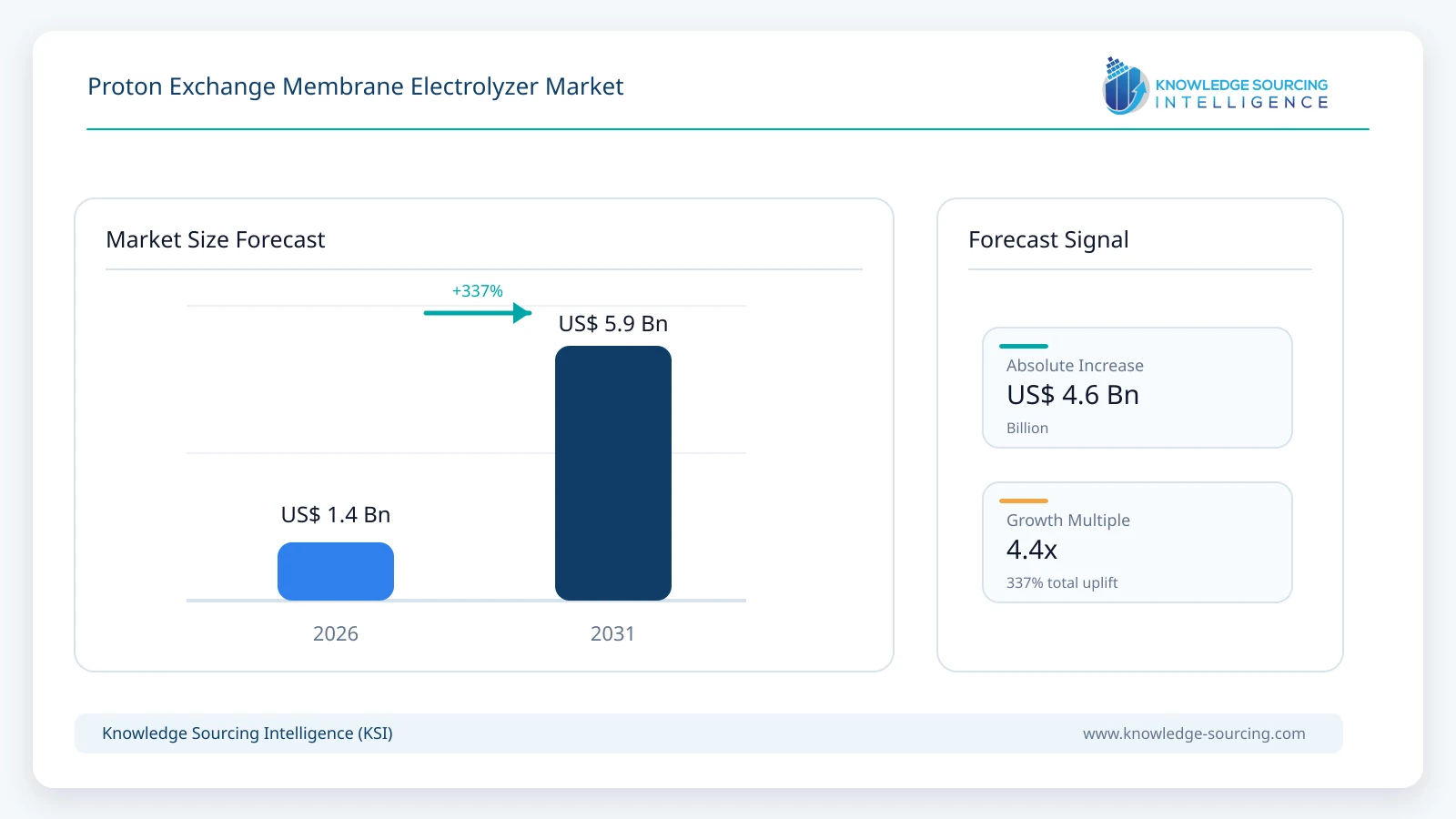
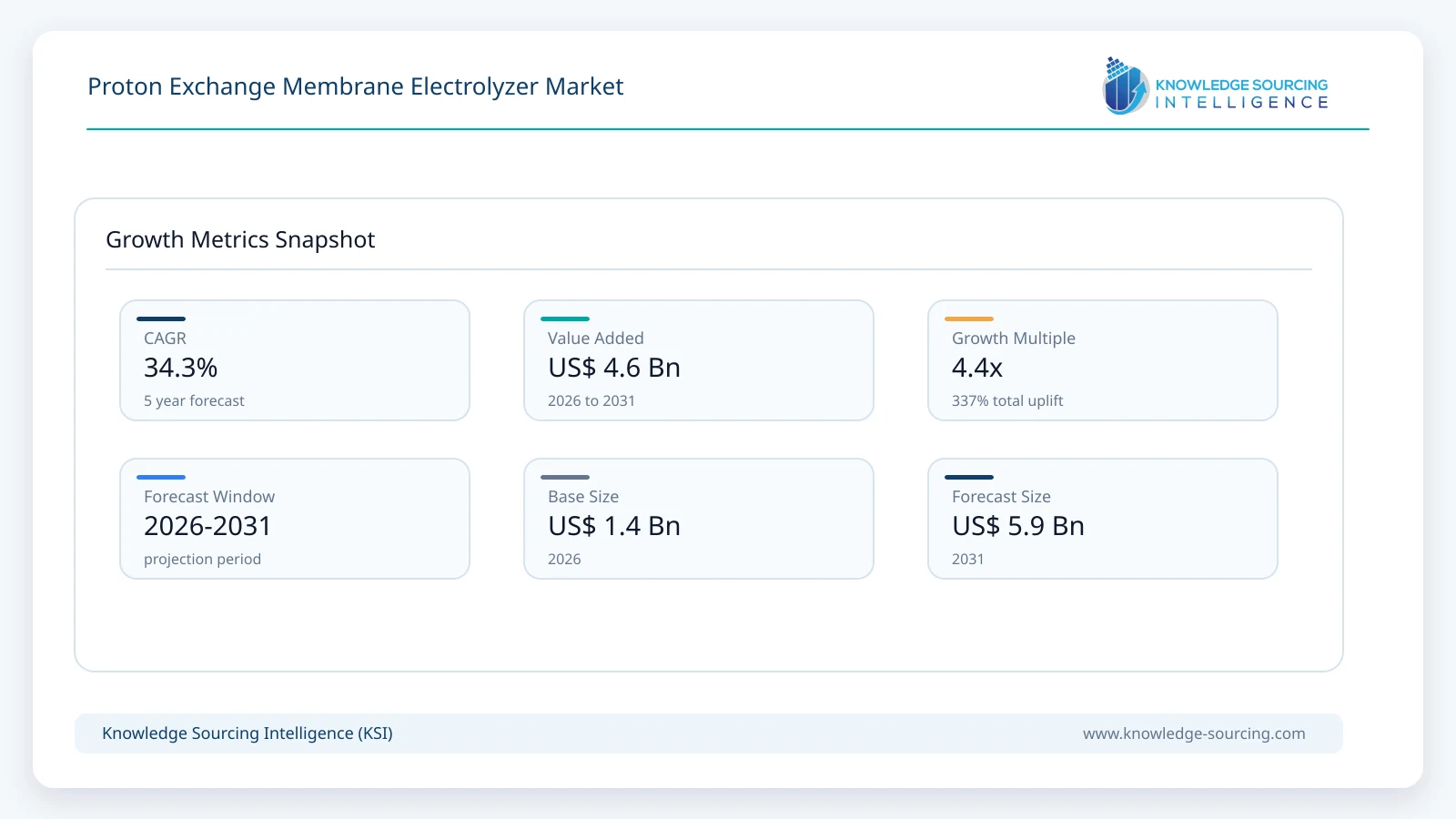
The Proton Exchange Membrane Electrolyzer Market is forecast to grow at a CAGR of 34.3%, reaching USD 5.90 billion in 2031 from USD 1.35 billion in 2026.
Highlights:
- 1Type leadershipLow-Pressure PEM Electrolyzers hold the largest market position at 62.0% in 2026, generating USD 0.84 billion and reflecting their strong adoption across hydrogen production systems.
- 2North America sets the growth paceWith a projected 33.2% CAGR through 2031, North America stands out as the fastest-expanding regional segment in the Proton Exchange Membrane Electrolyzer Market.
- 3Hydrogen production gains scaleThe hydrogen production segment is forecast to rise from USD 0.57 billion in 2026 to USD 2.24 billion by 2031, supported by its central role in PEM electrolyzer deployment.
- 4Chemical & petrochemical demand strengthensThe chemical and petrochemical end-user segment starts at USD 0.30 billion in 2026, accounting for 22.0% of the market, and is expected to reach USD 1.12 billion by 2031.
PEM electrolyzers split purified water into hydrogen and oxygen in an electrochemical reaction separated by a proton-conducting membrane using electricity. This technology has high current density and is fast-responding, so it is especially applicable to hydrogen production with an imbalanced renewable-electricity supply.
The growth in the market is from demonstration-scale systems to ever-larger industrial installations. Manufacturers are working on larger stacks, modular systems, higher-pressure designs, improved membrane-electrode assemblies, and reduced precious-metal loading or integration in the power-conversion system.
One of the main advantages of PEM electrolysis is its flexibility in operation. During the day, solar and wind generation changes, while PEM systems can quickly adjust their electrical load. According to Ohmium, its Lotus PEM platform can ramp dynamically from minimum to full load in eight seconds, a testament to the technology's ability to follow renewable variability.
Manufacturing scale is also increasing in the industry. The report states in a 2026 roundup of electrolyzers that worldwide PEM manufacturing capacity is located primarily in Europe, with plans coming into force in India and the US, along with new factories slated for Australia and China. Among the largest producers of PEM systems by capacity, Siemens Energy, Ohmium, Fortescue, ITM Power and Cummins are all identified in the report.
In addition to this, industrial applications are the most immediate source of hydrogen demand. According to the International Energy Agency (IEA), global hydrogen demand grew beyond 100mt in 2025, mainly due to its use in traditional industrial and refinery applications. New applications, which have been replacing old ones as they are added much faster than they can be processed, comprise only a small part of the total.
Market Dynamics
Market Drivers
-
Increasing Demand for Low-Emission Hydrogen: Hydrogen demand is poised to grow more broadly than traditional refining and ammonia applications as industries seek to decarbonize processes that are hard to electrify. Steelmakers are also assessing hydrogen-based direct-reduced iron, while forms of chemical companies will use renewable hydrogen for reasons including ammonia, methanol, and other chemicals.
-
Growing Renewable Energy Deployment: Proton Exchange Membrane Electrolyzer deployments are directly benefiting from the expansion of solar and wind generation. PEM systems can shift according to dynamic electricity availability, enabling them to electrolyze surplus renewable electricity into hydrogen rather than being fixed on an uninterrupted electrical supply. It forges a critical tie between renewable-power developers and hydrogen suppliers.
-
Rapid Response and Operational Flexibility: Proton Exchange Membrane Electrolyzers have fast response characteristics compared to technologies primarily designed for continuous operation. This allows operators to maximize hydrogen production during low-cost periods of renewable electricity and minimize electricity consumption during high-priced ones. Dynamic ramping that is designed for renewable variability is exhibited on Ohmium's Lotus platform.
Market Restraints & Opportunities
-
PEM electrolyzers are suffering from high capital costs of the system relative to conventional hydrogen-production technologies such as SMRs or thermochemical cycles, especially when electricity and water treatment and compression, storage, and hydrogen distribution infrastructure are taken into account.
-
The technology is also reliant on scarce metals like iridium and platinum, leading to restraints on supply chains and long-term cost reduction.
-
A third market risk is cancellations and delays. Yet these challenges present opportunities for manufacturers focusing on stacks that support high current density, low-iridium catalyst systems, the use of high-pressure PEM configurations, modular electrolyzers, automated manufacturing, and integrated power-electronics systems.
-
A further opportunity is to colocate electrolyzers in geographical proximity to distributed renewable-energy generation and industrial-derived hydrogen demand. This method can decrease the amount of transmission needed for electricity, make better use of renewable power, and lower the cost of transporting the hydrogen.
Key Developments
-
May 2026: Ohmium announced that it has partnered with In Solare for a green hydrogen project using a 4 MW order to NLC India Limited, in Neyveli, Tamil Nadu. It represents modular PEM systems being used in India's renewable energy ecosystem
-
September 2025: Kitz announced entering Japan’s First Commercial-Scale Green-Hydrogen Business with the launch of KHG-PX100, which is the first in-house PEM water electrolysis unit. The configure-to-order system generated ultra-pure hydrogen at up to 100 Nm³/h, required about 700 kVA of input power capacity, and was able to upgrade production to 500 Nm³/h.
Market Segmentation
The market is segmented by type, application, end user, and geography.
By Type: High-Pressure PEM Electrolyzers
High-Pressure PEM Electrolyzers would witness high demand, accounting for 58.0% share in 2031, with the segment value reaching USD 3.42 billion at a 32.5% CAGR, as these electrolyzers reduce downstream compression requirements when hydrogen is needed at higher pressures for industrial, mobility, storage, or pipeline applications.
Standard electrolysis systems would require additional mechanical compression of hydrogen after production. Higher-pressure electrolyzers help reduce the pressure differential and associated energy requirements for downstream compression systems.
This benefit becomes increasingly relevant in hydrogen-refueling and storage applications, where hydrogen must be compressed to high pressures. PEM technology is well suited for pressurized operation due to its compact stack architecture, rapid response characteristics, and ability to support high current densities.
By Application: Hydrogen Production
Hydrogen Production is expected to remain the largest application segment, accounting for a 38.0% share in 2031 and recording a 31.6% CAGR during the forecast period. This dominance reflects the central role of PEM electrolyzers in producing low-emission hydrogen for industrial, energy, and mobility applications.
Global hydrogen demand for industrial purposes has surpassed 100 Mt annually, while most existing production remains fossil-fuel based. According to the IEA, nearly all hydrogen demand in 2025 continued to come from established applications, particularly oil refining and industrial processes, creating significant opportunities for cleaner hydrogen production technologies.
PEM electrolyzers are increasingly being deployed to produce renewable hydrogen for on-site industrial consumption, renewable energy projects, and emerging hydrogen hubs. Their ability to respond rapidly to changing electricity supply makes them well suited for integration with variable renewable power sources such as solar and wind.
Siemens Energy’s Elyzer P-300 provides a large-scale PEM electrolysis solution designed for sustainable hydrogen production and integration with renewable electricity. Similarly, Ohmium’s Lotus PEM electrolyzer platform uses a modular architecture for industrial, energy, and mobility applications, while its rapid dynamic response supports hydrogen production from variable renewable electricity.
By End User: Chemical & Petrochemical
Chemical & Petrochemical segment is predicted to hold relevant value in the end-user segments, as hydrogen has been an integral part of many chemical processes and refining in the coming years.
Hydrogen is involved in several processes such as ammonia production, methanol production, hydrocracking, and lastly hydrodesulfurization. By substituting fossil-derived hydrogen with renewable hydrogen, existing chemical and petrochemical companies can reduce the carbon intensity of their current operations while avoiding a from-scratch redesign of the downstream production process.
Chemicals, fertilizer production, and refining continue to be among the leading uses of hydrogen according to the IEA, with about 80% of low-emissions hydrogen production opportunities that could potentially be up and running around 2030 focusing on chemicals, refining, and low-emissions fuels.
Onsite production from PEM electrolyzers is especially favorable at chemical sites that may be connected to existing hydrogen demand, as this can reduce the transportation and storage overhead.
Regional Analysis
North America Market Analysis
North America’s PEM electrolyzer market is expanding, supported by hydrogen incentives, renewable-energy deployment, industrial decarbonization programs, and growing investment in hydrogen hubs. By 2031, the segment is projected to hold a 24.0% share, reaching a value of USD 1.42 billion. The US is expected to remain the leading regional market, driven by federal clean-hydrogen initiatives and rising applications across steel, chemicals, refining, mobility, and energy storage.
South America Market Analysis
This PEM electrolyzer market is being constructed in emerging South America, with large renewable resources that ensure opportunity for hydrogen to be available at low production costs. Chile is especially attractive because the solar resource in the north and wind in Patagonia provide the right conditions for renewable hydrogen production. Brazil is another potential big opportunity, due to its large renewable-energy base, industrial economy, and nascent hydrogen strategy.
Europe Market Analysis
Europe is currently responsible for a majority of global PEM electrolyzer demand due to aggressive decarbonization targets, deployment of renewable generation capacity, development of hydrogen strategies, and the need to reduce industrial emissions. Germany is a significant manufacturing and deployment hub. An electrolyzer factory in Berlin from Siemens Energy, capable of multi-gigawatt production with automation and digitalization.
Middle East and Africa Market Analysis
The Middle East & Africa region is emerging as a key future PEM electrolyzer market due to significant solar resources, mature existing hydrogen-consuming industries, and goals to become a top global supplier of low-emissions hydrogen and hydrogen-based products. Additionally, due to the region's existing energy infrastructure and proximity to major export markets, several large-scale hydrogen and ammonia projects have advanced in the Middle East.
Asia Pacific Market Analysis
There is rapid growth of PEM electrolyzer deployment and manufacturing in Asia Pacific, driven by expanding electrolysis deployment. China led almost three-quarters of new worldwide electrolysis installations during 2025, supported by low technology costs and large-project expertise, according to the IEA. India is also emerging as a major hub for PEM manufacturing and deployment. The Asia Pacific PEM electrolyzer segment accounted for 30.0% share in 2026, valued at USD 0.41 billion, and is projected to maintain a 30.0% share by 2031, reflecting continued regional investment and manufacturing expansion.
List of Companies
-
Plug Power Inc.
-
Ohmium
-
Hovogen Energy
-
Siemens Energy
-
Cummins Inc.
-
Robert Bosch GmbH
-
Nel ASA
-
Elogen
-
Shandong Saksay Hydrogen Energy Co., Ltd.
-
H2TECH
Plug Power Inc.
Plug Power is building an integrated hydrogen ecosystem that encompasses electrolyzers, hydrogen generation, storage, fueling, and associated infrastructure. The company is using proton-exchange membrane technology in its electrolyzer portfolio and is targeting hydrogen production at an industrial scale.
Ohmium
Ohmium is a specialist in modular PEM electrolyzer technology and green-hydrogen project design. The Lotus PEM Electrolyzer has a compact modular architecture specifically designed for industrial, energy, and mobility applications.
Hovogen Energy
Hovogen Energy is an emerging hydrogen-technology player in the competitive landscape, focused exclusively on electrolyzer and green-hydrogen solutions. It is also positioned to take benefit of the market's move toward modular hydrogen production systems and renewable-energy integration.
Analyst View
The proton exchange membrane electrolyzer market is moving from demonstration-led deployment towards larger-scale industrial and renewable-integrated hydrogen projects. However, high electricity prices, the need for project financing, infrastructure gaps, and uncertainty surrounding hydrogen offtake are still limiting adoption. The predominant application of hydrogen production will continue to hold ground due to the well-established industrial hydrogen demand that constitutes a strong foundation for the short-term market, while high-pressure PEM systems are getting more relevant for mobility, storage, and downstream applications. Chemical and petrochemical companies will continue as significant end users since they are already major consumers of hydrogen. Although Europe is still a key technology and manufacturing hub, the APAC region is expected to scale in both deployments as well as manufacturing at an unprecedented rate, driven largely through China and India.
Proton Exchange Membrane Electrolyzer Market Scope:
| Report Metric | Details |
|---|---|
| Total Market Size in 2026 | USD 1.35 billion |
| Total Market Size in 2031 | USD 5.90 billion |
| Forecast Unit | Billion |
| Growth Rate | 34.3% |
| Study Period | 2021 to 2031 |
| Historical Data | 2021 to 2024 |
| Base Year | 2025 |
| Forecast Period | 2026 – 2031 |
| Segmentation | Type, Application, End User, Geography |
| Companies |
|
Market Segmentation
By Type
Low-Pressure PEM Electrolyzers
High-Pressure PEM Electrolyzers
By Application
Hydrogen Production
Power Generation
Power-to-Gas
E-Fuels & Synthetic Fuel Production
Renewable Energy Storage
Others
By End User
Chemical & Petrochemical
Oil & Gas
Ammonia & Fertilizer
Steel & Metals Companies
Mobility & Transportation
Energy Storage
Others
By Geography
North America
USA
Canada
Mexico
South America
Brazil
Argentina
Others
Europe
United Kingdom
Germany
France
Others
Middle East and Africa
Saudi Arabia
UAE
Others
Asia Pacific
China
Japan
India
South Korea
Others
Table of Contents
1. EXECUTIVE SUMMARY
2. MARKET SNAPSHOT
2.1. Market Overview
2.2. Market Definition
2.3. Scope of the Study
2.4. Market Segmentation
3. MARKET DYNAMIC
3.1. Market Drivers
3.2. Market Restraints
3.3. Market Opportunities
3.4. Porter’s Five Forces Analysis
3.5. Industry Value Chain Analysis
4. BUSINESS LANDSCAPE
4.1. Hydrogen Regulations, Standards & Certification Landscape
4.2. Green Hydrogen Policy, Incentive & Investment Landscape
4.3. Raw Material Landscape
4.4. Input–Output Analysis
4.5. Strategic Recommendations
5. TECHNOLOGICAL OUTLOOK
5.1. PEM Electrolyzer Stack & Membrane Electrode Assembly Technologies
5.2. Catalyst, Electrode & Porous Transport Layer Technologies
5.3. Power Electronics, Water Management & Balance-of-Plant Technologies
5.4. High-Pressure, High-Current-Density & Advanced PEM Electrolysis Technologies
6. PROTON EXCHANGE MEMBRANE ELECTROLYZER MARKET BY TYPE
6.1. Introduction
6.2. Low-Pressure PEM Electrolyzers
6.3. High-Pressure PEM Electrolyzers
7. PROTON EXCHANGE MEMBRANE ELECTROLYZER MARKET BY APPLICATION
7.1. Introduction
7.2.Hydrogen production
7.3. Power generation
7.4. Power-to-Gas
7.5. E-Fuels & Synthetic Fuel Production
7.6. Renewable Energy Storage
7.7. Others
8. PROTON EXCHANGE MEMBRANE ELECTROLYZER MARKET BY END USER
8.1. Introduction
8.2. Chemical & Petrochemical
8.3. Oil & Gas
8.4. Ammonia & Fertilizer
8.5. Steel & Metals Companies
8.6. Mobility & Transportation
8.7. Energy Storage
8.8. Others
9. PROTON EXCHANGE MEMBRANE ELECTROLYZER MARKET BY GEOGRAPHY
9.1. Introduction
9.2. North America
9.2.1. USA
9.2.2. Canada
9.2.3. Mexico
9.3. South America
9.3.1. Brazil
9.3.2. Argentina
9.3.3. Others
9.4. Europe
9.4.1. United Kingdom
9.4.2. Germany
9.4.3. France
9.4.4. Others
9.5. Middle East and Africa
9.5.1. Saudi Arabia
9.5.2. UAE
9.5.3. Others
9.6. Asia Pacific
9.6.1. China
9.6.2. Japan
9.6.3. India
9.6.4. South Korea
9.6.5. Others
10. COMPETITIVE ENVIRONMENT AND ANALYSIS
10.1. Major Players and Strategy Analysis
10.2. Market Share Analysis
10.3. Mergers, Acquisitions, Agreements, and Collaborations
10.4. Competitive Dashboard
11. COMPANY PROFILES
11.1. Plug Power Inc.
11.2. Ohmium
11.3. Hovogen Energy
11.4. Siemens Energy
11.5. Cummins Inc.
11.6. Robert Bosch GmbH
11.7. Nel ASA
11.8. Elogen
11.9. Shandong Saksay Hydrogen Energy Co., Ltd.
11.10. H2TECH
12. APPENDIX
12.1. Currency
1.2. Assumptions
12.3. Base and Forecast Years Timeline
12.4. Key benefits for the stakeholders
12.5. Research Methodology
12.6. Abbreviations
Navigate
Trusted by the world's leading organizations











