
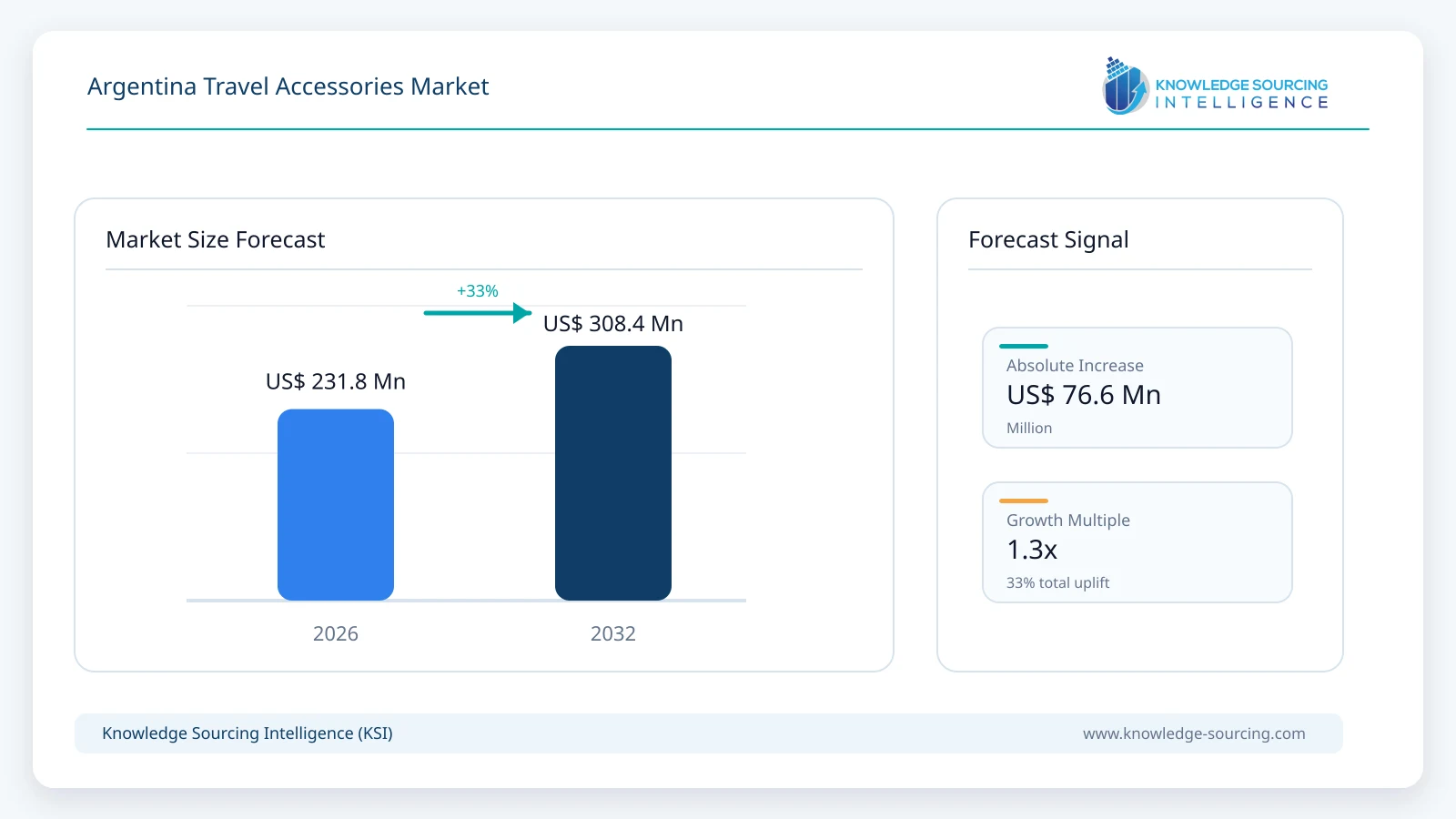
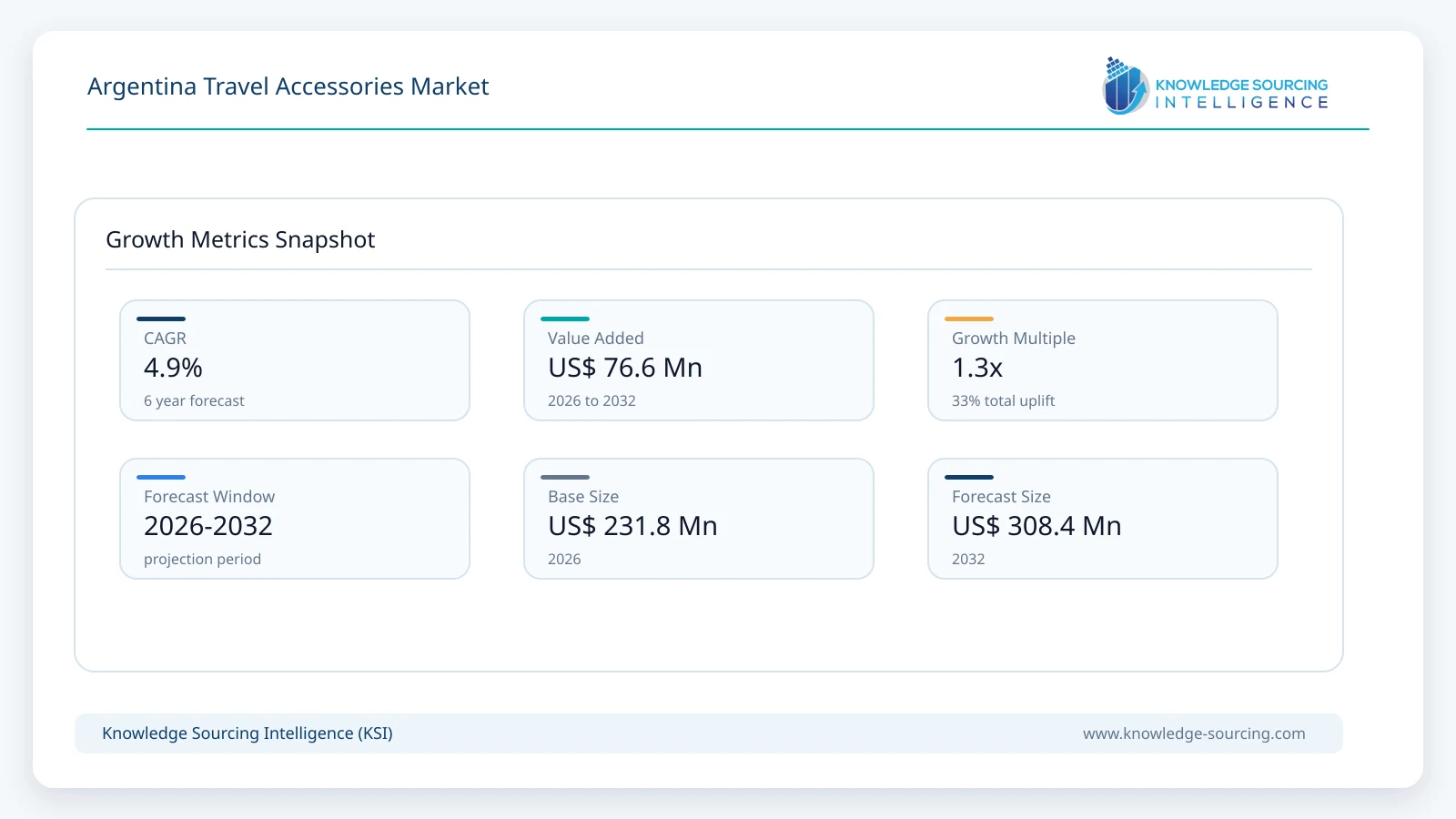
The Argentina Travel Accessories Market is projected to increase from USD 231.8 million in 2026 to USD 308.4 million in 2032, representing a 4.9% CAGR during the forecast period.
Highlights:
- 1Luggage and wheeled cases represent 36.4% of market revenue in 2026, supported by higher retail tickets and periodic replacement of checked and cabin luggage.
- 2Packing and toiletry organizers expand at approximately 7.3% CAGR during 2026–2032, reflecting accessible pricing and purchases accompanying existing luggage.
- 3Travel backpacks and duffels reach US$87.37 million in 2032, supported by short domestic trips, road travel, and practical cabin-carry formats.
- 4Online channels compete strongly on accessory assortment and price transparency, while physical stores remain influential in premium luggage where handle movement, shell strength, and wheel performance matter.
- 5Greater Buenos Aires concentrates higher-value retail demand, while Córdoba, the Litoral and Patagonia support regionally differentiated products for city breaks, longer holidays and outdoor travel.
Demand covers luggage, travel-specific bags, packing products, personal comfort and security items, and electronics accessories intended primarily for use during journeys. Purchasing depends on luggage replacement cycles, household affordability, domestic holidays, regional air connectivity, and the availability of imported products through specialist stores and online retailers.
The commercial environment is more complex than a simple recovery in tourist numbers. In September 2026 Argentina's airports handled more than 4.18 million passengers, a record for the month, while INDEC reported that outbound tourist trips by residents declined compared with September 2025. Travellers can make more domestic flights, extend the life of existing luggage, or purchase a low-cost organizer without buying a new suitcase. These purchasing patterns create separate demand cycles for durable travel goods and smaller accessories.
Import dependence has a direct effect on the product ladder. Customs data for 2024 records more than 1.2 million imported items in the suitcase-related HS 420212 category, with China supplying most units. Although the tariff category includes related containers and is not a perfect luggage-sales measure, it demonstrates the scale of foreign sourcing at the mass-market end. Local distributors and branded suppliers must manage landed costs, seasonal inventory, warranty obligations, and customer demand for installment payments. Currency exposure and retail price competition remain important constraints on margin expansion.
Market Dynamics
Domestic and outbound travel produce different purchasing opportunities
Argentina's domestic tourism market combines family holidays, provincial journeys, visiting friends and relatives, adventure travel, and short city breaks. These trips require different carry solutions. A family travelling by car may reuse several bags and purchase organizers or a duffel, while an international flyer may prioritize airline-compatible cabin luggage and a secure electronics pouch. The result is a diversified market in which journey frequency cannot be treated as equivalent to annual luggage replacement.
The government's October 2026 holiday report recorded 1.5 million domestic travellers during one long weekend, while the national aviation authority reported stronger airport passenger flows in September. These measures demonstrate travel activity, not individual buyers, but they underline the opportunity for retailers to plan inventory around predictable peaks. Retailers that stock the correct price tiers ahead of summer departures, winter holidays, and extended weekends can achieve better sell-through than sellers using the same assortments year-round.
Import economics determine accessible and premium price tiers
The value chain relies heavily on imported finished goods, particularly mass-market bags and wheeled cases. The wide difference between landed customs values and retail selling prices reflects transport, taxation, wholesale margins, retail operating costs, and product mix. Retail prices are not equivalent to customs unit values. Argentina's luggage distributors therefore compete on sourcing efficiency, stock availability, repair arrangements, and the ability to provide credible warranties as much as on branding.
Local wholesale catalogues demonstrate material and feature differentiation. Entry polypropylene and polyester cases compete against higher-priced polycarbonate models, with choices determined by dimensions, weight, handles, wheel assemblies, and closure systems. The consumer trade-off is tangible: a better shell or wheel assembly can reduce product failure during repeated travel, but a higher initial ticket may delay replacement. Premium suppliers need to explain performance advantages rather than rely on generalized durability claims.
Manufacturers and importers also face concentration risk. Heavy dependence on a small group of overseas sourcing countries creates exposure to logistics costs and changes in import conditions. Distributors serving both wholesale and retail customers can diversify channels but may encounter margin conflicts when promotional online prices undercut independent luggage retailers. Inventory planning is particularly important for bulky suitcases, which occupy more warehouse and shop-floor capacity than small travel organizers.
Digital retail broadens selection but sharpens price competition
Argentina's e-commerce sector reported 181.5 million purchase orders during the first six months of 2026, up 21% year-on-year. Travel accessories benefit from this established digital retail infrastructure, particularly where product specifications are standardized. Consumers can compare a travel adapter, luggage lock, packing cube or organizer using photographs, dimensions and ratings without inspecting it in a shop. High-value luggage remains more dependent on tactile evaluation because wheels, telescopic handles, structural rigidity, and finish can be difficult to judge online.
Online marketplaces reduce distribution barriers for small accessory suppliers but also compress prices in easily replicated categories. A packing-cube seller needs attractive styling, reliable fabric and zippers, fast delivery, and credible product dimensions to distinguish its range from imports sold by multiple merchants. Marketplace fees, returns and promotions can materially reduce realized profitability. Retailers with a recognizable brand or coordinated travel sets may sustain better margins by selling accessories alongside luggage rather than as isolated products.
Payment options are important in Argentina. Installment financing can change the affordability of a medium-priced case without reducing its stated ticket. For suppliers, however, promotional financing and merchant transaction costs must be weighed against conversion. The stronger digital channel does not eliminate the role of conventional luggage specialists, which still provide product demonstration, fit assessment, immediate availability, and after-sales support.
Product development is moving toward practical trip efficiency
Lightweight construction, compact dimensions and modular interiors help consumers make more effective use of cabin baggage allowances and crowded transit environments. Hard-shell cases target rolling durability, while soft-sided bags offer flexibility and accessible exterior pockets. Travel backpacks and duffels serve consumers who want one product for bus, road and air travel, making multifunctionality commercially valuable when household budgets limit the number of bags purchased.
Smaller accessories address distinct frictions: organizers reduce packing time, toiletry cases separate liquids from clothing, and security accessories protect personal documents and luggage. These products have shorter purchase cycles than suitcases but also lower barriers to entry. Suppliers cannot assume that product differentiation automatically supports premium pricing; practical performance, fit with existing bags, and merchandising execution are decisive.
Travel electronics require a separate safety and compatibility proposition. Plug adapters and purpose-built travel charging accessories must be selected according to destination, voltage handling, and product certification. Generic headphones, smartphones and ordinary domestic charging equipment do not belong in the category. Producers offering reliable destination guidance and clear electrical specifications can reduce returns and increase trust, particularly as travellers purchase accessories immediately before departure.
Market Segmentation Analysis
By Product Type: Luggage and Wheeled Cases
Luggage and wheeled cases are the largest segment, generating approximately US$84.48 million in 2026. The segment includes cabin-size rolling cases, checked suitcases, soft-sided wheeled designs and coordinated luggage sets used primarily for travel. It does not include ordinary handbags or non-travel storage containers. Retail demand arises through replacement, new household purchases, gifts, and changes in travel requirements, rather than the number of passengers moving through airports alone.
Purchase frequency is structurally different from disposable accessories. A serviceable suitcase can remain in use for several years, even among frequent travellers. Price-sensitive households may postpone replacement until a wheel, zipper, handle or shell fails, or an airline-size requirement makes the existing product inconvenient. This leads to discontinuous demand that is concentrated around holiday periods and promotional events. For suppliers, the objective is to win a replacement decision at the right time rather than presume a direct relationship between annual trips and suitcase purchases.
The 2024 HS 420212 import data highlights an extensive supply of lower-cost externally sourced products. Chinese manufacturing dominates the reported import unit count. Lower customs prices enable accessible retail offers but do not eliminate downstream logistics, duties, domestic distribution or warranty expenses. Retailers balance lower initial procurement costs against failures that could increase returns and customer dissatisfaction. A suitcase with a weak telescopic mechanism may look competitive on shelf price yet impose higher after-sales costs than a better-constructed alternative.
Materials and engineering contribute to meaningful segmentation. Polypropylene cases provide an accessible balance of weight and flexibility, while polycarbonate shells compete on finish, impact behavior and premium positioning. Textile cases can provide expandable pockets and flexible storage. None of these materials guarantees reliability on its own. Wheel housing, stitching, reinforced corners, locks, zippers, interior fastening and handle assemblies influence real-world serviceability. These components help determine repeat purchasing and retailer confidence in a brand.
A comparison of Argentine wholesaler catalogues shows a range of cabin cases at different price points, with entry models and higher-cost polycarbonate designs sold alongside one another. This spectrum allows distributors to compete through assortment depth rather than a single price tier. Premium brands emphasize build consistency, handling, product styling and service coverage; local and value-oriented suppliers focus on affordability and immediate availability. Retailers need product ladders that reflect different income levels and journey frequency instead of concentrating exclusively on fashionable premium designs.
Distribution further differentiates the segment. Luggage specialists can demonstrate wheel movement, handles, capacity and physical dimensions. Large retail chains offer convenient access and promotions; online platforms provide selection breadth and price comparisons. Stronger suppliers coordinate inventory across channels to avoid overstocking obsolete colors and seasonal designs. Bulky cases create meaningful storage costs, so better forecasting and replenishment discipline can matter as much as gross margin per unit.
Competition is especially sensitive to pricing and payment conditions. Long replacement cycles can make consumers reluctant to buy premium luggage without a clear functional improvement. Installment offers may support higher-ticket purchases, but the associated financing costs affect retailer economics. Brands that combine reliable handling, practical dimensions, repairability and appropriate warranties have a stronger basis for sustained pricing than those relying on cosmetic upgrades alone.
Looking forward, the segment is expected to reach US$102.79 million by 2032. Its expansion remains slower than packing accessories because long product life limits repeat purchase frequency. Sales growth depends on price-tier management, consistent product quality, the conversion of new travellers, and well-timed replacement demand. Suppliers that use travel activity to refine inventory and channel strategy, rather than assuming that higher traffic automatically produces higher case sales, are better positioned to protect margins.
By Product Type: Travel Backpacks and Duffels
Travel backpacks and duffels serve overnight trips, student travel, business journeys and leisure weekends. The category benefits from flexible storage, carry-on compatibility and broad portability, but it competes with ordinary backpacks. Dedicated travel features such as suitcase handles, luggage sleeves, compression straps and organized compartments provide a practical distinction. Revenue growth depends on maintaining that differentiation while competing with lower-priced general-purpose alternatives.
By Product Type: Packing and Toiletry Organizers
Packing cubes, toiletry bags, compression pouches and garment organizers are small-ticket accessories that can be added to a luggage purchase. Product sales benefit from family travel and increasingly organized packing habits, but inexpensive imported alternatives make differentiation difficult. Coordinated sets, durable zippers and clear capacity specifications support higher attachment rates and reduce customer confusion during online ordering.
By Product Type: Travel Electronics and Adapters
Travel electronics and adapters are forecast to reach US$34.43 million by 2032. The category includes travel-specific plug adapters and dedicated journey-related electronic accessories. Compatibility, safety, product labeling and customer trust influence purchases more than general consumer-electronics innovation. Online comparison is important, but technical claims must be sufficiently clear to distinguish a travel converter from a simple plug adapter.
By Product Type: Comfort, Security and Other Accessories
Comfort products and security items, including neck pillows, luggage locks, travel covers and document wallets, appeal to consumers looking to improve a particular trip. Their purchasing cycle can be shorter than luggage, but products remain exposed to commodity price competition. Merchandising around departure periods and the sale of compatible accessory bundles help suppliers convert convenience into repeatable demand.
By Distribution Channel
Online channels provide assortment depth, price comparisons and convenient delivery, particularly for low-ticket organizers and accessories. Offline channels remain important for cases and bags requiring physical inspection. Specialist retailers add value through warranties, fit assessment and brand expertise, while mass merchants and airport outlets compete on convenience and promotional pricing. The optimal channel mix therefore depends on product value, the need for demonstration, and the economics of fulfillment and returns.
By End User
Leisure travellers constitute the largest demand group because domestic holidays, short breaks and family journeys create a broad range of accessory needs. Business travellers prioritize efficient packing, laptop protection, reliable wheels and compact carry systems. Other travellers, including students and people undertaking extended temporary stays, purchase selected carry solutions without having the same buying patterns as leisure or business users.
Argentina Regional Outlook
Buenos Aires Metropolitan Area
Greater Buenos Aires is the country's largest concentration of formal retail outlets, import distribution and premium consumer demand. Specialist stores and national e-commerce fulfillment networks provide broad product availability. Its market position reflects population, income distribution and retail infrastructure, not simply passenger volumes through Ezeiza and Aeroparque. Urban buyers have access to branded luggage, locally distributed alternatives and price-comparison channels.
Buenos Aires Province outside AMBA and Centro
Demand in provincial Buenos Aires and central Argentina combines domestic trips, family travel and national air connections. Córdoba and other principal cities support luggage specialists and online fulfillment. Practical midmarket cases, duffels and organizers are relevant to both road journeys and intercity transport, while premium products compete primarily among consumers who prioritize reliability and warranty coverage.
Litoral and Cuyo
The Litoral serves visitors and residents travelling through river, road and regional aviation networks. Cuyo supports travel linked to Mendoza and surrounding destinations. Accessories purchased before departure compete with last-minute convenience purchases in transport hubs and destination towns. Merchants benefit from flexible assortments that address both short domestic journeys and longer trips requiring more structured luggage.
Norte and Patagonia
Northern provinces and Patagonia have different journey characteristics but share opportunities for compact durable bags and travel organizers. Patagonia's longer distances and adventure-oriented travel support rugged designs and functional compartments, while northern regional travel benefits from affordable carry products and increasing air connectivity. Distribution costs and local inventory access can influence consumer price levels more strongly than in the metropolitan area.
Competitive Environment
Competition is fragmented across multinational luggage groups, national brands, domestic distributors and online private-label sellers. Samsonite's Argentine business distributes branded travel collections, including American Tourister. Primicia offers a broad local luggage catalogue across materials and price points. Specialist importers and retailers such as La Valija distribute both international and domestic brands, while online merchants compete in organizers, simple travel adapters and comfort accessories. Global names including DELSEY and Victorinox participate primarily through distribution and selected premium products, where available.
Market share depends on the retail price tier and distribution channel. Branded luggage can compete on warranty credibility, handling and design, whereas smaller trip accessories often have low brand loyalty and limited product protection. Retailers that maintain disciplined inventory and offer appropriate financing terms can protect sales despite changes in travel patterns. The strongest competitive propositions connect product reliability, attainable prices and convenient availability rather than relying solely on an expanding traveller population.
Recent Developments
October 26, 2026: INDEC reported 613,100 outbound tourist trips by Argentine residents in September, a 13.2% year-on-year decrease.
October 13, 2026: Argentina's civil aviation authority reported 4.19 million airport passengers in September, the highest September level on record.
October 12, 2026: Argentina's tourism secretariat reported 1.5 million domestic travellers during the long weekend, an increase of 3.5% from the previous year.
October 9, 2026: Argentina announced lower regional airport charges for selected short international routes, effective December 2026.
September 25, 2026: INDEC reported 652,100 resident outbound tourist trips in August, down 18.3% year-on-year.
Argentina Travel Accessories Market Scope
| Report Metric | Details |
|---|---|
| Total Market Size in 2026 | USD 231.8 million |
| Total Market Size in 2032 | USD 308.4 million |
| Forecast Unit | Million |
| Growth Rate | 4.9% |
| Study Period | 2021 to 2032 |
| Historical Data | 2021 to 2024 |
| Base Year | 2025 |
| Forecast Period | 2026 – 2032 |
| Segmentation | Product Type, Distribution Channel, End User |
| Companies |
|
| Customization Scope | 15% Free Customization included with purchase — Request Custom Breakdown → |
| Sample & Data Access | PDF Sample, Excel Databook & Analyst Briefing — Download Free Sample → |
Market Segmentation
By Product Type
Luggage and Wheeled Cases
Travel Backpacks and Duffels
Packing and Toiletry Organizers
Travel Electronics and Adapters
Comfort and Security Accessories
Other Trip-Specific Accessories
By Distribution Channel
Online
Offline
Luggage and Specialty Stores
Department Stores and Mass Merchandisers
Airport and Travel Retail
Other Offline Channels
By End User
Leisure Travellers
Business Travellers
Other Travel Users
By Geography
Buenos Aires Metropolitan Area
Buenos Aires Province excluding AMBA
Centro
Litoral
Cuyo
Norte
Patagonia
Table of Contents
1. EXECUTIVE SUMMARY
1.1. Market Snapshot and Key Findings
1.2. Market Size and Outlook, 2026–2032
1.3. Commercial Opportunities and Risks
2. RESEARCH SCOPE AND METHODOLOGY
2.1. Market Definition and Inclusion Criteria
2.2. Historical and Forecast Timeline
2.3. Product Classification and Price Basis
2.4. Market Estimation and Validation
3. ARGENTINA TRAVEL ACCESSORIES MARKET OVERVIEW
3.1. Retail Value Chain and Import Structure
3.2. Tourism Demand and Purchase Conversion
3.3. Replacement Cycles and Product Price Tiers
3.4. Competitive and Distribution Structure
4. MARKET DYNAMICS
4.1. Market Drivers
4.1.1. Domestic Holidays and Regional Travel
4.1.2. Airport Connectivity and International Journeys
4.1.3. Packing Efficiency and Multifunctional Products
4.1.4. Digital Retail and Product Assortment
4.1.5. Practical Materials and Product Durability
4.2. Market Restraints
4.2.1. Consumer Purchasing Power and Currency Volatility
4.2.2. Long Luggage Replacement Cycles
4.2.3. Import and Inventory Exposure
4.2.4. Online Price Competition
4.2.5. Seasonal Sales Concentration
4.3. Market Opportunities
4.4. Porter's Five Forces Analysis
4.5. Industry Value Chain Analysis
5. ARGENTINA TRAVEL ACCESSORIES MARKET BY PRODUCT TYPE
5.1. Introduction
5.2. Luggage and Wheeled Cases
5.3. Travel Backpacks and Duffels
5.4. Packing and Toiletry Organizers
5.5. Travel Electronics and Adapters
5.6. Comfort and Security Accessories
5.7. Other Trip-Specific Accessories
6. ARGENTINA TRAVEL ACCESSORIES MARKET BY DISTRIBUTION CHANNEL
6.1. Introduction
6.2. Online
6.3. Offline
6.3.1. Luggage and Specialty Stores
6.3.2. Department Stores and Mass Merchandisers
6.3.3. Airport and Travel Retail
6.3.4. Other Offline Channels
7. ARGENTINA TRAVEL ACCESSORIES MARKET BY END USER
7.1. Introduction
7.2. Leisure Travellers
7.3. Business Travellers
7.4. Other Travel Users
8. ARGENTINA TRAVEL ACCESSORIES MARKET BY GEOGRAPHY
8.1. Introduction
8.2. Buenos Aires Metropolitan Area
8.3. Buenos Aires Province excluding AMBA
8.4. Centro
8.5. Litoral
8.6. Cuyo
8.7. Norte
8.8. Patagonia
9. COMPETITIVE ENVIRONMENT AND ANALYSIS
9.1. Competitive Strategy and Price Tier Analysis
9.2. Product and Channel Comparison
9.3. Import Supply Chain and Distribution
9.4. Partnerships, Launches and Collaborations
9.5. Competitive Dashboard
10. COMPANY PROFILES
10.1. Samsonite Group S.A.
10.2. American Tourister (Samsonite Group)
10.3. Xtrem
10.4. Primicia
10.5. DELSEY Paris
10.6. Victorinox
10.7. Kether S.A.
10.8. Travel House
10.9. Thule Group
10.10. Targus
10.11. Pierre Cardin Travel Goods
10.12. Benetton Travel Goods
11. APPENDIX
11.1. Currency and Measurement Basis
11.2. Source Definitions
11.3. Base and Forecast Years
11.4. Research Methodology
11.5. Abbreviations
11.6. Market Segmentation Definitions





Frequently asked questions
What is the projected market size for Argentina travel accessories by 2032?
Market projects to reach $308.4 million by 2032, from $231.8 million.
What is the compound annual growth rate (CAGR) forecast?
The Argentina Travel Accessories Market is forecast to grow at a 4.9% CAGR (2026-2032).
Which product category dominates market revenue?
Luggage and wheeled cases represent 36.4% of 2026 market revenue.
Which accessory segment shows notable growth?
Packing and toiletry organizers expand at approximately 7.3% CAGR.
Which region concentrates higher-value retail demand?
Greater Buenos Aires concentrates higher-value retail demand.
What are key factors influencing purchasing decisions?
Luggage replacement, affordability, domestic holidays, and imports influence purchases.
Cite this report
Knowledge Sourcing Intelligence. (Oct 2026). Argentina Travel Accessories Market - Strategic Insights and Forecasts (2026-2032). https://www.knowledge-sourcing.com/report/argentina-travel-accessories-market