
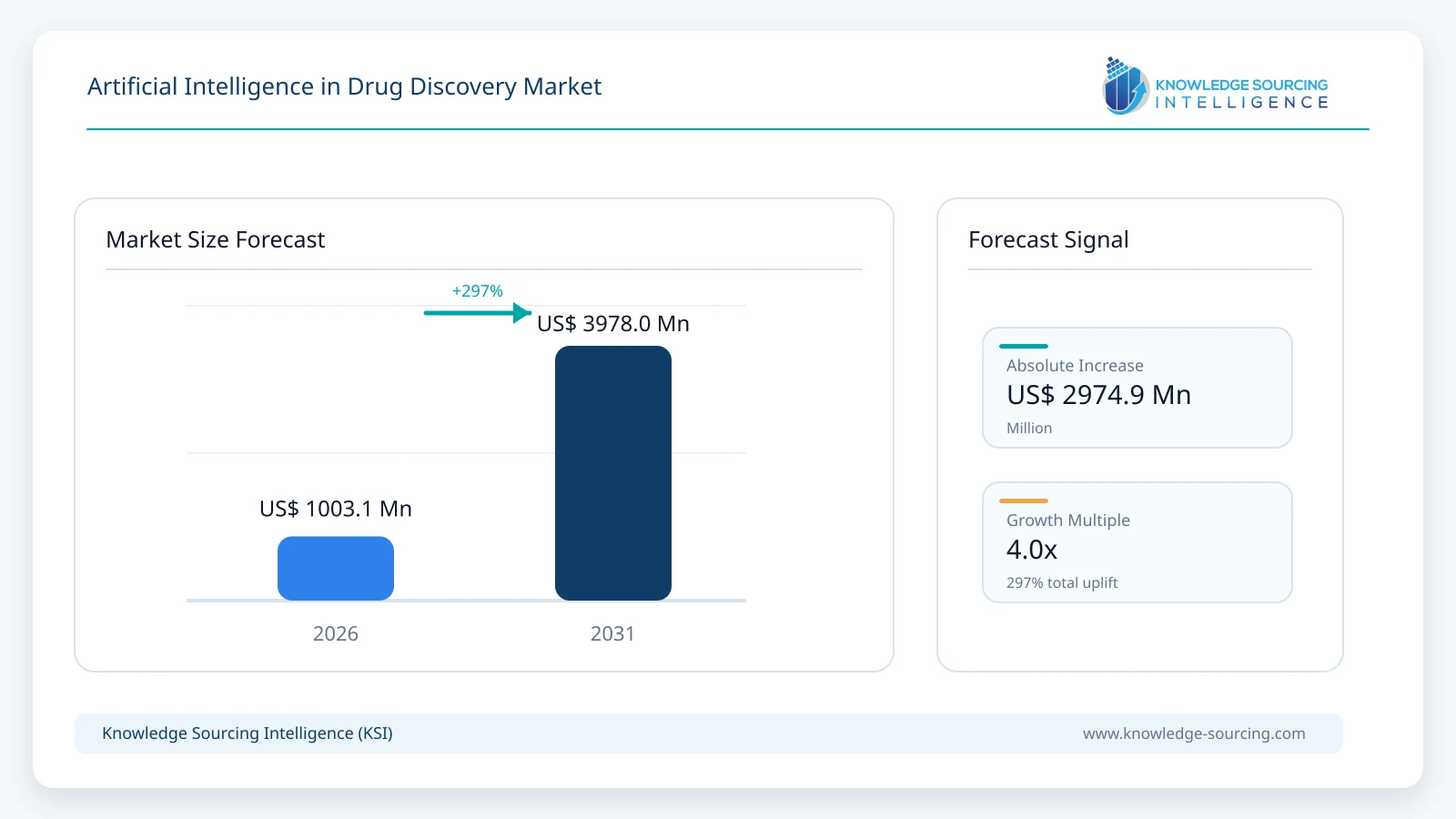
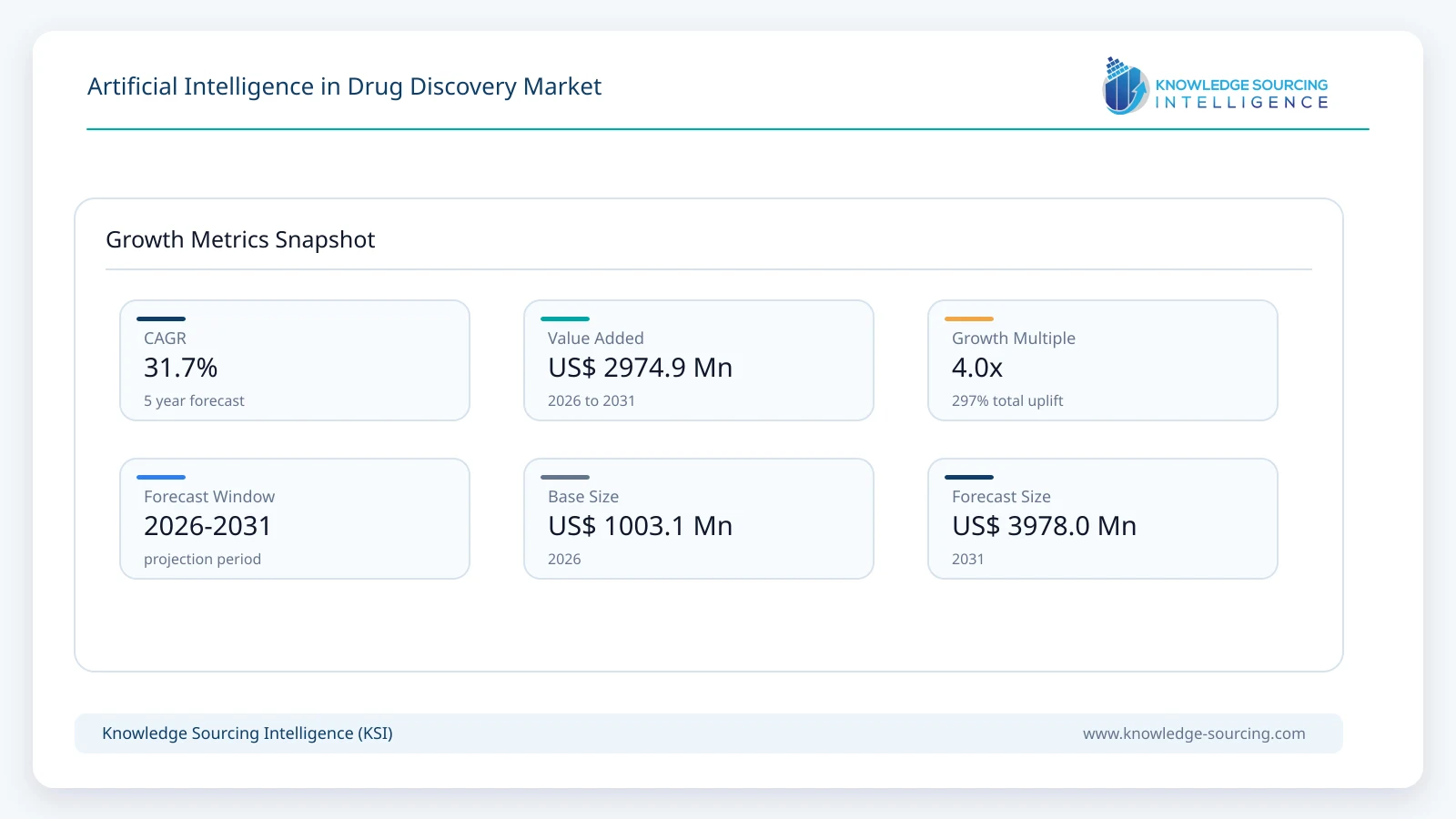
The Artificial Intelligence in Drug Discovery Market is forecast to grow at a CAGR of 31.7%, reaching USD 3,978.0 million in 2031 from USD 1,003.1 million in 2026.
Highlights:
- 1Growing pharmaceutical R&D expenditure and declining research productivity continue to stimulate investment in AI-assisted drug discovery platforms.
- 2Target identification and validation remain commercially important applications because early-stage decisions strongly influence downstream development costs.
- 3North America maintains the largest demand base due to established pharmaceutical research infrastructure, venture capital investment, and cloud computing capabilities.
- 4Foundation AI models combining molecular biology, chemistry, and genomics are expanding the analytical scope of drug discovery platforms.
- 5Regulatory agencies continue to encourage structured validation, data transparency, and Good Machine Learning Practice for AI-enabled healthcare applications.
- 6Competition increasingly depends on proprietary biological datasets, computational infrastructure, and long-term pharmaceutical partnerships rather than standalone software capabilities.
Artificial intelligence in drug discovery refers to the application of machine learning, deep learning, natural language processing (NLP), and related computational methods across the pharmaceutical research workflow, including target identification, molecule design, lead optimization, toxicity assessment, biomarker discovery, and clinical trial planning. Rather than replacing laboratory research, AI functions as a decision-support layer that enables researchers to analyze biological, chemical, genomic, and clinical datasets at a scale that conventional computational methods cannot efficiently manage.
Commercial demand is being shaped by persistent pressure on pharmaceutical research productivity. Drug developers continue to face long development timelines, high attrition rates during clinical development, and rising research expenditure. AI platforms are increasingly being procured to improve candidate selection, reduce experimental iterations, and prioritize compounds with higher probabilities of clinical success. Pharmaceutical companies remain the largest purchasers, although biotechnology companies and contract research organizations (CROs) are expanding adoption as AI software becomes more accessible through cloud-based deployment models.
The industry operates through collaboration between enterprise software providers, AI-focused biotechnology companies, cloud computing firms, computational chemistry specialists, and pharmaceutical manufacturers. Software represents the principal revenue source because algorithm licensing, predictive analytics platforms, molecular simulation tools, and foundation models can be integrated into existing discovery workflows without replacing laboratory infrastructure. Service revenue continues to expand as organizations require model customization, workflow integration, data engineering, validation, and regulatory documentation.
Technology adoption varies across discovery stages. Machine learning is widely deployed for target prioritization and predictive modeling, while deep learning supports molecular generation and protein structure prediction. NLP platforms extract scientific evidence from biomedical literature, patents, clinical trial registries, and electronic health records, enabling researchers to identify emerging biological relationships more efficiently. Buyers increasingly evaluate AI solutions based on explainability, interoperability with laboratory information management systems, computational scalability, and the availability of validated biological datasets rather than algorithmic performance alone.
Market Drivers
One of the strongest demand drivers is the continued escalation of pharmaceutical research costs alongside relatively modest improvements in clinical success rates. Pharmaceutical companies increasingly view AI as an economic tool capable of reducing expensive laboratory screening campaigns through computational prioritization of drug candidates. Procurement decisions increasingly emphasize platforms demonstrating measurable reductions in experimental cycles, resource utilization, and candidate failure rates.
The rapid expansion of biological datasets has also strengthened demand. Advances in next-generation sequencing, proteomics, transcriptomics, imaging technologies, and electronic health records have generated data volumes that exceed conventional analytical capacity. AI enables researchers to integrate heterogeneous datasets into unified biological models, supporting improved target discovery and biomarker identification. Organizations with extensive proprietary datasets therefore possess an important commercial advantage.
Cloud computing infrastructure has become another enabling factor. Pharmaceutical companies increasingly prefer scalable computing resources capable of supporting foundation models, molecular simulations, and high-throughput virtual screening without substantial internal hardware investments. Technology providers offering integrated cloud services, GPU acceleration, and enterprise security have strengthened their competitive position through reduced deployment complexity.
Strategic collaborations between pharmaceutical companies and AI specialists continue to expand industry investment. Rather than developing proprietary AI capabilities independently, pharmaceutical organizations frequently establish licensing agreements, co-development partnerships, or joint research programs that reduce technical risk while accelerating technology adoption. These partnerships also provide AI developers with access to proprietary biological data and clinical expertise that strengthen future platform development.
Market Restraints and Challenges
Data quality remains one of the industry's primary constraints. Drug discovery requires standardized biological, chemical, genomic, and clinical information collected across multiple research environments. Inconsistent experimental protocols, incomplete datasets, and fragmented data ownership reduce algorithm reliability and limit model generalization across therapeutic programs. Companies increasingly invest in internal data governance and curation to address these limitations.
Regulatory uncertainty also affects commercial adoption. Although regulatory agencies support innovation, AI-generated evidence used in pharmaceutical development must satisfy established scientific validation requirements. Buyers therefore prioritize platforms capable of producing transparent, reproducible, and explainable outputs suitable for regulatory documentation. Vendors unable to demonstrate algorithm validation may encounter longer procurement cycles.
Integration complexity presents another challenge. Many pharmaceutical organizations operate legacy laboratory systems developed over several decades. Integrating AI software with laboratory information management systems, electronic notebooks, chemical databases, and computational chemistry workflows requires substantial technical expertise and implementation resources, increasing deployment costs.
The limited availability of multidisciplinary expertise continues to influence purchasing decisions. Successful AI deployment requires computational scientists, medicinal chemists, molecular biologists, bioinformaticians, and regulatory specialists working within integrated research teams. Competition for experienced personnel remains intense, particularly among biotechnology companies with limited recruitment budgets.
Major Segment Analysis
Software represents the most commercially important offering within the Artificial Intelligence in Drug Discovery Market because software platforms generate recurring licensing revenue while supporting multiple discovery functions throughout pharmaceutical research.
Large pharmaceutical organizations increasingly procure enterprise software capable of integrating molecular modeling, target identification, predictive toxicology, and clinical data analysis into unified research environments. Buyers seek flexible platforms that accommodate evolving research priorities rather than isolated analytical applications.
Competitive differentiation increasingly depends on proprietary algorithms, validated biological datasets, cloud-native deployment, computational efficiency, and compatibility with laboratory workflows. Vendors capable of demonstrating measurable improvements in discovery productivity are better positioned to secure multi-year enterprise agreements. Subscription licensing and usage-based pricing models further improve revenue predictability while encouraging long-term customer relationships.
Software also benefits from continuous performance improvements as additional biological and chemical datasets become available. Unlike laboratory equipment requiring physical replacement, AI software platforms can deliver expanded analytical capabilities through periodic updates, strengthening customer retention and recurring commercial revenue.
Regional Analysis
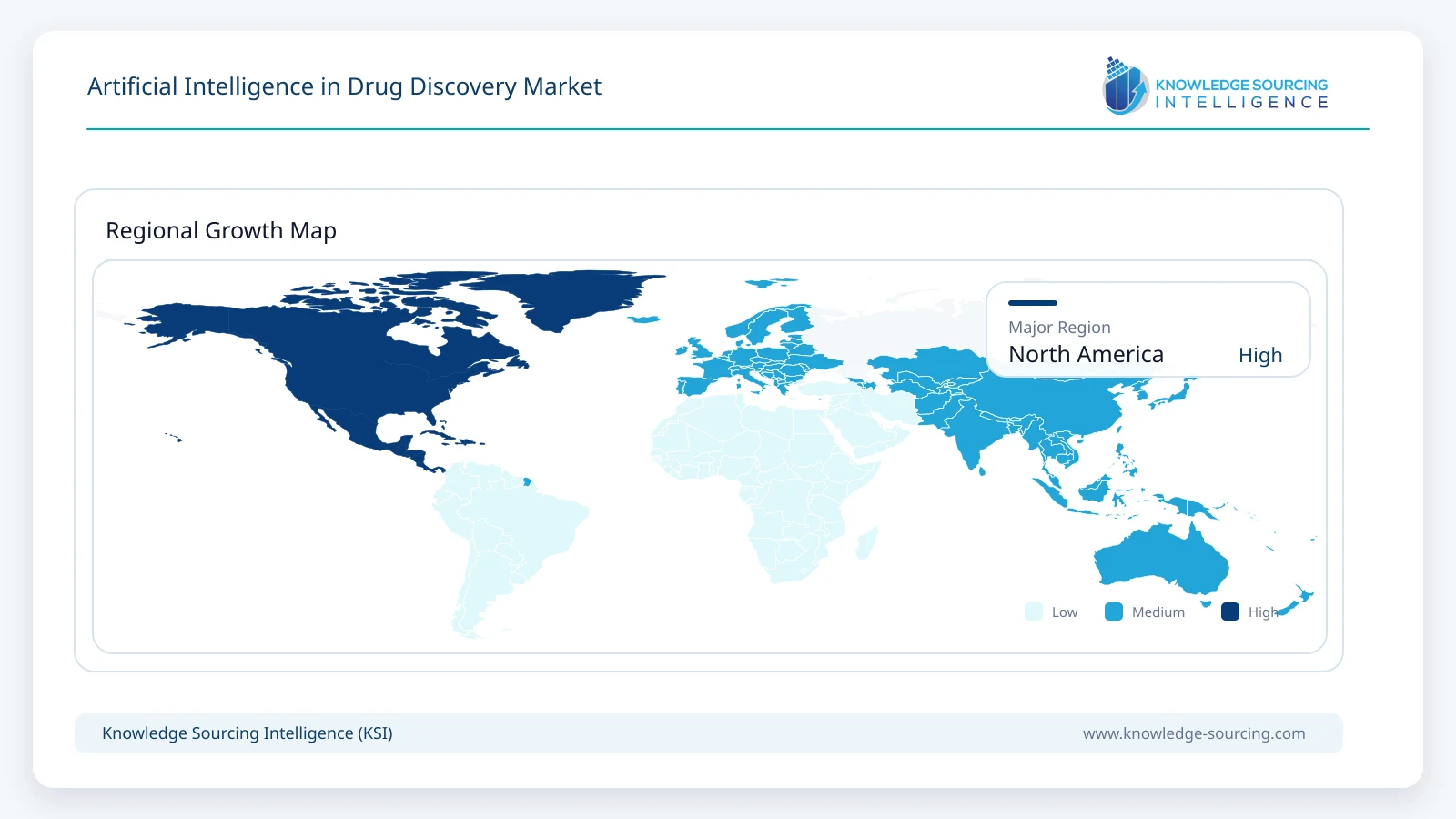
North America represents the largest regional market due to substantial pharmaceutical R&D expenditure, mature biotechnology ecosystems, advanced cloud infrastructure, and strong venture capital investment. The United States accounts for the majority of regional demand, supported by established pharmaceutical manufacturers, academic medical centers, and AI technology companies. Procurement decisions increasingly prioritize enterprise-scale deployments integrated across discovery programs.
Europe maintains strong adoption through pharmaceutical innovation, academic research collaboration, and public investment supporting life sciences research. Countries including the United Kingdom, Germany, and France continue expanding AI capabilities through collaborative research initiatives linking universities, biotechnology companies, and pharmaceutical manufacturers. Data governance requirements remain comparatively stringent, encouraging investment in explainable AI solutions.
Asia Pacific is becoming an important investment destination as pharmaceutical manufacturing expands alongside biotechnology research capabilities. China, Japan, India, South Korea, Taiwan, and Australia continue strengthening national research infrastructure while increasing computational biology capacity. Growing clinical research activity and government support for digital health technologies contribute to broader AI adoption across pharmaceutical research organizations.
Middle East & Africa and South America remain comparatively smaller markets but present selective opportunities. Investment concentrates primarily within government-supported research institutions, multinational pharmaceutical operations, and regional biotechnology initiatives. Infrastructure limitations, workforce availability, and funding constraints continue moderating adoption, although targeted national innovation strategies support gradual expansion.
Competitive Landscape
Competition combines established enterprise technology companies with specialized AI drug discovery developers possessing proprietary biological datasets and computational platforms. IBM Corporation, Microsoft Corporation, Alphabet Inc. (Google), NVIDIA Corporation, Atomwise, Inc., BenevolentAI, Exscientia plc, Insilico Medicine, Schrödinger, Inc., and Recursion Pharmaceuticals compete through different combinations of software infrastructure, molecular modeling, cloud computing, generative AI, computational chemistry, and collaborative drug development capabilities.
Long-term pharmaceutical partnerships have become an important competitive differentiator because they provide access to proprietary research data while validating platform performance under commercial conditions. Companies also invest in GPU computing, foundation models, automated laboratory integration, and explainable AI capabilities to strengthen customer retention. Geographic expansion increasingly emphasizes proximity to pharmaceutical research clusters across North America, Europe, and Asia Pacific.
Recent Developments
June 2026: Bayer and Iambic Therapeutics announced an AI-powered small molecule drug discovery collaboration, leveraging Iambic's Enchant and NeuralPLexer platforms to identify novel therapeutic candidates targeting previously difficult-to-drug biological targets.
April 2026: Novo Nordisk and OpenAI announced a strategic partnership to integrate advanced AI across drug discovery and medicine development, enabling faster identification of promising drug candidates while strengthening responsible AI governance throughout research operations.
March 2026: Insilico Medicine announced a drug discovery collaboration with Eli Lilly valued at up to approximately US$2.75 billion. The agreement expands commercial validation of AI-enabled therapeutic discovery platforms.
February 2026: Merck (MSD) and Mayo Clinic entered a strategic research collaboration to apply artificial intelligence, machine learning, multimodal clinical data, and genomic insights for AI-enabled drug discovery, target identification, and early-stage drug development.
Regulatory and Policy Environment
Regulatory oversight increasingly emphasizes transparency, reproducibility, cybersecurity, and data integrity rather than AI algorithms alone. Pharmaceutical developers must demonstrate that AI-assisted analyses support scientifically valid decision-making throughout drug development. Agencies including the U.S. FDA and the European Medicines Agency continue promoting structured approaches for AI validation while encouraging Good Machine Learning Practice and risk-based oversight for AI-enabled medical products. Compliance with Good Clinical Practice, Good Laboratory Practice, data privacy regulations, and secure electronic record management remains essential for commercial deployment.
Outlook and Strategic Implications
Commercial investment is expected to concentrate on integrated AI platforms capable of combining molecular biology, chemistry, genomics, imaging, and clinical evidence within unified research environments. Buyers are likely to prioritize enterprise solutions demonstrating measurable improvements in research productivity, transparent model validation, and seamless integration with existing laboratory infrastructure.
Technology competition will increasingly extend beyond algorithm performance toward ownership of proprietary biological datasets, computational infrastructure, and collaborative pharmaceutical ecosystems. Cloud computing providers, AI specialists, and pharmaceutical companies are expected to deepen strategic alliances that combine computing capacity with therapeutic expertise.
Future procurement decisions will increasingly consider regulatory readiness, cybersecurity, explainability, and lifecycle support alongside predictive accuracy. Organizations capable of delivering validated software platforms supported by scalable cloud infrastructure, multidisciplinary scientific expertise, and established pharmaceutical partnerships are expected to strengthen their competitive position as AI becomes a standard component of modern drug discovery workflows.
AI in Drug Discovery Market Scope
| Report Metric | Details |
|---|---|
| Total Market Size in 2026 | USD 1,003.1 million |
| Total Market Size in 2031 | USD 3,978.0 million |
| Forecast Unit | Million |
| Growth Rate | 31.7% |
| Study Period | 2021 to 2031 |
| Historical Data | 2021 to 2024 |
| Base Year | 2025 |
| Forecast Period | 2026 – 2031 |
| Segmentation | Offering, Technology, Therapeutic Area, Application, End-User, Geography |
| Companies |
|
Market Segmentation
By Offering
- Software
- Services
By Technology
- Machine Learning
- Deep Learning
- Natural Language Processing (NLP)
- Other AI Technologies
By Therapeutic Area
- Oncology
- Neurology
- Cardiovascular Diseases
- Infectious Diseases
- Immunology
- Rare Diseases
- Others
By Application
- Target Identification and Validation
- Hit-to-Lead Identification
- Lead Optimization
- Drug Repurposing
- Clinical Trial Optimization
- Biomarker Discovery
- Toxicity Prediction
- Others
By End-User
- Pharmaceutical Companies
- Biotechnology Companies
- Contract Research Organizations (CROs)
- Research Institutes
- Others
By Geography
- North America
- United States
- Canada
- Mexico
- South America
- Brazil
- Argentina
- Others
- Europe
- United Kingdom
- Germany
- France
- Italy
- Spain
- Others
- Middle East and Africa
- Saudi Arabia
- UAE
- Others
- Asia Pacific
- Japan
- China
- India
- South Korea
- Australia
- Indonesia
- Taiwan
- Others
Table of Contents
1. INTRODUCTION
1.1. Market Overview
1.2. Market Definition
1.3. Scope of the Study
1.4. Market Segmentation
1.5. Currency
1.6. Assumptions
1.7. Base and Forecast Years Timeline
2. RESEARCH METHODOLOGY
2.1. Research Data
2.2. Research Process
3. EXECUTIVE SUMMARY
3.1. Research Highlights
4. MARKET DYNAMICS
4.1. Market Drivers
4.2. Market Restraints
4.3. Porter's Five Forces Analysis
4.3.1. Bargaining Power of Suppliers
4.3.2. Bargaining Power of Buyers
4.3.3. Threat of New Entrants
4.3.4. Threat of Substitutes
4.3.5. Competitive Rivalry in the Industry
4.4. Industry Value Chain Analysis
5. ARTIFICIAL INTELLIGENCE (AI) IN THE DRUG DISCOVERY MARKET BY OFFERING
5.1. Introduction
5.2. Software
5.3. Services
6. ARTIFICIAL INTELLIGENCE (AI) IN THE DRUG DISCOVERY MARKET BY TECHNOLOGY
6.1. Introduction
6.2. Machine Learning
6.3. Deep Learning
6.4. Natural Language Processing (NLP)
6.5. Other AI Technologies
7. ARTIFICIAL INTELLIGENCE (AI) IN THE DRUG DISCOVERY MARKET BY THERAPEUTIC AREA
7.1. Introduction
7.2. Oncology
7.3. Neurology
7.4. Cardiovascular Diseases
7.5. Infectious Diseases
7.6. Immunology
7.7. Rare Diseases
7.8. Others
8. ARTIFICIAL INTELLIGENCE (AI) IN THE DRUG DISCOVERY MARKET BY APPLICATION
8.1. Introduction
8.2. Target Identification and Validation
8.3. Hit-to-Lead Identification
8.4. Lead Optimization
8.5. Drug Repurposing
8.6. Clinical Trial Optimization
8.7. Biomarker Discovery
8.8. Toxicity Prediction
8.9. Others
9. ARTIFICIAL INTELLIGENCE (AI) IN THE DRUG DISCOVERY MARKET BY END-USER
9.1. Introduction
9.2. Pharmaceutical Companies
9.3. Biotechnology Companies
9.4. Contract Research Organizations (CROs)
9.5. Research Institutes
9.6. Others
10. ARTIFICIAL INTELLIGENCE (AI) IN THE DRUG DISCOVERY MARKET BY GEOGRAPHY
10.1. Introduction
10.2. North America
10.2.1. United States
10.2.2. Canada
10.2.3. Mexico
10.3. South America
10.3.1. Brazil
10.3.2. Argentina
10.3.3. Others
10.4. Europe
10.4.1. United Kingdom
10.4.2. Germany
10.4.3. France
10.4.4. Italy
10.4.5. Spain
10.4.6. Others
10.5. Middle East and Africa
10.5.1. Saudi Arabia
10.5.2. UAE
10.5.3. Others
10.6. Asia Pacific
10.6.1. Japan
10.6.2. China
10.6.3. India
10.6.4. South Korea
10.6.5. Australia
10.6.6. Indonesia
10.6.7. Taiwan
10.6.8. Others
11. COMPETITIVE ENVIRONMENT AND ANALYSIS
11.1. Major Players and Strategy Analysis
11.2. Market Share Analysis
11.3. Mergers, Acquisitions, Agreements, and Collaborations
12. COMPANY PROFILES
12.1. IBM Corporation
12.2. Microsoft Corporation
12.3. Alphabet Inc. (Google)
12.4. NVIDIA Corporation
12.5. Atomwise, Inc.
12.6. BenevolentAI
12.7. Exscientia plc
12.8. Insilico Medicine
12.9. Schrödinger, Inc.
12.10. Recursion Pharmaceuticals, Inc.
Navigate
Trusted by the world's leading organizations











