
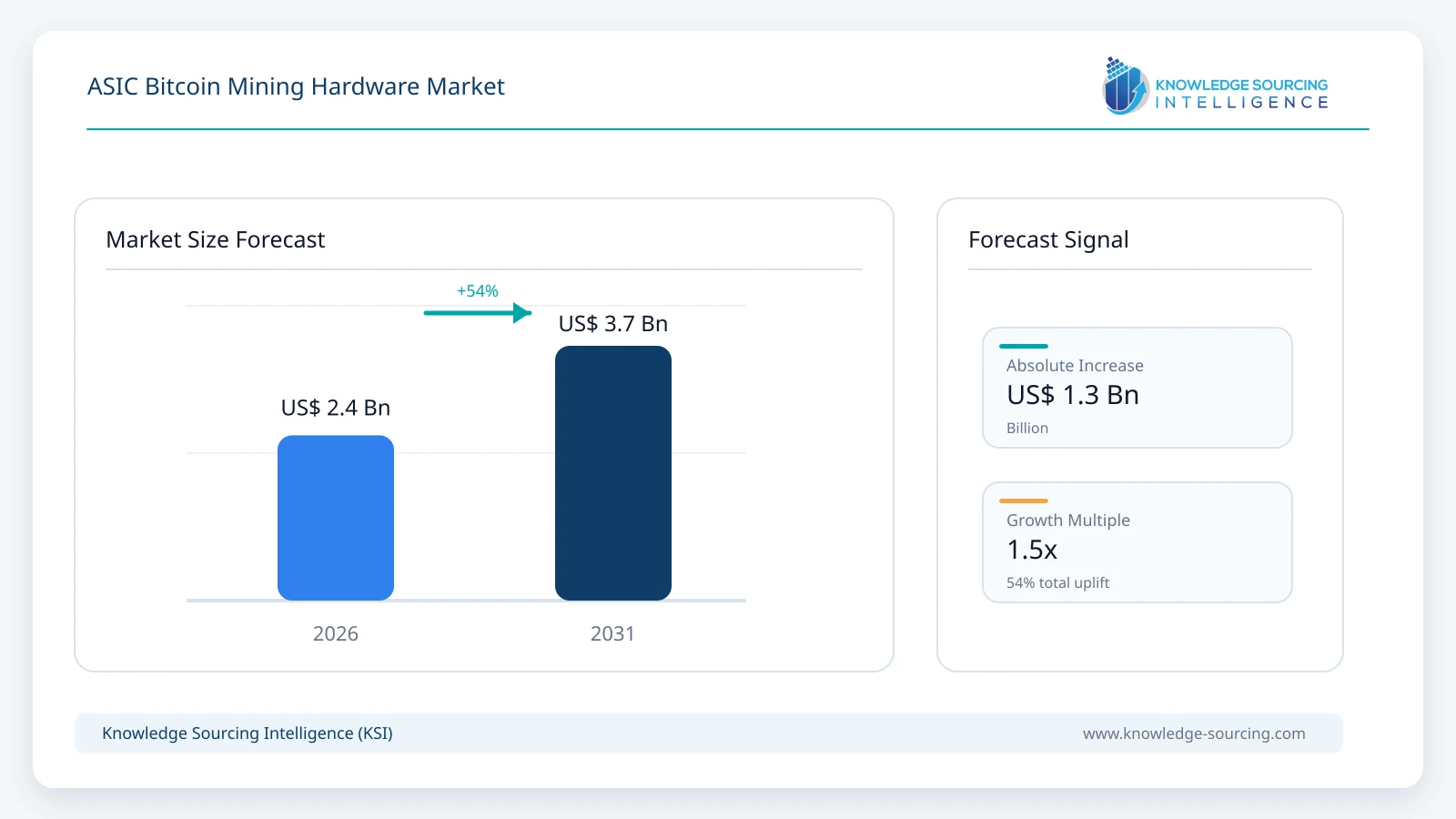
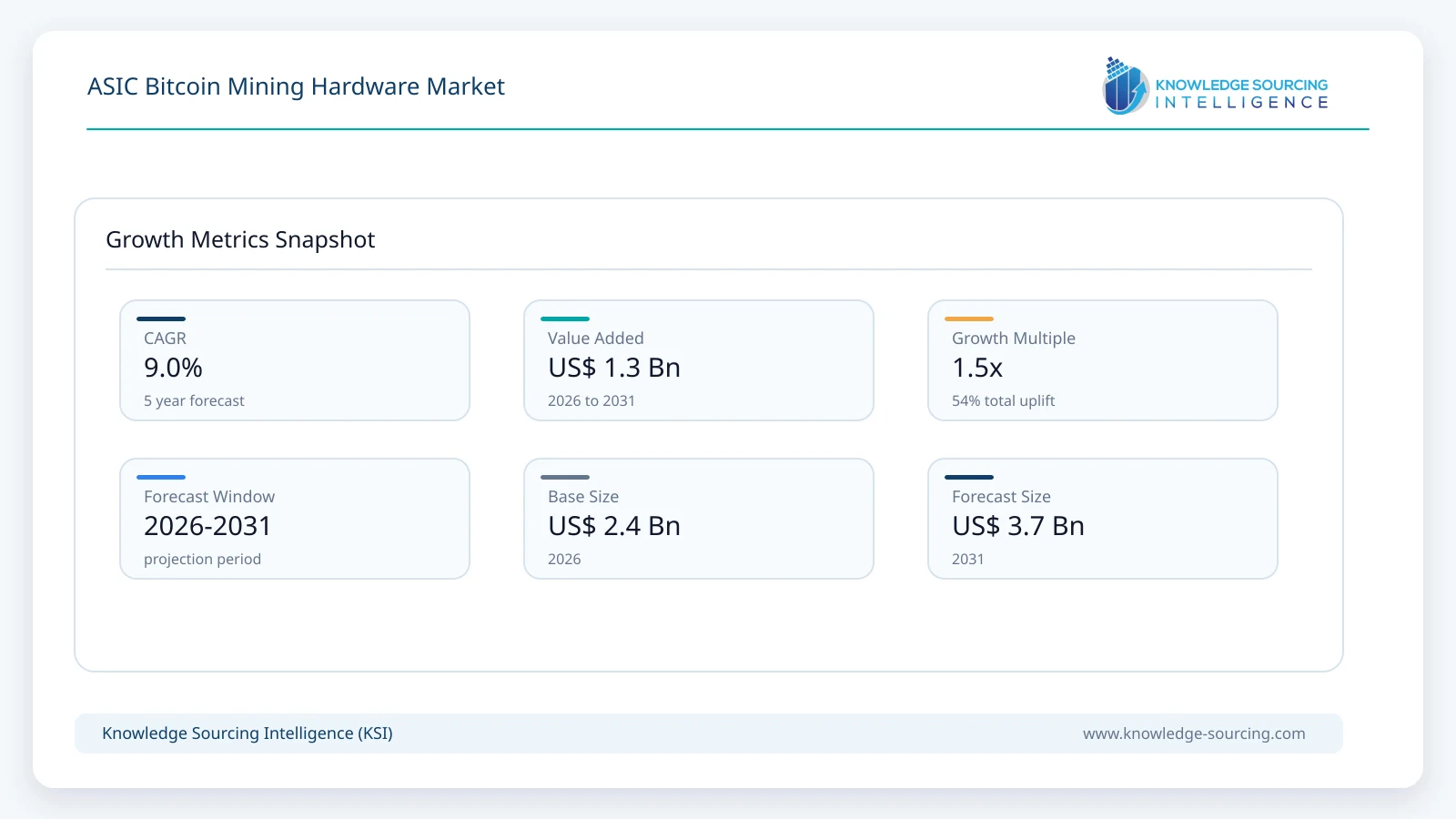
The ASIC Bitcoin Mining Hardware Market is projected to expand at a CAGR of 9.04%, reaching USD 3.70 billion in 2031 from USD 2.40 billion in 2026.
Highlights:
- 1Enterprise mining operators account for the overwhelming majority of equipment purchasing value.
- 2Hydro-cooled miners represent approximately 35% of 2026 value as farms prioritize thermal efficiency.
- 3Frontier-efficiency hardware is increasingly important in fleet replacement and capacity expansion.
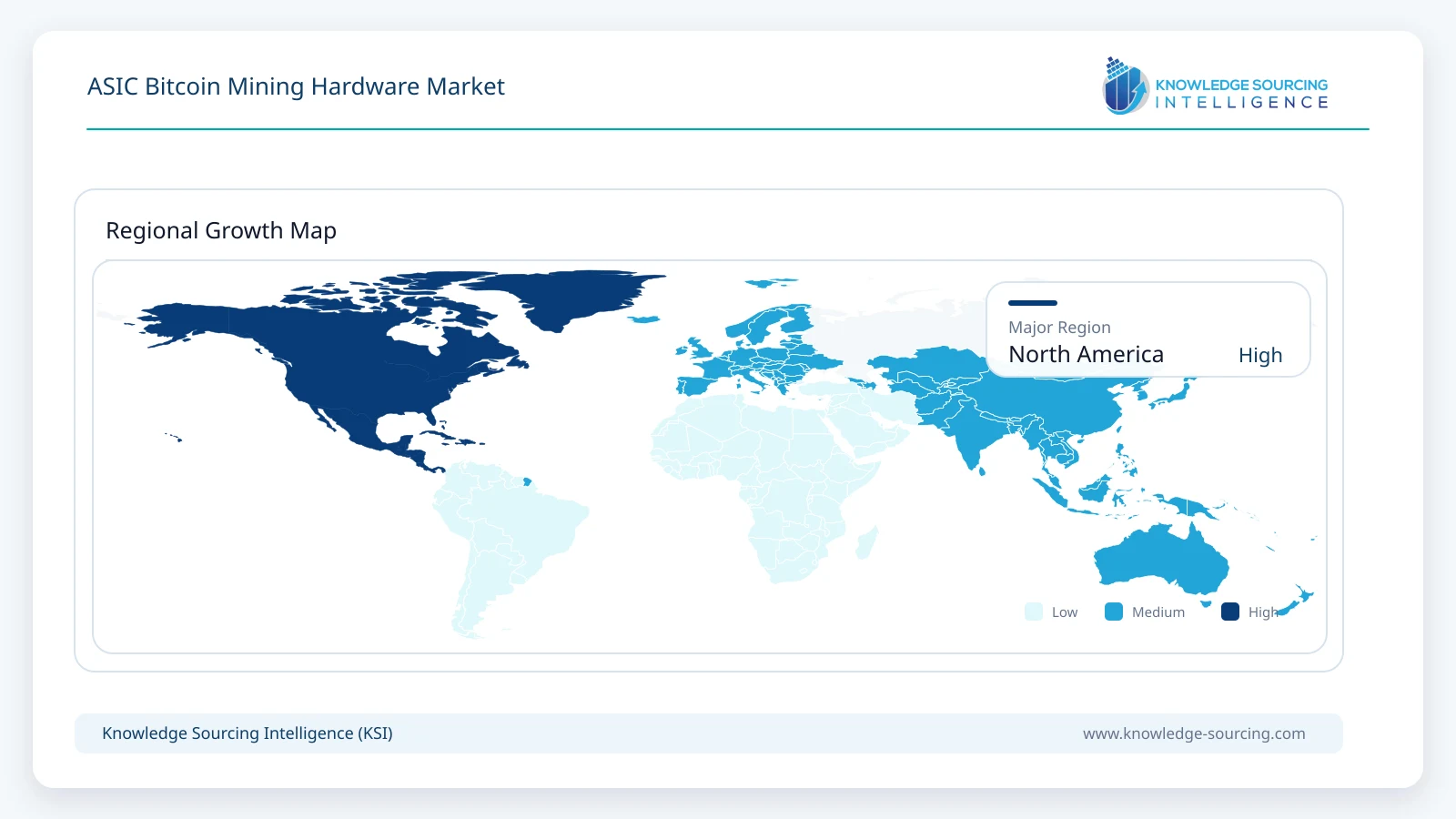
- 4North America retains the largest market position through its existing industrial mining footprint.
- 5Middle East and Africa offers faster expansion where power access supports larger installations.
Specialized SHA-256 computing equipment forms the core of the bitcoin-mining hardware business. Finished ASIC miners integrate application-specific chips, control electronics, power conversion and cooling hardware into machines delivered to commercial farms or smaller private operators. Unit shipments and realized equipment prices, rather than bitcoin rewards or hosted-computing fees, determine the value of the hardware market. Complete data-centre construction, utility supply, separate cooling plants and mining-as-a-service contracts sit outside the equipment revenue measured here.
Mining economics can change more rapidly than the equipment development cycle. Manufacturers have therefore moved beyond the purchase price of a machine to compete on energy consumption, deployment density, warranty terms and tuning capabilities. BITMAIN's ANTMINER S23 hydro-cooled line, MicroBT's WhatsMiner M70 series and Bitdeer's SEALMINER A4 platforms illustrate different approaches to combining proprietary chips with more efficient electrical and thermal systems. Canaan's Avalon range and Auradine's Teraflux products broaden the set of credible alternatives for operators seeking diversified procurement.
Market Overview
Mining-farm procurement increasingly turns on the combined economics of hardware efficiency, local electricity prices and the difficulty of earning Bitcoin rewards. A machine operating at 10 J/TH consumes materially less electricity per unit of computation than one operating above 20 J/TH, but the efficiency improvement only creates economic value when acquisition cost and facility adaptation are proportionate. An operator replacing older equipment must consider whether the upgraded hash rate fits the available power connection and whether changing network difficulty will erode the expected savings before the machine has paid for itself.
BITMAIN demonstrated the ANTMINER S23 Hyd. and its ANTRACK V2 enclosure at Bitcoin 2026, highlighting how hydro-cooling, packaged infrastructure and heat utilization are becoming part of equipment selection. Bitdeer introduced SEALMINER A4 equipment with a specified efficiency as low as 9.45 J/TH in April 2026, while MicroBT launched its M70 generation across different cooling formats in December 2025. Such performance claims concern specified operating conditions; realized efficiency also depends on firmware, coolant temperature, and site power systems.
Hardware companies face an unusually cyclical ordering pattern. Canaan reported 2025 mining-machine and related product sales of approximately USD 412.6 million but only USD 13.6 million of product revenue in the second quarter of 2026 as customers deferred orders. Bitdeer has likewise shifted substantial proprietary output toward its own mining operations rather than selling every manufactured machine externally. Equipment adoption can therefore advance even when recognized third-party manufacturer sales weaken, and neither operator hashrate nor total ASIC capacity should be mistaken for current market revenue.
Market Trends
Cooling Architecture Is Reshaping Procurement
New high-density ASIC systems concentrate more electrical load in each chassis. BITMAIN's S23 Hyd. and Bitdeer's A4 Ultra Hydro illustrate the transition toward equipment specified together with coolant conditions rather than as isolated rack appliances.
Conversion costs remain consequential. Pumps, heat exchangers, distribution manifolds and maintenance procedures have to be provided by the site, and their expense is not automatically included in the miner price. Consequently, air cooling continues to serve facilities that prize flexible installations or have limited capital for retrofitting, while immersion cooling retains a narrower role in specialized thermal environments.
Sub-15 J/TH Machines Raise the Replacement Threshold
Bitdeer's April 2026 A4 series reached a claimed 9.45 J/TH at the most efficient listed configuration, compared with Canaan's 2025 A16 series at approximately 12.8–13.8 J/TH. Advanced ASIC process design and power-management circuitry remain essential sources of differentiation rather than cosmetic model refreshes.
The transition does not require universal early replacement. Low-cost power contracts can keep older machines productive for longer, while high acquisition prices for the most advanced equipment may offset electricity savings. Operators therefore segment purchases by site economics and often retain an assortment of models rather than replacing all deployed hashrate at once.
Equipment Controls Are Becoming a Grid-Interface Feature
Auradine's Teraflux documentation describes dynamic frequency and voltage control that can alter miner output rapidly when the grid requires load reductions. Such capabilities are valuable to miners operating alongside renewable power, curtailed generation or variable power tariffs.
Grid-responsive operation is not equivalent to guaranteed electricity cost savings. Commercial value depends on dispatch arrangements, curtailment compensation, equipment wear and the degree to which hashing can resume without prolonged interruption. Manufacturers that validate fast operating-point changes may nonetheless gain an advantage in markets where site economics depend on flexible electricity consumption.
Regional Assembly and Supplier Diversification Gain Attention
Bitdeer disclosed plans for a SEALMINER manufacturing facility in Nevada in July 2026, reflecting interest in more geographically distributed hardware supply. At the same time, the advanced ASIC design and fabrication ecosystem remains concentrated in a limited supplier network.
Delivery timing, import requirements and customer service increasingly influence purchase decisions for large farms. Local assembly can shorten certain logistics routes and support procurement resilience, although regional assembly does not eliminate reliance on specialized wafer foundries, advanced packaging or globally sourced electronics.
Segment Analysis
By Customer Type: Enterprise Mining Operations
Enterprise facilities represent an estimated 94.5% of hardware market value in 2026, reflecting the concentration of new capacity and replacement purchases in industrial mining farms. BITMAIN, MicroBT and Bitdeer accordingly develop multi-unit deployment configurations alongside performance and service documentation.
Long operating schedules make warranty performance, spare-component availability and remote diagnostics significant buying considerations. Personal and residential products remain relevant to demonstration, heat-reuse and specialist audiences, but their lower power capacity and smaller order sizes leave industrial customers firmly in control of aggregate purchasing value.
By Cooling Technology: Hydro-Cooled ASIC Miners
Liquid cooling is receiving a growing allocation of manufacturer development budgets because it allows high electrical loads to be removed from densely packed machines. Bitdeer's A4 Pro Hydro and A4 Ultra Hydro systems illustrate how vendors sell different power and throughput options within one ASIC generation.
The hydro-cooled share expands where high-density facilities justify external cooling equipment and operational expertise. Air-cooled machines continue to provide simpler deployment for small and medium-sized farms; liquid-cooled procurement is most compelling when capital cost, site uptime and electricity utilization are evaluated together.
By Efficiency Class: Frontier-Efficiency Systems
Machines rated at no more than 15 J/TH are becoming the principal focus of new high-specification mining projects. The category includes multiple cooling formats; efficiency class and cooling technology therefore represent different ways of dividing the same market.
Electricity supply price determines how quickly this category displaces older models. Operators with expensive grid tariffs have a stronger incentive to invest in lower-energy hardware, while low-cost sites may continue purchasing less advanced equipment at discounted prices. The shift in mix is thus meaningful but should not be read as a forecast that every operating mining machine will meet the newest efficiency benchmark.
By Sales Channel: Direct Manufacturer Contracts
Large Bitcoin mines typically procure batches directly from ASIC equipment manufacturers, enabling specification negotiation, shipping schedules and aftermarket arrangements to be aligned with farm design. This is particularly relevant to integrated hydro-cooled orders where compatibility between machines and facility infrastructure must be established before delivery.
Specialist distributors nevertheless remain important for smaller orders, geographic markets without a direct local manufacturer presence and fast inventory availability. Secondary equipment trading is economically material to mining operations but is not counted as a new manufacturer sale in this market estimate.
Market Drivers
Power-Cost Savings from Higher ASIC Efficiency
Industrial miners routinely operate large continuous electrical loads, making even modest gains in joules per terahash commercially significant. The incentive is strongest for sites with limited electrical capacity, where a more efficient machine increases hashing output without requiring a proportional expansion of the power connection.
Procurement is therefore anchored in energy cost per unit of computation, alongside equipment reliability and network conditions. Efficiency-led replacement supports recurring hardware demand even when the total number of mining facilities grows slowly.
Industrial Fleet Renewal and Hardware Obsolescence
Equipment installed in earlier Bitcoin market cycles can remain mechanically functional after its commercial value falls. This creates an equipment renewal cycle that is not identical to growth in the number of active miners or the Bitcoin price itself.
For hardware suppliers, the opportunity lies in supplying additional efficient hashrate to established operations. Customers may retire older equipment, move it to lower-cost sites or operate it intermittently; each path affects the timing and geography of new orders.
Expansion in Locations with Dedicated Power Access
Data-centre projects in the Middle East, Africa and selected North American power markets provide room for new industrial ASIC capacity where infrastructure and operating permissions are available. High-temperature locations can favor hydro-cooling even when the initial hardware cost is higher.
Construction timelines and power contracts determine when the opportunity becomes realizable revenue. A proposed mining farm is not an equipment order, so forecast demand is tied to staged energized capacity rather than simply to announced megawatts.
Improving Farm-Level Management and Control
Mining operators require diagnostics, firmware control, fleet performance data and reliable remote operation across large numbers of machines. Hardware that can adjust power draw in response to site conditions allows operators to balance revenue generation with electrical constraints.
These capabilities matter commercially when the embedded control contributes to device uptime or reduces operating expenditure. Separately sold third-party fleet-management software is excluded from equipment revenue unless incorporated in the purchase price of the finished miner.
More Competitive ASIC Supplier Ecosystem
BITMAIN and MicroBT remain important established vendors, but Canaan, Bitdeer, Auradine and Block's Proto initiative demonstrate that ASIC design and finished-system innovation are not confined to one manufacturing group. Vendors with demonstrable chip development capabilities are better positioned than brand-only resellers to influence next-generation hardware economics.
The opportunity remains difficult to enter because advanced chip design, wafer access and system qualification demand substantial investment. Supplier diversification supports market competitiveness without implying that all announced new products will capture durable sales volume.
Market Restraints
Bitcoin Revenue and Hashrate Volatility
The profitability of mining hardware depends on bitcoin rewards, transaction fees, market prices and total network competition. Canaan's sharp decline in second-quarter 2026 product sales illustrates how quickly demand can contract during difficult operating conditions.
This exposure makes equipment revenue cyclical rather than smoothly correlated with the installed mining fleet. Producers may be forced to discount inventory, delay fabrication commitments or accept lower margins while customers reassess payback periods.
High Capital Requirements for Liquid-Cooled Deployments
Hydro-cooled mining machines require suitable pumps, fluid distribution, heat rejection systems and trained operating teams. Savings from improved machine density therefore have to outweigh a larger capital commitment at the facility level.
For customers with uncertain mining economics, deferring the infrastructure conversion may be rational even when new liquid-cooled equipment offers superior laboratory efficiency. The restraint affects the rate at which hydro-cooling displaces installed air-cooled machines.
Specialized Foundry and Supply-Chain Dependence
Bitcoin-mining ASIC designers rely on sophisticated semiconductor manufacturing capacity and a limited set of production partners for advanced chips. Small manufacturers may find it difficult to match the manufacturing scale of established producers.
The concentration of technical inputs also limits how rapidly production can respond to a sudden improvement in equipment demand. Excess inventory after a downturn creates the opposite problem, with suppliers holding machines whose selling prices decline as newer chips reach market.
Power Availability and Location-Specific Constraints
The deployment of ASIC equipment depends on dependable electrical supply, suitable tariffs and workable site permissions. Interconnection constraints and variable electricity charges can be as consequential as machine cost in determining the location of new mining investments.
Grid-support and demand-response features improve operating flexibility but do not remove the need for sufficient transmission, cooling water where relevant, and maintenance capability. Projects without secured operating infrastructure remain uncertain sources of hardware demand.
Rapid Product-Generation Turnover
Mining ASIC technology evolves in cycles that can shorten the commercial life of inventory before devices are physically worn out. Manufacturers must balance rapid technology development against customers' need for dependable availability and price stability.
Buyers can also delay decisions in anticipation of future releases, weakening current sales. This purchasing behavior creates a risk of abrupt order changes, especially for companies carrying significant finished-goods inventory or committed wafer supply.
Regional Outlook
North America: Largest Market
North America is estimated to represent 38% of global ASIC bitcoin mining hardware purchasing value in 2026, reflecting an established network of industrial-scale operators, access to specialized data-centre sites and a mature market for fleet refurbishment. The United States drives the majority of regional expenditure; Canada supports additional demand where suitable electricity contracts and cooling conditions are available. Equipment orders often involve integrated power and logistics planning, favoring manufacturers able to deliver predictable batches and technical support.
Manufacturing localization is becoming more visible alongside procurement. Bitdeer's Nevada assembly plans and Auradine's US-engineered Teraflux systems reflect customer interest in diversified hardware sourcing. North America remains the largest destination by 2031, but its share is expected to moderate as new mining capacity develops in other regions and some established facilities redirect capital toward non-mining compute applications.
Middle East and Africa: Fastest-Growing Market
Mining hardware revenue in the Middle East and Africa is forecast to reach approximately USD 777 million by 2031, supported by projects in jurisdictions where generation capacity, operating permissions and industrial sites can sustain continuous computing loads. Ethiopia and selected Gulf markets are important demand centers in the model, although realized ordering depends on site commissioning and the availability of appropriate electrical contracts. Hot ambient conditions make cooling architecture a significant part of procurement decisions.
Regional demand is projected to grow faster than the global average from a smaller base. Large projects can create concentrated purchasing cycles rather than a steady flow of replacement orders, and delayed infrastructure completion can move equipment deliveries between years. Vendors offering high-density hydro-cooled machines and reliable service support are positioned to compete where power availability and facility engineering permit expansion.
Competitive Landscape
BITMAIN and MicroBT compete through established ANTMINER and WhatsMiner product families spanning air, hydro and immersion cooling. Their product ranges address different facility densities and energy-cost conditions, while performance, delivered price and warranty support remain central purchasing factors. BITMAIN's S23 generation and MicroBT's M70 series demonstrate the emphasis placed on efficiency improvements and packaged deployment options.
Canaan combines proprietary Avalon hardware engineering with public disclosure of product sales and computing power shipped. Its financial reporting provides unusually clear evidence of the industry's exposure to revenue cycles: the scale of its 2025 mining-machine sales was not sustained in the second quarter of 2026. Bitdeer occupies a different position because its SEALMINER manufacturing business is connected to a large self-mining fleet. Internally deployed equipment supports its mining capacity but should not be interpreted as equivalent to external equipment sales.
Auradine's Teraflux systems emphasize power control, cooling options and supplier diversification. Block's Proto hardware program introduces a further design-led approach, but its long-term shipment scale remains to be established. Competition is therefore concentrated among relatively few real chip and equipment developers, with meaningful differences in distribution, internal deployment, technology maturity and customer concentration. Distributors of third-party machines are not treated as distinct manufacturers.
Recent Developments
8 September 2026: Canaan reported Q2 2026 product revenue of USD 13.6 million and 2.5 EH/s of mining-machine computing power sold, reflecting weaker orders and pricing.
21 July 2026: Bitdeer disclosed the groundbreaking of its planned SEALMINER manufacturing facility in Sparks, Nevada, with completion targeted for the end of 2026.
8 May 2026: BITMAIN detailed its Bitcoin 2026 showcase of the ANTMINER S23 Hyd. and ANTRACK V2, emphasizing hydro-cooling and heat-utilization options.
7 April 2026: Bitdeer launched the SEALMINER A4 series, including an Ultra Hydro model specified at 9.45 J/TH.
8 December 2025: MicroBT launched its WhatsMiner M70 generation in Abu Dhabi, covering new efficiency-focused SHA-256 mining designs.
28 October 2025: Canaan introduced its Avalon A16 series, including the 300 TH/s A16XP air-cooled system rated at 12.8 J/TH.
Market Outlook
The ASIC bitcoin mining hardware market will remain an equipment replacement and capacity-expansion business rather than a simple derivative of cryptocurrency trading activity. The most competitive machines are likely to combine stronger chip efficiency with reliable thermal and electrical integration, but new orders will depend on the returns available after electricity, network difficulty and financing costs. Fleet renewal should support investment in advanced hardware, while the timing of that investment will remain sensitive to mining profitability.
Hydro-cooled equipment is expected to capture a larger portion of new revenue as large facilities prioritize density and thermal control. Air-cooled products retain meaningful demand where flexible installation and limited infrastructure expenditure matter more. Regional revenue also becomes less concentrated as sites outside North America acquire suitable operating conditions, particularly in selected African and Gulf markets.
ASIC Bitcoin Mining Hardware Market Scope:
| Report Metric | Details |
|---|---|
| Total Market Size in 2026 | USD 2.40 billion |
| Total Market Size in 2031 | USD 3.70 billion |
| Forecast Unit | Billion |
| Growth Rate | 9.04% |
| Study Period | 2021 to 2031 |
| Historical Data | 2021 to 2024 |
| Base Year | 2025 |
| Forecast Period | 2026 – 2031 |
| Segmentation | Customer Type, Cooling Technology, Efficiency Class, Sales Channel |
| Companies |
|
| Customization Scope | 15% Free Customization included with purchase — Request Custom Breakdown → |
| Sample & Data Access | PDF Sample, Excel Databook & Analyst Briefing — Download Free Sample → |
Market Segmentation
By Customer Type
Enterprise Mining Operations
Personal and Home Operators
By Cooling Technology
Air-Cooled Miners
Hydro-Cooled Miners
Immersion-Cooled Miners
By Efficiency Class
Frontier Efficiency (15 J/TH or Below)
Mainstream Efficiency (Above 15–25 J/TH)
Legacy Efficiency (Above 25 J/TH)
By Sales Channel
Direct Manufacturer Contracts
Authorized Distributors and Resellers
By Geography
North America
United States
Canada
Mexico
South America
Brazil
Paraguay
Argentina
Others
Europe
Germany
United Kingdom
France
Norway
Sweden
Others
Middle East and Africa
Ethiopia
United Arab Emirates
Oman
Israel
South Africa
Others
Asia Pacific
China
Kazakhstan
Japan
South Korea
India
Taiwan
Thailand
Indonesia
Others
Table of Contents
1. EXECUTIVE SUMMARY
1.1. Key Findings
1.2. Global Market Outlook, 2026–2031
1.3. Segment and Regional Highlights
2. MARKET SNAPSHOT
2.1. Market Overview
2.2. Market Definition
2.3. Scope of the Study
2.4. Market Segmentation
3. BUSINESS LANDSCAPE
3.1. Market Drivers
3.1.1. Power-Cost Savings from Higher ASIC Efficiency
3.1.2. Industrial Fleet Renewal and Hardware Obsolescence
3.1.3. Expansion in Locations with Dedicated Power Access
3.1.4. Improving Farm-Level Management and Control
3.1.5. More Competitive ASIC Supplier Ecosystem
3.2. Market Restraints
3.2.1. Bitcoin Revenue and Hashprice Volatility
3.2.2. High Capital Requirements for Liquid-Cooled Deployments
3.2.3. Specialized Foundry and Supply-Chain Dependence
3.2.4. Power Availability and Location-Specific Constraints
3.2.5. Rapid Product-Generation Turnover
3.3. Market Opportunities
3.4. Porter’s Five Forces Analysis
3.5. Industry Value Chain Analysis
3.6. Policies and Regulations
3.7. Strategic Recommendations
4. TECHNOLOGICAL OUTLOOK
4.1. ASIC Chip Architecture and Process Advances
4.2. Air, Hydro and Immersion Cooling
4.3. Power Management and Frequency Tuning
4.4. Control, Firmware and Fleet Interfaces
4.5. Reliability and Lifecycle Performance
5. ASIC BITCOIN MINING HARDWARE MARKET, BY CUSTOMER TYPE
5.1. Enterprise Mining Operations
5.2. Personal and Home Operators
6. ASIC BITCOIN MINING HARDWARE MARKET, BY COOLING TECHNOLOGY
6.1. Air-Cooled Miners
6.2. Hydro-Cooled Miners
6.3. Immersion-Cooled Miners
7. ASIC BITCOIN MINING HARDWARE MARKET, BY EFFICIENCY CLASS
7.1. Frontier Efficiency (15 J/TH or Below)
7.2. Mainstream Efficiency (Above 15–25 J/TH)
7.3. Legacy Efficiency (Above 25 J/TH)
8. ASIC BITCOIN MINING HARDWARE MARKET, BY SALES CHANNEL
8.1. Direct Manufacturer Contracts
8.2. Authorized Distributors and Resellers
9. ASIC BITCOIN MINING HARDWARE MARKET, BY GEOGRAPHY
9.1. North America
9.1.1. United States
9.1.2. Canada
9.1.3. Mexico
9.2. South America
9.2.1. Brazil
9.2.2. Paraguay
9.2.3. Argentina
9.2.4. Others
9.3. Europe
9.3.1. Germany
9.3.2. United Kingdom
9.3.3. France
9.3.4. Norway
9.3.5. Sweden
9.3.6. Others
9.4. Middle East and Africa
9.4.1. Ethiopia
9.4.2. United Arab Emirates
9.4.3. Oman
9.4.4. Israel
9.4.5. South Africa
9.4.6. Others
9.5. Asia Pacific
9.5.1. China
9.5.2. Kazakhstan
9.5.3. Japan
9.5.4. South Korea
9.5.5. India
9.5.6. Taiwan
9.5.7. Thailand
9.5.8. Indonesia
9.5.9. Others
10. COMPETITIVE ENVIRONMENT AND ANALYSIS
10.1. Major Players and Strategy Analysis
10.2. Market Share Analysis
10.3. Mergers, Acquisitions, Agreements and Collaborations
10.4. Competitive Dashboard
11. COMPANY PROFILES
11.1. BITMAIN Technologies Ltd.
11.2. Shenzhen MicroBT Electronics Technology Co., Ltd.
11.3. Canaan Inc.
11.4. Bitdeer Technologies Group
11.5. Auradine, Inc.
11.6. Block, Inc. (Proto)
12. APPENDIX
12.1. Currency
12.2. Assumptions
12.3. Base and Forecast Years
12.4. Research Methodology
12.5. Abbreviations
12.6. Key Benefits to Stakeholders




Frequently asked questions
What is the projected market size and growth rate for ASIC Bitcoin mining hardware?
Market reaches USD 3.70 billion by 2031, growing at 9.04% CAGR.
Which type of operators drive most ASIC Bitcoin mining hardware purchases?
Enterprise mining operators account for most equipment purchasing value.
Which region currently holds the largest market share for ASIC mining hardware?
North America retains the largest market position through its footprint.
What key hardware efficiency trends are highlighted for ASIC miners?
Hydro-cooled miners and frontier-efficiency hardware are increasingly important.
What factors determine the value of the ASIC Bitcoin mining hardware market?
Unit shipments and realized equipment prices determine the hardware market value.
Which region offers faster expansion for larger ASIC Bitcoin mining installations?
Middle East and Africa offers faster expansion where power access supports.
Cite this report
Knowledge Sourcing Intelligence. (Oct 2026). ASIC Bitcoin Mining Hardware Market - Strategic Insights and Forecasts (2026-2031). https://www.knowledge-sourcing.com/report/asic-bitcoin-mining-hardware-market