
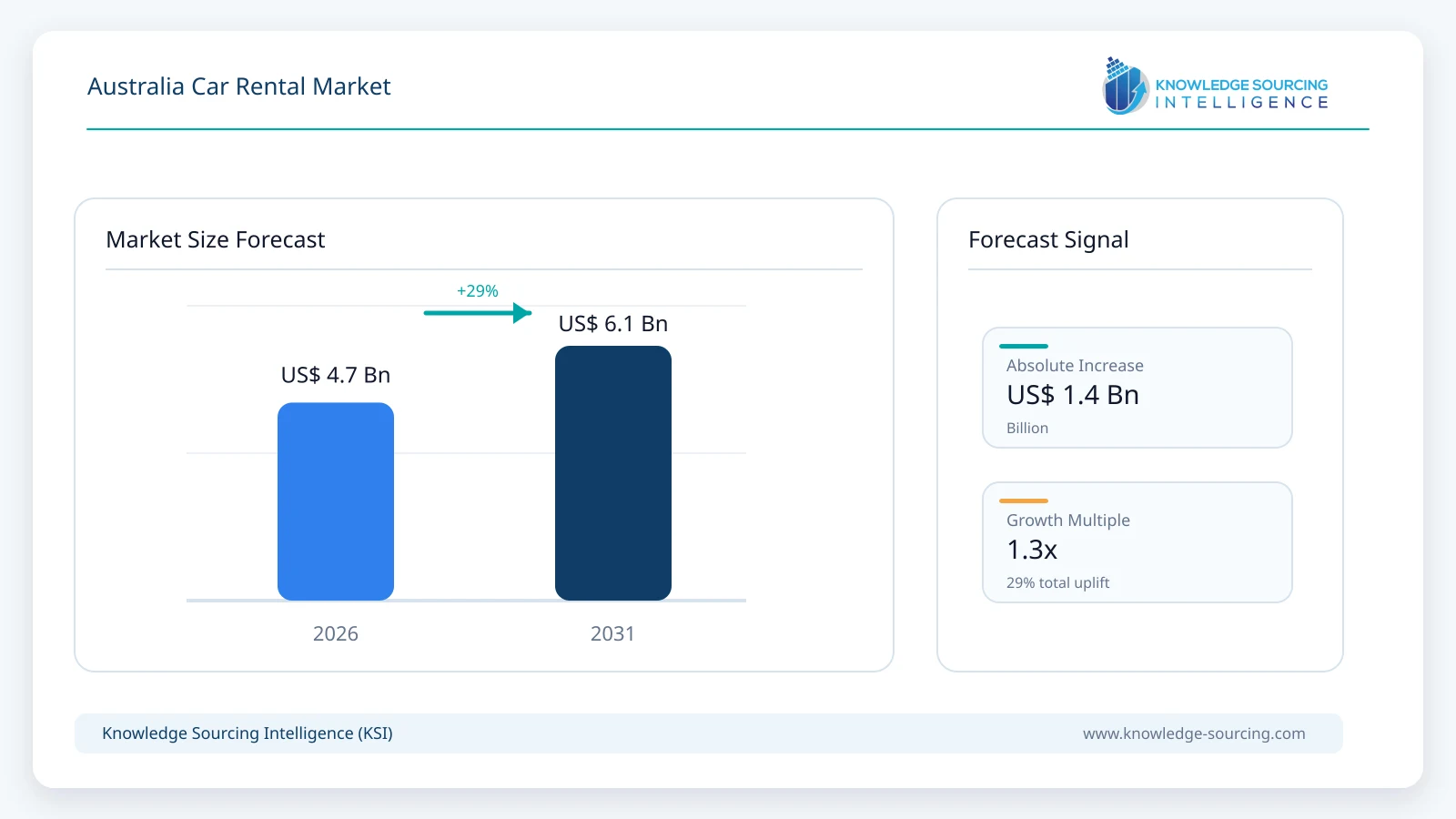
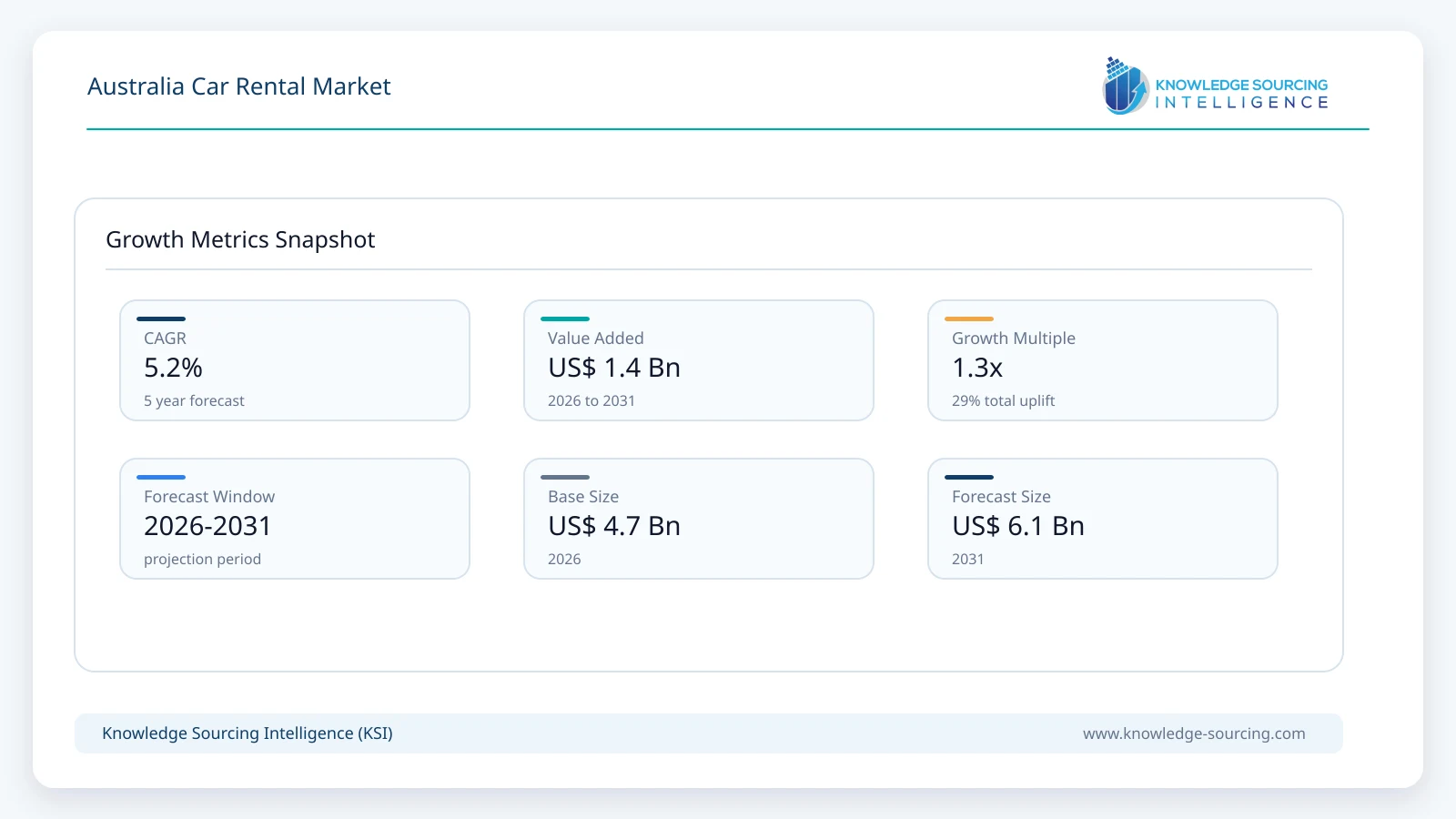
The Australian car rental market is forecast to grow at a CAGR of 5.17%, reaching USD 6.10 billion in 2031 from USD 4.74 billion in 2026.
Highlights:
- 1Tourism recovery and sustained domestic travel continue supporting rental demand across airport and leisure destinations.
- 2Airport rentals represent the most commercially influential rental purpose because they capture international and interstate travelers immediately upon arrival.
- 3Online booking platforms are becoming the preferred reservation channel due to pricing transparency, real-time fleet availability, and simplified comparison.
- 4Fleet digitization through telematics, mobile applications, and contactless vehicle collection is improving operational efficiency.
- 5Australian Consumer Law continues to influence contract transparency, pricing disclosure, and customer protection across rental operators.
The Australian car rental market forms an integral part of the country's travel, tourism, and business mobility ecosystem. Rental vehicles serve leisure travelers, corporate customers, government agencies, insurance replacement programs, and temporary mobility users who require flexible transportation without the long-term financial commitment of vehicle ownership. The industry comprises multinational operators alongside domestic rental providers that compete through fleet availability, digital booking capabilities, pricing models, airport networks, and customer service rather than vehicle ownership alone.
Demand is closely linked to domestic tourism, international visitor arrivals, airline passenger traffic, business travel, and regional mobility requirements. Australia’s vast geography and dispersed population create sustained demand for rental vehicles across metropolitan areas and tourism corridors where public transportation coverage is limited. Airport rental locations remain commercially important because visitors frequently require immediate ground transportation after arrival, while local rentals support replacement vehicles, weekend travel, relocations, and short-term mobility requirements.
Buyer priorities have shifted beyond daily rental pricing. Customers increasingly evaluate total rental costs, insurance options, fuel policies, contactless vehicle collection, booking flexibility, vehicle availability, and transparent contract terms before making reservations. Digital comparison platforms have also improved price transparency, encouraging operators to refine revenue management practices and dynamic pricing models according to seasonal demand and fleet utilization.
Fleet management has become a major determinant of profitability. Rental companies balance procurement costs, vehicle depreciation, maintenance schedules, residual values, and remarketing strategies to optimize fleet economics. Investment decisions increasingly consider fuel efficiency, hybrid and electric vehicle availability, telematics integration, and predictive maintenance technologies that reduce operating expenses while improving customer satisfaction.
Industry competition reflects both scale advantages and regional specialization. Large international operators benefit from established airport concessions, corporate agreements, and loyalty programs, while regional companies differentiate themselves through localized service networks, competitive pricing, and strong customer relationships. Regulatory compliance under Australian Consumer Law also places greater emphasis on transparent pricing, disclosure of optional charges, and fair contract terms, reinforcing consumer confidence across the sector.
Market Drivers
One of the strongest demand drivers is Australia's expanding tourism activity. Domestic holidays remain resilient while international arrivals continue supporting airport-based rental demand. Many tourist destinations are best accessed by private vehicles, particularly coastal routes, national parks, and regional attractions where public transport options remain limited. Rental operators therefore continue expanding airport fleets, seasonal capacity, and one-way rental options to accommodate visitor travel patterns.
Digital reservation channels have also changed purchasing behavior. Consumers increasingly compare rental prices, insurance coverage, vehicle categories, and customer reviews before making reservations. Real-time inventory management enables operators to adjust pricing according to local demand conditions while reducing idle fleet capacity. Mobile applications further simplify vehicle collection, identity verification, and digital contract execution, lowering operating costs.
Corporate mobility remains another stable source of revenue. Organizations increasingly prefer rental fleets for temporary assignments, project-based travel, employee relocation, and executive transportation instead of maintaining large owned vehicle fleets. Flexible rental agreements reduce capital expenditure while allowing businesses to align transportation costs with operational requirements.
Fleet modernization continues to support commercial performance. Rental companies are introducing newer vehicles equipped with advanced safety systems, improved fuel economy, navigation technologies, and connected telematics. Modern fleets reduce maintenance expenses, improve resale values, and enhance customer satisfaction, strengthening long-term profitability.
Market Restraints and Challenges
Fleet acquisition costs represent a persistent commercial challenge. Higher vehicle prices, financing expenses, and maintenance costs increase the capital required to maintain competitive fleet sizes. Operators must balance procurement decisions with expected utilization rates and residual vehicle values to preserve operating margins.
Demand seasonality also affects profitability. Tourism peaks during school holidays, major events, and summer travel periods, while off-peak utilization declines significantly in certain regions. Maintaining sufficient fleet availability during peak periods without creating excessive idle capacity throughout the remainder of the year remains an operational challenge.
Pricing transparency has intensified competition. Online comparison platforms enable customers to evaluate rental offers almost instantly, reducing pricing power and increasing promotional activity. Companies therefore compete through customer experience, loyalty benefits, insurance products, and operational reliability rather than relying solely on advertised daily rates.
Consumer protection obligations require careful compliance. Australian Consumer Law places strong emphasis on transparent pricing, disclosure of mandatory fees, optional insurance products, and fair contractual terms. Non-compliance exposes operators to regulatory action, financial penalties, and reputational damage.
Major Segment Analysis
Airport rental remains the most commercially significant rental purpose within the Australian market. Airports provide consistent access to domestic business travelers, international tourists, visiting friends and relatives, and government travelers requiring immediate transportation after arrival. This concentration of demand enables rental companies to achieve higher fleet utilization while benefiting from established concession agreements and integrated reservation systems.
Customers selecting airport rentals generally prioritize vehicle availability, rapid collection procedures, transparent insurance options, flexible return locations, and extended operating hours. Business travelers often emphasize speed and loyalty program benefits, whereas leisure travelers compare pricing, luggage capacity, child safety equipment, and optional navigation services.
Competitive differentiation extends beyond vehicle selection. Operators invest in self-service kiosks, digital identity verification, contactless pickup, and mobile booking platforms to reduce waiting times and improve operational efficiency. Airport locations also provide opportunities for premium vehicle upgrades, ancillary insurance products, and additional driver services, supporting higher average transaction values.
Competitive Landscape
Competition within the Australia car rental market remains moderately concentrated, with multinational operators competing alongside regional providers. Hertz, Avis, Budget, Europcar, Sixt, Thrifty Car Rental, East Coast Car Rentals, Redspot Car Rentals, Ace Rental Cars, and Enterprise Rent-A-Car compete through fleet quality, airport presence, digital booking capabilities, loyalty programs, corporate agreements, and customer service standards.
Competitive positioning increasingly depends on efficient fleet utilization, dynamic pricing algorithms, online reservation platforms, contactless customer experiences, and diversified vehicle portfolios that include economy cars, SUVs, premium vehicles, and people movers. Strategic partnerships with airlines, travel agencies, tourism organizations, and online travel platforms further expand customer acquisition opportunities.
Recent Developments
August 2026: Simba reported continued expansion across Australia, operating a 1,200-car fleet and preparing to launch its first Melbourne branch in October 2026, strengthening its eastern Australia rental footprint.
August 2026: Thrifty launched its latest Australian sale on 23 August 2026, covering rentals through December 2026 and reinforcing promotional pricing across its nationwide passenger-vehicle rental network.
May 2026: United Rentals launched a nationwide Vehicle Rental Program across Australia, adding civil-specification, 5-star ANCAP safety-rated work-ready vehicles with integrated telematics to its rental portfolio and targeting commercial customers requiring streamlined fleet-management solutions.
April 2026: Pearl Coast Hire announced Uber’s appointment as its preferred vehicle-solutions supplier and official launch partner, supporting regional Australia’s expansion through vehicle rentals and driver onboarding.
Regulatory and Policy Environment
The Australian regulatory framework emphasizes consumer protection, vehicle safety, and transparent commercial practices. Australian Consumer Law establishes requirements regarding advertising, pricing disclosure, unfair contract terms, refunds, and consumer guarantees applicable to rental transactions. Rental providers must clearly communicate optional charges, insurance conditions, and contractual obligations before customers complete bookings.
Vehicle procurement and fleet compliance are also influenced by the Road Vehicle Standards Act and Australian Design Rules, which establish safety, environmental, and vehicle approval requirements before vehicles enter the Australian market. These standards support fleet quality while encouraging modernization and improved safety performance.
Outlook and Strategic Implications
Commercial performance over the next several years will depend on tourism activity, airline capacity, corporate travel recovery, and continued digital adoption. Fleet investment decisions are expected to prioritize utilization efficiency, connected vehicle technologies, predictive maintenance, and environmentally efficient vehicles that improve lifetime operating economics.
Procurement strategies will increasingly emphasize flexible fleet composition to accommodate seasonal demand while limiting capital exposure. Digital pricing, automated fleet management, and enhanced customer analytics are expected to improve operational decision-making and revenue optimization.
Competition will remain centered on customer experience, transparent pricing, airport accessibility, digital convenience, and fleet reliability rather than daily rental pricing alone. Companies capable of balancing efficient fleet utilization with regulatory compliance and technology-enabled customer service are expected to strengthen their commercial position within Australia's evolving mobility sector.
Australia Car Rental Market Scope
| Report Metric | Details |
|---|---|
| Total Market Size in 2026 | USD 4.74 billion |
| Total Market Size in 2031 | USD 6.10 billion |
| Forecast Unit | Billion |
| Growth Rate | 5.17% |
| Study Period | 2021 to 2031 |
| Historical Data | 2021 to 2024 |
| Base Year | 2025 |
| Forecast Period | 2026 – 2031 |
| Segmentation | Vehicle Type, Mode Of Booking, Rental Purpose |
| Companies |
|
Market Segmentation
By Vehicle Type
By Mode Of Booking
By Rental Purpose
Table of Contents
1. EXECUTIVE SUMMARY
2. MARKET SNAPSHOT
2.1. Market Overview
2.2. Market Definition
2.3. Scope of the Study
2.4. Market Segmentation
3. BUSINESS LANDSCAPE
3.1. Market Drivers
3.2. Market Restraints
3.3. Market Opportunities
3.4. Porter’s Five Forces Analysis
3.5. Industry Value Chain Analysis
3.6. Policies and Regulations
3.7. Strategic Recommendations
4. AUSTRALIA CAR RENTAL MARKET BY VEHICLE TYPE
4.1. Introduction
4.2. Economy Cars
4.3. Compact Cars
4.4. Luxury Cars
4.5. SUVs
4.6. Vans and People Movers
5. AUSTRALIA CAR RENTAL MARKET BY MODE OF BOOKING
5.1. Introduction
5.2. Online
5.3. Offline
6. AUSTRALIA CAR RENTAL MARKET BY RENTAL PURPOSE
6.1. Introduction
6.2. Airport Rental
6.3. Local Rental
6.4. Intercity Rental
6.5. Corporate Rental
7. COMPETITIVE ENVIRONMENT AND ANALYSIS
7.1. Major Players and Strategy Analysis
7.2. Emerging Players and Market Lucrativeness
7.3. Mergers, Acquisitions, Agreements, and Collaborations
7.4. Competitive Dashboard
8. COMPANY PROFILES
8.1. Hertz
8.2. Avis
8.3. Budget
8.4. Europcar
8.5. Sixt
8.6. Thrifty Car Rental
8.7. East Coast Car Rentals
8.8. Redspot Car Rentals
8.9. Ace Rental Cars
8.10. Enterprise Rent-A-Car
Navigate
Trusted by the world's leading organizations











