
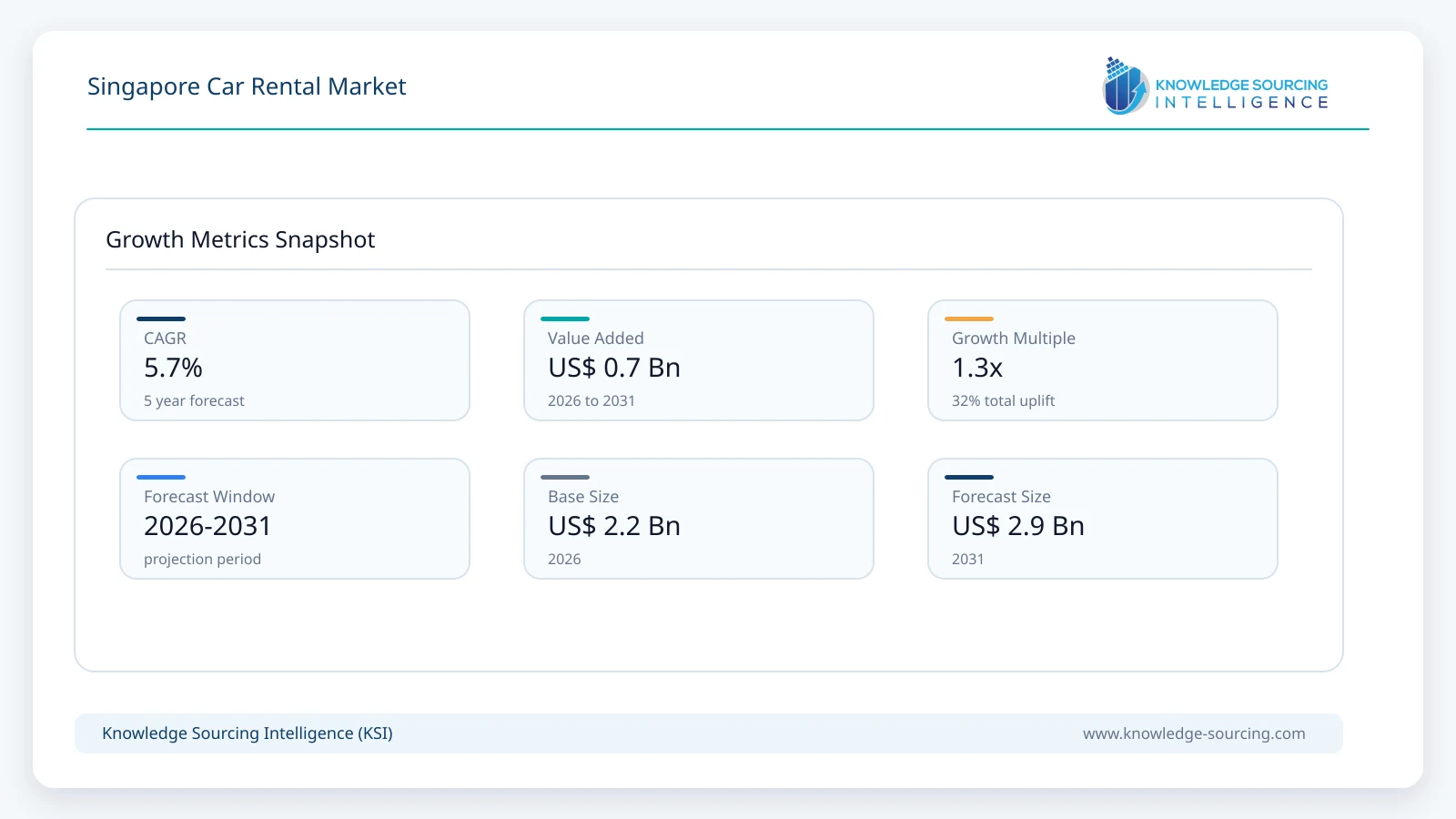
The Singapore Car Rental market is forecast to grow at a CAGR of 5.61%, reaching USD 2.90 billion in 2031 from USD 2.20 billion in 2026.
Highlights:
- 1High ownership costs drive strong demand for car rentals as individuals and businesses increasingly prefer flexible leasing over outright vehicle purchase amid elevated Certificate of Entitlement premiums.
- 2Rental fleets are rapidly shifting toward electric and hybrid vehicles, supported by government incentives and Singapore’s Green Plan 2030 push for cleaner-energy mobility solutions.
- 3The market sees growing adoption of digital booking platforms and short-term rentals, offering convenient access to vehicles near residential areas and public transport hubs.
- 4Long-term leasing gains popularity among corporates and residents seeking asset-light mobility options while avoiding high upfront costs and regulatory complexities of car ownership.
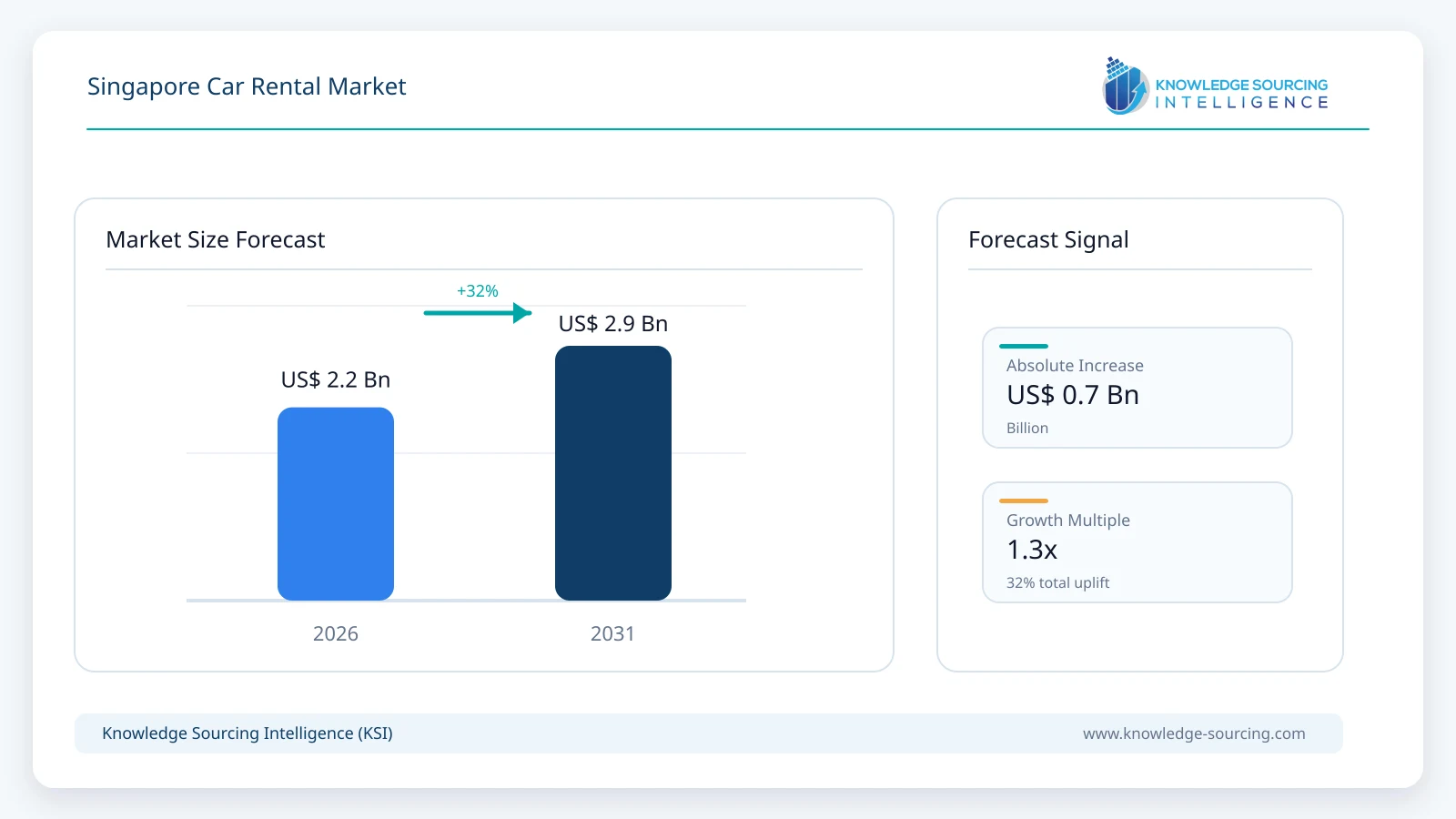
The Singaporean Car Rental Market growth is driven by the increasing ownership costs and strict government regulations and policies. High prices for the Certificate of Entitlement (COE) remain a significant factor that is shifting the demand from ownership to usage-based mobility solutions. This has led rental operators to attract a wider customer base seeking flexibility, predictable monthly costs, and avoidance of large capital outlays.
Singapore's government is proactively influencing the car rental market with a well-aligned set of mobility and electrification measures aimed at reducing emissions, broadening access to charging, and promoting fleet renewal. Among the most significant offerings is the EV Early Adoption Incentive (EEAI) that helps to reduce the initial EV purchase cost and the Vehicular Emissions Scheme (VES) that awards cleaner vehicles through rebates, both of which facilitate the rental and leasing companies that indirectly support the transition of their fleets to electric models.
In addition, the increasing shift among consumers towards car rental services in the country is also boosting market growth. For instance, according to the Nanyang Technological University report published in February 2026, car rentals are growing in Singapore, accounting for about 15 percent of the total car population, which was about 95,857 car rental vehicles in 2025.
Along with this, the total car ownership cost is estimated to be around S$200,000 to 250,000 over 10 years, i.e., around S$1,700 to S$2,100 per month in Singapore for mid-range cars as per the Key Motors 2025 report. These rising costs are the main driving factor for the increase in COE prices, prompting consumers and enterprises to opt for rental, leasing, and subscription-based mobility models.
Additionally, Singapore's tourism, which is mainly supported by strong regional travel flows and good connectivity, is experiencing strong short-term rental demand, especially among business travellers and leisure visitors seeking convenient point-to-point mobility.
In addition, the electric vehicles are gaining popularity as car rental operators are expanding to meet the national electrification goals, like the 2030 Zero-Emission Vehicle (ZEV) Deployment Goal.
The key players in Singapore’s car rental market include global brands such as Hertz Corporation, Sixt SE, Avis Budget Group, and Europcar Mobility Group, which dominate the airport and premium tourist segments, alongside strong local operators such as Asia Express Car Rental Singapore, Reach Group Holdings Pte. Ltd., GetGo Technologies Pte. Ltd., Tribecar Pte, Ltd, Siang Hock Holding Pte. Ltd., and Drive lah Pte. Ltd., which lead in app-based, car-sharing, and hourly rentals.
Meanwhile, Skyscanner serves as a major aggregator supporting online bookings. The market functions through these major components, including international premium companies and local digital platforms that operate with flexibility.
The increase in tourism, which has led to demand for rental services for leisure and activity trips, and the digital transformation are boosting market expansion. Furthermore, the shift towards sustainability in Singapore is supported by government incentives, and consumer awareness is also promoting market growth.
In 2025, electric vehicles are the fastest-growing segment by car type, accounting for % share by value, while gasoline holds the major market segment due to wide availability, contributing to % share in the same year.
Among services, the chauffeur-driven segment is the fastest-growing service type due to an increase in corporate clients and premium travelers demanding time efficiency and convenience.
By mode of booking, the online booking segment constitutes the major segment that is largely driven by the increase in digitalization in the country, along with the rise in adoption of mobile apps.
The airport rental category segment of the market is the dominant segment in the rental categories due to high inbound tourism.
Based on Contract type, long-term rental is the fastest-growing segment, driven by corporates seeking cost-effective alternatives for mobility.
The leisure/ activity trips are the major application segment due to tourism, which is a major factor for rental demand in Singapore.
Market Dynamics
Drivers
Escalating COE Prices and High Vehicle Ownership Costs
The growing Certificate of Entitlement (COE) prices, combined with the overall high cost of private vehicle ownership, remain major factors driving the rise in users towards car rental services for both individual and corporate mobility across Singapore.
Singapore’s COE system, designed to regulate the vehicle population, has led to repeated surges in premiums. At times, these have reached levels that render private car ownership unaffordable for a significant portion of the population.
According to the recent data published by the Automobile Association of Singapore (AAS), the COE price is witnessing a consistent rise. For Cat A (Car up to 1600cc & up to 97KW), the price was $106,501 in February 2026 to $111,890 in March 2026, and for Cat B (Car above 1600cc or above 97KW), the price was $105,001 in February 2026 to $115,568 in March 2026.
Apart from the COE, buyers need to take into consideration various other costs, such as the vehicle's base price, registration fees, taxes, insurance, maintenance, fuel, and depreciation, thus putting a hefty long-term financial burden on them.
According to Key Motor data for 2025, the estimated mid-range car ownership cost over 10 years in Singapore, which includes COE + Taxes + Upfront Fee, is S$120,000 – 150,000, while maintenance and fuel/charging are around S$10,000 – 15,000 and S$30,000 – 40,000, respectively. Besides, parking + ERP cost is S$25,000 – 35,000.
The rising cost of owning a vehicle is one of the factors that is promoting the rental services as a mobility option among the country's consumers, especially in urban regions.
Market Segmentation
By Mode of Booking: Online
By Mode of booking, the Singaporean car rental market is segmented into online and offline, where the online mode accounts for a 74.0% share in the market, fueled by growing internet penetration and smartphone adoption. The offline segment accounts for 26.0% share of the market.
Ongoing investment to digitize the economy has played an integral role in adopting digital platforms for car rental booking in Singapore.
The escalation in travel frequency has increased the preference for the most convenient mode of car rental booking in the country.
Rapid expansion of 5G network infrastructure has propelled the online trend in Singapore, with mobile subscriptions, including post-paid & pre-paid, reaching 2.98 million according to the August 2025 data from Infocomm Media Development Authority (IMDA).
Well-established presence of key market players, namely GetGo Technologies Pte. Ltd., which operates a fleet of more than 3,000 vehicles covering nearly 1,700 locations across Singapore, has further driven consumers’ preferences.
Ongoing efforts to revive the travel & tourism sector have played an integral role in driving the online mode of booking for car rentals in Singapore with OTAs (Online Travel Agencies), namely Traveloka, which has formed tie-ups with major players like Hertz and Avis Budget
High private vehicle ownership costs have further shifted the preference to short-term and long-term car rental in Singapore, with online platforms providing the most convenient mode of booking.
Domestic players like Grab, which are investing in E-ride hailing and offering rental EVs via its apps, are also set to transform the overall market landscape, with online booking mode growth showcasing a considerable upward trajectory.
By Rental Category: Airport Transport
Based on rental category, the Singaporean car rental market is segmented into local transport, airport transport, and outstation transport, where the airport transport segment is projected to grow consistently, owing to improved tourism activities.
Growing corporate and business travel has propelled the demand for flexible mobility in Singapore, with car rental providing an effective mobility platform.
Changing preferences from public transport to rental vehicles for specific outing needs has further amplified market growth.
The airport transport segment is projected to show considerable growth owing to the progression in domestic and international travel in Singapore.
Strategic efforts outlining investments in major tourist attractions have positively impacted IVA (International Visitor Arrivals) in Singapore, thereby simultaneously boosting tourism receipts (TR), with spending on accommodation witnessing 4.8% growth in 1H 2025.
Market players, namely Sixt SE, Avis Group, and Hertz, offer extensive car rental services ranging from economy to SUVs at major airports like Changi Airport, which has provided new growth prospects.
With the number of international travelers increasing, the demand for convenient commuting options is anticipated to grow in Singapore, thereby driving the market expansion in the airport segment. According to the Singapore Tourism Board (STB), total international visitor arrivals reached 16.9 million in 2025, showing a 2.3% growth over 2024 IVAs.
Expansion of airport routes to improve flight frequency has amplified the geographic spread in Singapore, which has offered new opportunities for rented transportation usage to travel to various locations. Efforts to improve the MICR tourism industry are also acting as an additional driving factor
The P2P (Point-to-Point) regulatory framework introduced by the Land Transport Authority (LTA), along with new franchise partnerships by major companies such as Hertz to offer short-term self-drive and premium chauffeur-driven rental services for leisure and business travelers, is expected to drive significant market growth.
List of Companies
Hertz Corporation
Sixt SE
Asia Express Car Rental Pte. Ltd.
Avis Budget Group, Inc.
Europcar Mobility Group S.A.
Reach Group Holdings Pte. Ltd.
GetGo Technologies Pte. Ltd.
Tribecar Pte. Ltd.
Siang Hock Holding Pte. Ltd.
Skyscanner Ltd
Drive lah Pte. Ltd.
Hertz Corporation, a subsidiary of Hertz Global Holdings, Inc., was established in 1918 and has a global presence, operating Hertz, Dollar, and Thrifty vehicle rental brands throughout Europe, North America, the Caribbean, Latin America, Africa, the Middle East, Asia, Australia, and New Zealand.
The company is known for its diverse range of vehicles, gaining customer loyalty through its commitment to customer service, competitive pricing, and extensive rental network. Hertz operates over 8,100 car rental locations in more than 150 countries, including Singapore, covering each state, territory, major airport, and town, ensuring a Hertz location is available for all car hire needs.
Singapore Car Rental Market Developments:
May 2026: Flexar officially launched operations in Singapore with 200 rental vehicles and 100 pickup and drop-off points, expanding accessible short-term urban car rental availability.
April 2026: BlueSG announced the relaunch of its Singapore car-sharing operations under the Flexar brand, introducing mixed electric and combustion-engine rental vehicles with point-to-point rental services.
December 2025: ComfortDelGro partnered with Pony.ai to begin autonomous vehicle shuttle testing in Singapore, supporting future smart mobility and automated rental transportation services.
June 2025: Ryde Group partnered with Tencent Cloud to strengthen Southeast Asia mobility infrastructure, supporting enhanced digital booking, fleet management, and connected car rental service capabilities in Singapore.
July 2025: Ryde Group announced RydeLUXE 6, a proposed premium electric and plug-in hybrid rental mobility service in Singapore, targeting expansion into the ultra-premium chauffeured and rental vehicle segment.
Singapore Car Rental Market Scope:
| Report Metric | Details |
|---|---|
| Total Market Size in 2026 | USD 2.2 billion |
| Total Market Size in 2031 | USD 2.9 billion |
| Forecast Unit | Billion |
| Growth Rate | 5.7% |
| Study Period | 2021 to 2031 |
| Historical Data | 2021 to 2024 |
| Base Year | 2025 |
| Forecast Period | 2026 – 2031 |
| Segmentation | Car Type, Service, Contract Type, Rental Category |
| Companies |
|
Table of Contents
1. Executive Summary
2. Market Snapshot
2.1. Market Overview
2.2. Market Definition
2.3. Scope of the Study
2.4. Market Segmentation
3. Business Landscape
3.1. Market Drivers
3.2. Market Restraints
3.3. Market Opportunities
3.4. Porter’s Five Forces Analysis
3.5. Industry Value Chain Analysis
3.6. Policies and Regulations
3.7. Strategic Recommendations
4. Technological Outlook
5. Singapore Car Rental Market By Car Type
5.1. Introduction
5.2. Electric
5.3. Gasoline
5.3.1. Economy
5.3.2. Luxury
5.3.3. SUV
5.3.4. MUV
6. Singapore Car Rental Market By Service
6.1. Introduction
6.2. Self-Driven
6.3. Chauffeur-Driven
7. Singapore Car Rental Market By Mode of Booking
7.1. Introduction
7.2. Online
7.3. Offline
8. Singapore Car Rental Market By Rental Category
8.1. Introduction
8.2. Local Transport
8.3. Airport Transport
8.4. Outstation Transport
9. Singapore Car Rental Market By Contract Type
9.1. Introduction
9.2. Long-Term
9.3. Short-Term
10. Singapore Car Rental Market By Application
10.1. Introduction
10.2. Leisure/ Activity Trips
10.3. Corporate/ Business Trips
11. Competitive Environment and Analysis
11.1. Major Players and Strategy Analysis
11.2. Market Share Analysis
11.3. Mergers, Acquisitions, Agreements, and Collaborations
11.4. Competitive Dashboard
12. Company Profiles
12.1. Hertz Corporation
12.2. Sixt SE
12.3. Asia Express Car Rental Pte. Ltd.
12.4. Avis Budget Group, Inc.
12.5. Europcar Mobility Group S.A.
12.6. Reach Group Holdings Pte. Ltd.
12.7. GetGo Technologies Pte. Ltd.
12.8. Tribecar Pte. Ltd.
12.9. Siang Hock Holding Pte. Ltd.
12.10. Skyscanner Ltd
12.11. Drive lah Pte. Ltd.
13. Research Methodology
14. List of Figures
15. List of Tables
Navigate
Trusted by the world's leading organizations











