
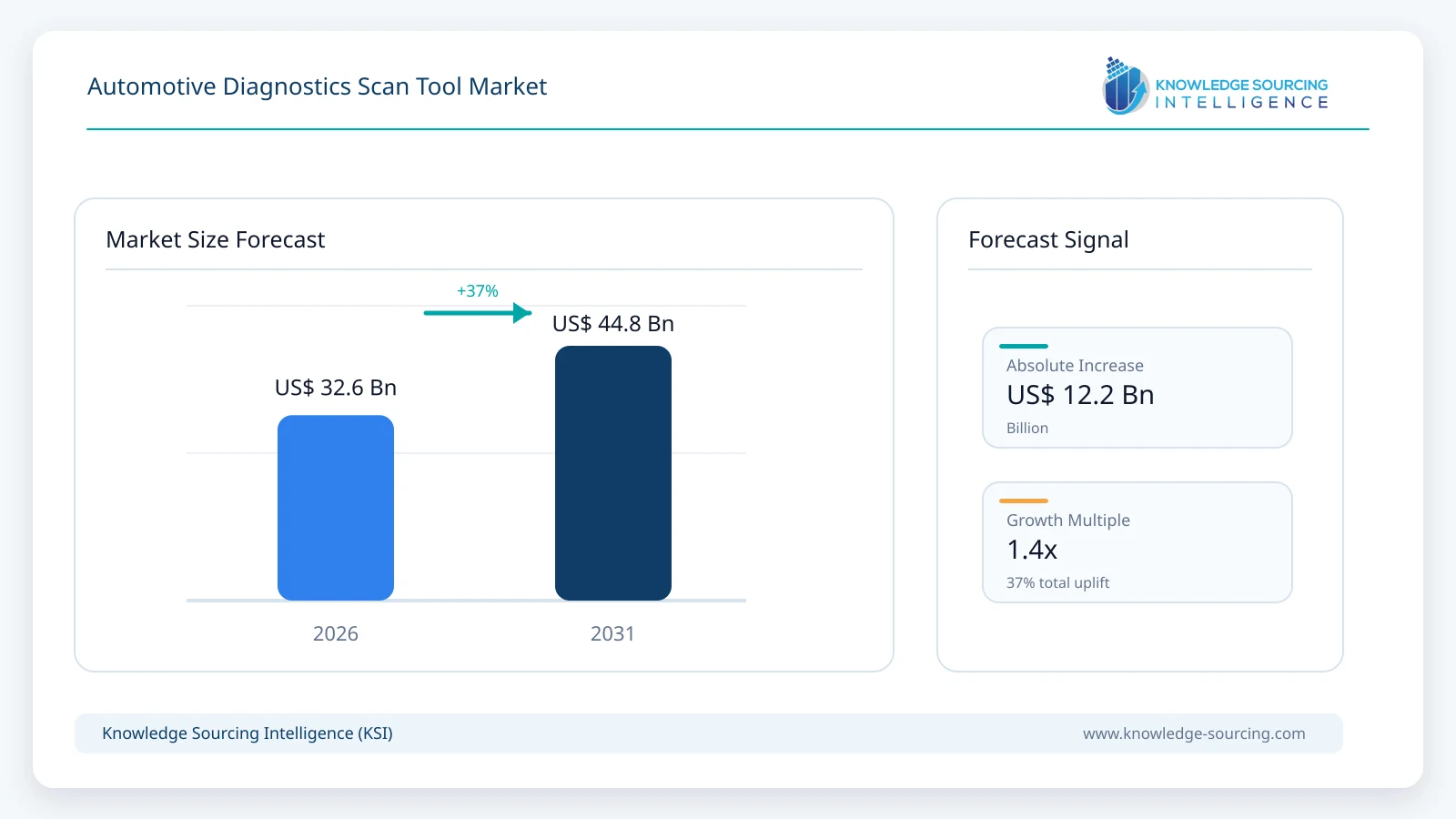
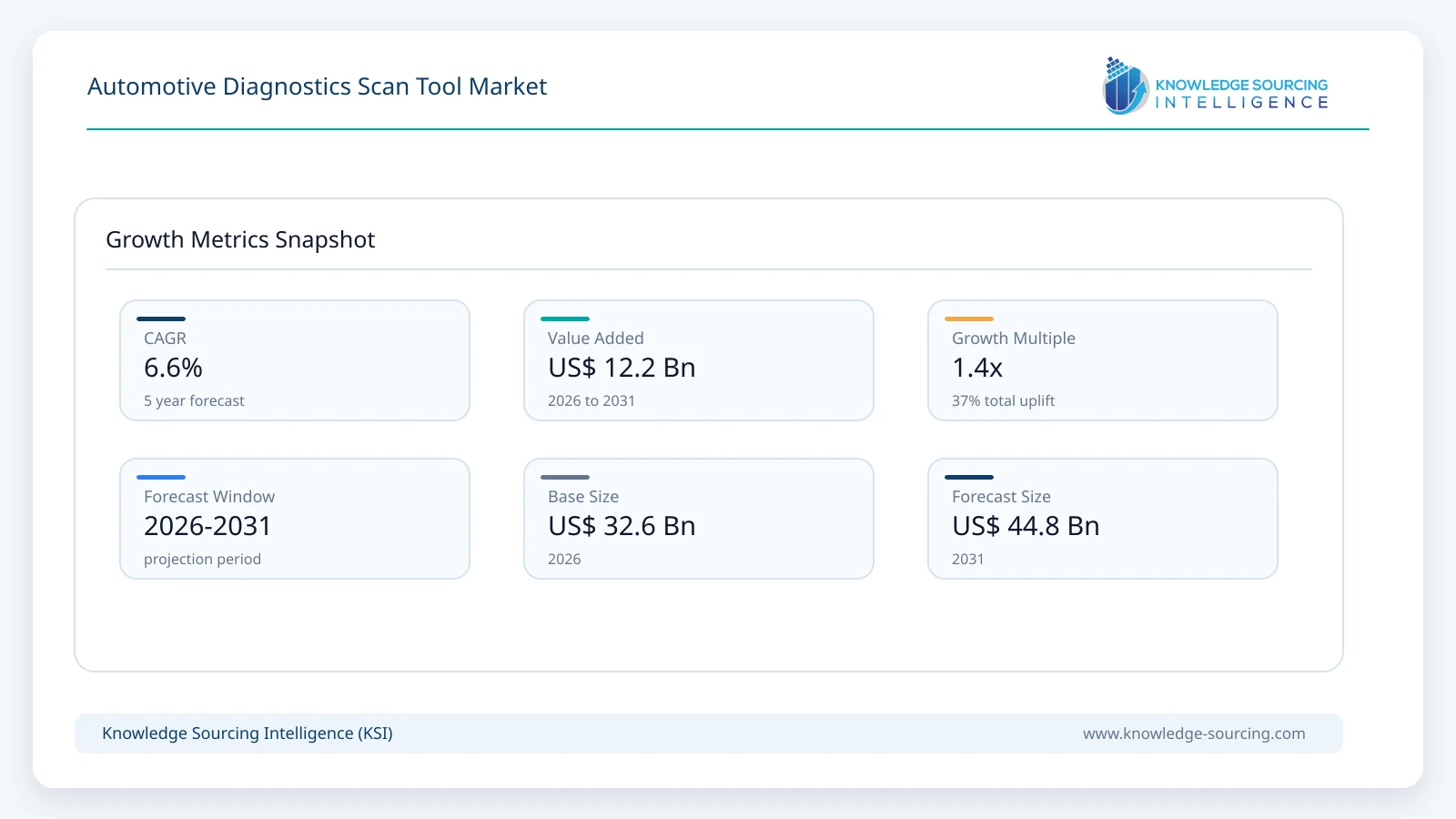
The Automotive Diagnostics Scan Tool Market is projected to grow from USD 32.6 billion in 2026 to USD 44.8 billion by 2031, registering a 6.6% CAGR during the forecast period.
Highlights:
- 1Professional multi-system scan tools account for approximately 54% of global market value in 2026, supported by expanding demand for full-system diagnostics, coding, active testing and guided repair workflows.
- 2Passenger vehicles account for approximately 74% of market value in 2026 due to their dominant share of the global vehicle production, sales and installed fleet.
- 3Professional workshops represent approximately 58% of market value in 2026 as increasingly complex vehicle electronics make advanced diagnostic equipment essential for independent and multi-brand repair operations.
- 4Asia Pacific accounts for approximately 38% of global market value in 2026, supported by more than 61% of worldwide vehicle production and rapidly expanding workshop networks.
- 5Professional multi-system scan tools are projected to reach approximately USD 25.3 billion by 2031, growing faster than basic OBD code readers as workshops require bidirectional, EV, ADAS and secure-gateway capabilities.
The market covers diagnostic hardware and directly associated software used to communicate with vehicle electronic systems, retrieve and interpret fault codes, monitor live data, conduct bidirectional tests, perform service resets, program or configure electronic control units and diagnose electrical, high-voltage and increasingly ADAS-related systems. The scope includes professional multi-system scan tools, OBD readers and electrical-system diagnostic platforms used by independent workshops, OEM/dealer service networks, commercial-vehicle workshops and DIY users. Workshop labour, general repair services and diagnostic operations performed without dedicated scan equipment are excluded.
The current KSI market estimate is retained because the underlying addressable vehicle and repair base remains large and is becoming more electronically complex. Global vehicle production increased from 92.7 million units in 2024 to 96.4 million in 2025, while global sales reached 99.8 million vehicles. At the same time, modern professional tools have moved far beyond reading emissions-related trouble codes. Bosch’s KTS 590 supports DoIP, J2534 PassThru, multiple CAN interfaces, multimeter and oscilloscope functions, while Autel’s current MaxiSYS platforms combine ECU coding, topology mapping, oscilloscopes, EV battery diagnostics and cloud-based vehicle records.
Automotive diagnostics is shifting from fault-code retrieval toward integrated analysis of complete vehicle networks. Contemporary vehicles contain numerous interconnected modules controlling the engine, transmission, braking, airbags, body electronics, battery systems, steering, infotainment and driver-assistance functions. Hella Gutmann’s current diagnostic systems, for example, support trouble-code retrieval, parameter monitoring, actuator tests, service resets, basic settings, coding and system tests from one interface, while Bosch diagnostic hardware supports several communication protocols simultaneously, including CAN, DoIP and J2534 PassThru. This technological progression increases the value of diagnostic software coverage and regular vehicle-database updates alongside the physical scanner itself.
Connectivity is also changing the economics of the market. Professional diagnostic platforms increasingly use internet-based databases, cloud records, remote assistance and recurring software subscriptions, creating revenue beyond the initial hardware purchase. Snap-on’s current diagnostic environment incorporates vehicle-specific OEM information, guided tests, secure-gateway access, ADAS, EV and diesel coverage, while its Fast-Track Intelligent Diagnostics platform draws on billions of repair records and hundreds of billions of diagnostic sessions. The market therefore increasingly consists of hardware-software ecosystems rather than standalone handheld scanners, with functionality and model coverage becoming major determinants of tool replacement and subscription renewal.
Market Trends
Artificial Intelligence and Guided Diagnostics Are Moving Into Workshop Tools
Professional scan tools are increasingly incorporating structured troubleshooting, large repair databases and artificial intelligence to reduce the time technicians spend interpreting codes and locating technical information. Snap-on’s APOLLO GEN 4 combines vehicle-specific codes, tests and repair data within a guided diagnostic workflow, while TEXA introduced IDC6 with TEXA AI at Automechanika Frankfurt in September 2026. TEXA’s platform uses verified automotive information to support technicians during diagnostic procedures rather than relying only on generic AI responses. This shift is commercially important because the value of a scan tool increasingly depends on how quickly it can move a technician from a fault code to a probable repair. Diagnostic vendors are consequently differentiating through repair databases, AI-assisted interpretation, workflow automation and cloud connectivity rather than only expanding the number of vehicle models supported.
EV Battery Health Is Becoming a Dedicated Diagnostic Function
Electric and plug-in hybrid vehicles are creating diagnostic requirements that conventional engine-focused scanners cannot address. Traction batteries require assessment of state of health, state of charge, module voltage differences, temperature behaviour and high-voltage-system faults. Autel’s current EV diagnostic systems provide battery-pack analysis for vehicles from Tesla, BMW, Volkswagen and other manufacturers and can generate state-of-health reports using compatible MaxiSYS platforms. MAHLE’s E-SCAN battery diagnostic function received CARA Battery Health Check certification in February 2026 and can assess EV battery condition in less than two minutes without requiring a road test. Battery diagnostics therefore increasingly represent a separate value layer within workshop scan tools, particularly for used-EV transactions, fleet management and independent repair operations where reliable battery-health information directly affects vehicle valuation and maintenance decisions.
Secure Gateway Access Is Becoming Part of the Diagnostic Platform
Vehicle manufacturers increasingly protect communication with sensitive electronic control units through secure gateway systems, requiring authenticated access before independent diagnostic tools can perform coding, resets or certain active functions. Hella Gutmann notes that several vehicle manufacturers now use security gateway modules that require activation before unrestricted vehicle communication can occur, while Snap-on supports manufacturer-specific secure-gateway access through authenticated technician profiles. TEXA extended its authenticated access service to Nissan and Infiniti vehicles in Europe and Japan in June 2026, adding those brands to a portfolio already covering FCA, Hyundai, Genesis, Mercedes-Benz, Renault/Dacia, Volkswagen Group, Volvo and others. Secure access is consequently becoming a core competitive capability because a scanner with broad basic vehicle coverage can still be commercially limited if technicians cannot access protected modules or perform manufacturer-authorized service functions.
Market Drivers
Increasing Electronic Complexity Across a Global Vehicle Market Approaching 100 Million Annual Sales
The automotive industry sold approximately 99.8 million vehicles globally in 2025 while production reached 96.4 million units, providing a large annual addition to the installed service base. The diagnostic opportunity grows faster than vehicle numbers alone because each generation incorporates more electronically controlled systems. Modern scan platforms now require access to body control, transmission, safety, emissions, steering, battery and ADAS modules in addition to engine-management systems. Bosch’s KTS platforms support multiple CAN interfaces, DoIP communication and J2534 programming, while TOPDON’s professional scanners incorporate network-topology mapping, CAN FD, DoIP, cloud programming and bidirectional tests across multiple systems. As electronic content increases, workshops need higher-level tools even when the number of repair visits does not increase proportionately. The driver is therefore the growing number and complexity of diagnosable electronic systems per vehicle as well as expansion of the global fleet.
Electrification Is Expanding the Diagnostic Scope Beyond Conventional Powertrains
EV and hybrid service requirements are opening new diagnostic categories around high-voltage batteries, power electronics, charging systems, isolation monitoring and thermal management. China produced 16.63 million new-energy vehicles in 2025, an increase of 29%, while global automotive production continued shifting toward Asia and electrified platforms. Tool manufacturers are responding by integrating dedicated EV functions into their premium diagnostic platforms. Autel’s MS909EV supports high-voltage-system diagnosis, battery-pack state-of-health assessment and OE-level functions across electric, hybrid, gasoline and diesel vehicles, while MAHLE’s certified E-SCAN technology provides rapid EV battery-health assessment. Electrification therefore expands the revenue opportunity in two ways: existing workshops must upgrade equipment to service newer vehicles, while battery-health testing creates diagnostic demand in vehicle remarketing, fleet management and pre-purchase inspection outside conventional mechanical repair.
Repair-Information Access Is Supporting the Independent Aftermarket
Regulatory requirements around diagnostic and repair access create an important demand base for multi-brand scan tools because independent workshops can only compete effectively when they can obtain vehicle information and communicate with manufacturer systems. In July 2026, the U.S. EPA reaffirmed that manufacturers must provide independent repairers with emissions-related service information, enhanced OBD diagnostics, PassThru reprogramming information and manufacturer-specific tools for purchase under Clean Air Act requirements. The European Commission similarly updated Regulation 2018/858 in March 2026 to address standardized and secure access to vehicle OBD and repair information, including modern batteries and driver-assistance systems. These measures reinforce the commercial position of independent diagnostic-tool suppliers because workshop access to advanced vehicle functions increasingly depends on platforms that can combine regulatory access, manufacturer authentication and continually updated software coverage.
Market Restraints
Secure Gateways and Manufacturer-Specific Procedures Increase Software Complexity
Secure vehicle architectures protect electronic systems from unauthorized access but make multi-brand diagnostics substantially more complex. Tool vendors must develop and maintain authentication relationships across numerous manufacturers, markets and security systems, while individual workshops may need technician accounts, internet connections and identity verification before certain functions can be performed. TEXA’s expansion of protected access across manufacturers including FCA, Hyundai, Mercedes-Benz, Renault/Dacia, Volkswagen Group, Volvo, Nissan and Infiniti illustrates the scale of integration required from a single aftermarket platform. This creates an ongoing engineering and licensing burden for suppliers and can limit the functionality of lower-cost tools. Workshops also face recurring software subscriptions and access costs because a scanner that is not continually updated can rapidly lose compatibility with new models, protocols and gateway procedures. The market consequently favours vendors with sufficient scale to maintain software coverage across many manufacturers.
Technician Skills Must Keep Pace With Increasing Diagnostic Capability
More capable tools do not automatically produce accurate repairs because technicians must understand network architecture, electrical measurements, high-voltage systems and increasingly complex software-controlled components. Professional platforms now integrate oscilloscopes, multimeters, ECU coding, network topology, battery diagnostics and ADAS functions that require substantially greater technical knowledge than conventional OBD code retrieval. Autel’s Ultra S2, for example, combines a four-channel oscilloscope, multimeter, topology analysis, J2534, DoIP, CAN FD and advanced ECU diagnostics in one platform, while Bosch’s KTS 590 similarly integrates ECU diagnosis with high-speed oscilloscope and measurement capabilities. The skills requirement can slow adoption among smaller workshops and encourages continued demand for guided diagnostics, remote assistance and integrated repair information. It also creates a gap between purchasing an advanced scanner and obtaining full economic value from its capabilities.
Automotive Diagnostics Scan Tool Market Segment Analysis
By Tool Type
Professional Multi-System Scan Tools
Professional multi-system scan tools account for approximately 54% of global market value in 2026, equivalent to around USD 17.6 billion, and are projected to reach approximately USD 25.3 billion by 2031 at growth of about 7.5% annually. These systems command higher value because they combine multi-brand ECU communication, bidirectional control, coding, programming, waveform analysis, secure-gateway access and repair information within rugged workshop platforms. Snap-on’s APOLLO, TRITON and ZEUS products, Bosch KTS systems, Autel MaxiSYS, TOPDON Phoenix and TEXA diagnostic platforms illustrate how the professional segment has progressed beyond conventional handheld readers. Basic OBD readers remain important in DIY and entry-level workshop applications but grow more slowly at around 4.4% annually as professional repair increasingly requires manufacturer-specific functions and complete module access. Electrical-system analyzers also grow above the basic-reader segment as electrification increases the importance of waveform analysis and high-voltage testing.
By Vehicle Type
Passenger Vehicles
Passenger vehicles represent approximately 74% of market value in 2026, equivalent to about USD 24.1 billion, and are projected to reach approximately USD 33.1 billion by 2031. The segment’s position reflects the scale of global passenger-car production and the breadth of the repair network serving privately owned vehicles. Diagnostic intensity is increasing as passenger cars incorporate connected infotainment systems, ADAS, hybrid and electric powertrains, electronically controlled transmissions and body-control modules. Global vehicle production reached 96.4 million units in 2025 and Asia Pacific accounted for more than 61% of output, reinforcing the large addressable base for multi-brand passenger-vehicle diagnostics. Commercial-vehicle diagnostics grows slightly faster at approximately 7.1% annually because fleet uptime, diesel-emissions systems and heavy-duty electronic architectures create strong demand for specialized equipment, but passenger vehicles continue to represent the larger overall market through 2031.
By End User
Professional Workshops
Professional independent and multi-brand workshops account for approximately 58% of global market value in 2026, equivalent to around USD 18.9 billion, and are projected to reach approximately USD 26.9 billion by 2031 at growth of about 7.3% annually. Independent workshops require broad vehicle coverage because a single facility may service dozens of brands and vehicle generations, making multi-brand scan platforms commercially more valuable than manufacturer-specific systems. Regulatory developments are also strengthening their access to advanced diagnostics. The U.S. EPA reaffirmed in July 2026 that independent repairers must have access to emissions-related service information, OBD data and PassThru programming, while European rules continue to standardize secure access to diagnostic and repair information. OEM and dealer networks remain a substantial segment because they require deeper brand-specific programming and guided procedures, while DIY diagnostics grows more slowly as advanced vehicle systems increasingly exceed the capability of basic consumer scanners.
Regional Outlook
Asia Pacific
Asia Pacific is the largest regional market and is also projected to record the strongest growth among the major regions. The market is estimated at approximately USD 12.4 billion in 2026 and is projected to reach around USD 18.0 billion by 2031, representing growth of approximately 7.8% annually.
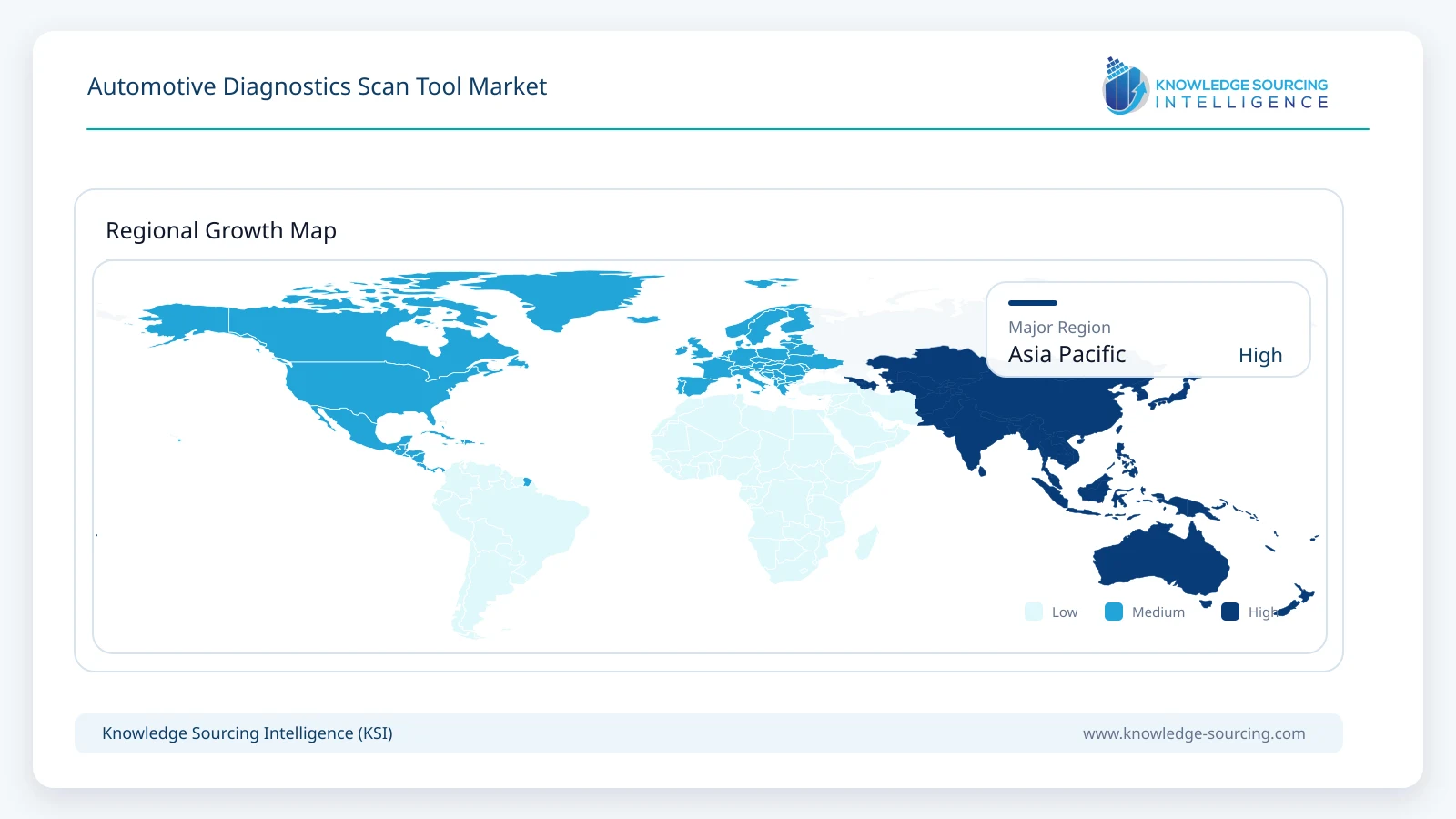
The region’s position is supported by its dominant vehicle-production base: Asia produced approximately 59.2 million vehicles in 2025, more than 61% of global output, while China alone produced 34.53 million vehicles. China also hosts major diagnostic-tool companies including Autel, Launch Tech, TOPDON and THINKCAR, providing the region with a large manufacturing and product-development ecosystem in addition to end-user demand. Rapid EV adoption further increases diagnostic complexity, while India and Southeast Asia are expanding both vehicle fleets and independent repair networks. Asia Pacific therefore benefits simultaneously from new vehicle production, a large installed fleet, electrification and a strong domestic diagnostic-equipment supply chain.
Competitive Environment and Analysis
The automotive diagnostics scan tool market combines global workshop-equipment companies, specialist diagnostic-platform suppliers and increasingly competitive Chinese electronics manufacturers. Snap-on differentiates through premium professional tools, extensive repair databases and guided diagnostics; Bosch combines KTS diagnostic hardware with ESI[tronic] software and measurement equipment; Autel and Launch Tech offer broad multi-brand coverage across professional, EV and ADAS applications; while TEXA and Hella Gutmann maintain strong European aftermarket positions. MAHLE is expanding from conventional workshop diagnostics into certified EV battery assessment, while companies such as TOPDON, THINKCAR and Innova compete aggressively across professional and prosumer price categories.
Competition increasingly centers on software rather than hardware specifications alone. Professional users evaluate vehicle coverage, bidirectional functions, programming, secure-gateway access, update frequency, EV capability, ADAS integration and guided troubleshooting before processing power or display size. TEXA’s 2026 introduction of AI-enhanced IDC6 and Snap-on’s APOLLO GEN 4 illustrate the shift toward information-driven diagnostics. Vendors with large historical repair databases, manufacturer relationships and recurring software subscriptions therefore have an increasingly defensible position even as tablet hardware becomes more commoditized.
Market Share Analysis
No single supplier dominates the global market because competitive positions differ between professional workshop scanners, OEM/dealer systems, consumer OBD tools, commercial-vehicle diagnostics and regional markets. Snap-on and Bosch maintain strong positions in premium professional workshop equipment, while Autel and Launch Tech have developed significant global scale in multi-brand scanners and increasingly compete at the upper end of the professional market. TEXA, Hella Gutmann and MAHLE remain particularly important in European workshop networks, while Cojali is strongly positioned in commercial-vehicle diagnostics.
Chinese suppliers have increased competitive pressure by combining broad vehicle coverage, CAN FD and DoIP compatibility, topology mapping, ECU coding and EV functions at prices below many traditional premium platforms. TOPDON’s Phoenix products, for example, support remote diagnostics, modern communication protocols and EV coverage, while Autel’s premium systems approach OEM-level functionality across numerous brands. Market share through 2031 is consequently likely to depend increasingly on recurring software revenue and authenticated manufacturer access rather than unit shipments of physical scanners alone.
Recent Developments
September 2026: Snap-on’s TRITON professional scan tool received a 2026 MOTOR Top 20 Award, highlighting its wireless diagnostics and guided component-testing workflow.
September 2026: TEXA introduced the TPS 3 TPMS diagnostic platform with more than 30 functions, VIN scanning, secure-gateway unlocking and integration with its IDC6 environment.
June 2026: TEXA extended authenticated secure-gateway diagnostics for Nissan and Infiniti to Europe and Japan, broadening unrestricted multi-brand access for independent workshops.
June 2026: Hella Gutmann released software Version 82 for its mega macs diagnostic platforms, adding new vehicle coverage, interface updates and expanded hardware support.
May 2026: Snap-on launched APOLLO GEN 4 with wireless scanning and Fast-Track Intelligent Diagnostics based on its large repair and diagnostic-session database.
February 2026: MAHLE received CARA Battery Health Check certification for its E-SCAN EV battery diagnostic function, which provides battery condition assessment in under two minutes without a road test.
Market Outlook
Growth is increasingly driven by diagnostic depth rather than simple expansion in the number of vehicles. Modern platforms must communicate with numerous electronic control units, support protected gateways, interpret vehicle-network data and increasingly evaluate high-voltage batteries and ADAS-related systems. Professional multi-system scanners therefore grow faster than basic OBD readers and reach approximately USD 25.3 billion by 2031, while professional workshops remain the largest end-user group because multi-brand repair requires broad software coverage and frequent updates.
Passenger vehicles retain the largest vehicle-type position through 2031, but commercial-vehicle diagnostics grows somewhat faster as fleets place greater value on uptime and emissions-system maintenance. Asia Pacific remains the largest and fastest-growing regional market, supported by more than 60% of global vehicle production, rapid EV deployment and a strong domestic diagnostic-tool manufacturing base. Competitive differentiation increasingly shifts toward software coverage, authenticated OEM access, EV battery diagnostics, cloud-based repair information and intelligent troubleshooting. As vehicle architectures become more software-defined, the scan tool evolves from a code-reading device into an integrated workshop information and vehicle-communication platform.
Automotive Diagnostics Scan Tool Market Scope:
| Report Metric | Details |
|---|---|
| Total Market Size in 2026 | USD 32.6 billion |
| Total Market Size in 2031 | USD 44.8 billion |
| Forecast Unit | Billion |
| Growth Rate | 6.6% |
| Study Period | 2021 to 2031 |
| Historical Data | 2021 to 2024 |
| Base Year | 2025 |
| Forecast Period | 2026 – 2031 |
| Segmentation | Technological Outlook, Tool Type, Vehicle Type, End User, Geography |
| Companies |
|
Market Segmentation
By Tool Type
Professional Multi-System Scan Tools
OBD Code Readers and Scanners
Electrical System Analyzers
By Vehicle Type
Passenger Vehicles
Commercial Vehicles
By End User
Professional Independent and Multi-Brand Workshops
OEM and Dealer Service Networks
DIY and Prosumer Users
By Geography
North America
United States
Canada
Mexico
South America
Brazil
Argentina
Others
Europe
United Kingdom
Germany
France
Spain
Italy
Others
Middle East and Africa
Saudi Arabia
UAE
South Africa
Others
Asia Pacific
China
Japan
India
South Korea
Indonesia
Thailand
Others
Table of Contents
1. INTRODUCTION
1.1. Market Overview
1.2. Market Definition
1.3. Scope of the Study
1.4. Market Segmentation
1.5. Currency
1.6. Assumptions
1.7. Base and Forecast Years
1.8. Key Benefits to Stakeholders
2. RESEARCH METHODOLOGY
2.1. Research Design
2.2. Secondary Research
2.3. Market Estimation
2.4. Segment Modelling
2.5. Data Triangulation and Validation
3. EXECUTIVE SUMMARY
3.1. Key Findings
3.2. Automotive Diagnostics Scan Tool Market Size, 2026-2031
3.3. Tool Type Outlook
3.4. Vehicle Type Outlook
3.5. End-User Outlook
3.6. Regional Opportunity Summary
4. MARKET DYNAMICS
4.1. Market Drivers
4.1.1. Increasing Electronic Complexity Across the Global Vehicle Fleet
4.1.2. Electrification Expanding the Diagnostic Scope
4.1.3. Repair-Information Access Supporting the Independent Aftermarket
4.2. Market Restraints
4.2.1. Secure Gateways and Manufacturer-Specific Software Complexity
4.2.2. Increasing Technician Skill Requirements
4.3. Porter’s Five Forces Analysis
4.4. Industry Value Chain Analysis
4.5. Regulatory and Right-to-Repair Environment
4.6. Secure Gateway and Vehicle Cybersecurity Landscape
5. TECHNOLOGICAL OUTLOOK
5.1. AI-Assisted Guided Diagnostics
5.2. Diagnostics over Internet Protocol (DoIP)
5.3. CAN FD and Vehicle Network Topology
5.4. EV Battery State-of-Health Diagnostics
5.5. Secure Gateway Authentication
5.6. Remote and Cloud-Based Diagnostics
5.7. ADAS Diagnostic Integration
6. AUTOMOTIVE DIAGNOSTICS SCAN TOOL MARKET BY TOOL TYPE
6.1. Introduction
6.2. Professional Multi-System Scan Tools
6.3. OBD Code Readers and Scanners
6.4. Electrical System Analyzers
7. AUTOMOTIVE DIAGNOSTICS SCAN TOOL MARKET BY VEHICLE TYPE
7.1. Introduction
7.2. Passenger Vehicles
7.3. Commercial Vehicles
8. AUTOMOTIVE DIAGNOSTICS SCAN TOOL MARKET BY END USER
8.1. Introduction
8.2. Professional Independent and Multi-Brand Workshops
8.3. OEM and Dealer Service Networks
8.4. DIY and Prosumer Users
9. AUTOMOTIVE DIAGNOSTICS SCAN TOOL MARKET BY GEOGRAPHY
9.1. North America
9.1.1. United States
9.1.2. Canada
9.1.3. Mexico
9.2. South America
9.2.1. Brazil
9.2.2. Argentina
9.2.3. Others
9.3. Europe
9.3.1. United Kingdom
9.3.2. Germany
9.3.3. France
9.3.4. Spain
9.3.5. Italy
9.3.6. Others
9.4. Middle East and Africa
9.4.1. Saudi Arabia
9.4.2. UAE
9.4.3. South Africa
9.4.4. Others
9.5. Asia Pacific
9.5.1. China
9.5.2. Japan
9.5.3. India
9.5.4. South Korea
9.5.5. Indonesia
9.5.6. Thailand
9.5.7. Others
10. COMPETITIVE ENVIRONMENT AND ANALYSIS
10.1. Major Players and Strategy Analysis
10.2. Market Share Analysis
10.3. Mergers, Acquisitions, Agreements, and Collaborations
10.4. Competitive Dashboard
11. COMPANY PROFILES
11.1. Snap-on Incorporated
11.2. Robert Bosch GmbH
11.3. Autel Intelligent Technology Corp., Ltd.
11.4. Launch Tech Co., Ltd.
11.5. TEXA S.p.A.
11.6. Hella Gutmann Solutions GmbH
11.7. MAHLE Aftermarket GmbH
11.8. ACTIA Group
11.9. DENSO Corporation
11.10. TOPDON Technology Co., Ltd.
11.11. THINKCAR Tech Inc.
11.12. Innova Electronics Corporation
11.13. Opus IVS
11.14. Cojali S.L.
11.15. AVL DiTEST GmbH
12. APPENDIX
Navigate
Trusted by the world's leading organizations











