
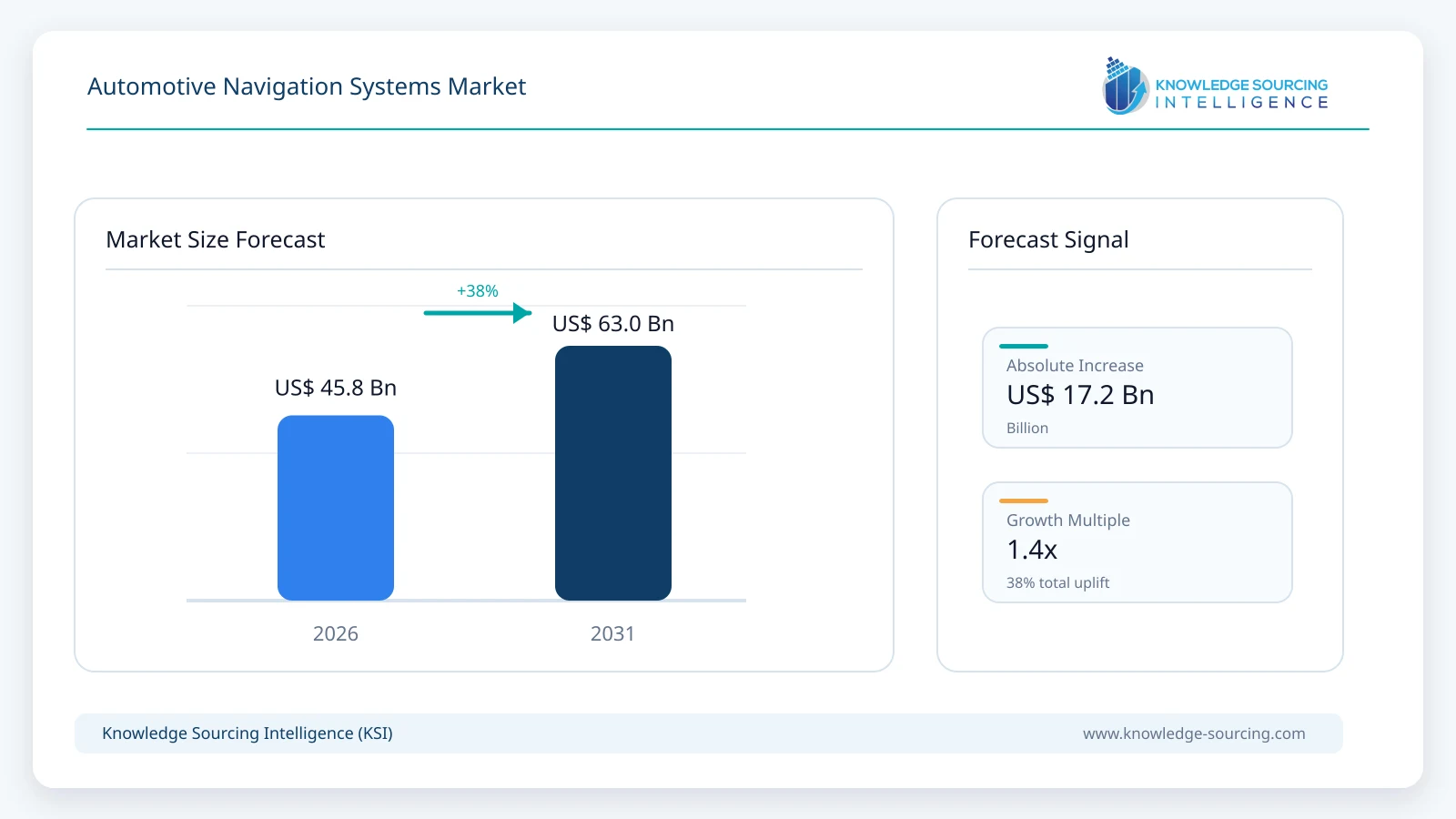
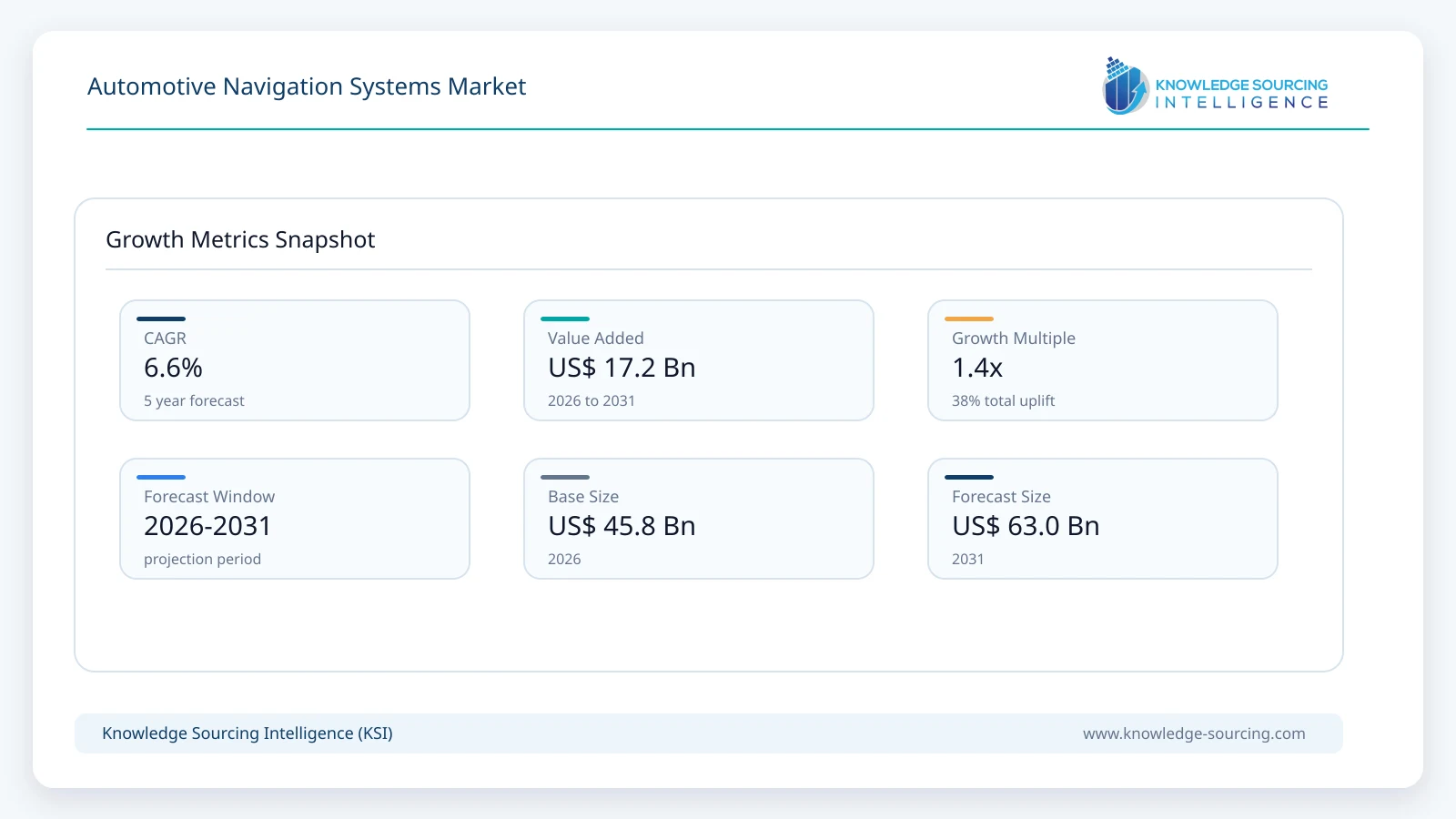
The Automotive Navigation Systems Market is expected to expand at a CAGR of 6.6%, reaching USD 63.0 billion in 2031 from USD 45.8 billion in 2026.
Highlights:
- 1OEM integration accounts for an estimated 84% of 2026 market value across vehicle programmes.
- 2Passenger cars remain the largest vehicle category, supported by high-volume digital cockpit deployment.
- 3Embedded navigation increasingly combines map guidance with electric-vehicle charging and range planning.
- 4Lane-level visualisation is improving the connection between routing information and driver assistance.
- 5Asia Pacific leads navigation demand, while European platform integration supports faster growth.
Automotive navigation systems provide vehicle-specific destination search, digital mapping, positioning, route planning and turn-by-turn guidance. Commercial value spans navigation applications and software development kits, licensed mapping and traffic services, embedded navigation hardware content attributable to the function, aftermarket GPS units and directly related support. In an OEM installation, these elements may be supplied by different vendors but are counted once within the integrated navigation function rather than added repeatedly at different supply-chain levels.
Mapbox supplies the software platform underpinning Toyota’s next-generation RAV4 navigation and BMW’s 3D Live Navigation, while HERE provides the location intelligence used across multiple manufacturers’ connected-cockpit programmes. TomTom offers its Automotive Navigation Application and modular navigation software, and NNG supplies iGO for embedded and commercial-vehicle navigation. Growth is being shaped by refreshable map services, brand-specific user interfaces, EV route planning and the separation of navigation software from the rest of an infotainment head unit.
Market Overview
High-volume vehicle platforms increasingly use a shared computing architecture to display navigation on the centre screen, driver instrument cluster and head-up display. This architecture requires more than a basic GPS receiver: the navigation engine must match the vehicle to the road network, interpret restrictions, choose suitable routes and render information with sufficient consistency for an embedded automotive interface. Data availability is also uneven across countries, making local map validation and offline functionality commercially important for manufacturers shipping the same model globally.
Toyota’s 2026 RAV4 uses Mapbox technology within the new Toyota Audio Multimedia system, allowing Toyota to control the interface while relying on specialist mapping and rendering services. HERE has expanded online navigation with Hyundai AutoEver and supplied location data for connected electric-vehicle programmes; TomTom offers a ready-to-integrate Automotive Navigation Application alongside a software toolkit. These models show why some automakers commission a complete branded navigation experience while others licence selected components and retain the user interface internally.
The supplier value chain includes automotive software developers, map-data producers, vehicle-electronics integrators and aftermarket-device manufacturers. Map updates, live traffic, search and charging information create continuing maintenance and service requirements after a vehicle leaves the factory. Payment can occur through a production nomination, platform licence, embedded component price or recurrent service contract; the commercial significance lies in the attributable navigation function, not the total selling price of a connected car or its infotainment display.
Market Trends
Navigation Is Converging with Driver-Assistance Visualisation
BMW’s October 2026 deployment of Mapbox 3D Live Navigation in Neue Klasse vehicles brings lane-level route guidance and selected surrounding-vehicle information into one map view. This is a material shift from displaying turn instructions separately from vehicle perception. An integrated presentation can help the driver understand where a manoeuvre is expected and how assisted-driving functions relate to the roadway, although the navigation product and the underlying driver-assistance system remain separate sources of commercial value.
HERE’s expanded collaboration with NIO in Europe similarly links fresher road intelligence to navigation and future Navigation on Autopilot capabilities. Map vendors therefore need high-quality lane geometry, regularly updated road restrictions and predictable interfaces to vehicle software. Their competitive advantage is increasingly determined by the ability to keep complex map information current at scale rather than by graphic presentation alone.
Electric-Vehicle Routing Requires Vehicle-Aware Calculations
Electric vehicles turn route selection into an energy-management decision. The preferred charging stop depends on remaining state of charge, expected consumption, terrain, station access, charging speed and the driver’s arrival constraints. The IEA reports that more than 20 million electric cars were sold worldwide in 2025, broadening the potential user base for navigation systems that can coordinate journeys with charging infrastructure. Still, a system needs dependable vehicle-battery interfaces and accurate station data before it can promise useful charging recommendations.
TomTom’s automotive application supports EV-oriented route planning and charging searches; the company’s technical documentation describes the vehicle information needed for battery-aware guidance. Map data must also support regional connector standards and charger reliability. Suppliers that combine live availability, efficient rerouting and appropriate offline fallback may command greater software value, especially where drivers use navigation daily rather than only for unfamiliar journeys.
Automakers Are Separating Navigation Logic from Cockpit Hardware
Toyota’s use of Mapbox within its Arene-related software architecture illustrates the move toward a brand-directed navigation application built on external specialist components. HERE and TomTom offer development tools and navigation software suitable for different cockpit platforms, while NNG’s iGO is designed for configurable embedded deployment. Vehicle programmes can therefore retain distinctive interfaces without maintaining every map-making, routing and localisation function internally.
This procurement model changes supplier economics. A reusable navigation software stack can be licensed across trims and model lines, whereas display hardware and compute capacity are shared with other vehicle functions. The benefit depends on stable application interfaces, the quality of software updates and whether suppliers can meet the OEM’s regional data, security and long-term maintenance requirements.
Dedicated Aftermarket Navigation Remains a Specialist Purchase
Integrated smartphone applications and factory-fitted maps limit the appeal of a separate general-purpose navigator in many passenger cars. However, professional drivers, older vehicles and users who want a dedicated screen still create demand for devices with reliable routing and offline maps. Garmin’s redesigned Drive devices launched in September 2026 reflect a continuing aftermarket category, with display layout, traffic updates and accessible route guidance as the principal product attributes.
Commercial navigation is more specialised than a generic car map because a truck’s dimensions, weight, restricted roads and permitted access affect route suitability. NNG’s 2026 agreement with LogiGo targets truck and bus navigation in Brazil and wider Latin America. This demand supports focused software and hardware sales without implying that aftermarket units will recover the share lost to factory-integrated systems.
Segment Analysis
By Sales Channel: OEM
OEM navigation represents the central revenue channel, estimated at USD 38.47 billion in 2026. Navigation is embedded at vehicle-platform level, allowing suppliers to provide digital maps, traffic data and routing software alongside integration and updates. Automakers increasingly specify controls over branding, driver-information displays and cybersecurity, raising both the initial qualification burden and the lifetime value of a dependable supplier relationship.
The segment is expected to gain additional share as navigation becomes available across more trims and as vehicle makers link maps to charging and driver-assistance features. Toyota’s Mapbox deployment demonstrates a division of labour in which an automaker controls application design and a navigation specialist provides core map technology. Standalone devices remain useful in certain fleets, but the economics of factory integration favour reuse of software across large model programmes.
By Vehicle Type: Passenger Cars
Passenger cars account for the broadest navigation installation base because navigation is increasingly distributed through standard infotainment platforms rather than confined to high-end option packages. Consumers use connected traffic guidance, search, charging-location data and destination sharing, giving automakers a reason to invest in a consistent route-planning experience across markets. The segment’s economic weight is driven by production volume and the number of supported vehicle lifecycles, not simply the sales value of the cockpit display.
The passenger-car market is projected to reach approximately USD 49.77 billion by 2031. Commercial vehicles are likely to take a modestly greater share over the period as fleet operations adopt truck-specific routing and dispatch integration, but passenger demand remains substantially larger. Vehicle makers must nevertheless manage feature availability across markets where connectivity, map licensing and privacy requirements differ.
Market Drivers
Increasing Factory Integration across Vehicle Platforms
Vehicle manufacturers increasingly make a common digital cockpit part of the underlying electrical architecture across model ranges. Supplying navigation through that platform avoids fitting separate devices and allows a consistent experience across central screens, clusters and connected mobile applications. Embedded mapping also makes it easier to coordinate route recommendations with the vehicle’s charging, energy and safety information.
For navigation vendors, the opportunity lies in securing platform nominations that persist across multiple production years, followed by map refreshes and software support. The supplier must demonstrate stable performance across hardware revisions and national road networks, because a navigation defect in a shared architecture can affect several vehicle lines.
Connected Traffic Data and Frequent Map Refreshes
Construction activity, road closures, changed speed limits and congestion make static maps increasingly unsuitable for vehicles expected to remain in service for many years. Navigation systems with live traffic and over-the-air map updates provide more relevant routing without requiring a replacement head unit. The customer benefit is clearest in dense urban travel where conditions change during the journey.
TomTom and HERE supply traffic and location-data services that can be maintained over a vehicle’s operating life. Commercial contracts must define regional coverage, update cadence and rights to use data in embedded applications. These recurring obligations provide a reason for software suppliers to remain involved after the initial vehicle sale.
Electric-Vehicle Adoption and Charging-Route Planning
An EV journey planner must judge whether a charger is reachable and useful, not merely whether it exists on the map. Battery state, temperature, charging characteristics and road gradient can change the appropriate route and stop sequence. The growth of battery-electric car fleets consequently increases the usefulness of navigation tied to vehicle operating data.
Automakers evaluating navigation suppliers increasingly require access to charging data and consistent state-of-charge prediction. However, charging-station availability is often reported with varying reliability, so useful navigation needs clear uncertainty handling and alternative-route planning rather than unsupported promises of perfectly available charging stops.
Improving Lane Guidance and Driver Information
Complex junctions, multilane motorways and unfamiliar urban interchanges expose limitations in conventional turn-by-turn prompts. High-resolution map geometry, junction views and lane-level guidance can reduce ambiguity by presenting the intended route in the context of road markings and detected surroundings. BMW’s integration with Mapbox exemplifies this technical direction.
The commercial value depends on map coverage and how reliably the software distinguishes navigation assistance from automated-driving control. Vendors capable of combining live geometry with clear driver interfaces may win higher-specification OEM programmes, while lower-cost products continue using simpler guidance for routine driving.
Commercial-Vehicle Demand for Restriction-Aware Routing
A truck route is constrained by bridge heights, axle loads, prohibited road classes, environmental zones and delivery access requirements. Fleet buyers therefore need navigation that reflects vehicle attributes rather than simply offering the fastest car route. NNG’s June 2026 partnership with LogiGo targets precisely this type of professional truck navigation in Latin America.
Commercial adoption is supported by the cost of failed deliveries, detours and vehicle downtime. Successful providers still require verified restriction databases, compatible fleet hardware and good coverage in industrial districts; generic consumer routing rarely addresses those requirements completely.
Market Restraints
Smartphone Navigation and Free-Use Alternatives
Phone-based map services already deliver search, traffic, voice guidance and route sharing to a large installed user population. A driver may therefore see little reason to pay extra for a navigation option or dedicated GPS unit when projection from a mobile device meets ordinary travel needs. This substitution is most evident in price-sensitive passenger-car segments.
Embedded-system suppliers must justify spending through better integration, dependable offline guidance and vehicle-aware functions. The distinction can narrow if phone platforms gain greater access to the vehicle’s own data. Standalone aftermarket products consequently face a more selective customer base than in earlier navigation hardware cycles.
Map Maintenance and Geographic Data Quality
Navigation reliability varies sharply with the completeness of address databases, private-road restrictions, lane information and construction updates. A software product proven in one major market may require substantial additional mapping and validation before it can support another country. Mistakes in restrictions are particularly costly for commercial vehicles.
Suppliers must also maintain localisation for languages, scripts, local search conventions and road-rule changes. Recurring maintenance expenditure can reduce the profitability of contracts with narrow regional volumes, making geographic coverage a commercial constraint rather than merely a technical specification.
Vehicle Integration and Qualification Costs
Modern navigation exchanges data with the instrument cluster, voice assistant, battery-management system and cockpit operating system. Compatibility testing must cover different screen resolutions, compute resources, connectivity states and vehicle variants. Software changes may require multi-stage regression testing before deployment to production vehicles.
For OEM customers, these costs can favour incumbent navigation partners that already support the selected electronics platform. New entrants need to demonstrate a reliable software lifecycle and long-term maintenance capacity, not only an attractive demonstration interface. Changes in operating-system or data-platform strategy can also force a costly redesign.
Location Privacy and Regional Data Governance
Navigation applications can process vehicle position, search histories and journeys that may identify the habits of individual drivers. OEM deployments therefore require appropriate consent handling, controlled retention and clear separation of permitted location uses. Cross-border map and connected-service deployments can create additional obligations where national location-data laws differ.
Vendors must support country-specific data practices while providing the functionality motorists expect. Privacy restrictions can limit personalisation and telemetry collection, especially where a connected service is not essential to basic guidance. Local hosting and security certification can add procurement complexity for vehicle programmes spanning several jurisdictions.
Connectivity Dependence and Software Security
Live traffic and online search improve navigation, but a journey can pass through areas with poor signal quality or expensive mobile data. Systems relying exclusively on cloud routing risk degraded performance during connectivity loss. An automotive-grade design generally needs cached or onboard maps and an intelligible fallback that does not mislead the driver.
Map update services and vehicle data interfaces also enlarge the software maintenance burden. Security vulnerabilities, expired credentials and faulty over-the-air updates can interrupt functions that remain in use long after the vehicle is sold. These requirements increase the cost of supporting a navigation platform across its full service life.
Regional Outlook
Asia Pacific
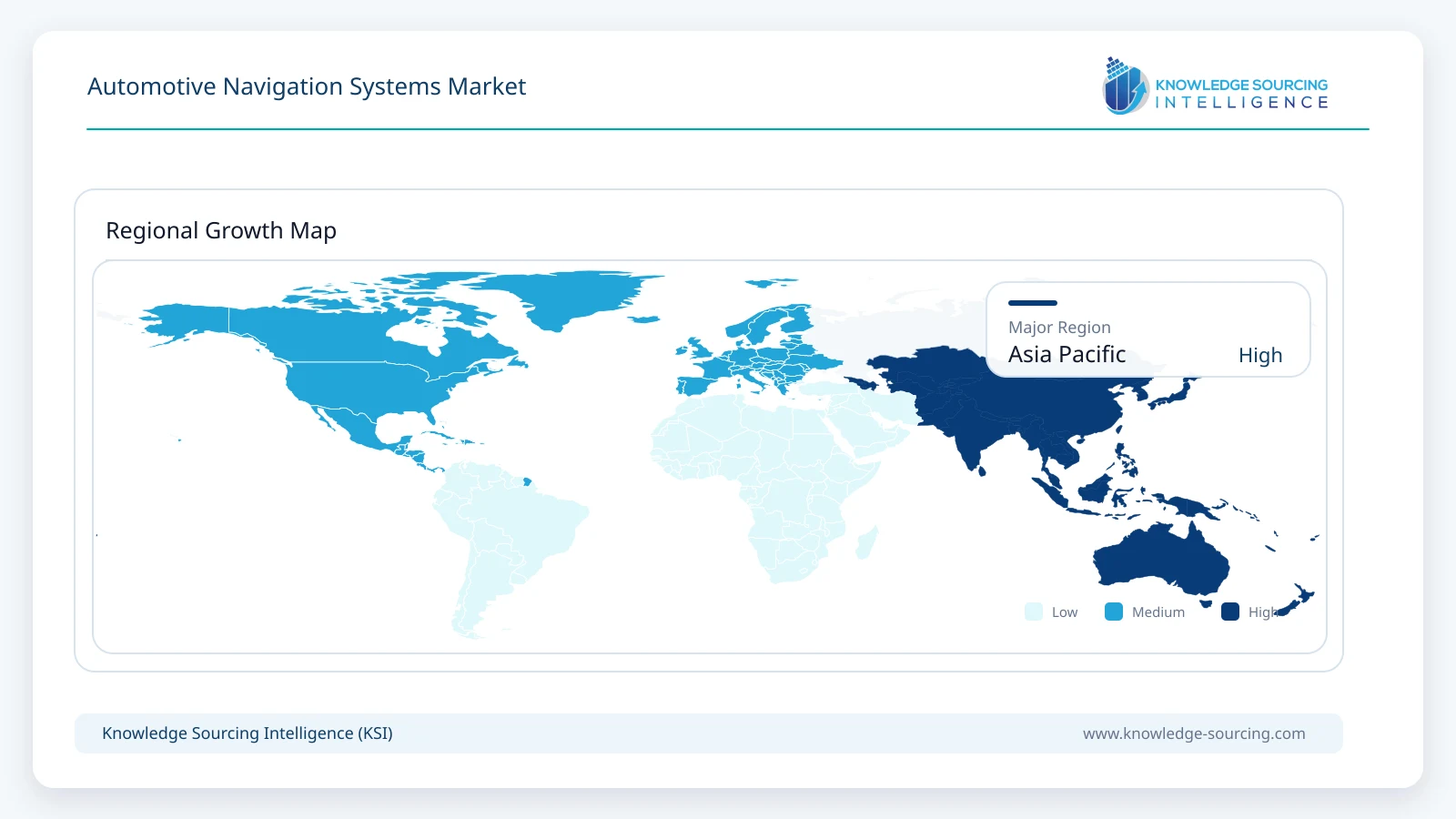
Asia Pacific accounts for an estimated 39% of global market value in 2026, supported by vehicle production and digital-cockpit adoption in China, Japan, South Korea and India. Chinese brands have advanced connected infotainment and integrated routing, while Japanese and Korean manufacturers maintain broad overseas model programmes requiring navigation localised for several markets. A growing population of electric vehicles also raises demand for charging-aware route planning and continuously updated map content.
Regional demand is projected to reach approximately USD 25.20 billion by 2031. Suppliers must navigate differences in local mapping ecosystems, data controls and user expectations: a solution suitable for Chinese urban navigation may need substantial modification for India or export markets. Partnerships between international map providers and regional software integrators are therefore likely to remain important.
Europe
European automotive programmes place significant demands on embedded route guidance because vehicles cross national borders frequently and manufacturers need a consistent service across multiple languages, traffic systems and road regulations. OEM demand increasingly includes EV charging coordination, map refreshes and functions that present navigation alongside driver assistance. HERE’s September 2026 expansion with NIO and BMW’s advanced map integration provide current examples of supplier-led development.
At an estimated 8.2% CAGR for 2026–2031, Europe is the fastest-growing region in the model. This forecast reflects navigation software value rising through multi-country connected services and higher-function vehicle platforms rather than an assumption that car production alone accelerates at the same rate. Suppliers still have to manage pricing pressure, privacy requirements and technical variation between vehicle manufacturers.
Competitive Landscape
The competitive environment contains specialist navigation platforms, regional map-data providers and companies integrating navigation into vehicle electronics. HERE and TomTom supply broad location-data and automotive software capabilities, while Mapbox offers APIs, rendering and application tools that automakers can tailor to their brand. NNG competes through the modular iGO platform, including embedded and commercial-vehicle offerings. Google Maps occupies a distinct position through vehicles using Google built-in, where software and ecosystem choices influence OEM sourcing.
Garmin remains relevant both through its aftermarket GPS products and its automotive OEM electronics work. AISIN has developed location-based automotive software and cloud-navigation capabilities, while Hyundai AutoEver integrates navigation for its associated vehicle programmes. ZENRIN contributes map data for Japanese automotive navigation, and Amap is a significant navigation platform in China, including partnerships addressing Chinese brands’ overseas expansion. The positions of these firms differ by product level and region; they should not be compared through unsupported uniform market-share rankings.
Supplier selection now turns on map coverage, production support, rights to vehicle and customer data, implementation speed, licence economics and the ability to deliver updates through a vehicle’s life. Full-stack contracts can deepen long-term supplier relationships, but OEMs also use modular licences to avoid dependence on a single software provider. Brand-controlled navigation interfaces may consequently coexist with third-party maps and routing logic in the same vehicle programme.
Recent Developments
14 October 2026: Mapbox launched 3D Live Navigation in BMW Neue Klasse vehicles, combining lane-level route guidance with live vehicle-surroundings information in an integrated map.
23 September 2026: HERE Technologies expanded its collaboration with NIO across the manufacturer’s European vehicle range, supplying refreshed map intelligence for navigation and future assisted-driving functions.
9 September 2026: Garmin introduced redesigned Drive GPS navigators with ultrawide displays, updated route interfaces and connected traffic and charging-location functions for aftermarket users.
18 June 2026: NNG announced a partnership with LogiGo to bring iGO Truck Navigation to truck and bus products in Brazil and other Latin American markets.
8 January 2026: TomTom and Visteon announced integration of TomTom’s Automotive Navigation Application with Visteon’s cognitoAI platform for an onboard conversational navigation experience.
5 January 2026: Mapbox announced that Toyota’s next-generation navigation software would debut in the 2026 RAV4, using Mapbox mapping and rendering within Toyota’s branded multimedia experience.
Market Outlook
Navigation demand through 2031 will be influenced more by recurring software capability and vehicle-level integration than by the simple number of GPS displays installed. Automakers will need map data, routing logic and traffic services that remain reliable across long product cycles, multiple countries and frequent cockpit software updates. The increasing use of lane-level map information will also create more opportunities to improve driver information without treating navigation as a substitute for certified driver-assistance functions.
Passenger-car OEM platforms should remain the main commercial channel, particularly when navigation is bundled into commonly used infotainment systems. Commercial-vehicle products can grow by serving specific operational needs such as vehicle restrictions and fleet integration, while general-purpose aftermarket GPS units will compete with phone navigation. The differing economics of these channels mean that suppliers will need targeted product strategies rather than a single navigation offer for every customer.
Asia Pacific will remain the largest demand centre in the forecast, and European platforms may deliver the strongest growth in value through higher integration requirements. Providers with reliable map operations, flexible software development tools and clear data-governance arrangements are positioned to capture a greater share of navigation spending as vehicle manufacturers refine their digital ecosystems.
Automotive Navigation Systems Market Scope
| Report Metric | Details |
|---|---|
| Total Market Size in 2026 | USD 45.8 billion |
| Total Market Size in 2031 | USD 63.0 billion |
| Forecast Unit | Billion |
| Growth Rate | 6.6% |
| Study Period | 2021 to 2031 |
| Historical Data | 2021 to 2024 |
| Base Year | 2025 |
| Forecast Period | 2026 – 2031 |
| Segmentation | Sales Channel, Vehicle Type, Geography |
| Companies |
|
| Customization Scope | 15% Free Customization included with purchase — Request Custom Breakdown → |
| Sample & Data Access | PDF Sample, Excel Databook & Analyst Briefing — Download Free Sample → |
Market Segmentation
By Sales Channel
OEM
Aftermarket
By Vehicle Type
Passenger Cars
Commercial Vehicles
By Geography
North America
United States
Canada
Mexico
South America
Brazil
Argentina
Others
Europe
United Kingdom
Germany
France
Italy
Spain
Others
Middle East and Africa
Saudi Arabia
United Arab Emirates
Others
Asia Pacific
China
Japan
India
South Korea
Taiwan
Thailand
Indonesia
Others
Table of Contents
1. EXECUTIVE SUMMARY
1.1. Key Findings
1.2. Market Size and Outlook, 2026–2031
1.3. Critical Growth Drivers
1.4. Regional Opportunity
2. MARKET SNAPSHOT
2.1. Market Overview
2.2. Market Definition
2.3. Scope of the Study
2.4. Market Segmentation
3. BUSINESS LANDSCAPE
3.1. Market Drivers
3.1.1. Increasing Factory Integration across Vehicle Platforms
3.1.2. Connected Traffic Data and Frequent Map Refreshes
3.1.3. Electric-Vehicle Adoption and Charging-Route Planning
3.1.4. Improving Lane Guidance and Driver Information
3.1.5. Commercial-Vehicle Demand for Restriction-Aware Routing
3.2. Market Restraints
3.2.1. Smartphone Navigation and Free-Use Alternatives
3.2.2. Map Maintenance and Geographic Data Quality
3.2.3. Vehicle Integration and Qualification Costs
3.2.4. Location Privacy and Regional Data Governance
3.2.5. Connectivity Dependence and Software Security
3.3. Market Opportunities
3.4. Porter’s Five Forces Analysis
3.4.1. Bargaining Power of Suppliers
3.4.2. Bargaining Power of Buyers
3.4.3. Threat of New Entrants
3.4.4. Threat of Substitutes
3.4.5. Competitive Rivalry
3.5. Industry Value Chain Analysis
3.6. Policies and Regulations
3.7. Strategic Recommendations
4. TECHNOLOGICAL OUTLOOK
4.1. Embedded Navigation Architectures
4.2. Digital Maps and Lane-Level Guidance
4.3. EV Charging and Route Optimisation
4.4. Connected Traffic and Offline Navigation
4.5. Voice Interfaces and Over-the-Air Updates
5. AUTOMOTIVE NAVIGATION SYSTEMS MARKET BY SALES CHANNEL
5.1. Introduction
5.2. OEM
5.3. Aftermarket
6. AUTOMOTIVE NAVIGATION SYSTEMS MARKET BY VEHICLE TYPE
6.1. Introduction
6.2. Passenger Cars
6.3. Commercial Vehicles
7. AUTOMOTIVE NAVIGATION SYSTEMS MARKET BY GEOGRAPHY
7.1. Introduction
7.2. North America
7.2.1. Country Outlook
7.2.2. United States
7.2.3. Canada
7.2.4. Mexico
7.3. South America
7.3.1. Country Outlook
7.3.2. Brazil
7.3.3. Argentina
7.3.4. Others
7.4. Europe
7.4.1. Country Outlook
7.4.2. United Kingdom
7.4.3. Germany
7.4.4. France
7.4.5. Italy
7.4.6. Spain
7.4.7. Others
7.5. Middle East and Africa
7.5.1. Country Outlook
7.5.2. Saudi Arabia
7.5.3. United Arab Emirates
7.5.4. Others
7.6. Asia Pacific
7.6.1. Country Outlook
7.6.2. China
7.6.3. Japan
7.6.4. India
7.6.5. South Korea
7.6.6. Taiwan
7.6.7. Thailand
7.6.8. Indonesia
7.6.9. Others
8. COMPETITIVE ENVIRONMENT AND ANALYSIS
8.1. Major Players and Strategy Analysis
8.2. Market Share Analysis
8.3. Mergers, Acquisitions, Agreements and Collaborations
8.4. Competitive Dashboard
9. COMPANY PROFILES
9.1. HERE Technologies
9.2. TomTom N.V.
9.3. Mapbox, Inc.
9.4. Garmin Ltd.
9.5. Google LLC
9.6. NNG LLC
9.7. Hyundai AutoEver Corp.
9.8. AISIN Corporation
9.9. ZENRIN Co., Ltd.
9.10. Amap (Alibaba Group)
10. APPENDIX
10.1. Currency
10.2. Assumptions
10.3. Base and Forecast Years Timeline
10.4. Key Benefits for Stakeholders
10.5. Research Methodology
10.6. Abbreviations





Frequently asked questions
What is the projected market size for automotive navigation systems by 2031?
The Automotive Navigation Systems Market is projected to reach USD 63.0 billion by 2031.
What is the projected CAGR for the Automotive Navigation Systems Market?
The Automotive Navigation Systems Market is expected to expand at a 6.6% CAGR.
Which region currently leads demand for automotive navigation systems?
Asia Pacific leads current navigation demand.
What integration type accounts for the largest market share?
OEM integration accounts for 84% of the 2026 market value.
What are key growth drivers shaping automotive navigation systems?
EV route planning and refreshable map services shape growth.
Which vehicle category represents the largest segment?
Passenger cars remain the largest vehicle category.
Cite this report
Knowledge Sourcing Intelligence. (Nov 2026). Automotive Navigation Systems Market - Strategic Insights and Forecasts (2026-2031). https://www.knowledge-sourcing.com/report/automotive-navigation-systems-market