
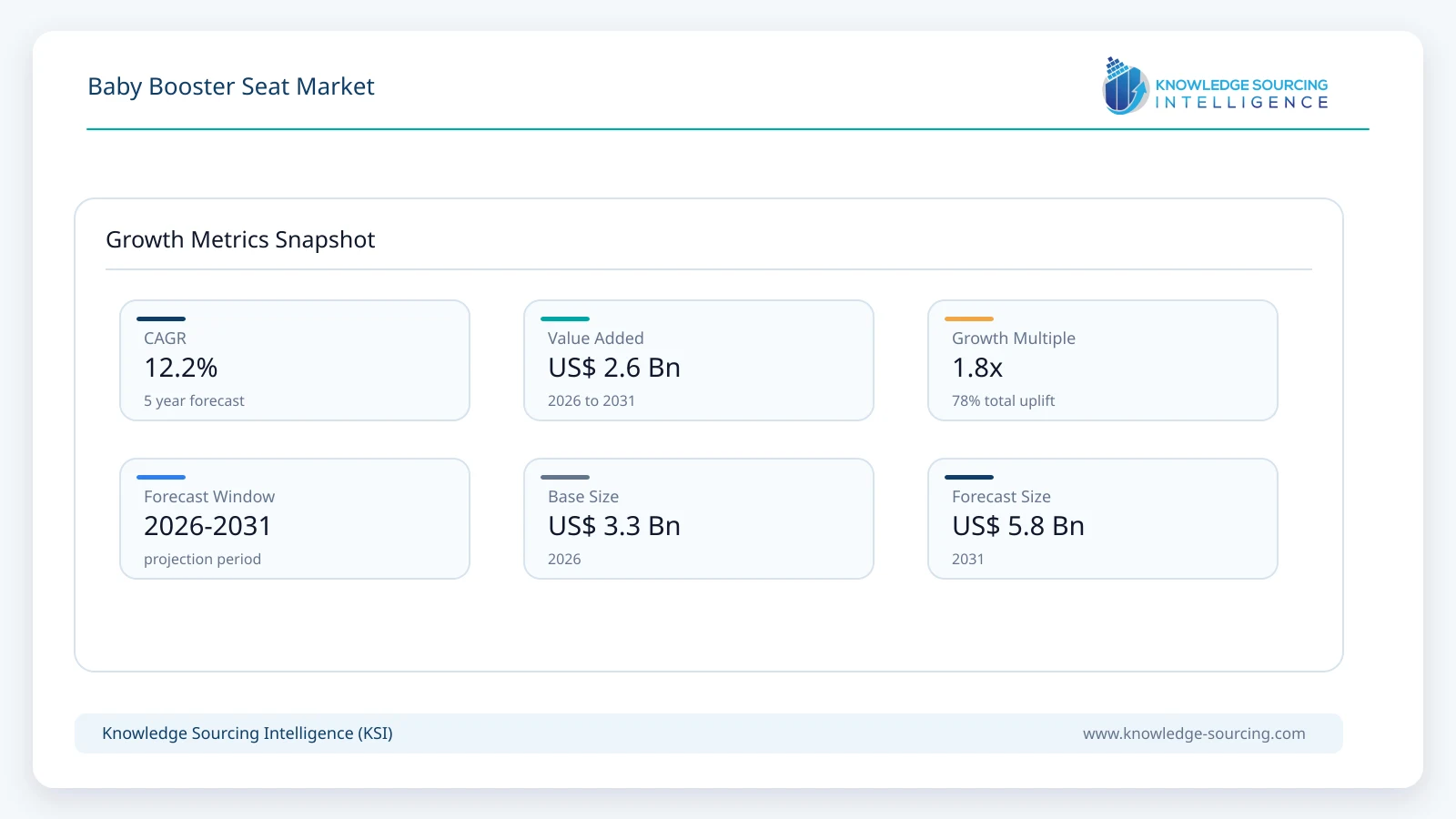
The Baby Booster Seat Market is forecast to grow at a CAGR of 12.2%, reaching USD 5.82 billion in 2031 from USD 3.27 billion in 2026.
Highlights:
- 1Safety-led demandBooster adoption is closely connected to the transition from forward-facing harnessed seats and the need for proper vehicle seat-belt positioning.
- 2High-back relevanceHigh-back products remain commercially important where parents prioritize head and torso support, belt guidance, adjustability, and longer usable stages.
- 3North American importanceThe United States and Canada have established child-restraint regulatory frameworks, extensive vehicle ownership, and strong consumer awareness around child passenger safety.
- 4Portability trendLightweight and narrow backless boosters address carpools, multi-vehicle households, travel, and vehicles with limited rear-seat width.
- 5Regulatory influenceChanges to crash-testing, side-impact requirements, labeling, anchorage systems, and certification procedures can influence product development costs and launch schedules.
- 6Product differentiationSuppliers increasingly differentiate through multi-stage functionality, compact dimensions, belt-positioning systems, installation features, comfort, and ease of transfer between vehicles.
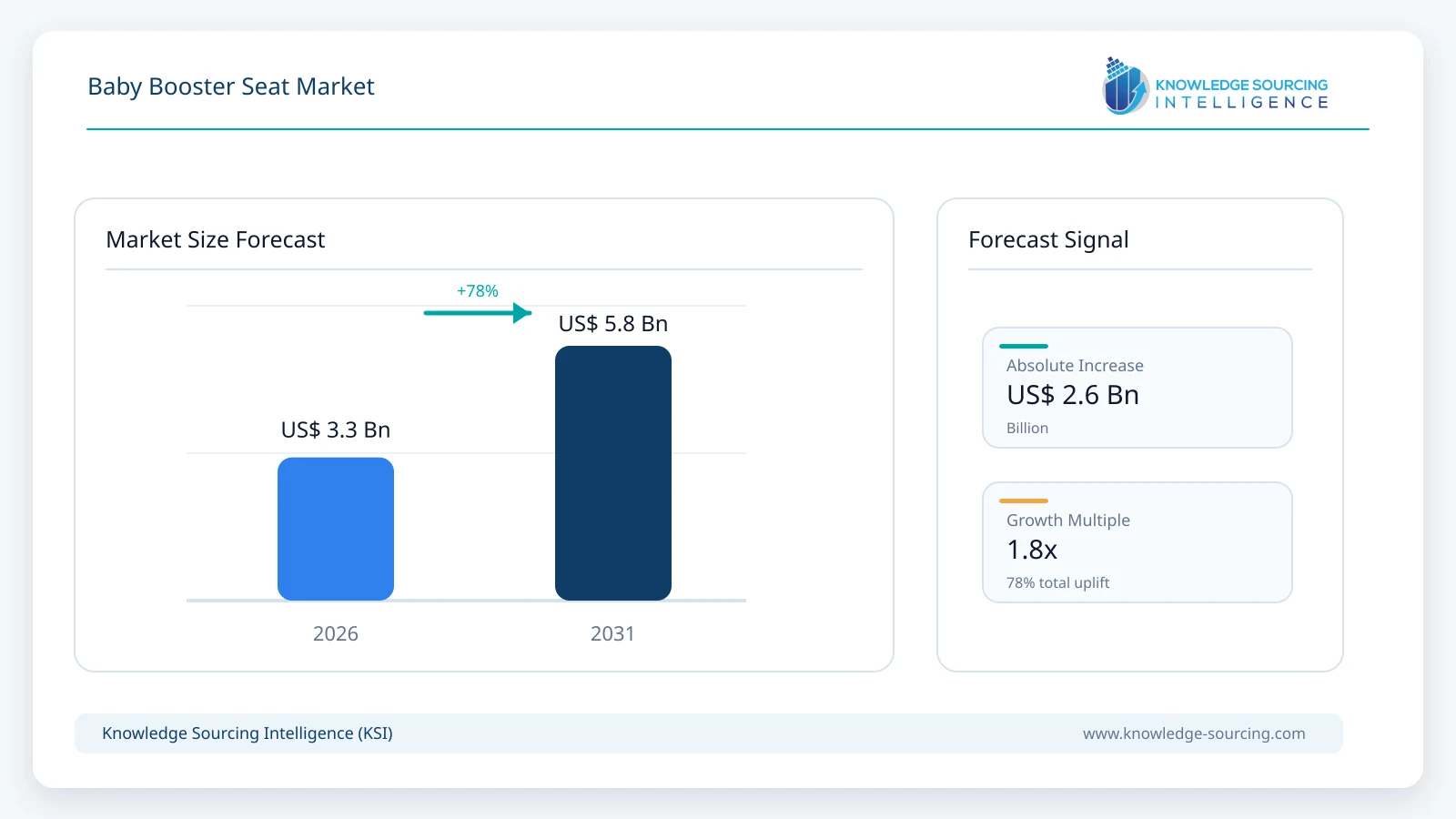
The Baby Booster Seat Market covers booster seats designed to raise children who have outgrown forward-facing harnessed child restraints but remain too small for a vehicle’s adult seat belt to fit correctly. The category includes high-back booster seats, backless booster seats, combination or harness-to-booster products, and other specialized configurations. Commercial demand is tied directly to child passenger safety requirements, vehicle ownership, household travel patterns, replacement cycles, and parental decisions concerning the transition from harnessed restraints to seat-belt positioning systems.
A booster seat does not replace the vehicle restraint system. Its primary function is to position the child so that the vehicle’s lap-and-shoulder belt crosses the stronger areas of the body. The U.S. National Highway Traffic Safety Administration (NHTSA) recommends moving a child to a booster after the child outgrows a forward-facing seat with a harness, while continuing booster use until the vehicle belt fits properly. NHTSA also recommends that children remain in the rear seat through at least age 12.
This creates a demand cycle that differs from infant and convertible car seats. Booster purchases are generally associated with a later stage of childhood, and the purchasing decision is strongly influenced by child height, weight, maturity, vehicle configuration, seat-belt geometry, and the useful life of an existing restraint. Families with multiple children can also purchase several booster seats over time, particularly when children reach the booster stage at different ages.
The commercial importance of the category comes from its position within the broader child passenger restraint ecosystem. Unlike many juvenile products, booster seats perform a clearly defined safety function governed by vehicle compatibility and regulatory requirements. Consequently, product certification, belt positioning, side-impact considerations, anchorage systems, labeling, installation simplicity, and fit guidance influence purchasing decisions alongside price and aesthetics.
Buyer priorities increasingly center on correct belt positioning, ease of installation, portability, seat width, adjustability, cleaning, and compatibility with multiple vehicles. These requirements matter particularly for families that move a booster between household vehicles, grandparents' vehicles, school transportation, carpools, and vacation vehicles. Transport Canada specifically advises consumers to consider both child and vehicle fit and, where possible, to try the booster in the vehicle before purchase.
The market also has an important replacement component. Booster seats are subject to product-specific height and weight limits, useful-life considerations, recalls, and changing regulatory requirements. Transport Canada notes that product materials can deteriorate with repeated use and exposure, while standards and safety requirements can change over time. These factors support recurring demand even when the underlying child population changes only gradually.
Distribution is divided between online and offline channels. Online channels provide broader assortment visibility, comparison capabilities, customer reviews, manufacturer specifications, and home delivery. Offline channels remain relevant because physical stores allow parents to evaluate dimensions, construction, comfort, and compatibility before purchase. The importance of each channel therefore varies according to product complexity, consumer confidence, local retail infrastructure, and regulatory awareness.
The industry structure combines established child-safety brands with specialist juvenile-product manufacturers and retailers. Competition is based less on simple seat capacity and more on safety engineering, certification, fit, ease of use, portability, product longevity, and brand trust. Product architecture also influences economics. Combination seats can extend the usable life of a product across multiple child stages, while lightweight backless products can target portability and lower price points.
Technology adoption is primarily incremental rather than electronic. Manufacturers are incorporating adjustable headrests, improved belt guides, rigid or flexible lower-anchor connections, side-impact design features, washable materials, ergonomic shaping, and compact structures. Some manufacturers are also examining electronic functions. China has published GB/T 47246-2026, a recommended national standard covering electronic functions in child restraint systems, scheduled to take effect on October 1, 2026.
Market Drivers
Regulatory Emphasis on Child Passenger Protection
Regulation is one of the strongest structural demand mechanisms because compliant child restraints are required in several major markets, while parents and caregivers also use regulatory guidance to determine when children should move between restraint stages.
In the United States, child restraint requirements operate alongside federal vehicle-safety standards and state-level child-seat laws. State requirements differ in age, height, weight, and restraint type, creating a fragmented compliance environment for consumers and suppliers. The Insurance Institute for Highway Safety's August 2026 state-law table demonstrates the variation among state child-seat requirements.
For manufacturers, this environment creates a continuous need to maintain compliant product portfolios and accurate labeling. Suppliers with established testing capabilities can spread certification and engineering costs across larger product volumes, creating an advantage over smaller manufacturers with limited regulatory resources.
Transition from Harnessed Seats to Seat-Belt Positioning
The transition from a forward-facing harnessed restraint to a booster creates a distinct replacement event. NHTSA recommends continuing to use a forward-facing harness until the child reaches the manufacturer's height or weight limit before moving to a booster.
This creates demand based on child development rather than discretionary purchasing alone. Parents must evaluate whether the child remains within the harnessed seat's limits and whether the child is mature enough to remain properly positioned with the vehicle belt.
Suppliers respond by offering combination products that bridge the two stages. Evenflo, for example, markets products that transition from a forward-facing harness configuration to a high-back belt-positioning booster, illustrating how manufacturers address the need for longer product utilization.
Demand for Multi-Vehicle and Portable Solutions
Households increasingly require restraint products that can move between vehicles. Families may use one vehicle for daily commuting and another for school, recreation, travel, or shared caregiving.
This requirement favors lightweight construction, narrow seat footprints, integrated handles, quick installation, and simple belt-routing systems. Backless boosters are particularly suited to these applications because they occupy less space and can be transported more easily than larger high-back products.
Britax's UpNGo Click illustrates this product direction. The company introduced the backless booster in 2025 with rigid LATCH connectors, a built-in carry handle, a slim 17.1-inch width, and a product weight below five pounds.
Expansion of Multi-Stage Product Architecture
Combination and multi-stage products address a commercial concern shared by parents and retailers: maximizing usable product life. A seat capable of accommodating a child through more than one restraint stage can reduce the number of separate purchases required over several years.
For manufacturers, multi-stage architecture can support higher average selling prices while strengthening brand retention across the child's development cycle. However, these products require careful engineering because the restraint must function correctly across materially different child sizes and restraint configurations.
The commercial value therefore comes from balancing versatility with ease of use. A product that offers several modes but creates confusion during conversion may lose consumer appeal despite having broader technical specifications.
Continued Vehicle Ownership and Family Mobility
Booster-seat demand is also linked to the number of households transporting children by private vehicle. Every vehicle-based child transportation journey creates a need for appropriate restraint use, while multi-car households can create demand for additional seats.
The category therefore benefits from school commuting, extracurricular activities, family travel, shared caregiving, and routine urban mobility. The resulting demand is distributed throughout the year rather than being restricted to a single purchasing season, although school-year preparation and family travel periods can influence retail timing.
Market Restraints and Challenges
Regulatory Fragmentation Across Markets
The absence of a single global regulatory framework creates compliance complexity. North American requirements differ from European systems, while Asian markets continue to introduce and update their own national standards.
China, for example, implemented GB 27887-2024 as a mandatory national standard for child restraint systems from July 1, 2025. China also has a separate current standard, GB/T 44083.4-2024, addressing usability evaluation for booster seats and booster cushions.
Manufacturers selling internationally must therefore manage product certification, testing, documentation, labeling, and market-specific product configurations. These requirements can lengthen development cycles and increase certification expenditure.
Product Fit and Vehicle Compatibility
Booster performance depends on the relationship among the child, booster, vehicle seat, and seat belt. A technically compliant product may still provide a poor user experience if the vehicle belt does not route correctly or the booster does not sit securely.
Transport Canada explicitly emphasizes child and vehicle fit and recommends checking the booster against the vehicle before purchase where possible.
This creates a commercial challenge for online retailers. Consumers may buy based on dimensions and specifications without physically testing compatibility. Suppliers can mitigate this issue through detailed compatibility guides, installation instructions, vehicle-fit databases, and responsive customer support.
Price Sensitivity in Backless Products
Backless boosters generally have simpler structures than high-back or combination seats, allowing manufacturers to compete at lower price points. This can create margin pressure where products become heavily commoditized.
Suppliers therefore need to distinguish products through belt guides, attachment systems, comfort features, washable materials, portability, brand reputation, and certification rather than relying solely on price.
Testing and Certification Costs
Changes in crash-testing requirements can require substantial engineering and testing investment. In the United States, NHTSA's 2025 regulatory actions concerning FMVSS 213a and related child-restraint standards demonstrated the complexity of implementing new requirements while maintaining product availability. NHTSA stated that manufacturers needed additional time for research, development, testing, and certification under the proposed timing changes.
Such requirements can affect smaller manufacturers disproportionately because testing expenses are spread over smaller production volumes. Established companies with established engineering and certification infrastructure can generally absorb regulatory development costs more efficiently.
Consumer Misuse and Early Transition
Consumer behavior can constrain category performance even when product availability is strong. Parents may move children into boosters before they have outgrown their harnessed seats or before they can remain correctly positioned.
NHTSA advises keeping children in forward-facing harnessed seats until they reach the manufacturer's limits and using boosters until the vehicle belt fits properly.
Manufacturers therefore need clear labeling and education. Better instructions can reduce misuse, support brand trust, and lower the likelihood of safety-related complaints or recalls.
Major Segment Analysis
High-Back Booster Seats
High-back booster seats represent an important commercial segment because they combine belt-positioning functionality with structural support around the child's torso and head. Their design addresses parents seeking greater containment and belt-guidance assistance during the transition from a harnessed seat.
The principal demand comes from children who have outgrown forward-facing harnessed seats but still require help positioning the vehicle's lap-and-shoulder belt. NHTSA describes the booster stage as the period following the child's outgrowth of the forward-facing harnessed restraint and continuing until the seat belt fits properly without assistance from a booster.
Buyer requirements extend beyond safety compliance. Parents evaluate headrest adjustment, shoulder-belt positioning, seat width, padding, ease of cleaning, cup-holder availability, installation method, and the product's usable height and weight range. Families with multiple children also consider whether the high-back booster can fit alongside other child restraints.
The segment offers manufacturers several opportunities for differentiation. Adjustable headrests can extend product usability as children become taller. Integrated belt guides can simplify correct positioning. Narrower designs can improve compatibility with three-across seating configurations. Washable covers address the practical demands of school-age children who use the product frequently.
High-back products can also support higher average selling prices than basic backless products because they incorporate more materials and components. However, this raises logistics costs because larger products consume more shelf and shipping space.
Competitive positioning consequently depends on achieving a balance among safety engineering, physical footprint, durability, comfort, price, and installation simplicity. Suppliers with broad child-restraint portfolios can use high-back boosters to retain consumers as they progress from infant and convertible products into later-stage restraints.
Regional Analysis
North America
North America represents a mature and regulation-intensive market. The United States has federal child-restraint standards alongside state-specific child-seat laws, creating a substantial compliance and consumer-education framework. NHTSA also provides extensive guidance concerning booster use, installation, registration, and seat-belt transition.
The United States is commercially important because consumers are accustomed to purchasing dedicated child restraints and have access to broad product portfolios through specialist retailers, mass merchants, and online channels.
Canada also has a formal national compliance structure. Transport Canada requires child seats and booster seats sold in Canada to comply with applicable Motor Vehicle Safety Act requirements, while products manufactured or imported for sale must be certified and labeled accordingly.
Mexico provides additional regional demand, although purchasing behavior and regulatory implementation differ from the United States and Canada. Suppliers operating across North America benefit from distribution scale but must account for country-specific compliance and consumer preferences.
Europe
Europe is strongly influenced by UNECE child-restraint requirements, particularly UN Regulation No. 129 covering Enhanced Child Restraint Systems.
European consumers generally place substantial emphasis on safety certification, vehicle compatibility, installation simplicity, and compact design. Dense urban environments and smaller vehicle footprints increase the commercial value of narrow products.
Germany, France, the United Kingdom, Spain, and Italy form important demand centers within the region. Retail competition is supported by established juvenile-product channels and strong brand recognition.
The major constraint is regulatory and product-development complexity across markets, particularly where suppliers must manage different national retail requirements and consumer expectations. European manufacturers also compete on design quality, materials, usability, and product integration rather than basic functionality alone.
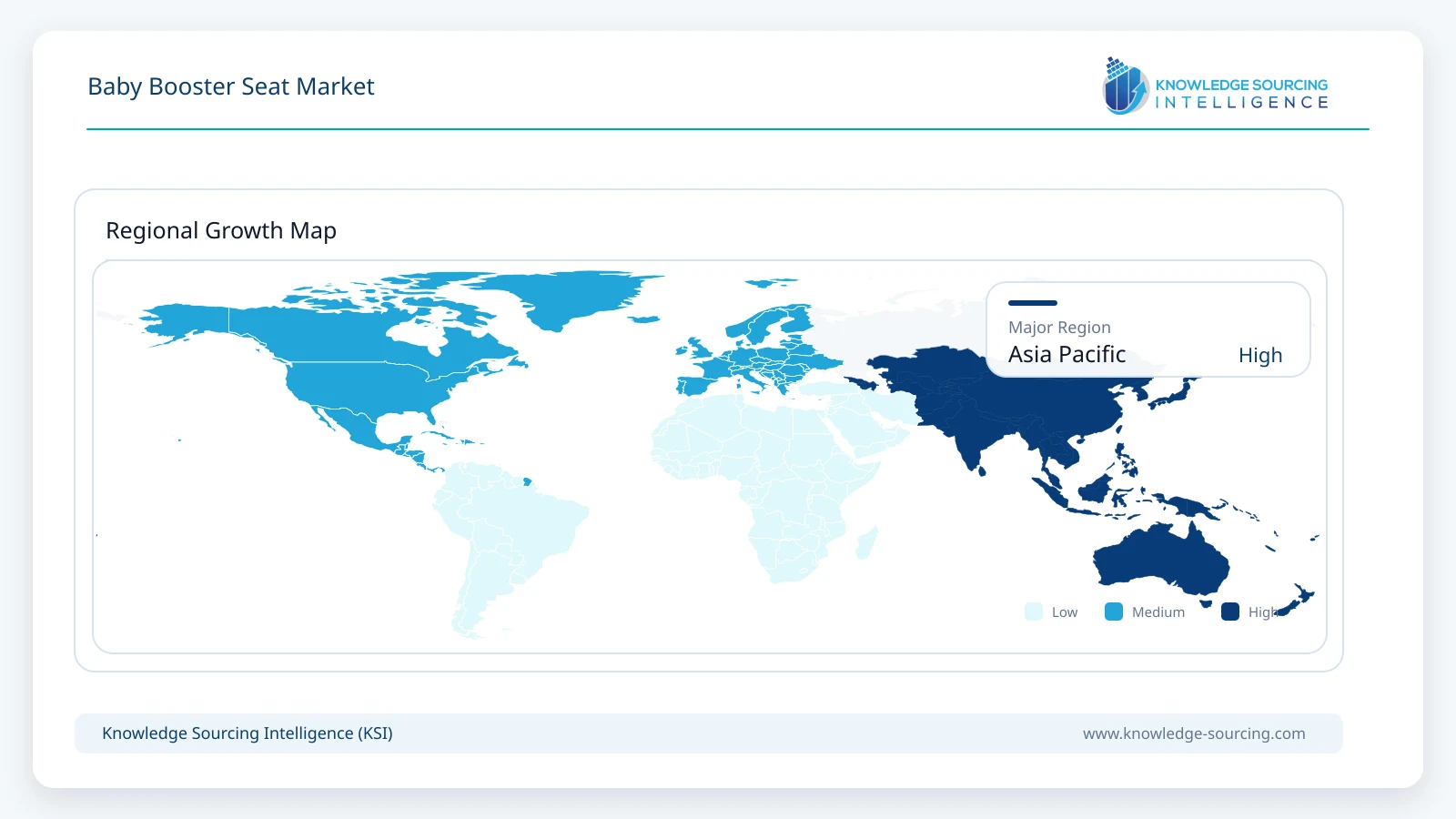
Asia Pacific
Asia Pacific offers substantial long-term commercial opportunity because child-restraint regulation is becoming more structured in several major markets. China provides the clearest example. GB 27887-2024 became effective on July 1, 2025, replacing the previous national standard and establishing a current mandatory framework for child restraint systems.
China also maintains a current booster-specific usability standard, GB/T 44083.4-2024, which addresses evaluation methods for booster seats and booster cushions.
India, Japan, South Korea, Indonesia, and Thailand have differing levels of child-restraint adoption and regulatory development. Demand is influenced by vehicle ownership, urban family mobility, child-safety awareness, retail accessibility, and enforcement.
The principal commercial opportunity lies in expanding consumer awareness while offering products suited to local vehicle configurations and household budgets. The main constraint remains uneven adoption and differing regulatory requirements across countries.
Middle East and Africa
Saudi Arabia and the United Arab Emirates represent important demand centers because of relatively high vehicle dependence and developed retail infrastructure in major urban areas. Demand is supported by family transportation, private vehicle use, premium retail channels, and consumer awareness of vehicle safety.
The region remains diverse, however. Purchasing power, enforcement, vehicle mix, and child-restraint awareness vary considerably among countries. Suppliers therefore need differentiated distribution strategies rather than a single regional approach.
South America
Brazil represents the largest commercial reference market in South America, supported by its large vehicle fleet, urban population, and established automotive ecosystem. Argentina provides another relevant market, while other countries create smaller but geographically distributed demand.
Price sensitivity is an important purchasing factor. Suppliers that can combine recognized safety performance with accessible pricing are better positioned to reach broader household segments.
Import dependence, currency volatility, retail fragmentation, and varying regulatory enforcement can affect margins and inventory decisions. Local distribution partnerships can therefore be important for maintaining product availability without excessive working-capital exposure.
Competitive Landscape
The competitive structure comprises established child-safety and juvenile-product companies with differentiated product portfolios rather than a single standardized business model. The companies considered in this market include Evenflo Company, Inc., Peg Perego, Inglesina, Graco Children’s Products, Inc., and Britax.
Competition is primarily based on safety engineering, product certification, stage coverage, comfort, ease of installation, physical dimensions, brand credibility, and retail reach. Product architecture is especially important because manufacturers can address different price points through high-back, backless, and combination configurations.
Multi-stage functionality provides one competitive route. Evenflo's portfolio includes harness-to-high-back-booster products and separate high-back and backless configurations, allowing the company to address several stages and purchasing requirements.
Britax has demonstrated a more specific emphasis on portability and compact backless designs. Its 2025 UpNGo Click launch combined rigid LATCH, a slim footprint, portability, and belt-positioning features.
Peg Perego and Inglesina bring established European juvenile-product positioning, while Graco benefits from a broad child-restraint portfolio and extensive consumer distribution. Competition among these companies is therefore likely to depend on product refresh cycles, channel coverage, certification capabilities, pricing architecture, and the ability to translate safety features into straightforward consumer benefits.
Partnerships with retailers, distributors, vehicle manufacturers, safety organizations, and child-safety educators can also influence market reach. Geographic expansion requires more than distribution capacity because product certification and labeling requirements can differ substantially among countries.
Recent Developments
May 2026: Thule’s Palm high-back booster seat gained increased market visibility following independent product evaluation, highlighting its i-Size design, comfort, adjustability, and suitability for children measuring approximately 100–150 cm.
February 2026: Transport Canada opened consultation on proposed updates to child-restraint and vehicle-anchorage regulations, with public consultation running from February 6 to April 22, 2026. Commercial relevance: potential regulatory changes may influence future testing, certification, anchorage requirements, product engineering, and compliance planning for suppliers serving Canada.
August 2025: Britax announced the UpNGo Click backless booster, featuring rigid LATCH connectors, a slim 17.1-inch width, a carry handle, belt-positioning guides, and a 40–120-pound child range. Commercial relevance: the launch reinforces demand for lightweight, portable booster products designed for carpools and multi-vehicle households.
July 2025: The U.S. National Highway Traffic Safety Administration issued a notice of enforcement discretion concerning FMVSS 213a, temporarily pausing enforcement of the side-impact standard while the agency considered amendments to the child-restraint regulatory framework. Commercial relevance: the action reduced immediate compliance uncertainty for manufacturers while extending the period available for product testing and certification.
Regulatory and Policy Environment
Regulation remains central to the Baby Booster Seat Market because booster seats are safety-critical products that interact directly with vehicle restraint systems.
In the United States, FMVSS No. 213 governs child restraint systems, while FMVSS No. 213a addresses side-impact protection and FMVSS No. 213b introduces updated child-restraint requirements. NHTSA has continued modifying implementation details, testing procedures, and compliance timing. The 2025 enforcement action illustrates the operational consequences of regulatory changes for manufacturers.
State laws add another layer. Requirements concerning the age, height, weight, and type of child restraint vary by state. This fragmentation influences consumer education and product labeling while creating additional compliance considerations for nationwide retailers.
Canada operates under the Motor Vehicle Restraint Systems and Booster Seats Safety Regulations. Products manufactured for sale or imported into Canada must meet applicable standards and carry the required certification markings. The regulations were last amended on January 1, 2025, and Transport Canada initiated another regulatory consultation in February 2026.
Europe operates under UNECE regulatory frameworks, including UN Regulation No. 129 for Enhanced Child Restraint Systems.
China introduced GB 27887-2024 as a mandatory child-restraint standard effective July 1, 2025. Separately, GB/T 44083.4-2024 provides usability evaluation methods for booster seats and booster cushions.
China is also developing requirements around electronic functions in child restraint systems. GB/T 47246-2026 is scheduled for implementation on October 1, 2026. Although electronic functions are not yet a defining requirement of conventional booster seats, the standard signals a broader regulatory interest in connected or electronically assisted child-restraint functionality.
For suppliers, regulatory compliance therefore affects product engineering, material selection, testing schedules, certification expenditure, labeling, inventory management, and market-entry decisions. Regulatory monitoring must be integrated into product planning rather than treated solely as a final-stage certification exercise.
Outlook and Strategic Implications
The outlook for the Baby Booster Seat Market will depend on the interaction between child passenger-safety regulation, vehicle ownership, consumer awareness, product replacement cycles, and product engineering.
Regulatory compliance will remain an investment priority. Manufacturers serving North America must prepare for changes to crash-testing and certification requirements, while suppliers operating in China must account for the updated mandatory child-restraint framework and emerging technical standards.
Product development is likely to concentrate on three commercial priorities: easier belt positioning, lower product weight, and greater adaptability. High-back products can improve belt guidance and support, while backless models address portability and vehicle-space constraints. Combination products can capture consumers seeking longer product utilization.
Procurement behavior will also remain closely linked to trust. Parents are unlikely to treat booster seats as ordinary juvenile accessories because the product directly affects child protection during vehicle travel. Certification, manufacturer reputation, transparent instructions, warranty support, recall communication, and demonstrated ease of installation can therefore influence purchasing decisions alongside price.
Online distribution will remain important for product discovery and price comparison, but suppliers need to address the physical-fit limitations of e-commerce. Detailed compatibility tools, vehicle-fit information, installation videos, dimensional specifications, and clear transition guidance can reduce uncertainty before purchase.
Offline retailers retain an important role where consumers want physical evaluation. This is particularly relevant for high-back products and combination seats, where dimensions and vehicle-seat interaction can materially affect usability.
Competitive differentiation will increasingly depend on practical engineering rather than feature accumulation. A narrower product that fits three rear seats may have greater commercial value to a family than additional accessories. Similarly, a simple belt guide that reduces installation errors may create more purchasing value than a technically complex feature that consumers do not understand.
The regulatory environment also creates an opportunity for established manufacturers. Testing and certification requirements raise the cost of entering the category, while established suppliers can use existing engineering platforms, testing infrastructure, compliance teams, and distribution networks across multiple products.
The principal risks include regulatory changes that increase certification costs, supply-chain disruptions affecting plastics, textiles, metal components, and packaging, product recalls, pricing pressure in basic booster categories, and consumer misuse. Suppliers should therefore maintain disciplined quality systems and regulatory monitoring while avoiding excessive SKU proliferation.
Over the 2026–2031 period, the most commercially relevant strategy is likely to be portfolio segmentation rather than reliance on a single booster architecture. High-back products can serve safety-conscious households seeking support and adjustability. Backless products can target portability and price-sensitive consumers. Combination products can address households seeking longer service life from a single purchase.
The market's long-term commercial direction will ultimately be shaped by one fundamental requirement: helping children use the vehicle's restraint system correctly until they are large enough for an adult seat belt to fit without assistance. Suppliers that align product engineering, regulatory compliance, vehicle compatibility, consumer education, and distribution around that requirement will be better positioned to capture replacement and upgrade demand through 2031.
Baby Booster Seat Market Scope:
| Report Metric | Details |
|---|---|
| Total Market Size in 2026 | USD 3.27 billion |
| Total Market Size in 2031 | USD 5.82 billion |
| Forecast Unit | Billion |
| Growth Rate | 12.2% |
| Study Period | 2021 to 2031 |
| Historical Data | 2021 to 2024 |
| Base Year | 2025 |
| Forecast Period | 2026 – 2031 |
| Segmentation | Type, Child Usage Stage, Distribution Channel, Geography |
| Companies |
|
Market Segmentation
By Type
By Child Usage Stage
By Distribution Channel
By Geography
Table of Contents
1. EXECUTIVE SUMMARY
2. MARKET SNAPSHOT
2.1. Market Overview
2.2. Market Definition
2.3. Scope of the Study
2.4. Market Segmentation
3. BUSINESS LANDSCAPE
3.1. Market Drivers
3.2. Market Restraints
3.3. Market Opportunities
3.4. Porter’s Five Forces Analysis
3.5. Industry Value Chain Analysis
3.6. Policies and Regulations
3.7. Strategic Recommendations
4. TECHNOLOGICAL OUTLOOK
5. BOOSTER CAR SEAT MARKET BY TYPE
5.1. Introduction
5.2. High-Back Booster Seats
5.3. Backless Booster Seats
5.4. Combination/Harness-to-Booster Seats
5.5. Others
6. BOOSTER CAR SEAT MARKET BY CHILD USAGE STAGE
6.1. Introduction
6.2. Children Transitioning from Forward-Facing Harnessed Seats
6.3. Belt-Positioning Booster Users
6.4. Older Children Requiring Booster Use
7. BOOSTER CAR SEAT MARKET BY DISTRIBUTION CHANNEL
7.1. Introduction
7.2. Online
7.3. Offline
8. BOOSTER CAR SEAT MARKET BY GEOGRAPHY
8.1. Introduction
8.2. North America
8.2.1. United States
8.2.2. Canada
8.2.3. Mexico
8.3. South America
8.3.1. Brazil
8.3.2. Argentina
8.3.3. Others
8.4. Europe
8.4.1. Germany
8.4.2. France
8.4.3. United Kingdom
8.4.4. Spain
8.4.5. Italy
8.4.6. Others
8.5. Middle East and Africa
8.5.1. Saudi Arabia
8.5.2. United Arab Emirates
8.5.3. Others
8.6. Asia Pacific
8.6.1. China
8.6.2. India
8.6.3. Japan
8.6.4. South Korea
8.6.5. Indonesia
8.6.6. Thailand
8.6.7. Others
9. COMPETITIVE ENVIRONMENT AND ANALYSIS
9.1. Major Players and Strategy Analysis
9.2. Market Share Analysis
9.3. Mergers, Acquisitions, Agreements, and Collaborations
9.4. Competitive Dashboard
10. COMPANY PROFILES
10.1. Evenflo Company, Inc.
10.2. Peg Perego
10.3. Inglesina
10.4. Graco Children’s Products, Inc.
10.5. Britax
11. APPENDIX
11.1. Currency
11.2. Assumptions
11.3. Base Year and Forecast Period
11.4. Key Benefits for Stakeholders
11.5. Data Sources and Validation
11.6. Research Methodology
11.7. Abbreviations
LIST OF FIGURES
LIST OF TABLES
Navigate
Trusted by the world's leading organizations











