
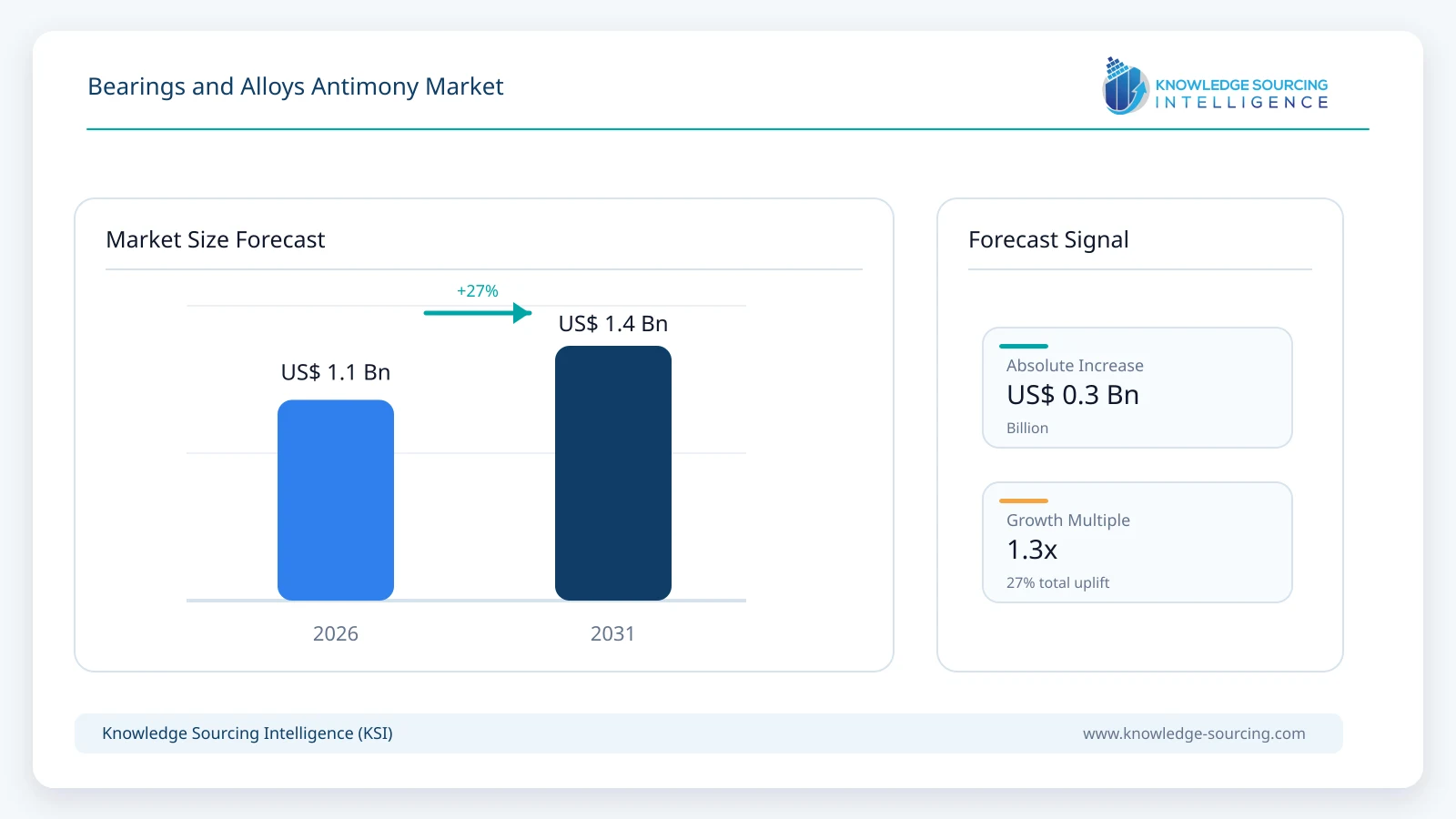
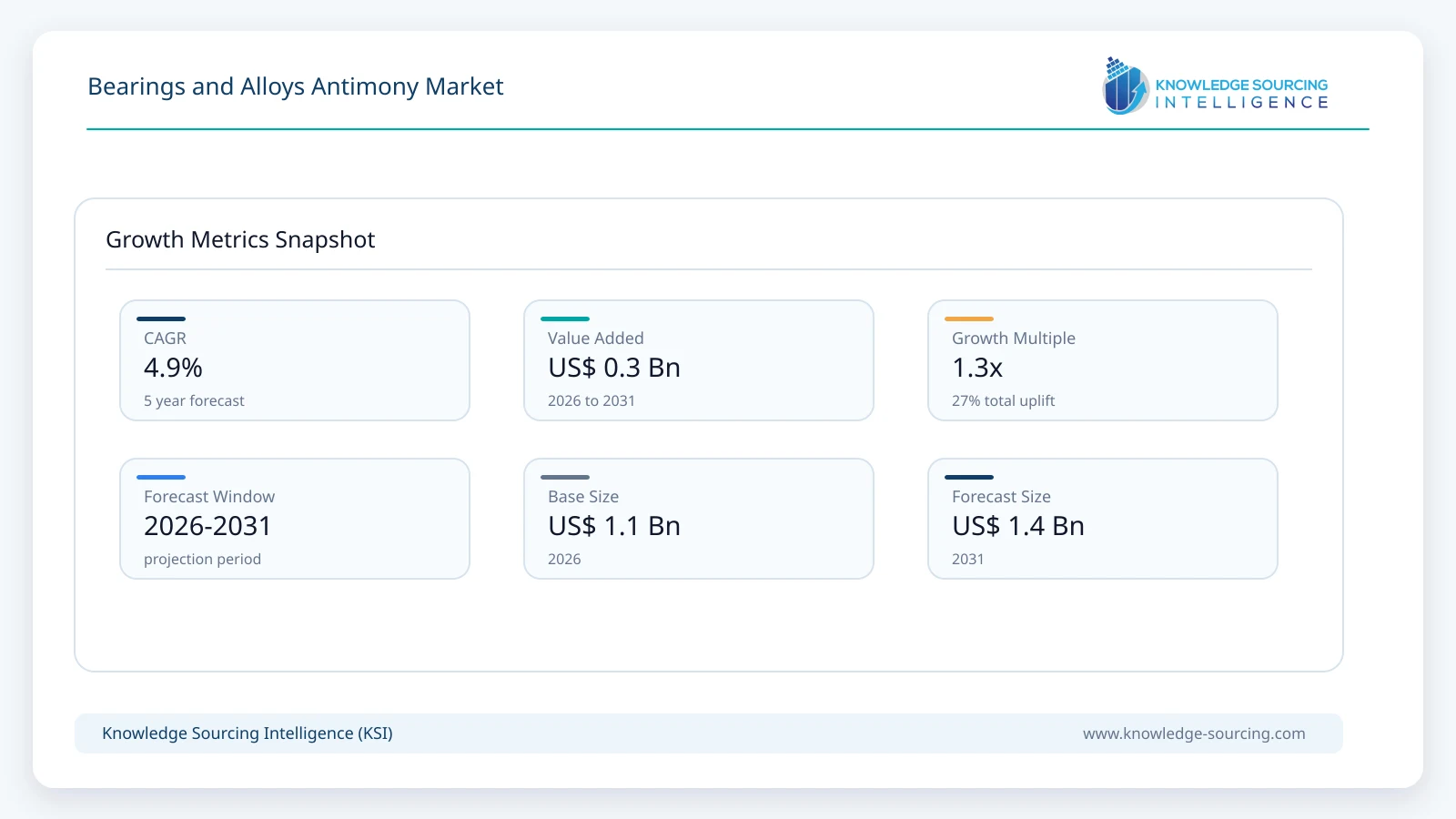
The Bearings and Alloys Antimony Market is projected to grow from USD 1.08 billion in 2026 to USD 1.37 billion by 2031, registering a CAGR of 4.89% during the forecast period.
Highlights:
- 1Antimonial lead remains the principal alloy family across battery grids and specialised industrial uses.
- 2Lead-acid storage batteries account for approximately 55% of modelled application demand in 2026.
- 3Tin-based Babbitt remains technically important for higher-speed, demanding bearing applications.
- 4Recycled lead and recovered antimony strengthen supply security for qualified alloy producers.
- 5Asia Pacific concentrates battery, industrial equipment and metallurgical processing demand.
- 6Alloy qualification and changing lead specifications influence substitution more than simple metal-price comparisons.
The bearings and alloys antimony market includes antimony-containing lead, tin and specialty alloy materials sold as ingots, casting stock, bearing-lining metal and related semi-finished forms for industrial and battery applications. Antimony modifies solidification, hardness and wear behaviour, but its contribution depends on the host metal and the service conditions. An antimonial lead grid alloy has different performance requirements and pricing from a high-tin Babbitt bearing grade, even when both qualify within the same metallurgical market.
Lead-antimony alloys are cast into battery grids and a variety of industrial components because a small controlled addition of antimony increases lead hardness and alters the structure of the cast metal. Commercial alloys span low-antimony grades to heavier antimonial formulations. Jaytee Alloys lists grades containing roughly one to ten percent antimony, while Mayco offers several standard compositions. Producers must manage associated elements and trace impurities, as minor changes can alter fluidity, corrosion behaviour and downstream processing yields.
Bearing alloys occupy a different engineering category. Babbitt is often a tin-antimony-copper metal, or a lead-based formulation with antimony and other alloying elements. Kapp Alloy identifies tin-based grades as suitable for many higher-speed bearing duties; lead-based Babbitts commonly serve slower operating conditions. Belmont Metals supplies both families against established composition specifications. Bearing rebuilders generally cannot replace a specified high-tin grade with a cheaper lead antimony alloy without checking speed, pressure, temperature and lubrication requirements.
Market Trends
Greater Attention to Closed-Loop Antimonial Lead
Battery scrap can return both lead and antimony to a refinery, giving qualified suppliers a route to reduce exposure to imported virgin antimony. The commercial difficulty is not simply recovering metal: battery grids, paste, other lead scrap and mixed chemistry must be processed into consistent output. Campine’s lead-alloy operations and Gravita’s recycled lead-alloy production illustrate why battery recycling and alloy supply are closely connected.
Closed-loop arrangements reward testing capability and secure collection networks. Battery manufacturers often specify narrow limits for antimony and other alloying elements, and processing may need to separate grades with different metallurgical histories. As formal recovery expands, producers capable of certified chemistry and reliable delivery schedules may retain accounts even when the feedstock market becomes volatile.
Bearing-Metal Sales Are Increasingly Specification-Led
Kapp Alloy and Belmont Metals publish separate ASTM B23 formulations for tin-based and lead-based Babbitts, rather than marketing them as interchangeable materials. Their distinctions are commercially important because an industrial repair shop purchasing bearing metal usually seeks compatibility with an installed shaft and original lining specification. The wrong choice can compromise running temperature, load performance or the durability of the bond between backing and liner.
For alloy specialists, technical guidance, small production batches and availability in practical shapes can be more valuable than large-scale commodity output. Mills, pumps and power-generation assets continue to require refurbishment even where newly designed machinery adopts alternative bearings. This supports a durable replacement market, although it does not imply rapid growth in the total metal tonnage consumed.
Supply Concentration Is Changing Purchasing Behaviour
Antimony experienced severe price and sourcing volatility in 2024–2026. Campine’s March 2026 results linked the surge in antimony-product sales to exceptional market conditions, followed by customer substitution and renewed supply. Such swings complicate alloy quotations when a producer must honour delivery schedules months after agreeing a price. Lead and tin pricing create additional exposure for finished-alloy suppliers.
Manufacturers are responding through recycled feedstock, inventory management and clearer metal-price adjustment arrangements. The qualification process can prevent rapid substitution of a different grade merely because antimony becomes expensive. More flexible procurement is therefore likely to favour manufacturers that can demonstrate the metallurgy of both primary and secondary inputs.
High-Tin Grades Remain Essential Despite Lead Restrictions
Lead-use restrictions and handling requirements encourage attention to tin-rich bearing alloys, particularly where an application already requires their operating properties. However, such a shift does not remove antimony demand: many tin-based Babbitts deliberately include antimony and copper to obtain the intended bearing structure. Grades such as ASTM B23 Grade 2 demonstrate why lead-free material cannot be equated with antimony-free material.
Substitution remains constrained by cost, mechanical behaviour and customer approvals. High tin content changes the material cost sharply, while rebuilding an old housing requires suitable pouring and bonding methods. Consequently, the market is likely to retain a technically differentiated mix of alloys rather than converge on one universal low-impact formulation.
Segment Analysis
By Alloy Type
Lead-Antimony Alloys
Lead-antimony alloys represent approximately 72% of modelled market value in 2026. Battery grid metals account for much of the volume, supported by the established secondary lead supply chain and specifications ranging from low to higher antimony content. Producers typically sell a defined chemistry rather than a generic antimony supplement, with hardness, castability and corrosion behaviour evaluated against the customer process.
The dominance of lead-based material reflects the quantity of alloy handled, not a technical superiority across every bearing application. Some higher-speed Babbitt bearings rely instead on tin-antimony-copper grades, and battery makers can reduce antimony content as grid technology changes. Lead-antimony is therefore expected to remain the largest alloy group while gradually ceding percentage share to more specialised and higher-value formulations.
By Application
Lead-Acid Storage Batteries
Battery-grid alloy revenue is expected to approach USD 740 million by 2031, supported by replacement demand for conventional lead-acid batteries, reserve-power installations and selected industrial or traction applications. The segment contains antimony-bearing alloy material supplied to battery manufacturers, not the value of finished batteries. Hybrid and low-maintenance designs require deliberate control over antimony percentage and interactions with tin, selenium and other elements.
Lead-acid applications remain significant despite advances in lithium-ion storage because starter batteries, power backup and existing installed equipment have large replacement requirements. However, a growing fraction of battery production uses calcium-based or other low-antimony grids. This moderates antimony-alloy value growth relative to the underlying stock of batteries in service and intensifies competition around precise material recipes.
By End-User
Automotive
Automotive end users include producers of antimonial grid alloys for appropriate lead-acid starter and auxiliary batteries, along with smaller bearing and metal-casting applications. This category is linked more closely to battery material procurement and vehicle replacement demand than to a universal use of antimony in modern passenger-car engine bearings. Buyers place particular emphasis on consistency, high-volume delivery and performance over defined service lives.
The automotive end-user segment is estimated to grow at approximately 3.92% annually through 2031, below the overall market pace. This reflects selective migration toward lower-antimony battery grids, alongside continued demand from commercial fleets, replacement batteries and regions with sizeable conventional vehicle stocks. Industrial machinery and specialist bearing maintenance provide different demand patterns and are retained in other end-use categories.
Market Drivers
Installed Lead-Acid Battery Base and Replacement Cycles
Lead-acid batteries remain present across starting, lighting and ignition systems, industrial equipment and backup power. Each replacement cycle creates a requirement for lead-based materials, although not every battery uses antimony-bearing grids. Alloy procurement depends on the producer’s grid design, battery-duty profile and acceptable antimony content. Sustained demand for approved lead alloys follows this existing installed base more reliably than broad claims about electric-vehicle production.
Manufacturers who can deliver consistent low-antimony or conventional grid formulations have a repeat purchasing opportunity. Gravita and Jaytee illustrate the ability to serve multiple specified lead alloys instead of relying on a single generic grade. This flexibility helps suppliers respond to different battery manufacturing and export requirements.
Industrial Maintenance and Rebabbitting
Turbines, pumps, motors, compressors and certain heavy-duty rotating assets require replacement or repair of bearing liners after extended operation. Many users maintain fixed metallurgy specifications to protect shaft surfaces and preserve lubrication performance. Kapp Alloy and Belmont Metals supply several Babbitt grades, reflecting the breadth of technical requirements among repair shops and original equipment producers.
Demand is often generated by maintenance scheduling rather than new-plant investment alone. A refurbishment contractor may purchase relatively small quantities of carefully specified metal, creating a service-sensitive segment with a higher value per tonne than commodity lead alloys. Reliable availability and casting guidance can influence supplier selection as much as the initial quoted price.
Expansion of Organised Secondary-Lead Processing
Recycling turns spent lead-acid batteries into a feedstock for renewed alloy production. USGS identifies recovered antimonial lead as an important secondary supply channel, while Campine and Gravita operate integrated recovery and refining systems. Collection and smelting capacity provide a strategic supply advantage when primary antimony prices rise or cross-border movement becomes more complicated.
The benefit depends on downstream refining standards. Recovered lead from mixed inputs requires analysis, removal of unsuitable impurities and controlled alloying before battery manufacturers or industrial users can qualify it. Suppliers investing in this quality infrastructure can capture repeat orders and reduce reliance on volatile spot-metal purchases.
Precision Castings and Special-Purpose Formulations
Antimony is used where a lead or tin alloy requires adjusted hardness, fluidity or dimensional behaviour. Specific requirements arise in industrial castings, specialty components and selected solder or bearing materials. Jaytee’s published PbSb grades and Mayco’s custom alloy range show how orders can be tied to declared chemistry rather than a broad metal family.
Although these applications are individually smaller than battery-grid procurement, they allow technically capable producers to diversify away from high-volume contracts. The ability to cast controlled batches and verify composition is particularly relevant where an engineering drawing or maintenance standard prescribes a narrow alloy range.
Qualification of Recovered Metal for International Customers
Battery and bearing suppliers purchasing alloys across borders need confidence in trace elements, ingot consistency and traceability. Large refiners with multiple sites may serve diverse markets, but qualification remains plant- and product-specific. Campine’s European recycling footprint and Gravita’s India and Africa operations provide examples of facilities positioned near scrap collection or export channels.
A manufacturer that can document consistent composition across production lots can lower the testing burden for buyers. This encourages longer contractual relationships, especially during periods of constrained antimony supply, while smaller shops can retain specialty orders where their metallurgical service is difficult to substitute.
Market Restraints
Volatility in Antimony Supply and Pricing
Antimony supply is concentrated in a relatively small group of producing countries, leaving refiners sensitive to export rules, feedstock availability and sudden price increases. Campine described an exceptional rise in antimony metal prices followed by demand adjustment in 2025. Alloy suppliers may have to purchase metal before obtaining customer approval for revised sales prices, causing cash-flow and margin pressure.
Higher input costs can encourage buyers to redesign grades or defer discretionary casting work where engineering requirements permit. Such changes are not immediate for qualified bearing alloys or battery grids, making inventory and procurement risk a persistent constraint rather than a simple pass-through expense.
Lead-Handling and Environmental Compliance
Lead-bearing alloys require controlled smelting, dust capture, safe transportation and appropriate worker exposure management. Spent batteries create additional responsibilities for collection, acid handling and hazardous-waste disposal. These requirements raise fixed costs and make informal metal recovery less suitable for customers that require traceability and consistent specifications.
The compliance burden is particularly significant for smaller plants with limited capital for emissions controls or laboratory testing. It also raises the importance of verified recycling arrangements and can delay projects where licensing, environmental approval or imported waste permits are required.
Shift Toward Low-Antimony and Alternative Grid Chemistries
Some lead-acid batteries use calcium-based or hybrid grid alloys to reduce maintenance and gas evolution. Their use limits demand for conventional antimonial lead even when overall lead-acid battery production remains stable. Battery producers can also optimise grid thickness, additives and manufacturing yields to reduce metal consumed per unit.
This substitution pressure varies by end-market and battery construction. The strongest effect is likely to fall on commodity antimonial grid material rather than specialist Babbitt grades, where replacement decisions follow different mechanical criteria. Producers therefore need product flexibility across several lead alloys.
Technical Limits on Bearing-Metal Substitution
Bearing design depends on shaft speed, load, temperature, lubrication and backing-metal compatibility. A tin-based Babbitt may carry a materially higher alloy price than a lead-based grade, but an unsuitable replacement can reduce bearing life. Engineers must weigh the approved metallurgy against component geometry and operating conditions before changing supplier or material.
Qualification and repair procedures can therefore slow adoption of alternative alloys. Customers may also need specialist contractors capable of preparing the housing, applying the lining and machining the finished bearing to tolerance. This narrows the practical market for generic low-price substitutes.
Fragmented Specialty-Alloy Order Sizes
Battery manufacturers purchase comparatively large and regular quantities, whereas Babbitt repair projects can be irregular and require a specific grade in bar, ingot or wire form. Maintaining several chemistries increases stockholding, melt scheduling and quality-control requirements. For a smaller foundry, low-volume custom work may not cover these costs at commodity-level margins.
The result is a structurally mixed market. Specialist suppliers compete on responsiveness and formulation knowledge, while integrated recyclers compete more heavily on volume, metal recovery and logistical access. Neither model automatically captures the full breadth of antimony-containing alloy demand.
Regional Outlook
Asia Pacific
Asia Pacific is estimated to generate approximately 48% of global alloy revenue in 2026. The region contains major lead-acid battery manufacturing operations, industrial foundries and machinery plants, supported by extensive metal processing across China, India, Japan, South Korea and Southeast Asia. The volume of battery-related lead alloying is especially important, although growing interest in reduced-antimony grid formulations changes the grade mix over time.
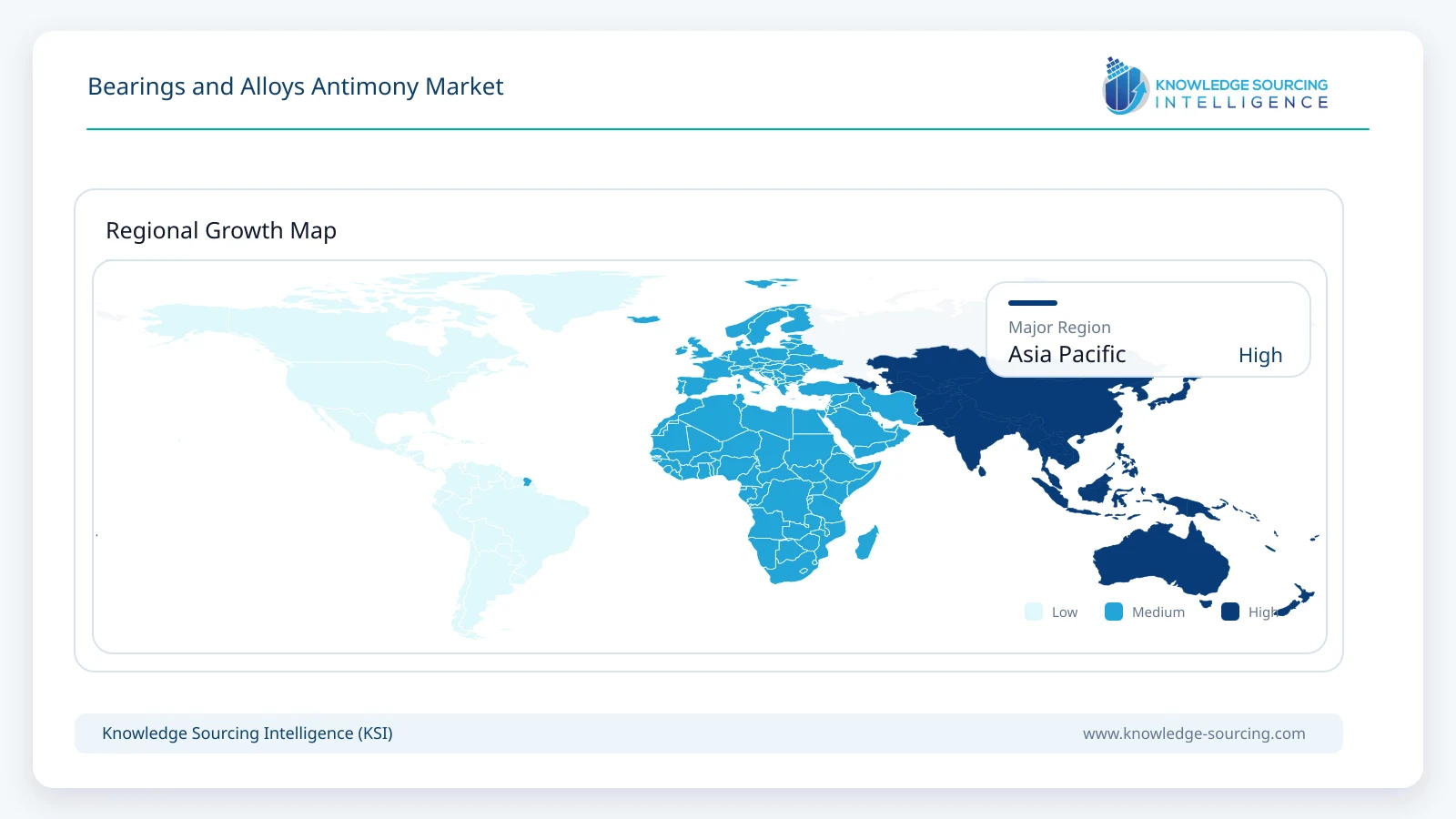
India has a sizeable secondary metals industry, including Gravita’s recycling and alloy operations, while Chinese manufacturers and regional repair networks provide substantial demand for industrial castings and bearing materials. Asia Pacific is projected to retain the largest revenue share in 2031 as specialised alloy output, formal collection and higher-value industrial uses expand alongside conventional battery replacement demand.
Middle East and Africa
The Middle East and Africa is modelled as the fastest-growing region, expanding at approximately 10.52% annually through 2031 from a smaller commercial base. Secondary lead processing and cross-border export activity support this trajectory more than new local bearing manufacture alone. Gravita’s Ghana facility supplies refined lead and customised alloys, illustrating how recycling capacity can connect regional scrap collection with European and Asian customers.
Investment in organised collection, refining and grade qualification offers the clearest route to higher local alloy value. The region remains exposed to regulatory enforcement, financing and export-market conditions, and the forecast does not presume that every newly announced recycling project produces antimonial alloys immediately. Growth is expected to be uneven across countries and operations.
Competitive Landscape
The industry consists of high-volume secondary lead refiners, specialised Babbitt manufacturers and custom alloy houses. Gravita and Campine combine scrap sourcing with metal recovery and the production of qualified lead alloys. Belmont Metals, Kapp Alloy and Mayco compete through numerous established compositions, practical delivery forms and technical guidance for casting and bearing repair. Jaytee Alloys provides declared antimonial lead grades for users requiring controlled chemistries.
Commercial relationships depend on the intended end product. Battery customers generally evaluate price, impurities, consistency and throughput; industrial repair clients need precise legacy or ASTM-based formulations and reliable support. Supplier-scale comparisons can be misleading because a recycler’s total lead business includes refined lead and other products, while an alloy specialist’s revenue is more concentrated in the relevant grades.
Recent Developments
March 2026: Campine reported approximately 61,000 tonnes of lead-alloy production at its Beerse plant during 2025, alongside stronger metal recovery volumes. The disclosure demonstrates the commercial importance of secondary alloy supply within a diversified recycling business.
February 2026: Gravita India Limited officially announced the completion of an 80,300 metric tonnes per annum (MTPA) lead recycling capacity expansion at its existing facility in Mundra, Gujarat. This project brought the plant’s total lead recycling capacity from 64,800 MTPA up to 145,100 MTPA
September-October 2025: Campine completed the purchase of Ecobat’s French lead operations, including two battery-recycling plants and a semi-finished lead-products facility. The sites add approximately 70,000 tonnes of annual battery-recycling capacity and support the company’s metals-recovery and downstream supply capabilities.
Market Outlook
The market is expected to retain a large battery-alloy component while shifting gradually toward better-controlled chemistry, formal recycling and high-value specialist applications. Demand for lead-antimony material is supported by an installed battery base and selected castings, but the migration toward alternative grids restricts unqualified assumptions about volume growth. In bearing metals, the durability of specified tin-antimony-copper grades is likely to support maintenance revenue even where wider industrial production cycles remain uneven.
Bearings and Alloys Antimony Market Scope:
| Report Metric | Details |
|---|---|
| Total Market Size in 2026 | USD 1.08 billion |
| Total Market Size in 2031 | USD 1.37 billion |
| Forecast Unit | USD Billion |
| Growth Rate | 4.89% |
| Study Period | 2021 to 2031 |
| Historical Data | 2021 to 2024 |
| Base Year | 2025 |
| Forecast Period | 2026 – 2031 |
| Segmentation | Alloy Type, Application, End User, Geography |
| Companies |
|
| Customization Scope | 15% Free Customization included with purchase — Request Custom Breakdown → |
| Sample & Data Access | PDF Sample, Excel Databook & Analyst Briefing — Download Free Sample → |
Market Segmentation
By Alloy Type
Lead-Antimony Alloys
Tin-Antimony Alloys
Copper-Antimony Alloys
Other Alloys
By Application
Bearing Assembly
Lead-Acid Storage Batteries
Casting Metal
Step Soldering
Others
By End User
Electronics
Automotive
Aerospace and Defence
Building and Construction
Others
By Geography
North America
United States
Canada
Mexico
South America
Brazil
Argentina
Others
Europe
United Kingdom
Germany
France
Italy
Spain
Others
Middle East and Africa
Saudi Arabia
UAE
Others
Asia Pacific
China
India
Japan
South Korea
Thailand
Others
Table of Contents
1. EXECUTIVE SUMMARY
2. MARKET SNAPSHOT
2.1. Market Overview
2.2. Market Definition
2.3. Scope of the Study
2.4. Market Segmentation
3. BUSINESS LANDSCAPE
3.1. Market Drivers
3.1.1. Installed Lead-Acid Battery Base and Replacement Cycles
3.1.2. Industrial Maintenance and Rebabbitting
3.1.3. Expansion of Organised Secondary-Lead Processing
3.1.4. Precision Castings and Special-Purpose Formulations
3.1.5. Qualification of Recovered Metal for International Customers
3.2. Market Restraints
3.2.1. Volatility in Antimony Supply and Pricing
3.2.2. Lead-Handling and Environmental Compliance
3.2.3. Shift Toward Low-Antimony and Alternative Grid Chemistries
3.2.4. Technical Limits on Bearing-Metal Substitution
3.2.5. Fragmented Specialty-Alloy Order Sizes
3.3. Market Opportunities
3.4. Porter’s Five Forces Analysis
3.5. Industry Value Chain Analysis
3.6. Policies and Regulations
3.7. Strategic Recommendations
4. TECHNOLOGICAL OUTLOOK
4.1. Lead-Antimony Grid Alloy Formulations
4.2. Tin-Based and Lead-Based Babbitt Metallurgy
4.3. Secondary Metal Recovery and Chemistry Qualification
5. BEARINGS AND ALLOYS ANTIMONY MARKET BY ALLOY TYPE
5.1. Introduction
5.2. Lead-Antimony Alloys
5.3. Tin-Antimony Alloys
5.4. Copper-Antimony Alloys
5.5. Other Alloys
6. BEARINGS AND ALLOYS ANTIMONY MARKET BY APPLICATION
6.1. Introduction
6.2. Bearing Assembly
6.3. Lead-Acid Storage Batteries
6.4. Casting Metal
6.5. Step Soldering
6.6. Others
7. BEARINGS AND ALLOYS ANTIMONY MARKET BY END-USER
7.1. Introduction
7.2. Electronics
7.3. Automotive
7.4. Aerospace & Defence
7.5. Building and Construction
7.6. Others
8. BEARINGS AND ALLOYS ANTIMONY MARKET BY GEOGRAPHY
8.1. Introduction
8.2. North America
8.2.1. United States
8.2.2. Canada
8.2.3. Mexico
8.3. South America
8.3.1. Brazil
8.3.2. Argentina
8.3.3. Others
8.4. Europe
8.4.1. United Kingdom
8.4.2. Germany
8.4.3. France
8.4.4. Italy
8.4.5. Spain
8.4.6. Others
8.5. Middle East and Africa
8.5.1. Saudi Arabia
8.5.2. UAE
8.5.3. Others
8.6. Asia Pacific
8.6.1. China
8.6.2. India
8.6.3. Japan
8.6.4. South Korea
8.6.5. Thailand
8.6.6. Others
9. COMPETITIVE ENVIRONMENT AND ANALYSIS
9.1. Major Players and Strategy Analysis
9.2. Market Share Analysis
9.3. Mergers, Acquisitions, Agreements and Collaborations
9.4. Competitive Dashboard
10. COMPANY PROFILES
10.1. Belmont Metals Inc.
10.2. Kapp Alloy & Wire, Inc.
10.3. Mayco Industries
10.4. Jaytee Alloys & Components Private Limited
10.5. Gravita India Limited
10.6. Campine NV
10.7. RotoMetals, Inc.
11. APPENDIX
11.1. Currency
11.2. Assumptions
11.3. Base and Forecast Years Timeline
11.4. Key Benefits for Stakeholders
11.5. Research Methodology
11.6. Abbreviations





Frequently asked questions
What is the projected market size for bearings and alloys antimony by 2031?
The Bearings and Alloys Antimony Market will grow from $1.08 billion (2026) to $1.37 billion (2031).
What is the forecast CAGR for the Bearings and Alloys Antimony Market?
The Bearings and Alloys Antimony Market is projected to grow at a 4.89% CAGR through 2031.
Which application segment accounts for the largest antimony demand?
Lead-acid storage batteries account for approximately 55% of demand.
Which region concentrates the most demand for antimony alloys?
Asia Pacific concentrates battery, industrial equipment, and metallurgical processing demand.
What are the primary alloy types discussed in the market?
Lead-antimony and tin-based Babbitt alloys are key materials.
What factors influence antimony alloy substitution in the market?
Alloy qualification and changing lead specifications influence substitution.
Cite this report
Knowledge Sourcing Intelligence. (Nov 2026). Bearings and Alloys Antimony Market - Strategic Insights and Forecasts (2026-2031). https://www.knowledge-sourcing.com/report/bearings-and-alloys-antimony-market