Bio-Based Polymers Market - Strategic Insights and Forecasts (2026-2031)
Bio-Based Polymers Market Size, Share, Forecasts and Trends Analysis By Type (Starch-based Plastics, Polylactic Acid (PLA), Polyhydroxyalkanoates (PHA), Other Bio-based Polyesters, Cellulose Derivatives, Bio-based Polyolefins and Other Engineered Polymers), By Application (Agriculture, Textile, Electronics, Packaging, Healthcare, Other Applications), and Region
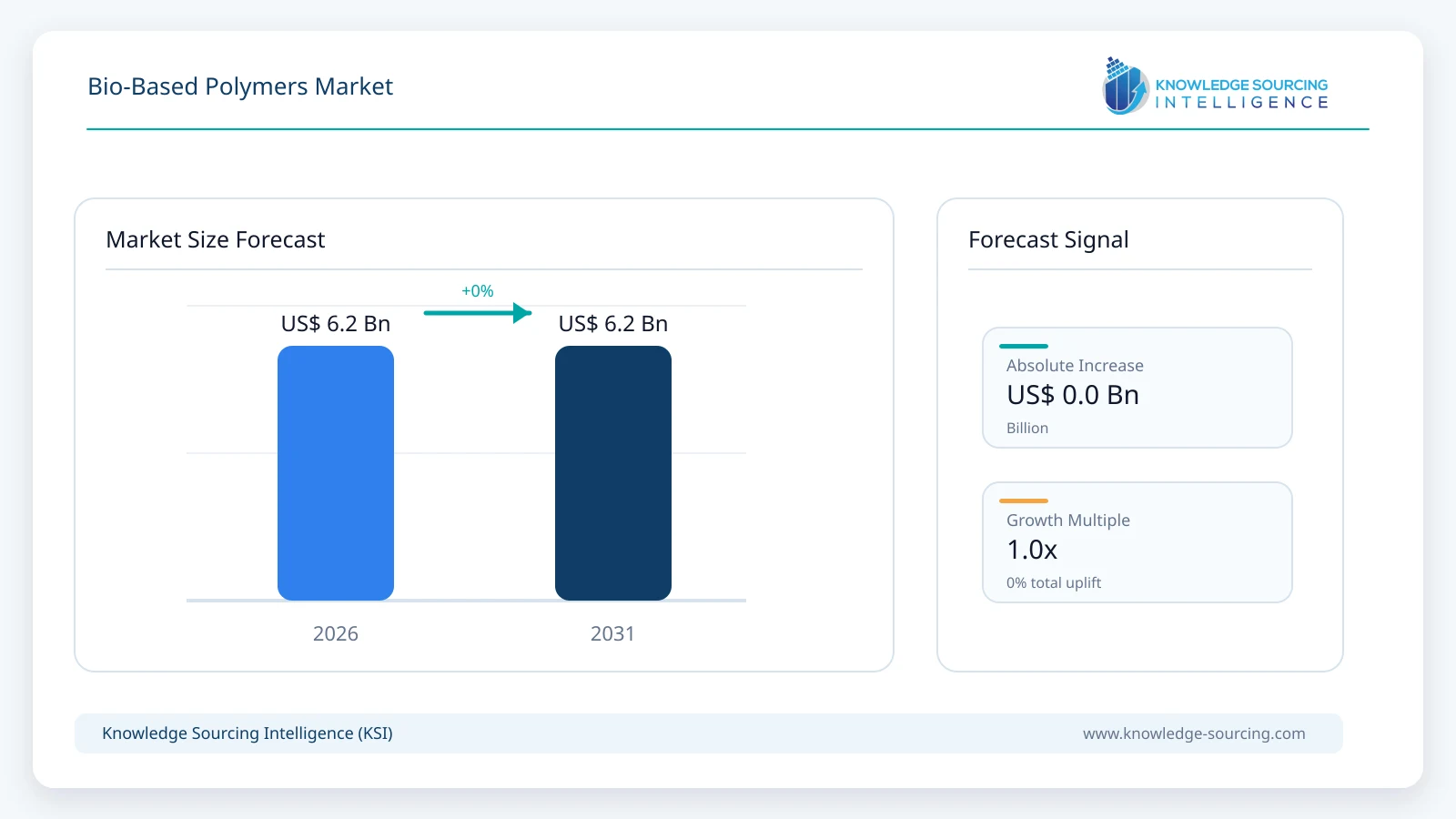
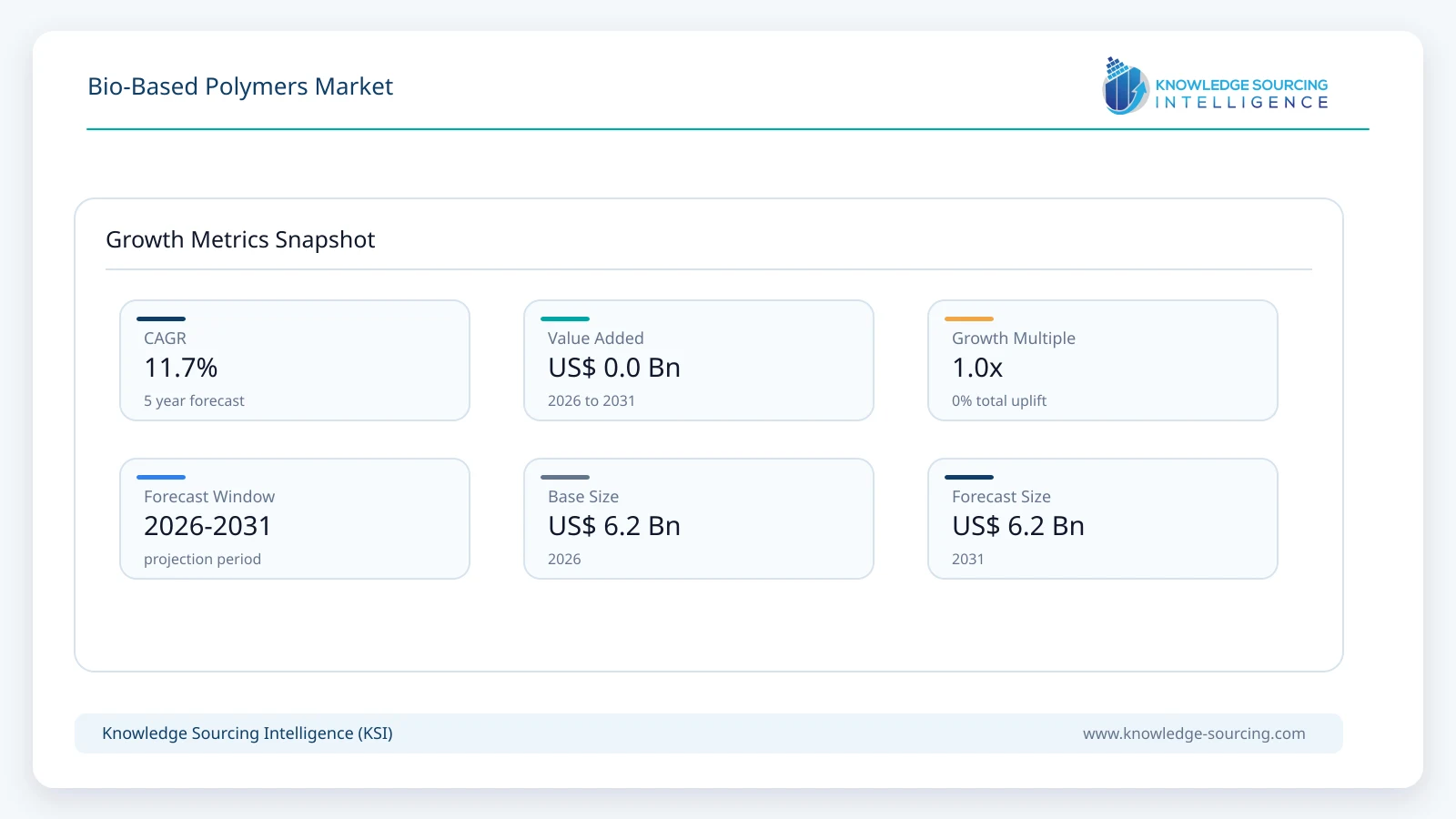
The Bio-Based Polymers Market is expected to expand at a CAGR of 11.7%, reaching USD 10.8 billion in 2031 from USD 6.2 billion in 2026.
Highlights:
1
PLA manufacturing is becoming more geographically diversified as Thailand adds integrated supply capacity.
2
Packaging retains the broadest material demand, with barrier performance and machine compatibility guiding purchases.
3
Starch compounds, PHA and renewable polyolefins differ materially in end-of-life properties.
4
Asia Pacific remains the largest production and conversion hub for commercial bio-based polymers.
5
European material qualification increasingly depends on documented renewable content and suitable recovery routes.
Full historical and forecast dataset available in Excel and dashboard formats.Download Sample Data →
Bio-based polymers are plastics and polymeric materials made wholly or partly from renewable biological feedstocks such as sugars, starch, vegetable oils and cellulose. Commercial products include PLA, PHA, starch-based compounds, cellulose derivatives, bio-based polyesters and renewable polyolefins. Buyers obtain resins or compounded materials for conversion into packaging, textiles, agricultural films, medical products and durable components. Material selection depends on barrier strength, stiffness, heat resistance, processing windows, food-contact compliance and the relevant recovery route.
The market combines established production routes with newer polymer families. NatureWorks and TotalEnergies Corbion supply PLA resins; Braskem produces sugarcane-derived polyethylene; Kaneka and other specialists manufacture microbial PHA materials; and Arkema supplies castor-oil-derived polyamide 11. For converters, substitution is commercially viable when a bio-based resin meets throughput, specification and total-cost requirements without extensive retooling.
Market Overview
Global biobased-plastics capacity reached 2.31 million tonnes in 2025, according to European Bioplastics, while actual production was about 1.67 million tonnes. The gap between installed and utilised capacity is material: suppliers must secure contracted volumes and demonstrate dependable processing before new plants translate into commercial supply. Packaging remains the largest application, but fibres, transport components and industrial products account for a growing proportion of the available material grades.
PLA expansion is now tangible in Southeast Asia. NatureWorks opened its integrated Nakhon Sawan complex on 29 April 2026, adding approximately 75,000 tonnes of annual Ingeo capacity and linking sugarcane feedstock to lactic acid, lactide and polymer manufacture. TotalEnergies Corbion is developing specialty grades for foamed trays and fine-fibre filtration, while Kaneka’s Green Planet PHBH targets products requiring biological degradation under suitable conditions. These distinct technologies create different pricing and qualification conditions rather than a uniform market for interchangeable plastics.
Bio-based does not automatically mean biodegradable or compostable. Braskem’s renewable polyethylene retains conventional polyethylene recycling characteristics, while PLA and certain starch blends require specified processing and collection conditions for claimed end-of-life performance. The EU Packaging and Packaging Waste Regulation began applying on 12 August 2026, increasing attention to design, recyclability and compostability requirements. Manufacturers therefore need documented feedstock origins and product-specific certifications alongside claims about renewable carbon.
Market Trends
Integrated PLA Production Is Strengthening Asian Supply Chains
NatureWorks’ Nakhon Sawan facility combines locally sourced sugarcane conversion with monomer and polymer production. Integration limits dependence on imported intermediates and gives Asian packaging and fibre converters access to a regional source of a widely specified biopolymer. A new facility nevertheless requires stable qualification runs and sustained order intake to achieve commercial utilisation.
With Thailand already home to a PLA manufacturing base operated by TotalEnergies Corbion and a BioPBS supply chain, buyers can diversify sourcing across different polyester families. The proximity of resin supply and conversion capacity matters for custom grades, smaller order quantities and shorter development cycles.
Renewable Polymers Are Moving Into Performance-Specific Applications
TotalEnergies Corbion introduced Luminy FOAM 50F in July 2026 for extruded foamed packaging, aiming to replace polystyrene in demanding food-service formats. Its September 2026 L040 grade similarly addresses fine-fibre filtration on existing meltblown lines. Both launches use processing characteristics, not just renewable content, as the basis for customer adoption.
Engineering polymers illustrate another route: Arkema’s castor-oil-derived Rilsan PA11 competes on chemical resistance, dimensional stability and temperature performance in demanding parts. Bio-based chemistry can therefore create value well beyond single-use items, but converters still assess durability and operating economics against qualified incumbents.
End-of-Life Claims Are Becoming More Specific
The distinction between renewable feedstock, biodegradability and recyclability is becoming central to packaging specifications. Polyethylene made from sugarcane follows established polyethylene recovery routes, whereas compostable packaging needs suitable infrastructure and testing to prove performance in defined conditions. Buyers increasingly request documentation for the exact grade and application.
European packaging rules encourage more rigorous design and material claims, but they do not establish a blanket requirement to replace fossil resins with bio-based alternatives. Producers of PLA, starch compounds and cellulose films must show compatibility with intended collection systems if sustainability claims are to influence procurement.
Fermentation and Novel Monomers Are Broadening the Material Portfolio
Microbially produced PHAs offer a different property and degradation profile from PLA or starch-rich blends. Kaneka’s Green Planet production demonstrates the ability to manufacture such resins commercially, although fermentation yields, downstream separation and consistency still influence price and delivered volumes.
PTT MCC Biochem’s BioPBS and Kaneka’s PHBH demonstrate how alternative polymer synthesis routes serve different end-use requirements. PBS-based materials can provide useful flexibility in selected packaging applications, while PHBH offers biodegradation characteristics under prescribed conditions. Reproducible fermentation and polymer compounding still determine whether these materials can win high-volume specifications.
Full historical and forecast dataset available in Excel and dashboard formats.Download Sample Data →
Segment Analysis
By Type: Polylactic Acid (PLA)
Polylactic acid remains one of the most commercially established renewable polyester families, with an estimated 2026 market value of USD 1.40 billion. Its combination of clarity, rigidity and melt-processing familiarity supports rigid packaging, fibres and selected films, while crystallisation and tailored formulations extend potential use beyond conventional disposable formats. NatureWorks and TotalEnergies Corbion provide identifiable commercial production platforms.
New integrated capacity in Thailand improves supplier proximity to Asian converters, yet PLA adoption still depends on thermal performance, barrier requirements and access to suitable disposal pathways. Producers developing specialty foam and meltblown grades can broaden demand without relying solely on general-purpose packaging resin volumes.
By Application: Packaging
Food-contact trays, flexible films, bottles, coated paper structures and food-service items make packaging the largest application of bio-based polymers. Packaging accounts for approximately 42% of 2026 market revenue; the segment includes technically distinct PLA, starch blends, renewable PE and other specified compounds. Demand is tied to converter qualification, barrier testing and retailer or brand-owner material specifications.
BASF’s April 2026 launch of flexible barrier grades of ecovio illustrates the need for grease, moisture and oxygen control alongside certified end-of-life behaviour. Flexible-packaging procurement is particularly sensitive to seal integrity and machine uptime, so commercial adoption rarely follows a simple one-for-one substitution based on polymer origin.
Market Drivers
Packaging Converters Are Qualifying Renewable Resin Grades
Flexible-film and rigid-packaging converters need materials that satisfy food-contact, sealing and shelf-life requirements on existing equipment. PLA foam development, cellulose-based barriers and engineered starch blends expand the number of technical options available for particular formats.
Brands may support the qualification expense where renewable feedstock or a validated compostability pathway is relevant to the product. Once film structure, printing and filling performance are approved, recurring resin demand follows production schedules rather than one-off sustainability trials.
Integrated Feedstock and Polymer Plants Are Improving Supply Reliability
NatureWorks’ integrated Thai facility links agricultural sugar production with polymerisation, allowing commercial grades to be supplied within the Asian converting region. Braskem’s established Brazilian renewable-ethylene operation likewise demonstrates an industrial supply model based on renewable feedstock.
Co-location and integration can reduce intermediate-handling and logistics exposure, although agricultural input prices still matter. Converters planning regional sourcing benefit more from consistent polymer specifications and delivery schedules than from nominal capacity alone.
Specialty Grades Are Opening Higher-Value Technical Uses
Meltblown filtration grades, high-melt-strength PLA foam and bio-based engineering polyamides are being offered for performance-sensitive processes. These applications can support a more differentiated resin price than basic disposable bags and commodity packaging compounds.
Product development remains closely linked to processor trials because fibre diameter, foam stability, hydrolysis resistance and mechanical strength vary with grade. Manufacturers that provide technical support and reproducible batches are positioned to secure longer-running application programs.
Procurement Requires Verified Renewable Content and End-of-Life Properties
Retailers, packaging suppliers and industrial buyers face increasingly detailed documentation requirements for materials described as renewable or compostable. The EU packaging framework places greater emphasis on design and appropriate recovery, making specification files and credible testing commercially useful.
A supplier able to demonstrate feedstock traceability and the relevant performance standard can reduce qualification uncertainty for multinational customers. Demand benefits most where certifications match the packaging format and available waste-processing route.
New Polymer Families Expand the Choice of Functional Materials
PHA fermentation, PEF monomer development and bio-based polyamides create avenues for applications not fully served by conventional PLA or starch blends. Each offers a different combination of strength, barrier performance, processability and product life.
Kaneka’s established PHBH range and PTT MCC Biochem’s BioPBS offerings show different ways for smaller polymer families to enter commercial supply chains. Wider availability gives converters more ways to meet demanding specifications, although new applications still require individual material qualification.
Market Restraints
Resin Premiums Remain Material in Cost-Sensitive Packaging
Bio-based resins frequently compete with established petroleum polymers whose production assets operate at much larger scale. The European Commission’s Joint Research Centre reports that bio-based plastics can cost roughly 1.5 to 2 times conventional alternatives, although premiums differ by chemistry and grade.
For high-volume films and basic bags, a modest resin premium can outweigh marketing or environmental benefits. The strongest purchasing case normally combines verified material performance, supply security and a recognisable end-use requirement.
Insufficient Collection Infrastructure Can Undermine End-of-Life Benefits
Industrial compostability claims do not establish that a package will break down in a home compost bin or an uncontrolled environment. PLA products may require specified processing conditions, and mixed-material packaging can create sorting problems if collection routes are unclear.
Converters must consider the waste-management systems where products are actually sold. When those routes are absent, recyclable drop-in polymers or traditional recyclable materials may be preferred despite lower renewable content.
Feedstock Availability and Conversion Economics Remain Volatile
Sugar, starch and vegetable-oil feedstocks are exposed to agricultural yields, processing energy, logistics and competing food or industrial demand. Chemical polymerisation and fermentation plants also require reliable utilities and tight quality control.
Yield variation or unplanned shutdowns can materially increase realised unit costs for new production sites. Long qualification periods leave suppliers carrying inventory and fixed costs before customer volumes fully develop.
Qualification Is Slow for Regulated and Performance-Critical Uses
Food-contact films, medical applications, automotive components and technical fibres require material tests beyond a simple certificate of renewable content. Ageing, barrier performance, chemical resistance and manufacturing repeatability can all delay substitution.
An approved polymer may also require equipment settings or tooling changes at the converter. Manufacturers have to support long trial programs without assuming that demonstrated technical feasibility translates immediately into contracted demand.
Capacity Growth Does Not Guarantee Equivalent Market Sales
The 2025 industry average utilisation rate was materially below installed nameplate capacity, reflecting differences in product maturity, qualification and the timing of new demand. Some polymers have established production volumes while others are still at demonstration or early industrial scale.
Large announced plants can therefore affect supplier pricing and capital returns before output is fully absorbed. Commercial success will depend on conversion yields, dependable customer offtake and sustained throughput rather than capacity announcements alone.
Regional Outlook
Full historical and forecast dataset available in Excel and dashboard formats.Download Sample Data →
Asia Pacific
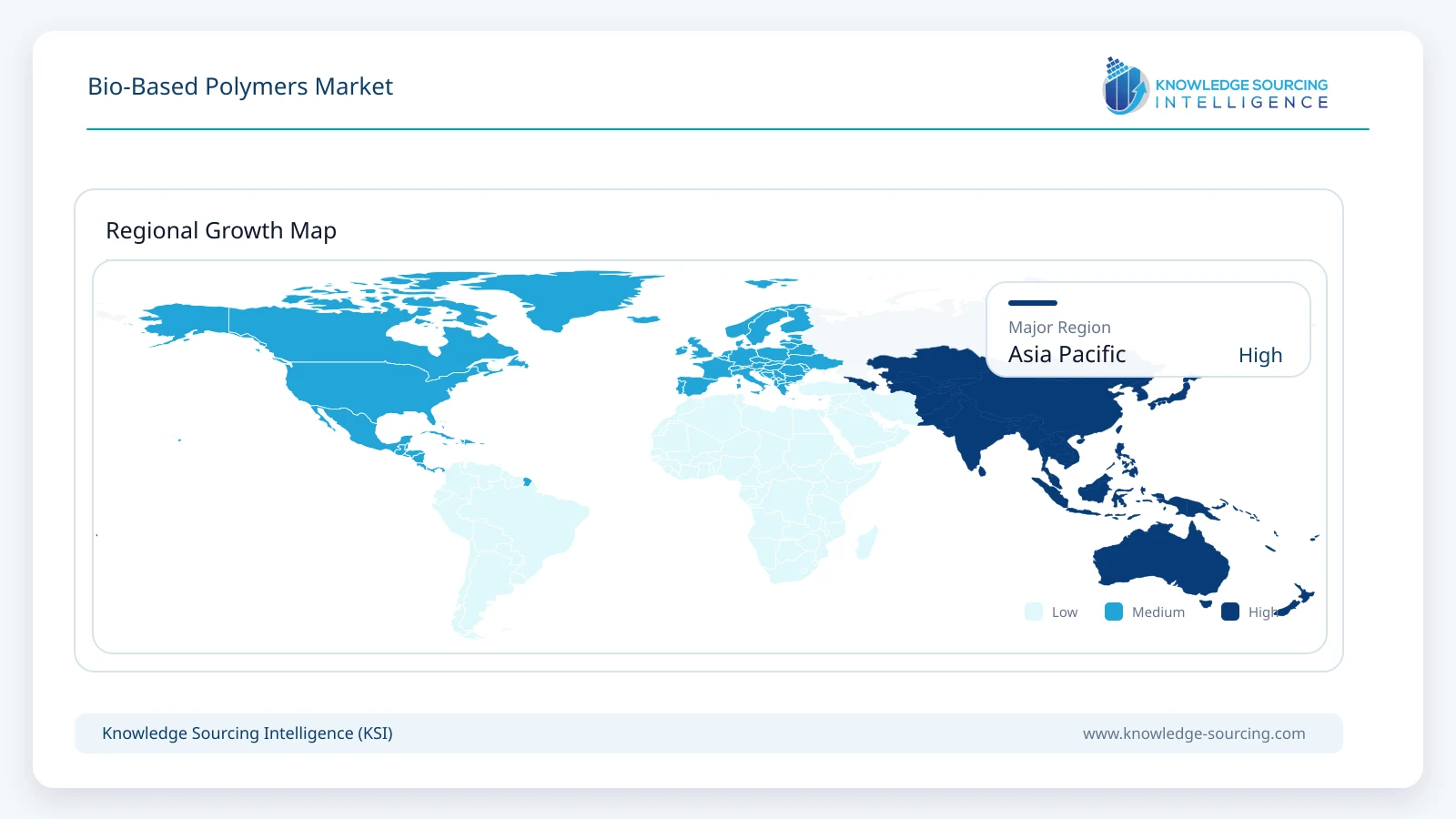
Asia Pacific represents approximately 46% of the global market in 2026, supported by polymer manufacturing and conversion activity across China, Japan, Thailand, India and other industrial economies. Thailand hosts integrated PLA production, while Japan contributes commercially established microbial polymer technologies and specialist materials. The region combines export-oriented capacity with demand from packaging, nonwovens and consumer manufacturing.
Bio-based polymer consumption is expected to rise as additional grades move into locally manufactured packaging and fibres. China’s processing scale strengthens the regional buyer base, although supplier competition remains sensitive to resin prices and verified disposal conditions. Dependable regional feedstock and industrial infrastructure should support further expansion.
Europe
Europe is expected to register approximately 13.3% annual growth between 2026 and 2031, supported by specialist resin innovation, converter qualification and tighter packaging-design requirements. Manufacturers including BASF, Novamont, Arkema and FKuR serve different parts of the renewable-material portfolio, from compostable barrier grades to bio-based engineering plastics.
The region’s competitive advantage is not confined to polymer volumes. Food-contact specification, specialty processing, bio-based content verification and compliant waste routes create demand for technically supported grades. The EU Packaging and Packaging Waste Regulation began applying in August 2026, increasing the importance of compliant material design without imposing a universal requirement for bio-based plastics.
Competitive Landscape
The market is split between large chemical producers, integrated resin specialists and smaller compounders that formulate grades for converter machinery. NatureWorks and TotalEnergies Corbion compete through PLA production and application development; Braskem offers recyclable renewable PE derived from sugarcane; Arkema sells high-performance PA11 from castor oil. Kaneka and CJ Biomaterials address microbial polyester applications, while Mitsubishi Chemical and PTT MCC Biochem participate in bio-based succinate polymer chains.
European suppliers compete through application-specific capabilities rather than simply through scale. BASF and Novamont formulate compostable grades for defined packaging applications, while FKuR develops process-specific compounds. The specialist end of the market rewards firms that combine material formulation with food-contact expertise, converter trials and dependable certification documentation.
Buyers compare resin suppliers on consistency, certified content, total delivered cost and technical service. No single polymer has the mechanical and end-of-life properties required across all applications. Competitive positioning therefore turns on the ability to win distinct approved formulations and maintain supplies as converters grow production.
Recent Developments
30 September 2026: TotalEnergies Corbion launched Luminy L040, a PLA grade formulated for ultra-fine meltblown filtration fibres on existing production equipment.
7 July 2026: TotalEnergies Corbion commercially introduced Luminy FOAM 50F, a high-melt-strength PLA grade for extruded food-service and fresh-food packaging.
8 May 2026: TotalEnergies Corbion announced commercialisation of washable kitchen towels using Luminy PLA developed with Yuhan-Kimberly.
29 April 2026: BASF introduced new ecovio flexible barrier packaging formulations with selectable grease, oxygen and moisture barrier performance.
29 April 2026: NatureWorks opened its integrated Ingeo PLA manufacturing site in Thailand, with approximately 75,000 tonnes of annual nameplate capacity.
Market Outlook
Commercial growth is likely to concentrate in polymer grades that fit existing converting equipment and meet defined end-of-life requirements, rather than in undifferentiated renewable-material claims. Higher-volume PLA and drop-in polyolefins offer process familiarity, while PHA, PEF and specialty bio-based polyamides serve applications where their particular properties justify qualification and additional material cost.
Supplier economics will be shaped by plant utilisation and feedstock integration as much as demand growth. Thailand’s integrated PLA capacity may improve regional delivery times, while Europe’s emerging polymer technologies must prove continuous operation and financing durability before their announced capacities can meaningfully affect resin supply. Packaging remains the principal revenue pool, but technical textile, filtration, automotive and healthcare grades offer opportunities for differentiated performance and pricing.