
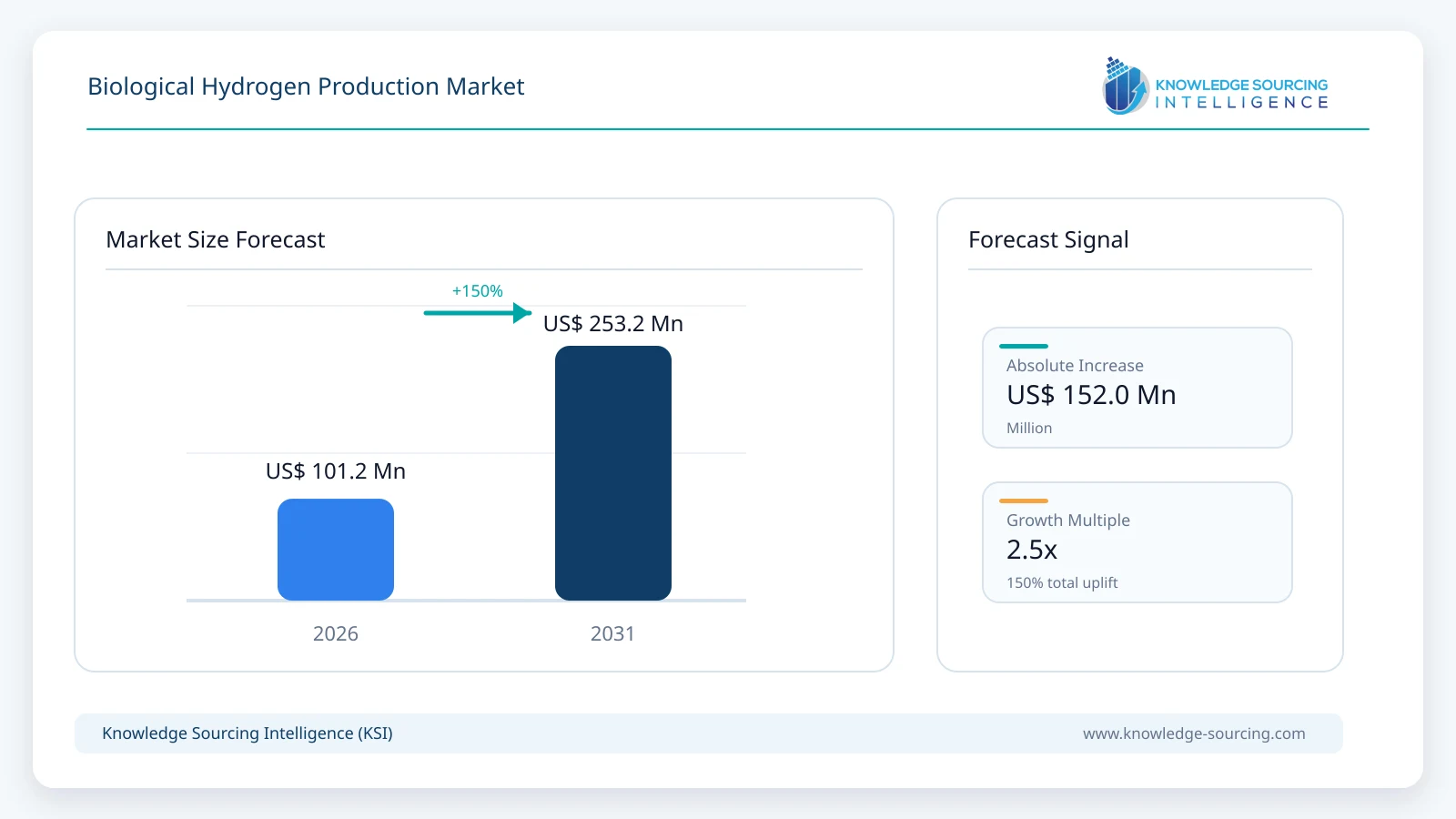
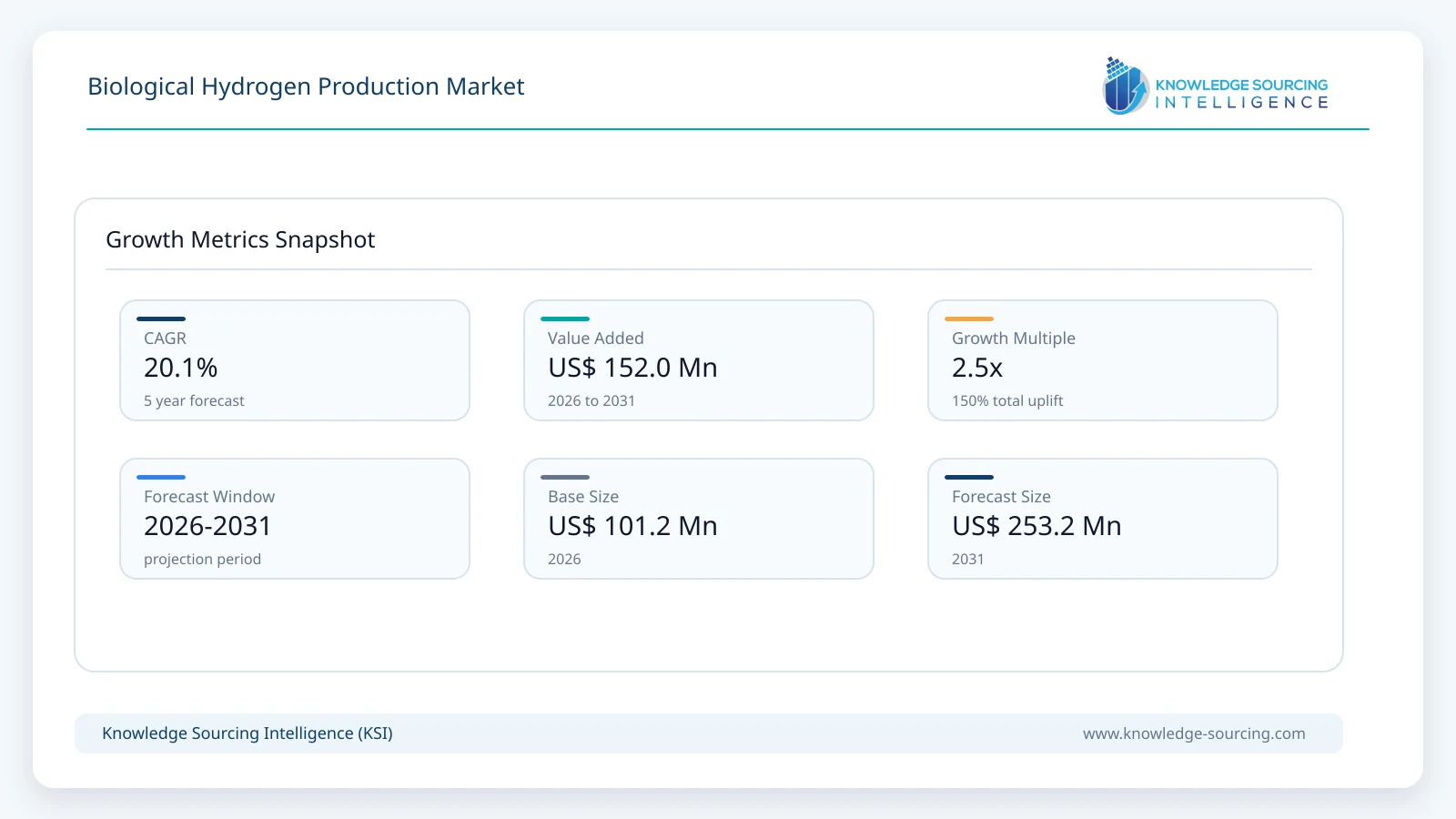
The Biological Hydrogen Production Market is forecast to grow at a CAGR of 20.1%, reaching USD 253.2 million in 2031 from USD 101.2 million in 2026.
Highlights:
- 1Dark fermentation is the dominant production pathway as it is economical, scalable and can be implemented alongside existing anaerobic digestion facilities when compared with photo-fermentation and biophotolysis.
- 2The Asia-Pacific region is the largest market, as governments across the region have aggressive hydrogen roadmaps, industries are developing quickly, and governments are supporting clean energy policies in the region.
- 3North America is showing promising momentum of growth, as the market continues to be fuelled by sustainability demand and technological innovations, with the level 3 U.S. hydrogen hubs announced in 2025 offering opportunities to integrate biohydrogen into the broader hydrogen supply chain.
- 4Together, the transportation and power generation segments have the highest biohydrogen application-level market share and are projected to see the highest growth rate in biohydrogen application market throughout the forecast period, with power generation expected to grow at the fastest rate.
There are three main biological routes to produce biohydrogen. Dark fermentation is the predominant pathway which might hold a significant market share based on the use of anaerobic bacteria to produce hydrogen and organic acids from organic substrates like food waste, agricultural residues and wastewater sludge without the need for light input and is relatively easy to scale in terms of scale-up in existing anaerobic digestion facilities. In photo-fermentation, light is used to drive the reaction of a photosynthetic microbial community with feedstock to produce hydrogen, typically as a second-stage process after dark fermentation to recover additional hydrogen from the same feedstock. Another route that has been theoretically proposed and practised, but is less commercially-viable and of lower yield compared to the fermentation, is biophotolysis, which involves splitting water directly into hydrogen and oxygen via sunlight and microalgae/cyanobacteria.
Demand comes mainly from applications in transportation and power generation. Although some of the key applications for biohydrogen have not yet commenced, the transportation segment is expected to account for a significant share of the biohydrogen market due to the growing demand for clean and low-carbon fuel alternatives in fuel-cell vehicles and heavy-duty transportation, whereas the power generation segment is projected to be the fastest-growing application-level opportunity, as utilities and industrial operators consider biohydrogen as a dispatchable and low-carbon fuel in combustion and fuel-cell power generation. The energy and power industry accounts for the maximum overall share, whereas the transportation industry is projected to witness the highest end-use industry growth during the forecast period.
Market Dynamics
Market Drivers
Governments are working to diversified hydrogen supply portfolios, and hydrogen production via biological methods are being targeted by investment as governments pursue scalable low-carbon hydrogen production pathways through policy frameworks such as the EU Hydrogen Strategy, the U.S. Inflation Reduction Act hydrogen production tax credit and national net-zero commitments under the Paris Agreement.
Biohydrogen is emerging as more viable at scale with the integration within the U.S. and EU's massive hydrogen hubs, which are also announcing other hydrogen production methods.
Continued progress in microbial strain engineering, enzyme optimization and bioreactor design is helping to further increase hydrogen yield rates and production efficiency, and thus reducing the cost difference between biological production and electrolysis-based hydrogen production that has historically existed.
Market Restraints & Opportunities
Some of the main challenges to near-term commercial scale-up are the high production cost of hydrogen by biophotolysis versus conventional and electrolysis-based hydrogen, low technology readiness of biophotolysis and some photo-fermentation methods, and low infrastructure for hydrogen distribution and storage.
Nevertheless, the increasing demand for clean hydrogen in mobility, the still increasing growth of biofuels and biotechnology innovations, as well as the increasing willingness of public research institutions and private companies to invest in pilot and commercial scale biohydrogen facilities, constitute important long-term opportunity, especially if biological hydrogen production can be used to solve the problem of organic waste management while generating clean fuels.
Market Segmentation
The market is segmented by production method, application, end-use industry, and geography.
By Production Method: Dark Fermentation
The cost-effectiveness, scalability, and capacity to use existing anaerobic digestion infrastructure to produce hydrogen from food waste, agricultural residues and wastewater sludge without the need for lighting make dark fermentation the dominant production method.
Air Products and Chemicals, Inc. is a key player in the hydrogen sector, and is increasingly interested in biological, as well as other low carbon hydrogen production methods, as part of its portfolio of clean hydrogen.
With the local agricultural sector, BES Sustainable Solutions works to transform organic waste into hydrogen by implementing economically viable anaerobic digestion (AD) systems at the local and regional level.
By Application: Transportation
Transportation holds a substantial application-level market share, propelled by rising demand for clean and sustainable fuel alternatives to support fuel-cell vehicles and decarbonize heavy-duty transport.
Plug Power Inc. is a leading hydrogen and fuel-cell solutions provider expanding its involvement across the broader hydrogen value chain, including exploration of biological and other low-carbon hydrogen production pathways to support fuel-cell mobility applications.
By End-Use Industry: Energy & Power
The energy and power segment holds the largest end-use industry share, reflecting biohydrogen's role as a dispatchable, low-carbon fuel option for combustion and fuel-cell power generation applications.
Growing adoption of biohydrogen in the transportation end-use industry is expected to register the fastest end-use industry growth through the forecast period, driven by decarbonization mandates targeting fuel-cell vehicles and clean mobility.
Regional Analysis
North America Market Analysis
North America is registering strong growth momentum in biological hydrogen production, driven by sustainability demand, technological advancement, and large-scale hydrogen hub announcements that are opening pathways for biohydrogen integration into broader regional clean hydrogen infrastructure.
Europe Market Analysis
Europe's market is shaped by the EU Hydrogen Strategy and regulatory frameworks established by the European Commission's Fuel Cells and Hydrogen Joint Undertaking, driving enterprise and public-sector investment in biological hydrogen production pathways alongside electrolysis-based green hydrogen.
Asia-Pacific Market Analysis
Asia-Pacific dominates the global biohydrogen market, driven by aggressive government hydrogen roadmaps, rapid industrialization, and clean energy policy support across China and other regional markets, and is also expected to register strong continued growth through the forecast period.
Middle East and Africa Market Analysis
The Middle East and Africa are seeing early-stage investment in biological hydrogen production tied to broader national hydrogen strategy and clean energy diversification initiatives.
South America Market Analysis
South America represents an emerging market for biological hydrogen production, with growing enterprise and academic research interest in biomass and organic-waste-derived hydrogen pathways in Brazil and other regional markets.
List of Companies
Air Products and Chemicals, Inc.
Linde plc
Plug Power Inc.
Ballard Power Systems, Inc.
ITM Power plc
Nel ASA
Siemens AG
Cummins Inc.
McPhy Energy S.A.
BES Sustainable Solutions
Competitive Landscape
Air Products and Chemicals, Inc.
Air Products and Chemicals, Inc. is a major global industrial gas and hydrogen company with growing interest in biological and other low-carbon hydrogen production pathways as part of its broader clean hydrogen portfolio.
Plug Power Inc.
Plug Power Inc. is a leading hydrogen and fuel-cell solutions provider, expanding its involvement across the hydrogen value chain, including exploration of biological hydrogen production pathways to support fuel-cell mobility and stationary power applications.
BES Sustainable Solutions
BES Sustainable Solutions collaborates with local agricultural sectors to convert organic waste into hydrogen using economically efficient anaerobic digestion systems, illustrating commercial-scale application of dark fermentation technology.
Analyst View
The Biological Hydrogen Production market remains an early-stage but strategically significant segment of the broader clean hydrogen landscape, offering a production pathway that is both genuinely carbon-neutral and capable of simultaneously treating organic waste streams. Dark fermentation's cost and scalability advantages have made it the leading production method, while continued advances in microbial engineering and bioreactor design are steadily narrowing the yield and cost gap with electrolysis-based green hydrogen. The integration of biohydrogen into large-scale U.S. and EU hydrogen hub infrastructure announced in 2025 marks an important inflection point, positioning biological production as a complementary pathway within diversified national hydrogen strategies rather than a standalone niche technology. Vendors that combine proven fermentation or biophotolysis technology, feedstock-flexible design, and strong positioning within emerging regional hydrogen hub ecosystems are best positioned to lead the next phase of market growth.
Biological Hydrogen Production Market Scope:
| Report Metric | Details |
|---|---|
| Total Market Size in 2026 | USD 101.2 million |
| Total Market Size in 2031 | USD 253.2 million |
| Forecast Unit | Million |
| Growth Rate | 20.1% |
| Study Period | 2021 to 2031 |
| Historical Data | 2021 to 2024 |
| Base Year | 2025 |
| Forecast Period | 2026 – 2031 |
| Segmentation | Production Method, Application, End-Use Industry, Geography |
| Companies |
|
Market Segmentation
By Production Method
Dark Fermentation
Photo-Fermentation
Biophotolysis
Others
By Application
Transportation
Power Generation
Chemical & Industrial Feedstock
Others
By End-Use Industry
Energy & Power
Transportation
Chemical
Healthcare
Others
By Geography
North America
USA
Canada
Mexico
Europe
Germany
France
United Kingdom
Others
Asia Pacific
China
India
Japan
South Korea
Others
Middle East and Africa
UAE
Saudi Arabia
Others
South America
Brazil
Others
Table of Contents
1. EXECUTIVE SUMMARY
2. MARKET SNAPSHOT
2.1. Market Overview
2.2. Market Definition
2.3. Scope of the Study
2.4. Market Segmentation
3. BUSINESS LANDSCAPE
3.1. Market Drivers
3.2. Market Restraints
3.3. Market Opportunities
3.4. Porter's Five Forces Analysis
3.5. Industry Value Chain Analysis
3.6. Policies and Regulations
3.7. Strategic Recommendations
4. TECHNOLOGICAL OUTLOOK
4.1. Dark Fermentation Process Advances
4.2. Photo-Fermentation & Hybrid Systems
4.3. Biophotolysis & Microalgae-Based Production
4.4. Microbial Strain Engineering & Bioreactor Design
5. BIOLOGICAL HYDROGEN PRODUCTION MARKET BY PRODUCTION METHOD
5.1. Introduction
5.2. Dark Fermentation
5.3. Photo-Fermentation
5.4. Biophotolysis
5.5. Others
6. BIOLOGICAL HYDROGEN PRODUCTION MARKET BY APPLICATION
6.1. Introduction
6.2. Transportation
6.3. Power Generation
6.4. Chemical & Industrial Feedstock
6.5. Others
7. BIOLOGICAL HYDROGEN PRODUCTION MARKET BY END-USE INDUSTRY
7.1. Introduction
7.2. Energy & Power
7.3. Transportation
7.4. Chemical
7.5. Healthcare
7.6. Others
8. BIOLOGICAL HYDROGEN PRODUCTION MARKET BY GEOGRAPHY
8.1. Introduction
8.2. North America
8.2.1. USA
8.2.2. Canada
8.2.3. Mexico
8.3. Europe
8.3.1. Germany
8.3.2. France
8.3.3. United Kingdom
8.3.4. Others
8.4. Asia Pacific
8.4.1. China
8.4.2. India
8.4.3. Japan
8.4.4. South Korea
8.4.5. Others
8.5. Middle East and Africa
8.5.1. UAE
8.5.2. Saudi Arabia
8.5.3. Others
8.6. South America
8.6.1. Brazil
8.6.2. Others
9. COMPETITIVE ENVIRONMENT AND ANALYSIS
9.1. Major Players and Strategy Analysis
9.2. Market Share Analysis
9.3. Mergers, Acquisitions, Agreements, and Collaborations
9.4. Competitive Dashboard
10. COMPANY PROFILES
10.1. Air Products and Chemicals, Inc.
10.2. Linde plc
10.3. Plug Power Inc.
10.4. Ballard Power Systems, Inc.
10.5. ITM Power plc
10.6. Nel ASA
10.7. Siemens AG
10.8. Cummins Inc.
10.9. McPhy Energy S.A.
10.10. BES Sustainable Solutions
11. APPENDIX
11.1. Currency
11.2. Assumptions
11.3. Base and Forecast Years Timeline
11.4. Key Benefits for the Stakeholders
11.5. Research Methodology
11.6. Abbreviations
Navigate
Trusted by the world's leading organizations











