
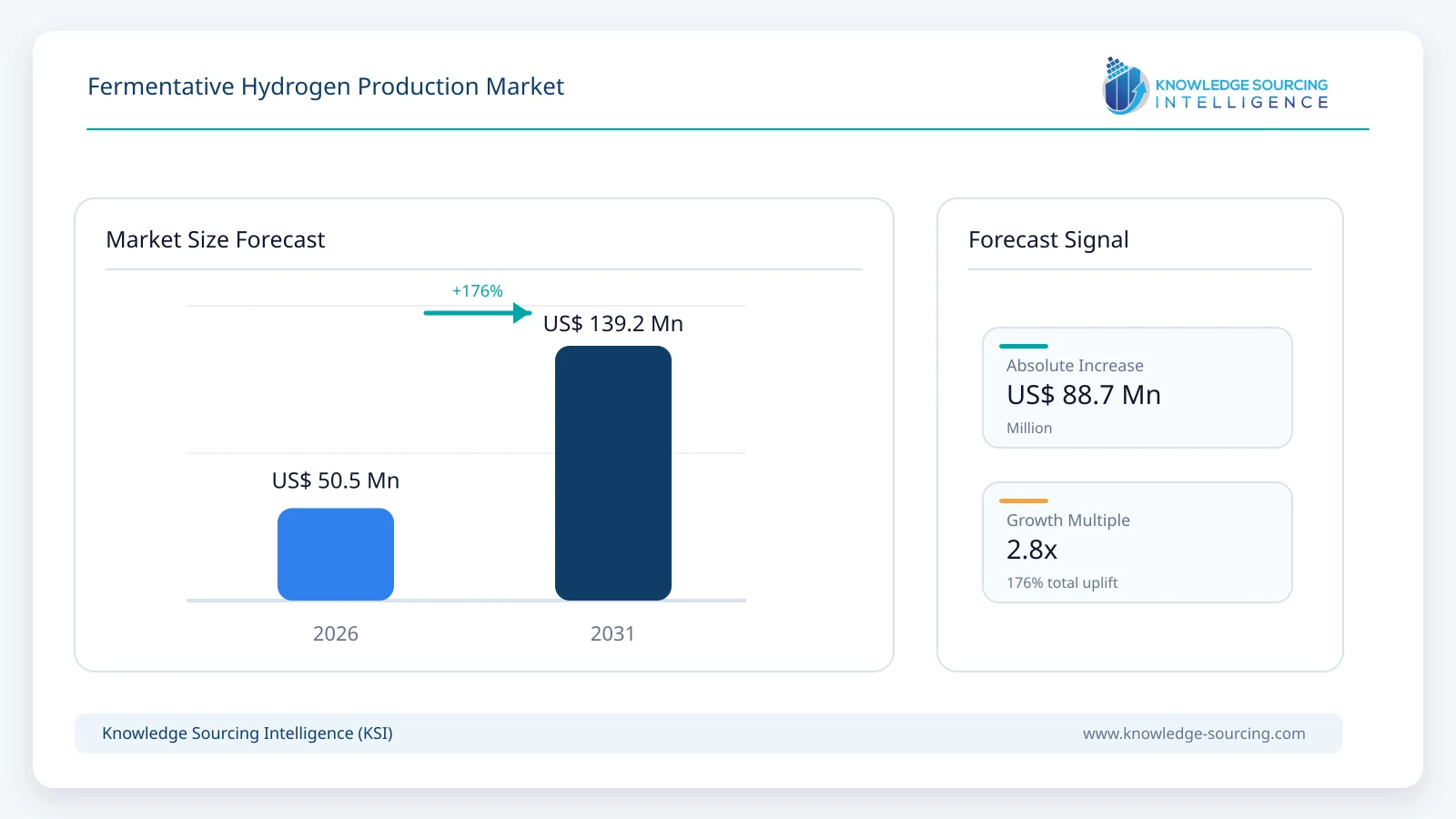
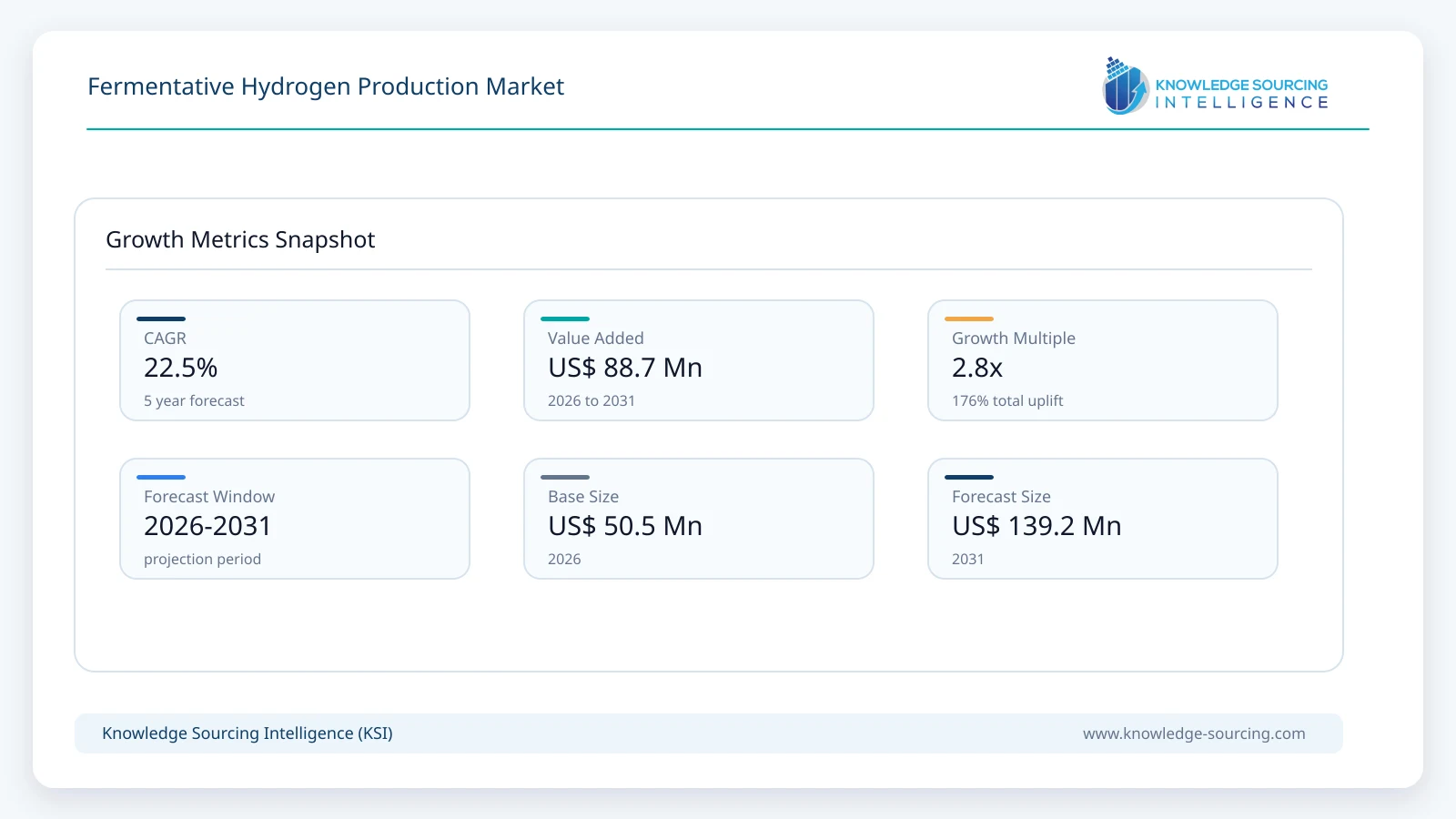
The Fermentative Hydrogen Production Market is forecast to grow at a CAGR of 22.5%, reaching USD 139.2 million in 2031 from USD 50.5 million in 2026.
Highlights:
- 1Two-stage integrated systems that sequence dark fermentation followed by photo-fermentation are gaining research and pilot-scale interest for their ability to extract greater overall hydrogen yield from a single organic feedstock stream.
- 2Fermentative hydrogen production's compatibility with existing anaerobic digestion and wastewater treatment infrastructure gives it a meaningful commercial and capital-cost advantage relative to photobiological and biophotolysis pathways that require purpose-built photobioreactor systems.
- 3Continued research into nanocatalyst-enhanced dark fermentation and genome-resolved microbial engineering is steadily improving hydrogen yield rates from food waste and other organic substrates.
- 4Asia-Pacific leads global deployment of fermentative hydrogen production technology, supported by large organic waste volumes from rapid industrialization and supportive government clean-energy and hydrogen roadmap policies.
Fermentative hydrogen production encompasses two related but distinct biological pathways. Dark fermentation uses anaerobic bacteria, most commonly from genera such as Clostridium and Enterobacter, to break down carbohydrate-rich organic substrates in the absence of light, producing hydrogen alongside organic acids such as acetate and butyrate as metabolic byproducts. Photo-fermentation uses purple non-sulfur photosynthetic bacteria, such as Rhodobacter species, that consume simple organic acids in the presence of light to produce additional hydrogen and is increasingly deployed as a second-stage process following dark fermentation in integrated two-stage systems designed to extract greater overall hydrogen yield from a single feedstock stream than either pathway could achieve independently.
Feedstock flexibility is a defining commercial advantage of fermentative hydrogen production relative to other biohydrogen pathways. Because dark fermentation can process a wide range of carbohydrate-rich organic waste streams, including food waste, agricultural residues, industrial organic effluents, and municipal wastewater sludge, facility operators can often integrate fermentative hydrogen production alongside or within existing anaerobic digestion and biogas infrastructure, converting facilities that already handle organic waste streams into dual-output sites producing both biogas and biohydrogen. This infrastructure compatibility, combined with continued research into nanocatalyst enhancement and genome-resolved microbial engineering to improve hydrogen yield rates, is positioning fermentative pathways as the near-term commercial leader within biological hydrogen production even as photobiological and biophotolysis alternatives continue to mature.
Market Dynamics
Market Drivers
Infrastructure Compatibility with Existing Anaerobic Digestion Facilities: Dark fermentation's ability to operate using organic waste streams and equipment already deployed at municipal wastewater and agricultural biogas facilities substantially lowers the capital barrier to entry relative to purpose-built biological hydrogen production systems, accelerating commercial adoption.
Dual-Output Economics for Waste-Processing Facilities: The ability to integrate fermentative hydrogen production alongside existing biogas production at organic-waste-processing facilities creates dual-revenue-stream economics that improve overall project returns relative to single-output waste treatment or hydrogen production facilities alone.
Advances in Microbial Strain Engineering and Two-Stage System Design: Continued research into nanocatalyst-enhanced dark fermentation, genome-resolved microbial engineering, and integrated two-stage dark-photo fermentation systems is steadily improving hydrogen yield rates, narrowing the efficiency gap with more established hydrogen production methods.
Market Restraints & Opportunities
Relatively low hydrogen yield per unit of feedstock compared to thermochemical and electrolysis-based production methods, the need for downstream gas purification to remove carbon dioxide and trace contaminants, and a persistent shortage of pilot-scale commercial reference facilities represent meaningful restraints on faster near-term scale-up.
However, continued improvement in microbial strain performance, growing interest in dual-output biogas-and-biohydrogen facility designs, and the potential for fermentative hydrogen production to be integrated into large-scale U.S. and EU hydrogen hub infrastructure represent substantial long-term opportunity, particularly as organic waste treatment and clean hydrogen production increasingly converge as complementary infrastructure investments.
Key Developments
April 2026: BalticSeaH2 creates a large-scale, cross-border hydrogen valley around the Baltic Sea, and it enables over 20 use cases to showcase the diverse applications of hydrogen across multiple sectors. In the project, Solar Foods focuses on hydrogen in protein production, and the company has received funding of EUR 350 000 for further developing the production of Solein® as one of the use cases in hydrogen economy.
Market Segmentation
The market is segmented by fermentation type, feedstock, application, and geography.
By Fermentation Type: Dark Fermentation
Dark fermentation holds the largest fermentation-type share, reflecting its ability to operate continuously without light input using organic waste substrates already collected and processed at municipal and industrial waste facilities.
Air Products and Chemicals, Inc. maintains a growing interest in fermentative and other biological hydrogen production pathways as part of its broader clean hydrogen portfolio diversification.
BES Sustainable Solutions collaborates with local agricultural sectors to convert organic waste into hydrogen using economically efficient anaerobic digestion systems built around dark fermentation processes.
By Fermentation Type: Photo-Fermentation & Two-Stage Systems
Photo-fermentation and integrated two-stage dark-photo fermentation systems are gaining research and pilot-scale interest for their ability to extract additional hydrogen yield from organic acid byproducts left over after the dark fermentation stage.
Ongoing academic research into Rhodobacter-based photo-fermentation systems continues to demonstrate yield improvements when paired with dark fermentation in integrated two-stage configurations.
By Feedstock: Food & Agricultural Waste
Food waste and agricultural residues represent a leading feedstock category, given their consistent availability at municipal and agricultural processing facilities and their favorable carbohydrate content for dark fermentation conversion.
Growing utilization of industrial organic effluents and wastewater sludge as fermentative hydrogen feedstock is expected to broaden the addressable substrate base beyond food and agricultural waste alone.
Regional Analysis
North America Market Analysis
North America is registering strong growth momentum in fermentative hydrogen production, supported by sustainability demand, technological advancement, and large-scale hydrogen hub announcements that are opening pathways for fermentative hydrogen integration into broader regional clean hydrogen infrastructure.
Europe Market Analysis
Europe's market is shaped by the EU Hydrogen Strategy and regulatory frameworks established by the European Commission's Fuel Cells and Hydrogen Joint Undertaking, alongside the region's mature anaerobic digestion and biogas infrastructure base that provides natural integration points for fermentative hydrogen production.
Asia-Pacific Market Analysis
Asia-Pacific leads global deployment of fermentative hydrogen production technology, supported by large organic waste volumes from rapid industrialization, aggressive government hydrogen roadmaps, and clean energy policy support across China and other regional markets.
Middle East and Africa Market Analysis
The Middle East and Africa are seeing early-stage investment in fermentative hydrogen production tied to broader national hydrogen strategy and organic waste management modernization initiatives.
South America Market Analysis
South America represents an emerging market for fermentative hydrogen production, with growing academic and enterprise research interest in agricultural-residue-derived hydrogen pathways in Brazil and other regional markets.
List of Companies
Air Products and Chemicals, Inc.
Linde plc
Plug Power Inc.
Ballard Power Systems, Inc.
ITM Power plc
Nel ASA
Siemens AG
Cummins Inc.
McPhy Energy S.A.
BES Sustainable Solutions
Competitive Landscape
Air Products and Chemicals, Inc.
Air Products and Chemicals, Inc. is a major global industrial gas and hydrogen company maintaining growing interest in fermentative and other biological hydrogen production pathways as part of its broader clean hydrogen portfolio.
Plug Power Inc.
Plug Power Inc. is a leading hydrogen and fuel-cell solutions provider, expanding its involvement across the hydrogen value chain, including exploration of fermentative hydrogen production pathways to support fuel-cell mobility and stationary power applications.
BES Sustainable Solutions
BES Sustainable Solutions collaborates with local agricultural sectors to convert organic waste into hydrogen using economically efficient anaerobic digestion systems built around dark fermentation technology.
Analyst View
The Fermentative Hydrogen Production market represents the most commercially advanced segment of the broader biological hydrogen production landscape, benefiting from dark fermentation's ability to leverage existing anaerobic digestion and wastewater treatment infrastructure already deployed across municipal and agricultural waste facilities globally. The emergence of integrated two-stage dark-photo fermentation systems, combined with continued microbial engineering advances, is steadily improving hydrogen yield rates and narrowing the cost gap with more established hydrogen production methods. As organic waste treatment and clean hydrogen production increasingly converge as complementary infrastructure investments, fermentative pathways are well positioned to capture dual-revenue-stream economics that more capital-intensive purpose-built biological hydrogen systems cannot easily replicate. Vendors that combine proven fermentation technology, feedstock-flexible system design, and integration capability with existing biogas infrastructure are best positioned to lead the next phase of market growth.
Fermentative Hydrogen Production Market Scope:
| Report Metric | Details |
|---|---|
| Total Market Size in 2026 | USD 50.5 million |
| Total Market Size in 2031 | USD 139.2 million |
| Forecast Unit | Million |
| Growth Rate | 22.5% |
| Study Period | 2021 to 2031 |
| Historical Data | 2021 to 2024 |
| Base Year | 2025 |
| Forecast Period | 2026 – 2031 |
| Segmentation | Fermentation Type, Feedstock, Application, Geography |
| Companies |
|
Market Segmentation
By Fermentation Type
Dark Fermentation
Photo-Fermentation
Two-Stage / Hybrid Fermentation Systems
By Feedstock
Food & Agricultural Waste
Industrial Organic Effluents
Municipal Wastewater Sludge
Others
By Application
Transportation
Power Generation
Chemical & Industrial Feedstock
Others
By Geography
North America
USA
Canada
Mexico
South America
Brazil
Others
Europe
Germany
France
United Kingdom
Others
Middle East and Africa
UAE
Saudi Arabia
Others
Asia Pacific
China
India
Japan
Others
Table of Contents
1. EXECUTIVE SUMMARY
2. MARKET SNAPSHOT
2.1. Market Overview
2.2. Market Definition
2.3. Scope of the Study
2.4. Market Segmentation
3. BUSINESS LANDSCAPE
3.1. Market Drivers
3.2. Market Restraints
3.3. Market Opportunities
3.4. Porter's Five Forces Analysis
3.5. Industry Value Chain Analysis
3.6. Policies and Regulations
3.7. Strategic Recommendations
4. TECHNOLOGICAL OUTLOOK
4.1. Dark Fermentation Process Advances
4.2. Photo-Fermentation & Two-Stage Hybrid Systems
4.3. Nanocatalyst-Enhanced Fermentation
4.4. Genome-Resolved Microbial Strain Engineering
5. FERMENTATIVE HYDROGEN PRODUCTION MARKET BY FERMENTATION TYPE
5.1. Introduction
5.2. Dark Fermentation
5.3. Photo-Fermentation
5.4. Two-Stage / Hybrid Fermentation Systems
6. FERMENTATIVE HYDROGEN PRODUCTION MARKET BY FEEDSTOCK
6.1. Introduction
6.2. Food & Agricultural Waste
6.3. Industrial Organic Effluents
6.4. Municipal Wastewater Sludge
6.5. Others
7. FERMENTATIVE HYDROGEN PRODUCTION MARKET BY APPLICATION
7.1. Introduction
7.2. Transportation
7.3. Power Generation
7.4. Chemical & Industrial Feedstock
7.5. Others
8. FERMENTATIVE HYDROGEN PRODUCTION MARKET BY GEOGRAPHY
8.1. Introduction
8.2. North America
8.2.1. USA
8.2.2. Canada
8.2.3. Mexico
8.3. South America
8.3.1. Brazil
8.3.2. Others
8.4. Europe
8.4.1. Germany
8.4.2. France
8.4.3. United Kingdom
8.4.4. Others
8.5. Middle East and Africa
8.5.1. UAE
8.5.2. Saudi Arabia
8.5.3. Others
8.6. Asia Pacific
8.6.1. China
8.6.2. India
8.6.3. Japan
8.6.4. Others
9. COMPETITIVE ENVIRONMENT AND ANALYSIS
9.1. Major Players and Strategy Analysis
9.2. Market Share Analysis
9.3. Mergers, Acquisitions, Agreements, and Collaborations
9.4. Competitive Dashboard
10. COMPANY PROFILES
10.1. Air Products and Chemicals, Inc.
10.2. Linde plc
10.3. Plug Power Inc.
10.4. Ballard Power Systems, Inc.
10.5. ITM Power plc
10.6. Nel ASA
10.7. Siemens AG
10.8. Cummins Inc.
10.9. McPhy Energy S.A.
10.10. BES Sustainable Solutions
11. APPENDIX
11.1. Currency
11.2. Assumptions
11.3. Base and Forecast Years Timeline
11.4. Key Benefits for the Stakeholders
11.5. Research Methodology
11.6. Abbreviations
Navigate
Trusted by the world's leading organizations











