
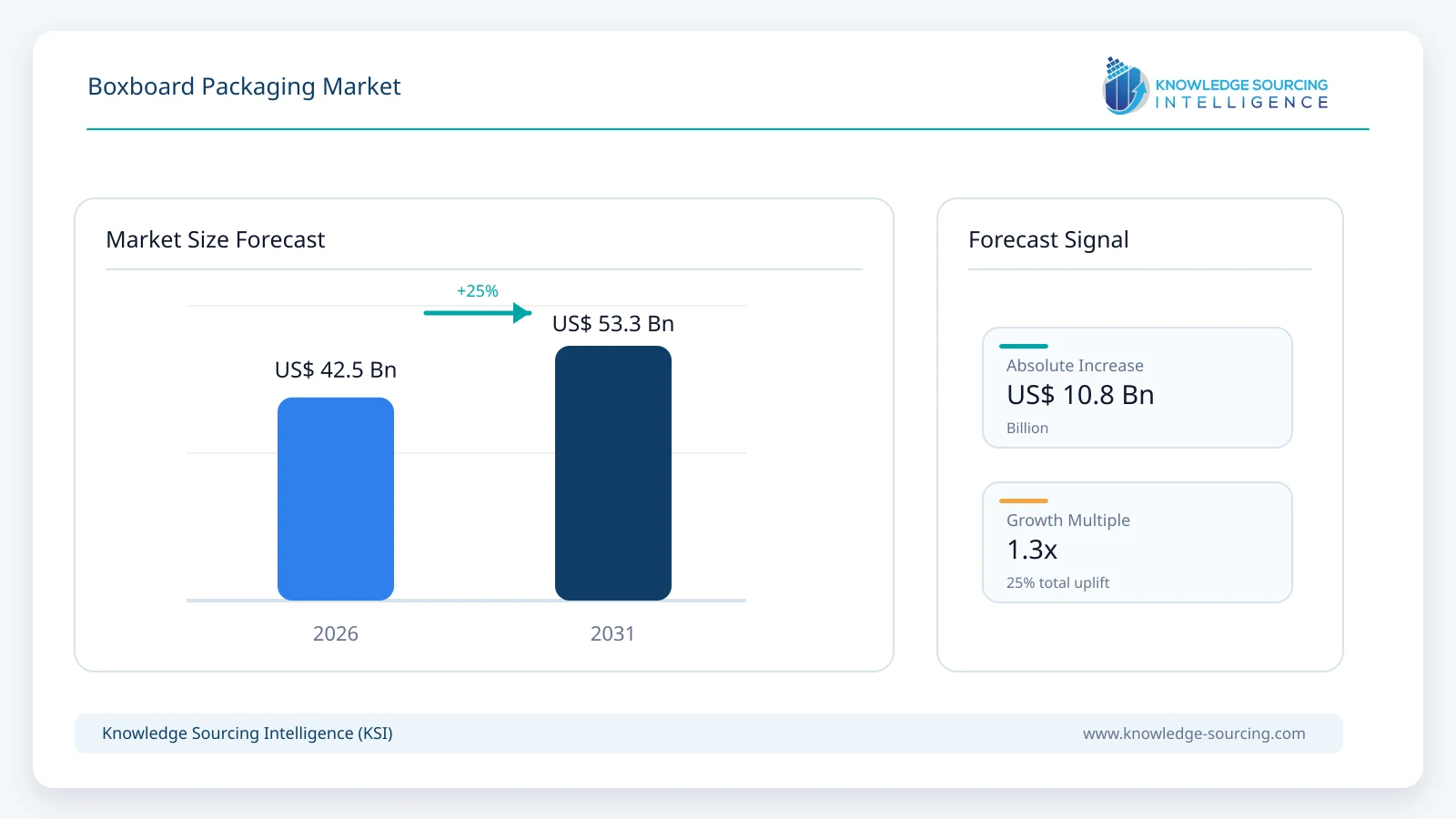
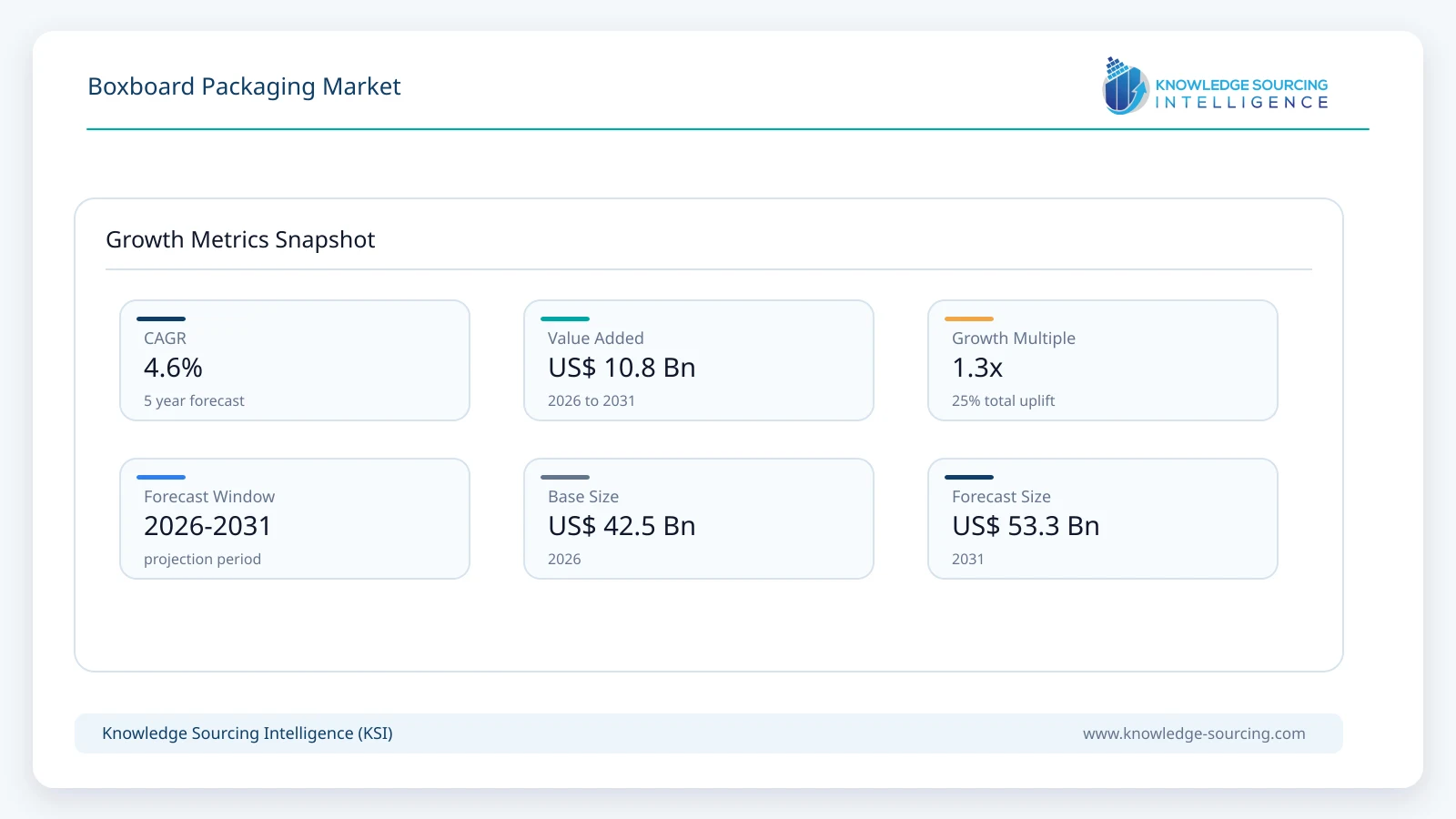
The Boxboard Packaging Market is forecast to grow at a CAGR of 4.6%, reaching USD 53.3 billion in 2031 from USD 42.5 billion in 2026.
Highlights:
- 1Food and beverage packaging remains a major demand catalyst, supported by packaged food volumes, convenience formats, retail distribution, and foodservice applications.
- 2Cartons and boxes represent an important product category because they serve high-volume consumer applications and support automated filling, folding, printing, and distribution processes.
- 3Asia Pacific offers substantial volume opportunities through manufacturing expansion, urban consumption, packaged-food penetration, pharmaceutical production, and growing organised retail.
- 4Recycled fibre and virgin-fibre blends are gaining procurement relevance as buyers balance performance requirements with recycled-content and circularity objectives.
- 5Packaging regulations are shifting purchasing criteria toward recyclability, material efficiency, traceability, and controlled use of coatings and composite structures.
- 6Competition is increasingly based on integrated fibre supply, board performance, geographic coverage, converting capability, technical support, and investment in efficient production assets.
The Boxboard Packaging Market covers the production and conversion of paperboard grades into cartons, boxes, inserts, dividers, trays, cups, clamshells, and related rigid or semi-rigid packaging formats. The market includes packaging manufactured primarily from virgin fibre, recycled fibre, or blends of both, with applications spanning food and beverages, pharmaceuticals and healthcare, cosmetics and personal care, homecare, consumer electronics, automotive, and other consumer and industrial uses. The market is assessed across North America, South America, Europe, the Middle East and Africa, and Asia Pacific for the 2026–2031 forecast period.
Boxboard occupies an important position between flexible packaging and heavier corrugated structures. Its commercial value comes from its combination of printability, stiffness, relatively low material weight, machinability, stackability, and compatibility with high-speed filling and packing equipment. Buyers do not generally procure boxboard only on the basis of board price. Basis weight, caliper, stiffness, surface quality, moisture resistance, folding performance, print reproduction, food-contact suitability, fibre composition, and supply reliability can materially affect the economics of the finished package.
Demand is closely tied to the number of packaged consumer and industrial products entering retail, foodservice, healthcare, e-commerce, and distribution channels. Food and beverage companies remain important buyers because cartons, trays, cups, sleeves, and other board-based formats are integrated into high-volume production lines. Pharmaceutical and healthcare customers place a different emphasis on dimensional consistency, print quality, product protection, traceability, and regulatory compliance. Cosmetics and personal care brands place greater weight on graphics, tactile characteristics, structural design, and shelf presentation. Consumer electronics and automotive customers tend to prioritise protection, component organisation, dimensional accuracy, and logistics efficiency.
The purchasing decision therefore involves several layers. Brand owners and consumer goods companies typically specify packaging performance and sustainability requirements, while converters determine the appropriate board grade, coating, printing process, and converting configuration. Packaging manufacturers must balance these requirements against fibre availability, energy costs, freight, machine utilisation, and customer-specific specifications. This makes supply-chain integration an important source of commercial advantage.
Material selection is also becoming more sophisticated. Virgin-fibre board continues to be important where brightness, purity, stiffness, strength, food-contact performance, and appearance are critical. Recycled fibre is attractive where buyers prioritise recycled content, resource efficiency, and cost competitiveness, although its performance characteristics can vary according to fibre quality and processing. Blended grades provide converters and brand owners with a way to balance performance, fibre sourcing, and environmental requirements.
The regulatory environment is adding another dimension to procurement. In Europe, Regulation (EU) 2025/40 on packaging and packaging waste entered into force on 11 February 2025 and began generally applying on 12 August 2026. The regulation establishes requirements covering packaging manufacturing, composition, recyclability, reuse, recovery, and waste management. The immediate commercial implication is that packaging specifications must increasingly consider end-of-life performance alongside production cost and functional requirements.
The European regulatory shift is particularly relevant to boxboard because paper-based packaging is often selected as an alternative to packaging formats that face greater scrutiny over fossil-based materials. However, paperboard does not automatically satisfy every sustainability requirement. Coatings, laminates, inks, adhesives, barrier layers, and combinations with other materials can affect recyclability and waste handling. Suppliers therefore need to compete on the total packaging system rather than simply promoting fibre content.
The market also has a substantial capital-intensive component upstream. Board mills require large investments in papermaking equipment, fibre preparation, energy systems, water treatment, coating, drying, and logistics infrastructure. Recent investment decisions demonstrate that leading suppliers are still willing to commit substantial capital to packaging board capacity where they see long-term demand and opportunities to improve asset economics. Stora Enso, for example, began production ramp-up of its new consumer packaging board line at Oulu, Finland, in March 2025. The line is designed for folding boxboard and coated unbleached kraft and has annual capacity of approximately 750,000 tonnes.
For buyers, the commercial question is increasingly whether a board supplier can deliver consistent quality across multiple plants and markets while supporting lightweighting, regulatory compliance, recyclability, and reliable delivery. This favours suppliers with integrated fibre access, geographically distributed manufacturing, technical service capabilities, and broad product portfolios.
The Boxboard Packaging Market is therefore shaped by a combination of packaged-product volumes, material substitution, packaging redesign, regulation, fibre economics, manufacturing efficiency, and customer-specific performance requirements. The 2026–2031 period is expected to place greater emphasis on recyclable structures, fibre optimisation, lightweighting, recycled-content strategies, barrier technologies, and supply security.
Market Drivers
Expansion of Packaged Food and Beverage Consumption
Food and beverage companies constitute a core source of recurring boxboard demand because packaging is consumed continuously rather than purchased as a durable industrial asset. Cartons, trays, cups, sleeves, and secondary packaging are integrated into production and distribution systems, creating a direct relationship between packaged-product volumes and board consumption.
The buyer requirement is not simply additional board. Food producers need grades that run reliably on high-speed filling and packing equipment, tolerate handling and distribution, provide appropriate stiffness, and meet food-contact requirements. Surface quality also matters because packaging frequently serves as the principal printed communication surface at the point of sale.
Suppliers respond by developing grades that reduce basis weight without compromising stiffness, improve printing performance, or incorporate functional barriers. This creates an economic incentive for packaging converters to test new grades when material savings or improved machine performance can offset qualification costs.
The commercial implication is that suppliers capable of combining lightweighting with reliable converting performance can protect customer relationships even when the underlying board price is under pressure.
Replacement of Less Recyclable Packaging Structures
Environmental policy and corporate packaging targets are encouraging brand owners to examine material combinations and end-of-life performance. Fibre-based packaging can benefit where it provides the required protection without excessive use of plastics or difficult-to-separate composite structures.
The substitution opportunity is not uniform. A board-based structure must still provide grease, moisture, oxygen, aroma, heat, or liquid resistance where required. Consequently, suppliers are investing in barrier solutions rather than relying on uncoated board for every application.
This trend creates demand for engineered board grades and compatible coatings. It also changes the competitive basis of the market because a supplier offering board, coating technology, printing compatibility, and technical assistance can address more of the customer's specification than a commodity-grade supplier.
The European Commission's PPWR places greater emphasis on recyclable packaging and circular material use, strengthening the need for packaging designs that consider recovery and material composition at the design stage.
Growth of Premium Consumer Packaging
Consumer brands continue to use packaging as part of product differentiation, particularly in cosmetics, personal care, confectionery, premium food, and selected consumer electronics applications. Boxboard provides a comparatively efficient platform for high-quality graphics, embossing, folding structures, special finishes, and engineered opening experiences.
For buyers, packaging has both functional and commercial value. A stronger visual presentation can support product positioning, while accurate folding and dimensional consistency reduce production interruptions. Converters therefore seek board with predictable surface characteristics, stiffness, scoring behaviour, and printability.
The commercial effect is greater demand for differentiated grades rather than undifferentiated board volumes. Suppliers that can provide consistent performance for premium converting applications can compete on technical specifications rather than solely on price.
Expansion of Recycled Fibre and Fibre Blending
Recycled fibre is becoming more relevant as packaging companies and brand owners seek to reduce dependence on virgin resources and improve circularity. However, recycled content introduces technical constraints because fibre quality deteriorates through repeated recycling cycles, and recovered material can contain contaminants or exhibit variability.
As a result, recycled fibre does not simply replace virgin fibre across all applications. Blended grades allow buyers to obtain a combination of stiffness, strength, brightness, cleanliness, and recycled content suited to the final package.
The resulting demand structure benefits suppliers with access to multiple fibre sources and the ability to engineer board grades around customer requirements. Mills with strong recovered-fibre procurement and process-control capabilities can improve their position in applications where recycled content is commercially valuable.
Investment in High-Efficiency Packaging Board Capacity
Capacity investment is another structural driver because older board assets can carry disadvantages in energy consumption, product flexibility, quality consistency, and production economics. New or converted machines can provide higher output, broader grade capability, improved process control, and lower unit costs.
Stora Enso's Oulu investment illustrates the scale of capital allocation possible in the segment. The new consumer board line represents approximately EUR 1.1 billion of investment in the line itself and is designed for a production capacity of 750,000 tonnes annually at full operation.
Such investments can alter regional supply balances. New capacity can improve supply security for converters while simultaneously increasing competition among existing mills, particularly when demand does not rise at the same pace as installed capacity.
Market Restraints and Challenges
Fibre and Energy Cost Volatility
Boxboard manufacturing remains exposed to the cost of wood, recovered fibre, chemicals, electricity, natural gas, transport, and water treatment. Energy-intensive drying and coating operations make mill economics sensitive to regional power prices.
The impact extends beyond producers. When input costs rise rapidly, converters may face difficulty passing the full increase through to brand owners, particularly under annual procurement contracts or competitive tenders. This can compress margins across the value chain.
Suppliers mitigate this risk through energy-efficiency investments, integrated fibre sourcing, longer-term procurement arrangements, product mix optimisation, and improved machine utilisation. However, these measures cannot eliminate exposure to commodity cycles.
Qualification Requirements and Switching Costs
Large packaging customers rarely change board specifications without technical validation. A new board must perform correctly through printing, die-cutting, folding, gluing, filling, packing, transport, and storage.
This creates switching costs for both the buyer and supplier. Brand owners must validate packaging performance, while converters must adjust machine settings and maintain quality controls. Consequently, lower-priced board may not win business if it introduces operational uncertainty.
The challenge favours established suppliers but can also slow adoption of new recycled, lightweight, or coated grades. Suppliers therefore need technical data, trials, customer support, and predictable quality to accelerate qualification.
Recyclability Challenges from Coatings and Composite Structures
Boxboard can become difficult to recover when packaging incorporates incompatible coatings, laminates, foils, plastics, adhesives, or functional barriers. This is particularly important for food and beverage applications requiring resistance to liquids, grease, or moisture.
The underlying challenge is technical rather than purely regulatory. A board must perform during its useful life while remaining compatible with available recovery systems after disposal. Excessive emphasis on either performance or recyclability can compromise the other.
The European Commission's implementation guidance for PPWR demonstrates the increasing importance of detailed material classification, packaging design, reuse, recyclability, and labelling requirements.
Regional Supply Imbalances and Logistics Costs
Board is relatively bulky compared with its value, which makes freight economics important. A mill can be technologically competitive yet commercially disadvantaged if it serves a distant market with high transportation costs.
Converters also require dependable delivery schedules because packaging inventories are often tightly managed. Disruptions at a mill, port, rail network, or major road corridor can affect production at downstream customers.
This creates an incentive for suppliers to establish regional production and converting footprints rather than relying exclusively on long-distance exports. Geographic proximity can therefore be a decisive procurement criterion even where imported board has a lower ex-mill price.
Major Segment Analysis
Cartons and Boxes
Cartons and boxes represent one of the most commercially important product segments because they serve a wide range of high-volume applications and can be produced in many structural configurations. Folding cartons are widely used for food, beverages, pharmaceuticals, personal care, household products, and consumer goods, while rigid and specialty box formats address higher-protection or premium applications.
Demand is closely connected to the need for efficient product containment, branding, retail presentation, and logistics. For a packaged food producer, for example, the carton must protect the product while passing through automated filling and closing equipment. For a pharmaceutical company, dimensional consistency and print accuracy become particularly important because packaging can carry product identification, dosage information, safety information, and traceability elements.
Buyer requirements increasingly combine performance with material efficiency. Lightweighting can reduce board consumption and transportation costs, but excessive reduction in basis weight can affect stiffness, folding behaviour, compression resistance, or machine performance. The optimum specification is therefore application-specific.
Competitive dynamics in cartons and boxes extend beyond board manufacturing. Integrated suppliers can combine board production with converting, printing, structural design, and logistics, allowing them to provide a broader solution. Other suppliers compete through specialised board grades, premium surfaces, recycled-content options, food-contact compliance, or cost-efficient regional production.
The segment also benefits from the shift toward packaging structures that simplify recovery. As brand owners review packaging portfolios against new regulatory expectations, they are likely to favour designs with fewer incompatible materials and clearer recycling pathways where functional requirements allow.
For suppliers, cartons and boxes offer opportunities for value-added differentiation because board performance directly affects converting productivity and finished-package quality. This can reduce the extent to which procurement decisions are based purely on tonnes or board price.
Regional Analysis
North America
North American demand is supported by large food and beverage, pharmaceutical, personal care, household, retail, and consumer goods industries. The United States provides the largest demand base in the region, while Canada and Mexico contribute through food processing, manufacturing, consumer products, and cross-border supply chains.
Buyer behaviour is strongly influenced by reliability and scale. Large brand owners often require national or multi-regional supply, consistent board specifications, and dependable delivery. This favours suppliers with extensive production and distribution networks.
Sustainability requirements are also influencing packaging specifications, although adoption varies by application and jurisdiction. Recycled fibre availability, fibre certification, packaging recovery infrastructure, and customer commitments all affect material selection.
The region's primary constraint is cost pressure across the packaging value chain. Energy, recovered fibre, labour, transportation, and equipment costs can affect converting economics. Suppliers therefore compete through operational efficiency, regional manufacturing footprints, lightweighting, and integrated packaging offerings.
Europe
Europe is a strategically important boxboard market because of its mature packaged-food and consumer-goods industries and strong regulatory emphasis on packaging circularity. The PPWR began applying generally from 12 August 2026, establishing common requirements covering packaging design, composition, recyclability, reuse, and waste management.
This regulatory environment is influencing procurement well beyond compliance departments. Brand owners and converters increasingly need documentation regarding material composition, recyclability, fibre sourcing, and packaging design.
The region also contains substantial production capacity from companies such as Mondi, Stora Enso, Metsä Board, Sappi, Mayr-Melnhof, and Smurfit Westrock. Recent investment illustrates continued strategic interest in board manufacturing. Stora Enso inaugurated its new Oulu consumer packaging board line in Finland in August 2025, with the line expected to reach full capacity during 2027.
Competition is likely to centre on efficient capacity, specialised grades, recycled and virgin fibre options, regulatory readiness, and proximity to major converters and brand owners.
Asia Pacific
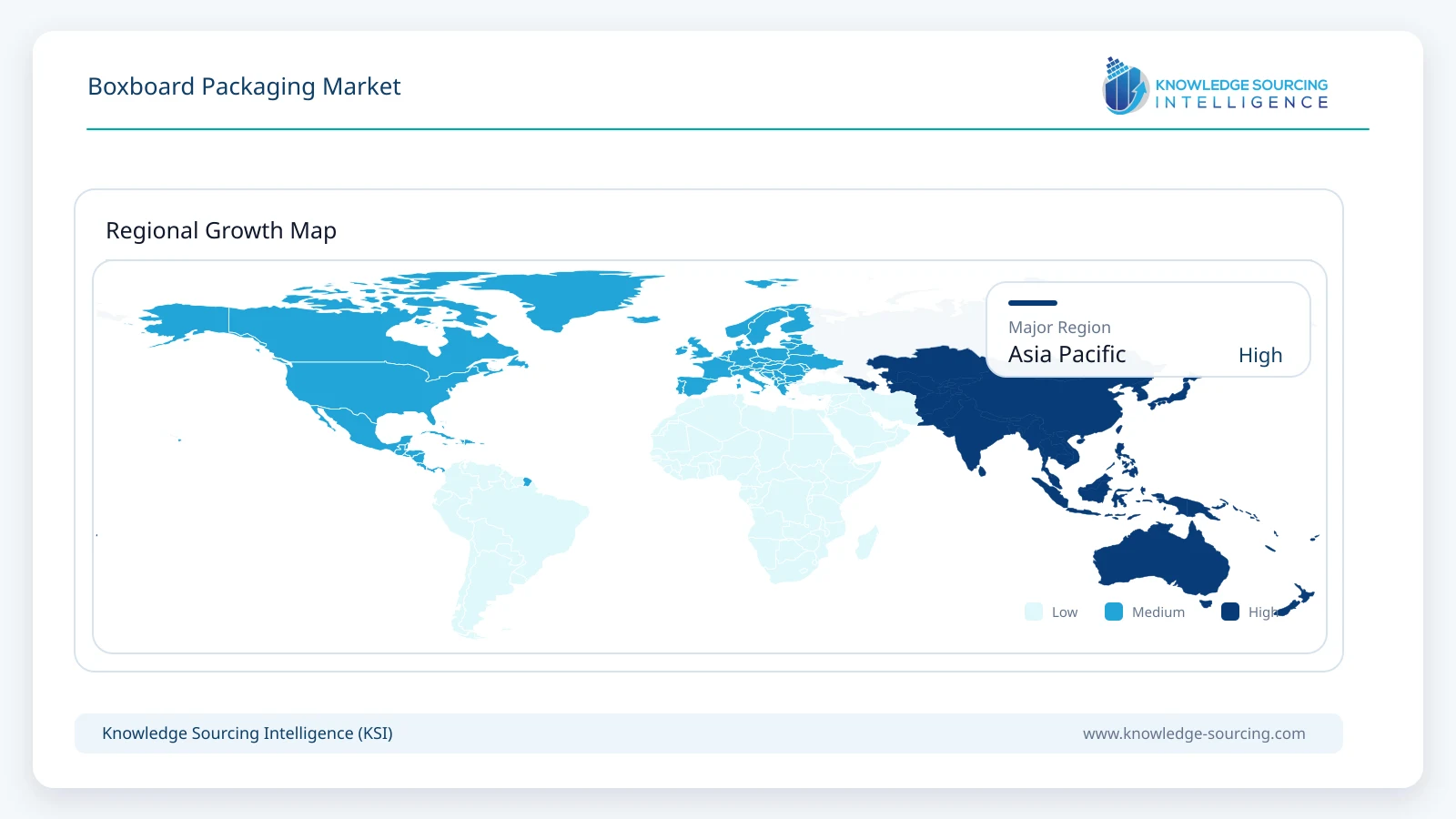
Asia Pacific provides the largest structural demand opportunity because of its manufacturing base, population scale, expanding packaged-food consumption, pharmaceutical production, personal care markets, and electronics industry.
China remains a major production and consumption centre, while India is supported by expanding packaged food, pharmaceuticals, consumer goods, and organised retail. Japan and South Korea have mature packaging industries with strong quality requirements. Taiwan is particularly relevant to electronics and industrial supply chains, while Thailand and Indonesia provide opportunities through food processing, consumer products, and manufacturing.
Regulatory and technical standards are also becoming more sophisticated. China, for example, has established standards covering food-packaging paper and board. GB/T 44834-2024 for water-based coated paper and board for food packaging took effect in May 2025, while GB/T 36392-2025 for coated paper and board for food packaging took effect in January 2026.
The principal constraints include uneven recycling infrastructure, fibre availability, energy costs, and differences in regulatory requirements between countries. Suppliers with regional production and technical capabilities can therefore address a broader customer base than companies relying on a single export market.
Middle East and Africa
Demand in the Middle East and Africa is concentrated in food and beverage, household products, pharmaceuticals, retail, and selected industrial applications. Saudi Arabia and the United Arab Emirates are important regional centres because of their food distribution, consumer markets, logistics infrastructure, and investment in manufacturing.
The region's demand profile differs from Europe because regulatory maturity and recycling infrastructure vary significantly between countries. Packaging suppliers therefore need to balance sustainability objectives with cost, local availability, and performance.
Import dependence can influence board pricing and lead times, creating opportunities for regional production and converting capacity. However, investment decisions must account for fibre availability, energy economics, water requirements, and logistics.
South America
South American demand is anchored by Brazil, with Argentina and other markets contributing through food processing, beverages, pharmaceuticals, personal care, agriculture-related products, and consumer goods.
Brazil's substantial forestry and pulp base provides a structural advantage for virgin-fibre supply and supports domestic paper and packaging production. The region also has opportunities to expand recycled-fibre use as collection and sorting systems improve.
Economic volatility, currency fluctuations, logistics costs, and differences in recycling infrastructure can constrain investment. Suppliers with local fibre access and domestic converting capacity can mitigate some of these risks.
Competitive Landscape
The competitive structure of the Boxboard Packaging Market includes integrated forest-products companies, packaging specialists, paper and board manufacturers, and diversified packaging groups. The companies considered in this market assessment are Mondi, Nippon Paper Group, Sappi Limited, Stora Enso Oyj, Metsä Board Oyj, Mayr-Melnhof, International Paper Company, ITC Limited, DS Smith, Huhtamaki Oyj, and Smurfit Westrock plc.
Competition is not based on a single product specification. Suppliers differentiate through board grade breadth, fibre sourcing, production scale, geographical coverage, converting capabilities, technical service, sustainability credentials, and the ability to maintain supply during demand fluctuations.
Vertical integration remains commercially important. Companies with access to fibre, pulp, board production, converting assets, and distribution can manage more stages of the value chain and potentially respond faster to changes in customer requirements. Stora Enso, for example, describes packaging as a major focus and maintains capabilities across fresh and recycled fibre-based packaging materials. Metsä Board specialises in lightweight folding boxboards, foodservice boards, and white kraftliners, illustrating the role of application-specific product portfolios.
Consolidation is another competitive mechanism. International Paper and DS Smith combined in January 2025, creating a larger packaging platform across North America and Europe. DS Smith's reporting archive confirms that the combination occurred on 31 January 2025 and that subsequent reporting is incorporated into International Paper's annual reporting.
Mondi's 2025 acquisition of Schumacher Packaging's Western European operations provides another example of capacity and portfolio expansion. The acquisition added more than one billion square metres of packaging capacity and expanded Mondi's offering to include solid board solutions.
The competitive direction therefore favours companies able to combine scale with specialised grades. Large customers increasingly value suppliers that can provide consistent specifications across multiple locations, while smaller and specialised converters can compete through application expertise, flexibility, and niche product development.
Sustainability reporting is also becoming part of competitive positioning. Major suppliers now disclose detailed information on fibre sourcing, emissions, recycled materials, circularity, and product development. Smurfit Westrock, for example, publishes dedicated sustainability reporting and describes fibre-based packaging as part of its circularity strategy. Huhtamaki similarly integrates circular packaging objectives into its sustainability programme and operates across 35 countries and 106 locations.
Recent Developments
August 2026: The European Union began applying the Packaging and Packaging Waste Regulation across the EU. The rules establish harmonised requirements for packaging design, composition, recyclability, reuse, waste management, and restrictions on certain substances, raising compliance requirements for packaging suppliers and brand owners.
August 2026: Graphic Packaging highlighted two 2026 AmeriStar-winning paperboard packaging innovations, reinforcing its latest recyclable and circular packaging designs for consumer applications.
July 2026: Graphic Packaging launched PaceSetter Ridgeline, a 100%-recycled-fiber uncoated recycled paperboard grade for folding cartons, laminations, edge protectors, tubes, cores, and specialty applications.
June 2026: APP Group’s Foopak Bio Natura paperboard received BPI compostability certification, strengthening its certified compostable fiber-based offering for food and sustainable packaging applications.
March 2026: Clearwater Paper launched Velora, a lightweight folding-carton paperboard designed for everyday packaging and foodservice applications, offering lower basis weights and higher material yield.
Regulatory and Policy Environment
Regulatory requirements are becoming an increasingly important input into boxboard specifications because packaging legislation is shifting from waste management toward design-stage requirements.
The European Union's PPWR is the most consequential recent policy development for European packaging markets. Regulation (EU) 2025/40 entered into force on 11 February 2025 and generally applies from 12 August 2026. It covers packaging regardless of material or origin and establishes requirements relating to manufacturing, composition, recyclability, reuse, recovery, and waste prevention.
For boxboard suppliers, the regulation increases the importance of material composition, recyclability assessments, documentation, and packaging design. The Commission issued implementation guidance in June 2026 and updated FAQs in August 2026 to address interpretation and compliance questions.
The regulation also introduces restrictions affecting certain substances in food-contact packaging. The European Commission confirmed in August 2026 that PPWR application includes restrictions on PFAS in food-contact packaging. This creates commercial implications for coated and treated board grades and may accelerate development of alternative barrier systems.
The United Kingdom is following its own packaging Extended Producer Responsibility framework. A February 2025 joint government policy statement outlined objectives including greater use of environmentally sustainable packaging, increased recycling quantity and quality, and reduced packaging material placed on the market. The Environment Agency also issued a 2025 regulatory position concerning fibre-based composite and paper-and-board packaging obligations.
China is also strengthening technical requirements for food-contact paper and board. The updated GB/T 36392-2025 standard for coated paper and board used in food packaging took effect on 1 January 2026, replacing the previous 2018 standard. Such standards affect material formulation, testing, product qualification, and quality control for suppliers serving the Chinese food-packaging industry.
Across markets, regulatory direction is therefore creating a common commercial theme: packaging suppliers must demonstrate that products meet functional requirements without creating unnecessary barriers to collection, sorting, recycling, or safe use.
Outlook and Strategic Implications
The 2026–2031 outlook for the Boxboard Packaging Market will be shaped less by a single end-use trend and more by the interaction of packaged-product demand, packaging redesign, material economics, regulation, and manufacturing efficiency.
Investment priorities are likely to concentrate on high-efficiency board machines, lightweight grades, recycled-fibre processing, barrier technologies, coating optimisation, digital quality control, and production flexibility. New capacity will not automatically translate into higher margins. Mills must match capacity with customer qualification, regional demand, and efficient logistics.
Procurement is also likely to become more technically driven. Large brand owners will increasingly evaluate board suppliers against multiple criteria, including fibre source, recycled content, recyclability, carbon performance, food-contact compliance, consistency, delivery reliability, and total packaging cost. This favours suppliers capable of providing verified product information rather than relying on broad sustainability claims.
The distinction between virgin and recycled fibre will become more nuanced. Virgin fibre will remain necessary for applications requiring specific purity, strength, brightness, and performance characteristics. Recycled fibre will continue to gain importance where technical specifications permit and customers assign commercial value to recovered content. Blended grades are likely to remain important because they provide a practical route to balancing performance and circularity.
Technology development will focus on reducing the trade-off between barrier performance and recyclability. Food packaging represents a particularly important application because suppliers must protect products from grease, moisture, oxygen, or liquids while maintaining an acceptable end-of-life pathway. Progress in water-based coatings, fibre-based barriers, improved dispersion coatings, and compatible adhesives can therefore influence future product portfolios.
Competitive evolution will also involve consolidation and geographic optimisation. The International Paper–DS Smith combination and Mondi's Schumacher acquisition illustrate how companies are using scale, capacity, geographic reach, and product breadth to strengthen customer coverage. At the same time, Stora Enso's Oulu investment shows that organic capacity expansion remains strategically important where new assets can improve product economics and supply capability.
Risks remain substantial. A prolonged downturn in consumer demand can weaken board volumes and pricing. Excess capacity can intensify price competition, while fibre and energy volatility can pressure margins. Trade restrictions and logistics disruption can affect regional supply economics. Regulatory changes can also increase product-development and compliance costs, particularly for food-contact and coated grades.
The strongest strategic opportunities are therefore likely to arise where suppliers can connect material science with packaging economics. Board that enables lower material consumption, efficient converting, reliable machine performance, regulatory compliance, and improved recyclability offers more value than a commodity grade differentiated only by price.
For converters and brand owners, supplier diversification will remain important. Maintaining qualified alternatives for critical grades can reduce exposure to mill outages, logistics disruption, and regional price fluctuations. However, switching costs mean that qualification should occur before supply disruption becomes a problem.
For board producers, customer intimacy will become more important. Technical collaboration during packaging redesign can secure demand earlier in the product-development process and make the supplier part of the customer's packaging specification. This can reduce direct price comparability and improve account retention.
Overall, the Boxboard Packaging Market is moving toward a more specification-driven procurement model. Volume demand from food, beverages, healthcare, personal care, household products, electronics, and other packaged goods will remain fundamental, but future competitive advantage will increasingly depend on material efficiency, circularity, regulatory readiness, manufacturing reliability, and regional supply capability.
The 2026–2031 period should therefore be viewed as a period of portfolio optimisation rather than simple capacity expansion. Companies that align board grades with customer-specific performance requirements, invest selectively in efficient assets, strengthen fibre security, and adapt products to changing recyclability requirements will be better positioned to capture profitable demand. Suppliers that treat boxboard as a commodity and underinvest in product engineering, compliance, and supply resilience are likely to face greater pricing pressure as buyers become more sophisticated in evaluating total packaging economics.
Boxboard Packaging Market Scope:
| Report Metric | Details |
|---|---|
| Total Market Size in 2026 | USD 42.5 billion |
| Total Market Size in 2031 | USD 53.3 billion |
| Forecast Unit | Billion |
| Growth Rate | 4.6% |
| Study Period | 2021 to 2031 |
| Historical Data | 2021 to 2024 |
| Base Year | 2025 |
| Forecast Period | 2026 – 2031 |
| Segmentation | Product Type, Material Type, End-Use Industry, Geography |
| Companies |
|
Market Segmentation
By Product Type
- Cartons and Boxes
- Inserts and Dividers
- Trays
- Cups
- Clamshells
- Others
By Material Type
- Virgin Fiber
- Recycled Fiber
- Recycled and Virgin Fiber Blends
By End-Use Industry
- Food and Beverages
- Pharmaceuticals and Healthcare
- Cosmetics and Personal Care
- Homecare
- Consumer Electronics
- Automotive
- Others
By Geography
- North America
- United States
- Canada
- Mexico
- South America
- Brazil
- Argentina
- Others
- Europe
- United Kingdom
- Germany
- France
- Italy
- Spain
- Others
- Middle East and Africa
- Saudi Arabia
- United Arab Emirates
- Others
- Asia Pacific
- Japan
- China
- India
- South Korea
- Taiwan
- Thailand
- Indonesia
- Others
Table of Contents
1. INTRODUCTION
1.1. Market Overview
1.2. Market Definition
1.3. Scope of the Study
1.4. Market Segmentation
1.5. Currency
1.6. Assumptions
1.7. Base and Forecast Years
2. RESEARCH METHODOLOGY
2.1. Research Design
2.2. Research Data
2.3. Validation
3. EXECUTIVE SUMMARY
3.1. Key Findings
4. MARKET DYNAMICS
4.1. Market Drivers
4.2. Market Restraints
4.3. Porter’s Five Forces Analysis
4.3.1. Bargaining Power of Suppliers
4.3.2. Bargaining Power of Buyers
4.3.3. Threat of New Entrants
4.3.4. Threat of Substitutes
4.3.5. Competitive Rivalry
4.4. Industry Value Chain Analysis
5. BOXBOARD PACKAGING MARKET BY PRODUCT TYPE
5.1. Introduction
5.2. Cartons and Boxes
5.3. Inserts and Dividers
5.4. Trays
5.5. Cups
5.6. Clamshells
5.7. Others
6. BOXBOARD PACKAGING MARKET BY MATERIAL TYPE
6.1. Introduction
6.2. Virgin Fiber
6.3. Recycled Fiber
6.4. Recycled and Virgin Fiber Blends
7. BOXBOARD PACKAGING MARKET BY END-USE INDUSTRY
7.1. Introduction
7.2. Food and Beverages
7.3. Pharmaceuticals and Healthcare
7.4. Cosmetics and Personal Care
7.5. Homecare
7.6. Consumer Electronics
7.7. Automotive
7.8. Others
8. BOXBOARD PACKAGING MARKET BY GEOGRAPHY
8.1. Introduction
8.2. North America
8.2.1. United States
8.2.2. Canada
8.2.3. Mexico
8.3. South America
8.3.1. Brazil
8.3.2. Argentina
8.3.3. Others
8.4. Europe
8.4.1. United Kingdom
8.4.2. Germany
8.4.3. France
8.4.4. Italy
8.4.5. Spain
8.4.6. Others
8.5. Middle East and Africa
8.5.1. Saudi Arabia
8.5.2. United Arab Emirates
8.5.3. Others
8.6. Asia Pacific
8.6.1. Japan
8.6.2. China
8.6.3. India
8.6.4. South Korea
8.6.5. Taiwan
8.6.6. Thailand
8.6.7. Indonesia
8.6.8. Others
9. COMPETITIVE ENVIRONMENT AND ANALYSIS
9.1. Major Players and Strategy Analysis
9.2. Emerging Players and Market Opportunities
9.3. Mergers, Acquisitions, Agreements, and Collaborations
9.4. Competitive Positioning Matrix
10. COMPANY PROFILES
10.1. Mondi
10.2. Nippon Paper Group
10.3. Sappi Limited
10.4. Stora Enso Oyj
10.5. Metsä Board Oyj
10.6. Mayr-Melnhof
10.7. International Paper Company
10.8. ITC Limited
10.9. DS Smith
10.10. Huhtamaki Oyj
10.11. Smurfit Westrock plc
Navigate
Trusted by the world's leading organizations











