Report Overview
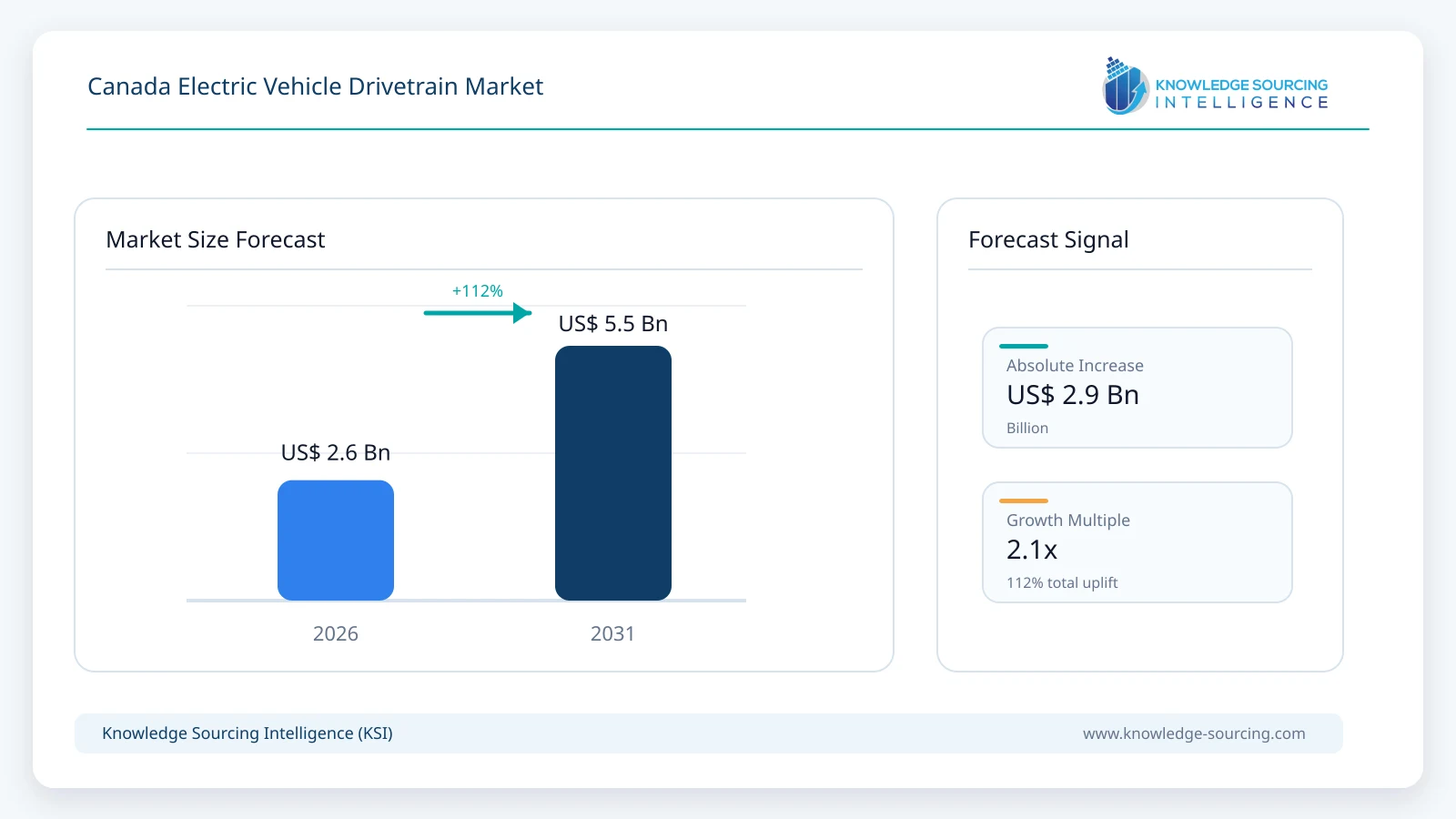
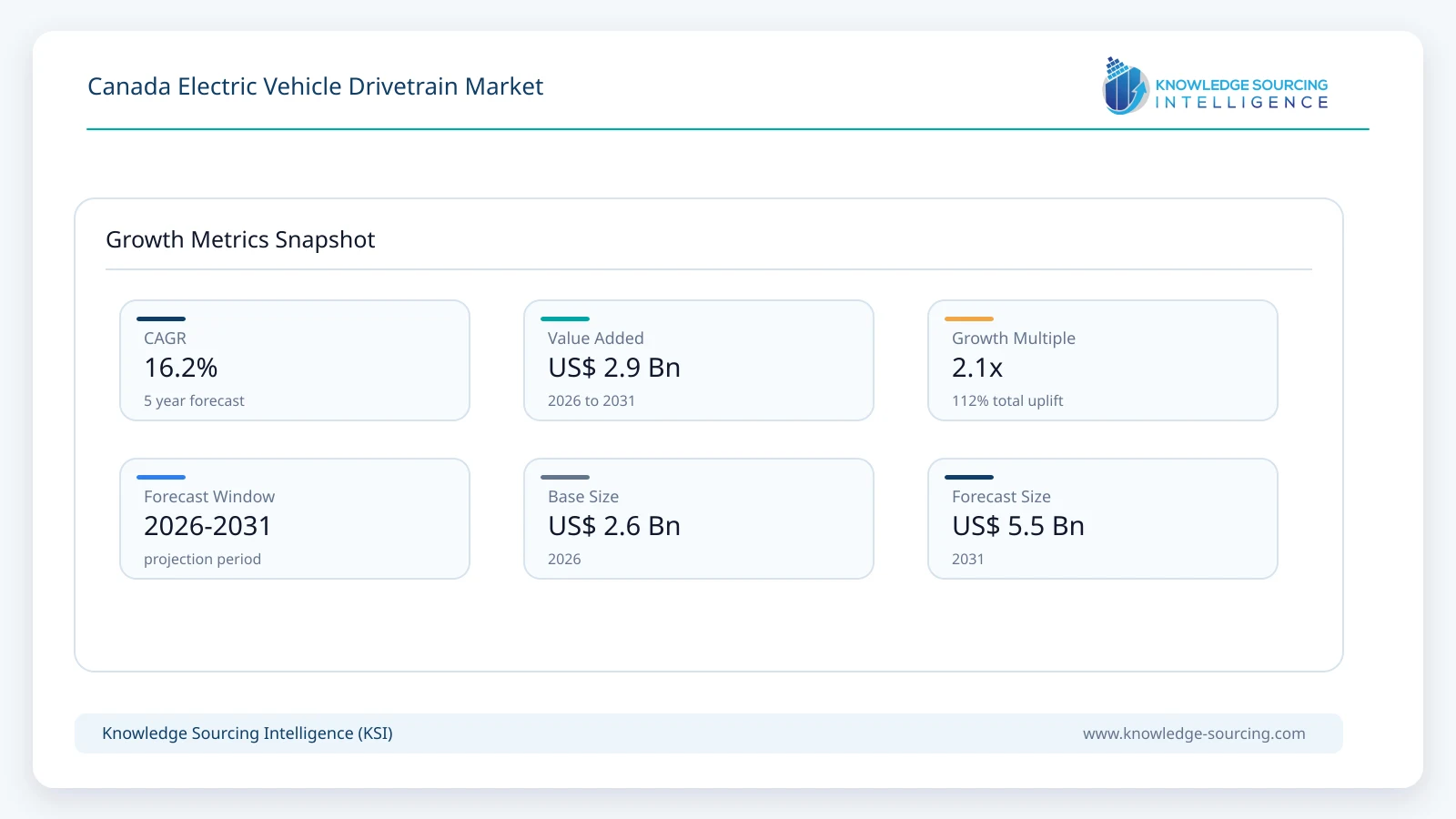
The Canada Electric Vehicle Drivetrain Market is forecast to grow at a CAGR of 16.2%, reaching USD 5.5 billion in 2031 from USD 2.6 billion in 2026.
Highlights:
- 1The implementation of the Electric Vehicle Availability Standard (EVAS), although subject to recent federal and provincial adjustments in 2025, remains the core policy lever that structurally compels automakers to increase the supply of electric vehicles (EVs), directly driving guaranteed long-term demand for EV drivetrains.
- 2Market preference in Canada exhibits regional dichotomyQuebec and British Columbia remain ZEV strongholds, creating concentrated demand for drivetrain manufacturers.
- 3The Canadian automotive sector is undergoing a substantial domestic manufacturing investment wave, supported by federal and provincial funds, specifically targeting the expansion of eAxle and other electrified powertrain component production.
- 4A notable short-term market realignment has occurred, signaling a consumer pivot towards affordability and range-flexibility, which alters demand toward hybrid-compatible drivetrain components.
The Canadian electric vehicle drivetrain market is anchored by an aggressive federal commitment to transportation decarbonization, yet it faces immediate headwinds from consumer pragmatism and policy adjustments. The federal government’s establishment of a Zero-Emission Vehicle (ZEV) sales mandate targeting 100% of new light-duty vehicle sales by 2035 has created a long-term, irreversible demand signal for electric motors, batteries, controllers, and transmissions. This regulatory push has catalyzed significant capital expenditure across the domestic automotive supply chain, particularly in Ontario’s manufacturing cluster. However, the market's trajectory in early 2025 revealed a temporary deceleration in ZEV sales and market share contraction relative to full hybrids, driven by high interest rates, affordability constraints, and the temporary removal or reduction of federal and provincial consumer purchase incentives. Manufacturers must therefore strategically balance the need to meet future ZEV mandates with current consumer demand for cost-effective, hybrid-compatible solutions.
Canada Electric Vehicle Drivetrain Market Analysis
Growth Drivers
The Electric Vehicle Availability Standard (EVAS) is the primary, non-negotiable driver, requiring automakers to sell a minimum percentage of ZEVs starting in 2026 and culminating in 100% by 2035. This supply-side regulation structurally mandates the volume of electric motors, power electronics, and transmissions required for light-duty vehicles sold in Canada, creating a stable, long-term demand curve for drivetrain components irrespective of short-term consumer sentiment. Provincial-level incentives, such as those in Quebec and British Columbia, sustain elevated demand by directly mitigating the high upfront cost barrier for consumers, thereby accelerating the adoption of vehicles that require complete electric drivetrains. Furthermore, the Canadian government's targeted Strategic Innovation Fund (SIF) investments are directly subsidizing the retooling and expansion of domestic parts manufacturers, effectively creating a local supply base that pulls demand for Canadian-made drivetrain solutions.
Challenges and Opportunities
The most significant constraint is the high upfront cost of BEVs and their associated components, exacerbated by a high interest rate environment, which has temporarily shifted consumer preference toward full hybrid vehicles. This challenge, however, presents an opportunity: the growing popularity of Plug-in Hybrid Electric Vehicles (PHEVs) and Hybrid Electric Vehicles (HEVs) drives immediate demand for specialized drivetrain components, such as power-split devices and smaller, high-efficiency traction motors compatible with hybrid systems. Additionally, the fragmented charging infrastructure outside of major metropolitan areas, with a national EV-to-public charger ratio of 26:1 as of March 2025, creates an opportunity for new eDecoupling technologies and optimized range-extender drivetrains that mitigate consumer range anxiety.
Raw Material and Pricing Analysis
The Electric Vehicle Drivetrain Market, being a physical product segment, is fundamentally tied to the price volatility and supply chain security of critical minerals. The electric motor, a core component, relies heavily on rare-earth elements such as neodymium and dysprosium for permanent magnets, or copper for induction motors. Battery components, though not part of the drivetrain per se, but integral to the overall system, dictate vehicle pricing and thus final drivetrain demand; these rely on lithium, nickel, and cobalt. With China dominating the refining and processing of these critical materials, the Canadian market is exposed to geopolitical risks and price fluctuations. This reliance compels Canadian manufacturers to focus on vertically integrating or localizing the supply chain, increasing demand for local suppliers of magnetic materials and high-purity metals to mitigate cost and supply risks, thereby stabilizing the final pricing of the integrated e-Axle systems.
Supply Chain Analysis
The electric vehicle drivetrain supply chain is globally distributed, with core dependencies on Asian manufacturing hubs, particularly for battery cells and power electronics. China controls over 80% of global lithium-ion electrode and battery cell production, creating a significant logistical and geopolitical risk for Canadian Original Equipment Manufacturers (OEMs). The Canadian domestic supply chain is robust in the mid-stream manufacturing of e-Axle assemblies, electric motor housings, and gear train components, centered primarily in the Ontario automotive cluster. Logistical complexities stem from the long-distance transport of high-voltage battery modules from Asian or European suppliers to Canadian vehicle assembly plants. This dependency is driving a concerted national effort, supported by government funding, to onshore the upstream processing of critical minerals and mid-stream component manufacturing, aiming to reduce international dependency and secure the supply of vital parts like high-specification controllers and inverters.
Government Regulations
Jurisdiction | Key Regulation / Agency | Market Impact Analysis |
Federal | Electric Vehicle Availability Standard (EVAS) | Directly drives supply-side demand: Requires ZEVs to reach a minimum share of total new light-duty vehicle sales, escalating to 100% by 2035. This creates a regulatory imperative for automakers to procure and integrate a guaranteed volume of electric drivetrains. |
Federal | Incentives for Zero-Emission Vehicles (iZEV) Program | Boosts consumer demand (demand-side): Offers up to $5,000 in rebates for new ZEV purchases, directly reducing the purchase price for consumers. The temporary suspension or exhaustion of funds directly correlates to a short-term market softening in demand for ZEVs, as seen in Q1 2025. |
Quebec | Regulation Respecting the Application of the Act Respecting Certain Measures Enabling the Enforcement of the Environmental Protection Act | Creates concentrated regional demand: This mandate, with a revised 90% ZEV sales target by 2035, has made Quebec a high-priority market for ZEV allocation. This drives manufacturers to tailor their product mix and drivetrain availability specifically for the Quebec consumer base. |
Canada Electric Vehicle Drivetrain Market Segment Analysis
By Component: Electric Motor
The electric motor is the core traction component, directly impacted by the push for high-performance and lightweight solutions, creating an urgent market imperative for advanced designs. Growth drivers center on two key performance metrics: power density and thermal management capability. The shift to 800V architectures, as seen in new product announcements from major suppliers, necessitates motors designed with superior insulation and cooling systems to handle increased voltage and power output, directly increasing the demand for sophisticated motor components. Furthermore, the segment is seeing a bifurcation of demand: high-end models require Permanent Magnet Synchronous Motors (PMSMs) for maximum efficiency and torque density, thereby increasing demand for rare-earth element content, while lower-cost, high-volume segments are seeing increased viability for AC Induction Motors (ACIMs) to mitigate raw material price risk. This segmentation compels suppliers to maintain diverse product lines, from advanced PMSM rotors to specialized ACIM windings.
By Vehicle Type: Battery Electric Vehicle (BEV)
The need for drivetrains in the Battery Electric Vehicle segment is an undisputed function of the federal 100% ZEV sales target by 2035, creating an exponential long-term demand curve. The specific demand drivers for BEV drivetrains revolve around maximizing driving range and vehicle platform commonality. The proliferation of dedicated electric vehicle platforms and skateboard chassis drives concentrated demand for highly integrated, modular e-Axle systems (combining the motor, power electronics, and transmission into one compact unit) to simplify vehicle assembly and reduce production costs. Furthermore, the BEV segment is pushing the envelope on efficiency. The drive to achieve a greater range, often by focusing on drivetrain efficiency rather than just battery size, elevates demand for components like Silicon Carbide (SiC) inverters and multi-speed transmissions that optimize motor operation across a broader range of speeds, directly supporting the market’s focus on energy consumption minimization.
Canada Electric Vehicle Drivetrain Market Competitive Environment and Analysis
The Canadian EV drivetrain market is characterized by a mix of large, established global automotive suppliers with a strong domestic footprint and smaller, highly specialized Canadian technology companies. Competition centers on scalability, integration capability (e-Axle solutions), and power electronics expertise.
Magna International Inc.
Magna International, a major Canadian-domiciled global automotive supplier, leverages its vast manufacturing network and deep OEM relationships to secure its position in the market. The company’s strategic positioning is focused on highly integrated eDrive systems. A verifiable product highlight is the global unveiling of their Next Generation 800V eDrive solution at CES 2024. This advanced product is specifically designed to meet the increasing demand for high-efficiency, high-power solutions in the C, D, and E segments, setting a new standard for power-to-weight ratio and efficiency up to 93% in real-world driving. This focus on 800V architecture and integration solidifies their strategic aim to be a primary, modular e-Axle supplier for global and domestic vehicle platforms.
Linamar Corporation
Linamar Corporation is strategically capitalizing on its core expertise in precision metal machining and assembly by pivoting aggressively into the electrified powertrain space. The company's positioning is rooted in its large-scale domestic manufacturing capacity within Ontario, supported by significant public investment. A key strategic focus is the development and production of eAxle systems for both passenger vehicles and heavy-duty trucks, as confirmed by its major investment program announced in 2025. This multi-billion-dollar investment, backed by the Strategic Innovation Fund, is designed to expand and retool its Ontario facilities to manufacture e-drivetrain components, directly addressing the government's imperative to localize the EV supply chain and securing its role as a high-volume, domestic component supplier.
Canada Electric Vehicle Drivetrain Market Developments
June 2026: Toyota Canada highlighted its expanded 2026 electrified lineup, including four battery-electric options by year-end and new BEV powertrains across the Canadian portfolio.
April 2026: Volvo Cars started production of the fully electric EX60, with Canadian P10 deliveries scheduled for late 2026, expanding the country’s premium electric drivetrain vehicle offering.
April 2026: General Motors Canada reported 13.1% year-over-year EV sales growth in Q1, strengthening adoption of its electric powertrain portfolio across Chevrolet, Cadillac, and GMC vehicles.
February 2026: APMA unveiled Project Arrow Vector and Borealis, advancing Canada’s nationally developed electric vehicle platforms and commercialization of locally developed next-generation EV technologies.
Canada Electric Vehicle Drivetrain Market Scope
| Report Metric | Details |
|---|---|
| Total Market Size in 2026 | USD 2.6 billion |
| Total Market Size in 2031 | USD 5.5 billion |
| Forecast Unit | Billion |
| Growth Rate | 16.2% |
| Study Period | 2021 to 2031 |
| Historical Data | 2021 to 2024 |
| Base Year | 2025 |
| Forecast Period | 2026 – 2031 |
| Segmentation | Component, Drive Type, Vehicle Type |
| Companies |
|
Market Segmentation
By Component
By Drive Type
By Vehicle Type
Table of Contents
1. EXECUTIVE SUMMARY
2. MARKET SNAPSHOT
2.1. Market Overview
2.2. Market Definition
2.3. Scope of the Study
2.4. Market Segmentation
3. BUSINESS LANDSCAPE
3.1. Market Drivers
3.2. Market Restraints
3.3. Market Opportunities
3.4. Porter’s Five Forces Analysis
3.5. Industry Value Chain Analysis
3.6. Policies and Regulations
3.7. Strategic Recommendations
4. TECHNOLOGICAL OUTLOOK
5. CANADA ELECTRIC VEHICLE DRIVETRAIN MARKET BY COMPONENT
5.1. Introduction
5.2. Battery
5.3. Controller
5.4. Transmission
5.5. Electric Motor
5.6. Others
6. CANADA ELECTRIC VEHICLE DRIVETRAIN MARKET BY DRIVE TYPE
6.1. Introduction
6.2. Front-Wheel Drive (FWD)
6.3. Rear-Wheel Drive (RWD)
6.4. All-Wheel Drive (AWD)
6.5. Four-Wheel Drive (4WD)
7. CANADA ELECTRIC VEHICLE DRIVETRAIN MARKET BY VEHICLE TYPE
7.1. Introduction
7.2. Battery Electric Vehicle (BEV)
7.3. Hybrid Electric Vehicle (HEV)
7.4. Plug-in Hybrid Electric Vehicle (PHEV)
7.5. Fuel Cell Electric Vehicle (FCEV)
8. COMPETITIVE ENVIRONMENT AND ANALYSIS
8.1. Major Players and Strategy Analysis
8.2. Market Share Analysis
8.3. Mergers, Acquisitions, Agreements, and Collaborations
8.4. Competitive Dashboard
9. COMPANY PROFILES
9.1. Magna International Inc.
9.2. Linamar Corporation
9.3. Electrovaya Inc.
9.4. DANA TM4 INC.
9.5. Exro Technologies Inc.
9.6. TECO-Westinghouse
9.7. MEDATECH
9.8. ZF Friedrichshafen AG
9.9. Eaton
9.10. Canadian Electric Vehicles Ltd.
10. APPENDIX
10.1. Currency
10.2. Assumptions
10.3. Base and Forecast Years Timeline
10.4. Key benefits for the stakeholders
10.5. Research Methodology
10.6. Abbreviations
LIST OF FIGURES
LIST OF TABLES
Navigate
Trusted by the world's leading organizations











