
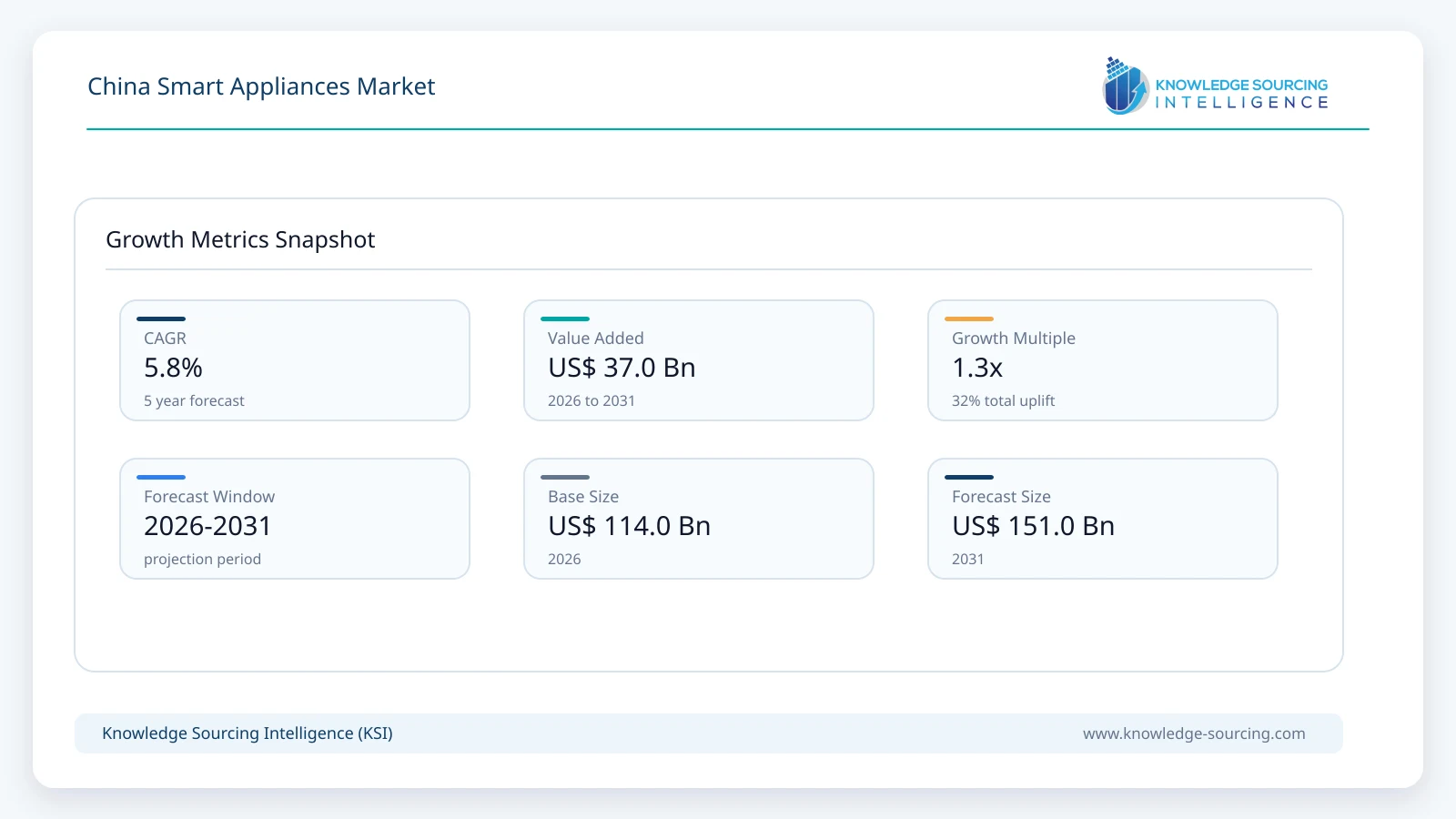
The China smart appliances market is projected to grow from USD 114.0 billion in 2026 to USD 151.0 billion by 2031, registering an estimated CAGR of 5.8% during the forecast period (2026–2031).
Highlights:
- 1China smart appliance revenue is estimated at USD 114.0 billion in 2026 despite a softer broader appliance market.
- 2Smart air conditioners represent approximately 22% of 2026 value and have among the highest connectivity penetration.
- 3Smart refrigerators and washing machines together account for roughly 26% of 2026 market revenue.
- 4Residential demand represents approximately 92% of revenue; commercial demand is concentrated in hospitality and managed properties.
- 5East China is the largest regional demand pool at about 32%, supported by income, urbanization and premium replacement.
- 6AI agents and whole-home orchestration are shifting differentiation from app connectivity toward autonomous appliance coordination.
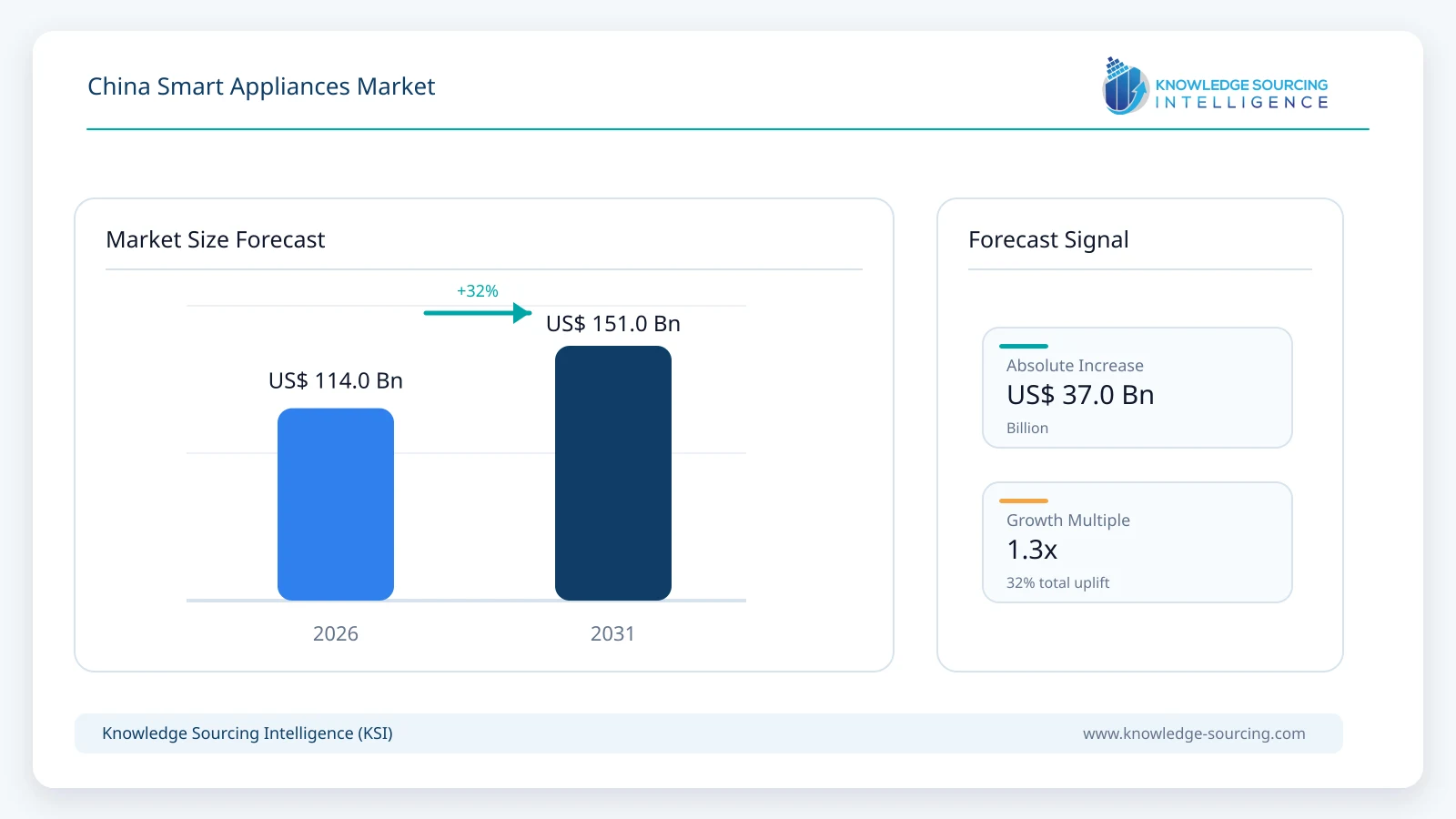
The USD 114.0 billion 2026 estimate corresponds to approximately RMB 808 billion at an exchange-rate assumption near RMB 7.09 per USD. This represents roughly two-thirds of the 2025 broad home-appliance and audio-video retail pool before adjusting for the 2026 category slowdown. The ratio is supported by category-level smart penetration. Midea’s 2025 annual report, citing AVC, states that smart refrigerators accounted for 57.35% of online and 70.83% of offline domestic refrigerator sales. Other industry data show connected air conditioners, dishwashers and several premium categories at even higher smart penetration, while hoods, water appliances and entry-level kitchen products remain lower.
The forecast path is USD 114.0 billion in 2026, USD 118.5 billion in 2027, USD 125.5 billion in 2028, USD 133.0 billion in 2029, USD 141.5 billion in 2030 and USD 151.0 billion in 2031. Growth is modest in 2027 as the market normalizes after large replacement subsidies, then strengthens as AI-enabled products, whole-home integration and natural replacement cycles raise average selling prices. The forecast is therefore materially more conservative than a simple continuation of 2025 subsidy-driven growth.
China Smart Appliances Market Trends
AI is replacing basic remote control as the principal premiumization layer. Haier’s 2025 annual report describes a strategy of 100% product intelligence and platform connectivity; Hisense used AWE 2026 to demonstrate AI agents across televisions, air conditioners, refrigerators, washing machines and kitchen equipment; and Midea is expanding its Home Agent and whole-home strategy. The competitive question is increasingly whether appliances can perceive context, learn routines and coordinate actions rather than whether they can simply connect to Wi-Fi.
Whole-home ecosystems are becoming more open. Midea is integrating its appliances with partner smartphone and automotive ecosystems, while Hisense ConnectLife, Haier Smart Home and Xiaomi Home link appliances with broader connected-device portfolios. This reduces the usefulness of connectivity protocol as a revenue segmentation: the same appliance may use Wi-Fi, Bluetooth and a Matter-compatible bridge. The report therefore removes the prior Wi-Fi/Bluetooth/Zigbee/NFC segmentation and replaces it with a more commercially relevant smart-integration architecture view.
Energy efficiency remains a key purchase trigger because smart control increasingly overlaps with high-efficiency replacement. China’s 2026 national programme subsidizes Level-1 refrigerators, washing machines, TVs, air conditioners, water heaters and computers at 15% of final price, subject to per-unit caps. Smart features such as occupancy sensing, adaptive compressor control and time-of-use optimization support premium positioning when they also lower running cost.
China’s appliance industry is moving toward vertically integrated smart-home production. Xiaomi disclosed investment of more than RMB 2.5 billion in a smart home appliance factory with peak annual capacity of seven million units, and it continues to expand Mijia air conditioners, refrigerators and washing machines. Traditional appliance leaders are responding with software, AI, direct-to-consumer distribution and ecosystem partnerships rather than relying only on mechanical product differentiation.
China Smart Appliances Market Segment Analysis
By Product Category
Smart Air Conditioners
Smart air conditioners are estimated at approximately USD 25.1 billion in 2026, or about 22% of the China smart appliances market. The category combines large unit volume, relatively high average selling prices and high smart penetration. Connected air conditioners support app control, energy scheduling, occupancy sensing, air-quality integration and increasingly AI-based comfort management. Midea, Gree, Haier, Hisense, Xiaomi, TCL and AUX compete across mass-market and premium price points.
Smart refrigerators and washing machines together account for approximately USD 29.6 billion, or roughly 26% of 2026 revenue. Refrigerator smart penetration is already above half of sales in major channels, while laundry is shifting toward multi-drum, heat-pump and fabric-recognition systems. Smart kitchen and water appliances contribute about 23%, smart TVs about 15%, and robotic cleaning, air treatment and other smart-living appliances make up the balance.
By Smart Integration Level
Connected and App-Controlled Appliances
Connected and app-controlled products remain the largest installed and revenue pool. These appliances provide remote operation, status monitoring, scheduling and firmware-based functions but do not necessarily coordinate autonomously with other household devices. They are widely available across mainstream price bands and therefore anchor market volume.
AI-adaptive and whole-home-integrated appliances are the faster-growing value pool. These products use embedded or cloud AI, multimodal sensing, user-profile learning or home-level orchestration to change operation without explicit command. The segment commands a higher average selling price and is central to premium strategies from Haier, Midea, Hisense and Xiaomi. This classification is based on the highest level of commercially enabled functionality rather than overlapping radio protocols.
By End User
Residential
Residential users are estimated to account for approximately USD 104.9 billion in 2026, or about 92% of market revenue. China has a large installed base of refrigerators, washing machines, air conditioners and water heaters, making replacement rather than first-time ownership the dominant demand mechanism. National statistics show more than 100 refrigerators and washing machines per 100 households and 161.8 air conditioners per 100 households in 2025, reinforcing the maturity of core categories.
Commercial demand is estimated at roughly 8% and includes hotels, serviced apartments, co-living properties, small offices and managed residential developments. Commercial buyers value centralized monitoring, diagnostics and energy management more than consumer entertainment features, so the product mix is weighted toward HVAC, laundry, refrigeration, water heating and cleaning systems.
By Region
East China
East China is estimated at approximately USD 36.5 billion in 2026, or about 32% of national smart-appliance revenue. Shanghai, Jiangsu, Zhejiang, Shandong and surrounding markets combine high urban incomes, dense e-commerce infrastructure, strong appliance distribution and early adoption of premium home renovation. Regional consumers are also more likely to purchase integrated suites rather than isolated replacement products.
South Central China is the second-largest demand pool, supported by Guangdong’s manufacturing base and large urban population. North China follows, led by Beijing-Tianjin-Hebei and strong demand for intelligent climate and air-treatment products. Southwest, Northeast and Northwest China have lower average spending but continue to gain smart penetration as entry-level connected products become standard.
Market Drivers
Replacement of a mature appliance installed base is the central volume driver. China already has high household ownership of refrigerators, washing machines, air conditioners and water heaters, so manufacturers create demand through energy savings, larger capacity, built-in form factors, health functions, AI and connected convenience rather than basic ownership expansion.
Government trade-in subsidies accelerate replacement and disproportionately support efficient products. Although the 2026 programme is narrower than 2025, it still covers six major appliance categories at the highest efficiency tier, reinforcing the economics of upgrading to newer connected models.
AI integration raises average selling prices and creates new reasons to replace still-functional appliances. Food recognition, adaptive preservation, fabric detection, predictive maintenance, occupancy-aware climate control and household AI agents differentiate premium products from conventional efficient appliances.
China’s domestic IoT ecosystems reduce adoption friction. Xiaomi Home, Haier Smart Home, Midea’s smart-home platform, Hisense ConnectLife and other ecosystems provide a large installed base of apps, accounts, cloud services and compatible devices, making connected appliances easier to configure and use.
Market Restraints
The market is replacement-led and therefore exposed to subsidy timing and high-base effects. Official data through August 2026 show the broad appliance category below the prior-year level after the very strong 2025 trade-in cycle. This limits the credibility of forecasts that assume persistent double-digit market growth.
Smart functionality is becoming standard in many categories, reducing the incremental price premium attached to connectivity alone. As Wi-Fi and app control move into mid-market products, vendors must monetize AI, energy savings, design, health features or service ecosystems to sustain value growth.
Platform fragmentation and privacy remain adoption frictions. Consumers increasingly own appliances from several brands, while account requirements, cloud dependencies and inconsistent interoperability can reduce the value of whole-home automation. Open ecosystem integration is improving but is not uniform across categories.
Competition is intense and price-led in large-volume categories such as air conditioners, televisions and entry-level appliances. Domestic manufacturing scale and e-commerce transparency make it difficult to sustain premium margins without differentiated technology or brand positioning.
Competitive Environment
The competitive structure combines established appliance conglomerates, consumer-electronics ecosystems and specialist smart-appliance brands. Haier Smart Home and Midea Group have the broadest multi-category footprints, spanning refrigeration, laundry, climate, kitchen and whole-home systems. Hisense combines television leadership with refrigerators, laundry and climate products, while Gree remains particularly strong in air conditioning. Xiaomi uses its smartphone and IoT ecosystem to expand rapidly into air conditioners, refrigerators, washing machines, TVs and small appliances.
TCL Smart Home, Skyworth and Changhong Meiling compete across televisions and major appliances. Roborock and Ecovacs are major smart floor-care specialists, while Robam, Fotile, Vatti and Joyoung compete in connected kitchen appliances. BSH remains relevant in premium urban households through Bosch and Siemens appliances. The market therefore cannot be represented accurately by a company list dominated only by general consumer-electronics brands.
Company inclusion is based on current appliance participation in China and evidenced connected, smart or AI-enabled products. Pure ecosystem platforms without material appliance hardware participation are excluded from the main participant list.
Recent Developments
September 2026: Hisense presented its AI Companion Suite at IFA 2026, using the ConnectLife AIoT platform to coordinate kitchen, laundry and living-space appliances through dedicated AI agents.
July 2026: Hisense announced an AI-powered growth strategy focused on transforming smart devices into smart-home companions through scenario-based AI innovation.
March 2026: Haier Smart Home reported 2025 revenue above RMB 302 billion and described deeper AI integration across its product and operating platform, alongside continued leadership in major Chinese appliance categories.
March 2026: Hisense used AWE 2026 to introduce AI-enabled televisions, air conditioners, refrigerators, washing machines and kitchen products designed around proactive rather than command-driven service.
2026: Midea expanded its whole-home smart strategy around AI Agent capability, deeper appliance-home integration and an open people-vehicle-home ecosystem, extending control and automation beyond a single brand environment.
2025-2026: Xiaomi expanded domestic smart large-appliance manufacturing and product launches after investing more than RMB 2.5 billion in a dedicated smart-home-appliance factory with planned peak annual capacity of seven million units.
Market Outlook
The China smart appliances market is expected to reach approximately USD 151.0 billion in 2031. Growth is driven primarily by mix rather than household formation: a larger share of replacement purchases will carry connectivity, AI and ecosystem functions, while average selling prices increase for premium multi-door refrigerators, heat-pump laundry, advanced HVAC, robotic cleaning and whole-home packages.
The market should not be modeled as a simple extension of the 2025 trade-in surge. The broader appliance category is already showing a high-base correction in 2026. The base case therefore assumes low-single-digit smart-market growth immediately after the subsidy surge, followed by mid-single-digit expansion as replacement cycles normalize and smart penetration rises.
The largest upside risk is faster monetization of AI appliance suites and whole-home integration, which could lift average selling prices even without higher unit volume. The main downside risk is prolonged price competition combined with weaker housing turnover, which would delay premium replacement and compress smart-feature premiums.
China Smart Appliances Market Scope:
| Report Metric | Details |
|---|---|
| Total Market Size in 2026 | USD 114.0 billion |
| Total Market Size in 2031 | USD 151.0 billion |
| Forecast Unit | USD Billion |
| Growth Rate | 5.8% |
| Study Period | 2021 to 2031 |
| Historical Data | 2021 to 2024 |
| Base Year | 2025 |
| Forecast Period | 2026 – 2031 |
| Segmentation | Product Category, Smart Integration Level, Distribution Channel, End User |
| Companies |
|
Market Segmentation
By Product Category
Smart Air Conditioners
Smart Refrigerators
Smart Washing Machines and Laundry Appliances
Smart Kitchen and Cooking Appliances
Smart TVs and Audio-Visual Appliances
Smart Floor-Care and Robotic Cleaning Appliances
Smart Air Treatment Appliances
Smart Water Heating and Water Appliances
Others
By Smart Integration Level
Connected and App-Controlled Appliances
AI-Adaptive Appliances
Whole-Home / Ecosystem-Integrated Appliances
By Distribution Channel
Online
Offline and Omnichannel Retail
By End User
Residential
Commercial and Managed Properties
By Region
East China
South Central China
North China
Southwest China
Northeast China
Northwest China
Table of Contents
1. INTRODUCTION
1.1. Market Overview
1.2. Market Definition
1.3. Scope of the Study
1.4. Market Segmentation
1.5. Currency
1.6. Assumptions
1.7. Base and Forecast Years Timeline
2. RESEARCH METHODOLOGY
2.1. Research Design
2.2. Official Retail and Installed-Base Data
2.3. Product Smart-Penetration Mapping
2.4. Company Revenue and Product Validation
2.5. Market Estimation and Forecasting
2.6. Data Triangulation and Quality Control
3. EXECUTIVE SUMMARY
3.1. Key Findings
3.2. China Market Size, 2026-2031
3.3. Segment Summary
3.4. Regional Summary
4. MARKET DYNAMICS
4.1. Market Drivers
4.1.1. Replacement of Mature Appliance Stock
4.1.2. Trade-In and Energy-Efficiency Subsidies
4.1.3. AI-Enabled Premiumization
4.1.4. Domestic IoT Ecosystems
4.2. Market Restraints
4.2.1. High-Base and Subsidy Timing Effects
4.2.2. Commoditization of Basic Connectivity
4.2.3. Platform Fragmentation and Privacy
4.2.4. Price Competition
5. CHINA SMART APPLIANCES MARKET BY PRODUCT CATEGORY
5.1. Smart Air Conditioners
5.2. Smart Refrigerators
5.3. Smart Washing Machines and Laundry Appliances
5.4. Smart Kitchen and Cooking Appliances
5.5. Smart TVs and Audio-Visual Appliances
5.6. Smart Floor-Care and Robotic Cleaning Appliances
5.7. Smart Air Treatment Appliances
5.8. Smart Water Heating and Water Appliances
5.9. Others
6. CHINA SMART APPLIANCES MARKET BY SMART INTEGRATION LEVEL
6.1. Connected and App-Controlled Appliances
6.2. AI-Adaptive Appliances
6.3. Whole-Home / Ecosystem-Integrated Appliances
7. CHINA SMART APPLIANCES MARKET BY DISTRIBUTION CHANNEL
7.1. Online
7.2. Offline and Omnichannel Retail
8. CHINA SMART APPLIANCES MARKET BY END USER
8.1. Residential
8.2. Commercial and Managed Properties
9. CHINA SMART APPLIANCES MARKET BY REGION
9.1. East China
9.2. South Central China
9.3. North China
9.4. Southwest China
9.5. Northeast China
9.6. Northwest China
10. COMPETITIVE ENVIRONMENT AND ANALYSIS
10.1. Major Appliance Conglomerates
10.2. Consumer-Electronics Ecosystems
10.3. Specialist Smart-Appliance Brands
10.4. AI and Whole-Home Platform Positioning
10.5. Distribution and Channel Competition
10.6. Recent Developments
10.7. Competitive Dashboard
11. COMPANY PROFILES
11.1. Haier Smart Home Co., Ltd.
11.2. Midea Group Co., Ltd.
11.3. Hisense Home Appliances Group Co., Ltd.
11.4. Gree Electric Appliances, Inc.
11.5. Xiaomi Corporation
11.6. TCL Smart Home Appliances Co., Ltd.
11.7. Skyworth Group Limited
11.8. Changhong Meiling Co., Ltd.
11.9. Beijing Roborock Technology Co., Ltd.
11.10. Ecovacs Robotics Co., Ltd.
11.11. Hangzhou Robam Appliances Co., Ltd.
11.12. Ningbo Fotile Kitchen Ware Co., Ltd.
11.13. Vatti Corporation Limited
11.14. Joyoung Co., Ltd.
11.15. BSH Home Appliances Group
12. APPENDIX
12.1. Currency
12.2. Assumptions
12.3. Base and Forecast Years Timeline
12.4. Abbreviations
Navigate
Trusted by the world's leading organizations











