
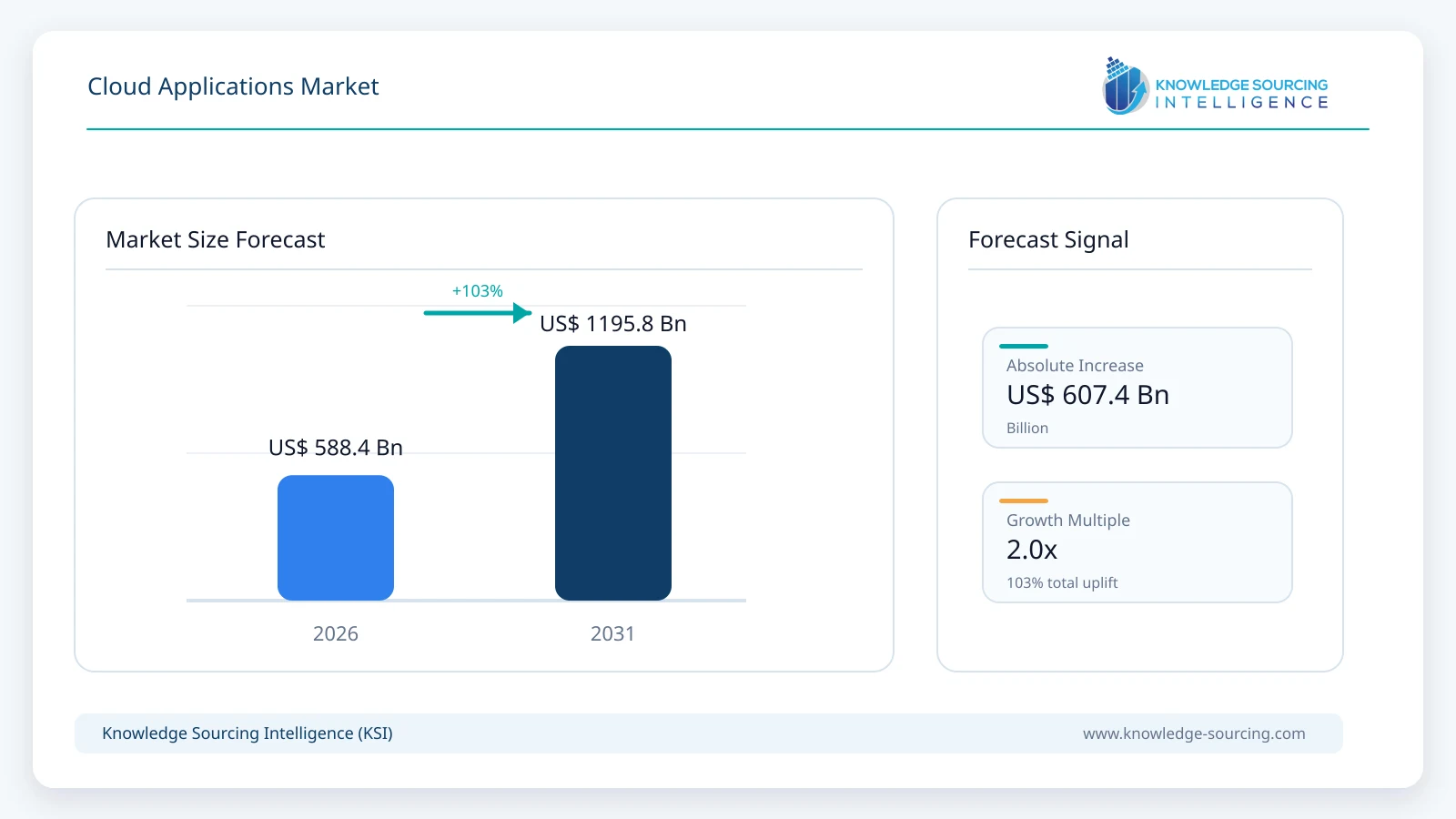
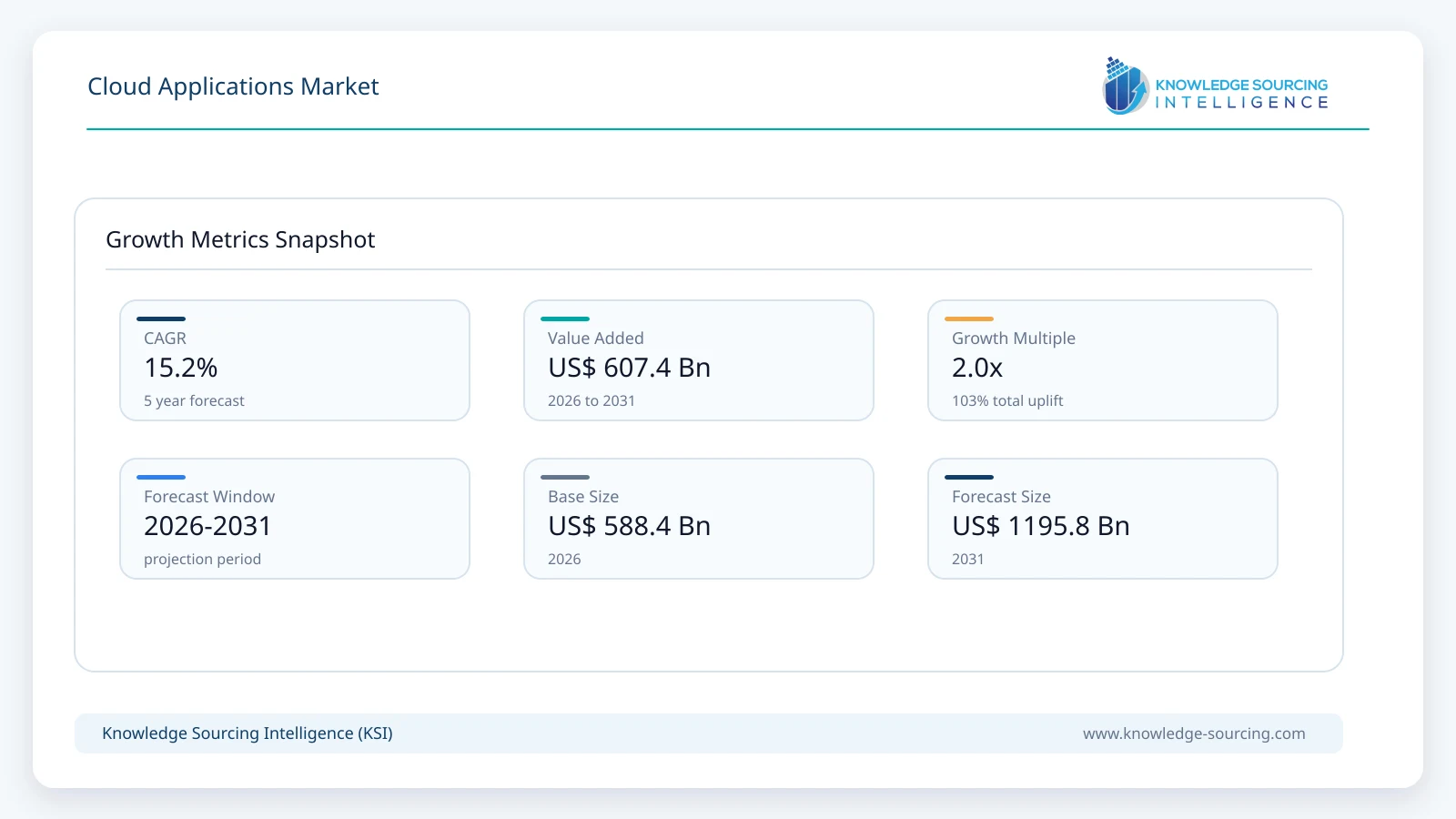
The Cloud Applications Market is forecast to grow at a CAGR of 15.24%, reaching USD 1,195.81 billion in 2031 from USD 588.41 billion in 2026.
Highlights:
- 1Growing enterprise preference for subscription-based business software continues to support recurring software procurement.
- 2Enterprise Resource Planning (ERP) applications remain among the most commercially important cloud application categories because they manage core operational processes.
- 3Asia Pacific presents considerable long-term opportunities owing to expanding enterprise digital investment, SME software adoption, and government-backed digital economy initiatives.
- 4Embedded artificial intelligence, workflow automation, predictive analytics, and generative AI assistants are influencing enterprise purchasing decisions across application portfolios.
- 5Data protection regulations, cybersecurity standards, and data residency requirements are encouraging investment in compliant cloud deployment models.
- 6Competition increasingly focuses on integrated application ecosystems, industry-specific capabilities, AI functionality, and long-term customer retention through platform expansion.
The cloud applications market comprises software solutions delivered over cloud infrastructure that support enterprise operations, customer engagement, workforce management, collaboration, analytics, and industry-specific business processes. Unlike traditional on-premises software, cloud applications are accessed through internet-based environments, allowing organisations to deploy new capabilities with lower upfront infrastructure investment, faster implementation cycles, and continuous feature updates. The market encompasses enterprise applications such as enterprise resource planning (ERP), customer relationship management (CRM), human capital management (HCM), collaboration platforms, content management systems, and business intelligence applications deployed through public, private, hybrid, and multi-cloud environments.
Demand is being shaped by enterprise priorities centred on operational efficiency, workforce flexibility, cybersecurity, and application modernisation. Organisations are replacing ageing legacy software with subscription-based cloud platforms that reduce maintenance requirements while improving scalability. Procurement decisions increasingly consider interoperability, application programming interfaces (APIs), security certifications, regulatory compliance, vendor ecosystem maturity, and artificial intelligence (AI) capabilities embedded within business workflows.
Large enterprises remain the largest purchasers due to complex application estates and ongoing digital infrastructure investments. However, small and medium-sized enterprises (SMEs) are becoming an important customer group as software-as-a-service (SaaS) pricing models lower implementation barriers and eliminate substantial capital expenditure. Buyers increasingly seek integrated application suites rather than standalone software, reducing vendor complexity while improving enterprise-wide data consistency.
Competition extends beyond software functionality. Vendors differentiate through cloud infrastructure integration, industry-specific functionality, AI-enabled automation, developer ecosystems, partner networks, implementation services, and security capabilities. Investment in sovereign cloud offerings, regional data centres, and compliance frameworks is becoming a commercial requirement, particularly for regulated industries such as banking, healthcare, and government.
Enterprise adoption patterns continue to shift towards hybrid operating models where cloud applications coexist with existing business systems. Organisations rarely migrate every workload simultaneously, creating sustained demand for integration platforms, workflow automation, identity management, and application interoperability services.
Market Drivers
Enterprise software modernisation is accelerating application migration
Many organisations continue operating legacy enterprise software that requires expensive maintenance, periodic hardware replacement, and specialised technical support. Cloud applications reduce infrastructure management responsibilities while enabling continuous software updates. Finance, manufacturing, retail, and professional services organisations increasingly replace fragmented software with unified cloud platforms that improve operational visibility. Software vendors respond by offering migration frameworks, automated implementation tools, and industry-specific templates that shorten deployment timelines while reducing migration risk.
Artificial intelligence integration is influencing enterprise procurement
Embedded AI capabilities have become an important purchasing consideration across cloud applications. Organisations seek automated document processing, predictive forecasting, conversational interfaces, workflow recommendations, intelligent search, and anomaly detection without developing proprietary AI systems. Vendors are incorporating AI assistants directly into ERP, CRM, HCM, and productivity platforms, increasing customer value while expanding software subscription opportunities. Buyers increasingly evaluate AI governance, transparency, and enterprise security alongside functional capabilities.
Hybrid work continues to support collaboration and productivity applications
Distributed workforces have altered enterprise software priorities. Organisations require secure communication platforms, document collaboration, workflow management, virtual meeting capabilities, and cloud-based content sharing regardless of employee location. Employers increasingly procure integrated collaboration suites instead of multiple disconnected productivity tools. Vendors compete by improving interoperability with enterprise applications, identity management platforms, and cybersecurity solutions while supporting mobile-first work environments.
Regulatory compliance encourages cloud investment
Regulatory requirements concerning cybersecurity, financial reporting, data privacy, and operational resilience are encouraging organisations to modernise enterprise software. Certified cloud platforms often provide stronger audit capabilities, automated compliance reporting, encryption, access controls, and security monitoring than ageing legacy environments. Highly regulated industries increasingly prioritise vendors with recognised compliance certifications, regional hosting options, and transparent governance frameworks.
Market Restraints and Challenges
Complex legacy integration increases implementation costs
Many organisations maintain customised enterprise applications developed over decades. Integrating cloud applications with existing operational technology, databases, and proprietary systems frequently requires substantial consulting resources and extended implementation schedules. These integration costs can delay procurement decisions, particularly among manufacturers and financial institutions with complex IT environments.
Data sovereignty requirements complicate deployment decisions
National regulations governing personal data, financial information, healthcare records, and government information require organisations to evaluate application hosting locations carefully. Suppliers must invest continuously in regional cloud infrastructure, compliance certifications, and sovereign cloud capabilities. Limited regional availability may delay deployments for multinational organisations operating across multiple regulatory jurisdictions.
Subscription expenditure requires continuous budget justification
Although cloud software reduces capital expenditure, recurring subscription costs become material operating expenses over time. Procurement teams increasingly examine software utilisation, licence optimisation, and measurable business outcomes before expanding deployments. Vendors therefore face greater pressure to demonstrate productivity improvements, operational savings, and measurable return on investment throughout customer contracts.
Cybersecurity risks remain a board-level concern
Cloud application providers continue strengthening security controls, yet cyber threats remain a primary procurement consideration. Organisations require strong identity management, encryption, zero-trust architecture, continuous monitoring, disaster recovery capabilities, and incident response processes. Security expectations increase implementation complexity while raising ongoing investment requirements for suppliers.
Major Segment Analysis
Enterprise Resource Planning (ERP) represents one of the most commercially important application categories within the cloud applications market because it supports finance, procurement, supply chain management, inventory control, manufacturing operations, and enterprise planning through a unified software environment. Organisations increasingly prefer cloud-based ERP systems that simplify upgrades while improving operational visibility across geographically distributed business units.
Demand originates primarily from enterprises seeking to replace fragmented legacy software with integrated platforms capable of supporting data-driven decision-making. Buyers evaluate implementation timelines, industry functionality, integration capabilities, regulatory compliance, scalability, and total cost of ownership before selecting vendors. ERP procurement typically involves long sales cycles, executive sponsorship, and substantial systems integration services, making customer retention particularly valuable for suppliers.
Competition within ERP increasingly centres on embedded analytics, AI-assisted forecasting, workflow automation, industry-specific functionality, and interoperability with CRM, HCM, and supply chain applications. Vendors also compete through partner ecosystems that provide implementation consulting, managed services, and regional support. Because ERP systems become deeply embedded within organisational operations, switching costs remain relatively high, contributing to stable recurring subscription revenues for established providers.
Regional Analysis
North America maintains the largest concentration of cloud application spending due to advanced enterprise software adoption, mature cloud infrastructure, extensive hyperscale data centre capacity, and high investment in AI-enabled enterprise applications. Financial services, healthcare, manufacturing, and technology companies remain major purchasers. Regulatory attention to cybersecurity and data protection continues supporting investment in secure cloud platforms.
Europe demonstrates consistent enterprise demand supported by digital economy initiatives, manufacturing modernisation, and compliance-driven software investment. General Data Protection Regulation (GDPR) requirements encourage organisations to prioritise vendors offering transparent data governance, regional hosting, and comprehensive security controls. Demand for sovereign cloud capabilities continues expanding across public sector and regulated industries.
Asia Pacific represents the fastest expanding opportunity as enterprises modernise business systems while governments encourage digital economic development. Rapid SME digitisation, manufacturing investment, expanding internet infrastructure, and growing cloud service availability support application deployment across China, India, Japan, South Korea, Southeast Asia, and Australia. Cost sensitivity remains an important purchasing factor, encouraging flexible subscription models.
Middle East and Africa continues expanding through government digital programmes, financial sector modernisation, and investment in smart city initiatives. Public cloud adoption is increasing, although data residency requirements and infrastructure disparities influence deployment strategies across individual countries.
South America presents steady long-term potential driven by banking modernisation, retail digitisation, telecommunications investment, and expanding cloud infrastructure. Currency volatility and uneven technology investment may affect enterprise purchasing cycles, yet organisations continue prioritising operational efficiency through cloud-based software.
Competitive Landscape
The cloud applications market combines global enterprise software providers with regional platform specialists competing across application breadth, industry expertise, and cloud ecosystem integration. Microsoft Corporation, Amazon Web Services, Inc., Google LLC, Oracle Corporation, SAP SE, Salesforce, Inc., IBM Corporation, ServiceNow, Inc., Adobe Inc., Workday, Inc., Zoho Corporation Pvt. Ltd., and Atlassian Corporation Plc compete through differentiated application portfolios supported by recurring subscription models.
Competition increasingly centres on integrated enterprise platforms rather than individual software products. Vendors expand through acquisitions, technology partnerships, developer ecosystems, AI integration, industry-specific solutions, and geographic expansion of cloud infrastructure. Strategic alliances with systems integrators, consulting firms, telecommunications providers, and independent software vendors remain important for customer acquisition and implementation support. Long-term competitive advantage depends upon ecosystem strength, product interoperability, customer retention, security capabilities, and continuous product innovation.
Recent Developments
July 2026: Oracle published the 26.07 Cloud Applications release, adding new application integration features and enhancements that simplify extending, integrating, and managing enterprise cloud applications across Oracle Cloud environments.
May 2026: Salesforce expanded Agentforce capabilities with additional autonomous AI workflow functions across customer service and sales applications. Commercial relevance: strengthens enterprise demand for AI-enabled CRM automation and productivity.
April 2026: Apps Associates officially launched its FinOps solution, enabling enterprises to optimise cloud application spending, strengthen financial governance, and improve operational visibility across Oracle Cloud and other enterprise cloud environments.
April 2026: Oracle introduced Fusion Agentic Applications embedded within Oracle Fusion Cloud Applications, launching AI-driven agents for finance, supply chain, human resources, and customer experience to automate enterprise workflows and business decision-making.
January 2026: Microsoft introduced broader Microsoft 365 Copilot and Dynamics 365 AI enhancements for enterprise users. Commercial relevance: accelerates AI integration across productivity and business applications while increasing platform value.
Regulatory and Policy Environment
The regulatory environment increasingly influences enterprise cloud application procurement. Data protection legislation such as the European Union's General Data Protection Regulation (GDPR), national privacy laws, financial supervisory requirements, healthcare information regulations, and cybersecurity frameworks require organisations to evaluate software providers beyond functional capabilities.
International standards including ISO/IEC 27001, ISO/IEC 27701, SOC reporting frameworks, and cloud security certifications have become important procurement criteria. Government digital service policies encourage cloud adoption while imposing security, resilience, and operational continuity requirements for suppliers serving public sector organisations.
Cross-border data transfer rules, sector-specific operational resilience regulations, and national cybersecurity legislation continue influencing cloud deployment strategies. Vendors therefore invest heavily in regional data centres, encryption technologies, identity management, audit capabilities, and sovereign cloud infrastructure to address evolving compliance expectations.
Outlook and Strategic Implications
Enterprise software investment over the next five years will increasingly prioritise integrated cloud application ecosystems that combine operational functionality with embedded AI, automation, advanced analytics, and secure collaboration capabilities. Procurement strategies are expected to shift from isolated application purchases towards unified enterprise platforms capable of supporting finance, customer engagement, workforce management, and operational planning through interoperable architectures.
Suppliers are expected to allocate greater investment towards AI governance, cybersecurity, sovereign cloud infrastructure, industry-specific functionality, and developer ecosystems. Organisations will continue evaluating vendors based on measurable productivity improvements, implementation complexity, regulatory compliance, and long-term subscription economics rather than software functionality alone.
Competitive differentiation is likely to depend upon ecosystem breadth, integration capabilities, AI maturity, customer success services, and global infrastructure availability. Organisations capable of balancing innovation with regulatory compliance, operational resilience, and predictable total ownership costs are expected to remain well positioned as enterprise cloud application adoption continues across both developed and emerging economies.
Cloud Applications Market Scope
| Report Metric | Details |
|---|---|
| Total Market Size in 2026 | USD 588.41 billion |
| Total Market Size in 2031 | USD 1,195.81 billion |
| Forecast Unit | Billion |
| Growth Rate | 15.24% |
| Study Period | 2021 to 2031 |
| Historical Data | 2021 to 2024 |
| Base Year | 2025 |
| Forecast Period | 2026 – 2031 |
| Segmentation | Application, Pricing Model, Deployment Model, Enterprise Size, Industry Vertical, Geography |
| Companies |
|
Market Segmentation
By Application
By Pricing Model
By Deployment Model
By Enterprise Size
By Industry Vertical
By Geography
Table of Contents
1. EXECUTIVE SUMMARY
2. MARKET SNAPSHOT
2.1. Market Overview
2.2. Market Definition
2.3. Scope of the Study
2.4. Market Segmentation
3. BUSINESS LANDSCAPE
3.1. Market Drivers
3.2. Market Restraints
3.3. Market Opportunities
3.4. Porter's Five Forces Analysis
3.5. Industry Value Chain Analysis
3.6. Policies and Regulations
3.7. Strategic Recommendations
4. TECHNOLOGICAL OUTLOOK
5. CLOUD APPLICATIONS MARKET BY APPLICATION
5.1. Introduction
5.2. Enterprise Resource Planning (ERP)
5.3. Customer Relationship Management (CRM)
5.4. Human Capital Management (HCM)
5.5. Collaboration and Productivity
5.6. Content Management
5.7. Business Intelligence and Analytics
5.8. Others
6. CLOUD APPLICATIONS MARKET BY PRICING MODEL
6.1. Introduction
6.2. Subscription-Based
6.3. Pay-Per-Use
6.4. Freemium
6.5. Enterprise Licensing
7. CLOUD APPLICATIONS MARKET BY DEPLOYMENT MODEL
7.1. Introduction
7.2. Public Cloud
7.3. Private Cloud
7.4. Hybrid Cloud
7.5. Multi-Cloud
8. CLOUD APPLICATIONS MARKET BY ENTERPRISE SIZE
8.1. Introduction
8.2. Small and Medium Enterprises (SMEs)
8.3. Large Enterprises
9. CLOUD APPLICATIONS MARKET BY INDUSTRY VERTICAL
9.1. Introduction
9.2. Banking, Financial Services, and Insurance (BFSI)
9.3. IT and Telecommunications
9.4. Retail and E-commerce
9.5. Healthcare and Life Sciences
9.6. Manufacturing
9.7. Government and Public Sector
9.8. Education
9.9. Media and Entertainment
9.10. Others
10. CLOUD APPLICATIONS MARKET BY GEOGRAPHY
10.1. Introduction
10.2. North America
10.2.1. USA
10.2.2. Canada
10.2.3. Mexico
10.3. South America
10.3.1. Brazil
10.3.2. Argentina
10.3.3. Others
10.4. Europe
10.4.1. United Kingdom
10.4.2. Germany
10.4.3. France
10.4.4. Italy
10.4.5. Spain
10.4.6. Others
10.5. Middle East and Africa
10.5.1. Saudi Arabia
10.5.2. UAE
10.5.3. Others
10.6. Asia Pacific
10.6.1. China
10.6.2. Japan
10.6.3. India
10.6.4. South Korea
10.6.5. Taiwan
10.6.6. Thailand
10.6.7. Indonesia
10.6.8. Others
11. COMPETITIVE ENVIRONMENT AND ANALYSIS
11.1. Major Players and Strategy Analysis
11.2. Market Share Analysis
11.3. Mergers, Acquisitions, Agreements, and Collaborations
11.4. Competitive Dashboard
12. COMPANY PROFILES
12.1. Microsoft Corporation
12.2. Amazon Web Services, Inc.
12.3. Google LLC
12.4. Oracle Corporation
12.5. SAP SE
12.6. Salesforce, Inc.
12.7. IBM Corporation
12.8. ServiceNow, Inc.
12.9. Adobe Inc.
12.10. Workday, Inc.
12.11. Zoho Corporation Pvt. Ltd.
12.12. Atlassian Corporation Plc
13. APPENDIX
13.1. Currency
13.2. Assumptions
13.3. Base and Forecast Years Timeline
13.4. Key Benefits for Stakeholders
13.5. Research Methodology
13.6. Abbreviations
LIST OF FIGURES
LIST OF TABLES
Navigate
Trusted by the world's leading organizations











