
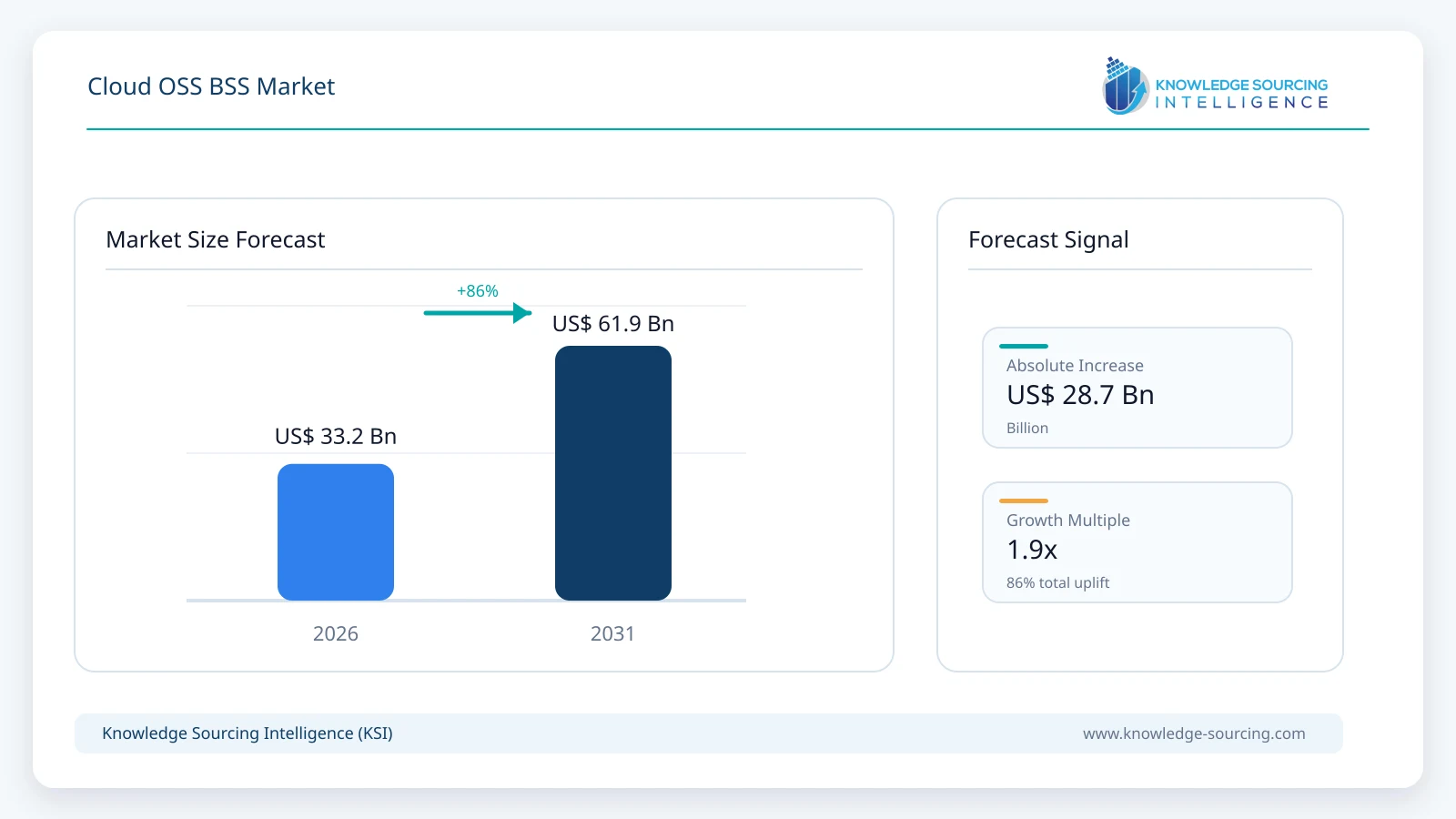
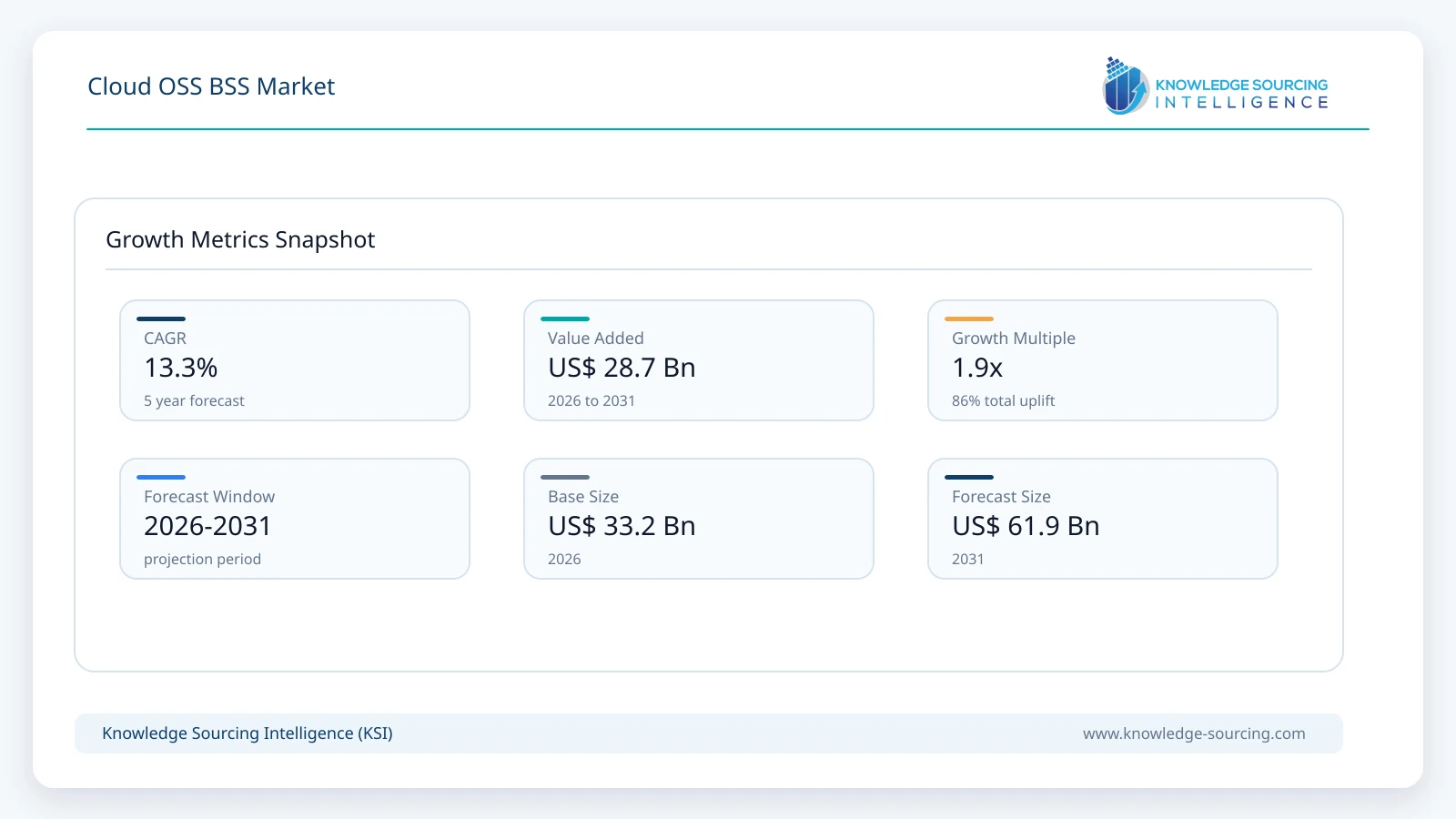
The Cloud OSS BSS Market is forecast to grow at a CAGR of 13.26%, reaching USD 61.91 billion in 2031 from USD 33.22 billion in 2026.
Highlights:
- 1Expansion of 5G Standalone and fiber broadband infrastructure is strengthening demand for cloud-native OSS and BSS platforms.
- 2Public cloud deployments continue gaining traction among operators seeking lower infrastructure management costs and faster software updates.
- 3Asia Pacific represents an important investment destination due to extensive telecom network expansion and digital connectivity initiatives.
- 4AI-assisted service assurance, automated operations, and predictive analytics are becoming standard procurement requirements.
- 5Open API frameworks and telecom interoperability standards are influencing platform selection across major operator modernization projects.
- 6Vendors increasingly compete through ecosystem partnerships, cloud integration capabilities, and modular deployment approaches rather than standalone software functionality.
The Cloud OSS BSS (Operations Support Systems and Business Support Systems) market comprises cloud-based software platforms that enable communications service providers (CSPs), internet service providers, mobile virtual network operators (MVNOs), and digital infrastructure operators to manage network operations, customer lifecycle management, billing, charging, service fulfillment, assurance, and revenue management. The transition from hardware-centric telecommunications infrastructure toward software-defined, cloud-native networks has fundamentally changed how operators procure and deploy OSS and BSS platforms. Rather than maintaining isolated on-premises systems, service providers increasingly seek modular cloud environments that shorten deployment cycles, simplify software upgrades, and improve operational visibility across fixed, mobile, enterprise, and digital services.
Demand is primarily driven by telecom operators modernizing legacy technology stacks while preparing for broader commercialization of 5G Standalone (SA), private wireless networks, fiber broadband expansion, network slicing, and enterprise digital connectivity services. Traditional OSS and BSS architectures often struggle to support real-time charging, API-driven service delivery, and dynamic resource orchestration required by next-generation networks. Consequently, buyers increasingly prioritize cloud-native software built on microservices, containerization, and open APIs.
Purchasing decisions extend beyond software functionality. Operators evaluate implementation timelines, integration complexity, scalability, cybersecurity capabilities, vendor support, interoperability with existing network infrastructure, and long-term operating costs. Large multinational operators frequently adopt phased migration strategies that preserve critical legacy systems while gradually introducing cloud-native applications. Smaller providers generally favor software-as-a-service deployment models that reduce capital expenditure and internal IT management requirements.
Industry revenues are supported through software licensing, recurring subscription models, managed services, consulting, integration, application modernization, maintenance, and long-term support agreements. System integrators, cloud infrastructure providers, telecom equipment vendors, and specialized OSS/BSS software developers collectively shape a competitive ecosystem where interoperability has become a major purchasing criterion.
Growing adoption of artificial intelligence for network assurance, automated fault management, predictive maintenance, customer analytics, and intelligent service orchestration is further reshaping procurement priorities. Buyers increasingly expect OSS and BSS platforms to provide operational intelligence rather than simply automating traditional business processes.
Market Drivers
Migration toward cloud-native telecom operations
Telecommunications operators continue replacing monolithic operational platforms with cloud-native software capable of supporting continuous software releases, elastic computing resources, and automated lifecycle management. The transition enables faster service launches while reducing infrastructure maintenance requirements. Buyers increasingly prioritize modular architectures that minimize service disruption during migration. Vendors have responded by redesigning OSS and BSS portfolios around microservices, Kubernetes orchestration, and API-based integration, creating additional consulting and managed services opportunities.
Commercial expansion of 5G and enterprise connectivity
Deployment of 5G Standalone architecture introduces new operational requirements including network slicing, dynamic service provisioning, low-latency enterprise applications, and flexible charging mechanisms. Traditional billing and operational systems cannot efficiently support these capabilities. Enterprise customers purchasing dedicated connectivity services expect rapid provisioning and transparent service management, encouraging operators to modernize business support platforms capable of handling increasingly complex commercial models.
Growing operational cost optimization initiatives
Telecommunications operators face sustained pressure to improve profitability despite rising network investment requirements. Cloud OSS and BSS solutions enable automation across service fulfillment, network monitoring, fault management, inventory management, customer support, and revenue assurance. Buyers increasingly evaluate software based on measurable reductions in manual intervention, operational expenditure, and service activation times. Vendors differentiate themselves by demonstrating quantifiable efficiency improvements supported through automation and analytics.
Expansion of digital service portfolios
Communication providers increasingly generate revenue from cloud services, IoT connectivity, edge computing, cybersecurity offerings, content delivery, and enterprise managed services. These diversified business models require flexible billing systems capable of supporting subscription services, consumption-based pricing, partner ecosystems, and multi-service customer management. Cloud-based BSS platforms provide greater commercial flexibility than traditional billing architectures, supporting long-term revenue diversification strategies.
Market Restraints and Challenges
Complexity of legacy system migration
Many telecommunications operators continue relying on decades-old operational systems deeply integrated with network infrastructure. Replacing these environments involves substantial implementation risk, prolonged testing, and business continuity considerations. Migration projects frequently require parallel operations, increasing implementation costs while extending deployment schedules. Vendors increasingly offer phased modernization frameworks and coexistence strategies to reduce operational disruption.
Cybersecurity and regulatory compliance requirements
Cloud deployment introduces additional considerations regarding data sovereignty, customer privacy, identity management, and critical infrastructure protection. National telecommunications regulations often require operators to maintain strict control over sensitive subscriber information. Compliance obligations increase procurement complexity, particularly for multinational operators operating across multiple regulatory jurisdictions. Software suppliers increasingly incorporate encryption, zero-trust security frameworks, and regional hosting capabilities to address these requirements.
Integration across multi-vendor environments
Modern telecommunications networks typically include equipment from multiple infrastructure suppliers alongside numerous legacy operational applications. Integrating cloud-native OSS and BSS platforms with existing ecosystems requires standardized APIs, middleware, and customized development work. Integration complexity can delay implementation schedules and increase project budgets. Buyers therefore place considerable emphasis on interoperability and open standards during vendor evaluation.
Skills shortages in cloud operations
Migration toward cloud-native software requires expertise in container orchestration, DevOps, automation, cloud security, and software engineering. Many operators continue facing shortages of personnel capable of managing modern cloud operations environments. As a result, demand for managed services, implementation consulting, and long-term vendor support continues expanding alongside software adoption.
Major Segment Analysis
Operations Support Systems (OSS)
Operations Support Systems represent one of the most commercially important segments because they directly influence network efficiency, service quality, and customer experience. As telecommunications infrastructure becomes increasingly virtualized, operators require centralized platforms capable of orchestrating network resources across fixed, mobile, fiber, cloud, and edge environments. Real-time visibility into network performance has become essential for maintaining service reliability while supporting increasingly complex service portfolios.
Buyer priorities extend beyond traditional fault management. Operators increasingly seek predictive maintenance, AI-assisted network analytics, automated provisioning, inventory synchronization, and intelligent service assurance. Procurement teams evaluate scalability, interoperability, API compatibility, and automation capabilities alongside implementation experience.
Competition within the OSS segment increasingly centers on cloud-native architecture, automation capabilities, AI integration, and ecosystem compatibility rather than conventional network management functionality. Vendors capable of supporting hybrid operating environments while enabling gradual migration from legacy platforms are positioned favorably in large modernization programs. Since operational efficiency directly influences network profitability, OSS investment remains strategically important across both established and emerging telecommunications markets.
Regional Analysis
North America maintains strong demand supported by continued investment in 5G Standalone deployment, fiber expansion, private wireless networks, and enterprise digital infrastructure. Operators generally prioritize cloud migration strategies that improve operational efficiency while supporting diversified digital services. Mature cloud infrastructure and established enterprise software ecosystems encourage adoption, although cybersecurity compliance remains an important purchasing consideration.
Europe benefits from extensive broadband modernization, Open RAN initiatives, and regulatory emphasis on secure digital infrastructure. Operators increasingly invest in software modernization while balancing cost efficiency and sustainability objectives. Procurement decisions frequently emphasize interoperability, standardized interfaces, and compliance with European cybersecurity and privacy requirements.
Asia Pacific represents a substantial opportunity due to expanding mobile subscribers, government-supported digital infrastructure investment, extensive 5G deployment, and accelerating enterprise connectivity demand. Large-scale network expansion across China, India, Japan, South Korea, and Southeast Asia supports sustained investment in scalable cloud-based operational platforms. Local implementation capabilities and regional partnerships remain important competitive differentiators.
Middle East & Africa continues investing in telecommunications modernization as governments prioritize digital economy initiatives, smart city programs, and next-generation connectivity. Cloud adoption is expanding, although implementation pace varies according to regulatory maturity, digital infrastructure availability, and operator investment capacity.
South America demonstrates growing modernization activity driven by mobile broadband expansion and operational efficiency initiatives. Budget constraints encourage phased implementation strategies emphasizing cost-effective cloud deployment models. Vendors offering managed services and flexible commercial arrangements are well positioned within the region.
Competitive Landscape
The Cloud OSS BSS market remains moderately concentrated, combining established telecommunications software providers, global IT services companies, network infrastructure suppliers, and enterprise cloud solution providers. Competition increasingly depends on delivering integrated cloud-native platforms capable of supporting modernization without disrupting existing operations.
Suppliers differentiate themselves through modular software architecture, AI-enabled automation, open API support, implementation expertise, cybersecurity capabilities, and long-term managed services. Strategic partnerships with hyperscale cloud providers, systems integrators, and telecommunications operators continue influencing competitive positioning. Geographic expansion increasingly relies on regional implementation capabilities, local regulatory compliance expertise, and industry-specific consulting services rather than software functionality alone.
Major companies operating in the market include Amdocs, Accenture, Cisco Systems, Inc., Comarch, Ericsson, Hewlett Packard Enterprise (HPE), Huawei Technologies Co., Ltd., IBM Corporation, NEC Corporation, Nokia Corporation, Oracle Corporation, and Tata Consultancy Services (TCS).
Recent Developments
June 2026: Netcracker Technology announced that Lightpath expanded its long-standing partnership to modernize its OSS environment and professional services, improving operational agility, accelerating enterprise service innovation, and supporting cloud-based network operations.
June 2026: Nokia and Amazon Web Services (AWS) expanded their collaboration to deliver autonomous cloud-based telecom networks, making Nokia's Autonomous Network Fabric available on AWS to support AI-driven OSS operations, orchestration, assurance, and unified inventory.
March 2026: Amdocs introduced expanded generative AI capabilities across its OSS and BSS software portfolio to improve customer support automation, operational analytics, and service lifecycle management. The release supports telecom operators pursuing higher operational productivity.
Regulatory and Policy Environment
The regulatory framework for Cloud OSS BSS adoption is shaped by telecommunications licensing requirements, cybersecurity regulations, privacy legislation, and cloud governance policies. Subscriber information management must comply with applicable privacy regulations, while operators handling critical communications infrastructure must satisfy national cybersecurity obligations.
Industry standards developed through organizations such as TM Forum continue supporting interoperability through standardized APIs and operational frameworks, reducing integration complexity across multi-vendor environments. Telecommunications regulators increasingly encourage resilient digital infrastructure capable of supporting national connectivity objectives.
Government investments supporting broadband expansion, 5G deployment, digital public infrastructure, and enterprise connectivity indirectly stimulate demand for modern OSS and BSS platforms. Procurement increasingly includes compliance assessments covering cloud security, data residency, operational resilience, disaster recovery, and software supply chain assurance.
Outlook and Strategic Implications
Over the forecast period, investment decisions will increasingly prioritize cloud-native software capable of supporting autonomous network operations, AI-assisted service management, and highly automated customer engagement. Procurement strategies are expected to shift toward modular deployment models that reduce migration risk while preserving compatibility with existing operational environments.
Operators are likely to expand subscription-based software procurement and managed services agreements as cloud adoption accelerates. Artificial intelligence, predictive analytics, API-driven ecosystems, and software automation will influence vendor selection more strongly than traditional software feature breadth. Open architectures that simplify interoperability across diverse network environments should remain commercially attractive.
Competitive differentiation will increasingly depend on implementation capability, cybersecurity assurance, ecosystem integration, cloud scalability, and measurable operational performance improvements. Vendors capable of combining software innovation with consulting, migration support, and long-term managed operations are expected to strengthen customer retention and recurring revenue opportunities. At the same time, successful market expansion will require careful management of cybersecurity risks, regulatory compliance, legacy integration complexity, and evolving operator investment priorities.
Cloud OSS BSS Market Scope
| Report Metric | Details |
|---|---|
| Total Market Size in 2026 | USD 33.22 billion |
| Total Market Size in 2031 | USD 61.91 billion |
| Forecast Unit | Billion |
| Growth Rate | 13.26% |
| Study Period | 2021 to 2031 |
| Historical Data | 2021 to 2024 |
| Base Year | 2025 |
| Forecast Period | 2026 – 2031 |
| Segmentation | Solution Type, Deployment Model, Enterprise Size, Geography |
| Companies |
|
Market Segmentation
By Solution Type
By Deployment Model
By Enterprise Size
By Geography
Table of Contents
1. EXECUTIVE SUMMARY
2. MARKET SNAPSHOT
2.1. Market Overview
2.2. Market Definition
2.3. Scope of the Study
2.4. Market Segmentation
3. BUSINESS LANDSCAPE
3.1. Market Drivers
3.2. Market Restraints
3.3. Market Opportunities
3.4. Porter’s Five Forces Analysis
3.5. Industry Value Chain Analysis
3.6. Policies and Regulations
3.7. Strategic Recommendations
4. TECHNOLOGICAL OUTLOOK
5. CLOUD OSS BSS MARKET BY SOLUTION TYPE
5.1. Introduction
5.2. Operations Support Systems (OSS)
5.3. Business Support Systems (BSS)
6. CLOUD OSS BSS MARKET BY DEPLOYMENT MODEL
6.1. Introduction
6.2. Public Cloud
6.3. Private Cloud
6.4. Hybrid Cloud
7. CLOUD OSS BSS MARKET BY ENTERPRISE SIZE
7.1. Introduction
7.2. Small and Medium-sized Enterprises (SMEs)
7.3. Large Enterprises
8. CLOUD OSS BSS MARKET BY GEOGRAPHY
8.1. Introduction
8.2. North America
8.2.1. United States
8.2.2. Canada
8.2.3. Mexico
8.3. South America
8.3.1. Brazil
8.3.2. Argentina
8.3.3. Others
8.4. Europe
8.4.1. Germany
8.4.2. France
8.4.3. United Kingdom
8.4.4. Spain
8.4.5. Others
8.5. Middle East & Africa
8.5.1. Saudi Arabia
8.5.2. UAE
8.5.3. Israel
8.5.4. Others
8.6. Asia Pacific
8.6.1. China
8.6.2. Japan
8.6.3. India
8.6.4. South Korea
8.6.5. Indonesia
8.6.6. Thailand
8.6.7. Others
9. COMPETITIVE ENVIRONMENT AND ANALYSIS
9.1. Major Players and Strategy Analysis
9.2. Market Share Analysis
9.3. Mergers, Acquisitions, Agreements, and Collaborations
9.4. Competitive Dashboard
10. COMPANY PROFILES
10.1. Amdocs
10.2. Accenture
10.3. Cisco Systems, Inc.
10.4. Comarch
10.5. Ericsson
10.6. Hewlett Packard Enterprise (HPE)
10.7. Huawei Technologies Co., Ltd.
10.8. IBM Corporation
10.9. NEC Corporation
10.10. Nokia Corporation
10.11. Oracle Corporation
10.12. Tata Consultancy Services (TCS)
11. RESEARCH METHODOLOGY
LIST OF FIGURES
LIST OF TABLES
Navigate
Trusted by the world's leading organizations











