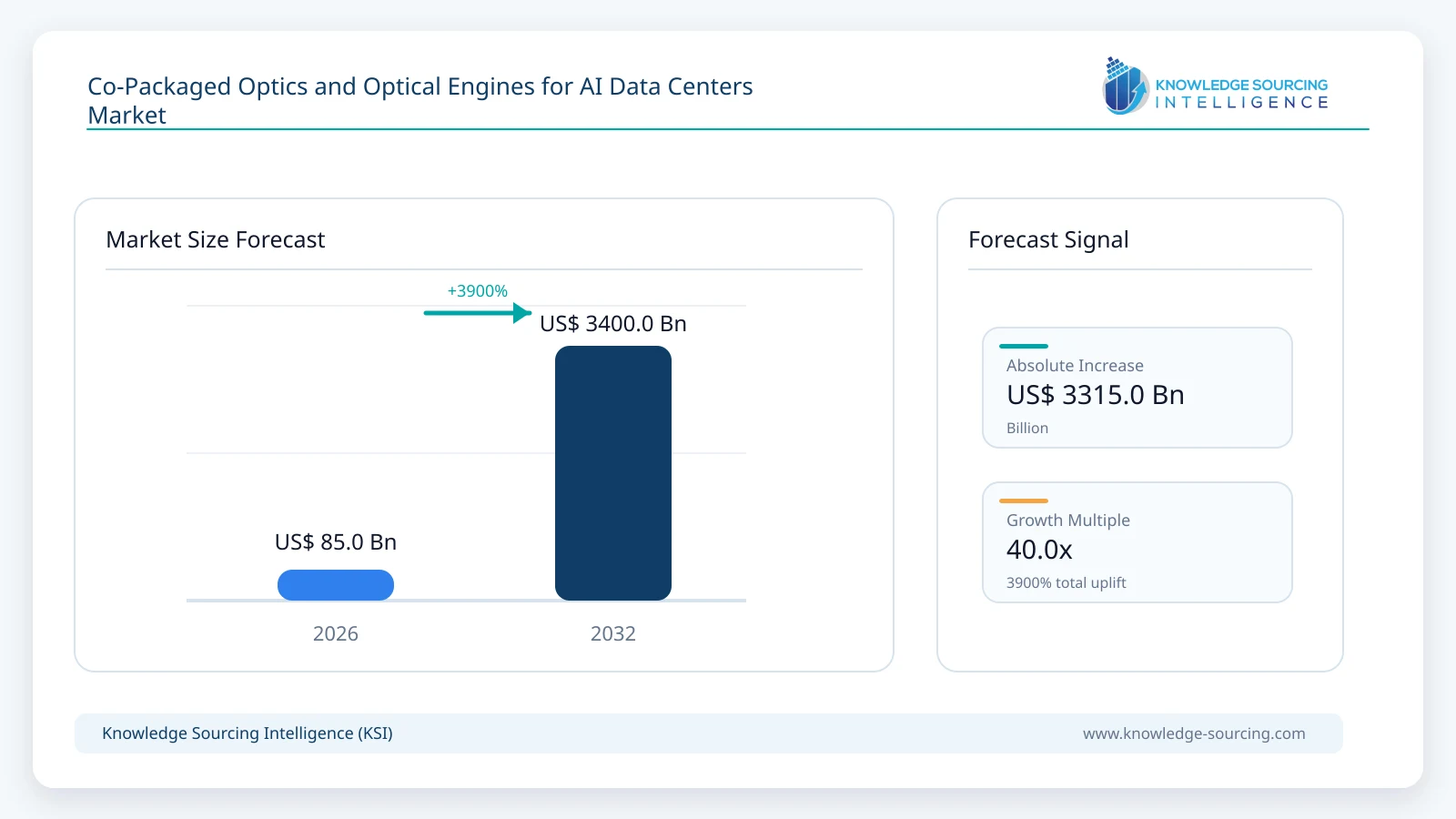
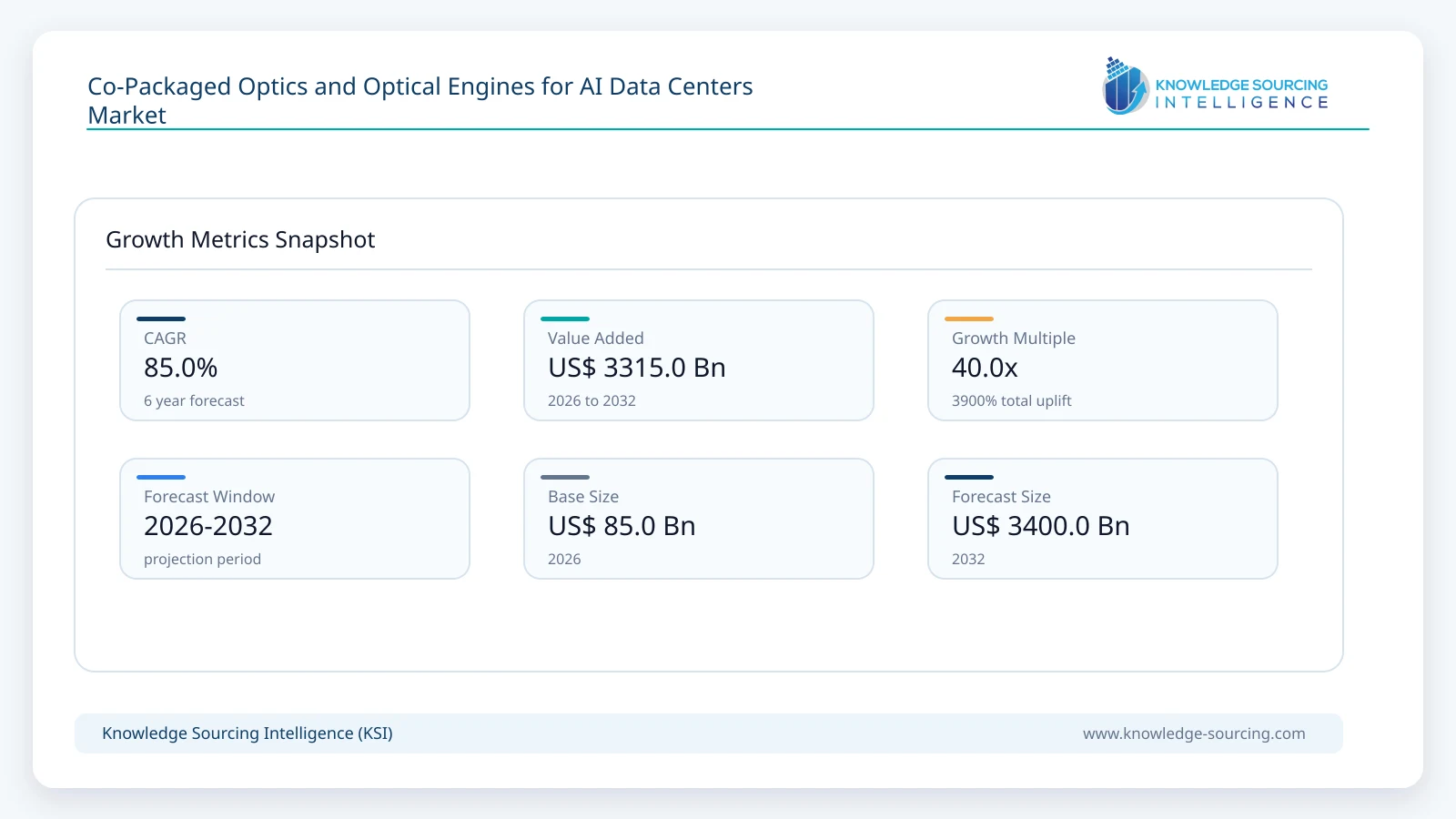
The Co-Packaged Optics and Optical Engines for AI Data Centers Market is forecast to grow at a CAGR of 85.0%, reaching USD 3,400.0 million in 2032 from USD 85.0 million in 2026.
Highlights:
- 1NVIDIA reports that Spectrum-X Ethernet Photonics entered production in May 2026, while Broadcom disclosed shipments of 102.4 Tb/s CPO-enabled switching technology.
- 2High-speed electrical channel loss and retimer power make photonic integration more attractive as switch bandwidth and the number of links rise.
- 3TSMC is beginning production of COUPE-on-substrate technology in 2026, creating a repeatable foundry and packaging route for integrated photonics.
- 4Serviceable external lasers, removable fiber interfaces and package-level testing remain commercial qualification requirements, not secondary engineering details.
- 5Scale-out switches provide the initial installed base, while photonic I/O for custom accelerators and multi-rack scale-up domains represents a later adoption path.
- 6CPO competes with continuously improving 800G, 1.6T and higher-speed pluggable technologies and therefore does not replace all data-center optical connections.
Market Overview
At high electrical lane rates, sending signals across a circuit board and through faceplate connectors creates insertion loss, equalization, and retiming requirements. The penalties rise with lane rate, physical distance, and switch radix. CPO moves the optical-electrical conversion closer to the ASIC so the longest path is optical. The resulting power saving is especially valuable when every additional kilowatt devoted to networking competes with accelerator capacity inside a constrained AI factory.
NVIDIA states that Spectrum-X Ethernet Photonics provides materially better power efficiency than conventional transceiver-based designs. Broadcom is commercializing its own high-radix CPO-enabled Ethernet switching platforms. The platforms differ in optical bandwidth, engine configuration, port reach, topology, and field-service requirements. Operators therefore evaluate the entire network power budget, network topology and operational risks rather than purchase optics against a nominal cost per terabit alone.
The packaging transition changes supplier bargaining power. Photonic engines must align with electrical SerDes, laser wavelengths, fiber arrays, thermal performance, and high-yield package assembly. TSMC has identified 2026 production for COUPE on substrate; Coherent has demonstrated a socketed 6.4 Tb/s CPO engine paired with an external laser. The socketed design adds a serviceability option, while volume production will depend on package yield, component reliability, and customer qualification.
The next adoption decision concerns optical connections associated with accelerators rather than network switches alone. Ayar Labs, Lightmatter and other developers are integrating optical I/O with system or accelerator packaging, with production volumes dependent on system-level qualification and design wins. Commercial adoption will depend on optical-link reliability, fabric compatibility and the economics of replacing copper. Customer production schedules will determine the timing of volume ramps.
Market Drivers
Increasing Cost of Electrical Reach
The decisive constraint is the shortening usable reach of high-speed electrical links, not optical speed in isolation. Additional retiming can preserve a front-panel architecture, but it adds power, board area, heat, and component count. Moving optical conversion closer to the switch silicon changes the design trade-off: the system accepts more difficult package assembly to reduce recurring network electricity and board-level signal conditioning. This improves CPO economics first in the largest and most heavily utilized AI fabrics.
AI Fabric Bandwidth and Accelerator Utilization
Large AI training domains demand synchronized communication and predictable throughput across many network hops. Congestion and electrical link constraints can lower the useful compute delivered by expensive accelerators. CPO supports higher optical bandwidth density, while procurement decisions increasingly depend on sustained network performance and energy per delivered bit rather than peak interface throughput alone. Buyers may retain pluggables wherever replacement access, price competition and incremental installation are more valuable.
Packaging and External Laser Supply
As optical engines move inside the system, manufacturing yield and external laser supply become procurement risks. A photonic defect at final assembly may affect an expensive system package, while a hard-to-service laser could raise lifecycle costs. Socketed engines, external light sources and detachable fiber arrays preserve serviceability, creating opportunities for specialized optics and connector suppliers. Capacity investments by NVIDIA, Coherent and Corning reflect increasing demand for a reliable, qualified photonics supply chain.
Market Restraints
Yield, Qualification and Repair Economics
CPO raises the cost of incomplete optical testing. Yield losses can multiply when photonics, packaging and high-value switch electronics are integrated before defects are detected. Operators also require clear repair procedures because an optical fault may take an entire switch out of service rather than a single transceiver port. Test-at-source, detachable fiber interfaces and field-replaceable lasers directly influence procurement acceptance and supplier margins.
Strong Pluggable Optics Competition
Transceiver suppliers are improving density and power efficiency at 800G and 1.6T, with higher-speed roadmaps continuing. Pluggables provide multivendor flexibility, straightforward field replacement and incremental port deployment. CPO is therefore more likely to gain penetration in high-port-count configurations with sustained bandwidth use than in small AI pods or enterprise networks where operational simplicity has greater value.
Segment Analysis
By Integration Target
Switch-ASIC CPO constitutes the initial commercial installation base because Ethernet and InfiniBand switching platforms already have identified products and production programs. It concentrates optical subsystems next to a high-radix switch ASIC and requires careful integration of thermal control, laser distribution, and fiber routing. Accelerator/XPU optical I/O is an emerging adjacent opportunity, with a wider set of possible architectures from directly co-packaged optical chiplets to near-package systems. Its commercial growth depends on accelerator and fabric qualification, not simply the number of AI GPUs sold.
By Component
Photonic engines and optical control electronics account for the main subsystem content, while external light sources are critical to lifetime reliability and serviceability. Fiber-array units, connector systems and assembly/test providers influence manufacturability and cost even when their individually invoiced value is smaller. Greater integration can simplify procurement while concentrating component-sourcing and manufacturing risk at the optical-engine supplier.
By Network Role and Customer
Scale-out switching is the near-term deployment center, led by hyperscalers and major AI-platform vendors. Scale-up optical interconnects potentially extend photonics across accelerator trays and racks, but face strict latency, power, error-rate and fabric-control requirements. System OEMs often make integration and qualification decisions, while cloud operators influence architectures and purchasing terms. Consequently, equipment specifications are often set jointly by cloud buyers and system vendors, while component purchasing is concentrated among platform integrators.
Regional Analysis
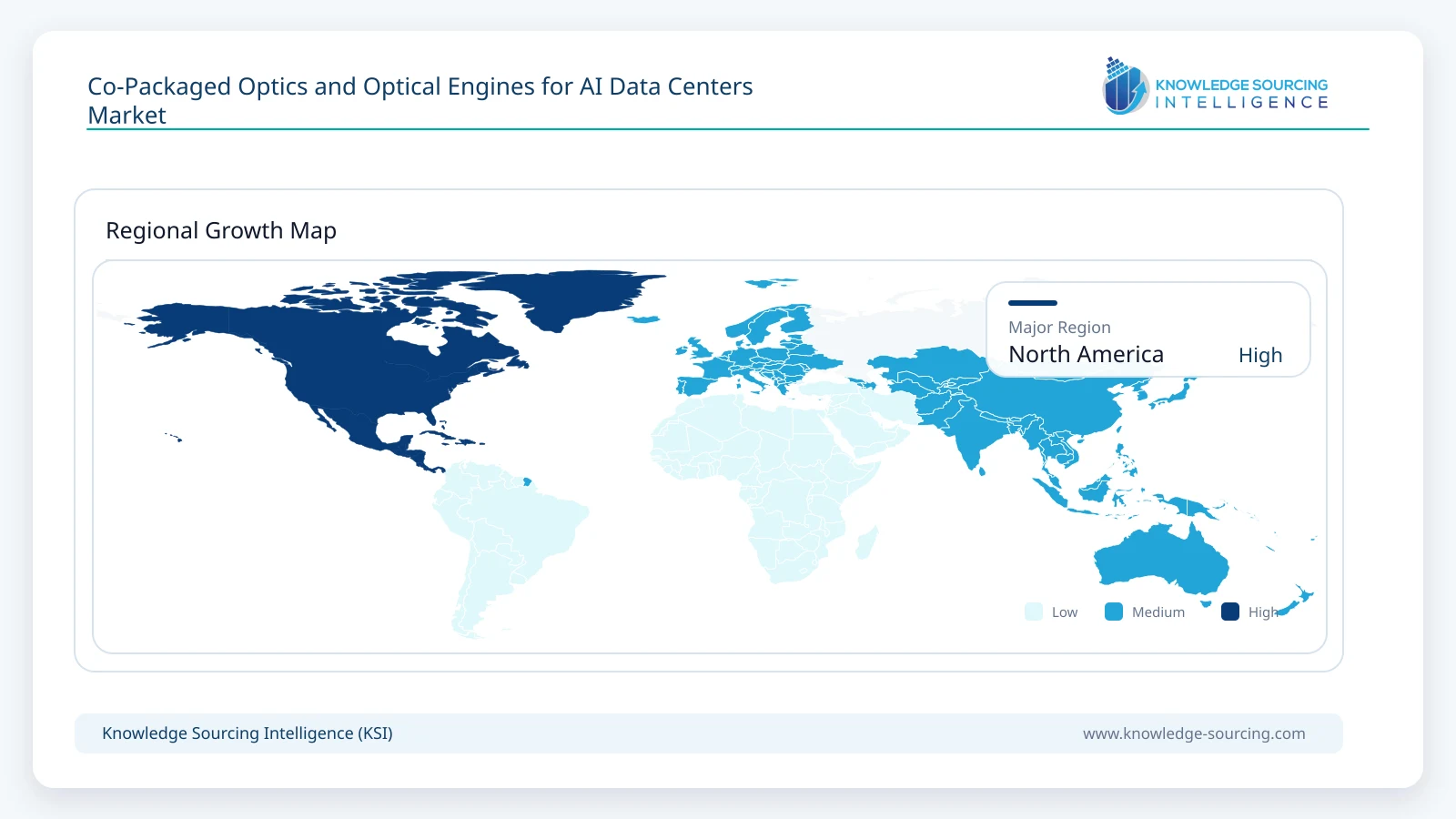
North America
North America leads architectural decisions through NVIDIA, Broadcom, hyperscale AI operators, photonic-engine specialists and large network-equipment programs. The commercial opportunity is shaped by demand for high-bandwidth AI fabrics and by access to supply chains in Taiwan and other Asian electronics hubs. Taiwan remains essential to foundry, packaging and system assembly even where AI systems are ultimately deployed in the United States. Consequently, manufacturing investment in Asian supply chains can expand even when North America remains the principal end market.
Near-term investment includes suppliers of laser sources, photonics, fiber handling and system test. NVIDIA announced a multiyear optics agreement with Coherent and separately expanded its optical-connectivity partnership with Corning. These partnerships strengthen access to optical components and manufacturing capacity as AI networking platforms adopt higher-bandwidth architectures.
Competitive and Technology Landscape
NVIDIA and Broadcom lead identifiable switch-level CPO commercialization. Marvell supplies optical and custom-compute semiconductor capabilities; Coherent, Lumentum and Ayar Labs focus on active optical engines or light-source technology; Lightmatter and Intel participate in optical I/O architectures. TSMC is a foundry and packaging enabler, while Corning, SENKO and Sumitomo Electric serve fiber attachment and connector requirements. Competition therefore differs across integrated switching systems, photonic-engine development, advanced packaging and passive optical connectivity.
The wider CPO supply chain also depends on network-equipment design, advanced assembly and high-volume manufacturing. Arista, Cisco, Celestica, Foxconn Interconnect Technology, Fabrinet and others remain relevant ecosystem participants where they qualify integrated hardware or contribute packaging, assembly and supply capacity.
Recent Developments
September 2026: Ayar Labs disclosed additional funding to expand manufacturing capability and advance customer qualification of optical-I/O technology.
May 2026: NVIDIA stated that Spectrum-X Ethernet Photonics had entered production with Vera Rubin systems.
April 2026: TSMC announced 2026 production for COUPE on substrate, a photonic engine integrated within advanced packages.
March 2026: Coherent demonstrated a 6.4 Tb/s socketed CPO optical engine with an external laser source and a separate 400G-lane technology path.
March 2026: Broadcom confirmed production shipments of the 102.4 Tb/s Tomahawk 6 family; its CPO-enabled Davisson configuration was announced separately.
March 2026: NVIDIA and Coherent announced a multi-year optics partnership that includes purchase commitments and manufacturing investment.
Co-Packaged Optics and Optical Engines for AI Data Centers Market Scope:
| Report Metric | Details |
|---|---|
| Total Market Size in 2026 | USD 85.0 million |
| Total Market Size in 2032 | USD 3,400.0 million |
| Forecast Unit | USD Billion |
| Growth Rate | 85.0% |
| Study Period | 2021 to 2032 |
| Historical Data | 2021 to 2024 |
| Base Year | 2025 |
| Forecast Period | 2026 – 2032 |
| Segmentation | Integration Target, Component, Network Role, Lane and Switch Bandwidth |
| Companies |
|
Market Segmentation
By Integration Target
Switch-ASIC Co-Packaged Optics
Accelerator/XPU Optical I/O
By Component
Photonic Engines
External Laser Sources
Fiber Arrays and Connectors
Photonic Assembly and Test
By Network Role
Scale-Out Networking
Scale-Up and Multi-Rack Optical Fabrics
By Lane and Switch Bandwidth
200G Optical Lanes
Higher-Speed Optical Lanes
51.2T to 102.4T-Plus Switches
By Customer Type
Hyperscalers
AI System and Network OEMs
Neoclouds and Sovereign AI
By Geography
North America
China
Asia Pacific Excluding China
Europe
Rest of World
Table of Contents
1. EXECUTIVE SUMMARY
1.1. Market Opportunity and Findings
1.2. CPO Commercialization Timeline
1.3. Adoption and Competitive Positioning
2. RESEARCH SCOPE AND METHODOLOGY
2.1. CPO Qualification and Market Boundary
2.2. Optical-Subsystem Revenue Recognition
2.3. Equipment Shipments and Optical Content
2.4. Forecast Scenarios and Assumptions
3. CPO TECHNOLOGY ARCHITECTURE
3.1. Pluggable versus Co-Packaged Optics
3.2. Switch CPO and Photonic Engines
3.3. Accelerator Optical I/O
3.4. External Laser Sources
3.5. Packaging, Testing and Serviceability
4. MARKET SIZE AND FORECAST, 2026–2032
4.1. Global Optical-Subsystem Revenue
4.2. Annual CPO Switch Shipments
4.3. Accelerator Optical-I/O Adoption
4.4. Revenue per Enabled System
4.5. Scenario Sensitivities
5. MARKET BY INTEGRATION TARGET
5.1. Switch-ASIC Co-Packaged Optics
5.2. Accelerator/XPU Optical I/O
6. MARKET BY COMPONENT
6.1. Photonic Engines
6.2. External Laser Sources
6.3. Fiber Arrays and Connectors
6.4. Photonic Assembly and Test
7. MARKET BY NETWORK ROLE
7.1. Scale-Out Networking
7.2. Scale-Up and Multi-Rack Optical Fabrics
8. MARKET BY LANE AND SWITCH BANDWIDTH
8.1. 200G Optical Lanes
8.2. Higher-Speed Optical Lanes
8.3. 51.2T to 102.4T-Plus Switches
9. MARKET BY CUSTOMER TYPE
9.1. Hyperscalers
9.2. AI System and Network OEMs
9.3. Neoclouds and Sovereign AI
10. REGIONAL MARKET
10.1. North America
10.2. China
10.3. Asia Pacific Excluding China
10.4. Europe
10.5. Rest of World
11. COMMERCIALIZATION AND PROJECT ECONOMICS
11.1. Energy and Reach Economics
11.2. Packaging Yield and Reliability
11.3. Field Replacement and Maintenance
11.4. Open Standards and Interoperability
12. COMPETITIVE LANDSCAPE
12.1. Switch and Accelerator Vendors
12.2. Optical Engines and Lasers
12.3. Foundry, Packaging and Fiber Connectivity
13. COMPANY PROFILES
13.1. NVIDIA
13.2. Broadcom
13.3. Marvell Technology
13.4. Coherent
13.5. Lumentum
13.6. Ayar Labs
13.7. Lightmatter
13.8. Intel
13.9. TSMC
13.10. Corning
13.11. ASE Technology
13.12. SENKO Advanced Components
14. APPENDIX
Navigate
Trusted by the world's leading organizations