
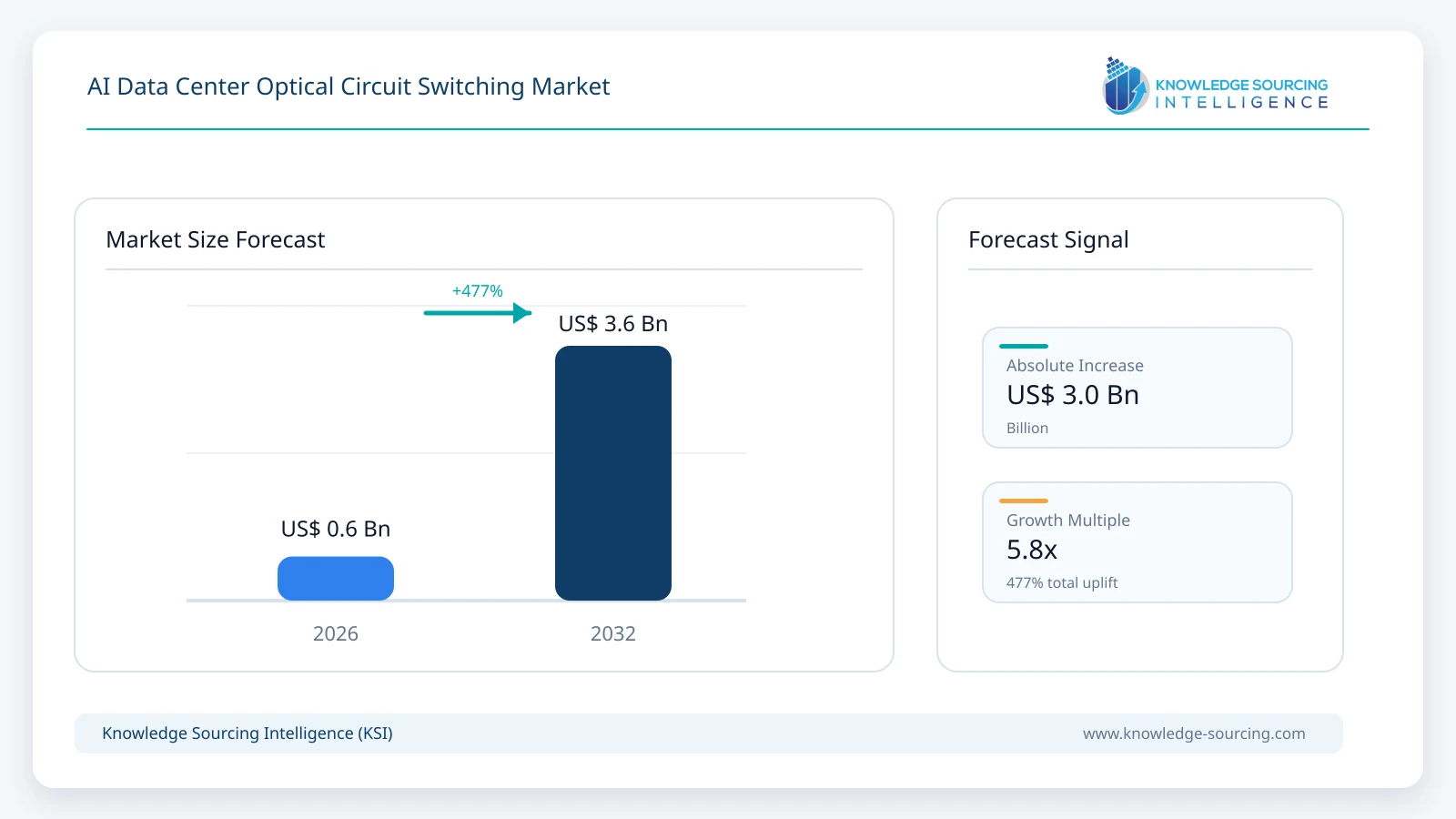
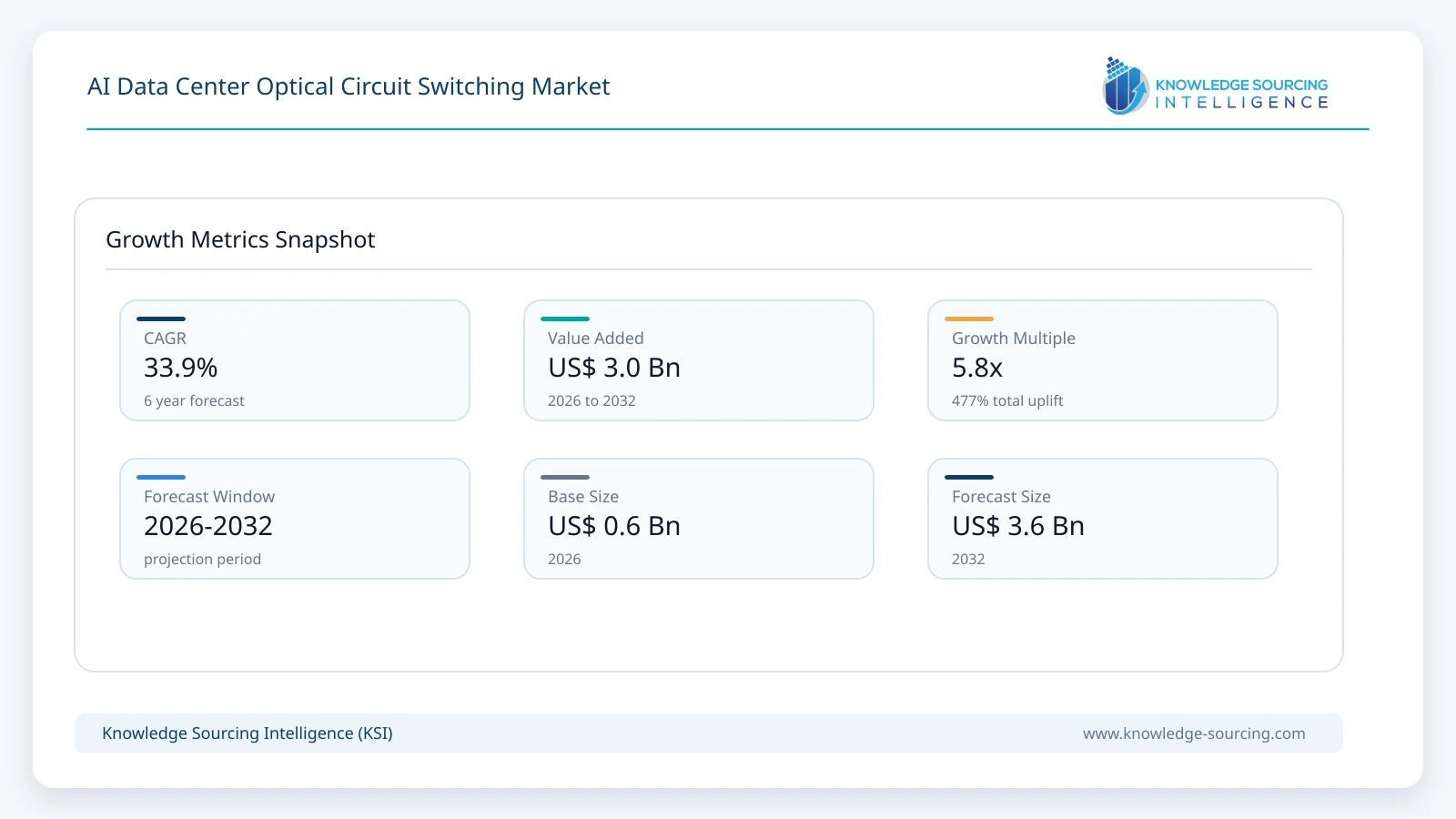
The AI Data Center Optical Circuit Switching Market is estimated at USD 0.62 billion in 2026 and is projected to reach USD 3.58 billion by 2032, representing a CAGR of 33.9% during 2026–2032.
Highlights:
- 1MEMS optical circuit switches form the largest commercial architecture in 2026.
- 2AI resource composability increases the value of programmable physical-layer connectivity across clusters.
- 3320x320 and larger switches form an important hyperscale deployment class during the forecast.
- 4Integrated-photonic switching is the fastest-growing emerging technology from a small commercial base.
- 5North America leads adoption through hyperscale AI operators and optical-networking suppliers.
Market Overview
Traditional data-center networks build connectivity by passing traffic through several layers of electrical packet switches. This provides fine-grained routing and statistical multiplexing but requires high-power switch silicon, transceivers and repeated optical-electrical-optical conversion as networks scale. OCS introduces a different function. It establishes a dedicated optical path between selected endpoints and leaves the high-speed data signal in the optical domain. The OCS itself does not inspect packets and therefore adds very little latency or bandwidth-dependent processing power. It is best suited to traffic patterns that persist long enough to justify reconfiguring the physical topology.
Google provides the strongest production proof point. Its Jupiter network has used optical circuit switching for years, and Cloud TPU systems use OCS to connect accelerator cubes while software reroutes around failed optical links. Ironwood combines inter-chip interconnect, OCS and the data-center network into a system that scales to 9,216 TPU chips per superpod. Google also describes OCS as part of the current TPU 8i pod topology. This shows that OCS can operate as a production AI interconnect layer rather than only a laboratory or test-automation technology.
The merchant market is now broadening. Lumentum offers 64x64 and 300x300 MEMS-based platforms with SONiC-based control and gNMI management. Coherent lists OCS configurations from 64x64 through 512x512. HUBER+SUHNER offers POLATIS systems up to 384x384 and opened a dedicated production site in Poland with plans to increase capacity at least fivefold. Molex is entering with a high-radix platform, while Calient and Telescent bring established OCS and automated-fiber-switching technologies into AI networking. This supplier expansion is important because hyperscalers increasingly want qualified, serviceable platforms rather than fully proprietary optical switching systems.
Market Drivers
AI cluster scale increases the cost of fixed network topology
Large training and inference systems increasingly span thousands to tens of thousands of accelerators. At this scale, fixed network topology can leave expensive compute resources stranded when links fail or when workload communication patterns do not match the physical network. Google uses OCS to reconfigure TPU interconnects and route around failures, improving slice availability. Merchant OCS suppliers are positioning the same principle for GPU and heterogeneous accelerator clusters: software can rearrange physical optical paths without recabling the data center or replacing packet-switch hardware.
Electrical switching power creates room for optical bypass
High-bandwidth electrical packet switching consumes significant power and requires optical-electrical-optical conversion wherever fiber links terminate at a switch. OCS can bypass selected packet-switch stages for flows that do not need per-packet routing, reducing conversion and switching overhead. Google reported substantial network power and cost benefits from integrating OCS into Jupiter, while commercial suppliers such as Lumentum, Coherent, Calient and HUBER+SUHNER emphasize protocol transparency and very low switching-path power. The benefit becomes more valuable as accelerator networks consume a larger share of total AI-factory power.
Higher optical lane rates increase the value of protocol-transparent switching
OCS switches route light rather than process a specific Ethernet or InfiniBand data rate, allowing the same optical switching chassis to remain useful as links migrate from 400G and 800G toward 1.6T and later generations. Calient and POLATIS position their platforms as bit-rate and protocol independent, while Lumentum and Coherent are developing OCS specifically around AI networking. This can extend equipment life compared with packet switches whose ASIC generation is tightly tied to port speed and forwarding capacity.
Software-defined topology enables composable AI infrastructure
Dynamic optical switching becomes more valuable when compute, storage and accelerators are treated as pools rather than permanently wired systems. Google GKE dynamic slicing can orchestrate physical reconfiguration in the TPU OCS network, while Drut Technologies and POLATIS have demonstrated photonic-native resource composition. Molex similarly positions high-radix OCS as a way to dynamically reconfigure AI cluster topology. As orchestration software matures, OCS can move from static resilience and test automation toward workload-aware infrastructure composition.
Restraints and Adoption Challenges
OCS does not replace packet switching across every traffic flow. Reconfiguration takes milliseconds or longer in many MEMS and robotic systems, so short-lived or highly bursty flows still require electrical packet fabrics. Network control software must decide when a circuit should be created, how long it should remain in place and how traffic is moved safely during reconfiguration. Optical loss, port count, connector density and fiber management become harder as radix increases. Operators also need redundant paths because an OCS can become a high-concentration physical-layer element. Finally, much of the largest production experience remains concentrated among hyperscalers, so broader adoption depends on merchant platforms proving interoperability, reliability and operational simplicity at scale.
Segment Analysis
By Switching Technology
MEMS-based free-space OCS represents the largest 2026 revenue pool. Lumentum, Coherent, Calient and HUBER+SUHNER all use mature optical beam-steering or MEMS approaches to deliver hundreds of ports with low optical loss and protocol-transparent operation. The technology benefits from field experience in telecom, test automation and hyperscale networks and is therefore the most commercially mature route for high-radix AI fabrics.
Integrated-photonic optical switching is expected to grow fastest from a small base through 2032. Silicon-photonic and other planar approaches can potentially reduce size and switching time while integrating monitoring or wavelength functions more tightly. However, high radix, low loss, manufacturability and thermal stability remain significant engineering constraints. Robotic fiber cross-connect systems form a separate niche where physical fiber paths can be reconfigured more slowly but at very high connector density, which is useful for planned topology changes, provisioning and large parallel-optics fabrics.
Technology / Platform | Revenue Contribution | Growth Direction | Primary AI Data Center Application |
MEMS free-space OCS | Largest category | Strong | Dynamic high-radix optical paths for scale-up and scale-out fabrics |
Robotic / physical fiber cross-connect | Established niche | Strong | Automated provisioning and reconfiguration of parallel fiber links |
Integrated-photonic OCS | Small commercial base | Fastest emerging | Lower-footprint and potentially faster future optical switching |
OCS control and orchestration software | Recurring support layer | Very strong | Topology programming, failover and workload-aware circuit control |
Monitoring and OCS integration services | Project-based layer | Strong | Power monitoring, validation, deployment and lifecycle support |
Market and Technology Indicators
Indicator | Latest Development | Market Impact |
Production AI use | Google uses OCS across TPU superpods, including Ironwood and current architectures. | Confirms OCS at production AI scale rather than only laboratory use. |
Merchant high-radix entry | Molex introduced a High-Radix OCS platform in March 2026. | Broadens the supplier base and commercial availability for hyperscale AI fabrics. |
OCS product breadth | Lumentum offers R64 and R300 platforms; Coherent lists 64x64 to 512x512 configurations. | Shows merchant platforms now span smaller clusters through hyperscale fabrics. |
Manufacturing scale-up | HUBER+SUHNER opened a dedicated POLATIS plant with at least 5x planned capacity expansion. | Provides physical capacity for substantially higher hyperscale OCS volumes. |
Hyperscale orders | HUBER+SUHNER disclosed major multi-year POLATIS orders from a hyperscale operator. | Demonstrates commercial demand beyond internal hyperscaler-developed OCS. |
Parallel-optics automation | Telescent launched a high-density OCS for 1.6T DR4/DR8 GPU-cluster interconnects in March 2026. | Extends automated optical switching into dense parallel-optics fabrics. |
Regional Opportunity
North America
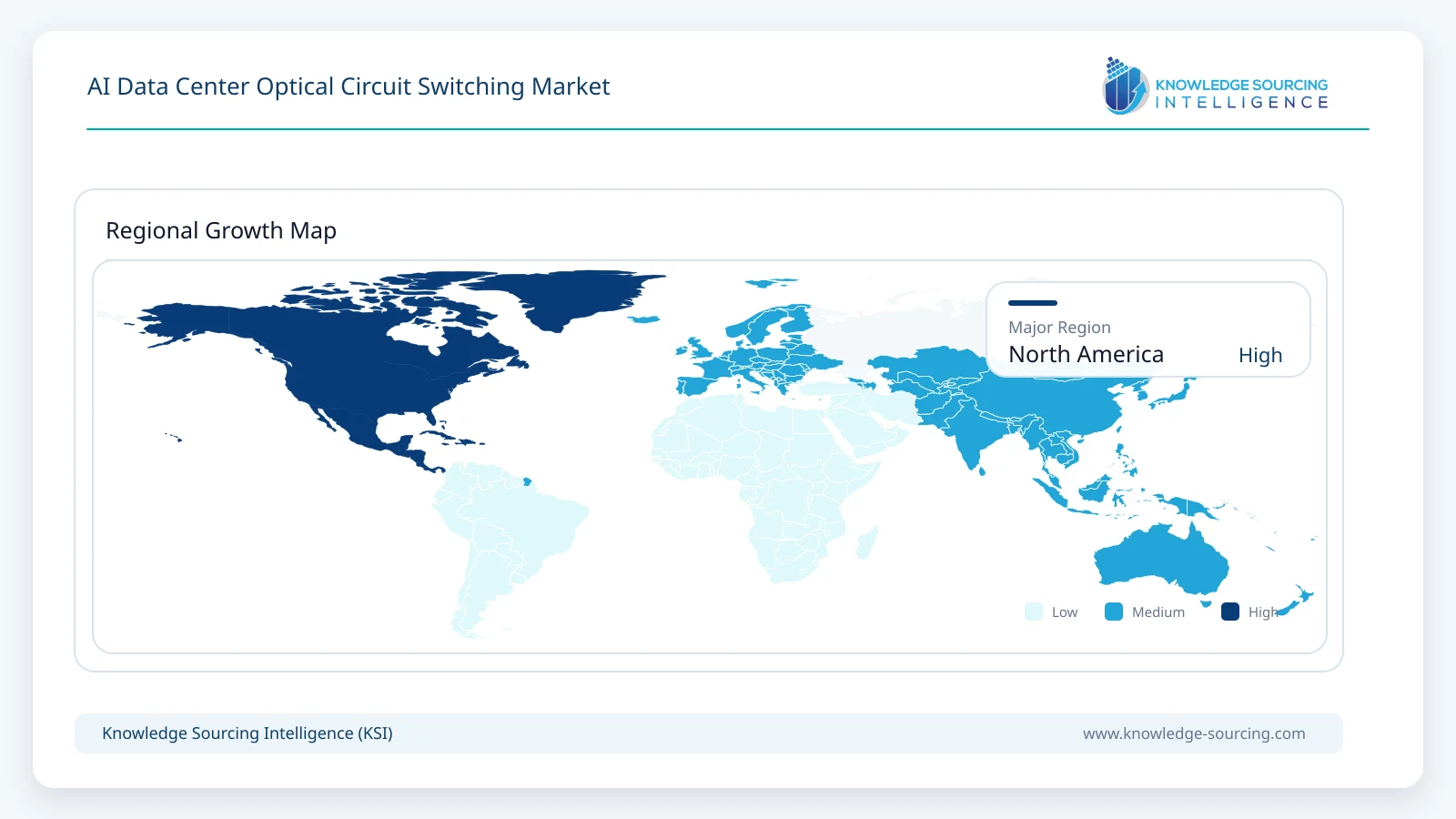
North America is the largest early market for AI data-center optical circuit switching because the United States combines hyperscale AI operators, cloud TPU deployments, large GPU clusters and a dense photonics supplier base. Google provides the most mature production example through Jupiter and TPU interconnect systems. Lumentum, Coherent, Molex, Calient and Telescent are all headquartered or maintain major operations in the region, giving U.S. operators access to both high-radix MEMS systems and emerging automated-fiber-switching platforms.
The commercial opportunity is strongest where the cost of idle accelerators or redundant packet-switch layers is high enough to justify a programmable optical fabric. Training clusters, large inference domains and composable AI infrastructure meet that condition because network topology can materially affect accelerator utilization. OCS is also attractive for operators that need rapid failover around fiber or switch-path faults without physically recabling thousands of links. The economics improve as optical lane rates increase because the same protocol-transparent OCS can switch successively higher amounts of bandwidth per port.
North American deployments are likely to remain heterogeneous through 2032. Hyperscalers may continue to use proprietary or heavily customized systems, while neoclouds and enterprise-scale AI operators are more likely to adopt merchant OCS platforms integrated with Ethernet or InfiniBand packet fabrics. Control software and orchestration therefore become as important as the optical switch itself. Suppliers that expose standards-based APIs, telemetry and topology-management interfaces are better positioned to fit into multi-vendor AI fabrics.
Asia Pacific is important through optical-component manufacturing, hyperscale buildout and large domestic AI infrastructure programs. Europe has a smaller deployment base but hosts HUBER+SUHNER and a strong photonics ecosystem, and the new POLATIS production expansion in Poland increases regional manufacturing capacity. Other regions are expected to adopt OCS selectively in sovereign AI and very large greenfield campuses where network architecture can be optimized from the initial design stage.
Competitive Landscape
The merchant OCS market remains concentrated compared with Ethernet switching or optical transceivers. Lumentum, Coherent, HUBER+SUHNER / POLATIS, Molex, Calient and Telescent have the clearest commercial OCS or automated optical-switching portfolios. Their technologies differ in port count, switching mechanism, speed, insertion loss, control interfaces and target application. MEMS dominates high-radix direct optical switching, while robotic cross-connects serve slower topology reconfiguration and physical provisioning use cases.
Large network and AI platform companies form the surrounding ecosystem. Google is the most important reference operator because it has deployed OCS deeply in production TPU and Jupiter networks. NVIDIA, Broadcom, Cisco and Arista influence where OCS can complement packet fabrics as AI scale-up and scale-out topologies evolve. Drut Technologies is developing photonic-native composable infrastructure using POLATIS, while Ciena, Fujitsu and NEC bring optical-network control and switching expertise relevant to future data-center OCS integration. Competitive advantage increasingly depends on radix, optical loss, switching speed, reliability, software control, serviceability and manufacturing scale.
Major companies and ecosystem participants covered: Lumentum, Coherent, HUBER+SUHNER / POLATIS, Molex, Calient, Telescent, Google, Drut Technologies, NVIDIA, Broadcom, Cisco, Arista Networks, Ciena, Fujitsu and NEC.
Recent Developments
September 2026: Coherent showcased optical circuit switching alongside CPO, NPO and next-generation AI data-center connectivity technologies at ECOC 2026.
September 2026: Lumentum exhibited its R300 optical circuit switch at ECOC 2026 as part of a broader scalable-AI infrastructure portfolio.
March 2026: Molex introduced a High-Radix Optical Circuit Switch Platform designed for large-scale reconfigurable AI cluster fabrics.
March 2026: Telescent launched a high-density robotic optical circuit switch for 1.6T DR4 and DR8 parallel-optics connections in GPU clusters.
2026: Google expanded software-controlled OCS usage through dynamic TPU slicing and current TPU cluster architectures.
May 2026: Lumentum described MEMS-based optical circuit switching as a strategic technology for reconfigurable AI data-center fabrics.
2025–2027: HUBER+SUHNER opened a dedicated POLATIS manufacturing site in Pisary, Poland, planning an at least fivefold capacity expansion over two years, which was followed by major multi-year hyperscale OCS orders.
AI Data Center Optical Circuit Switching Market Scope:
| Report Metric | Details |
|---|---|
| Total Market Size in 2026 | USD 0.62 billion |
| Total Market Size in 2032 | USD 3.58 billion |
| Forecast Unit | USD Billion |
| Growth Rate | 33.9% |
| Study Period | 2021 to 2032 |
| Historical Data | 2021 to 2024 |
| Base Year | 2025 |
| Forecast Period | 2026 – 2032 |
| Segmentation | Switching Technology, Switch Radix, Network Role, Customer Type |
| Companies |
|
Market Segmentation
By Switching Technology
MEMS Free-Space Optical Circuit Switches
Robotic / Physical Fiber Cross-Connects
Integrated-Photonic Optical Switches
Other Emerging Optical Switching Technologies
By Switch Radix
Up to 64x64
65x65 to 320x320
Above 320x320
Modular Multi-Chassis Architectures
By Network Role
AI Scale-Up Fabrics
AI Scale-Out / Spine Reconfiguration
Failure Recovery and Resiliency
Resource Disaggregation and Composable Infrastructure
Test, Provisioning and Automated Fiber Management
By Customer Type
Hyperscale Cloud Providers
Neocloud and GPU-Cloud Operators
Sovereign AI Infrastructure
High-Performance Computing
Enterprise AI Infrastructure
By Region
North America
United States
Canada
Europe
Asia Pacific
Middle East and Rest of World
Table of Contents
1. EXECUTIVE SUMMARY
1.1. Market Opportunity and Key Findings
1.2. OCS Commercialization Timeline
1.3. Principal Revenue Pools
2. MARKET OVERVIEW
2.1. Optical Circuit Switching versus Packet Switching
2.2. OCS Role in AI Scale-Up and Scale-Out Fabrics
2.3. Dynamic Topology and Failure Recovery
2.4. OCS Control and Orchestration
2.5. Merchant versus Proprietary OCS Deployment
3. MARKET SIZE AND FORECAST, 2026-2032
3.1. Global Market Revenue
3.2. Annual Growth Analysis
3.3. OCS Port Shipments
3.4. Revenue by Merchant and Custom Deployment
4. MARKET BY SWITCHING TECHNOLOGY
4.1. MEMS Free-Space Optical Circuit Switches
4.2. Robotic / Physical Fiber Cross-Connects
4.3. Integrated-Photonic Optical Switches
4.4. Other Emerging Optical Switching Technologies
5. MARKET BY SWITCH RADIX
5.1. Up to 64x64
5.2. 65x65 to 320x320
5.3. Above 320x320
5.4. Modular Multi-Chassis Architectures
6. MARKET BY NETWORK ROLE
6.1. AI Scale-Up Fabrics
6.2. AI Scale-Out / Spine Reconfiguration
6.3. Failure Recovery and Resiliency
6.4. Resource Disaggregation and Composable Infrastructure
6.5. Test, Provisioning and Automated Fiber Management
7. MARKET BY CUSTOMER TYPE
7.1. Hyperscale Cloud Providers
7.2. Neocloud and GPU-Cloud Operators
7.3. Sovereign AI Infrastructure
7.4. High-Performance Computing
7.5. Enterprise AI Infrastructure
8. REGIONAL MARKET
8.1. North America
8.1.1. United States
8.1.2. Canada
8.2. Europe
8.3. Asia Pacific
8.4. Middle East and Rest of World
9. MARKET DYNAMICS
9.1. Drivers
9.1.1. Growth in Accelerator Cluster Scale
9.1.2. Packet-Switch Power and OEO Conversion Overhead
9.1.3. Protocol-Transparent Bandwidth Scaling
9.1.4. Software-Defined Composable AI Infrastructure
9.2. Restraints
9.2.1. Circuit Reconfiguration Time
9.2.2. Control-Plane and Scheduling Complexity
9.2.3. High-Radix Optical Loss and Fiber Management
9.2.4. Concentrated Hyperscaler Deployment Experience
10. COMPETITIVE LANDSCAPE
10.1. Value Chain
10.2. MEMS OCS Suppliers
10.3. Robotic Optical Cross-Connect Suppliers
10.4. Integrated-Photonic OCS Developers
10.5. AI Network Platform and Orchestration Ecosystem
10.6. Manufacturing Capacity and Hyperscale Supply Agreements
11. COMPANY PROFILES
11.1. Lumentum
11.2. Coherent
11.3. HUBER+SUHNER / POLATIS
11.4. Molex
11.5. Calient
11.6. Telescent
11.7. Google
11.8. Drut Technologies
11.9. NVIDIA
11.10. Broadcom
11.11. Cisco
11.12. Arista Networks
11.13. Ciena
11.14. Fujitsu
11.15. NEC
12. RECENT DEVELOPMENTS
13. APPENDIX
Navigate
Trusted by the world's leading organizations











