
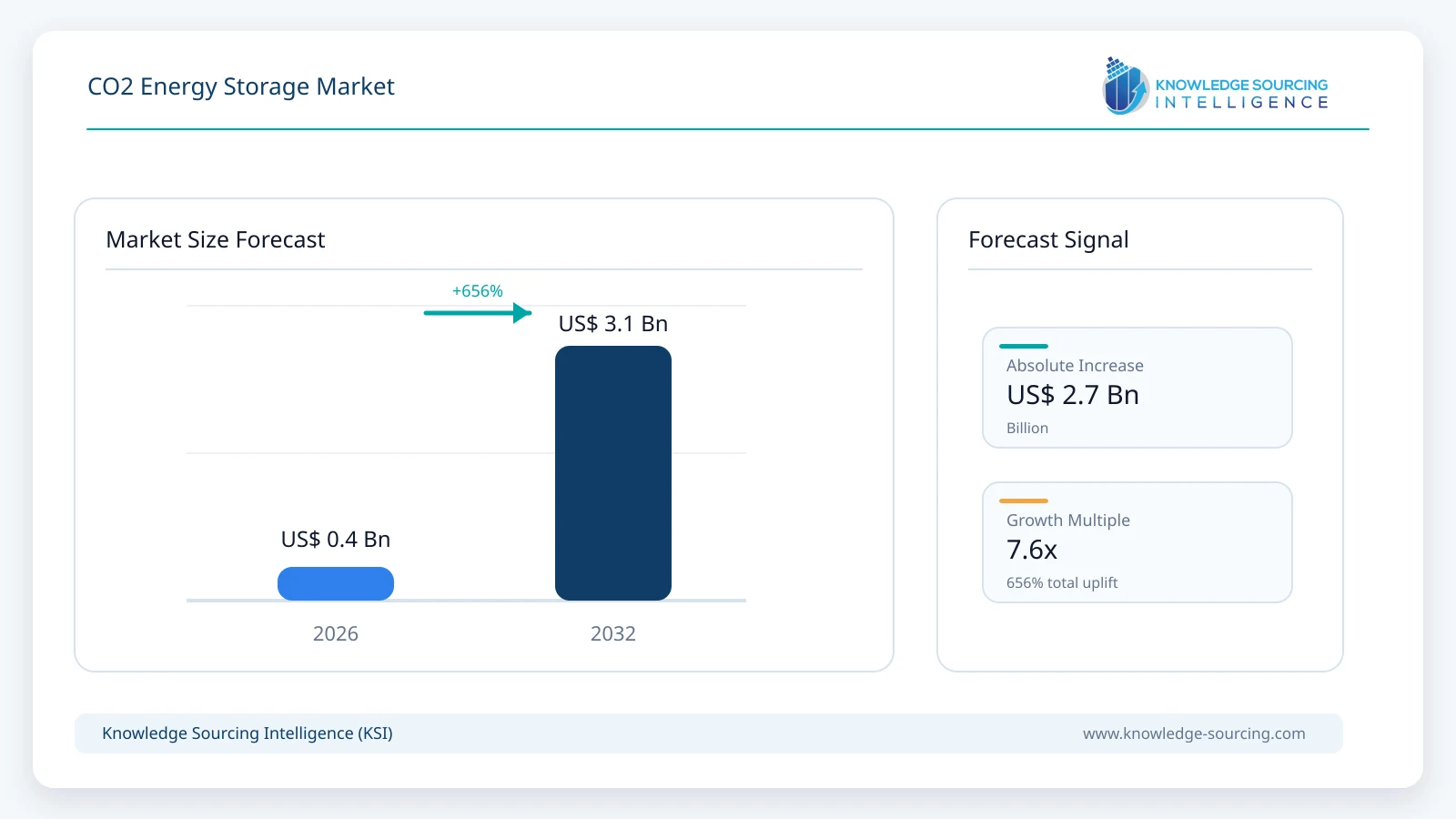
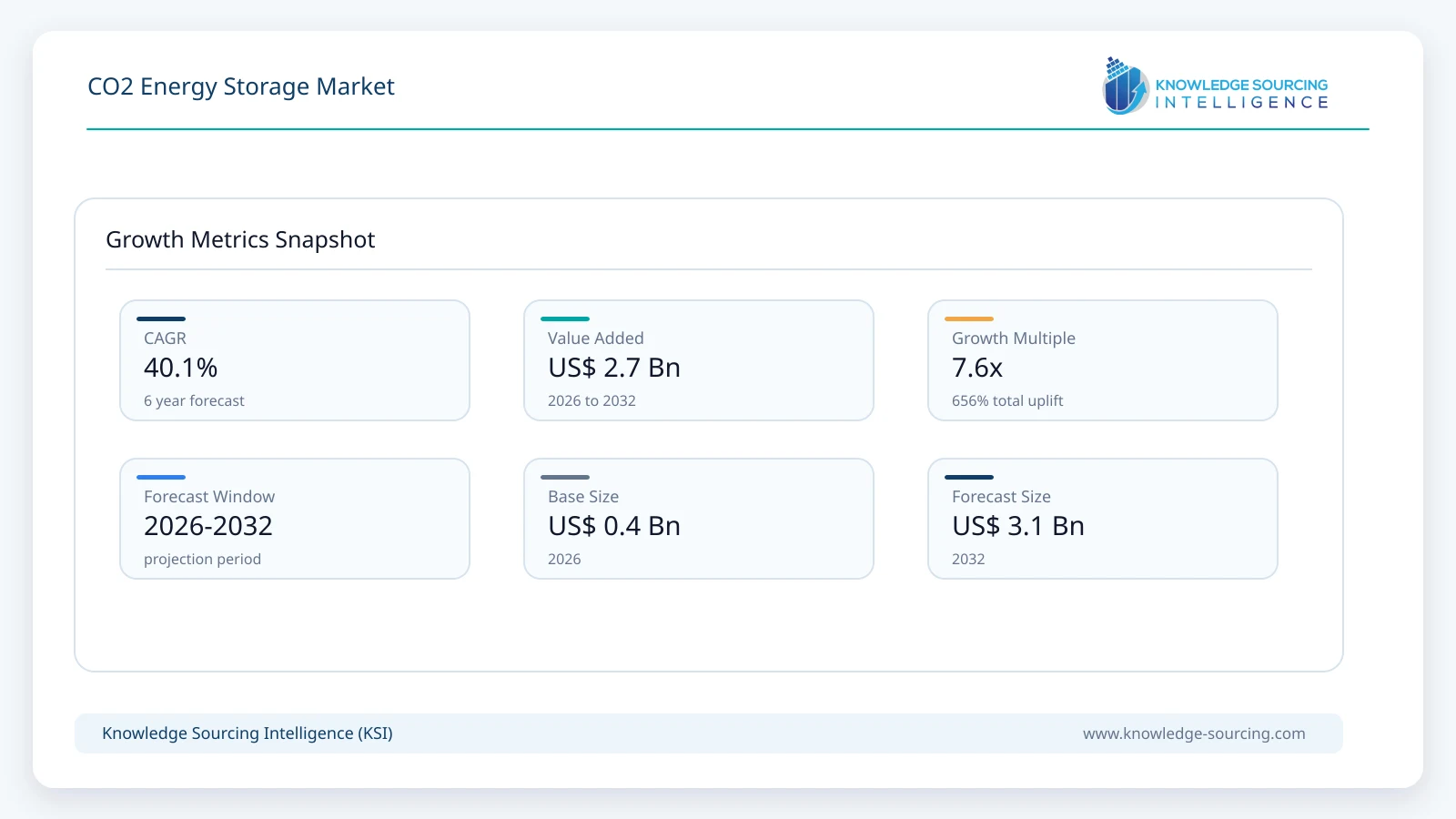
The CO2 Energy Storage Market is estimated at USD 0.41 billion in 2026 and is projected to reach USD 3.10 billion by 2032, representing a CAGR of 40.1% during 2026-2032.
Highlights:
- 1Gas-liquid phase-change and closed-loop compressed-CO2 systems account for an estimated 82% of 2026 market revenue because the largest operating and contracted projects use this architecture.
- 2Energy Dome and Exa Energy Technology are the two most defensible current commercial system developers; most other participants remain pilot, pre-commercial or research-stage.
- 3Ten-hour configurations are emerging as the most visible commercial format, particularly for renewable firming, capacity contracts and grid congestion relief.
- 4China is the strongest near-term deployment market by project scale, while Europe is important for standardized commercial CO2 Battery deployment and storage-as-a-service contracting.
- 5Data centres, industrial sites and renewable-energy hubs are widening the application base beyond utility peak shifting as developers position CO2 storage as firm, dispatchable capacity.
Market Overview
CO2 energy storage is a family of thermo-mechanical and pumped-thermal storage technologies rather than one uniform system design. In a typical gas-liquid phase-change system, electricity drives compressors during charging, compression heat is captured, and CO2 is stored at higher pressure in liquid or dense form while a lower-pressure reservoir holds the working fluid on the opposite side of the cycle. During discharge, stored heat is returned to the working fluid and the pressurized CO2 expands through a turbine to regenerate electricity. Supercritical CO2 pumped-thermal systems follow a different architecture: electricity is converted into stored thermal energy and a supercritical CO2 cycle later converts that heat back into power.
Commercial interest is being driven by duration, site flexibility and component familiarity. Unlike pumped hydro or cavern-based compressed-air storage, above-ground CO2 systems can be deployed without highly specific geology. Unlike electrochemical batteries, the core working fluid does not wear out with each cycle. The trade-off is that these plants are more complex than containerized battery systems and require project-specific integration of turbomachinery, pressure vessels, thermal storage, balance-of-plant systems and grid interconnection. Bankability therefore depends heavily on demonstrated efficiency, availability, construction schedule and long-term service capability.
Market Drivers
Long-duration capacity becomes more valuable as renewable penetration rises
Power systems with growing wind and solar penetration increasingly need storage that can shift energy for eight, ten or more hours rather than only provide short bursts of balancing power. CO2 systems are being positioned for evening peak coverage, renewable firming, congestion relief and multi-hour capacity contracts. Energy Dome’s recent commercial activity illustrates this direction: its June 2026 Irish project with Google is designed at 23 MW/200 MWh, while its Arizona project with Salt River Project is a 19 MW, ten-hour system. These projects move the technology from generic demonstration toward contracted capacity with clearly defined dispatch requirements.
Standardized project designs improve replicability
CO2 storage developers are increasingly moving toward repeatable plant blocks rather than one-off demonstrations. Energy Dome has standardized around a 20 MW/200 MWh commercial-scale frame for several projects and offers both turnkey plant supply and storage-as-a-service structures. Standardization can reduce engineering cost, simplify procurement and create a clearer path to financing. Exa Energy is following a parallel scale-up pathway in China, moving from a 10 MW/80 MWh commercial system at Wuhu Conch to the 100 MW/1,000 MWh Huadian Mulei project and a 25 MW/250 MWh project announced as under construction in Lancaster, California in January 2026.
Industrial heat and carbon-management integration create additional use cases
Compressed CO2 systems can recover or reuse heat from industrial processes, improving system economics where suitable thermal streams exist. Exa Energy’s Wuhu project is linked to cement-plant operations and uses industrial waste heat, demonstrating how energy storage can be integrated with high-emission industrial facilities rather than deployed only as a stand-alone grid asset. This is important for cement, metals, chemicals and other sectors where storage, heat recovery and carbon-management infrastructure can share site resources.
Hyperscale and data-centre demand creates a new capacity market
Data-centre operators increasingly require firm capacity that can support high-load facilities while reducing dependence on additional fossil peaking generation. Energy Dome’s 2026 collaboration with Google and its memorandum with New Era Energy & Digital show how CO2 storage is being marketed as part of AI-era power infrastructure. These applications can support longer-duration capacity contracts and may accelerate project financing if storage performance is tied to a large creditworthy offtaker.
Restraints and Adoption Challenges
The market is still early enough that bankable operating evidence remains limited. Only a small number of multi-megawatt projects have reached commercial operation, and published long-term data on availability, maintenance cost and round-trip efficiency under real dispatch conditions remain sparse. Large systems also require significant upfront engineering and procurement, making financing more difficult than for standardized lithium-ion projects with a deep installed base. Project schedules depend on turbomachinery, heat exchangers, pressure systems and civil works, while CO2 containment and thermal management require disciplined plant-level engineering. As a result, several companies with credible technology programmes remain at pilot or development stage rather than full commercial supply.
Segment Analysis
By Technology Architecture
Gas-liquid phase-change and closed-loop compressed-CO2 systems form the largest commercial category in 2026. The estimated 82% share in Key Highlights is equivalent to approximately USD 336 million of market revenue. These systems currently benefit from the strongest evidence of project deployment through Energy Dome and Exa Energy Technology. Supercritical-CO2 pumped-thermal storage is a smaller development-stage category led by firms such as Echogen Power Systems and EarthEn Energy. Adsorption-assisted, all-liquid and geologically coupled CO2 storage remain research or demonstration pathways and are not yet comparable in commercial maturity.
Technology Architecture | How Energy Is Stored | Current Maturity | Commercial Direction |
Gas-liquid phase-change compressed CO2 | Compression heat plus pressurized/liquid CO2 in a closed loop | Commercial / early scale-up | Ten-hour grid storage, renewable firming and capacity contracts |
Liquid CO2 energy storage | CO2 maintained predominantly in liquid-phase storage with thermal recovery | Demonstration / research | High-density above-ground long-duration storage |
Supercritical CO2 pumped thermal | Electricity converted to heat, then reconverted through an sCO2 cycle | Pilot / pre-commercial | Long-duration grid storage using compact turbomachinery |
Adsorption-assisted compressed CO2 | Adsorbent media moderates low-pressure CO2 storage requirements | Research / pilot | Potential reduction in low-pressure reservoir footprint |
Geologically integrated CO2 storage | Subsurface or pipeline-linked dense CO2 used with power-cycle integration | Research / planned demonstrations | Large-scale storage where suitable infrastructure exists |
By Storage Duration
Eight-to-twelve-hour systems are the clearest near-term commercial segment because they can cover evening peaks, daily renewable shifting and capacity obligations without requiring multi-day storage economics. Ten-hour projects have become particularly visible across Energy Dome’s project pipeline and Exa Energy’s larger installations. Storage durations beyond twelve hours remain technically relevant but will depend more strongly on site economics, tank sizing, thermal-storage cost and capacity-market revenue.
By Application
Grid-scale renewable firming and capacity provision represent the major application because early commercial projects are being contracted by utilities, grid operators and large electricity users. Industrial applications are emerging where waste heat can support the thermodynamic cycle or where storage can be integrated with carbon capture and industrial energy management. Data-centre applications are newer but potentially important because large computing loads require firm power and can support long-term contractual structures.
Commercialisation and Project Indicators
Indicator | Current Evidence | Market Significance |
Commercial ten-hour projects | Energy Dome announced 23 MW/200 MWh in Ireland and 19 MW/200 MWh in Arizona in June 2026 | Shows movement from demonstration to contracted utility-scale capacity |
Large Chinese scale-up | Exa Energy lists Wuhu 10 MW/80 MWh in operation and Huadian Mulei 100 MW/1,000 MWh under construction | Confirms rapid scaling of gas-liquid phase-change CO2 storage |
International project expansion | Exa Energy announced construction start for a 25 MW/250 MWh Lancaster, California project in January 2026 | Extends Chinese CCES technology into an overseas project pipeline |
Storage-as-a-service | Energy Dome offers owned-and-operated capacity under long-term tolling structures | Reduces customer capital burden and can improve bankability |
sCO2 development pipeline | Echogen markets PTES using a closed-loop supercritical CO2 cycle; EarthEn lists its sCO2 battery as in active development | Creates a distinct second technology pathway beyond phase-change CCES |
Early-stage urban CCES | Activated Energy is developing compressed/liquefied CO2 storage and received California support for prototype development | Shows continuing innovation in smaller-footprint and longer-duration concepts |
Regional Opportunity
Asia Pacific
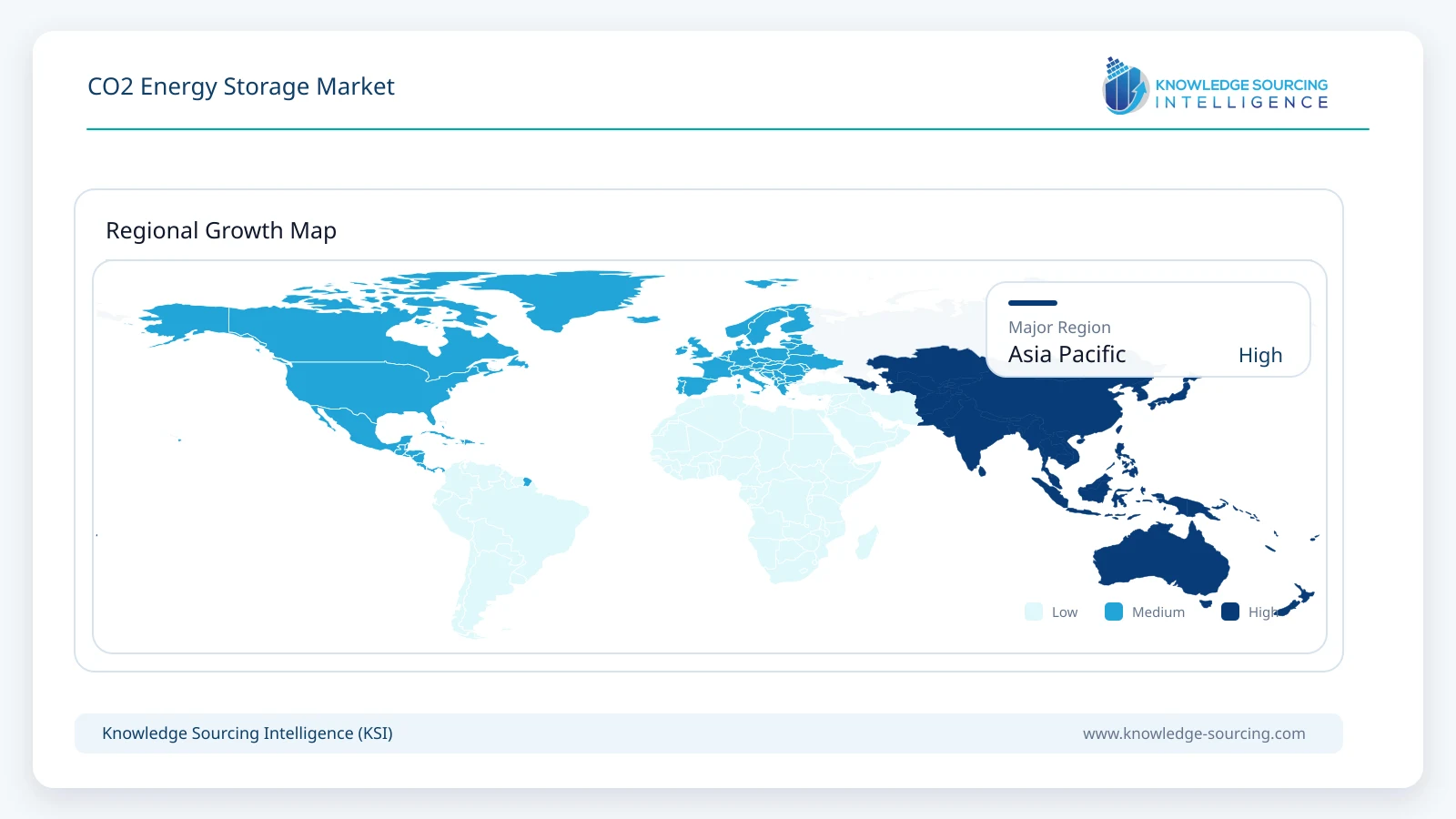
Asia Pacific is the strongest near-term deployment region because China has moved compressed CO2 storage beyond laboratory work into multi-megawatt commercial and construction-stage projects. Exa Energy Technology’s Wuhu Conch 10 MW/80 MWh plant provides operating evidence, while the Huadian Mulei 100 MW/1,000 MWh project represents a step-change in scale. China also has additional research programmes around all-liquid, adsorption-assisted and other compressed-CO2 configurations, supported by large engineering and power-sector groups. The region’s combination of renewable build-out, industrial waste-heat availability, large project-development organizations and domestic turbomachinery supply can accelerate project replication if the first large plants meet performance expectations.
Europe remains important through Energy Dome’s Italian operating base, standardized CO2 Battery design and projects linked to commercial offtakers. North America is moving from demonstration funding toward larger projects in Wisconsin, Arizona and California, but project execution will determine how quickly revenue scales. Australia is also emerging through Energy Dome’s Victoria activity and wider interest in long-duration storage for coal-transition regions.
Competitive Landscape
The competitive landscape is much narrower than the wider long-duration energy storage market. Only a few companies currently have direct, defensible participation in CO2-based electricity storage. Energy Dome and Exa Energy Technology are the principal commercial-scale system developers. Echogen Power Systems and EarthEn Energy are developing supercritical-CO2 pumped-thermal architectures, but their electricity-storage offerings are not yet equivalent in commercial maturity to the leading deployed systems. Activated Energy remains at prototype stage. China Energy Engineering Corporation is retained as a research-stage developer because its 2025 annual report cites technical breakthroughs in all-liquid carbon dioxide energy storage, but it is not presented as an established commercial CO2 storage vendor.
Key Market Participant | Specific CO2 Energy Storage Role | Commercial Status | Current Evidence / Identity Check |
Energy Dome S.p.A. | Closed-loop CO2 Battery using gas-liquid phase change for long-duration grid storage | Commercial supplier / project developer | Multiple 2026 commercial projects; turnkey and storage-as-a-service models; active global project offices |
Exa Energy Technology (Shenzhen) Co., Ltd. | Compressed CO2 gas-liquid phase-change energy storage systems and integrated negative-carbon power plants | Commercial supplier / system integrator | Wuhu commercial project, Huadian Mulei scale-up, and Lancaster project; Exa Energy is treated as one current company identity, not separate participants |
Echogen Power Systems | Pumped thermal energy storage using a closed-loop supercritical CO2 power cycle | Pre-commercial / technology developer | Current 2026 website markets long-duration PTES based on sCO2; operational company with long-running sCO2 engineering activity |
EarthEn Energy | sCO2 battery combining packed-bed thermal storage with a supercritical CO2 pumped-heat cycle | Development-stage developer | Current product page states sCO2 Battery is in active development; not presented as an established commercial electricity-storage supplier |
Activated Energy, LLC | Compressed and liquefied CO2 long-duration storage for compact urban applications | Pilot / prototype-stage developer | Active company website plus California Energy Commission support for prototype development |
China Energy Engineering Corporation Limited | All-liquid carbon dioxide energy storage technology R&D | Research-stage developer | 2025 annual report identifies breakthroughs in all-liquid CO2 energy storage; not classified as a commercial system supplier |
Utilities, industrial hosts, project owners, EPC contractors, turbomachinery suppliers and pressure-vessel manufacturers are treated as ecosystem participants unless they directly develop or supply the complete CO2 energy storage system. Google, Salt River Project, ENGIE, Alliant Energy, State Electricity Commission Victoria, Huadian, Conch, CIMC Enric and other project partners therefore do not appear in the core competitor list solely because they finance, own, host, buy from or supply equipment into CO2 storage projects.
Recent Developments
July 2026: Energy Dome announced a partnership to deliver Victoria’s first ten-hour battery in Australia, extending its standardized CO2 Battery deployment into another utility-scale market.
June 2026: Energy Dome and Google announced a 23 MW/200 MWh CO2 Battery project in County Offaly, Ireland under a bilateral commercial agreement, with commercial operation expected in 2028.
June 2026: Energy Dome and Salt River Project announced a 19 MW/200 MWh ten-hour CO2 Battery in Arizona under a 20-year tolling agreement, with Energy Dome expected to own and operate the facility.
June 2026: Exa Energy continued international commercialization activity around compressed CO2 energy storage and promoted its phase-change storage platform for renewable generation, industrial sites and computing loads.
April 2026: China Energy Engineering Corporation’s 2025 annual reporting identified technical breakthroughs in all-liquid carbon dioxide energy storage, confirming continued R&D activity in this technology route.
January 2026: Exa Energy announced that its 25 MW/250 MWh Lancaster, California CO2 energy storage project had completed approvals and entered construction.
2026: EarthEn Energy continued active development of its sCO2 Battery, while Echogen Power Systems continued to market supercritical-CO2 pumped thermal storage as a long-duration grid solution.
CO2 Energy Storage Market Scope:
| Report Metric | Details |
|---|---|
| Total Market Size in 2026 | USD 0.41 billion |
| Total Market Size in 2032 | USD 3.10 billion |
| Forecast Unit | Billion |
| Growth Rate | 40.1% |
| Study Period | 2021 to 2032 |
| Historical Data | 2021 to 2024 |
| Base Year | 2025 |
| Forecast Period | 2026 – 2032 |
| Segmentation | Technology Architecture, Storage Duration, Application, Project Model, End User, Geography |
| Companies |
|
Market Segmentation
By Technology Architecture
Gas-Liquid Phase-Change Compressed CO2 Storage
Liquid CO2 Energy Storage
Supercritical CO2 Pumped Thermal Energy Storage
Adsorption-Assisted CO2 Storage
Geologically Integrated CO2 Storage
By Storage Duration
4-8 Hours
Above 8-12 Hours
Above 12 Hours
By Application
Renewable Energy Firming
Grid Capacity and Peak Shifting
Industrial Energy Storage and Waste-Heat Integration
Data Centres and Digital Infrastructure
Carbon-Management-Integrated Energy Storage
By Project Model
Turnkey Plant Supply
Developer-Owned / Storage-as-a-Service
Utility-Owned Projects
Industrial Behind-the-Meter Projects
By End User
Utilities and Independent Power Producers
Renewable Energy Developers
Industrial Facilities
Data Centre Operators
Public-Sector and Demonstration Projects
By Geography
Asia Pacific
China
Australia
India
Europe
Italy
Ireland
United Kingdom and Continental Europe
North America
United States
Canada
Rest of World
Table of Contents
1. EXECUTIVE SUMMARY
1.1. Market Opportunity and Key Findings
1.2. CO2 Energy Storage Commercialisation Outlook
1.3. Long-Duration Storage Role
2. MARKET OVERVIEW
2.1. CO2 Thermodynamic Storage Fundamentals
2.2. Closed-Loop Gas-Liquid Phase-Change Systems
2.3. Supercritical CO2 Pumped-Thermal Systems
2.4. Thermal Storage, Turbomachinery and Pressure Systems
3. MARKET SIZE AND FORECAST, 2026-2032
3.1. Global Market Revenue
3.2. Annual Growth Analysis
3.3. Commercial Project Pipeline and Revenue Timing
4. MARKET BY TECHNOLOGY ARCHITECTURE
4.1. Gas-Liquid Phase-Change Compressed CO2 Storage
4.2. Liquid CO2 Energy Storage
4.3. Supercritical CO2 Pumped Thermal Energy Storage
4.4. Adsorption-Assisted CO2 Storage
4.5. Geologically Integrated CO2 Storage
5. MARKET BY STORAGE DURATION
5.1. 4-8 Hours
5.2. Above 8-12 Hours
5.3. Above 12 Hours
6. MARKET BY APPLICATION
6.1. Renewable Energy Firming
6.2. Grid Capacity and Peak Shifting
6.3. Industrial Energy Storage and Waste-Heat Integration
6.4. Data Centres and Digital Infrastructure
6.5. Carbon-Management-Integrated Energy Storage
7. MARKET BY PROJECT MODEL
7.1. Turnkey Plant Supply
7.2. Developer-Owned / Storage-as-a-Service
7.3. Utility-Owned Projects
7.4. Industrial Behind-the-Meter Projects
8. MARKET BY END USER
8.1. Utilities and Independent Power Producers
8.2. Renewable Energy Developers
8.3. Industrial Facilities
8.4. Data Centre Operators
8.5. Public-Sector and Demonstration Projects
9. REGIONAL MARKET
9.1. Asia Pacific
9.1.1. China
9.1.2. Australia
9.1.3. India
9.2. Europe
9.2.1. Italy
9.2.2. Ireland
9.2.3. United Kingdom and Continental Europe
9.3. North America
9.3.1. United States
9.3.2. Canada
9.4. Rest of World
10. MARKET DYNAMICS
10.1. Drivers
10.1.1. Need for Eight-to-Twelve-Hour Grid Storage
10.1.2. Standardized Commercial Plant Designs
10.1.3. Industrial Heat and Carbon-Management Integration
10.1.4. Data Centre Demand for Firm Capacity
10.2. Restraints
10.2.1. Limited Long-Term Operating Data
10.2.2. Project Finance and Bankability
10.2.3. Plant Complexity and Balance-of-Plant Cost
10.2.4. Competition from Lithium-Ion, Flow Batteries and Other LDES Technologies
11. COMPETITIVE LANDSCAPE
11.1. Commercial CO2 Storage System Developers
11.2. Supercritical CO2 Pumped-Thermal Developers
11.3. Pilot and Research-Stage Technology Developers
11.4. Ecosystem Suppliers and Project Partners
12. COMPANY PROFILES
12.1. Energy Dome S.p.A.
12.2. Exa Energy Technology (Shenzhen) Co., Ltd.
12.3. Echogen Power Systems
12.4. EarthEn Energy
12.5. Activated Energy, LLC
12.6. China Energy Engineering Corporation Limited
13. RECENT DEVELOPMENTS
14. Appendix
Navigate
Trusted by the world's leading organizations











