
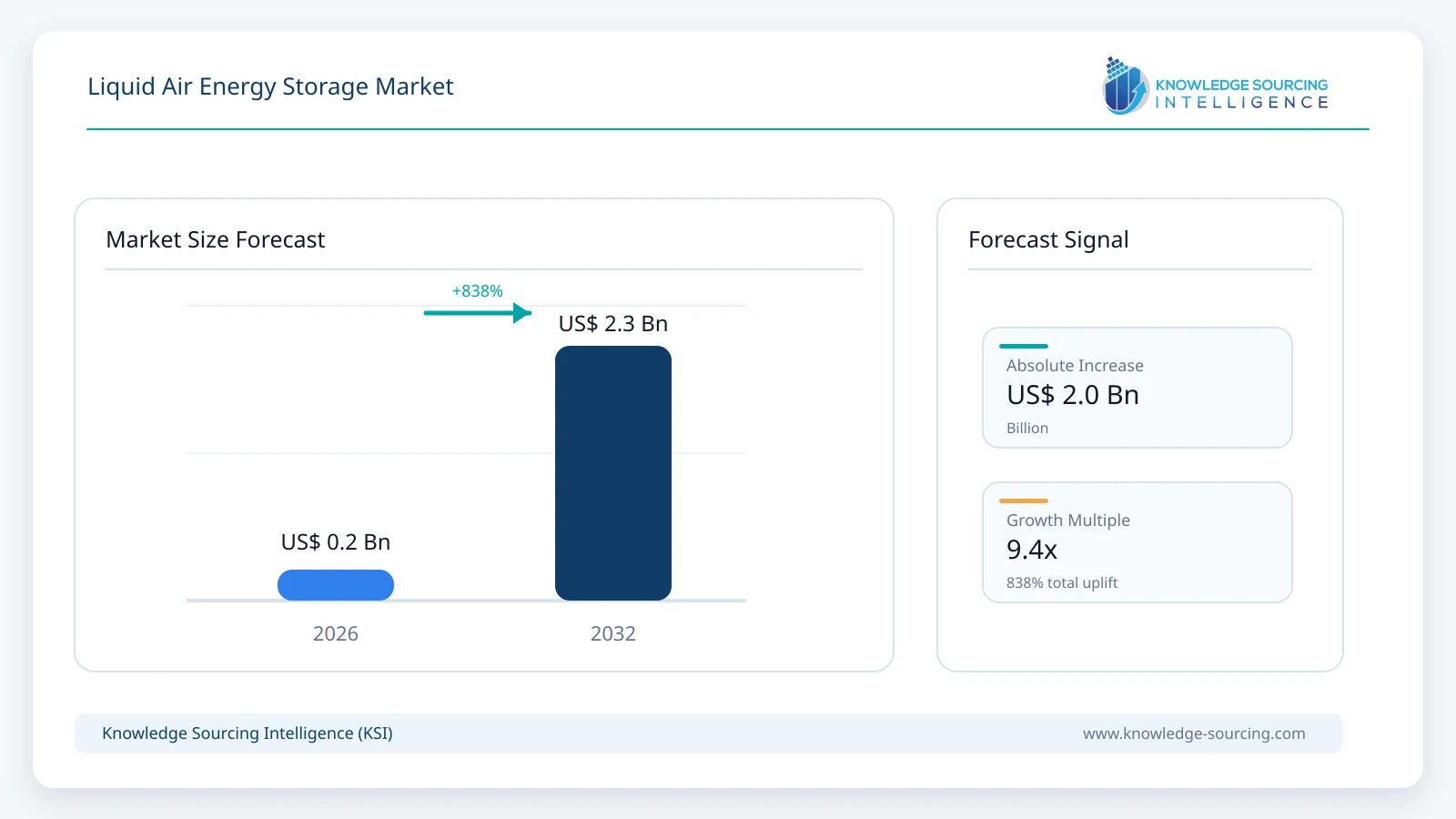
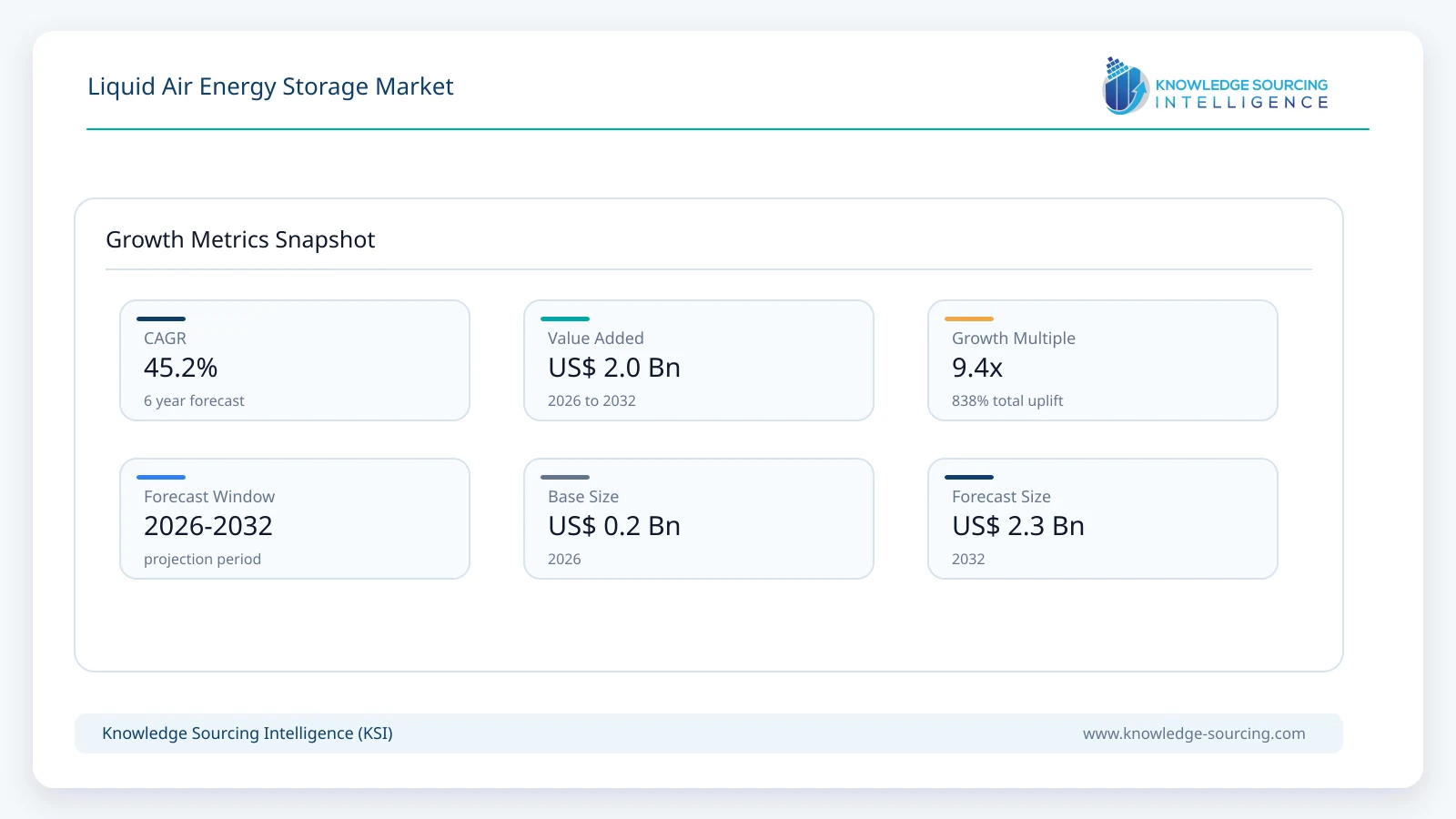
The Liquid Air Energy Storage Market is estimated at USD 0.24 billion in 2026 and is projected to reach USD 2.25 billion by 2032, representing a CAGR of 45.2% over 2026-2032.
Highlights:
- 1LAES separates power equipment from storage capacity, allowing longer duration mainly through larger cryogenic tanks.
- 2Commercial deployment is moving from 20 MWh-class demonstrations toward 300 MWh and multi-gigawatt-hour projects.
- 3The technology uses industrial gas and turbomachinery components rather than critical battery minerals.
- 4Waste heat and LNG cold energy can materially improve system efficiency where suitable industrial integration exists.
- 5Europe leads the current commercial pipeline, while Japan, Canada and South Korea are creating additional deployment centers.
A LAES plant operates in three main stages. During charging, electricity powers compressors and refrigeration equipment that draw in ambient air, remove water and carbon dioxide and cool the remaining gases until the air becomes liquid. The liquid air is stored at low pressure in insulated cryogenic tanks. During discharge, cryogenic pumps raise the liquid pressure, heat exchangers vaporize and warm it, and the high-pressure gas expands through turbines connected to generators. Thermal and cold stores capture heat from compression and cold from expansion so that both can be reused in later cycles.
This architecture makes LAES different from electrochemical batteries. Power capacity is mainly determined by the compressor, pump, turbine and generator trains, while energy capacity is strongly influenced by tank volume and stored liquid-air inventory. Increasing duration therefore does not require duplicating the full power block. The system can also provide synchronous inertia, voltage support and short-circuit strength when paired with synchronous machinery or dedicated stability equipment, creating value beyond energy arbitrage.
The technology benefits from mature industrial supply chains in air separation, liquefied natural gas, cryogenic storage, heat exchangers and power generation. However, LAES must integrate these components into an optimized thermodynamic cycle with acceptable round-trip efficiency. Project economics improve when waste heat from industry or cold from LNG regasification is available. Sumitomo Heavy Industries' Hatsukaichi plant is specifically designed to evaluate efficiency gains from LNG cold energy, while Highview's UK projects emphasize grid stability and renewable-curtailment reduction.
Market Drivers
Longer renewable-balancing periods increase the value of bulk storage
Wind-dominant power systems can experience renewable surpluses and deficits lasting far longer than the evening peak. LAES can be configured for six hours, ten hours, twelve hours or substantially longer without requiring a geographically suitable reservoir or underground cavern. The United Kingdom's Clean Flexibility Roadmap identifies a requirement for 4 GW to 6 GW of long-duration electricity storage by 2030 and cites Highview's Carrington project as a commercial LAES case study. This policy environment supports development of larger follow-on projects.
Modular siting expands the project opportunity beyond pumped hydro and cavern storage
LAES can be located on industrial or brownfield land and does not require the elevation difference of pumped hydro or the salt caverns used by many compressed-air projects. This allows development near transmission substations, renewable-generation corridors and large demand centers. Highview's Carrington project uses existing transmission infrastructure, while Hunterston is being developed at a former industrial site with strong grid connectivity. NRStor's proposed Ontario project similarly targets grid-capacity services without dependence on underground storage geology.
Industrial heat and cold integration can improve operating economics
The thermodynamic cycle becomes more attractive when a project can use otherwise wasted heat or cold. LNG regasification facilities reject substantial cold energy, which can reduce the electricity required for air liquefaction. Sumitomo Heavy Industries located its 5 MW / 20 MWh commercial demonstration plant at the Hatsukaichi LNG terminal for this reason. Industrial waste heat can also be used during discharge to increase expansion work, creating opportunities for co-location with process industries and thermal-power sites being repurposed.
Grid-stability services increase revenue diversity
Long-duration storage assets are increasingly expected to support both energy shifting and power-system stability. Highview's UK projects incorporate a stability island intended to provide inertia, short-circuit strength, voltage support and frequency response independently of the storage cycle. This gives LAES projects access to grid-service revenue streams that ordinary energy arbitrage alone may not provide. It also strengthens the case for locating plants at constrained or weak parts of transmission networks.
Restraints and Adoption Challenges
LAES remains capital intensive and project development is more complex than deploying modular lithium-ion containers. The plant combines large compressors, cryogenic equipment, tanks, heat exchangers, pumps, turbines, generators and civil works, so design, permitting and construction periods are longer. Round-trip efficiency is also generally lower than lithium-ion unless thermal and cold recovery are well optimized or external heat and cold sources are available. The supplier base remains concentrated, and only a small number of plants have operated at commercial or near-commercial scale. Project bankability therefore depends heavily on long-term revenue support, grid-service contracts and confidence in scale-up.
Liquid Air Energy Storage Market Segment Analysis
By System Architecture
Standalone LAES plants use electricity from the grid or co-located renewable generation to liquefy air, store it and later generate power through expansion. Integrated plants add external thermal or cold-energy sources, which can reduce charging energy or increase discharge output. LNG-integrated LAES is particularly attractive because the regasification process provides a high-quality cold source that would otherwise be rejected. Hybrid systems can combine LAES with lithium-ion batteries or dedicated synchronous equipment so short-duration response, long-duration energy and grid-stability functions are optimized separately.
The largest near-term value growth is expected in multi-gigawatt-hour grid projects. Highview's planned UK Millennium Series moves from Carrington's 300 MWh scale to facilities in the 2.5 GWh to 3.2 GWh range. At these sizes, project value increasingly shifts toward large turbomachinery, cryogenic storage, civil works, grid connection and EPC capability rather than only proprietary process design.
System Layer | Primary Function | Commercial Importance | Direction |
Air compression and purification | Compresses and conditions ambient air before liquefaction | Major charging-side capital block | Scaling to larger compressor trains |
Air liquefaction | Cools air to cryogenic liquid | Core process technology | Efficiency improvement through cold recovery |
Cryogenic storage tanks | Stores liquid air at low pressure | Primary energy-capacity component | Tank volume grows with storage duration |
Cryogenic pumps and heat exchangers | Pressurize and vaporize liquid air | Critical discharge and efficiency equipment | Higher integration with waste heat and LNG cold |
Expansion turbine and generator | Converts pressurized gas into electricity | Primary discharge power block | Increasing unit size for grid projects |
Stability / hybrid equipment | Provides inertia, voltage support and fast response | Additional revenue layer | Growing in UK grid applications |
Commercial Deployment Indicators
Project / Indicator | Recent Developments | Market Significance |
Carrington, United Kingdom | 50 MW / 300 MWh LAES project under construction; commercial-scale plant targeted around 2026-2027. | First major UK commercial reference and foundation for larger roll-out. |
Highview UK pipeline | Four follow-on facilities were announced at approximately 2.5 GWh each, with Hunterston as the first larger project. | Creates a potential 10 GWh deployment programme beyond Carrington. |
Hunterston, Scotland | Highview is developing a multi-phase project with stability infrastructure followed by multi-GWh LAES capacity. | Demonstrates convergence of storage and transmission-stability services. |
Hatsukaichi, Japan | Sumitomo Heavy Industries began commercial operation of a 5 MW / 20 MWh LAES demonstration plant in December 2025. | Provides operating evidence outside the UK and validates LNG-cold integration. |
St. Clair, Canada | NRStor is proposing up to 200 MW / 2,000 MWh of LAES in Ontario and held a public open house in July 2026. | Shows North American movement toward utility-scale project development. |
South Korea | Alfa Laval announced a 2026 partnership to supply cryogenic equipment for the country's first large-scale LAES facility. | Expands the supplier and deployment ecosystem in Asia Pacific. |
Regional Opportunity
Europe
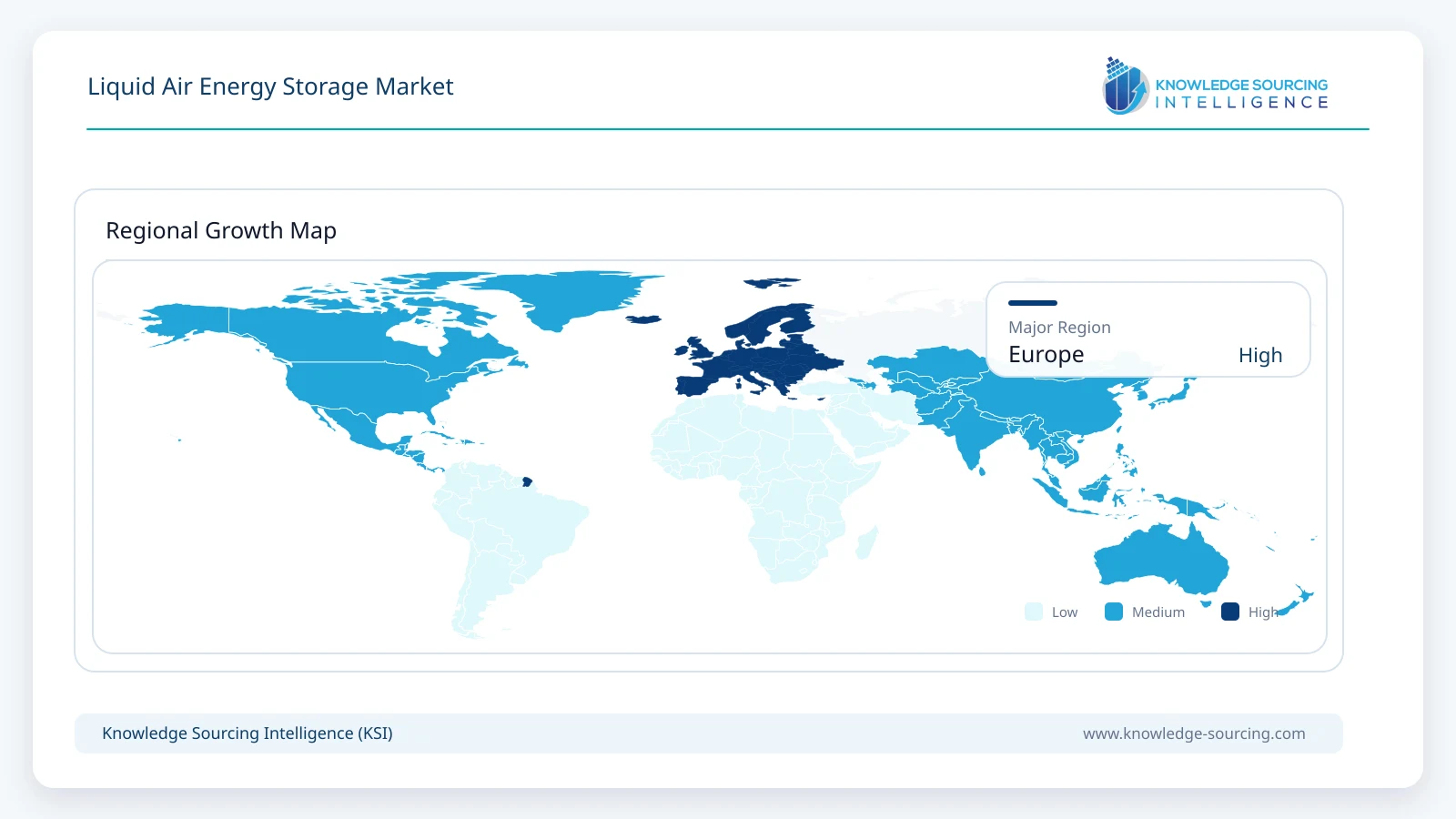
Europe is the leading commercial market for liquid air energy storage because the United Kingdom has created the most advanced combination of demonstration experience, project finance, long-duration-storage policy and announced multi-gigawatt-hour pipeline. Highview Power operated an earlier 5 MW demonstrator near Bury and is now constructing the 50 MW / 300 MWh Carrington facility. The project has attracted backing from the National Wealth Fund, Centrica and other institutional investors, giving LAES a commercial financing precedent rather than only public research support.
The next phase is significantly larger. Highview has announced a programme of four follow-on plants at approximately 2.5 GWh each, including Hunterston in Scotland. Hunterston is being developed in phases, with grid-stability infrastructure preceding the liquid-air storage build-out. The project model is important because it allows revenue from inertia, voltage support and short-circuit strength to complement the energy-storage value of the LAES plant.
United Kingdom policy is also supportive. The government's long-duration electricity storage cap-and-floor mechanism is intended to reduce revenue uncertainty for projects with high upfront capital cost and long asset life. Highview's Hunterston and Killingholme projects were selected for further consideration under this framework. The broader Clean Power 2030 programme estimates several gigawatts of additional long-duration storage will be needed, creating a sizeable addressable market if LAES projects achieve targeted cost and efficiency.
Asia Pacific is the second most important development region. Japan's Hatsukaichi facility is already operating commercially as a demonstration project and tests the use of LNG cold energy. South Korea is developing its first large-scale facility with cryogenic equipment from Alfa Laval. North America is emerging through NRStor's proposed 200 MW / 2,000 MWh Ontario project, while other regions remain at an earlier stage of project development.
Competitive Landscape
Highview Power remains the principal proprietary LAES technology developer and the company with the largest announced commercial pipeline. Its platform integrates liquefaction, thermal storage, cryogenic storage, power recovery and grid-stability functions. The company has also licensed the technology internationally, enabling deployment by partners such as Sumitomo Heavy Industries.
Sumitomo SHI FW provides turnkey engineering, procurement and construction solutions using licensed Highview technology and remains an active LAES solution provider. Sumitomo Heavy Industries operates the Hatsukaichi demonstration plant within the same corporate group and is therefore not counted as a separate competitor. NRStor is a project developer, while Alfa Laval, Siemens Energy and other cryogenic, turbomachinery and EPC companies are treated as equipment or project-ecosystem suppliers rather than standalone LAES technology vendors.
Key Market Participants: Highview Power; Sumitomo SHI FW. The market remains highly concentrated, with Highview providing the proprietary LAES platform and Sumitomo SHI FW offering licensed turnkey LAES solutions.
Recent Developments
July 2026: NRStor held a public open house for its proposed St. Clair Township LAES project in Ontario, planned at up to 200 MW / 2,000 MWh.
May 2026: Highview appointed Peter Jones as Chief Executive as the company advances construction and scale-up of its UK long-duration-storage programme.
2026: Alfa Laval announced a partnership with South Korea's Institute for Advanced Engineering to supply cryogenic heat exchangers and a high-pressure pump for the country's first large-scale LAES facility.
2026: Highview continued development and consultation for the Hunterston project, including phase-two liquid-air storage plans following the grid-stability phase.
December 2025: Sumitomo Heavy Industries began commercial operation of the 5 MW / 20 MWh Hatsukaichi LAES demonstration plant in Hiroshima Prefecture.
November 2025: Highview formally broke ground on the 50 MW / 300 MWh Carrington commercial-scale LAES facility in Greater Manchester.
Liquid Air Energy Storage Market Scope:
| Report Metric | Details |
|---|---|
| Total Market Size in 2026 | USD 0.24 billion |
| Total Market Size in 2032 | USD 2.25 billion |
| Forecast Unit | USD Billion |
| Growth Rate | 45.2% |
| Study Period | 2021 to 2032 |
| Historical Data | 2021 to 2024 |
| Base Year | 2025 |
| Forecast Period | 2026 – 2032 |
| Segmentation | System Component, Storage Duration, Plant Configuration, Application, Project Scale, Geography |
| Companies |
|
Market Segmentation
By System Component
Air Compression and Purification
Liquefaction Equipment
Cryogenic Storage Tanks
Cryogenic Pumps
Heat Exchangers and Thermal Stores
Expansion Turbines and Generators
Electrical and Grid-Stability Systems
By Storage Duration
Below 8 Hours
8-12 Hours
12-24 Hours
Above 24 Hours
By Plant Configuration
Standalone LAES
LNG-Cold Integrated LAES
Industrial Waste-Heat Integrated LAES
Hybrid LAES plus Lithium-Ion
LAES plus Grid-Stability Island
By Application
Renewable Energy Shifting
Grid Capacity and Reliability
Renewable Curtailment Reduction
Grid Stability Services
Industrial and Utility Microgrids
By Project Scale
Below 100 MWh
100-500 MWh
500 MWh-2 GWh
Above 2 GWh
By Geography
Europe
United Kingdom
Rest of Europe
Asia Pacific
Japan
South Korea
Rest of Asia Pacific
North America
Canada
United States
Rest of World
Table of Contents
1. EXECUTIVE SUMMARY
1.1. Market Opportunity and Key Findings
1.2. Long-Duration Storage Outlook
1.3. Commercial Scale-Up and Project Pipeline
2. MARKET OVERVIEW
2.1. Liquid Air Energy Storage Operating Principle
2.2. Air Compression, Purification and Liquefaction
2.3. Cryogenic Storage
2.4. Power Recovery and Expansion
2.5. Thermal and Cold Recovery
2.6. Grid Stability and Hybrid Integration
3. MARKET SIZE AND FORECAST, 2026-2032
3.1. Global Market Revenue
3.2. Annual Growth Analysis
3.3. Equipment, EPC and Lifecycle Revenue
4. MARKET BY SYSTEM COMPONENT
4.1. Air Compression and Purification
4.2. Liquefaction Equipment
4.3. Cryogenic Storage Tanks
4.4. Cryogenic Pumps
4.5. Heat Exchangers and Thermal Stores
4.6. Expansion Turbines and Generators
4.7. Electrical and Grid-Stability Systems
5. MARKET BY STORAGE DURATION
5.1. Below 8 Hours
5.2. 8-12 Hours
5.3. 12-24 Hours
5.4. Above 24 Hours
6. MARKET BY PLANT CONFIGURATION
6.1. Standalone LAES
6.2. LNG-Cold Integrated LAES
6.3. Industrial Waste-Heat Integrated LAES
6.4. Hybrid LAES plus Lithium-Ion
6.5. LAES plus Grid-Stability Island
7. MARKET BY APPLICATION
7.1. Renewable Energy Shifting
7.2. Grid Capacity and Reliability
7.3. Renewable Curtailment Reduction
7.4. Grid Stability Services
7.5. Industrial and Utility Microgrids
8. MARKET BY PROJECT SCALE
8.1. Below 100 MWh
8.2. 100-500 MWh
8.3. 500 MWh-2 GWh
8.4. Above 2 GWh
9. REGIONAL MARKET
9.1. Europe
9.1.1. United Kingdom
9.1.2. Rest of Europe
9.2. Asia Pacific
9.2.1. Japan
9.2.2. South Korea
9.2.3. Rest of Asia Pacific
9.3. North America
9.3.1. Canada
9.3.2. United States
9.4. Rest of World
10. MARKET DYNAMICS
10.1. Drivers
10.1.1. Multi-Hour and Multi-Day Renewable Balancing
10.1.2. Flexible Siting versus Geology-Dependent Storage
10.1.3. Waste Heat and LNG Cold Integration
10.1.4. Grid-Stability Revenue
10.2. Restraints
10.2.1. High Upfront Capital Cost
10.2.2. Round-Trip Efficiency
10.2.3. Long Development and Construction Period
10.2.4. Limited Commercial Operating History
11. COMPETITIVE LANDSCAPE
11.1. Proprietary LAES Technology Developers
11.2. Turnkey EPC and License Partners
11.3. Cryogenic Equipment Suppliers
11.4. Turbomachinery and Electrical Suppliers
11.5. Project Developers, Investors and Utilities
12. COMPANY PROFILES
13. RECENT DEVELOPMENTS
14. APPENDIX
Navigate
Trusted by the world's leading organizations











