
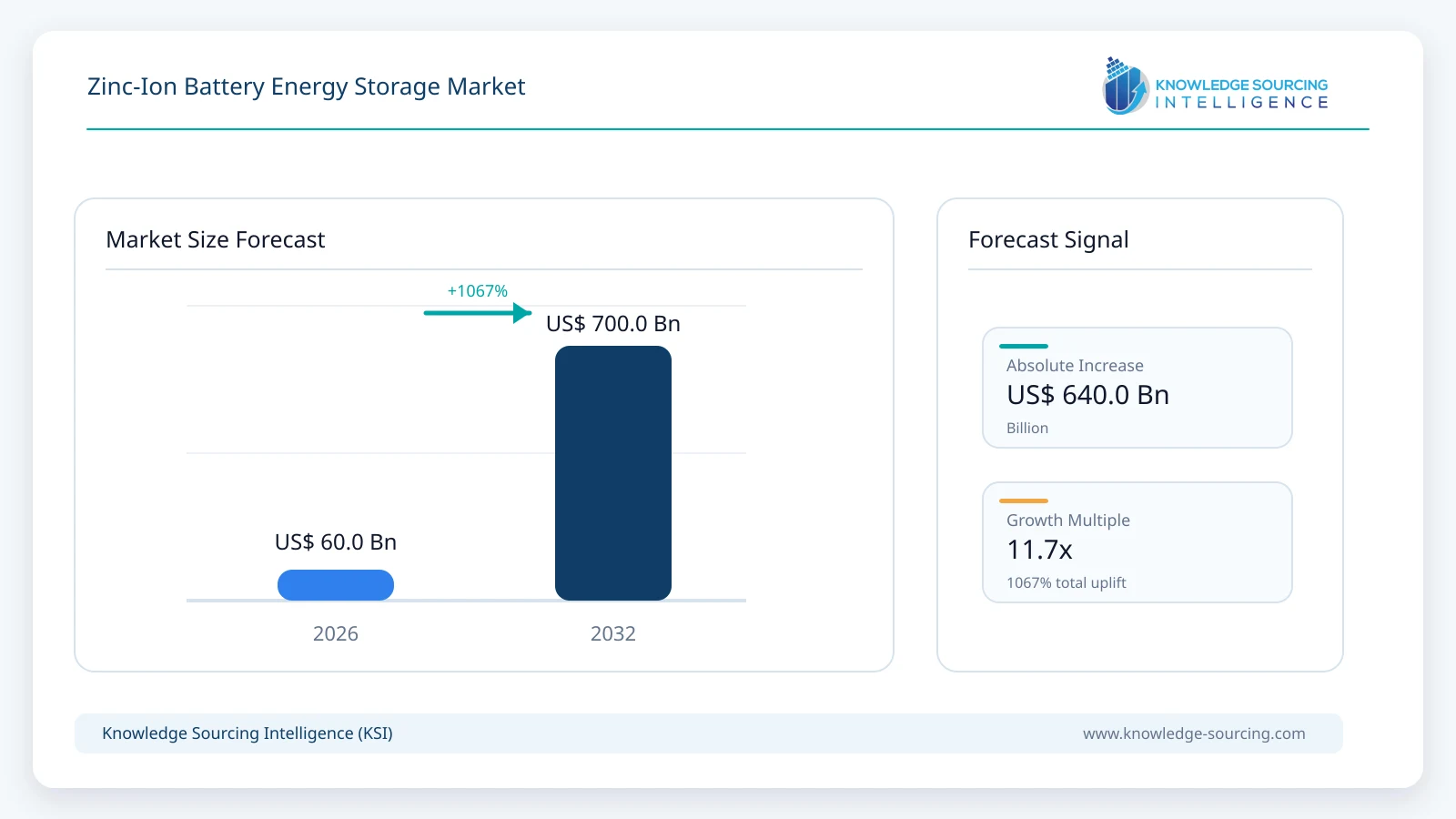
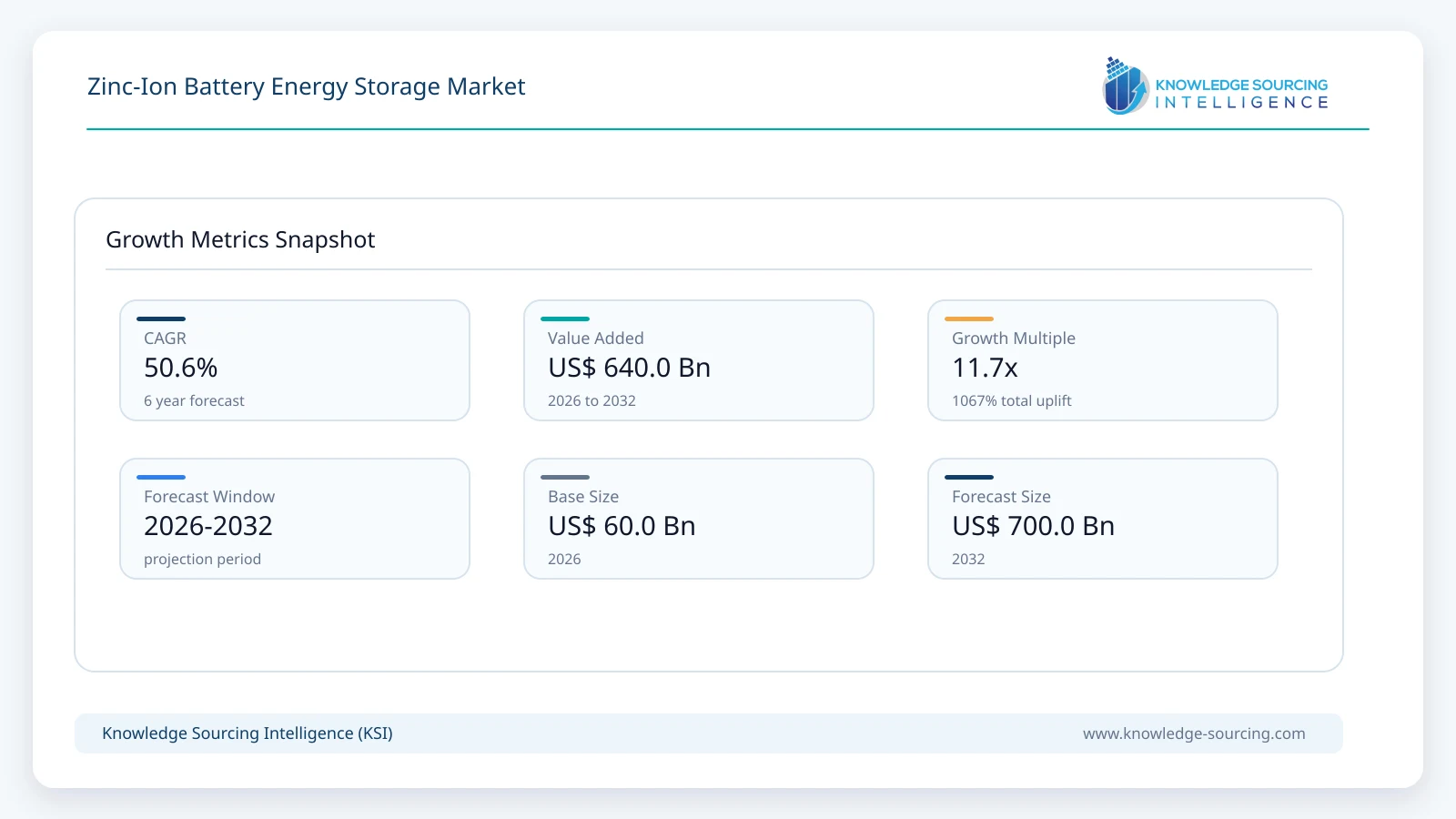
The Zinc-Ion Battery Energy Storage Market is estimated at USD 60.0 million in 2026 and is projected to reach USD 700.0 million by 2032, representing a CAGR of 50.6% during 2026-2032.
Highlights:
- 1Aqueous electrolytes provide an inherently non-flammable architecture suited to stationary indoor and grid-adjacent storage.
- 2Commercial deployment remains limited and concentrated, with China showing the clearest evidence of MW-scale system activity.
- 3Stationary applications benefit from abundant zinc supply and reduced dependence on lithium, nickel and cobalt.
- 4Cycle life, zinc dendrites, hydrogen evolution and cathode stability remain the main technical commercialization barriers.
- 5Asia Pacific leads current commercialization evidence, while North America and Europe remain important validation and development centers.
Market Overview
A rechargeable zinc-ion cell uses metallic zinc as the negative electrode and a host material at the positive electrode that can reversibly accept and release zinc ions. During discharge, zinc atoms oxidize at the anode and enter the water-based electrolyte as Zn2+ ions. These ions migrate toward the cathode and are stored within its crystal structure or participate in coupled intercalation reactions. Charging reverses the process and plates zinc back onto the anode. The cell voltage is lower than that of lithium-ion, but the chemistry is designed around low-cost stationary storage rather than minimum weight.
The main commercial attraction is the water-based electrolyte. It cannot support the same flammable-solvent thermal runaway mechanism that drives fire-suppression, separation and permitting requirements for large lithium-ion systems. Zinc is also widely produced and already supported by mature refining, metal-forming and recycling industries. Manufacturing can potentially use simpler humidity-control requirements than lithium-ion production because the aqueous cell does not require the same dry-room environment. These factors could reduce both cell cost and balance-of-system safety cost if the technology reaches scale.
The technology challenge is durability. Zinc can plate unevenly, form dendritic structures and experience corrosion or hydrogen evolution in aqueous electrolytes. Cathode materials can dissolve or undergo structural changes during repeated cycling, and water activity can narrow the practical electrochemical stability window. Commercial developers therefore focus on electrolyte additives, protective interfaces, cathode design and battery-management methods that stabilize zinc deposition and maintain capacity in practical pouch or prismatic cells.
Market Drivers
Stationary storage places greater value on safety than energy density
Grid, commercial and residential batteries do not need to minimize weight in the same way as electric-vehicle packs. This allows zinc-ion developers to trade lower gravimetric energy density for non-flammable electrolyte, commodity raw materials and simpler safety engineering. The California Energy Commission's completed Salient project specifically targeted stationary storage and demonstrated a 10 kWh residential system, while current Canadian development is aimed at backup and grid-support applications where safety constraints can restrict conventional batteries.
Abundant zinc creates a diversified material supply chain
Zinc is produced at large scale across multiple countries and already supports established galvanizing, alloy and battery markets. This gives zinc-ion systems a different supply-chain profile from lithium-ion batteries that depend on lithium, graphite and, in some chemistries, nickel or cobalt. Hindustan Zinc's 2026 collaboration with JNCASR shows how an integrated zinc producer can participate directly in battery-technology development, creating a potential link between upstream metal supply and stationary battery manufacturing.
Renewable integration creates demand for lower-cost stationary chemistries
Solar and wind expansion is increasing storage requirements at utility, commercial and residential scales. Zinc-ion is being positioned for daily energy shifting, backup and distributed storage where several hours of capacity are required and where fire risk can affect siting. The chemistry's materials and manufacturing route could become competitive if commercial-scale production validates expected cost reductions. European and Indian research programmes increasingly frame zinc-ion specifically around stationary renewable-energy storage rather than mobile applications.
Research is addressing the principal anode and electrolyte failure mechanisms
Commercial progress depends on stabilizing zinc plating and suppressing parasitic reactions. In June 2026, researchers supported by India's Department of Science and Technology reported an electrolyte additive that reduces hydrogen evolution, corrosion and dendrite formation at the zinc surface. Earlier in February, another Indian team reported a sulfur-vacancy-engineered cathode retaining 97.91% of its initial capacity after 500 cycles in laboratory testing. These advances do not yet establish commercial cell life, but they widen the design options available to developers.
Restraints and Adoption Challenges
The most important restraint is the gap between laboratory performance and reliable commercial cells. Recent 2026 reviews continue to describe practical deployment as constrained by zinc dendrites, hydrogen evolution, corrosion, cathode dissolution and the difficulty of reproducing laboratory performance under high-loading, lean-electrolyte and practical pouch-cell conditions. The market also has limited long-duration field data and few suppliers with independently visible commercial shipments. Enerpoly's technically successful European manufacturing project ended early after the company could not secure additional external funding, showing that industrial scale-up risk is financial as well as electrochemical.
Segment Analysis
By System Application
Small stationary systems remain an important validation pathway because they allow developers to test modules, battery management, safety and cycling without immediately requiring utility-scale manufacturing. Salient's California programme developed and tested a 10 kWh residential energy-storage system, while Canadian work is integrating zinc-ion modules into a prototype enclosure for backup and grid-support applications. China has moved further toward commercial stationary systems, with Vastech reporting aqueous-storage deployments and production-scale capability.
Commercial, industrial and grid applications represent the larger long-term opportunity. These markets require standardized containers, long warranty periods, bankable cycle-life data and repeatable manufacturing. Zinc-ion's non-flammable aqueous architecture can be valuable for indoor installations, data and telecom infrastructure, dense urban sites and industrial facilities where fire risk adds cost or limits deployment. Utility-scale adoption will depend on proving multi-year durability and competitive installed cost across larger fleets rather than isolated demonstration systems.
Technology / System Layer | Role | Commercial Status | Direction |
Zinc-metal anode | Hosts and plates zinc during cycling | Core chemistry; dendrite and corrosion control remain critical | Interface and electrolyte engineering |
Intercalation cathode | Stores Zn ions during discharge | Multiple manganese-oxide and alternative hosts under development | Higher loading and structural stability |
Aqueous electrolyte | Carries ionic charge without flammable organic solvent | Key safety advantage | Additives target hydrogen evolution and zinc stability |
Pouch / prismatic cell | Scalable stationary cell format | Pilot and qualification stage | Transition from lab cells to practical manufacturing |
Residential / backup module | Small stationary system for daily storage and resilience | Prototype validation outside China; early commercial activity in China | Near-term distributed and backup pathway |
Grid / C&I container | Large stationary BESS architecture | Early commercial / demonstration stage, concentrated in China | Long-term C&I and grid volume opportunity |
Commercialization and Technology Indicators
Indicator | Current Evidence | Market Significance |
Vastech commercialization | Current company materials describe aqueous zinc-ion technology, production-scale manufacturing capability and a 30 MW aqueous-storage application at a wind project. | Strongest public evidence of MW-scale commercialization, but shipment and revenue disclosure remains limited. |
Salient 10 kWh prototype | California Energy Commission reported development and testing of a 10 kWh residential zinc-ion system. | Demonstrates system integration beyond coin- and pouch-cell research. |
Hindustan Zinc / JNCASR | Stable zinc-ion pouch-cell prototypes for renewable-energy storage were announced in February 2026. | Builds an India-based materials-to-cell development pathway. |
Enerpoly scale-up outcome | EU reporting states Enerpoly completed first qualification cells but stopped operations in June 2025 after failing to secure further funding. | Highlights the financing and scale-up risk facing early zinc-ion manufacturers. |
Regional Opportunity
Asia Pacific
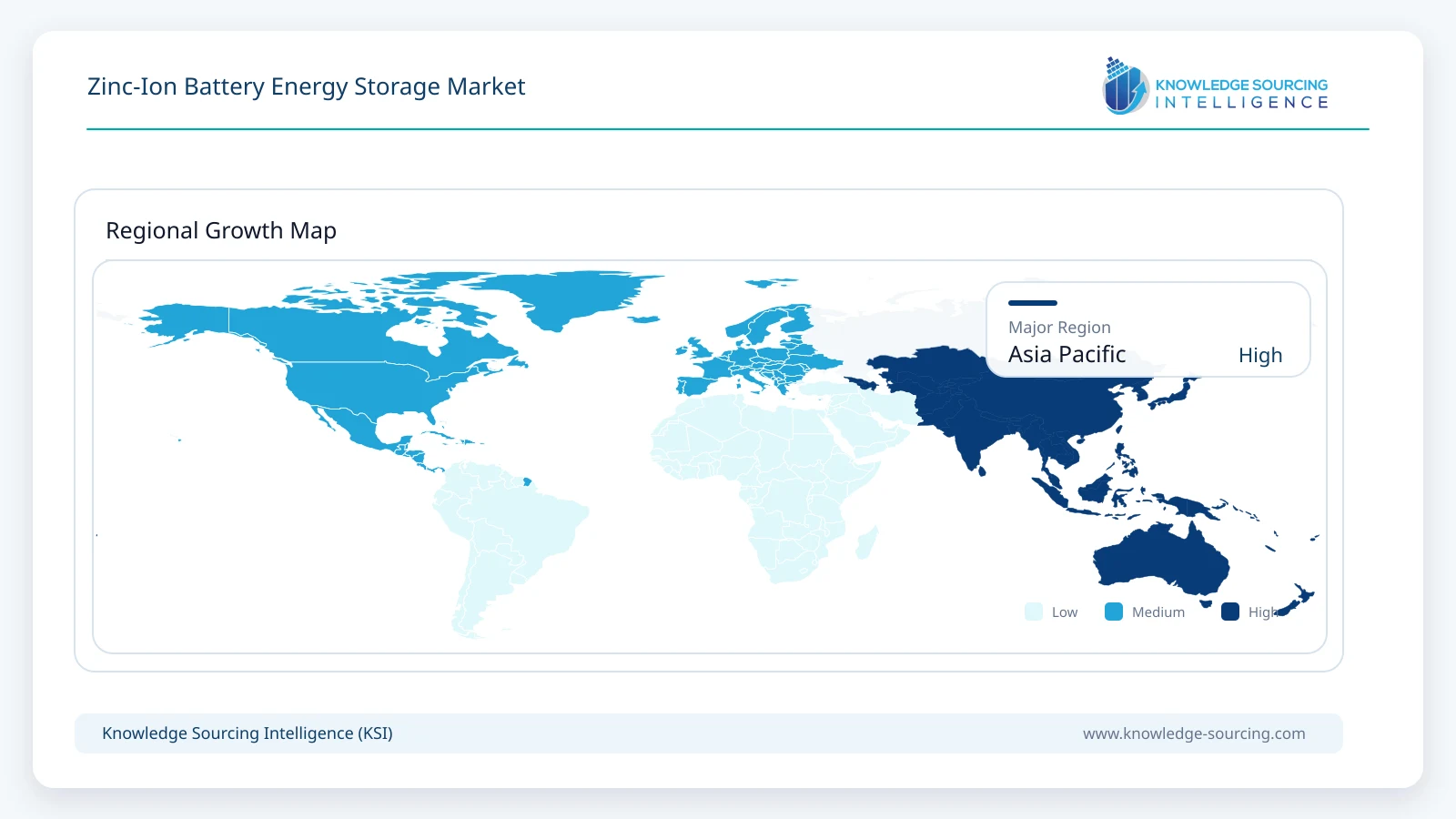
Asia Pacific has the strongest current commercialization evidence for true aqueous zinc-ion stationary storage. China is the most advanced visible market because Zhejiang Vastech Technology has moved beyond laboratory cells into energy-storage systems and manufacturing. Its current company materials describe aqueous zinc-ion technology, production-scale manufacturing capability and multiple storage applications, including a 30 MW aqueous-storage system associated with a wind project and an MW-scale power-system demonstration. These claims make China more commercially advanced than the predominantly prototype-stage activity visible in North America and Europe, although independent project-level disclosure remains limited.
Vastech's public information also illustrates why the market must still be treated cautiously. The company states that it has GW-scale production capability and MW-scale test production, while 2026 local reporting describes small-batch shipments and additional production-line construction. The direction of travel is clearly toward commercialization, but publicly available information does not yet provide a complete, independently verifiable picture of annual zinc-ion cell shipments or system revenue. This limits confidence in aggressive near-term market sizing.
India is the second important Asia Pacific development center. Hindustan Zinc and JNCASR announced zinc-ion pouch-cell prototypes in February 2026 after earlier work on electrolytes and zinc materials. The prototypes were evaluated under renewable-energy charge-discharge profiles, but the programme remains pre-commercial. India's large domestic zinc resource and stationary-storage requirement create a logical pathway toward future cell and system manufacturing if pouch-cell durability and scale-up targets are achieved.
North America remains important for system validation. The California Energy Commission-supported Salient programme moved zinc-ion technology from laboratory component demonstration to a 10 kWh residential technology-demonstration system, while the Prince Edward Island project is developing a prototype enclosure for backup, industrial and grid-support use. Europe has a strong research and manufacturing-development base through ZEBRA, Fraunhofer ISE and the legacy lessons from Enerpoly's qualification plant, but broad commercial deployment is not yet evident.
Competitive Landscape
The competitive landscape is still narrow. Vastech Energy (Zhejiang Hanwei Technology Co., Ltd.) has the strongest publicly visible evidence of true aqueous zinc-ion commercialization, with current company materials describing aqueous zinc-ion batteries, storage applications and production-scale capability. Salient Energy remains an active North American zinc-ion developer with current 2026 technical activity and prior stationary-system validation. ZNL Energy offers a zinc-ion cell technology for licensed production, targeting residential through industrial stationary storage with an aqueous zinc-manganese architecture.
Enerpoly demonstrated important manufacturing lessons by commissioning a European zinc-ion production line and producing qualification cells, but it stopped operations in 2025 and is not treated as an active market participant. Hindustan Zinc and JNCASR are developing pouch-cell prototypes in India, while Fraunhofer ISE and the ZEBRA consortium are part of the research and scale-up ecosystem rather than commercial zinc-ion suppliers. Adjacent zinc chemistries such as zinc-hybrid, zinc-air, nickel-zinc and zinc-bromine flow batteries remain excluded.
Key Market Participants: Vastech Energy (Zhejiang Hanwei Technology Co., Ltd.); Salient Energy; ZNL Energy. The limited list reflects the small number of active companies that can be verified as true zinc-ion developers rather than adjacent zinc-battery suppliers or research organizations.
Recent Developments
June 2026: Indian researchers reported a new electrolyte-additive strategy intended to suppress hydrogen evolution, corrosion and dendrite formation in aqueous zinc-ion batteries.
March 2026: The European ZEBRA project formally launched to develop safe and sustainable zinc-ion batteries for stationary energy storage.
February 2026: Hindustan Zinc and JNCASR announced stable zinc-ion pouch-cell prototypes tested under renewable-energy charge-discharge conditions.
February 2026: India's Department of Science and Technology reported a new molybdenum-disulfide cathode design for aqueous zinc-ion batteries; the work remains at laboratory prototype level.
2026: The Prince Edward Island zinc-ion project continued development of a prototype battery enclosure for backup and grid-support applications using Salient technology.
2026: European Commission reporting confirmed that Enerpoly's EUROZIP project produced first qualification batches before operations stopped in June 2025 because additional financing could not be secured.
2026: Zhejiang Vastech Technology continued commercialization of aqueous zinc-ion storage and states that it has production-scale manufacturing capability; its application portfolio includes a 30 MW aqueous-storage system at a wind project.
Zinc-Ion Battery Energy Storage Market Scope:
| Report Metric | Details |
|---|---|
| Total Market Size in 2026 | USD 60.0 million |
| Total Market Size in 2032 | USD 700.0 million |
| Forecast Unit | Billion |
| Growth Rate | 50.6% |
| Study Period | 2021 to 2032 |
| Historical Data | 2021 to 2024 |
| Base Year | 2025 |
| Forecast Period | 2026 – 2032 |
| Segmentation | Cell Chemistry, Cell Format, Application, Storage Duration, System Scale, Geography |
| Companies |
|
Market Segmentation
By Cell Chemistry
Manganese-Oxide Zinc-Ion
Vanadium-Based Zinc-Ion
Prussian-Blue-Analogue Zinc-Ion
Sulfide and Other Emerging Cathodes
By Cell Format
Pouch Cells
Prismatic Cells
Cylindrical and Specialty Formats
By Application
Residential Energy Storage
Commercial and Industrial Storage
Utility-Scale Energy Storage
Backup and Resilience
Telecom, Defense and Remote Power
By Storage Duration
Below 2 Hours
2-4 Hours
4-8 Hours
Above 8 Hours
By System Scale
Below 20 kWh
20-500 kWh
500 kWh-10 MWh
Above 10 MWh
By Geography
Asia Pacific
China
India
Rest of Asia Pacific
North America
United States
Canada
Europe
Germany
Sweden
Rest of Europe
Rest of World
Table of Contents
1. EXECUTIVE SUMMARY
1.1. Market Opportunity and Key Findings
1.2. Zinc-Ion Commercialization Outlook
1.3. Stationary Storage and Manufacturing Scale-Up
2. MARKET OVERVIEW
2.1. Zinc-Ion Battery Operating Principle
2.2. Zinc Anode and Intercalation Cathode
2.3. Aqueous Electrolyte and Separator
2.4. Cell Formats and Module Architecture
2.5. Battery Management and System Integration
2.6. Comparison with Other Stationary Battery Chemistries
3. MARKET SIZE AND FORECAST, 2026-2032
3.1. Global Market Revenue
3.2. Annual Growth Analysis
3.3. Cell, Module and System Revenue
4. MARKET BY CELL CHEMISTRY
4.1. Manganese-Oxide Zinc-Ion
4.2. Vanadium-Based Zinc-Ion
4.3. Prussian-Blue-Analogue Zinc-Ion
4.4. Sulfide and Other Emerging Cathodes
5. MARKET BY CELL FORMAT
5.1. Pouch Cells
5.2. Prismatic Cells
5.3. Cylindrical and Specialty Formats
6. MARKET BY APPLICATION
6.1. Residential Energy Storage
6.2. Commercial and Industrial Storage
6.3. Utility-Scale Energy Storage
6.4. Backup and Resilience
6.5. Telecom, Defense and Remote Power
7. MARKET BY STORAGE DURATION
7.1. Below 2 Hours
7.2. 2-4 Hours
7.3. 4-8 Hours
7.4. Above 8 Hours
8. MARKET BY SYSTEM SCALE
8.1. Below 20 kWh
8.2. 20-500 kWh
8.3. 500 kWh-10 MWh
8.4. Above 10 MWh
9. REGIONAL MARKET
9.1. Asia Pacific
9.1.1. China
9.1.2. India
9.1.3. Rest of Asia Pacific
9.2. North America
9.2.1. United States
9.2.2. Canada
9.3. Europe
9.3.1. Germany
9.3.2. Sweden
9.3.3. Rest of Europe
9.4. Rest of World
10. MARKET DYNAMICS
10.1. Drivers
10.1.1. Non-Flammable Stationary Storage
10.1.2. Abundant Zinc Supply
10.1.3. Renewable Energy Integration
10.1.4. Anode and Electrolyte Innovation
10.2. Restraints
10.2.1. Zinc Dendrites and Corrosion
10.2.2. Hydrogen Evolution and Gas Generation
10.2.3. Cathode Dissolution and Cycle Life
10.2.4. Manufacturing Finance and Bankability
11. COMPETITIVE LANDSCAPE
11.1. Zinc-Ion Cell Developers
11.2. Licensed Cell Technology
11.3. Research-Industry Partnerships
11.4. European Manufacturing Development
11.5. Zinc and Cathode-Material Supply Chain
12. COMPANY PROFILES
12.1. Vastech Energy (Zhejiang Hanwei Technology Co., Ltd.)
12.2. Salient Energy
12.3. ZNL Energy
13. RECENT DEVELOPMENTS
14. APPENDIX
Navigate
Trusted by the world's leading organizations











