
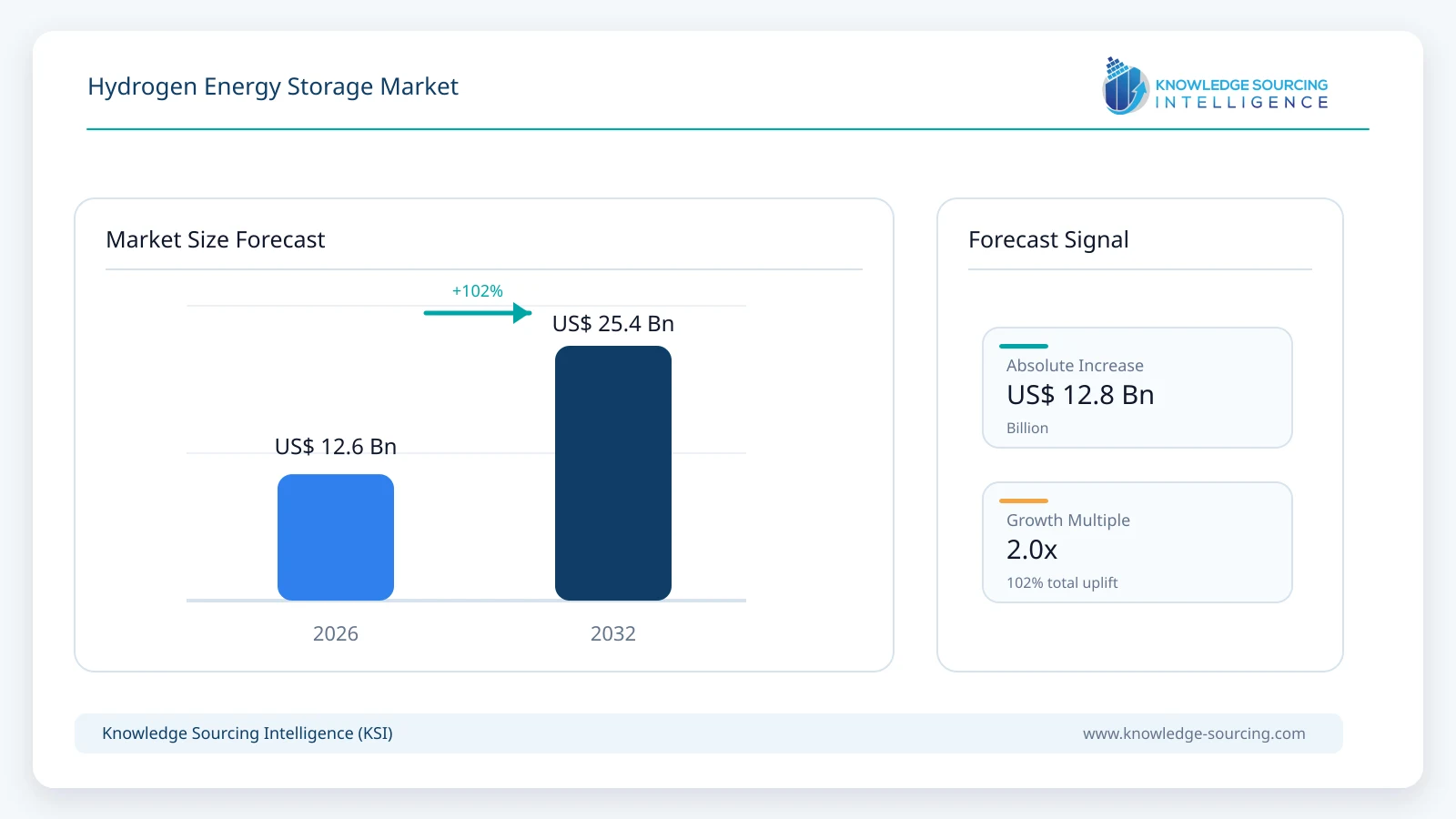
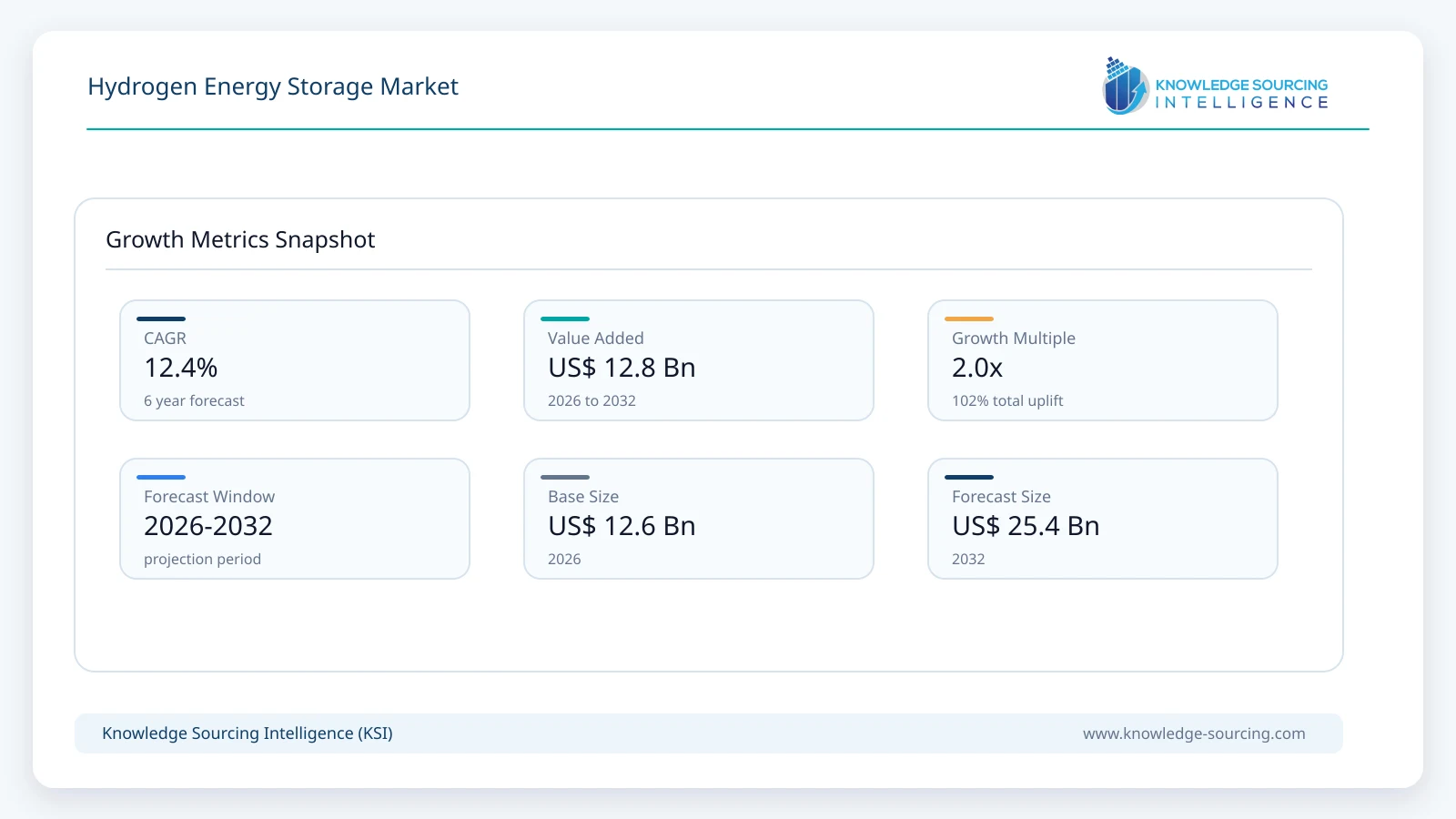
The Hydrogen Energy Storage Market is estimated at USD 12.60 billion in 2026 and is projected to reach USD 25.40 billion by 2032, representing a CAGR of 12.4% during 2026-2032.
Highlights:
- 1Compressed gaseous stationary storage represents an estimated 51.6% of 2026 market revenue because pressure-vessel systems are established across industrial and distributed hydrogen applications.
- 2Underground salt-cavern storage is the fastest-growing storage route as multi-day and seasonal hydrogen projects move toward commercial operation.
- 3North America is the largest regional market in 2026, supported by existing Gulf Coast caverns, pipeline infrastructure and the ACES Delta utility-scale project.
- 4Solid-state and metal-hydride systems remain smaller in revenue but are commercially relevant where low pressure, safety and long hold times matter more than gravimetric weight.
- 5The competitive set is narrower than the wider hydrogen industryelectrolyser companies, fuel-cell suppliers and hydrogen producers are not treated as storage competitors unless they supply or develop storage directly.
Market Overview
Hydrogen storage differs from conventional battery storage because the energy carrier can be held independently of the conversion equipment and for much longer periods. This makes hydrogen attractive for multi-day and seasonal storage, although the conversion chain introduces efficiency losses and additional balance-of-plant requirements. Storage architecture depends strongly on scale. Industrial and distributed systems typically use high-pressure vessels, tube bundles, cryogenic tanks or metal hydrides, while utility-scale seasonal projects can use solution-mined salt caverns containing thousands of tonnes of hydrogen. The storage asset can therefore range from a modular container to a subsurface facility linked to pipelines, compressors and power-generation equipment.
The market is also becoming more differentiated by duty cycle. Buffer storage smooths electrolyser output and supports continuous industrial delivery. Backup-power systems store hydrogen for infrequent discharge over many hours or days. Grid-scale projects use hydrogen to absorb renewable energy when power prices are low and return energy through fuel cells or hydrogen-capable turbines when the system is constrained. Salt caverns offer the strongest economics at very large scale where suitable geology exists, while surface tanks and solid-state systems are easier to site near distributed loads.
Market Drivers
Seasonal renewable balancing creates a storage requirement beyond batteries
Hydrogen can separate the cost of energy capacity from the power-conversion equipment and retain stored energy for long periods. This is particularly relevant when wind and solar output varies across weeks or seasons rather than hours. Underground storage can hold very large volumes with relatively small surface footprints. The ACES Delta project illustrates the scale difference: its two planned salt caverns are designed for more than 300 GWh of dispatchable energy storage, far beyond the practical range of conventional battery installations at a single site.
Existing industrial hydrogen infrastructure lowers technical risk
Hydrogen storage is not starting from a zero installed base. Air Liquide operates a 4.5 billion cubic-foot cavern in Texas, while Linde operates high-purity cavern storage and supplies liquid-hydrogen tanks and associated conditioning equipment. This existing experience in materials compatibility, compression, purification and cryogenic handling supports the transition toward lower-carbon hydrogen and renewable-energy storage. New projects can build on established industrial practices while adapting equipment for more frequent cycling, variable production and power-sector operating requirements.
Distributed storage expands through low-pressure and modular systems
Stationary hydrogen storage is broadening beyond high-pressure vessels. GRZ Technologies offers metal-hydride storage modules and integrated power-to-power systems, including multi-megawatt-hour containerised configurations. GKN Hydrogen, now part of Langley Holdings, develops metal-hydride storage and power-to-power products for stationary applications. These systems trade higher material mass for lower operating pressure and long storage times, making them relevant for industrial buffers, microgrids, backup energy and sites where compression complexity or safety zoning is a major constraint.
Restraints and Adoption Challenges
Hydrogen energy storage faces lower round-trip efficiency than most electrochemical storage, which limits frequent daily cycling where electricity-price spreads are narrow. Large underground projects require suitable geology, solution-mining or reservoir-development expertise, compression systems, permitting and long construction schedules. Surface storage requires expensive pressure vessels or cryogenic insulation, while liquid hydrogen introduces boil-off management and liquefaction energy demand. Materials must also be selected for hydrogen compatibility to control leakage and embrittlement. The strongest applications are therefore those where storage duration, energy capacity or resilience is valuable enough to outweigh conversion losses.
Segment Analysis
By Storage Technology
Compressed gaseous storage is the largest technology segment in 2026, with an estimated 51.6% revenue share, because high-pressure vessels and stationary cascades are established products and can be deployed without specialised geology. Underground storage is expected to grow fastest through 2032 as hydrogen hubs and power projects require much larger energy capacity. Salt caverns are the most commercially proven underground option for high-purity hydrogen, while lined rock caverns, depleted reservoirs and aquifers remain at different stages of technical validation. Solid-state systems remain a smaller segment but are gaining commercial relevance for distributed stationary applications.
Storage Route | Typical Scale | Commercial Maturity | Primary Advantages |
Compressed gaseous tanks / cascades | kg to hundreds of tonnes | Mature commercial | Modular, widely deployable, rapid cycling |
Liquid hydrogen storage | Tonnes to large terminals | Mature industrial / expanding energy use | High volumetric density; transport integration |
Salt caverns | Thousands of tonnes per cavern | Commercial industrial; energy-storage projects scaling | Very large capacity, low surface footprint, long duration |
Other underground storage | Large bulk / seasonal | Pilot to development | Potential scale where salt geology is unavailable |
Metal hydride / solid state | kg to hundreds of kg per module | Commercial niche / scaling | Low pressure, safety, long storage time |
Advanced adsorbent / reticular materials | Development-stage | R&D / pre-commercial | Lower-pressure storage with potential density benefits |
By Application
Industrial buffering and hydrogen supply remain the largest application because storage is already embedded in industrial hydrogen networks. Grid and renewable-energy storage is the fastest-growing application as electrolyser projects become linked with caverns, turbines and fuel cells. Backup power, data centres, remote power and microgrids create a separate distributed market where the ability to retain energy for long periods can be more important than round-trip efficiency.
Technology and Project Indicators
Indicator | Current Evidence | Market Significance |
Utility-scale salt-cavern storage | ACES Delta plans two caverns with more than 300 GWh of energy storage linked to a 220 MW electrolyser system | Demonstrates seasonal storage scale that is difficult to achieve with batteries |
Commercial cavern operations | Air Liquide operates 4.5 billion ft³ of hydrogen storage in Texas; Linde operates commercial high-purity cavern storage | Provides operating precedent for high-purity underground hydrogen |
Cryogenic storage consolidation | Baker Hughes completed its acquisition of Chart Industries in July 2026 | Combines cryogenic storage, transport and broader energy infrastructure under one current corporate identity |
Metal-hydride commercial systems | GRZ offers DASH storage and power systems; GKN Hydrogen remains active under Langley Holdings | Supports low-pressure distributed and industrial storage applications |
Advanced solid-state development | H2MOF showcased low-pressure, near-ambient solid-state storage technology in 2026 | Shows continued investment in next-generation storage materials |
Regional Opportunity
North America
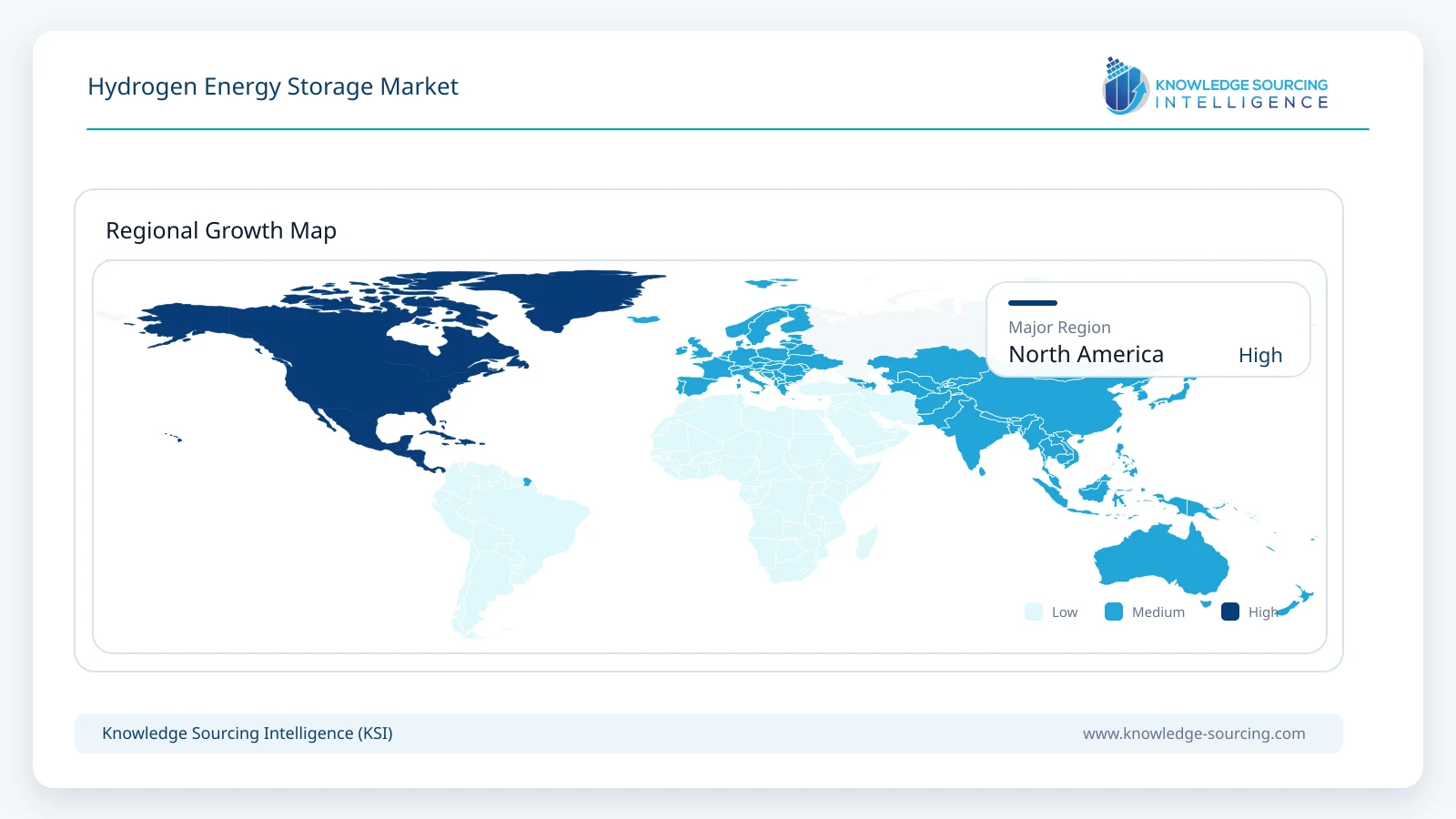
North America is the largest regional market in 2026 because the United States combines a mature industrial-hydrogen base with new utility-scale storage investment. The Gulf Coast has operating hydrogen caverns, extensive pipelines and industrial demand, creating a foundation for larger hydrogen networks. Utah adds a different use case through ACES Delta, where renewable electricity is converted to hydrogen and stored underground for dispatchable energy. Distributed storage also benefits from U.S. demand for resilient power at industrial facilities and data centres. Canada contributes through clean-hydrogen development and industrial-gas infrastructure, although project economics remain sensitive to electricity cost, hydrogen offtake and policy support.
Competitive Landscape
Hydrogen energy storage spans industrial-gas companies, cryogenic-equipment suppliers, pressure-vessel manufacturers, underground-storage developers and specialist solid-state companies. The main competitor list excludes companies that only manufacture electrolysers, fuel cells or hydrogen vehicles. Corporate identity also matters: Chart Industries should no longer be presented as a standalone company after Baker Hughes completed its acquisition in July 2026. GKN Hydrogen remains an operating hydrogen-storage business within Langley Holdings following its 2024 acquisition.
Key Market Participant | Storage Technology / Role | Commercial Status | Current Evidence |
Linde Engineering | Liquid hydrogen tanks, high-volume cavern integration and hydrogen conditioning | Commercial supplier / operator | Current LH? tank portfolio and commercial cavern operating experience |
Air Liquide | Underground hydrogen caverns and surface storage | Commercial operator / engineering participant | Current operation of 4.5 billion ft³ Beaumont cavern and underground-storage development programmes |
Baker Hughes (Chart Industries business) | Cryogenic hydrogen storage, transport and H? management | Commercial supplier | Chart acquisition completed July 2026; capabilities integrated into Baker Hughes |
NPROXX | Type 4 high-pressure stationary hydrogen storage | Commercial supplier | Current modular stationary and transport storage systems; active production organisation in Germany |
CIMC Enric | High-pressure vessels, cascades and large-capacity liquid-hydrogen storage | Commercial supplier | Current hydrogen storage vessel and LH? storage product portfolio |
GRZ Technologies | Metal-hydride solid-state storage and power-to-power systems | Commercial supplier | Current DASH C/M/Power product families and deployed industrial projects |
GKN Hydrogen, a Langley Holdings company | Metal-hydride stationary storage and power-to-power systems | Commercialising supplier | Active under Langley; 2025 large-scale storage feasibility work and ongoing stationary product platform |
ACES Delta | Utility-scale salt-cavern green-hydrogen storage hub | Project developer / operator | Project in Delta, Utah with two caverns designed for more than 300 GWh of energy storage |
H2MOF | Reticular-material solid-state hydrogen storage | Development-stage technology company | Active 2026 technology programme and Gastech presentation; not presented as an established commercial supplier |
Electrolyser manufacturers, fuel-cell suppliers, EPC contractors and hydrogen producers are treated as ecosystem participants unless they directly supply or develop hydrogen storage technology.
Recent Developments
July 2026: Baker Hughes completed its acquisition of Chart Industries. Hydrogen cryogenic-storage and management capabilities are therefore treated under the Baker Hughes identity rather than as a separate Chart competitor.
2026: ACES Delta continued toward start-up of its Utah green-hydrogen conversion and storage hub, designed around 220 MW of electrolysis and two salt caverns with more than 300 GWh of storage capacity.
September 2026: H2MOF presented its low-pressure, near-ambient solid-state hydrogen storage technology at Gastech 2026, reflecting continued development of advanced reticular-material storage.
2026: GRZ Technologies continued commercial deployment of metal-hydride DASH storage and integrated power systems while publishing new work on long-cycle hydrogen-storage alloys.
2025: Fraunhofer UMSICHT and GKN Hydrogen completed a feasibility study for integrating large-scale metal-hydride storage into the Port of Duisburg hydrogen infrastructure.
Hydrogen Energy Storage Market Scope
| Report Metric | Details |
|---|---|
| Total Market Size in 2026 | USD 12.60 billion |
| Total Market Size in 2032 | USD 25.40 billion |
| Forecast Unit | Billion |
| Growth Rate | 12.4% |
| Study Period | 2021 to 2032 |
| Historical Data | 2021 to 2024 |
| Base Year | 2025 |
| Forecast Period | 2026 – 2032 |
| Segmentation | Storage Technology, System Configuration, Application, End User, Geography |
| Companies |
|
Market Segmentation
By Storage Technology
Compressed Gaseous Hydrogen Storage
Liquid Hydrogen Storage
Salt-Cavern Hydrogen Storage
Depleted Reservoir and Aquifer Storage
Lined Rock Cavern Storage
Metal-Hydride and Solid-State Storage
Advanced Adsorbent and Reticular-Material Storage
By System Configuration
Storage-Only Infrastructure
Integrated Power-to-Hydrogen Storage
Hydrogen-to-Power / Backup Systems
By Application
Industrial Buffer and Supply Storage
Renewable Energy and Grid Storage
Seasonal Energy Storage
Backup Power and Critical Infrastructure
Microgrids and Remote Power
By End User
Utilities and Independent Power Producers
Industrial Gas and Chemical Companies
Heavy Industry
Data Centres and Critical Facilities
Hydrogen Hubs and Infrastructure Developers
By Geography
North America
United States
Canada
Europe
Asia Pacific
Rest of World
Table of Contents
1. Executive Summary
1.1. Market Opportunity and Key Findings
1.2. Hydrogen Storage Technology Outlook
1.3. Grid, Industrial and Seasonal Storage Opportunity
2. Market Overview
2.1. Hydrogen as an Energy-Storage Medium
2.2. Power-to-Hydrogen-to-Power Architecture
2.3. Stationary versus Bulk Storage
2.4. Storage Duration and Duty Cycle
3. Market Size and Forecast, 2026-2032
3.1. Global Market Revenue
3.2. Annual Growth Analysis
4. Market by Storage Technology
4.1. Compressed Gaseous Hydrogen Storage
4.2. Liquid Hydrogen Storage
4.3. Salt-Cavern Hydrogen Storage
4.4. Depleted Reservoir and Aquifer Storage
4.5. Lined Rock Cavern Storage
4.6. Metal-Hydride and Solid-State Storage
4.7. Advanced Adsorbent and Reticular-Material Storage
5. Market by System Configuration
5.1. Storage-Only Infrastructure
5.2. Integrated Power-to-Hydrogen Storage
5.3. Hydrogen-to-Power / Backup Systems
6. Market by Application
6.1. Industrial Buffer and Supply Storage
6.2. Renewable Energy and Grid Storage
6.3. Seasonal Energy Storage
6.4. Backup Power and Critical Infrastructure
6.5. Microgrids and Remote Power
7. Market by End User
7.1. Utilities and Independent Power Producers
7.2. Industrial Gas and Chemical Companies
7.3. Heavy Industry
7.4. Data Centres and Critical Facilities
7.5. Hydrogen Hubs and Infrastructure Developers
8. Regional Market
8.1. North America
8.1.1. United States
8.1.2. Canada
8.2. Europe
8.3. Asia Pacific
8.4. Rest of World
9. Market Dynamics
9.1. Drivers
9.1.1. Seasonal Renewable Balancing
9.1.2. Existing Industrial Hydrogen Infrastructure
9.1.3. Hydrogen-Hub Development
9.1.4. Distributed Resilience and Backup Power
9.2. Restraints
9.2.1. Round-Trip Efficiency
9.2.2. Geology and Siting Constraints
9.2.3. Compression and Liquefaction Energy Demand
9.2.4. Hydrogen Compatibility and Leakage Control
10. Competitive Landscape
10.1. Industrial-Gas and Cryogenic Storage Suppliers
10.2. Pressure-Vessel and Modular Storage Suppliers
10.3. Underground Storage Developers
10.4. Solid-State Hydrogen Storage Developers
11. Company Profiles
11.1. Linde Engineering
11.2. Air Liquide
11.3. Baker Hughes (Chart Industries business)
11.4. NPROXX
11.5. CIMC Enric
11.6. GRZ Technologies
11.7. GKN Hydrogen, a Langley Holdings company
11.8. ACES Delta
11.9. H2MOF
12. Recent Developments
13. Appendix
Navigate
Trusted by the world's leading organizations











