
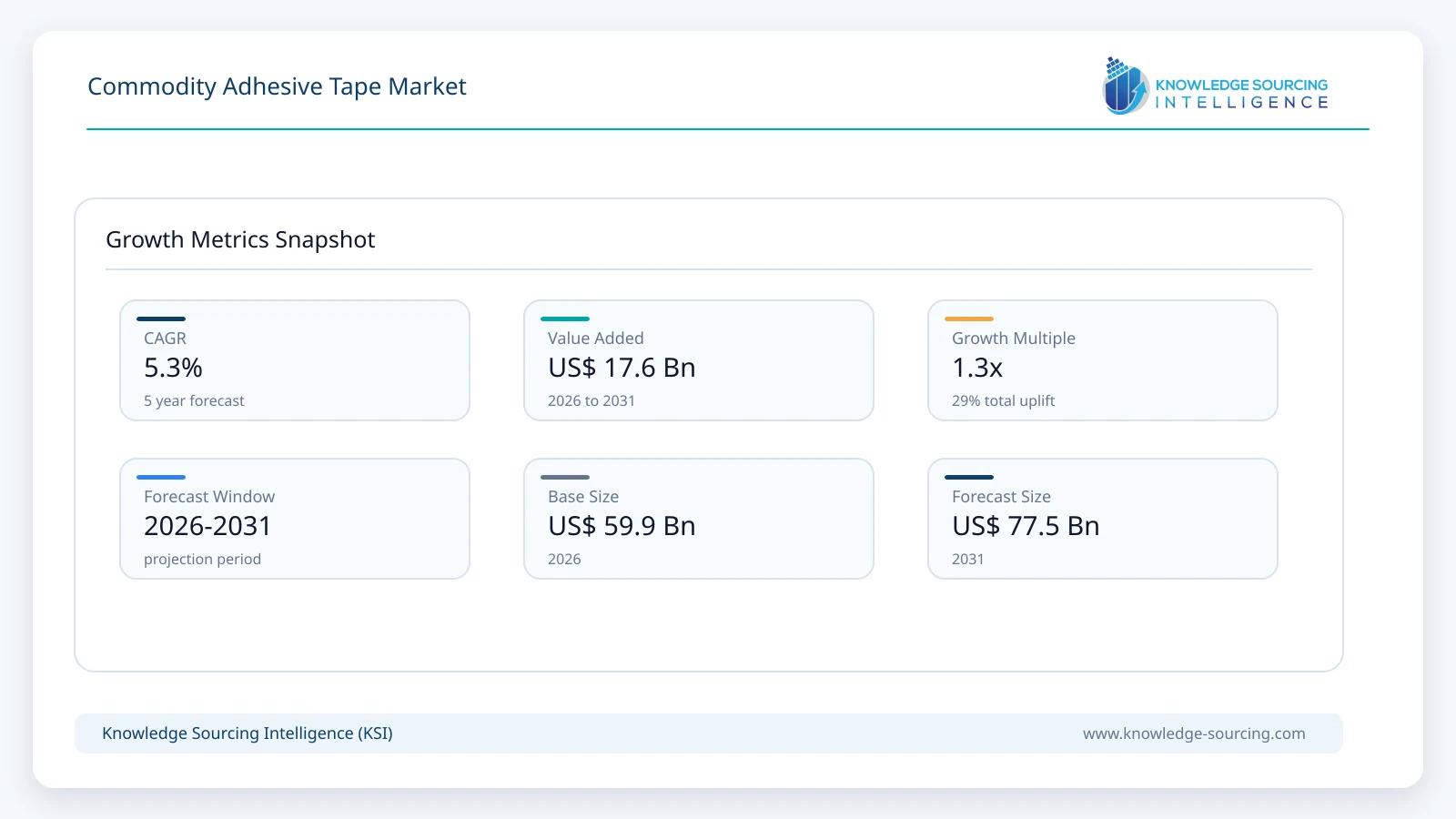
The Commodity Adhesive Tape market is forecast to grow at a CAGR of 5.3%, reaching USD 77.5 billion in 2031 from USD 59.9 billion in 2026.
Highlights:
- 1Packaging tapes are commercially important because carton sealing supports shipping, warehousing, retail distribution, and e-commerce fulfilment across many industries.
- 2Water-based and hot-melt coating systems serve different cost, drying, line-speed, and environmental needs, shaping manufacturer investment and buyer selection.
- 3Packaging and e-commerce provide a recurring demand base, while construction, automotive, and industrial uses require application-specific performance.
- 4Asia Pacific offers a broad manufacturing and distribution base, while North America and Europe present established industrial demand and distinct compliance needs.
- 5Competition increasingly combines price, consistent adhesion, converting capacity, product availability, and the ability to meet customer packaging and sustainability targets.
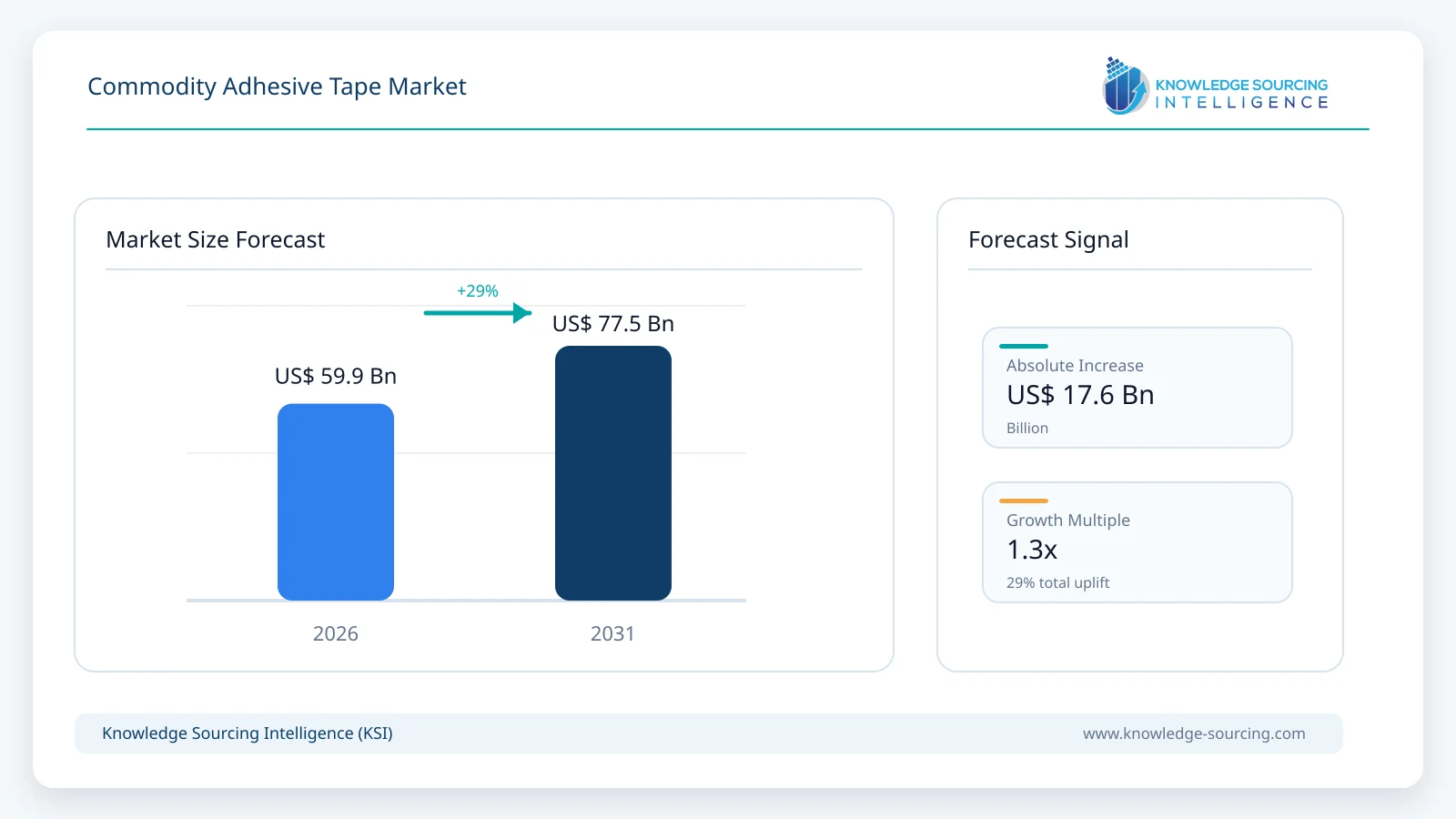
The Commodity Adhesive Tape Market covers pressure-sensitive tapes used in packaging, construction, office supplies, industrial assembly, electrical applications, and transportation. Demand depends on shipping volumes, carton sealing, surface protection, routine maintenance, and production needs. Buyers weigh price, bond strength, ease of use, residue, temperature resistance, and supply reliability. The commercial outlook also depends on adhesive chemistry, backing materials, manufacturing costs, and environmental rules. With the supplied market forecast indicating continued expansion through 2031, suppliers must balance high-volume, price-sensitive products with application-specific performance and dependable delivery.
Market Overview
Commodity adhesive tapes are pressure-sensitive products designed to bond surfaces through applied pressure rather than a separate curing process. The market includes packaging, masking, consumer and office, duct, double-sided, filament, and strapping tapes. Their broad use across routine commercial tasks creates repeat purchasing, although demand varies by end-use industry, product specification, and distribution channel.
Packaging operations form an important source of recurring demand. Manufacturers, retailers, logistics providers, and online sellers use adhesive tapes to close cartons, secure loads, bundle products, and protect goods during storage and transport. Buyers in these settings often prioritize cost per sealed carton, consistent adhesion, reliable unwinding, dispenser compatibility, and uninterrupted supply. Small differences in roll price can matter when purchasing volumes are high, but a failed seal can lead to damaged goods, rework, and customer claims.
The market also serves applications where tape performance affects the quality of the finished product. Construction contractors use masking and duct tapes for temporary protection, sealing, and repair. Automotive and electronics manufacturers use selected tapes for insulation, surface protection, attachment, and assembly. These applications can demand tighter control over residue, temperature tolerance, backing strength, and adhesion to specific surfaces. Suppliers therefore compete in two ways: by producing standard products at a competitive cost and by adapting materials and adhesive formulations to customer needs.
Key Market Indicators
Indicator | Latest evidence | Commercial meaning |
|---|---|---|
EU packaging regulation | Regulation (EU) 2025/40 entered into force on 11 February 2025 and began applying on 12 August 2026. | Tape suppliers serving packaging customers need to track changing material, recyclability, and packaging-design requirements. |
tesa global reach | The company reports operations in more than 100 countries. | International reach can support multinational customers that require consistent products across markets. |
tesa research capacity | Around 600 scientists, engineers, and product developers were reported in September 2026. | Product development remains a competitive tool for suppliers seeking differentiated industrial applications. |
tesa sustainability investment | The company announced around EUR 300 million in investment toward climate-neutral production in Scope 1 and 2 by 2030. | Energy use and production emissions are becoming part of manufacturing strategy and customer engagement. |
Recycled-content packaging tape | tesa introduced PET packaging tapes with up to 60% recycled content in September 2025. | Recycled feedstocks are entering commercial tape products, subject to performance and customer acceptance. |
Market Drivers
Packaging throughput and e-commerce fulfilment
Every shipped carton creates a potential requirement for sealing tape, while distribution centres also consume tape for repacking, bundling, and securing goods. The demand mechanism is tied to the number and type of packages handled, the number of tape strips used, and the performance required during transport. High-volume sites tend to favour machine-compatible rolls, predictable unwind force, and reliable bonds across different carton surfaces.
The commercial opportunity extends beyond online retail. Food and beverage distribution, consumer goods, industrial components, and wholesale shipments also rely on secure packaging. Suppliers can compete through roll length, adhesive consistency, automated application, and reduced downtime. Products that perform well on recycled-content corrugated board may also appeal to buyers whose packaging mix changes as they seek to reduce virgin material use.
Industrial production and maintenance needs
Factories use commodity tapes for masking, temporary holding, bundling, surface protection, insulation, and routine repairs. Demand depends on production activity and maintenance schedules, but product specifications differ sharply between a temporary masking task and a bond that must withstand heat, moisture, or vibration. Industrial buyers often assess total operating cost rather than roll price alone, particularly when poor adhesion can interrupt production or damage finished surfaces.
Suppliers with broad product ranges can serve several departments within the same customer account. However, the ability to supply standard tapes does not automatically qualify a company for more demanding uses. Manufacturers must match adhesive, backing, thickness, and removal properties to the application, while buyers may require sample testing before changing suppliers.
Automated packaging and handling
Automated case sealers and high-throughput packing lines favour tapes that unwind consistently, seal quickly, and remain stable under continuous operation. A roll that breaks, telescopes, or fails to adhere can cause stoppages and increase labour costs. Buyers therefore assess machine compatibility and line performance alongside the tape's purchase price.
This creates an opportunity for suppliers that can provide machine-length rolls, dependable supply, and technical support. Product development can focus on reducing application failures without raising unit costs beyond the value gained by the customer. The benefit is strongest where packaging lines operate at high volume, and interruptions carry a measurable cost.
Material efficiency and packaging redesign
Packaging teams face pressure to reduce waste, improve material recovery, and maintain shipment protection. Adhesive tape is a small part of the total package by weight, but its backing and adhesive can affect how packaging components are separated or processed. Suppliers are responding with paper-backed products, recycled-content backings, and formulations designed for particular recycling systems. The commercial test is whether these products meet sealing requirements at an acceptable cost.
tesa's recycled PET packaging tapes, introduced in September 2025, illustrate this direction. The company said the products contain up to 60% recycled material and are designed for high-volume packaging processes.
For buyers, material claims must be assessed alongside sealing performance, availability, and compatibility with the wider packaging system.
Market Restraints and Challenges
Raw-material price volatility and margin pressure
Tape manufacturers depend on backing materials, adhesive ingredients, release liners, packaging, and energy. Changes in polymer, paper, chemical, and transport costs can affect production economics, while competitive tenders may limit the speed at which suppliers can pass higher costs to customers. The exposure differs by product mix and purchasing terms, so a cost increase does not affect every manufacturer equally.
High-volume buyers may negotiate annual prices, volume discounts, or multi-site supply agreements. Smaller converters and distributors can face a narrower margin buffer when input prices rise faster than selling prices. Suppliers can reduce exposure through purchasing discipline, product redesign, production efficiency, and selective price changes, although these measures cannot remove commodity-cost risk.
Price competition and product substitutability
Standard packaging and office tapes are often compared on dimensions, roll length, adhesion, and price. Buyers can switch suppliers when specifications are sufficiently similar, particularly where products do not require extensive qualification. This limits pricing power and can shift competition toward distribution coverage, inventory availability, rebates, and service.
Low prices do not guarantee the lowest total cost. Poor sealing, tape breakage, adhesive residue, or inconsistent roll quality can increase labour and damage costs. Manufacturers need to maintain quality control while avoiding unnecessary product features that customers will not pay for. Distributors also need to balance a broad catalogue with inventory costs and the risk of slow-moving stock.
Environmental compliance and material selection
Environmental rules can change the packaging requirements that tape must meet, even when the tape itself is not the regulated packaging item. Buyers may seek evidence about recycled content, chemical composition, recyclability, and supplier emissions. These requests can add testing, documentation, and product-development costs, particularly for manufacturers serving several markets with different rules.
The EU Packaging and Packaging Waste Regulation began applying on 12 August 2026, with some provisions scheduled to take effect later.
Tape suppliers should distinguish between requirements that apply directly to their products and those that affect the packaging systems used by customers. A paper backing or recycled-content claim alone does not prove that a complete package is recyclable under every collection and processing system.
Performance variation across surfaces and operating conditions
Adhesion depends on the surface, temperature, moisture, dust, pressure, and duration of use. A tape that works well on clean corrugated board may perform differently on recycled fibreboard, rough construction surfaces, painted metal, or plastic. Buyers may need to test products under actual storage, transport, and application conditions before approving a change.
These differences can raise switching costs in industrial applications. Suppliers must maintain consistent coating and converting quality, provide clear technical data, and help customers select appropriate products. Poor product matching can result in returns, waste, or production delays, while excessive specification can raise costs without a corresponding operational benefit.
Major Segment Analysis
Packaging Tapes
Packaging tapes represent a commercially important segment because they support a routine step in shipping, warehousing, manufacturing, and retail distribution. Purchases recur as cartons move through supply chains, and customers often need several roll widths, lengths, and adhesive strengths. For large buyers, the cost of tape across thousands of shipments can influence supplier selection, while seal reliability affects damage rates and packing-line productivity.
Purchasing criteria vary by operating environment. Smaller businesses may favour easy-to-use rolls that work with handheld dispensers, whereas distribution centres place greater weight on machine compatibility, roll length, consistent unwinding, and supply continuity. Adhesion to recycled corrugated board can also matter as packaging materials change. Suppliers that help customers reduce line stoppages or tape consumption may defend their position more effectively than suppliers competing only on price.
Sustainability requirements are adding another product-selection factor. Paper-backed tapes and tapes made with recycled-content materials offer alternatives to conventional plastic-backed products, but buyers must assess seal strength, storage conditions, application speed, and compatibility with their packaging and recovery systems. The opportunity lies in meeting these requirements without compromising throughput or raising total packaging cost beyond an acceptable level.
Regional Analysis
Demand conditions vary with manufacturing output, parcel handling, construction activity, import dependence, and local distribution networks. The following regional assessment reflects structural demand factors rather than unverified market-share estimates.
Region | Main demand signal | Principal constraint |
|---|---|---|
North America | Parcel fulfilment, industrial distribution, maintenance, and established packaging operations | Price competition, input-cost exposure, and customer requirements for reliable automated sealing |
Europe | Industrial packaging, automotive production, and demand for resource-efficient packaging | Packaging compliance, material recovery requirements, and the cost of product reformulation |
Asia Pacific | Manufacturing supply chains, export packaging, electronics production, and domestic distribution | Uneven buyer purchasing power, competition among local suppliers, and differences in product standards |
South America | Food and agricultural distribution, consumer goods, construction, and industrial maintenance | Currency volatility, import costs, and uneven access to specialised products |
Middle East and Africa | Infrastructure work, industrial supply, consumer goods distribution, and import-led trade | Reliance on imported inputs in some markets, shipping costs, and variable local converting capacity |
North America
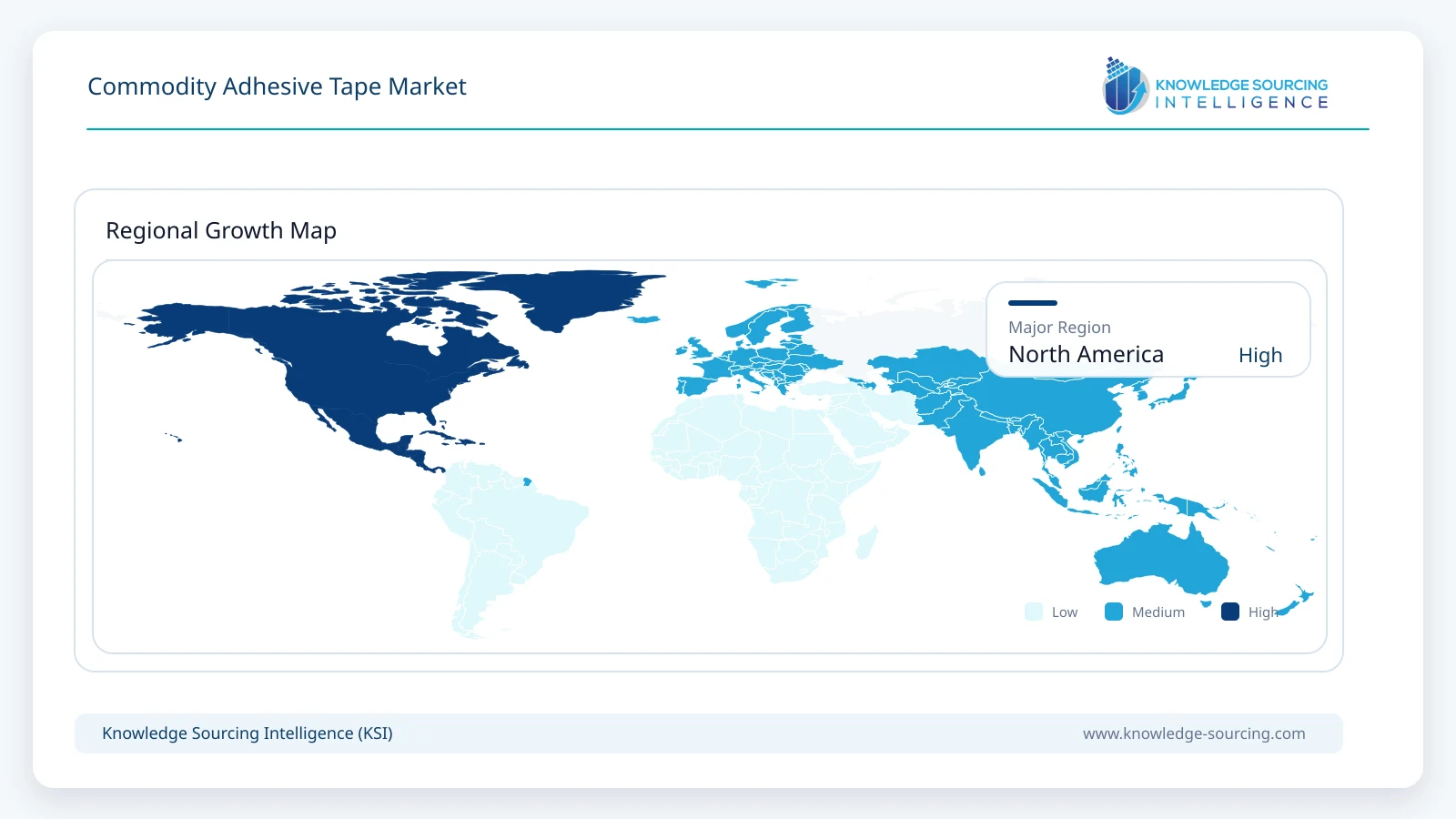
The United States, Canada, and Mexico form an important market area because of their connected manufacturing and distribution systems. Packaging users need tapes for parcel shipments, warehouse operations, consumer goods, and industrial transport. Automotive and electronics supply chains also use tapes for masking, protection, and assembly, although these applications can require tighter product specifications than routine carton sealing.
Suppliers compete through distribution reach, reliable stock, consistent quality, and compatibility with packaging equipment. Customers operating across multiple sites may prefer standardised specifications and a smaller group of qualified suppliers. Manufacturers must also manage differences in customer needs between high-volume packaging buyers and smaller businesses that purchase through distributors.
Europe
Germany, the United Kingdom, France, Italy, and Spain offer demand from manufacturing, construction, retail, and logistics. Industrial customers may require product consistency across sites, while consumer and office products depend more heavily on retail access, brand recognition, and shelf presentation. Competition also reflects the region's environmental policy framework and the need to document product and packaging characteristics.
The EU Packaging and Packaging Waste Regulation creates a common framework for packaging across member states. It entered into force in February 2025 and began applying in August 2026.
Tape manufacturers and distributors should monitor how the rules affect customer packaging designs, recycled materials, and recyclability claims. Suppliers that provide clear product information and work with packaging converters early may reduce the risk of late-stage specification changes.
Asia Pacific
China, Japan, India, South Korea, Taiwan, Thailand, Indonesia, and Australia have different combinations of industrial production, consumer demand, export activity, and local manufacturing. The region's commercial breadth creates demand for standard packaging products as well as tapes used in electronics, automotive, electrical equipment, and factory operations. Product selection varies by country, customer scale, and the maturity of distribution networks.
Local producers can compete through cost, proximity, and rapid fulfilment, while multinational suppliers may benefit from established product ranges and support for customers operating across borders. Buyers in export-oriented industries can place greater emphasis on consistent specifications and shipment protection. Suppliers must balance local price levels with the need to maintain quality, availability, and compliance across different markets.
South America
Brazil and Argentina are important country markets within a region where packaging demand connects to food, agriculture, retail, manufacturing, and construction. Standard tapes can be sourced through local distributors or imported channels, while more specialised products may depend on access to international suppliers. Purchasing decisions are sensitive to price, stock availability, and the cost of imported materials.
Currency movements and freight costs can affect landed prices and distributor margins. Suppliers need to consider local inventory, product range, and reliable replenishment rather than relying solely on cross-border sales. Demand prospects will also differ by country as industrial activity and investment conditions change.
Middle East and Africa
Saudi Arabia, the United Arab Emirates, and South Africa serve different demand patterns. Construction, industrial supply, retail distribution, and imports of consumer goods support recurring use of packaging and maintenance tapes. Some buyers also require specialised tapes for equipment protection, electrical work, and industrial applications.
Import dependence can increase lead times and expose buyers to freight and currency changes. Distributors with reliable inventory and a suitable mix of standard and specialised products can reduce supply gaps. Manufacturers evaluating local production or converting operations need to weigh available demand, access to backing and adhesive inputs, and the cost of serving multiple national markets.
Competitive Landscape
The commodity adhesive tape market combines large international suppliers, specialised tape makers, regional converters, and distributors. Competition is shaped by product breadth, manufacturing efficiency, customer access, quality control, and the ability to maintain supply at a competitive cost. Standard products can face intense price pressure because customers can compare similar specifications, while industrial applications may offer greater differentiation through performance, technical support, and customer qualification.
The companies covered in this report include 3M Company, tesa SE, Nitto Denko Corporation, Avery Dennison Corporation, Shurtape Technologies, LLC, PPM Industries S.p.A., Berry Global Group, Inc., Scapa Group plc, Intertape Polymer Group, CCT (Coating & Converting Technologies), and Yongle Tape. Their inclusion reflects the report's defined competitive scope, not an assertion that every company has the same exposure to commodity tape categories.
3M's product range illustrates the importance of balancing performance with packaging needs. In July 2025, the company highlighted its Scotch Performance Paper Box Sealing Tape 570, designed for automated dispensing and compatibility with recycling processes under specified testing conditions.
Such products compete on the ability to seal reliably while meeting changing customer material preferences.
tesa's public disclosures show a different but related approach: product development alongside resource efficiency and sustainability goals. Its recycled PET packaging tapes and paper-based consumer tape products address demand for alternative materials, while retaining requirements for practical handling and adhesion.
For industrial customers, a supplier's technical support and ability to maintain product consistency can matter as much as the initial price.
The market also includes companies with broad materials or converting capabilities. These businesses may compete through sourcing, production scale, access to distribution, and the ability to tailor products for specific customers. The precise position of each company depends on its current product portfolio, regional reach, and the extent to which it serves high-volume standard products versus specialised applications. Corporate ownership and portfolio changes also matter when assessing the competitive set, since they can affect product availability, investment priorities, and the identity of a supplier.
For buyers, supplier selection is increasingly a balance between unit cost and operational reliability. A supplier with consistent stock, suitable roll formats, technical documentation, and dependable delivery may offer better value than a lower-priced alternative that creates line interruptions. For manufacturers, the challenge is to protect margins in standard categories while developing products that address measurable customer needs. Distributors must manage breadth of assortment without carrying excessive inventory, especially where local demand is fragmented.
Recent Developments
September 2026: tesa reported progress toward lower-emission manufacturing. The company stated that it had reduced Scope 1 and Scope 2 emissions by 50% since 2018 and that 95% of its electricity demand came from renewable sources. The announcement highlights how energy efficiency and production emissions are becoming part of supplier investment priorities.
July 2026: tesa marked the first anniversary of its Debonding on Demand laboratory in Singapore. The laboratory supports adhesive technology research for repairability, circular product design, electronics, and automotive manufacturing. Its work points to opportunities beyond conventional disposable tapes, although the commercial impact will depend on application requirements and adoption by industrial customers.
September 2025: tesa introduced recycled PET packaging tapes. The products contain up to 60% recycled material and are designed for high-volume packaging, with attention to unwinding and immediate sealing performance. The launch illustrates how tape suppliers are responding to requests for lower-impact packaging materials without abandoning operational requirements.
April 2025: Avery Dennison introduced adhesive tape solutions for solar panel bonding. The portfolio addresses bonding needs in solar panel manufacturing, including solutions designed for durability and automated application. The launch illustrates the use of pressure-sensitive adhesives in applications where material performance and manufacturing efficiency can support product differentiation.
Regulatory and Policy Environment
Packaging waste and recyclability
Regulation (EU) 2025/40, the EU Packaging and Packaging Waste Regulation, entered into force on 11 February 2025 and began applying on 12 August 2026. It establishes a common framework covering packaging and packaging waste, with provisions addressing waste prevention, recycling, reuse, and the use of materials. Certain requirements apply on later dates or depend on additional measures.
Tape manufacturers should assess the rules in relation to the products they supply and the packaging systems in which customers use them. Requirements affecting packaging recyclability may influence demand for paper-backed tapes, recycled-content materials, and products designed to work with specific recovery processes. However, the use of a particular tape material does not, by itself, establish that a complete package meets all applicable requirements.
Chemical management and emissions
Adhesive formulations and coating operations can raise questions about chemical safety, workplace exposure, and air emissions. Requirements vary by jurisdiction, substance, application, and manufacturing process. Companies using solvent-based coatings need to assess the rules applicable to their facilities and products, while suppliers serving multiple countries must manage differences in documentation and customer expectations.
The U.S. Environmental Protection Agency maintains rules and guidance for several categories of solvent use and surface coating operations. These provisions do not establish a single universal emissions limit for all adhesive tapes, so manufacturers must determine which rules apply to their specific activities.
Product claims and customer documentation
Recycled-content, recyclability, and environmental claims need evidence appropriate to the claim being made. Suppliers may need product specifications, material declarations, test results, and supporting information for customer assessments. Claims should distinguish between a product's material composition and the performance of the complete packaging system.
For buyers, supplier documentation can reduce the risk of selecting a tape that fails technical or compliance checks. Manufacturers should coordinate product development, quality assurance, and sales teams before making environmental claims. Clear documentation can also support multinational customers that use common purchasing standards across several markets.
Outlook and Strategic Implications
The supplied forecast indicates that the Commodity Adhesive Tape Market will expand between 2026 and 2031. Demand should continue to draw on recurring packaging use, industrial maintenance, construction, and manufacturing applications. However, market performance will depend on end-use activity, input costs, product mix, and the ability of suppliers to meet customer specifications at acceptable prices. The forecast should not be interpreted as evidence that all tape types or regions will grow at the same rate.
Packaging tapes offer a commercially important route to recurring sales, but price pressure limits the scope for undifferentiated products to command higher margins. Manufacturers can improve their position by reducing production waste, maintaining consistent coating quality, offering suitable roll formats, and helping customers avoid packing-line interruptions. Product changes should be assessed against measurable benefits rather than environmental positioning alone.
The shift toward recycled-content and alternative backing materials creates both opportunity and execution risk. Buyers need to verify sealing performance, machine compatibility, and packaging-system requirements before changing specifications. Suppliers must also assess the availability and cost of input materials, production changes, and the evidence needed to support product claims.
Strategic priorities differ across the value chain:
Manufacturers: Protect unit economics through process control, input sourcing, and product designs that solve specific customer problems. Assess lower-impact materials against performance and production cost.
Distributors: Maintain dependable stock of commonly used formats, offer a suitable product range, and reduce the risk of supply gaps for repeat-purchase customers.
Industrial and packaging buyers: Compare suppliers on total operating cost, including application failures, downtime, waste, delivery reliability, and compliance documentation.
Investors and corporate planners: Assess exposure to standard, price-sensitive products against specialised applications, customer concentration, input-cost risks, and the cost of adapting production to new material requirements.
Over the next three to five years, suppliers will need to manage two commercial demands at once: competitive pricing for standard tapes and reliable performance for increasingly specific applications. Companies that match product design, manufacturing discipline, and distribution capability to their target customers are better placed to defend margins. Growth alone will not determine competitive outcomes. Cost control, product consistency, and the ability to meet changing packaging and industrial requirements will shape the quality of that growth.
Commodity Adhesive Tape Market Scope:
| Report Metric | Details |
|---|---|
| Total Market Size in 2026 | USD 59.9 billion |
| Total Market Size in 2031 | USD 77.5 billion |
| Forecast Unit | Billion |
| Growth Rate | 5.3% |
| Study Period | 2021 to 2031 |
| Historical Data | 2021 to 2024 |
| Base Year | 2025 |
| Forecast Period | 2026 – 2031 |
| Segmentation | Type, Coating Technology, End-Use Industry, Geography |
| Companies |
|
| Customization Scope | 15% Free Customization included with purchase — Request Custom Breakdown → |
| Sample & Data Access | PDF Sample, Excel Databook & Analyst Briefing — Download Free Sample → |
Market Segmentation
By Type
Packaging Tapes
Masking Tapes
Consumer and Office Tapes
Duct Tapes
Double-Sided Tapes
Filament and Strapping Tapes
Other Adhesive Tapes
By Coating Technology
Solvent-Based
Hot-Melt
Water-Based
Other Coating Technologies
By End-Use Industry
Packaging and E-Commerce
Building and Construction
Consumer Electronics and Electrical Equipment
Automotive and Transportation
Retail and Office
Manufacturing and Industrial Applications
Other End-Use Industries
By Geography
North America
United States
Canada
Mexico
Others
South America
Brazil
Argentina
Others
Europe
Germany
United Kingdom
France
Italy
Spain
Others
Middle East and Africa
Saudi Arabia
United Arab Emirates
South Africa
Others
Asia Pacific
China
Japan
India
South Korea
Taiwan
Thailand
Indonesia
Australia
Others
Table of Contents
1. EXECUTIVE SUMMARY
2. MARKET SNAPSHOT
2.1. Market Overview
2.2. Market Definition
2.3. Scope of the Study
2.4. Market Segmentation
3. BUSINESS LANDSCAPE
3.1. Market Drivers
3.2. Market Restraints
3.3. Market Opportunities
3.4. Porter’s Five Forces Analysis
3.5. Industry Value Chain Analysis
3.6. Policies and Regulations
3.7. Strategic Recommendations
4. TECHNOLOGICAL OUTLOOK
5. COMMODITY ADHESIVE TAPE MARKET BY TYPE
5.1. Introduction
5.2. Packaging Tapes
5.3. Masking Tapes
5.4. Consumer and Office Tapes
5.5. Duct Tapes
5.6. Double-Sided Tapes
5.7. Filament and Strapping Tapes
5.8. Other Adhesive Tapes
6. COMMODITY ADHESIVE TAPE MARKET BY COATING TECHNOLOGY
6.1. Introduction
6.2. Solvent-Based
6.3. Hot-Melt
6.4. Water-Based
6.5. Other Coating Technologies
7. COMMODITY ADHESIVE TAPE MARKET BY END-USE INDUSTRY
7.1. Introduction
7.2. Packaging and E-Commerce
7.3. Building and Construction
7.4. Consumer Electronics and Electrical Equipment
7.5. Automotive and Transportation
7.6. Retail and Office
7.7. Manufacturing and Industrial Applications
7.8. Other End-Use Industries
8. COMMODITY ADHESIVE TAPE MARKET BY GEOGRAPHY
8.1. Introduction
8.2. North America
8.2.1. By Type
8.2.2. By Coating Technology
8.2.3. By End-Use Industry
8.2.4. By Country
8.2.4.1. United States
8.2.4.2. Canada
8.2.4.3. Mexico
8.2.4.4. Others
8.3. South America
8.3.1. By Type
8.3.2. By Coating Technology
8.3.3. By End-Use Industry
8.3.4. By Country
8.3.4.1. Brazil
8.3.4.2. Argentina
8.3.4.3. Others
8.4. Europe
8.4.1. By Type
8.4.2. By Coating Technology
8.4.3. By End-Use Industry
8.4.4. By Country
8.4.4.1. Germany
8.4.4.2. United Kingdom
8.4.4.3. France
8.4.4.4. Italy
8.4.4.5. Spain
8.4.4.6. Others
8.5. Middle East and Africa
8.5.1. By Type
8.5.2. By Coating Technology
8.5.3. By End-Use Industry
8.5.4. By Country
8.5.4.1. Saudi Arabia
8.5.4.2. United Arab Emirates
8.5.4.3. South Africa
8.5.4.4. Others
8.6. Asia Pacific
8.6.1. By Type
8.6.2. By Coating Technology
8.6.3. By End-Use Industry
8.6.4. By Country
8.6.4.1. China
8.6.4.2. Japan
8.6.4.3. India
8.6.4.4. South Korea
8.6.4.5. Taiwan
8.6.4.6. Thailand
8.6.4.7. Indonesia
8.6.4.8. Australia
8.6.4.9. Others
9. COMPETITIVE ENVIRONMENT AND ANALYSIS
9.1. Major Players and Strategy Analysis
9.2. Market Share Analysis
9.3. Mergers, Acquisitions, Agreements, and Collaborations
9.4. Competitive Dashboard
10. COMPANY PROFILES
10.1. 3M Company
10.2. tesa SE
10.3. Nitto Denko Corporation
10.4. Avery Dennison Corporation
10.5. Shurtape Technologies, LLC
10.6. PPM Industries S.p.A.
10.7. Berry Global Group, Inc.
10.8. Scapa Group plc
10.9. Intertape Polymer Group
10.10. CCT (Coating & Converting Technologies)
10.11. Yongle Tape
11. APPENDIX
11.1. Currency
11.2. Assumptions
11.3. Base and Forecast Years Timeline
11.4. Key Benefits for the Stakeholders
11.5. Research Methodology
11.6. Abbreviations
List of Figures
List of Tables





Frequently asked questions
What is the projected market size for commodity adhesive tape by 2031?
The Commodity Adhesive Tape Market is projected to reach USD 77.5 billion by 2031.
What is the Compound Annual Growth Rate (CAGR) for this market?
The Commodity Adhesive Tape Market is forecast to grow at a 5.3% CAGR.
Which key applications drive Commodity Adhesive Tape Market demand?
Packaging, e-commerce, construction, automotive, and industrial uses drive demand.
Which regions are prominent in the Commodity Adhesive Tape Market outlook?
Asia Pacific, North America, and Europe are prominent regions.
What factors do buyers prioritize when selecting commodity adhesive tapes?
Buyers weigh price, bond strength, ease of use, and supply reliability.
What are key competitive factors in the Commodity Adhesive Tape Market?
Competition combines price, adhesion, capacity, availability, and sustainability targets.
Cite this report
Knowledge Sourcing Intelligence. (Oct 2026). Commodity Adhesive Tape Market - Strategic Insights and Forecasts (2026-2031). https://www.knowledge-sourcing.com/report/commodity-adhesive-tape-market