
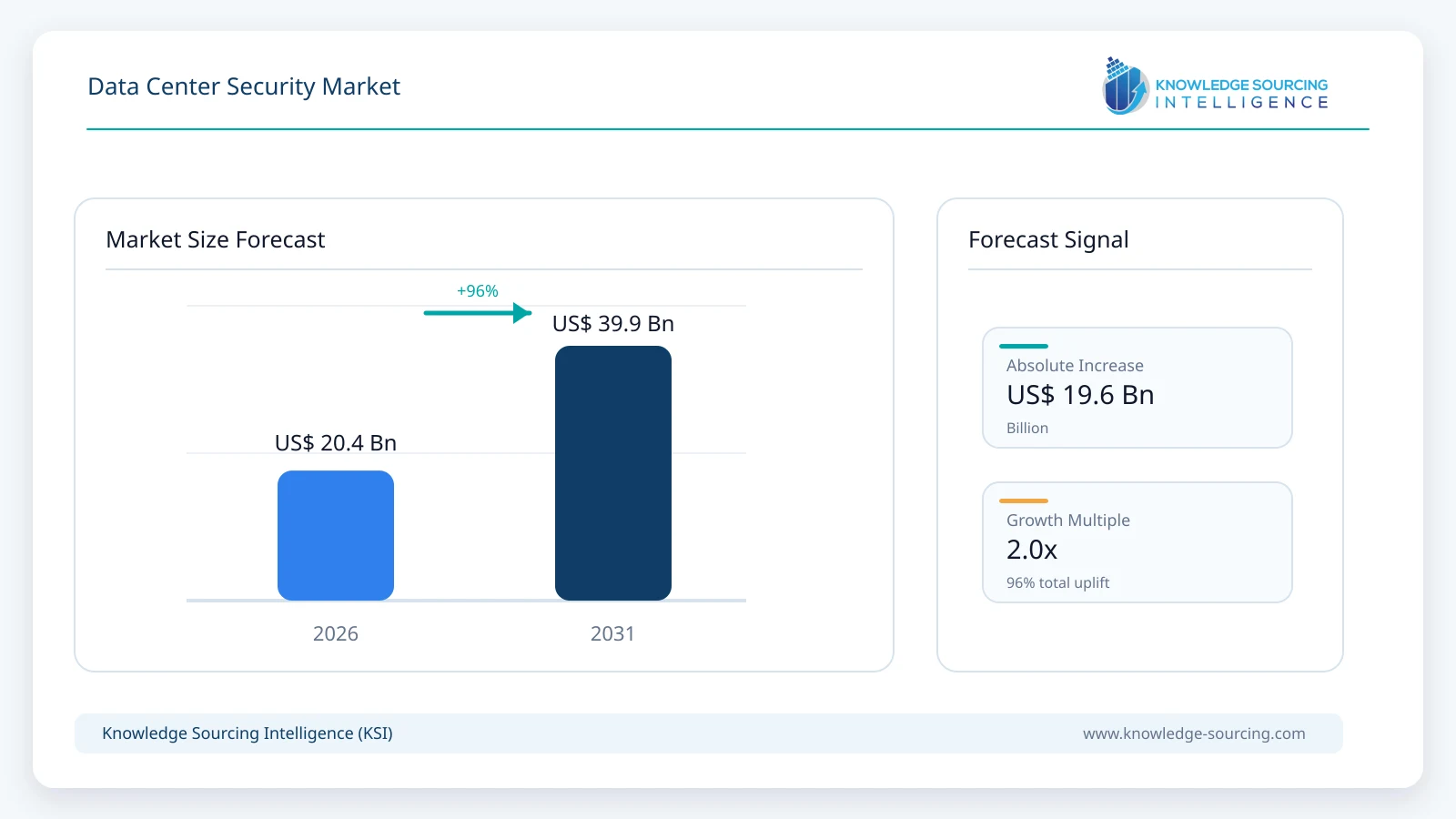
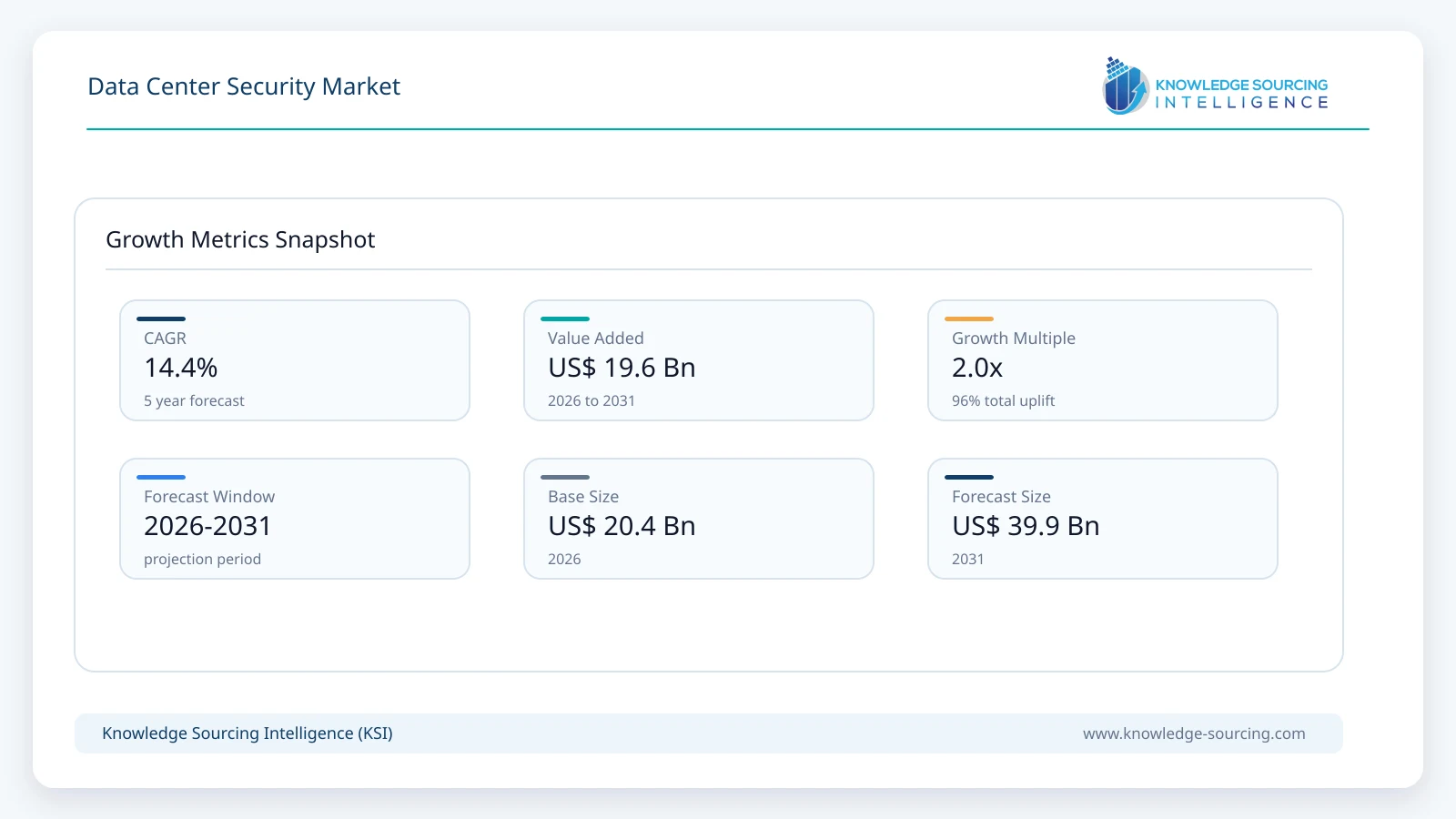
The Data Center Security Market is forecast to grow at a CAGR of 14.40%, reaching USD 39.94 billion in 2031 from USD 20.38 billion in 2026.
Highlights:
- 1Rising cyberattacks against critical digital infrastructure continue to strengthen enterprise investment in integrated data center security solutions.
- 2Hyperscale and colocation facilities represent commercially important deployment environments due to expanding cloud capacity.
- 3Asia Pacific presents substantial long-term opportunities as governments and private investors accelerate regional data center construction.
- 4Zero-trust security architecture, AI-assisted threat detection, and Security Information and Event Management (SIEM) modernization remain important technology priorities.
- 5Data protection regulations and critical infrastructure security requirements continue to influence procurement decisions across regulated industries.
- 6Competition increasingly centers on integrated platforms combining physical security, cybersecurity, monitoring, and managed services.
The data center security market comprises technologies and services designed to protect physical infrastructure, computing resources, storage systems, networking equipment, applications, and sensitive information housed within enterprise, colocation, hyperscale, and edge data centers. Security investments span physical protection, cyber defense, identity governance, monitoring, and managed services that collectively ensure business continuity, regulatory compliance, and operational resilience.
Demand is being supported by the continued expansion of cloud computing, artificial intelligence (AI) workloads, hybrid IT architectures, and edge computing deployments. Organizations are consolidating critical applications into highly connected environments while simultaneously facing a broader threat surface. As a result, security procurement has shifted from isolated point products toward integrated architectures capable of protecting facilities, networks, workloads, and privileged identities under a unified governance framework.
Large enterprises remain the primary buyers, but procurement activity has expanded across colocation providers, cloud service operators, financial institutions, healthcare organizations, government agencies, and telecommunications companies. Purchasing decisions are increasingly influenced by compliance requirements, cyber resilience objectives, operational efficiency, and the ability to support zero-trust security models. Buyers also prioritize interoperability with existing infrastructure, automation capabilities, incident visibility, and lifecycle support when evaluating vendors.
Industry structure reflects the convergence of information technology security, operational technology protection, physical access control, surveillance, and infrastructure management. Vendors compete by delivering integrated platforms that combine software, hardware, analytics, managed services, and lifecycle support. Partnerships among cybersecurity providers, infrastructure manufacturers, system integrators, and cloud ecosystem participants continue to shape competitive positioning as customers seek fewer vendors capable of delivering comprehensive protection.
Investment activity is also expanding within hyperscale and edge infrastructure projects, where distributed facilities require centralized monitoring and policy enforcement. Organizations increasingly recognize that physical and logical security cannot operate independently, particularly as critical workloads become more decentralized. Consequently, demand is moving toward unified security operations supported by automation, artificial intelligence-assisted threat detection, and continuous compliance monitoring.
Market Drivers
Expansion of Cloud Infrastructure and Hyperscale Data Centers
Cloud service providers continue investing in hyperscale facilities to support enterprise migration, AI computing, and digital services. Every new facility requires multilayer security covering perimeter protection, access management, workload security, and continuous monitoring. Buyers increasingly seek scalable solutions that can secure geographically distributed infrastructure while maintaining consistent governance. Suppliers respond by integrating software-defined security with centralized management platforms, creating recurring revenue opportunities through subscription-based offerings and lifecycle services.
Rising Regulatory Requirements for Critical Infrastructure
Financial institutions, healthcare providers, public agencies, and telecommunications operators operate under expanding cybersecurity and privacy regulations. Compliance requirements encourage investments in identity management, data protection, audit logging, and continuous monitoring. Procurement decisions increasingly prioritize products that simplify compliance reporting while reducing operational risk. Vendors capable of demonstrating regulatory alignment gain competitive advantages during public and regulated sector procurement processes.
Growth in AI Workloads and High-Value Computing Assets
Artificial intelligence training clusters, high-performance computing infrastructure, and advanced analytics environments have become strategic assets for enterprises. These facilities require enhanced physical protection alongside advanced cyber defenses because service interruptions or unauthorized access may result in substantial operational and financial consequences. Organizations therefore allocate higher security budgets to facilities supporting mission-critical AI applications, creating demand for integrated monitoring, privileged access management, and behavioral analytics.
Adoption of Hybrid and Multi-Cloud Architectures
Organizations rarely depend on a single computing environment. Hybrid deployments combining on-premises infrastructure, colocation facilities, and multiple cloud platforms have increased administrative complexity. Security teams therefore prioritize centralized visibility, policy consistency, and unified threat detection across diverse environments. Vendors compete by expanding interoperability, cloud-native capabilities, and centralized orchestration platforms that reduce operational overhead while improving incident response.
Market Restraints and Challenges
Integration Complexity Across Legacy Infrastructure
Many enterprises operate legacy facilities alongside modern cloud-connected environments. Integrating physical security systems, networking infrastructure, cybersecurity tools, and operational technology often requires customized deployment approaches. Implementation complexity increases project costs and extends deployment timelines, particularly for organizations with multiple geographically dispersed facilities. System integration services and phased modernization strategies help reduce operational disruption during migration.
Shortage of Skilled Cybersecurity Professionals
Security technologies continue becoming more sophisticated, yet many organizations experience shortages of experienced cybersecurity personnel. Limited internal expertise affects deployment quality, policy management, and incident response effectiveness. This constraint encourages greater adoption of managed security services, although reliance on external providers introduces vendor management considerations and long-term contractual commitments.
Budget Constraints Among Mid-Sized Enterprises
While cybersecurity remains a strategic priority, capital allocation varies significantly across industries. Mid-sized organizations often balance security investments against broader infrastructure modernization initiatives. Procurement decisions therefore emphasize measurable operational value, platform consolidation, and lower total cost of ownership. Vendors increasingly address this challenge through subscription licensing, managed services, and modular deployment models.
Rapidly Changing Threat Techniques
Attack methodologies continue changing as cybercriminals exploit artificial intelligence, supply chain vulnerabilities, and credential compromise. Organizations must continuously update security policies, software, and monitoring capabilities to remain effective. Continuous investment requirements increase operational expenditure and reinforce demand for automated threat intelligence and security analytics platforms.
Major Segment Analysis
Logical Security Solutions
Logical security solutions represent one of the most commercially significant segments because organizations increasingly prioritize protection of digital assets over isolated infrastructure components. Identity and Access Management (IAM), Security Information and Event Management (SIEM), threat protection, application security, and data protection collectively form the operational foundation of modern data center security strategies.
Buyer priorities have shifted toward identity-centric security as privileged credentials remain among the most common attack vectors affecting enterprise infrastructure. Organizations seek centralized authentication, role-based access control, privileged account management, and continuous identity verification that align with zero-trust operating principles. Procurement decisions also favor platforms capable of integrating with cloud services, enterprise directories, endpoint security, and security orchestration tools.
Competition within logical security increasingly depends on automation, artificial intelligence-assisted analytics, interoperability, and threat visibility rather than standalone feature sets. Vendors capable of correlating security events across physical infrastructure, applications, networks, and cloud environments provide stronger operational value for security operations centers. Subscription-based software licensing and managed detection services also contribute recurring revenue opportunities while improving customer retention.
The commercial importance of logical security continues to expand as organizations migrate sensitive workloads to hybrid environments where centralized governance becomes essential for maintaining operational continuity and regulatory compliance.
Regional Analysis
North America maintains a leading position due to extensive hyperscale infrastructure, mature cloud adoption, and substantial enterprise cybersecurity expenditure. Financial services, government agencies, healthcare providers, and cloud operators continue investing in integrated security platforms supported by stringent regulatory oversight. Vendor competition remains intense, with innovation centered on AI-assisted security operations, zero-trust implementation, and managed services.
Europe demonstrates consistent demand supported by data protection regulations, critical infrastructure security initiatives, and enterprise modernization programs. Organizations emphasize compliance, privacy, and operational resilience when evaluating security investments. Industrial automation, manufacturing, financial services, and public sector organizations remain major purchasers, although implementation complexity across multiple jurisdictions can extend procurement cycles.
Asia Pacific represents the strongest infrastructure expansion opportunity as governments and private investors continue developing hyperscale campuses, cloud regions, and edge facilities. China, India, Japan, Australia, and Southeast Asian markets continue expanding domestic digital infrastructure. Buyers increasingly seek scalable security platforms capable of supporting new facilities while complying with national cybersecurity regulations and data localization policies.
Middle East and Africa continues benefiting from national digital economy strategies, smart city initiatives, and sovereign cloud investments. Gulf Cooperation Council countries are expanding enterprise and government data center capacity, creating opportunities for integrated physical and logical security providers. Skills availability and varying regulatory maturity remain implementation considerations across several markets.
South America presents steady opportunities led by cloud adoption, financial sector modernization, and enterprise digital infrastructure investments. Brazil remains the largest regional market, supported by expanding colocation capacity and enterprise cybersecurity spending. Economic uncertainty and budget constraints may influence procurement timing, although regulatory developments continue encouraging long-term security investment.
Competitive Landscape
Competition within the data center security market combines global cybersecurity providers, networking companies, infrastructure specialists, industrial technology suppliers, and integrated physical security providers. Suppliers differentiate themselves through platform integration, cloud compatibility, threat intelligence, artificial intelligence-enabled analytics, lifecycle services, and global delivery capabilities.
Competitive positioning increasingly depends on the ability to deliver unified solutions spanning access control, surveillance, identity governance, network security, data protection, SIEM, environmental monitoring, and managed security services. Strategic partnerships between cybersecurity vendors, cloud providers, infrastructure manufacturers, and system integrators strengthen market reach while enabling broader solution portfolios. Geographic expansion, service capabilities, recurring software revenue, and interoperability with existing enterprise infrastructure continue influencing purchasing decisions across multinational customers.
Recent Developments
June 2026: Seclore announced the general availability of ARMOR DSPM, a Data Security Posture Management capability that helps organizations discover, classify, prioritize, and protect sensitive enterprise and AI data across hybrid cloud and data center environments.
June 2026: Palo Alto Networks completed its acquisition of Portkey, strengthening AI security capabilities by securing AI agents, models, and applications across enterprise and cloud data center environments.
March 2026: Databricks launched Lakewatch, an open, agentic SIEM platform that unifies security, IT, and business data to improve threat detection, investigation, and response across enterprise and cloud data center environments.
February 2026: Kyndryl launched its first Cyber Defense Operations Center in Bengaluru, India, integrating network operations with security operations to strengthen cyber resilience, accelerate incident response, and improve protection for enterprise IT and data center environments.
Regulatory and Policy Environment
Regulatory compliance remains an important purchasing consideration across the data center security market. Organizations operating critical infrastructure must comply with cybersecurity, privacy, and operational resilience requirements established by national governments and regulatory authorities. Data protection regulations require organizations to implement appropriate technical and organizational safeguards for sensitive information, while financial, healthcare, and government sectors often face additional sector-specific security obligations.
International standards including ISO/IEC 27001 for information security management, ISO/IEC 27017 for cloud security, ISO/IEC 27018 for privacy protection, and ISO 22301 for business continuity influence procurement specifications and supplier qualification. Many operators also align with NIST Cybersecurity Framework guidance, SOC audit requirements, and regional critical infrastructure protection programs. Compliance obligations encourage continuous monitoring, identity governance, audit capabilities, encryption, and incident response planning, supporting sustained investment across both physical and logical security solutions.
Outlook and Strategic Implications
The commercial outlook remains supported by continued expansion of cloud infrastructure, AI computing, edge deployments, and enterprise modernization initiatives. Organizations are expected to prioritize integrated security architectures capable of protecting distributed infrastructure rather than investing in isolated security products. Procurement strategies will increasingly emphasize interoperability, automation, centralized management, and lifecycle cost efficiency.
Managed security services are expected to capture greater enterprise spending as organizations address cybersecurity talent shortages while improving operational resilience. Artificial intelligence will support faster threat detection, behavioral analytics, and automated incident response, although governance and model security will become additional investment priorities.
Competition is expected to center on platform consolidation, recurring software revenue, cloud-native capabilities, and strategic ecosystem partnerships. Vendors capable of combining physical protection, cybersecurity, infrastructure monitoring, and compliance management within unified operating environments are likely to strengthen long-term customer relationships. Despite continuing challenges related to implementation complexity, evolving cyber threats, and regulatory changes, sustained investment in secure digital infrastructure is expected to support favorable demand conditions throughout the forecast period.
Data Center Security Market Scope
| Report Metric | Details |
|---|---|
| Total Market Size in 2026 | USD 20.38 billion |
| Total Market Size in 2031 | USD 39.94 billion |
| Forecast Unit | Billion |
| Growth Rate | 14.40% |
| Study Period | 2021 to 2031 |
| Historical Data | 2021 to 2024 |
| Base Year | 2025 |
| Forecast Period | 2026 – 2031 |
| Segmentation | Data Center Type, Solution, Service, End-User Industry, Geography |
| Companies |
|
Market Segmentation
By Data Center Type
- Enterprise Data Centers
- Colocation Data Centers
- Hyperscale Data Centers
- Edge Data Centers
By Solution
- Physical Security Solutions
- Access Control
- Video Surveillance
- Perimeter Security
- Environmental Monitoring
- Logical Security Solutions
- Identity and Access Management (IAM)
- Threat and Application Security
- Data Protection
- Security Information and Event Management (SIEM)
By Service
- Professional Services
- Consulting
- Integration and Deployment
- Support and Maintenance
- Managed Security Services
By End-User Industry
- BFSI
- IT and Telecommunications
- Government and Defense
- Healthcare
- Manufacturing
- Retail and E-commerce
- Media and Entertainment
- Energy and Utilities
- Others
By Geography
- North America
- United States
- Canada
- Mexico
- South America
- Brazil
- Argentina
- Others
- Europe
- Germany
- United Kingdom
- France
- Italy
- Spain
- Others
- Middle East and Africa
- Saudi Arabia
- UAE
- South Africa
- Others
- Asia Pacific
- China
- Japan
- India
- South Korea
- Australia
- Others
Table of Contents
1. INTRODUCTION
1.1. Market Overview
1.2. Market Definition
1.3. Scope of the Study
1.4. Market Segmentation
1.5. Currency
1.6. Assumptions
1.7. Base and Forecast Years Timeline
1.8. Key Benefits for Stakeholders
2. RESEARCH METHODOLOGY
2.1. Research Design
2.2. Research Process
3. EXECUTIVE SUMMARY
3.1. Key Findings
4. MARKET DYNAMICS
4.1. Market Drivers
4.2. Market Restraints
4.3. Market Opportunities
4.4. Porter's Five Forces Analysis
4.4.1. Bargaining Power of Suppliers
4.4.2. Bargaining Power of Buyers
4.4.3. Threat of New Entrants
4.4.4. Threat of Substitutes
4.4.5. Competitive Rivalry in the Industry
4.5. Industry Value Chain Analysis
4.6. Analyst's View
5. DATA CENTER SECURITY MARKET BY DATA CENTER TYPE
5.1. Introduction
5.2. Enterprise Data Centers
5.3. Colocation Data Centers
5.4. Hyperscale Data Centers
5.5. Edge Data Centers
6. DATA CENTER SECURITY MARKET BY SOLUTION
6.1. Introduction
6.2. Physical Security Solutions
6.2.1. Access Control
6.2.2. Video Surveillance
6.2.3. Perimeter Security
6.2.4. Environmental Monitoring
6.3. Logical Security Solutions
6.3.1. Identity and Access Management (IAM)
6.3.2. Threat and Application Security
6.3.3. Data Protection
6.3.4. Security Information and Event Management (SIEM)
7. DATA CENTER SECURITY MARKET BY SERVICE
7.1. Introduction
7.2. Professional Services
7.2.1. Consulting
7.2.2. Integration and Deployment
7.2.3. Support and Maintenance
7.3. Managed Security Services
8. DATA CENTER SECURITY MARKET BY END-USER INDUSTRY
8.1. Introduction
8.2. BFSI
8.3. IT and Telecommunications
8.4. Government and Defense
8.5. Healthcare
8.6. Manufacturing
8.7. Retail and E-commerce
8.8. Media and Entertainment
8.9. Energy and Utilities
8.10. Others
9. DATA CENTER SECURITY MARKET BY GEOGRAPHY
9.1. Introduction
9.2. North America
9.2.1. By Data Center Type
9.2.2. By Solution
9.2.3. By Service
9.2.4. By End-User Industry
9.2.5. By Country
9.2.5.1. United States
9.2.5.2. Canada
9.2.5.3. Mexico
9.3. South America
9.3.1. By Data Center Type
9.3.2. By Solution
9.3.3. By Service
9.3.4. By End-User Industry
9.3.5. By Country
9.3.5.1. Brazil
9.3.5.2. Argentina
9.3.5.3. Others
9.4. Europe
9.4.1. By Data Center Type
9.4.2. By Solution
9.4.3. By Service
9.4.4. By End-User Industry
9.4.5. By Country
9.4.5.1. Germany
9.4.5.2. United Kingdom
9.4.5.3. France
9.4.5.4. Italy
9.4.5.5. Spain
9.4.5.6. Others
9.5. Middle East and Africa
9.5.1. By Data Center Type
9.5.2. By Solution
9.5.3. By Service
9.5.4. By End-User Industry
9.5.5. By Country
9.5.5.1. Saudi Arabia
9.5.5.2. UAE
9.5.5.3. South Africa
9.5.5.4. Others
9.6. Asia Pacific
9.6.1. By Data Center Type
9.6.2. By Solution
9.6.3. By Service
9.6.4. By End-User Industry
9.6.5. By Country
9.6.5.1. China
9.6.5.2. Japan
9.6.5.3. India
9.6.5.4. South Korea
9.6.5.5. Australia
9.6.5.6. Others
10. COMPETITIVE ENVIRONMENT AND ANALYSIS
10.1. Major Players and Strategy Analysis
10.2. Market Share Analysis
10.3. Mergers, Acquisitions, Agreements, and Collaborations
10.4. Competitive Dashboard
11. COMPANY PROFILES
11.1. Cisco Systems, Inc.
11.2. Trend Micro Incorporated
11.3. Dell Technologies Inc.
11.4. International Business Machines Corporation (IBM)
11.5. Juniper Networks, Inc.
11.6. Broadcom Inc.
11.7. Fortinet, Inc.
11.8. Palo Alto Networks, Inc.
11.9. Honeywell International Inc.
11.10. Securitas Technology
11.11. Schneider Electric SE
11.12. Johnson Controls International plc
Navigate
Trusted by the world's leading organizations











