
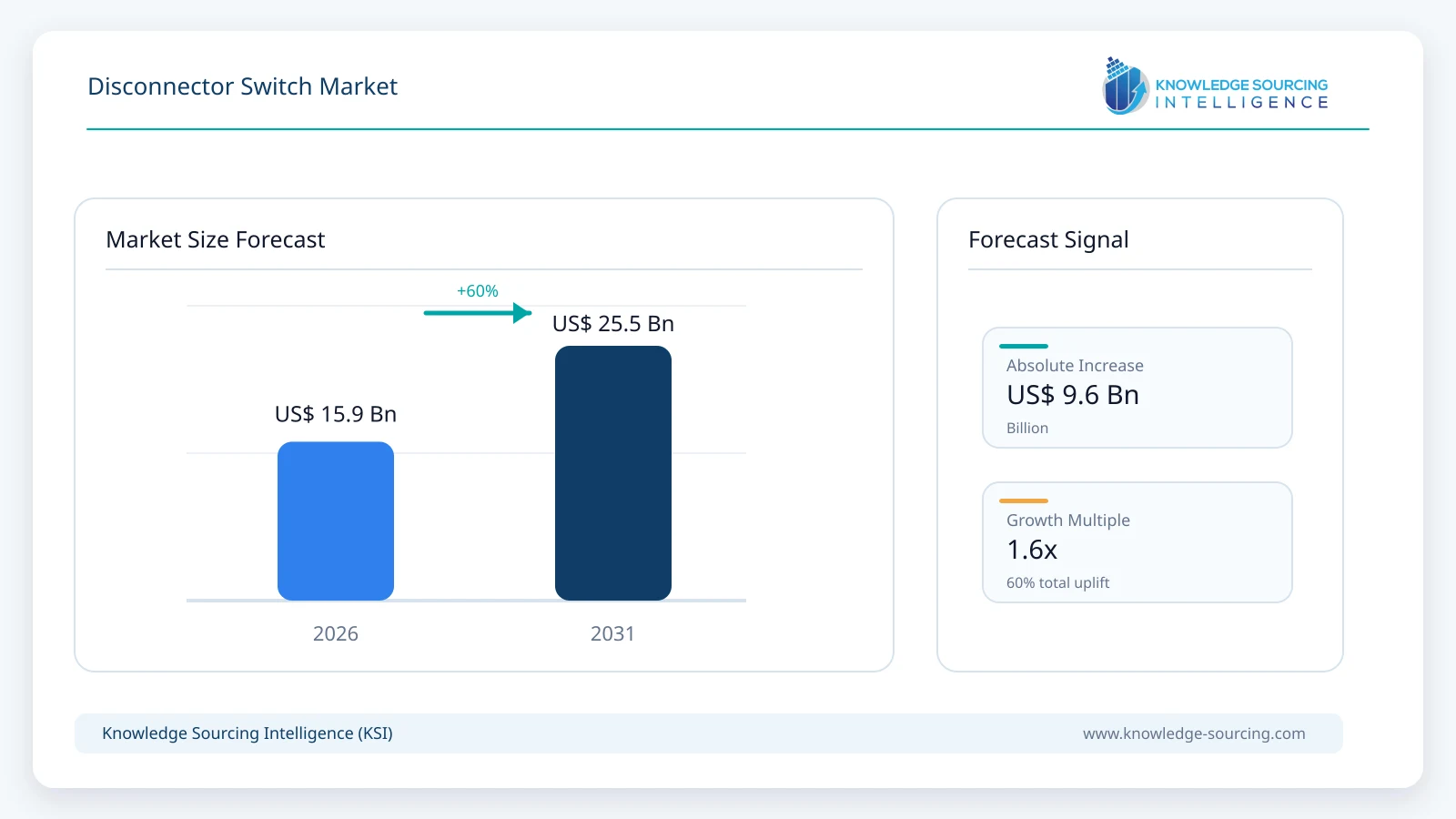
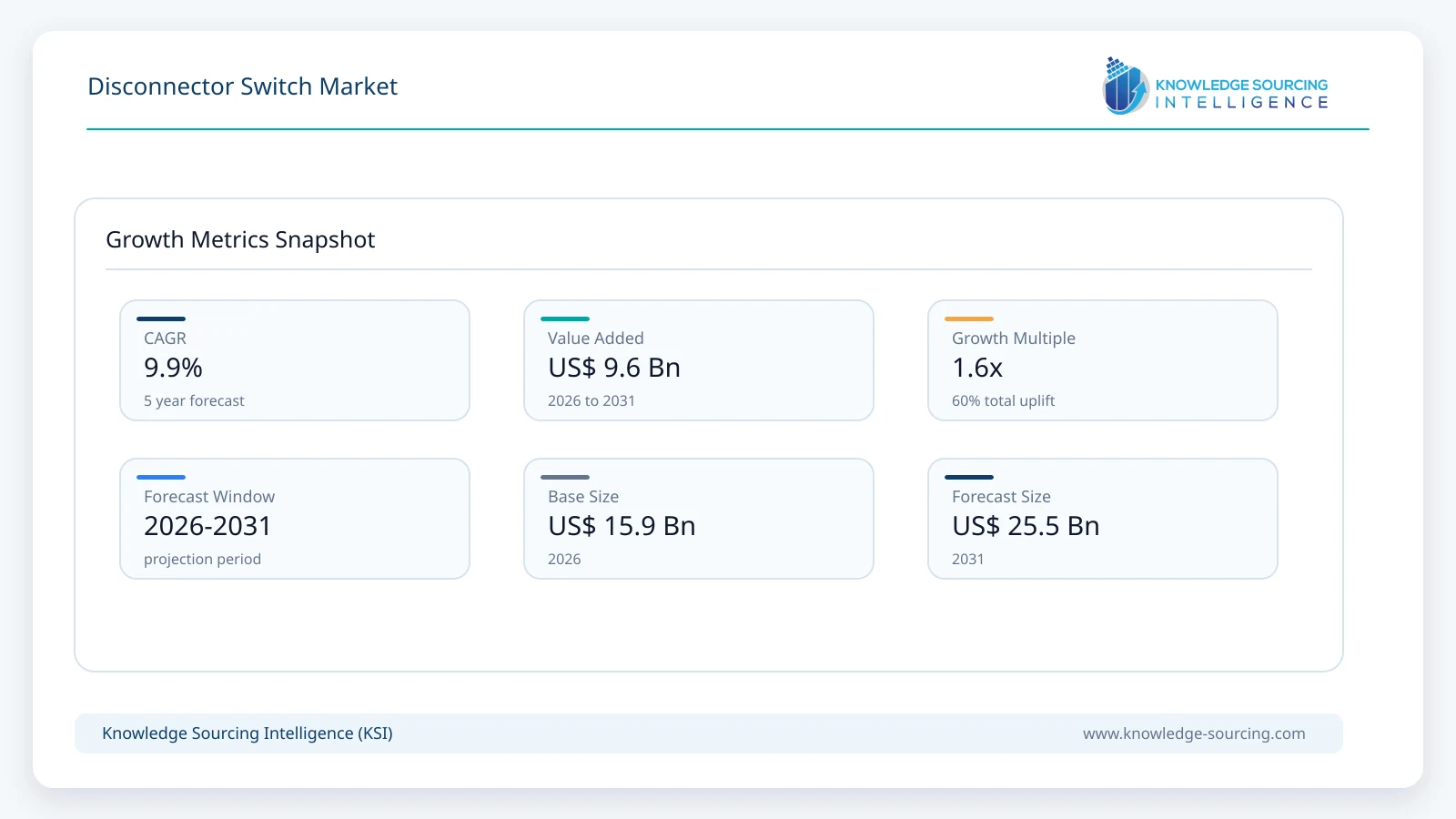
The Disconnector Switch Market is forecast to grow at a CAGR of 9.9%, reaching USD 25.5 billion in 2031 from USD 15.9 billion in 2026.
Highlights:
- 1Expansion of transmission networks and renewable grid integration is increasing demand for reliable isolation equipment.
- 2Utilities prioritize disconnectors that meet IEC and IEEE standards while reducing maintenance requirements.
- 3SF6-free switching technologies are gaining commercial importance as environmental regulations tighten.
- 4Data centers, industrial facilities, and transport electrification are widening application opportunities beyond conventional utilities.
- 5Manufacturers are investing in digital monitoring, modular designs, and localized production to improve delivery reliability.
Market Overview
Unlike circuit breakers, disconnectors are designed to isolate equipment only after current interruption has occurred, making them indispensable across transmission substations, industrial power systems, renewable energy facilities, commercial infrastructure, and critical installations where personnel safety and operational continuity are mandatory. Demand therefore reflects investment in electrical infrastructure rather than short-term fluctuations in electricity consumption.
Purchasing decisions increasingly extend beyond voltage ratings and switching performance. Utilities and industrial operators now evaluate lifecycle cost, maintenance intervals, compliance with IEC and IEEE standards, environmental performance, operating reliability, and compatibility with digital substation architectures. Grid modernization programs are also encouraging procurement of equipment capable of supporting automation, remote monitoring, and predictive maintenance while reducing outage durations.
Investment patterns across the value chain indicate a gradual shift toward higher-value products. Manufacturers are expanding portfolios that combine disconnectors with earthing switches, motorized operating mechanisms, digital diagnostics, and environmentally preferable insulation technologies. The transition away from SF6-based equipment in selected markets, particularly Europe, is encouraging suppliers to commercialize alternative insulation technologies without compromising switching reliability.
Commercial activity remains closely linked to transmission expansion, renewable power integration, replacement of ageing substations, industrial electrification, and data center construction. Utilities continue to represent the largest procurement group because network reliability and worker safety requirements demand high-quality isolation equipment throughout transmission and distribution infrastructure. Industrial facilities, renewable energy developers, and operators of critical infrastructure increasingly seek compact, modular products that simplify installation while reducing maintenance costs over long operating lives.
Key Market Indicators
Indicator | Latest Evidence | Commercial Meaning |
High-voltage operating range | 36-800 kV | Supports applications from transmission substations to extra-high-voltage grids. |
Medium-voltage switch capability | Up to 38.5 kV | Addresses industrial facilities, renewable plants, and secondary distribution networks. |
Rated current capability | Up to 5,000 A | Enables use in high-capacity transmission infrastructure. |
Short-circuit withstand | Up to 80 kA (1 second) | Demonstrates suitability for demanding grid protection requirements. |
Environmental transition | SF6-free product portfolios expanding | Reflects regulatory pressure and customer demand for lower-emission switchgear. |
Market Drivers
Expansion of transmission and distribution infrastructure. National utilities continue investing in grid reinforcement to improve reliability, connect new generating capacity, and replace ageing substations. Every transmission expansion project requires isolation equipment at substations, switching stations, and distribution facilities, making disconnectors a recurring procurement category rather than a one-time capital purchase. Manufacturers including Siemens Energy, ABB, and Hitachi Energy have expanded portfolios covering voltage ranges from medium voltage to extra-high-voltage applications while emphasizing standardized designs that shorten installation time and simplify maintenance. Utilities increasingly prefer suppliers capable of providing complete switching solutions together with long-term technical support.
Renewable energy integration is changing substation requirements. Utility-scale solar, wind, battery storage, and grid interconnection projects require reliable isolation equipment throughout collector substations, transmission interfaces, and distribution networks. Renewable installations also increase switching frequency because distributed generation introduces more complex operating conditions than conventional centralized power plants. Manufacturers have responded by offering modular switch-disconnector configurations compatible with compact substations and renewable grid connections. ABB specifically identifies solar and wind grid connection stations among key applications for its medium-voltage switch-disconnectors, reflecting changing customer demand across renewable infrastructure projects.
Greater emphasis on operational safety and lower lifecycle maintenance. Utilities and industrial operators increasingly evaluate equipment using total ownership cost rather than acquisition price alone. Long maintenance intervals, visible isolation, mechanical reliability, and compliance with IEC standards reduce planned outages and improve workforce safety. Product development therefore focuses on higher mechanical endurance, remote operation, condition monitoring, and integrated earthing functionality. Siemens Energy and Hitachi Energy both position disconnectors as essential safety devices that provide visible electrical isolation while supporting reliable operation across demanding environmental conditions, strengthening replacement demand in ageing transmission assets.
Market Restraints and Challenges
Lengthy qualification and utility procurement cycles. Utilities and transmission operators subject high-voltage disconnectors to extensive technical evaluation before approval because these components directly affect grid reliability and worker safety. Procurement commonly includes type testing, factory acceptance tests, site inspections, and compliance verification with IEC and IEEE standards before equipment enters approved vendor lists. This process extends sales cycles and delays revenue realization, particularly for new suppliers attempting to enter established utility markets. Large manufacturers such as Siemens Energy, Hitachi Energy, ABB, and GE benefit from proven operating records, while smaller suppliers often face higher certification costs and longer commercialization timelines due to limited field references. Official utility procurement frameworks across several countries continue to emphasize lifecycle reliability and documented operational performance rather than initial purchase price.
Raw material price volatility and supply-chain constraints. Disconnector switches depend on conductive metals, structural steel, aluminum, copper, silver-plated contacts, porcelain or composite insulators, and precision mechanical assemblies. Price fluctuations in these materials directly influence manufacturing costs and project profitability, particularly under fixed-price utility contracts negotiated months before delivery. Several electrical equipment manufacturers have highlighted inflationary pressure, supply-chain disruptions, and longer lead times for electrical components in recent annual reports and earnings disclosures. Companies have responded by expanding supplier networks, increasing regional sourcing, and strengthening inventory management, yet procurement risks remain elevated for customized high-voltage equipment where alternative suppliers are limited. These pressures affect manufacturer margins more than customer demand, although prolonged cost increases may eventually influence equipment pricing.
Environmental regulation increases product redesign requirements. Environmental policy is changing equipment specifications across the power transmission sector. European regulations targeting fluorinated greenhouse gases are encouraging the transition toward alternatives to sulfur hexafluoride (SF?), requiring manufacturers to redesign switchgear platforms and validate new insulation technologies without compromising operational safety or switching performance. Product redesign involves additional engineering investment, qualification testing, and certification before commercial deployment. Larger suppliers with broader research capabilities can distribute these development costs across multiple product families, whereas smaller manufacturers may face greater financial and technical challenges during the transition. The shift therefore raises barriers to entry while increasing development costs across portions of the industry. Official policy initiatives from the European Union continue to accelerate this transition by limiting future reliance on high-global-warming-potential gases in electrical equipment.
Project execution depends on broader grid infrastructure schedules. Demand for disconnectors is closely linked to transmission expansion, substation construction, industrial electrification, and renewable energy projects. Delays in environmental approvals, land acquisition, financing, or transmission planning frequently postpone equipment procurement even when supplier manufacturing capacity is available. Company disclosures from major electrical equipment manufacturers regularly identify project timing, customer capital expenditure decisions, and permitting delays as factors affecting order conversion. These challenges are generally cyclical rather than structural, but they can create uneven quarterly demand patterns and complicate production planning for manufacturers serving large infrastructure projects.
Major Segment Analysis
Utilities (Transmission and Distribution)
Utilities (Transmission and Distribution) represent the most commercially important application segment because disconnectors are fundamental components of transmission substations, switching stations, and distribution infrastructure. Every planned maintenance activity, network expansion project, transformer installation, and transmission upgrade requires reliable electrical isolation to protect personnel and equipment. Procurement therefore remains closely linked to long-term grid investment programs rather than short-term industrial production cycles.
Utilities evaluate suppliers using criteria that extend well beyond electrical ratings. Mechanical endurance, compliance with IEC and IEEE standards, corrosion resistance, ease of maintenance, digital monitoring capability, and availability of long-term spare parts frequently determine purchasing decisions. Grid operators also favor manufacturers with established service networks capable of supporting equipment throughout operating lives that often exceed three decades.
Competition within this segment increasingly centers on lifecycle performance rather than acquisition cost alone. Suppliers continue expanding portfolios that integrate disconnectors with earthing switches, motorized operating mechanisms, and digital condition monitoring, enabling utilities to reduce maintenance intervals while improving operational reliability. Industrial and renewable energy customers increasingly adopt similar specifications, reinforcing the segment's influence across the broader market.
Regional Analysis
Region | Main Demand Signal | Principal Constraint |
North America | Grid modernization, renewable integration, data center expansion | Ageing infrastructure and lengthy utility procurement |
Europe | Grid decarbonization, SF6 transition, offshore wind investment | Tight environmental regulations and certification requirements |
Asia Pacific | Rapid transmission expansion, industrial electrification, manufacturing investment | Supply-chain complexity and varying national standards |
Middle East and Africa | Utility expansion, renewable projects, smart city development | Project financing and dependence on imported equipment |
North America
Grid modernization programs across the United States and Canada continue to support procurement of high-voltage switching equipment. Utility investment in transmission resilience, wildfire mitigation, renewable energy integration, and replacement of ageing substations has increased demand for disconnectors capable of supporting higher reliability and remote operation. Data center construction also contributes to medium-voltage equipment demand as hyperscale facilities require dependable electrical isolation throughout power distribution systems. Buyers increasingly prioritize products with proven field performance, digital monitoring capability, and strong aftermarket support, reinforcing the competitive advantage of suppliers with established utility relationships.
Europe
European demand is shaped by transmission expansion, offshore wind integration, cross-border interconnections, and increasingly stringent environmental policy. The transition away from SF6-based electrical equipment is encouraging investment in alternative insulation technologies, prompting manufacturers to accelerate product development across medium- and high-voltage portfolios. Utilities also emphasize lifecycle efficiency, maintenance reduction, and compliance with evolving European standards when evaluating suppliers. Competition therefore depends as much on environmental performance and engineering capability as on conventional electrical specifications.
Asia Pacific
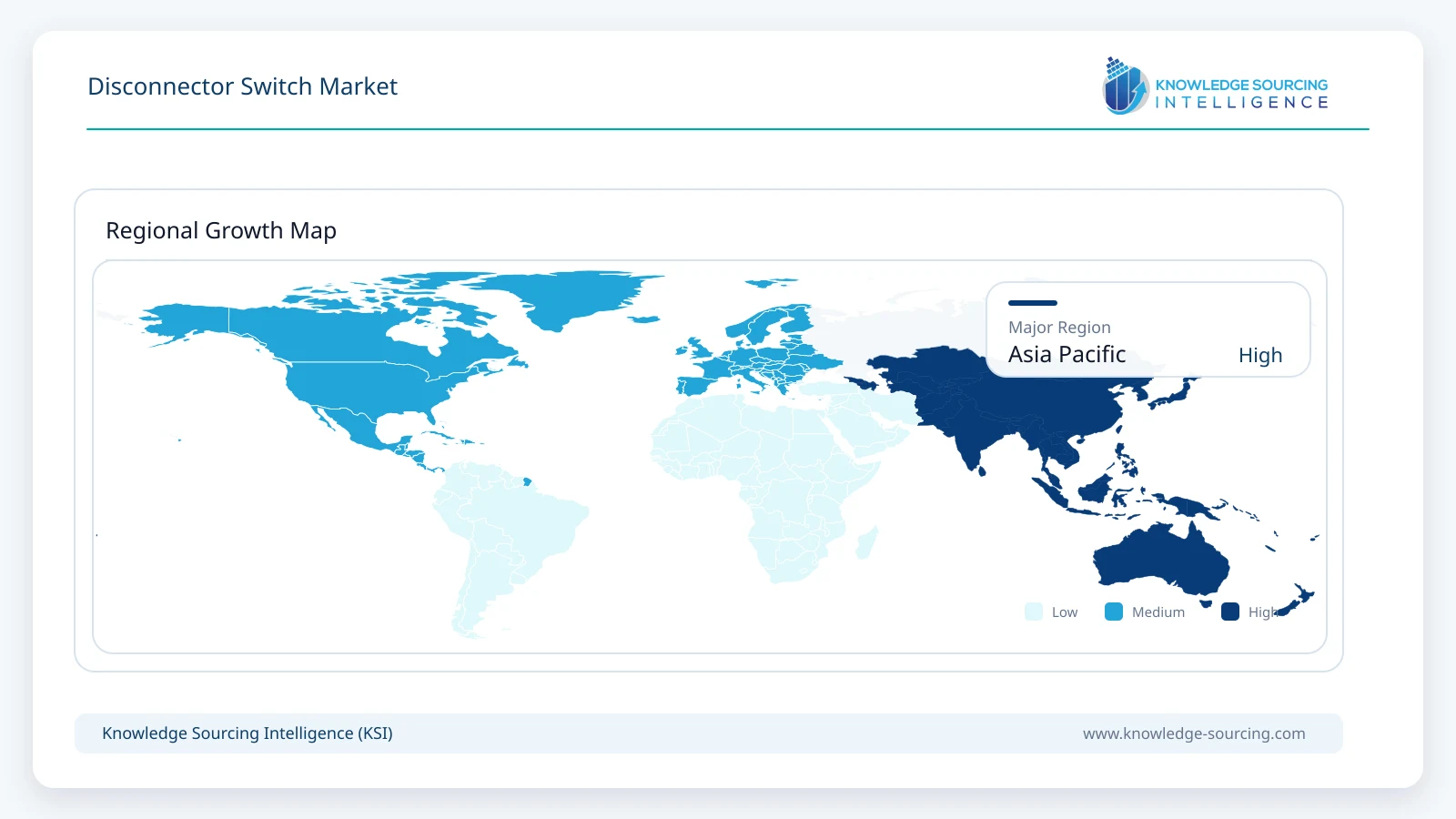
Asia Pacific remains the largest manufacturing base for electrical equipment and one of the most active regions for transmission network expansion. China and India continue investing in ultra-high-voltage transmission, renewable energy integration, and urban distribution infrastructure, while Japan, South Korea, and Taiwan maintain demand through industrial modernization and replacement of ageing electrical assets. Rapid expansion of manufacturing facilities, rail electrification, semiconductor production, and digital infrastructure further supports demand for medium-voltage disconnectors. Domestic manufacturing capacity is expanding, although imported technologies continue to play an important role in specialized high-voltage applications.
Middle East and Africa
Power generation diversification, transmission expansion, and utility modernization remain the principal demand drivers across the Middle East and Africa. Countries including Saudi Arabia and the UAE continue investing in renewable energy, industrial cities, and large-scale infrastructure requiring reliable switching equipment. Many projects specify internationally certified products to ensure long operating life under demanding climatic conditions. Procurement decisions often depend on engineering support, local service capability, and project financing, making partnerships between global manufacturers and regional distributors an important competitive strategy.
Competitive Landscape
The disconnector switch market remains moderately consolidated, with competition centered on engineering capability, compliance with international standards, manufacturing scale, and long-term service support rather than price alone. Utilities and industrial customers typically procure equipment through formal qualification processes, creating high barriers to entry for suppliers without established operating references. As a result, incumbent manufacturers retain competitive advantages through certified product portfolios, extensive testing capabilities, and global service networks.
Siemens AG, General Electric Company, ABB Ltd., Eaton Corporation, Schneider Electric SE, Mitsubishi Electric, Hitachi Energy, Socomec, Driescher, and Toshiba Energy Systems & Solutions compete across different voltage classes and application segments. While Siemens Energy, Hitachi Energy, GE, and ABB maintain broad portfolios covering high-voltage transmission infrastructure, Schneider Electric, Eaton, and Socomec emphasize medium- and low-voltage applications for industrial facilities, commercial buildings, and critical infrastructure. Manufacturers are expanding digital monitoring capabilities, introducing environmentally preferable switching technologies, increasing regional manufacturing capacity, and strengthening lifecycle service offerings to address customer requirements for higher reliability and lower maintenance costs. The competitive environment therefore increasingly rewards suppliers capable of delivering integrated switching solutions, engineering support, and long-term asset management rather than standalone hardware.
Recent Developments
April 2026 – Siemens launched its new direct current switching portfolio. The portfolio includes the SENTRON 3QD2 semiconductor circuit breaker and SIRIUS 3RF5 solid-state switching device, advancing high-speed DC protection and switching for data centers, battery storage, and industrial power systems.
December 2025 – ABB completed the acquisition of Gamesa Electric’s power electronics business. The acquisition broadens ABB’s electrification portfolio with complementary power conversion technologies supporting renewable energy, industrial switching, and modern electrical distribution infrastructure.
November 2025 – ABB introduced enclosed OT Plus 16A–160A switch disconnectors. The new compact disconnector switches enhance installation flexibility, operational safety, and reliable isolation performance for industrial, commercial, and low-voltage power distribution applications.
Regulatory and Policy Environment
Electrical disconnectors are governed primarily by equipment safety, grid reliability, and environmental regulations rather than product-specific legislation. International standards developed by the International Electrotechnical Commission (IEC) establish requirements for high-voltage disconnectors, earthing switches, testing procedures, insulation performance, and mechanical endurance through standards including IEC 62271. Compliance with these standards has become a prerequisite for participation in most utility procurement programs and large infrastructure projects.
North American utilities generally specify compliance with IEEE and ANSI standards alongside utility-specific qualification procedures. These additional testing requirements often extend supplier approval timelines but improve long-term network reliability and equipment interoperability across transmission systems.
Environmental regulation is becoming increasingly influential in product development. The European Union's revised F-gas Regulation accelerates the reduction of SF6 use in electrical equipment, encouraging manufacturers to commercialize alternative insulation technologies and redesign switchgear platforms for future compliance. Similar environmental objectives are influencing procurement strategies in other developed markets, although implementation timelines differ by jurisdiction.
Grid modernization policies also support demand indirectly. Public investment in transmission expansion, renewable energy integration, electrified transport, and power system resilience increases procurement of substation equipment, including disconnectors, as part of broader infrastructure development programs. Consequently, regulatory policy increasingly shapes product specifications, environmental performance expectations, and supplier qualification criteria.
Outlook and Strategic Implications
Demand through the 2026 to 2031 forecast period is expected to remain closely aligned with investment in transmission infrastructure, renewable energy integration, industrial electrification, and modernization of ageing electrical networks. While cyclical delays in infrastructure spending may influence short-term order timing, long-term replacement requirements and grid expansion programs continue to support sustained procurement of disconnector switches across utility and industrial applications.
Commercial priorities are shifting toward equipment offering lower lifecycle cost, extended maintenance intervals, digital asset monitoring, and compliance with evolving environmental standards. Suppliers capable of integrating disconnectors with intelligent substation architectures, remote operating mechanisms, and condition-based maintenance platforms are likely to strengthen their position in higher-value procurement opportunities.
Strategic priorities across the value chain include:
Utilities: Prioritize lifecycle reliability, digital monitoring capability, and compliance with evolving environmental regulations.
Manufacturers: Expand SF6-free product portfolios, strengthen regional manufacturing, and increase investment in digital asset management technologies.
Industrial and commercial buyers: Focus on standardized equipment that reduces maintenance requirements while supporting operational continuity.
Investors and technology providers: Monitor transmission infrastructure spending, renewable grid connection projects, and regulatory developments governing environmentally sustainable switchgear.
Over the medium term, competitive differentiation is expected to depend less on conventional switching performance and more on engineering support, environmental compliance, digital functionality, and long-term service capability. Manufacturers able to combine these attributes with resilient supply chains and localized customer support are expected to capture a greater share of utility modernization and infrastructure expansion projects.
Disconnector Switch Market Scope:
| Report Metric | Details |
|---|---|
| Total Market Size in 2026 | USD 15.9 billion |
| Total Market Size in 2031 | USD 25.5 billion |
| Forecast Unit | USD Billion |
| Growth Rate | 9.9% |
| Study Period | 2021 to 2031 |
| Historical Data | 2021 to 2024 |
| Base Year | 2025 |
| Forecast Period | 2026 – 2031 |
| Segmentation | Type, Voltage, Application, Geography |
| Companies |
|
Market Segmentation
Global Disconnector Switch Market Segmentation:
By Type
Fused switches
Non-Fused switches
By Mount
Panel Mounted
DIN Rail Mounted
Base Mounted
Pole Mounted
Others
By Voltage
High Voltage
Medium Voltage
Low Voltage
By Application
Industrial
Utilities (Transmission and Distribution)
Commercial
Renewable Energy
Residential
Transportation and Railways
Data Centers
By Geography
North America
USA
Canada
Mexico
South America
Brazil
Argentina
Others
Europe
United Kingdom
Germany
France
Spain
Others
Middle East and Africa
Saudi Arabia
UAE
Israel
Others
Asia Pacific
China
Japan
India
South Korea
Taiwan
Thailand
Indonesia
Others
Table of Contents
1. INTRODUCTION
1.1. Market Overview
1.2. Market Definition
1.3. Scope of the Study
1.4. Market Segmentation
1.5. Currency
1.6. Assumptions
1.7. Base and Forecast Years Timeline
1.8. Key Benefits for the stakeholder
2. RESEARCH METHODOLOGY
2.1. Research Design
2.2. Research Processes
3. EXECUTIVE SUMMARY
3.1. Key Findings
3.2. Analyst View
4. MARKET DYNAMICS
4.1. Market Drivers
4.2. Market Restraints
4.3. Porter’s Five Forces Analysis
4.3.1. Bargaining Power of Suppliers
4.3.2. Bargaining Power of Buyers
4.3.3. Threat of New Entrants
4.3.4. Threat of Substitutes
4.3.5. Competitive Rivalry in the Industry
4.4. Industry Value Chain Analysis
4.5. Analyst View
5. GLOBAL DISCONNECTOR SWITCH MARKET, BY TYPE
5.1. Introduction
5.2. Fused switches
5.3. Non-Fused switches
6. GLOBAL DISCONNECTOR SWITCH MARKET, BY MOUNT
6.1. Introduction
6.2. Panel Mounted
6.3. DIN Rail Mounted
6.4. Base Mounted
6.5. Pole Mounted
6.6. Others
7. GLOBAL DISCONNECTOR SWITCH MARKET, BY VOLTAGE
7.1. Introduction
7.2. High Voltage
7.3. Medium Voltage
7.4. Low Voltage
8. GLOBAL DISCONNECTOR SWITCH MARKET, BY APPLICATION
8.1. Introduction
8.2. Industrial
8.3. Utilities (Transmission and Distribution)
8.4. Commercial
8.5. Renewable Energy
8.6. Residential
8.7. Transportation and Railways
8.8. Data Centers
9. GLOBAL DISCONNECTOR SWITCH MARKET, BY GEOGRAPHY
9.1. Introduction
9.2. North America
9.2.1. By Type
9.2.2. By Mount
9.2.3. By Voltage
9.2.4. By Application
9.2.5. By Country
9.2.5.1. USA
9.2.5.1.1. Market Trends and Opportunities
9.2.5.1.2. Growth Prospects
9.2.5.2. Canada
9.2.5.2.1. Market Trends and Opportunities
9.2.5.2.2. Growth Prospects
9.2.5.3. Mexico
9.2.5.3.1. Market Trends and Opportunities
9.2.5.3.2. Growth Prospects
9.3. South America
9.3.1. By Type
9.3.2. By Mount
9.3.3. By Voltage
9.3.4. By Application
9.3.5. By Country
9.3.5.1. Brazil
9.3.5.1.1. Market Trends and Opportunities
9.3.5.1.2. Growth Prospects
9.3.5.2. Argentina
9.3.5.2.1. Market Trends and Opportunities
9.3.5.2.2. Growth Prospects
9.3.5.3. Others
9.3.5.3.1. Market Trends and Opportunities
9.3.5.3.2. Growth Prospects
9.4. Europe
9.4.1. By Type
9.4.2. By Mount
9.4.3. By Voltage
9.4.4. By Application
9.4.5. By Country
9.4.5.1. United Kingdom
9.4.5.1.1. Market Trends and Opportunities
9.4.5.1.2. Growth Prospects
9.4.5.2. Germany
9.4.5.2.1. Market Trends and Opportunities
9.4.5.2.2. Growth Prospects
9.4.5.3. France
9.4.5.3.1. Market Trends and Opportunities
9.4.5.3.2. Growth Prospects
9.4.5.4. Spain
9.4.5.4.1. Market Trends and Opportunities
9.4.5.4.2. Growth Prospects
9.4.5.5. Others
9.4.5.5.1. Market Trends and Opportunities
9.4.5.5.2. Growth Prospects
9.5. Middle East and Africa
9.5.1. By Type
9.5.2. By Mount
9.5.3. By Voltage
9.5.4. By Application
9.5.5. By Country
9.5.5.1. Saudi Arabia
9.5.5.1.1. Market Trends and Opportunities
9.5.5.1.2. Growth Prospects
9.5.5.2. UAE
9.5.5.2.1. Market Trends and Opportunities
9.5.5.2.2. Growth Prospects
9.5.5.3. Israel
9.5.5.3.1. Market Trends and Opportunities
9.5.5.3.2. Growth Prospects
9.5.5.4. Others
9.5.5.4.1. Market Trends and Opportunities
9.5.5.4.2. Growth Prospects
9.6. Asia Pacific
9.6.1. By Type
9.6.2. By Mount
9.6.3. By Voltage
9.6.4. By Application
9.6.5. By Country
9.6.5.1. China
9.6.5.1.1. Market Trends and Opportunities
9.6.5.1.2. Growth Prospects
9.6.5.2. Japan
9.6.5.2.1. Market Trends and Opportunities
9.6.5.2.2. Growth Prospects
9.6.5.3. India
9.6.5.3.1. Market Trends and Opportunities
9.6.5.3.2. Growth Prospects
9.6.5.4. South Korea
9.6.5.4.1. Market Trends and Opportunities
9.6.5.4.2. Growth Prospects
9.6.5.5. Taiwan
9.6.5.5.1. Market Trends and Opportunities
9.6.5.5.2. Growth Prospects
9.6.5.6. Thailand
9.6.5.6.1. Market Trends and Opportunities
9.6.5.6.2. Growth Prospects
9.6.5.7. Indonesia
9.6.5.7.1. Market Trends and Opportunities
9.6.5.7.2. Growth Prospects
9.6.5.8. Others
9.6.5.8.1. Market Trends and Opportunities
9.6.5.8.2. Growth Prospects
10. COMPETITIVE ENVIRONMENT AND ANALYSIS
10.1. Major Players and Strategy Analysis
10.2. Market Share Analysis
10.3. Mergers, Acquisitions, Agreements, and Collaborations
10.4. Competitive Dashboard
11. COMPANY PROFILES
11.1. Siemens AG
11.2. General Electric Company
11.3. ABB Ltd.
11.4. Eaton Corporation
11.5. Schneider Electric SE
11.6. Mitsubishi Electric
11.7. Hitachi Energy
11.8. Socomec
11.9. Driescher
11.10. Toshiba Energy Systems & Solutions
LIST OF FIGURES
LIST OF TABLES
Navigate
Trusted by the world's leading organizations











