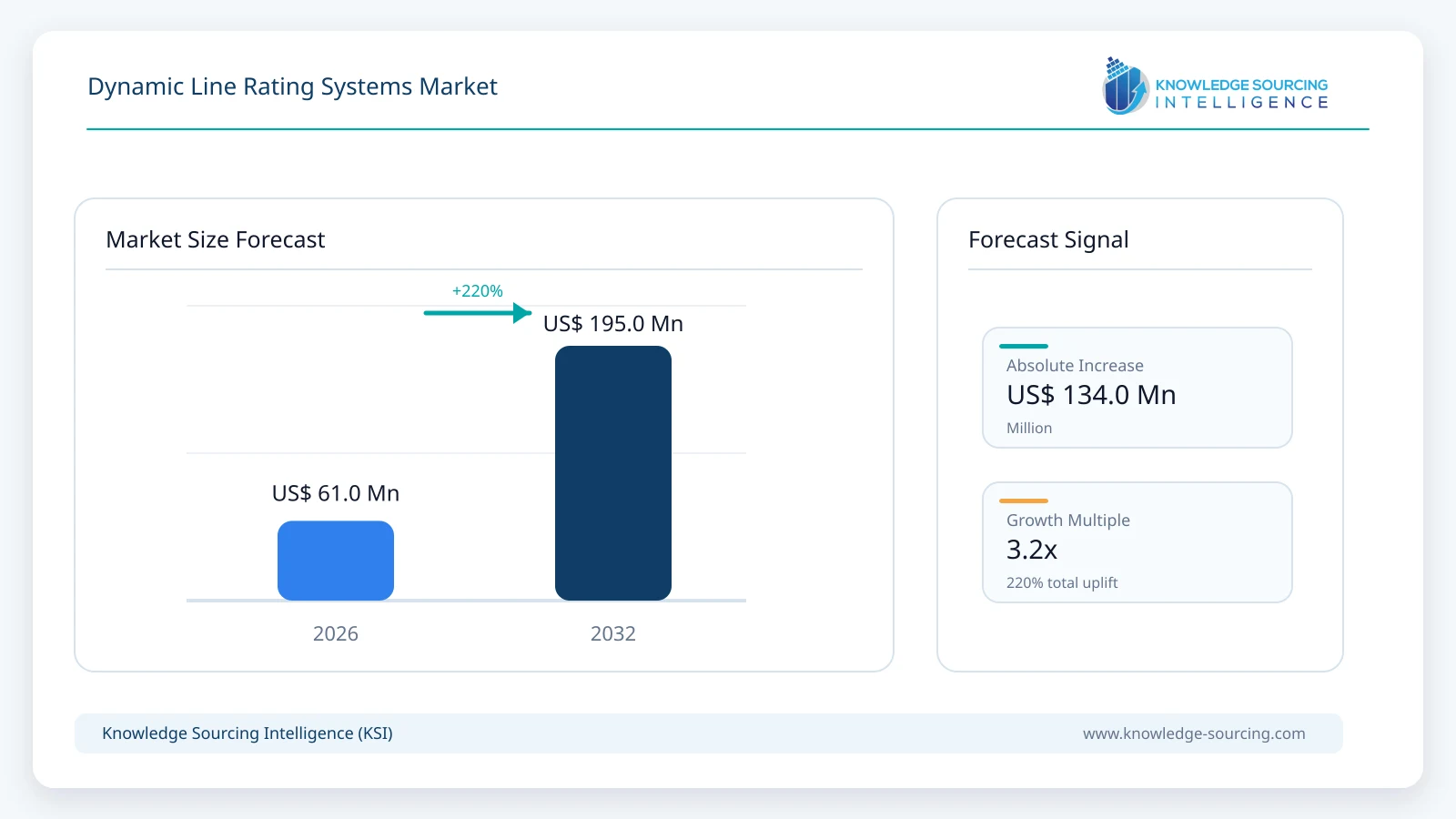
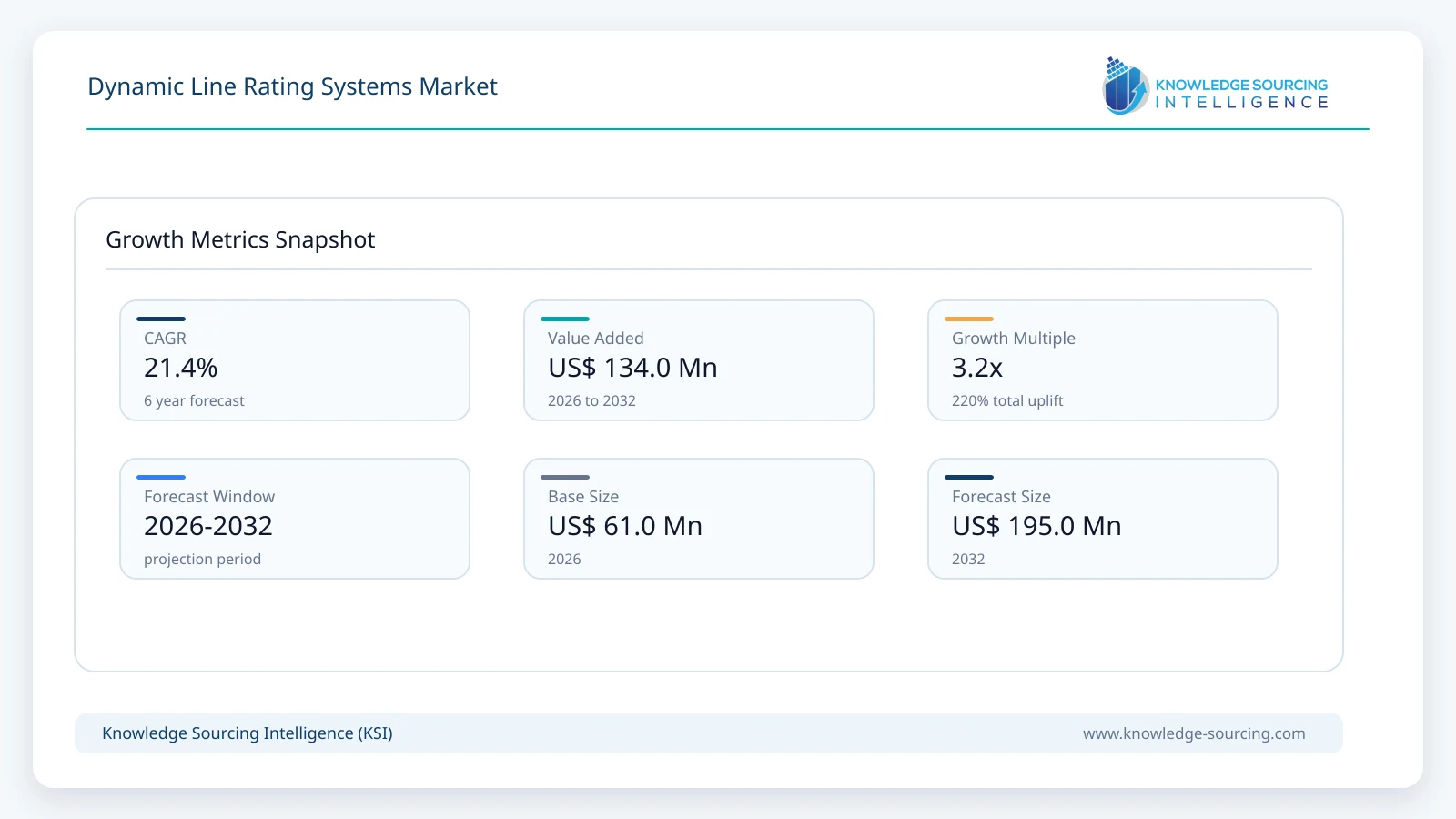
The global Dynamic Line Rating Systems market is forecast to grow at a CAGR of 21.4%, reaching USD 195.0 million in 2032 from USD 61.0 million in 2026.
Highlights:
- 1Dynamic Line Rating (DLR) systems is changing from isolated line trials toward control-room and market-operation integration at large transmission and distribution utilities.
- 2The IEA estimates that DLR can unlock approximately 20-30% additional capacity on suitable grid assets with implementation lead times of roughly one to two years.
- 3Sensorless DLR allows utilities to extend ratings across entire networks using weather, terrain and line models before adding physical sensors on critical spans.
- 4Conductor-mounted sensors remain important where utilities require direct measurement of sag, temperature, current or conductor-level wind conditions.
- 5Distributed fiber-optic sensing on existing OPGW creates a separate deployment path for long-corridor monitoring without installing devices on every conductor span.
- 6Forecast DLR is increasingly important because day-ahead and intraday ratings can be used in dispatch, congestion management and market operations rather than only real-time monitoring.
- 7Drone installation is lowering the field cost and outage requirement for conductor-mounted sensors on energized transmission lines.
Market Overview
Overhead-line capacity changes continuously because conductor cooling depends heavily on wind, ambient temperature, and solar conditions. Static or seasonal ratings are therefore intentionally conservative and can understate the amount of power that can be moved during many hours of the year. DLR replaces a fixed assumption with a calculated operating limit that can be updated in real time and forecast ahead for system operations.
The technology has developed along several architectures. Sensor-based systems measure conductor temperature, sag, vibration, current, or local weather on selected spans. Non-contact systems use tower-mounted sensing, LiDAR, cameras, or environmental data to improve line-state visibility. Sensorless DLR uses detailed line models, terrain, and high-resolution weather forecasts to calculate ratings across large networks without field hardware. OPGW-based approaches use distributed fiber-optic sensing to infer environmental and line conditions over long corridors.
Utilities are increasingly combining these methods rather than choosing one system for every line. Network-wide software can screen thousands of spans and identify locations where additional visibility creates operational value. Sensors can then be placed on critical or sheltered spans to reduce uncertainty, while fiber-based monitoring can provide continuous coverage where suitable OPGW is available. This hybrid architecture supports gradual expansion from planning analysis to control-room use.
Operational integration creates the largest step in commercial value. PPL Electric became an early U.S. example by incorporating DLR forecasts into operating systems and regional transmission-organization processes. Ampacimon reports a 186 km deployment across three 230 kV lines with up to 16% capacity gain, more than USD 23 million in congestion savings on one line and avoidance of a USD 50 million rebuild. European TSOs have similarly moved DLR into day-to-day capacity management rather than limiting the technology to engineering trials.
Forecasting is becoming as important as the real-time rating. Utilities need ratings several hours or days ahead to schedule generation, assess contingencies, plan maintenance, and submit available transfer capability to markets. Current commercial platforms provide intraday and multi-day forecasts together with confidence levels, emergency ratings, and fallback methods when sensors or weather feeds are unavailable.
Market Drivers
Transmission Congestion and Large-Load Growth
Data centers, industrial electrification, renewable projects and new generation are increasing power flows faster than major transmission corridors can be built. DLR can release additional capacity on selected constrained lines in a shorter period than new construction, allowing operators to reduce congestion or accommodate incremental transfers while longer-term reinforcements proceed.
Need to Use Existing Rights of Way More Intensively
New transmission routes face permitting, land, and construction constraints. DLR requires limited physical intervention relative to a new line or full reconductoring project and can therefore improve the utilization of existing assets with lower capital commitment. The IEA identifies DLR as one of the lowest-cost and fastest grid-enhancing options for suitable lines.
Improved Weather and Forecasting Resolution
High-resolution numerical weather prediction, terrain modelling and machine learning have improved the ability to estimate conductor cooling at individual spans. Sensorless providers can now generate network-wide ratings and confidence intervals, while sensor measurements provide calibration and validation for locations where wind sheltering or local conditions create additional uncertainty.
Regulatory Adoption of More Accurate Line Ratings
Regulators are increasing pressure on transmission providers to use ratings that better reflect actual conditions. FERC Order 881 requires ambient-adjusted ratings in the United States, and FERC has continued examining DLR and grid-enhancing technologies in planning and large-load interconnection. These requirements improve utility data, software and operating processes that can also support more advanced dynamic ratings.
Market Restraints
Variable and Non-Firm Capacity
DLR capacity depends on environmental conditions and cannot be treated as a fixed increase under all hours or contingencies. Utilities must incorporate uncertainty, forecast error and fallback ratings into operating procedures. This limits DLR as a complete substitute for reconductoring or new lines where additional firm capacity is required at all times.
Operational Validation and Control-Room Integration
A technically accurate rating does not automatically become an operational rating. Utilities must validate models, map critical spans, integrate forecasts into EMS/SCADA systems, define alarm and fallback logic, train operators, and coordinate with market or reliability organizations. These steps can take longer than sensor installation and slow the transition from pilot to routine use.
Communications and Cybersecurity Requirements
Sensor-based DLR relies on reliable communication from remote transmission corridors, while software-only systems depend on weather, line-model, and utility data feeds. Control-room integration requires cybersecurity, data availability, and auditability consistent with utility operating standards. These requirements increase system cost beyond the sensing device itself.
Line-Specific Suitability
DLR produces the greatest value where thermal line limits bind and favorable weather conditions frequently increase conductor cooling. Lines limited by substations, stability, voltage, protection, clearance, or downstream constraints may obtain little usable transfer increase. Utilities therefore need screening tools to identify corridors where DLR can materially change dispatch or investment decisions.
Segment Analysis
By Deployment Architecture
Four architectures shape adoption: sensor-based DLR, sensor-enhanced network-wide DLR, sensorless DLR and fiber-optic/OPGW-based DLR. Sensor-based systems provide direct physical measurement on selected spans and remain important for highly constrained lines where utilities want maximum measurement certainty. Sensor-enhanced network-wide systems combine modelling across all spans with physical sensors at critical locations, allowing broader coverage while containing hardware deployment cost.
Sensorless DLR is expected to expand rapidly because utilities can evaluate large portions of their transmission network without line installation. Its commercial value depends on high-resolution weather modelling, accurate conductor and geometry data, and confidence-aware forecasting. Fiber-optic systems provide another scalable option where utilities already have OPGW and can derive wind, vibration or temperature-related data over long corridors from distributed sensing.
By System Component
Commercial spending spans sensing hardware, communications and edge equipment, DLR software and thermal models, weather and forecast analytics, and integration/visualization software. Software and analytics represent a growing share of total revenue because network-wide DLR, rating forecasts and control-room integration can cover many more lines than physical sensor deployments alone.
By Utility Workflow
DLR serves real-time operations, day-ahead and intraday market operations, congestion management, interconnection and planning, and outage/maintenance planning. Real-time operations provide the core safety and capacity function, while forecast ratings create additional economic value by allowing system operators and markets to schedule available capacity before the operating hour.
By Voltage Class
Applications extend across sub-220 kV, 220-345 kV, 400-500 kV and above-500 kV overhead lines. Mid-voltage transmission and sub-transmission lines provide a large potential deployment base, while higher-voltage corridors can generate greater economic value per monitored line because congestion and transfer volumes are larger. Technology selection depends more on corridor conditions and operating value than voltage alone.
By Utility / Owner Type
Buyers include transmission system operators, investor-owned utilities, public and state utilities, distribution system operators with high-voltage assets, and vertically integrated utilities. TSOs account for the most advanced market integration, while DSOs are emerging buyers where renewable generation, regional constraints, and high-voltage distribution lines create local capacity bottlenecks.
Regional Opportunity
North America
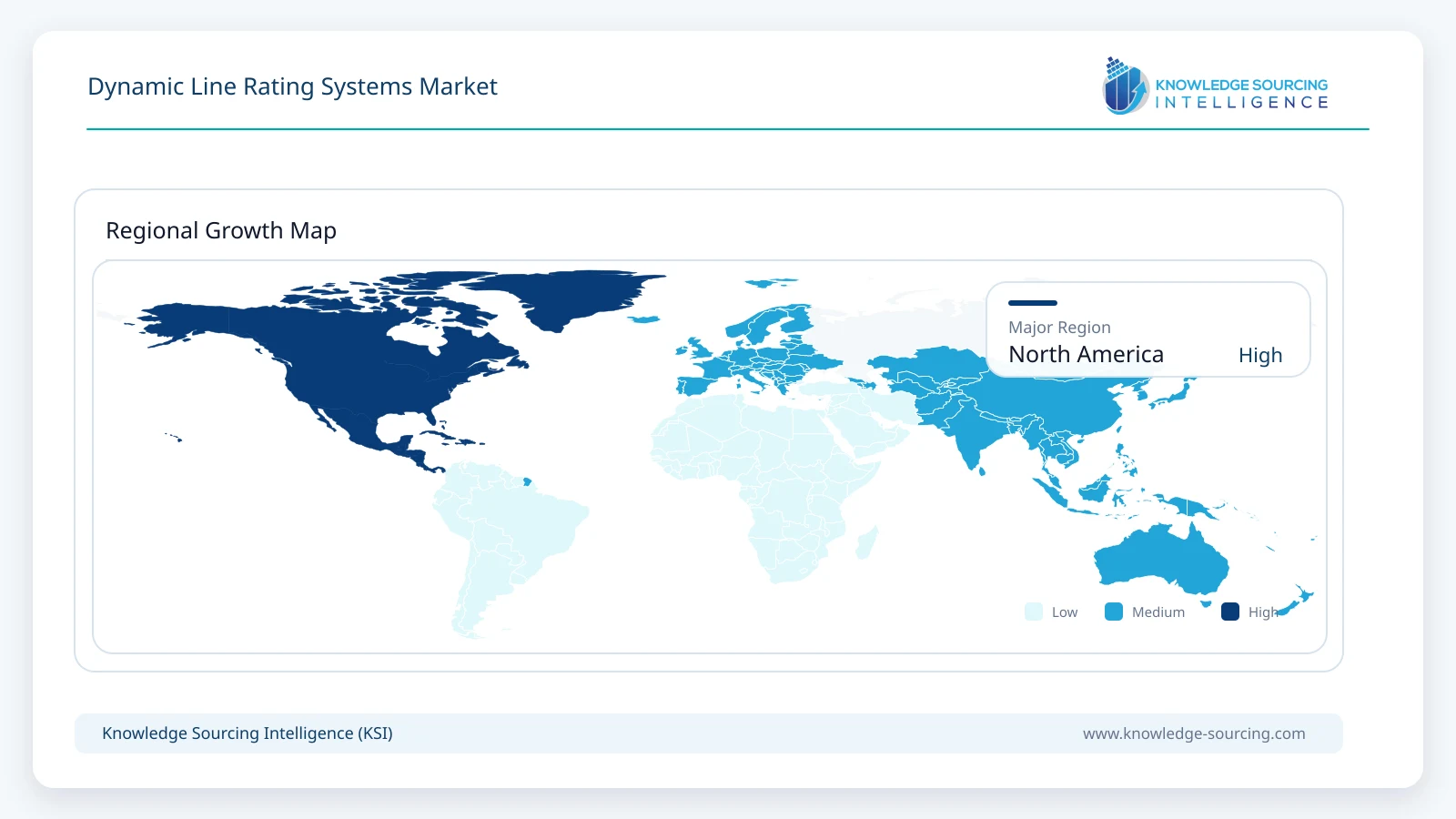
North America combines rising congestion costs, large-load interconnection pressure and increasingly supportive grid-enhancing-technology policy. U.S. deployments include PPL Electric, Entergy, National Grid operations in the region, AES, Xcel Energy, NV Energy and other utilities. FERC's continued focus on more accurate line ratings and GET consideration improves the commercial environment for both sensor-based and software-only DLR.
Europe
Europe has one of the most mature operational DLR markets. RTE, TenneT, Statnett, Elia, National Grid, Energa-Operator and other system operators are deploying or expanding DLR. Cross-border congestion, offshore and onshore renewable integration and limited right-of-way availability increase the value of variable capacity on existing corridors.
Asia Pacific excluding China
Australia, New Zealand, India, Japan and Southeast Asia provide a project-led opportunity driven by renewable integration, long transmission corridors and regional bottlenecks. Powerlink is among the utilities using DLR, while hot climates and rapidly growing renewable capacity create demand for better line-capacity visibility.
China
China operates one of the world's largest overhead transmission networks and has strong domestic sensing, weather and grid-automation capabilities. DLR opportunity is concentrated on constrained regional corridors and renewable-integration areas, although domestic technology and procurement structures differ from Western vendor-led markets.
Middle East and Rest of World
Latin America, the Middle East and Africa provide emerging DLR opportunities where new transmission construction faces long lead times or difficult terrain. Grid congestion, high renewable potential and variable weather can improve the economic case, while utility digitalization and communications infrastructure determine the pace of operational deployment.
Competitive and Technology Landscape
The competitive landscape includes specialist DLR companies, grid-monitoring suppliers, fiber-sensing companies and software-only forecasting providers. Ampacimon offers sensor-based, sensorless and OPGW-based DLR within a single platform and reports production deployments at major utilities in Europe and North America. Heimdall Power combines line-mounted Neuron sensors with virtual sensing and network-wide analytics, while LineVision uses non-contact sensing and detailed network models to provide sensor-enhanced ratings and situational awareness.
Software-only DLR is expanding through companies such as Gridraven, which uses high-resolution weather forecasting and span-level modelling. Sentrisense, now part of Megger, is scaling line-mounted DLR with TenneT. Prisma Photonics applies distributed fiber-optic sensing on OPGW, while AP Sensing has partnered with Ampacimon on fiber-based line monitoring. Established transmission-monitoring suppliers such as Lindsey Systems and Atecnum PowerDonut continue to participate in the broader DLR and line-monitoring ecosystem.
Suppliers active across these technology layers include: Ampacimon, Heimdall Power, LineVision, Gridraven, Sentrisense / Megger, Prisma Photonics, AP Sensing, Lindsey Systems, Atecnum / PowerDonut, Vaisala, Schweitzer Engineering Laboratories (SEL), GE Vernova, Siemens Energy, Hitachi Energy, Schneider Electric.
Recent Developments
September 2026: Heimdall Power signed a Dynamic Line Rating project with Polish distribution system operator Energa-Operator, adding DLR on transmission lines within a network serving more than three million customers.
July 2026: Ampacimon announced a DLR deployment with Winter Wind in Bosnia and Herzegovina, installing Sense X sensors across seven selected transmission lines to improve real-time capacity visibility.
June 2026: Sentrisense, a Megger company, secured a multi-year, multi-million-euro contract with TenneT to scale DLR sensing and software across selected high-voltage lines.
June 2026: Heimdall Power was selected for a new Statnett DLR project in Norway and began installation on a live 300 kV overhead line using autonomous drone deployment.
April 2026: Heimdall Power was selected under a large-scale National Grid UK DLR framework intended to upgrade key power lines and potentially reduce constraint costs over the deployment period.
March 2026: RTE completed a first drone-based installation of Ampacimon's DLR sensor on an energized transmission line in France, testing a lower-disruption method for sensor deployment.
March 2026: The U.S. Department of Energy launched the approximately USD 1.9 billion SPARK funding opportunity covering advanced transmission technologies, including DLR and other grid-enhancing solutions.
February 2026: Heimdall Power deployed DLR with Entergy across transmission assets in Louisiana, Texas and Arkansas using drone-installed line sensors.
February 2026: Ampacimon and AP Sensing announced a collaboration combining DLR analytics with distributed fiber-optic sensing for OPGW-based overhead-line monitoring.
Dynamic Line Rating Systems Market Scope:
| Report Metric | Details |
|---|---|
| Total Market Size in 2026 | USD 61.0 million |
| Total Market Size in 2032 | USD 195.0 million |
| Forecast Unit | USD Million |
| Growth Rate | 21.4% |
| Study Period | 2021 to 2032 |
| Historical Data | 2021 to 2024 |
| Base Year | 2025 |
| Forecast Period | 2026 – 2032 |
| Segmentation | Deployment Architecture, System Component, Utility Workflow, Voltage Class |
| Companies |
|
Market Segmentation
By Deployment Architecture
Sensor-Based DLR
Sensor-Enhanced Network-Wide DLR
Sensorless DLR
Fiber-Optic / OPGW-Based DLR
Hybrid Deployment Architectures
By System Component
Line and Environmental Sensing Hardware
Communications and Edge Equipment
DLR Software and Thermal Models
Weather and Forecast Analytics
Integration, Visualization and Control-Room Software
By Utility Workflow
Real-Time Grid Operations
Day-Ahead and Intraday Market Operations
Congestion Management
Interconnection and Grid Planning
Outage and Maintenance Planning
By Voltage Class
Below 220 kV
220-345 kV
400-500 kV
Above 500 kV
By Utility / Owner Type
Transmission System Operators
Investor-Owned Utilities
Public and State Utilities
Distribution System Operators
Vertically Integrated Utilities
By Geography
North America
Europe
Asia Pacific Excluding China
China
Middle East and Rest of World
Table of Contents
1. EXECUTIVE SUMMARY
1.1. Market Opportunity and Key Findings
1.2. DLR Adoption Outlook
1.3. Monitored Circuit-km and Capacity Uplift
1.4. Competitive Positioning
2. RESEARCH SCOPE AND METHODOLOGY
2.1. Market Definition
2.2. DLR Qualification Criteria
2.3. Monitored and Operational Circuit-km Model
2.4. Capacity-Uplift and Availability Model
2.5. Forecast Methodology, 2026-2032
3. DYNAMIC LINE RATING TECHNOLOGY
3.1. Static, Seasonal and Ambient-Adjusted Ratings
3.2. DLR Thermal Rating Methodology
3.3. Critical-Span Identification
3.4. Weather, Wind and Solar Inputs
3.5. Sag, Temperature and Conductor Measurement
3.6. DLR Forecasting and Confidence Levels
3.7. Emergency and Fallback Ratings
3.8. SCADA, EMS and Market-System Integration
4. MARKET SIZE AND FORECAST, 2026-2032
4.1. Global DLR System Revenue
4.2. Annual Circuit-km Receiving DLR Coverage
4.3. Operationally Rated Circuit-km
4.4. Recurring Software and Analytics Revenue
4.5. Average Capacity Uplift on Suitable Lines
4.6. Forecast Sensitivities
5. DYNAMIC LINE RATING SYSTEMS MARKET BY DEPLOYMENT ARCHITECTURE
5.1. Sensor-Based DLR
5.2. Sensor-Enhanced Network-Wide DLR
5.3. Sensorless DLR
5.4. Fiber-Optic / OPGW-Based DLR
5.5. Hybrid Deployment Architectures
6. DYNAMIC LINE RATING SYSTEMS MARKET BY SYSTEM COMPONENT
6.1. Line and Environmental Sensing Hardware
6.2. Communications and Edge Equipment
6.3. DLR Software and Thermal Models
6.4. Weather and Forecast Analytics
6.5. Integration, Visualization and Control-Room Software
7. DYNAMIC LINE RATING SYSTEMS MARKET BY UTILITY WORKFLOW
7.1. Real-Time Grid Operations
7.2. Day-Ahead and Intraday Market Operations
7.3. Congestion Management
7.4. Interconnection and Grid Planning
7.5. Outage and Maintenance Planning
8. DYNAMIC LINE RATING SYSTEMS MARKET BY VOLTAGE CLASS
8.1. Below 220 kV
8.2. 220-345 kV
8.3. 400-500 kV
8.4. Above 500 kV
9. DYNAMIC LINE RATING SYSTEMS MARKET BY UTILITY / OWNER TYPE
9.1. Transmission System Operators
9.2. Investor-Owned Utilities
9.3. Public and State Utilities
9.4. Distribution System Operators
9.5. Vertically Integrated Utilities
10. REGIONAL MARKET
10.1. North America
10.2. Europe
10.3. Asia Pacific excluding China
10.4. China
10.5. Middle East and Rest of World
11. DLR ECONOMICS AND UTILITY DECISION FRAMEWORK
11.1. Congestion-Cost Reduction
11.2. Avoided or Deferred Grid Investment
11.3. Renewable and Large-Load Interconnection Value
11.4. Sensor and Software Deployment Cost
11.5. Operational Integration Cost
11.6. DLR versus Reconductoring and New-Line Expansion
12. TECHNOLOGY AND COMMERCIALIZATION OUTLOOK
12.1. Network-Wide Sensorless DLR
12.2. Drone-Installed Line Sensors
12.3. Distributed Fiber-Optic / OPGW Monitoring
12.4. AI and Machine Learning in Rating Forecasts
12.5. DLR and Advanced Reconductoring Integration
12.6. Market and Dispatch Integration
13. COMPETITIVE LANDSCAPE
13.1. Value Chain
13.2. Sensor-Based DLR Specialists
13.3. Sensorless and Forecasting Providers
13.4. Fiber-Optic and OPGW Monitoring Providers
13.5. Grid Automation and Integration Suppliers
13.6. Partnerships and Contracts
14. COMPANY PROFILES
14.1. Ampacimon
14.2. Heimdall Power
14.3. LineVision
14.4. Gridraven
14.5. Sentrisense / Megger
14.6. Prisma Photonics
14.7. AP Sensing
14.8. Lindsey Systems
14.9. Atecnum / PowerDonut
14.10. Vaisala
14.11. Schweitzer Engineering Laboratories (SEL)
14.12. GE Vernova
14.13. Siemens Energy
14.14. Hitachi Energy
14.15. Schneider Electric
15. APPENDIX
Navigate
Trusted by the world's leading organizations