
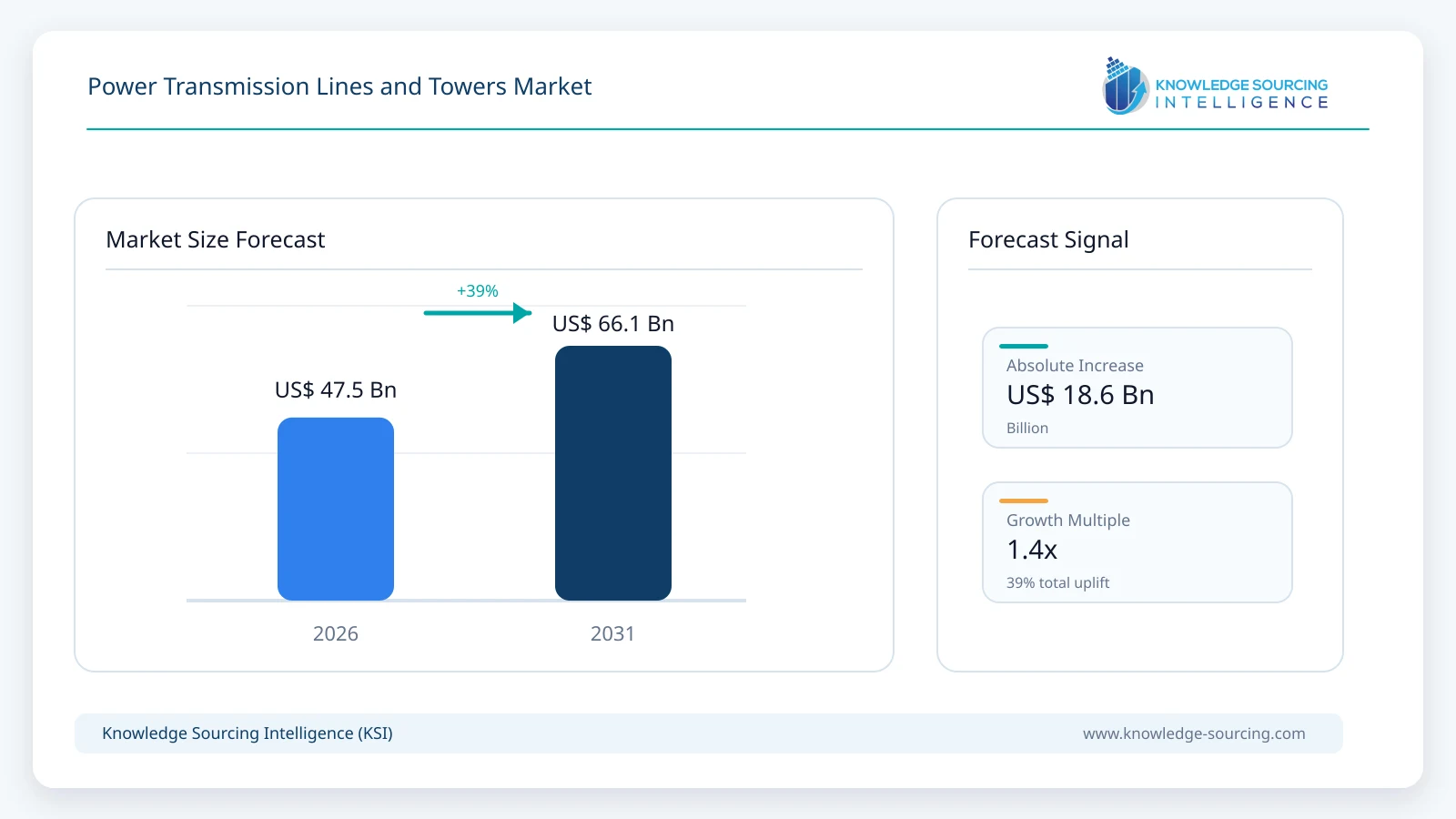
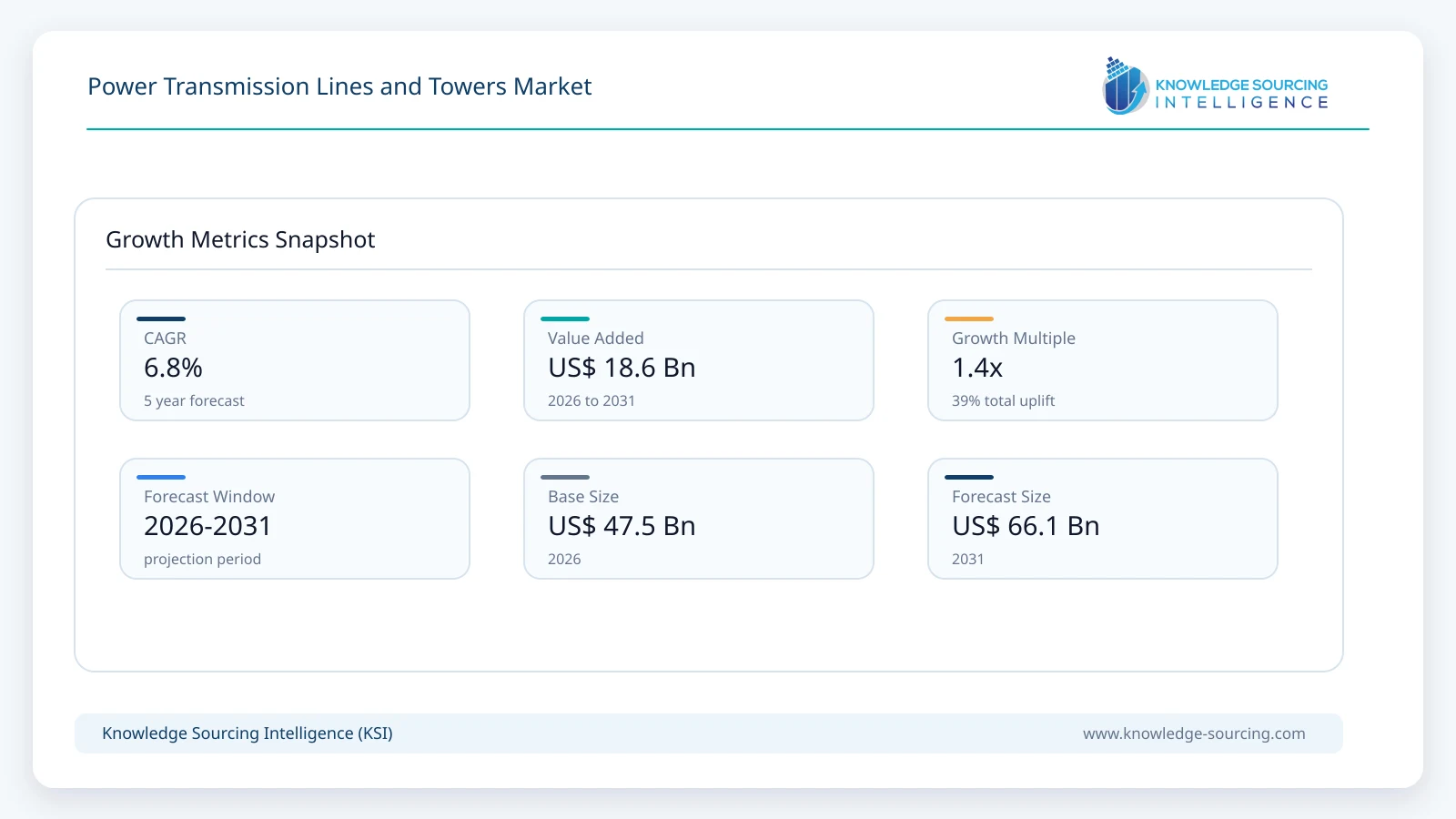
The Power Transmission Lines and Towers Market is projected to increase from USD 47.5 billion in 2026 to USD 66.1 billion by 2031, growing at a CAGR of 6.8%.
Highlights:
- 1Rising electricity demand, renewable generation, electrification, and data-center loads are driving up the need for more grid capacity, which is spurring a rapid increase in investment in transmission infrastructure.
- 2Overhead transmission continues to be the dominant segment of installation as it is typically more cost-effective for long-distance high-voltage corridors.
- 3Transmission lines are the leading segment because new generation and more grid connection and reinforcement projects need added conductor and line throughput capacity immediately.
- 4Renewable-energy transmission is a key application, taking the form of dedicated corridors to evacuate power from distant solar, wind, and hydroelectric generation.
The power transmission lines and towers market involves using equipment, structures, materials, and related hardware required for transferring electric power from generating locations to substations, regional networks, industrial consumers, and across electricity networks. It includes conductors and transmission lines, towers & supporting structures, insulators, fittings, hardware, and the systems required to build and maintain high-voltage transmission corridors.
Transmission investment is also accelerating because longer transmission lines are needed to relieve congestion on existing grids and because soaring electricity demand increases the amount of renewable energy generation that needs to be integrated. The world invested an estimated USD 140 billion in transmission in 2023, up by a year-over-year percentage of 10%, according to the International Energy Agency (IEA), and overall annual grid investment will need to increase by more than 50% by 2030 from around USD 400 billion in 2026 to satisfy electricity consumption and clean-energy integration projections.
The transmission infrastructure is subsequently used at higher voltage levels to convey larger currents over longer channels, minimizing transmission losses. As a result, utilities and transmission development firms are focusing on 400 kV, 500 kV, 765 kV, and HVDC transmission lines, especially where large wind resources are located far from major load centers.
The global market is dominantly impacted by the location mismatch between renewable-energy sources and electricity consumption. Solar and wind projects are frequently being built far away from industrial and population centers in resource-rich locations, necessitating prescribed evacuation corridors and also interregional transmission systems.
Transmission towers are the major supporting structures for overhead lines; insulating materials and line hardware lead to electrical isolation, mechanical stability, separation of conductors, and should ensure reliable operation in snow, rain, or wind loading conditions. Newer designs of towers are being increasingly used for high-voltage, extra-high-voltage, HVDC, tough-terrain, and high-wind applications.
Market Dynamics
Market Drivers
Rising global electricity demand: Growing demand for power transmission lines and towers is driven by industrial electrification, electric vehicles, cooling demand, data centers, and digital infrastructure, which are surging electricity consumption. The IEA forecasts global electricity demand to increase by an average of 3.6 percent per year between 2026 and 2030, necessitating onward needs for generation and transmission capacity. With growing volumes of new generation capacity being sited outside major consumption centers, utilities are building high-voltage transmission lines to push electricity over greater distances. This is a growing all-purpose market for conductors, towers, substations, insulation systems, and related line hardware.
Rapid expansion of renewable-energy generation: The scale of renewable power generation continues to grow into 2025, with a worldwide increase in renewables output of 9%. This leads to a structural need for transmission expansion since solar and wind projects are often sited in places with the best natural resources, far from load centers. This, as a way to absorb the effects of variable renewable generation, transmission developers are building dedicated renewables evacuation corridors and reinforcing inter-regional grids. For instance, India's Green Energy Corridor aims to link new transmission lines and substations specifically for evacuating renewable power.
Aging transmission infrastructure and strengthening of grids: Across many mature electricity markets, the existing transmission networks are aging as the demand for electricity and generation patterns change. Replace aging structures and conductors, which increases line capacity and resilience. This shows the growing need for infrastructure reinforcement, with annual global grid investment needing to be around 50% by 2030, higher than USD 400 billion as of 2026, according to IEA estimates.
Geographies of long-distance and interregional power transfer: Increased geographic separations between renewable generation and consumption are driving demand for high-capacity transmission corridors. HVDC is increasingly relevant for practical long-distance transmission applications due to its ability to carry vast amounts of power over long distances and to connect some asynchronous parts of grids. This trend can be illustrated with the recent project activity. 800 kV/HVDC and 765 kV transmission-line orders for green-energy evacuation were bagged by KEC International from Power Grid Corporation of India in 2025.
Market Restraints & Opportunities
Towers, conductors, substations, land acquisition, engineering, and construction costs are all substantial expenses associated with transmission projects.
Rail lines are densely populated around cities, along with forests, environmentally sensitive areas, and agricultural land; this will make the procurement of land and transmission more challenging. These constraints can drive up project price and prompt utilities to explore underground or other non-wire transmission technologies.
The growth in solar, wind, and hydroelectric generation is opening avenues for dedicated transmission systems to connect resource-rich regions to load centers.
Opportunities for underground and submarine transmission are expanding due to urbanization, land limitations, offshore wind development, and cross-sea interconnections. They are tied up with specific cables and accessories, joints, terminations, protection systems, as well as installation services, which creates higher-value opportunities than traditional overhead infrastructure.
Key Developments
July 2026: Engie won four important power-transmission projects in Peru in a 30-year public–private partnership concession. This included the construction of more than 400 km of new transmission lines as well as six new electrical substations and the expansion of ten existing substations.
May 2026: KEC International announced securing new orders worth ?1,303 crore, including 400/220 kV substations and associated transmission lines in southern India and tower, hardware, and pole supply orders in the Americas.
March 2026: Tata Power reported completing all the extra-high-voltage transmission lines and substations included in the SEUPTTCL project of Uttar Pradesh, with this substation commissioned on 25 March 2026.
Power Transmission Lines and Towers Market Market Segmentation
The market is segmented by component, voltage range, installation, tower type, application, end user, and geography.
By Component
Transmission Lines
Transmission Lines segment is expected to comprise the largest component segment because all new transmission corridors require conductors and associated line systems regardless of the purpose of the project. This is to support generation evacuation, grid interconnection, renewable-energy transmission, or reinforcement.
The shift in demand towards high-capacity and high-voltage lines such as 400 kV, 765 kV, and HVDC systems is evident due to the movement of bulk electricity over long distances. The sheer scale of lines being deployed in the future can be illustrated by the National Electricity Plan of India alone, which estimates that 191,474 circuit km of additional transmission lines at 220 kV and above will need to be built through 2031–32.
Alongside this, from a power transmission perspective, even the demand for transmission towers and structures is increasing, as every overhead corridor should be supported with the respective infrastructure; likewise, insulation and line equipment are becoming an urgent requirement for higher voltage, bigger conductor arrangements, and continuity needs.
By Installation
Overhead Transmission
Overhead Transmission is likely to be the largest installation segment due to its economic advantage for long-haul transportation of high-voltage electricity and ability to be built over broad corridors with minimum cable and installation costs compared with underground systems.
The technology is especially well-suited for large-scale renewable-energy evacuation projects and interregional transmission corridors. In addition, the most recent orders indicate that demand continues to remain strong. For instance, KEC International received 380 kV overhead transmission line orders in Saudi Arabia and tower and hardware supplies in the Americas in June 2025.
Meanwhile, underground transmission is more important in interconnections like urban environments and compressed, environmentally constrained corridors, while submarine transmission becomes increasingly relevant for offshore renewable projects or cross-sea interconnections.
By Application
Renewable-Energy Transmission
As renewable generation is increasingly developed at locations far from major electricity demand centers, Renewable-Energy Transmission has the highest growth potential of all major application segments in this market.
Solar and wind, as well as hydropower, projects need specialised transmission corridors and grid reinforcement. The Green Energy Corridor in India, which outlines the country's transmission and distribution requirements, has specifically called for adding new transmission lines to accommodate renewable electricity.
Additionally, this need is evident in activity on high-voltage projects. The 2025 orders of KEC International included both 800kV HVDC and the HTLS smart grid power systems to evacuate renewable energy, indicative of increasing deployment and scale-up in high-capacity transmission technologies such as grid optimization and efficient integration of renewables.
In addition, power generation evacuation continues to be an important application, as newly commissioned power plants need dedicated connections into the existing grid. Utility expansion of both grid interconnection and grid reinforcement is growing as utilities seek greater interregional transfer capacity and resilience.
Regional Analysis
North America Market Analysis
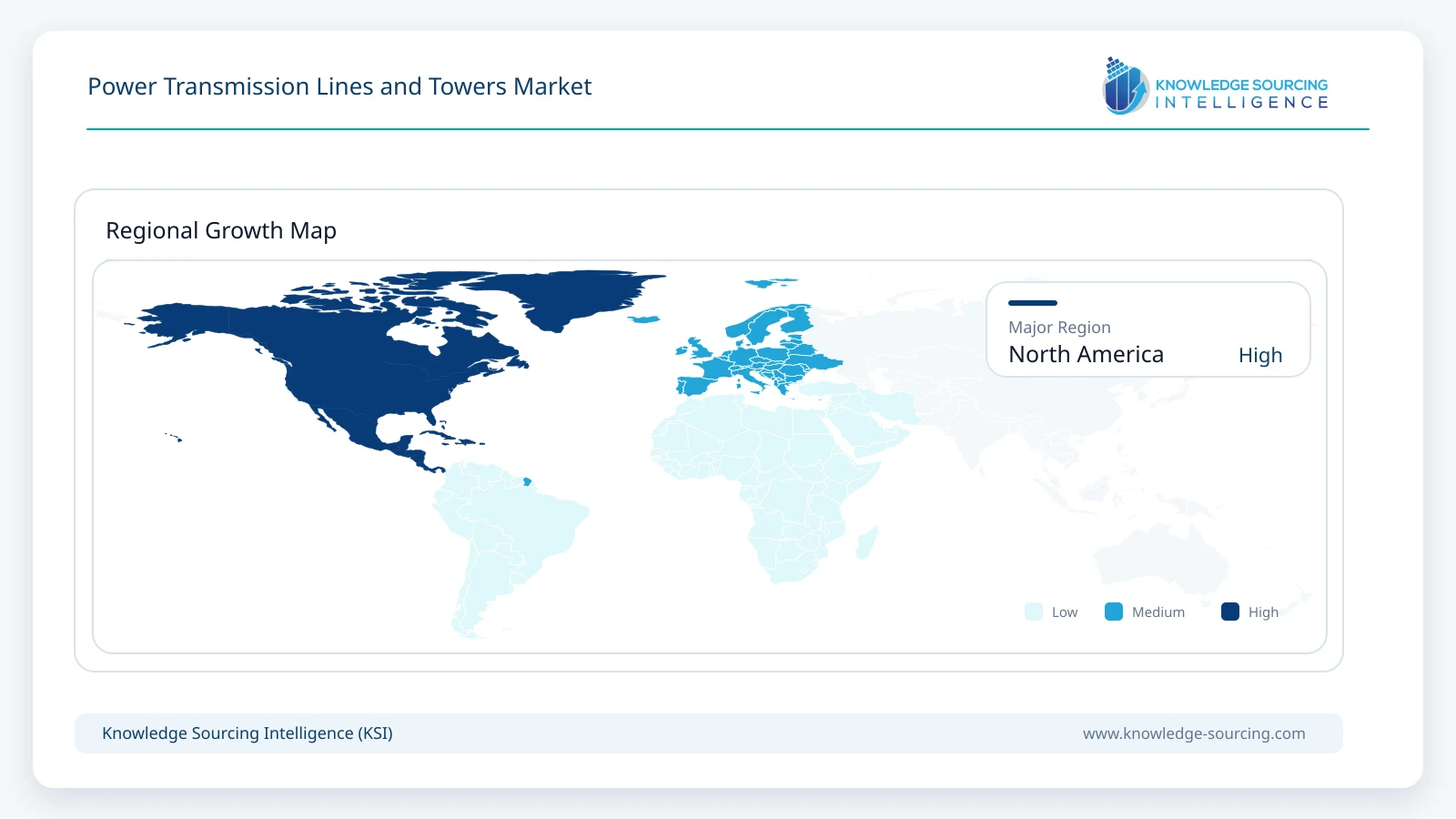
North America is likely to continue to be a key market as electricity demand continues to rise with the rapid expansion of data centers, electrification trends, renewable generation, and grid modernization. In the U.S., renewable projects have been built for diverse applications along with load centers, which is leading to increased requirements for transmission solutions.
South America Market Analysis
Transmission demand is driven by renewable-energy expansion in South America, specifically hydropower, wind, and solar resources sited far from major demand centers. The major regional opportunity is observed in Brazil, which is more than half the land area of continental Europe, providing considerable long-haul transmission infrastructure opportunities.
Europe Market Analysis
The European power transmission lines and tower market is growing steadily as countries ramp up cross-border electricity interconnections, leading to increasing investment in transmission. Offshore wind is placing more demands on submarine transmission infrastructure, while onshore renewable projects will require the construction of new high-voltage corridors.
Middle East and Africa Market Analysis
The Middle East and Africa region is witnessing a continuous rise in electricity demand and new generation projects, as well as a greater share of renewable-generation build-out in the region. The planned expansion of transmission infrastructure is also critical for national and regional interconnections across the region. Saudi Arabia and the UAE are witnessing colossal investments in high-voltage transmission networks, with acceleration in electricity consumption and the number of large-scale renewable projects.
Asia Pacific Market Analysis
Asia Pacific is anticipated to continue as the largest and most active transmission infrastructure region, supported by rapid electricity consumption growth, heavy industrialization, renewables deployment, and large-grid-scale development across China, India, Southeast Asia, Japan, South Korea, and Australia. According to the International Energy Agency (IEA), China is expected to be a main driver of global power demand growth until 2030, contributing almost half of the increase.
List of Companies
Larsen & Toubro Ltd.
Tata Group
Kalpataru Group
Skipper Ltd.
RPG Group
Valmont Industries Inc.
ZTT Group
State Grid Corporation of China
Hyosung Group
ABB
Larsen & Toubro Ltd.
Larsen & Toubro is a major Indian engineering and infrastructure company providing transmission solutions and services through its Power Transmission & Distribution business unit. It offers engineering, procurement, construction, substations, transmission lines, and grid services across multiple domestic and global markets.
Tata Group / Tata Power
Tata Power is on an expansion spree by adding interregional and renewable-energy evacuation projects into its transmission portfolio. In December 2025, it reported the Koteshwar–Rishikesh transmission line by constructing a 400 kV power line to evacuate the supply of 1,000 MW of hydroelectric generation. As of FY2025–26, 7,403 ckm of transmission assets formed part of its portfolio across both operational and under-construction projects.
Kalpataru Group
Kalpataru Group is one of the leading transmission and distribution EPC players with end-to-end capabilities including transmission lines and substations, underground cabling of medium & high voltage, design, fabrication, erection, testing, and commissioning for towers. The firm claims to have worked on transmission projects with capacities up to 1,200 kV and HVAC/HVDC transmission up to 800 kV, having delivered over 30,000 km of transmission-line contracts in more than 40 countries.
Analyst View
Power transmission lines and towers market is entering an infrastructure-intensive expansion phase due to increased demand for renewable generation, electrification, rising electricity demand, and interregional power transfers. Overhead lines still prevail as a major segment, while HVDC technology, underground and submarine transmission technologies, as well as high-capacity transmission technologies are generating higher value for EPC contractors and tower manufacturers and grid-equipment suppliers.
Power Transmission Lines and Towers Market Scope:
| Report Metric | Details |
|---|---|
| Total Market Size in 2026 | USD 47.5 billion |
| Total Market Size in 2031 | USD 66.1 billion |
| Forecast Unit | USD Billion |
| Growth Rate | 6.8% |
| Study Period | 2021 to 2031 |
| Historical Data | 2021 to 2024 |
| Base Year | 2025 |
| Forecast Period | 2026 – 2031 |
| Segmentation | Component, Voltage Range, Installation, Tower Type, Application, Geography |
| Companies |
|
Market Segmentation
By Component
Transmission Lines
Transmission Towers and Structures
Insulation and Line Hardware
By Voltage Range
Below 220 kV
220–500 kV
500–765 kV
Above 765 kV
By Installation
Overhead Transmission
Underground Transmission
Submarine Transmission
By Tower Type
Lattice Steel Towers
Tubular Steel Towers
Monopoles
Guyed Towers
Others
By Application
Power Generation Evacuation
Grid Interconnection
Renewable-Energy Transmission
Grid Reinforcement
Others
By Geography
North America
USA
Canada
Mexico
South America
Brazil
Argentina
Others
Europe
United Kingdom
Germany
France
Others
Middle East and Africa
Saudi Arabia
UAE
Others
Asia Pacific
China
Japan
India
South Korea
Others
Table of Contents
1. EXECUTIVE SUMMARY
2. MARKET SNAPSHOT
2.1. Market Overview
2.2. Market Definition
2.3. Scope of the Study
2.4. Market Segmentation
3. MARKET DYNAMICS
3.1. Market Drivers
3.2. Market Restraints
3.3. Market Opportunities
3.4. Porter’s Five Forces Analysis
3.5. Industry Value Chain Analysis
4. BUSINESS LANDSCAPE
4.1. Regulatory, Grid Codes & Transmission Standards Landscape
4.2. Transmission Infrastructure Manufacturing & Component Ecosystem
4.3. Raw Material, Equipment & Transmission Supply Chain Analysis
4.4. Global Trade Statistics & Major Supplier/Buyer Analysis
4.5. Strategic Recommendations
5. TECHNOLOGICAL OUTLOOK
5.1. Advanced High-Capacity & High-Voltage Transmission Technologies
5.2. High-Temperature & Advanced-Conductor Technologies
5.3. Advanced Transmission Tower & Structural Technologies
5.4. Underground & Submarine Transmission Technologies
5.5. Digitalized, Smart & Condition-Monitored Transmission Infrastructure
6. POWER TRANSMISSION LINES AND TOWERS MARKET BY COMPONENT
6.1. Introduction
6.2. Transmission Lines
6.3. Transmission Towers and Structures
6.4. Insulation and Line Hardware
7. POWER TRANSMISSION LINES AND TOWERS MARKET BY VOLTAGE RANGE
7.1. Introduction
7.2. Below 220 kV
7.3. 220-500 kV
7.4. 500-765 kV
7.5. >765 kV
8. POWER TRANSMISSION LINES AND TOWERS MARKET BY INSTALLATION
8.1. Introduction
8.2. Overhead Transmission
8.3. Underground Transmission
8.4. Submarine Transmission
9. POWER TRANSMISSION LINES AND TOWERS MARKET BY TOWER TYPE
9.1. Introduction
9.2. Lattice Steel Towers
9.3. Tubular Steel Towers
9.3.Monopoles
9.4.Guyed Towers
9.5. Others
10. POWER TRANSMISSION LINES AND TOWERS MARKET BY APPLICATION
10.1. Introduction
10.2. Power Generation Evacuation
10.3. Grid Interconnection
10.4. Renewable-Energy Transmission
10.5. Grid Reinforcement
10.6. Others
11. POWER TRANSMISSION LINES AND TOWERS MARKET BY GEOGRAPHY
11.1. Introduction
11.2. North America
11.2.1. USA
11.2.2. Canada
11.2.3. Mexico
11.3. South America
11.3.1. Brazil
11.3.2. Argentina
11.3.3. Others
11.4. Europe
11.4.1. United Kingdom
11.4.2. Germany
11.4.3. France
11.4.4. Others
11.5. Middle East and Africa
11.5.1. Saudi Arabia
11.5.2. UAE
11.5.3. Others
11.6. Asia Pacific
11.6.1. China
11.6.2. Japan
11.6.3. India
11.6.4. South Korea
11.6.5. Others
12. COMPETITIVE ENVIRONMENT AND ANALYSIS
12.1. Major Players and Strategy Analysis
12.2. Market Share Analysis
12.3. Mergers, Acquisitions, Agreements, and Collaborations
12.4. Competitive Dashboard
13. COMPANY PROFILES
13.1. Larsen & Toubro Ltd.
13.2. Tata Group
13.3. Kalpataru Group
13.4. Skipper Ltd.
13.5. RPG Group
13.6. Valmont Industries Inc.
13.7. ZTT Group
13.8. State Grid Corporation of China
13.9. Hyosung Group
13.10. ABB
14. APPENDIX
14.1. Currency
14.2. Assumptions
14.3. Base and Forecast Years Timeline
14.4. Key benefits for the stakeholders
14.5. Research Methodology
14.6. Abbreviations
Navigate
Trusted by the world's leading organizations











