
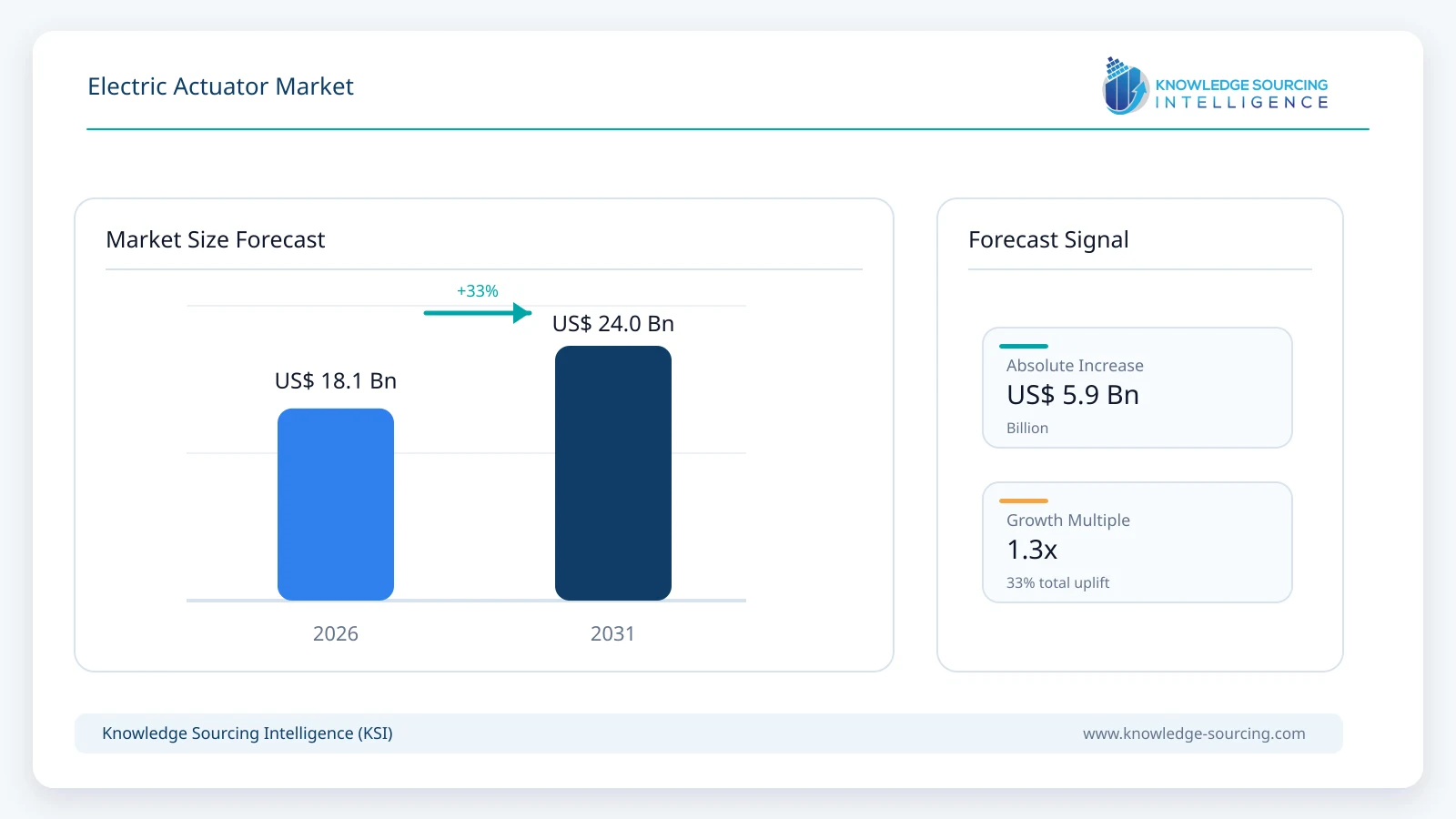
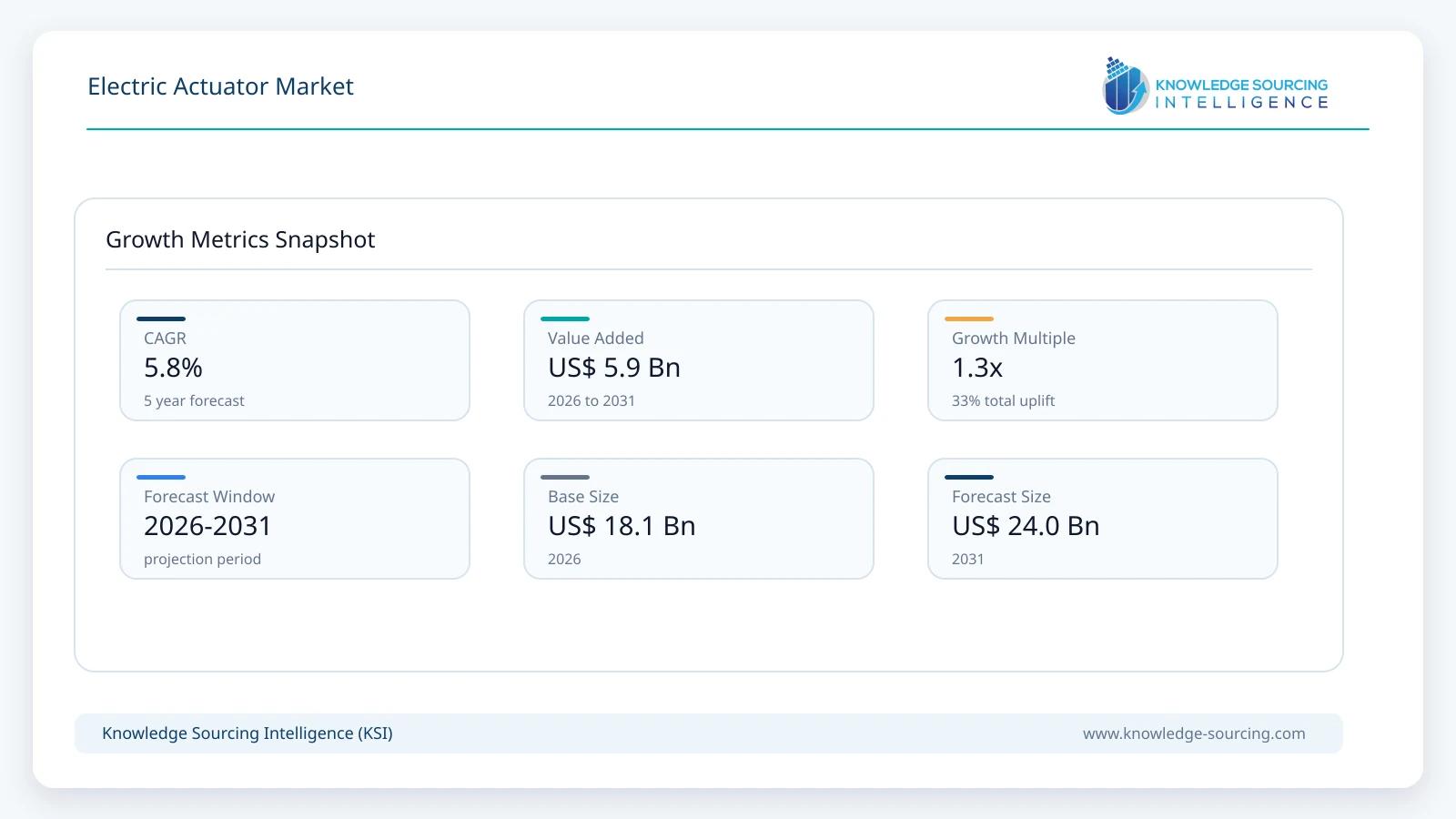
The electric actuator market is expected to grow at a 5.8% CAGR, increasing to USD 24.0 billion in 2031 from USD 18.1 billion in 2026.
Highlights:
- 1Linear actuators account for approximately 58% of global electric actuator market value in 2026, supported by factory automation, machinery, automotive and material-handling applications.
- 2Smart and connected electric actuators represent approximately 44% of market value in 2026 and are projected to grow substantially faster than conventional actuator systems through 2031.
- 3Industrial manufacturing accounts for approximately 27% of market value in 2026 as automation investment expands across assembly, packaging, material handling and process machinery.
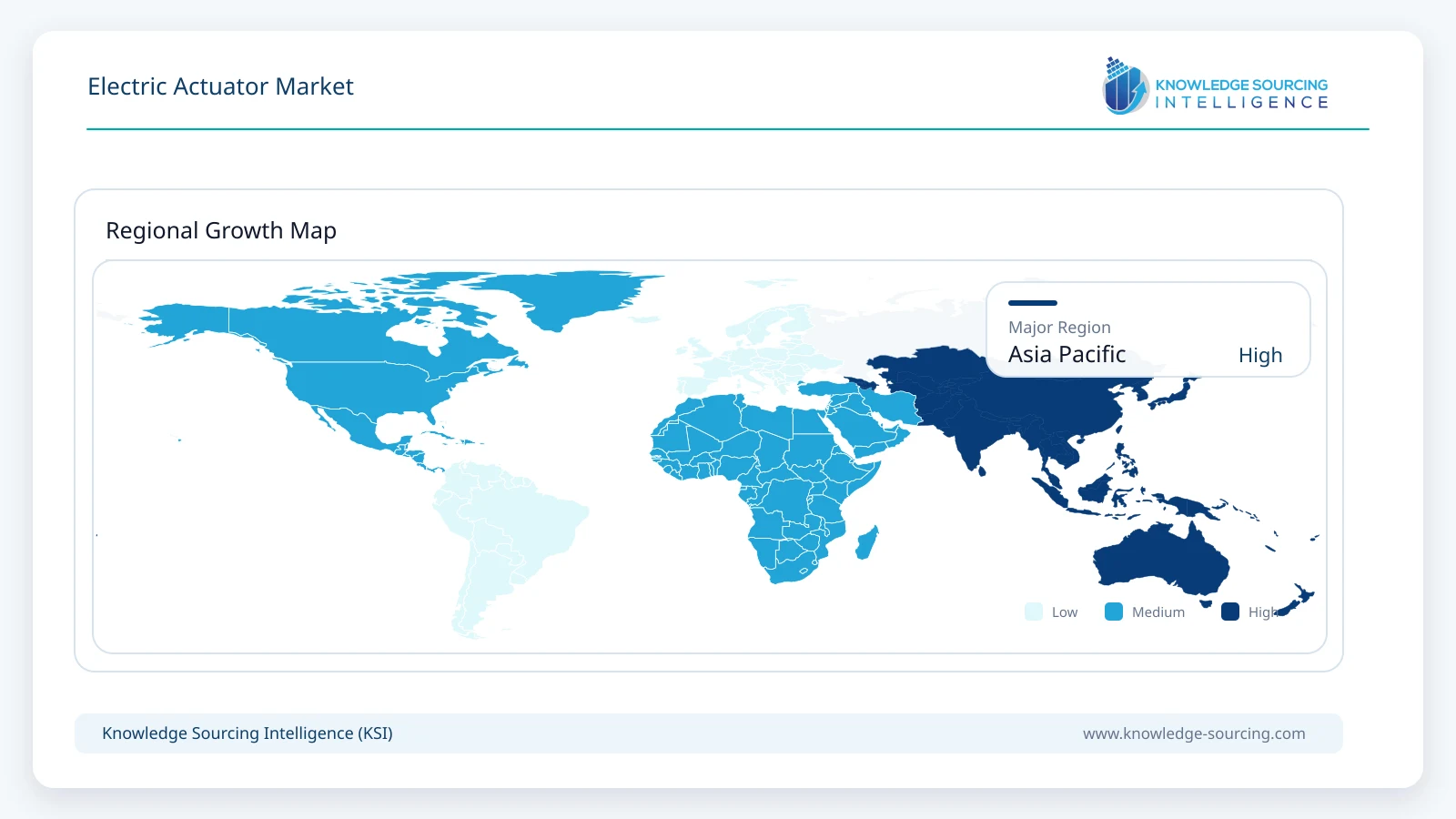
- 4Asia Pacific represents approximately 42% of global market value in 2026, supported by its dominant share of industrial robot deployment and automotive manufacturing.
- 5Middle East and Africa is projected to record the fastest regional growth as water infrastructure, oil and gas projects, utilities and industrial investment increase electric valve-actuator demand.
Increasing industrial automation remains a major source of demand as manufacturers require precise and repeatable motion control across material handling, assembly, packaging, process equipment, and robotic systems. Global manufacturing activity remained resilient in the first quarter of 2026, with manufacturing production increasing 1.2% quarter over quarter and Asia Pacific recording the strongest regional expansion.
The underlying automation base has also expanded substantially. The International Federation of Robotics reported that 542,000 industrial robots were installed globally in 2024 and that the operational stock reached approximately 4.66 million units. Asia accounted for 74% of new installations, demonstrating the geographic concentration of automation investment that also supports demand for electric linear and rotary motion systems.
Electric actuation is simultaneously extending beyond conventional factory automation. Current products are increasingly replacing hydraulic cylinders in high-force industrial and mobile applications, while intelligent valve actuators are integrating diagnostics, Ethernet communication, remote commissioning, and asset-management functions. Schaeffler’s 2026 EMA electric linear actuator additions are designed as oil-free alternatives to hydraulic and pneumatic cylinders, while Rotork’s IQ3 Pro incorporates connected control, data logging, and remote diagnostic functionality.
Market Trends
Electric Actuators Are Replacing Hydraulic Systems in Higher-Force Applications
Electromechanical actuators are moving into applications that historically depended on hydraulic cylinders because advances in roller screws, servo motors and mechanical transmission systems are increasing achievable force and power density. Tolomatic launched its RSX50 in March 2026 with force capability reaching 100,000 pounds-force, positioning the platform as an electric alternative to hydraulic cylinders for demanding industrial applications. Schaeffler followed this direction with EMA-50 and EMA-60 electromechanical linear actuators introduced at Hannover Messe 2026, explicitly targeting replacement of hydraulic and pneumatic cylinders in industrial automation, mobile machinery and material handling.
The transition is commercially significant because electric systems eliminate hydraulic pumps, hoses, and fluid handling while providing programmable positioning and easier integration with automated production environments. Hydraulic actuation retains advantages in extremely high-force and shock-intensive applications, but the boundary is shifting as electric actuator suppliers increase force density and regenerative capability. Schaeffler’s broader EMA platform also incorporates energy-recovery concepts in mobile machinery, demonstrating how electrification can extend beyond simple replacement of the cylinder itself.
Smart Connectivity Is Becoming a Standard Feature of Industrial Actuation
Electric actuators are increasingly being integrated directly into digital automation networks. Rotork’s IQ3 Pro platform supports integrated Ethernet, mobile-device configuration, data logging and cloud-based asset-management analysis, while Flowserve’s Limitorque MXb provides advanced diagnostics, operational trend data and network connectivity through protocols including Modbus TCP/IP, Profibus, Foundation Fieldbus and HART.
This functionality changes actuator procurement because operators can evaluate torque, position, temperature and operational history remotely rather than treating the device as a simple mechanical endpoint. Rotork joined Rockwell Automation’s Technology Partner Program with an EtherNet/IP-enabled IQ3 Pro in 2025, enabling the actuator to be specified more directly within industrial automation architectures. Predictive maintenance becomes particularly valuable in oil and gas, water treatment and power facilities where actuator failure can prevent operation of a critical valve and force unscheduled plant downtime.
Electric Actuation Is Expanding Across Mobile Machinery
Construction, agriculture and other mobile-equipment markets are beginning to replace hydraulic actuation in selected secondary and work functions. Schaeffler introduced a new Ewellix EMA-80 platform in late 2025 specifically for agricultural and construction machinery, while its broader electromechanical actuator portfolio targets cab adjustment, covers, jibs and other functions traditionally performed hydraulically.
Electric actuators provide precise controllability and can simplify increasingly electrified mobile-equipment architectures by removing hydraulic circuits from individual functions. Their suitability remains application-dependent because hydraulics continue to deliver exceptional force density, but electrification creates stronger economics where machines already include high-voltage electrical systems and where leak-free operation, accurate positioning, and lower maintenance are priorities.
Market Drivers
Industrial Automation and Robotics Investment
Industrial automation is increasing the number of controlled motion axes used across production lines, warehouses, packaging systems and processing equipment. IFR recorded 542,000 industrial robot installations in 2024, more than twice the level of a decade earlier, while the global operational stock reached approximately 4.66 million units. Annual installations remained above 500,000 for the fourth consecutive year.
Electric actuators complement robots and automated machinery by positioning workpieces, adjusting equipment, clamping components, changing guides and performing controlled linear and rotary movements. SMC’s current electric actuator portfolio includes high-speed slider, rod and guided actuator systems using stepper and servo motors, with selected models operating at speeds reaching 1,500 mm/s and battery-less absolute positioning. As automation becomes more flexible, programmable electric actuation also provides an advantage over fixed pneumatic systems because stroke, speed, and position can be changed through software rather than mechanical adjustment.
Electrification Across Automotive and Mobile Equipment
Automotive production remains a substantial demand base, while electrification increases the number of electronically controlled motion functions across vehicles and manufacturing systems. Global vehicle production increased to 96.4 million units in 2025, and sales reached approximately 99.8 million units. Electric cars represented one in four new cars sold worldwide during the year, with sales exceeding 20 million units.
Electric actuators are used across vehicle seating, closures, thermal-management valves, steering-related systems, braking subsystems and other controlled-motion functions. They are also used extensively in the automation equipment that manufactures batteries, electronics and vehicle assemblies. The automotive effect therefore operates through both vehicle content and factory equipment. Increasing electrification of construction and agricultural machinery provides an additional opportunity as manufacturers replace selected hydraulic functions with electromechanical systems.
Water, Energy and Process Infrastructure Investment
Electric valve actuators have established applications across water and wastewater treatment, oil and gas facilities, power generation and chemical processing because they provide remotely controlled isolation and modulation without requiring a plant-wide compressed-air supply. Flowserve’s Limitorque QX and MX electric actuator ranges target power, oil and gas, water and industrial applications, while Rotork’s IQ3 Pro includes isolation, regulating and modulating configurations across multi-turn, part-turn and linear motion requirements.
Infrastructure modernization is increasing the value of intelligent versions of these systems because operators require remote asset health information as well as valve positioning. In August 2026, Rotork completed the first production batch of IQ3 Pro actuators for the Liverpool Bay CO? transport and storage project, demonstrating electric actuation’s role in emerging carbon-management infrastructure as well as conventional process industries.
Market Restraints
Hydraulic and Pneumatic Technologies Remain Competitive
Electric actuation does not provide the optimal technical solution for every motion requirement. Hydraulic systems retain advantages where exceptionally high forces, compact power density, and tolerance of shock loading are required, while pneumatic cylinders remain inexpensive and mechanically simple for repetitive two-position movements. Existing factories may also have extensive compressed-air or hydraulic infrastructure, reducing the financial incentive to convert individual applications.
The transition therefore depends on total ownership economics rather than actuator purchase price alone. Electric systems can reduce energy consumption, leaks, and maintenance and provide superior positioning, but they may require servo drives, controllers, and more expensive mechanical components. Suppliers are responding by extending force capability and simplifying integrated control, but conventional actuation remains an important competitive restraint throughout the forecast period.
Initial Cost and Integration Requirements Can Slow Conversion
Replacing an existing pneumatic or hydraulic actuator with an electric system can require changes to controls, machine guarding, power supplies, and mechanical interfaces. High-performance electric linear actuators using roller screws and servo motors can also carry substantially higher initial acquisition costs than conventional pneumatic cylinders.
The economic case is strongest where precise positioning, multiple programmable positions, maintenance savings or energy efficiency justify the investment. For simple high-volume on-off movement, the benefit may be less compelling. This creates different adoption rates across industries and helps explain why electric actuation is expanding faster in highly automated manufacturing, electronics, and premium process applications than in basic machinery where conventional systems continue to meet operational requirements.
Segment Analysis
By Motion Type: Linear Actuators
Linear actuators represent the largest motion category, accounting for approximately 58% of global market value in 2026, equivalent to around USD 10.5 billion. The segment is projected to reach approximately USD 13.7 billion by 2031, representing growth of around 5.4% annually. Linear actuation has a broad application base spanning production machinery, material handling, automotive systems, medical equipment, mobile machinery and process control.
The technology is also expanding into higher-force applications. Tolomatic’s RSX50 reaches up to 100,000 pounds-force, while Schaeffler’s Ewellix EMA series provides modular electromechanical alternatives to hydraulic cylinders. SMC and Parker maintain extensive linear actuator portfolios for conventional industrial automation and multi-axis motion systems. Rotary actuators grow somewhat faster through 2031 because intelligent electric valve actuation is expanding across water, energy and process infrastructure, although linear systems remain the larger category.
By Control Type: Smart and Connected Electric Actuators
Smart and connected electric actuators account for approximately 44% of global market value in 2026, equivalent to around USD 8.0 billion. The segment is projected to reach approximately USD 12.7 billion by 2031, producing growth of approximately 9.8% annually and increasing its share substantially over the forecast period.
Growth is supported by the integration of industrial Ethernet, onboard diagnostics, position sensing, data logging and remote commissioning. Rotork’s IQ3 Pro allows configuration and control through its smartphone application and can export torque, temperature, vibration and event data to asset-management platforms. Flowserve’s MXb similarly incorporates enhanced analytics and multiple industrial communication protocols, while its FlowSync application enables remote Bluetooth-based monitoring and commissioning. Conventional electric actuators remain important in cost-sensitive applications, but their relative share declines as connectivity becomes increasingly standard in new industrial installations.
By End User: Industrial Manufacturing
Industrial manufacturing accounts for approximately 27% of the market in 2026, equivalent to around USD 4.9 billion, and is projected to reach approximately USD 6.7 billion by 2031 at a CAGR of about 6.6%. The segment includes machinery, material handling, packaging, assembly, robotics, machine tools and general factory automation where programmable linear and rotary motion is required.
The large installed automation base supports recurring demand for new and replacement actuators. More than 4.66 million industrial robots were operating globally in 2024, with 542,000 additional installations during the year. Electric actuators increasingly complement these systems by providing configurable axes outside the robot itself and replacing pneumatic cylinders where manufacturers require better control of acceleration, force and position. Automotive remains another major application, while water and wastewater record stronger growth as infrastructure operators increasingly adopt connected electric valve actuators.
Regional Outlook
Asia Pacific
Asia Pacific is the largest regional market, accounting for approximately USD 7.6 billion in 2026 and projected to reach around USD 10.3 billion by 2031, representing growth of approximately 6.3% annually. The region combines large automotive, electronics and machinery industries with the world’s most extensive industrial automation base. Asia accounted for 74% of new industrial robot deployments in 2024, with China alone installing approximately 295,000 units, equivalent to 54% of the global total.
Automotive production provides another large demand platform. Asia Pacific produced more than 59 million vehicles in 2025, while China alone produced approximately 34.5 million units. Electric actuator demand therefore spans factory automation, vehicle systems, electronics manufacturing, process plants and infrastructure. China, Japan and South Korea remain important automation markets, while India’s record industrial robot installations and manufacturing expansion broaden the regional customer base.
Middle East and Africa
Middle East and Africa is projected to record the fastest regional growth, increasing from approximately USD 1.27 billion in 2026 to around USD 1.92 billion in 2031 at a CAGR of approximately 8.7%. Growth is concentrated in oil and gas, water and wastewater, power infrastructure and new industrial projects where electric valve actuation offers remote operation and diagnostic capabilities.
The region’s opportunity is particularly relevant to intelligent part-turn and multi-turn actuators used in pipelines, processing facilities, desalination and utility infrastructure. Flowserve’s electric actuator portfolio is designed for oil and gas, water, chemicals and commercial power, while Rotork continues to target similar flow-control applications with connected intelligent actuator platforms. The regional market remains considerably smaller than Asia Pacific but benefits from a higher proportion of large infrastructure projects requiring high-value hazardous-area and smart actuation systems.
Competitive Environment and Analysis
The electric actuator market combines specialists in industrial motion with established valve-control and automation companies. Rotork and Flowserve maintain strong positions in intelligent electric valve actuation across oil and gas, water, power and process industries. Emerson participates through Bettis valve actuators and AVENTICS electric motion systems, while SMC, Parker Hannifin, Bosch Rexroth, Festo and Tolomatic address factory automation and linear motion. Schaeffler has strengthened its electromechanical actuator portfolio through Ewellix and is expanding into mobile machinery and higher-force hydraulic replacement applications.
Competitive differentiation varies by application. In factory automation, suppliers compete on speed, precision, force density, servo integration and ease of machine design. Process-industry customers place greater emphasis on hazardous-area certification, torque capability, reliability, communications and asset diagnostics. Mobile-equipment applications require compact high-force actuators capable of surviving vibration, contamination and outdoor operating conditions.
Digital functionality is becoming more important across each group. Flowserve’s latest Limitorque MXb combines smart actuation with analytics and network connectivity, while Rotork’s IQ3 Pro provides connected commissioning and asset-health information. The strategic value of intelligent actuation was highlighted in July 2026 when ABB agreed to acquire Rotork in a transaction valuing the company at approximately USD 5.5 billion, citing Rotork’s leading electric actuator portfolio and its fit with ABB’s automation strategy.
Recent Developments
August 2026: Rotork completed the first batch of IQ3 Pro intelligent electric actuators for the Liverpool Bay CO? transportation and storage project supporting the UK’s HyNet industrial decarbonisation cluster.
July 2026: ABB announced an agreement to acquire Rotork, positioning the electric-actuator specialist within ABB’s broader automation portfolio.
April 2026: Schaeffler introduced Ewellix EMA-50 and EMA-60 electromechanical linear actuators designed to replace hydraulic and pneumatic cylinders in industrial automation, mobile machinery and material handling.
March 2026: Tolomatic launched the RSX50 extreme-force electric linear actuator with capacity reaching 100,000 pounds-force for applications traditionally served by hydraulic cylinders.
October 2025: Schaeffler introduced the EMA-80 modular electromechanical actuator platform for agricultural and construction machinery, extending electric actuation into heavier mobile applications.
June 2025: Rotork joined Rockwell Automation’s Technology Partner Program, integrating its EtherNet/IP-enabled IQ3 Pro actuator into Rockwell’s system-design ecosystem.
Market Outlook
Industrial automation remains the largest structural demand source, but market development is increasingly shaped by replacement of pneumatic and hydraulic systems, connected valve automation, and broader electrification of machinery.
Linear actuators remain the largest motion category and reach approximately USD 13.7 billion by 2031. Smart and connected actuators grow considerably faster than the overall market, reaching approximately USD 12.7 billion as industrial Ethernet, onboard diagnostics and predictive-maintenance functionality move into mainstream product platforms. Industrial manufacturing remains the largest end-user category at approximately USD 6.7 billion in 2031.
Asia Pacific retains the largest regional position and reaches around USD 10.3 billion, supported by its dominant manufacturing and automation base. Middle East and Africa grows faster from a smaller base as water, energy and process-infrastructure projects create demand for intelligent electric valve actuation.
The principal competitive shift through 2031 is expected to be from standalone motion hardware toward connected electromechanical systems combining actuation, sensing, control and diagnostic data. Electric systems do not eliminate hydraulic and pneumatic technologies, particularly where extremely high force or basic low-cost motion is required, but improving power density and falling integration barriers continue to expand the applications in which electric actuation provides the stronger lifecycle proposition.
Electric Actuator Market Scope:
| Report Metric | Details |
|---|---|
| Total Market Size in 2026 | USD 18.1 billion |
| Total Market Size in 2031 | USD 24.0 billion |
| Forecast Unit | Billion |
| Growth Rate | 5.8% |
| Study Period | 2021 to 2031 |
| Historical Data | 2021 to 2024 |
| Base Year | 2025 |
| Forecast Period | 2026 – 2031 |
| Segmentation | Motion Type, Control Type, End User, Geography |
| Companies |
|
Market Segmentation
By Motion Type
Linear Actuators
Rotary Actuators
By Control Type
Conventional Electric Actuators
Smart and Connected Electric Actuators
By End User
Industrial Manufacturing
Automotive
Oil and Gas
Water and Wastewater
Food and Beverage
Electrical and Electronics
Power and Utilities
Others
By Geography
North America
United States
Canada
Mexico
South America
Brazil
Argentina
Others
Europe
Germany
France
United Kingdom
Italy
Spain
Others
Middle East and Africa
Saudi Arabia
UAE
South Africa
Others
Asia Pacific
China
Japan
India
South Korea
Indonesia
Thailand
Others
Table of Contents
1. INTRODUCTION
1.1. Market Overview
1.2. Market Definition
1.3. Scope of the Study
1.4. Market Segmentation
1.5. Currency
1.6. Assumptions
1.7. Base and Forecast Years
1.8. Key Benefits to Stakeholders
2. RESEARCH METHODOLOGY
2.1. Research Design
2.2. Secondary Research
2.3. Market Estimation
2.4. Segment Modelling
2.5. Data Triangulation and Validation
3. EXECUTIVE SUMMARY
3.1. Key Findings
3.2. Electric Actuator Market Size, 2026-2031
3.3. Motion Type Outlook
3.4. Control Type Outlook
3.5. End-User Outlook
3.6. Regional Opportunity Summary
4. MARKET DYNAMICS
4.1. Market Drivers
4.1.1. Industrial Automation and Robotics Investment
4.1.2. Electrification Across Automotive and Mobile Equipment
4.1.3. Water, Energy and Process Infrastructure Investment
4.2. Market Restraints
4.2.1. Competition from Hydraulic and Pneumatic Technologies
4.2.2. Initial Cost and Integration Requirements
4.3. Porter’s Five Forces Analysis
4.4. Industry Value Chain Analysis
4.5. Standards and Regulatory Environment
5. TECHNOLOGICAL OUTLOOK
5.1. Smart and Connected Actuators
5.2. Industrial Ethernet Integration
5.3. Roller-Screw High-Force Linear Actuation
5.4. Battery-Less Absolute Positioning
5.5. Predictive Maintenance and Actuator Diagnostics
5.6. Hydraulic-to-Electric Conversion
6. ELECTRIC ACTUATOR MARKET BY MOTION TYPE
6.1. Linear Actuators
6.2. Rotary Actuators
7. ELECTRIC ACTUATOR MARKET BY CONTROL TYPE
7.1. Conventional Electric Actuators
7.2. Smart and Connected Electric Actuators
8. ELECTRIC ACTUATOR MARKET BY END USER
8.1. Industrial Manufacturing
8.2. Automotive
8.3. Oil and Gas
8.4. Water and Wastewater
8.5. Food and Beverage
8.6. Electrical and Electronics
8.7. Power and Utilities
8.8. Others
9. ELECTRIC ACTUATOR MARKET BY GEOGRAPHY
9.1. North America
9.1.1. United States
9.1.2. Canada
9.1.3. Mexico
9.2. South America
9.2.1. Brazil
9.2.2. Argentina
9.2.3. Others
9.3. Europe
9.3.1. Germany
9.3.2. France
9.3.3. United Kingdom
9.3.4. Italy
9.3.5. Spain
9.3.6. Others
9.4. Middle East and Africa
9.4.1. Saudi Arabia
9.4.2. UAE
9.4.3. South Africa
9.4.4. Others
9.5. Asia Pacific
9.5.1. China
9.5.2. Japan
9.5.3. India
9.5.4. South Korea
9.5.5. Indonesia
9.5.6. Thailand
9.5.7. Others
10. COMPETITIVE ENVIRONMENT AND ANALYSIS
10.1. Major Players and Strategy Analysis
10.2. Market Share Analysis
10.3. Mergers, Acquisitions, Agreements, and Collaborations
10.4. Competitive Dashboard
11. COMPANY PROFILES
11.1. Rotork plc
11.2. Flowserve Corporation
11.3. Emerson Electric Co.
11.4. SMC Corporation
11.5. Parker Hannifin Corporation
11.6. Schaeffler AG
11.7. Festo SE & Co. KG
11.8. Bosch Rexroth AG
11.9. AUMA Riester GmbH & Co. KG
11.10. Tolomatic, Inc.
11.11. LINAK A/S
11.12. Regal Rexnord Corporation
11.13. Curtiss-Wright Corporation
11.14. Belimo Holding AG
11.15. Moog Inc.
12. APPENDIX
Navigate
Trusted by the world's leading organizations











