
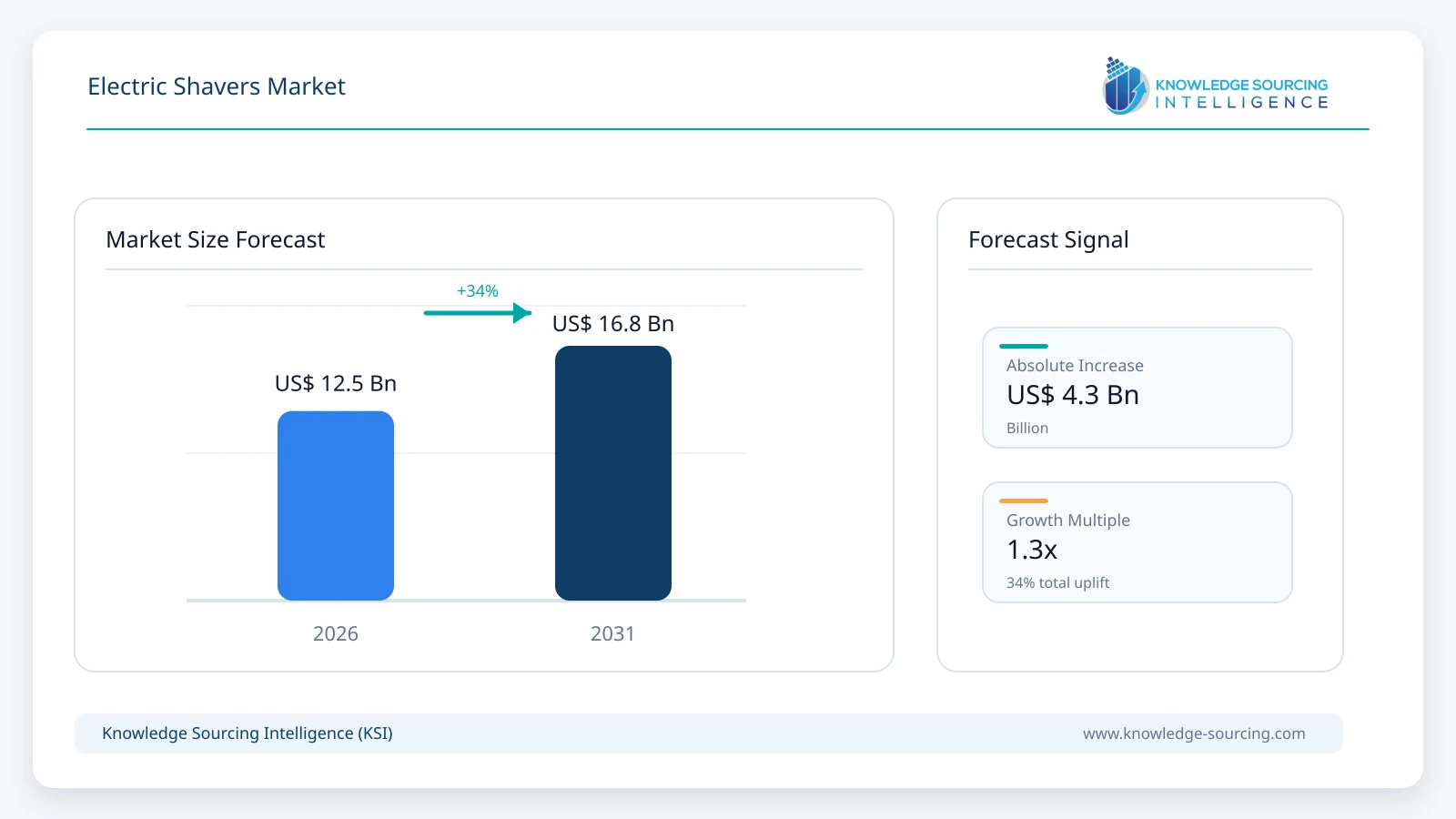
The electric shavers market is forecast to grow at a CAGR of 6.09%, reaching USD 16.8 billion in 2031 from USD 12.5 billion in 2026.
Highlights:
- 1Foil shavers account for approximately 54% of the market in 2026, supported by strong representation across Braun, Panasonic and professional barbering brands.
- 2Rechargeable and battery-powered products represent an estimated 93% of market value in 2026, reflecting the near-complete transition of consumer electric shaving toward cordless use.
- 3Online distribution is projected to grow at approximately 9.7% CAGR through 2031, supported by marketplace retailing, direct-to-consumer strategies and easier online feature comparison.
- 4Men account for approximately 86% of market value in 2026, although women’s electric shaving is expanding faster from a smaller base.
- 5Asia Pacific represents an estimated 38% of the global market in 2026, supported by China, Japan, India and the presence of established regional appliance manufacturers.
- 6Premium development increasingly focuses on adaptive shaving systems, compact designs, wet/dry capability, higher blade counts and improved battery performance.
Market growth is increasingly being shaped by product mix rather than first-time adoption alone. In mature markets, manufacturers are competing through closer shaving performance, skin-comfort features, compact designs, improved battery systems and intelligent sensing, while emerging markets are benefiting from broader access to rechargeable branded products through e-commerce and modern retail.
Electric shaving is also becoming more clearly differentiated from the broader grooming-device market. Shavers are primarily designed for close hair removal through foil or rotary systems, whereas beard trimmers, clippers and multi-groom devices are generally optimized for maintaining hair at a selected length. This distinction matters because premium shavers increasingly incorporate technologies specifically intended to improve skin-level shaving, including pressure sensing, adaptive motor control, flexible shaving heads, specialized foil geometries and enhanced blade systems.
Premium development remains active across both foil and rotary architectures. Philips strengthened its rotary portfolio with the 2025 launch of the i9000 series, incorporating pressure and motion guidance, adaptive power and personalized shaving functionality, while Panasonic continues to develop multi-blade foil platforms and compact premium products such as the LAMDASH Palm-In family. Braun is similarly strengthening foil-shaver differentiation through adaptive shaving elements, wet/dry functionality and premium cleaning systems. These developments indicate that the category is moving beyond simple blade-count or motor-speed competition toward shaving comfort, personalization, portability, battery performance and maintenance convenience.
Market Growth Drivers and Trends
Sensor-Led Premiumization of Electric Shaving Systems
Premium electric shaving is increasingly becoming a technology-driven category rather than a basic appliance purchase. Philips’ i9000 platform uses real-time pressure and motion guidance, adaptive power and personalization features, while Braun’s higher-end products use beard-density sensing, flexible shaving elements and sonic-assisted shaving technologies. These features allow manufacturers to differentiate premium models around comfort and shaving efficiency rather than only styling or motor specifications. KSI expects this continued premiumization to support market value even in countries where electric shaver ownership is already mature.
Expansion of Compact Premium and Travel Shavers
Portability is creating a distinct growth opportunity without necessarily pushing consumers toward low-value travel products. Panasonic’s Palm-In platform places premium multi-blade foil architecture into a compact handheld design, while MANSCAPED’s Handyman applies a similar concept to a smaller waterproof dual-foil face shaver. The resulting category combines portability with premium performance and is suited to business travel, gym use and secondary-device ownership. Compact shavers therefore increasingly function as differentiated products rather than inexpensive substitutes for full-size systems.
Professional Foil Technology Moving into Consumer Use
Professional barbering equipment is influencing consumer expectations for close shaving and finishing performance. Wahl, Andis, BaBylissPRO, JRL and StyleCraft all market foil systems designed for skin-level finishing, bald fades and precision grooming, with features such as high-speed motors, titanium foils and extended cordless runtimes. These technologies are gradually moving into prosumer and home-use products as consumers seek professional-style grooming results. This supports foil-shaver demand and expands the market beyond traditional daily facial shaving.
Growth of Online and Direct-to-Consumer Distribution
Electric shavers are particularly suitable for online distribution because purchasing decisions increasingly depend on feature comparison, reviews, replacement-head availability and price rather than physical demonstration. Established brands such as Philips sell through online platforms and direct channels, while digitally native companies such as MANSCAPED and Skull Shaver have built substantial consumer visibility without matching the physical-store footprint of traditional appliance companies. China’s major shopping platforms also play an important role in premium grooming sales. KSI therefore expects e-commerce to capture a larger portion of incremental market growth through 2031.
Expansion Beyond Conventional Male Facial Shaving
The addressable market is broadening beyond conventional facial shaving. Head shaving, women’s electric shaving, professional finishing and compact touch-up applications are creating additional use cases around the core category. Specialist head-shaving brands such as Skull Shaver and professional foil manufacturers address consumers seeking skin-close results outside traditional beard removal, while dedicated women’s foil shavers serve consumers looking for convenient reusable alternatives to manual shaving. These adjacent use cases support category diversification without requiring the report scope to expand into the wider grooming market.
Market Restraints
Long Replacement Cycles for Premium Electric Shavers
Product durability limits replacement frequency in higher-value segments. Premium shavers increasingly use long-life motors, replaceable shaving heads, improved rechargeable batteries and more durable housings, allowing consumers to retain devices for several years. Replacement blades and foils can extend useful product life even further. As a result, premiumization can increase market value per purchase while simultaneously reducing the frequency with which consumers replace the complete device.
Substitution from Trimmers and Hybrid Grooming Systems
Electric shavers face increasing substitution from beard trimmers, hybrid shaving systems and multi-groom devices, particularly among consumers who prefer stubble or maintained facial hair rather than a skin-close shave. These products can address multiple grooming needs through interchangeable heads or adjustable cutting lengths, reducing the requirement for a dedicated shaver. The effect is particularly relevant among younger users for whom clean shaving is only one grooming option. Dedicated shavers therefore need to maintain a clear performance advantage in closeness, speed or skin comfort.
Battery Serviceability Requirements for Waterproof Devices
Regulation is beginning to affect how rechargeable personal-care appliances are designed. The European Union’s Batteries Regulation increases requirements around portable-battery removability and replacement, while providing limited exceptions where professional replacement may be necessary to preserve safety or water resistance. Electric shavers are directly exposed to this design trade-off because waterproof construction is an important consumer feature. Manufacturers selling into Europe increasingly need to balance sealing, battery longevity, repairability and compliance without compromising product safety.
Price Competition in Entry-Level Online Products
E-commerce has lowered barriers to entry for smaller grooming brands and manufacturers, particularly across China and other Asian production centers. Numerous rechargeable foil and rotary shavers are now available at low price points, creating substantial pressure on mainstream products that lack differentiated technology or branding. Established companies can defend premium positions through performance, quality, replacement-part availability and customer trust, but entry-level products face more intense price comparison. This limits margin expansion in basic product categories even as overall online demand grows.
Premium Feature Inflation and Consumer Price Sensitivity
Premium shavers increasingly incorporate additional blades, sensors, cleaning stations, smartphone connectivity, premium materials and intelligent adjustment systems. These features can support higher selling prices, but consumers do not always perceive an equivalent improvement in shaving results. Manufacturers therefore face a risk that feature complexity increases faster than willingness to pay, particularly when reliable mid-range products already provide satisfactory performance. Premium innovation needs to deliver visible improvements in comfort, speed or convenience rather than simply adding technology.
Electric Shavers Market Segmentation Analysis
By Product Type
Foil Shavers
Foil shavers are projected to expand at approximately 6.9% CAGR through 2031, supported by mainstream consumer demand, professional grooming applications and compact shaving formats. Braun and Panasonic maintain broad foil portfolios across mid-range and premium positions, while Wahl, Andis, BaBylissPRO and other professional brands strengthen the format in close-finishing and barbering applications. Smaller portable products from companies such as MANSCAPED are also extending foil technology into travel and quick-touch-up use cases. KSI expects foil systems to gain modest market share as professional, compact and high-performance consumer applications expand.
Rotary Shavers
Rotary shavers retain approximately 44% of market value by 2031. Philips remains the strongest global reference point for rotary shaving and continues to invest in the architecture through premium launches such as the i9000 series, while Remington, Xiaomi and several Asian brands also maintain active rotary portfolios. The format remains well suited to consumers who value contour following and the ability to capture hair growing in multiple directions. KSI therefore expects rotary shaving to remain a substantial category through 2031, although foil systems gain modest share in professional, compact and premium applications.
By Power Source
Rechargeable and battery-powered systems increasingly define the electric-shaver market and are projected to account for approximately 96% of market value by 2031. Current flagship products from Philips, Braun and Panasonic are designed primarily around cordless operation, while professional brands are increasingly combining lithium-ion batteries with long runtime and rapid charging. Product competition is consequently shifting toward battery life, quick-charge functionality, charging convenience and long-term battery durability. Mains-powered products remain relevant in limited value-oriented and professional niches but continue losing relative importance as cordless products offer sufficient power for demanding use.
By Distribution Channel
Online channels represent an estimated 49% of market value in 2026 and are expected to become the larger distribution format during the forecast period. Consumers can compare shaving architecture, blade systems, battery performance, waterproof capability, accessories and replacement-part availability across a large range of products before purchase. Online marketplaces also allow smaller brands to reach international consumers without developing extensive physical retail networks, while established manufacturers increasingly combine retailer distribution with direct-to-consumer channels. Offline retail nevertheless remains relevant for premium appliances, particularly where consumers prefer to assess ergonomics, build quality or brand support before purchasing.
By End User
Men
The men’s segment is projected to grow at approximately 5.6% CAGR through 2031 and remains the core market for electric shaving. Facial shaving continues to generate the largest demand, but head shaving and professional-style finishing are increasing the range of applications addressed by dedicated devices. Brands such as Skull Shaver have developed specialized head-and-face platforms, while professional foil systems increasingly target both barber and home users. Premium men’s shaving is also benefiting from greater emphasis on sensitive-skin performance, adaptive power and personalized shaving guidance.
Women
Women’s electric shaving represents a smaller share of the market but is projected to grow at approximately 9.0% CAGR through 2031. Dedicated women’s foil shavers offer a reusable and relatively painless hair-removal format for legs, underarms and other body areas, although the category competes with manual razors, epilators and IPL systems. Scope discipline is therefore important, and KSI includes only products whose primary function is electric shaving. Growth is being supported by improved waterproof designs, rechargeable operation and broader online product availability.
Geographical Outlook
Asia Pacific
Asia Pacific is the largest regional market and is projected to expand at approximately 7.7% CAGR through 2031. The region combines large consumer populations, increasing e-commerce penetration, strong Japanese appliance companies and a growing base of Chinese grooming brands. Japan remains important to premium foil technology through Panasonic’s LAMDASH portfolio, while China combines demand from international brands with domestic participants such as Xiaomi, POVOS and Flyco. India and Southeast Asia provide additional growth opportunities as rechargeable personal-care products become more accessible through online retail and organized electronics distribution.
Europe
Europe retains approximately 25% of global market value by 2031 and remains a mature premium market. Growth is primarily driven by replacement, product upgrades and premiumization rather than large increases in first-time ownership. Philips and Braun maintain strong brand positions, while European regulation increasingly influences battery serviceability, sustainability and product-life considerations. The region therefore provides an important testing ground for premium product design as manufacturers balance waterproof construction, battery performance and repairability.
North America
North America remains important to premium consumer products, professional grooming equipment and digitally native brands. The region has strong representation from Wahl, Andis, Conair, MANSCAPED, Skull Shaver and professional foil manufacturers, while Philips, Braun and Panasonic maintain broad consumer distribution. Market growth is closely linked to replacement, premiumization and expansion into specialized use cases such as head shaving and professional-style finishing. Online and direct-to-consumer channels are particularly important for newer brands seeking to compete against established appliance companies.
South America and the Middle East & Africa remain smaller markets but continue to benefit from wider availability of rechargeable branded products, online distribution and expanding modern retail channels. Growth remains more price-sensitive than in mature markets, making mid-range rechargeable products particularly important.
Key Developments
July 2026: Panasonic announced new LAMDASH Palm-In and Palm-In PRO models for launch in September 2026, extending premium multi-blade foil technology into a compact handheld format. The development supports the emergence of high-performance portable shavers rather than treating travel products as low-value secondary appliances.
April 2025: Philips launched the i9000 electric-shaver family with pressure and motion guidance, adaptive power and personalized shaving features. The launch demonstrates the increasing role of sensors and software-assisted functionality in premium rotary shaving and reinforces the shift toward comfort and personalization as competitive differentiators.
Competitive Environment
The electric-shavers market combines diversified consumer-appliance companies, grooming specialists, professional barber-tool manufacturers and digitally native brands. Philips remains particularly important in rotary shaving, while Braun and Panasonic maintain strong positions in premium foil products, and Remington competes across both major shaving architectures. Professional foil competition is more fragmented, with Wahl, Andis, BaBylissPRO, JRL and StyleCraft competing through motor performance, foil materials, cordless runtime and close-finishing capability.
Chinese manufacturers and brands are intensifying competition across entry and mid-range price points, particularly through online channels. Xiaomi combines electric shaving with its broader consumer-electronics ecosystem, while Flyco, POVOS, Kemei and other Asian brands broaden the available range of rechargeable products. Competitive advantage increasingly depends on skin comfort, adaptive power, wet/dry capability, battery runtime, replacement-head availability, compactness, cleaning systems and distribution strength rather than shaving-system architecture alone.
Electric Shavers Market Scope:
| Report Metric | Details |
|---|---|
| Total Market Size in 2026 | USD 12.5 billion |
| Total Market Size in 2031 | USD 16.8 billion |
| Forecast Unit | USD Billion |
| Growth Rate | 6.09% |
| Study Period | 2021 to 2031 |
| Historical Data | 2021 to 2024 |
| Base Year | 2025 |
| Forecast Period | 2026 – 2031 |
| Segmentation | Product Type, Power Source, Distribution Channel, End-User, Geography |
| Companies |
|
Market Segmentation
By Product Type
Foil Shaver
Rotary Shaver
By Power Source
Battery-Powered
Mains-Powered
Dual-Powered
By Distribution Channel
Online
Offline
By End-User
Men
Women
By Geography
North America
United States
Canada
Mexico
South America
Brazil
Argentina
Others
Europe
Germany
France
United Kingdom
Italy
Spain
Others
Middle East and Africa
Saudi Arabia
United Arab Emirates
Israel
Others
Asia Pacific
China
India
Japan
South Korea
Indonesia
Thailand
Taiwan
Others
Table of Contents
1. EXECUTIVE SUMMARY
2. MARKET SNAPSHOT
2.1. Market Overview
2.2. Market Definition
2.3. Scope of the Study
2.4. Market Segmentation
3. BUSINESS LANDSCAPE
3.1. Market Drivers
3.2. Market Restraints
3.3. Market Opportunities
3.4. Porter’s Five Forces Analysis
3.5. Industry Value Chain Analysis
3.6. Policies and Regulations
3.7. Strategic Recommendations
4. TECHNOLOGICAL OUTLOOK
5. ELECTRIC SHAVERS MARKET BY PRODUCT TYPE
5.1. Introduction
5.2. Foil Shaver
5.3. Rotary Shaver
6. ELECTRIC SHAVERS MARKET BY POWER SOURCE
6.1. Introduction
6.2. Battery-Powered
6.3. Mains-Powered
6.4. Dual-Powered
7. ELECTRIC SHAVERS MARKET BY DISTRIBUTION CHANNEL
7.1. Introduction
7.2. Online
7.3. Offline
8. ELECTRIC SHAVERS MARKET BY END-USER
8.1. Introduction
8.2. Men
8.3. Women
9. ELECTRIC SHAVERS MARKET BY GEOGRAPHY
9.1. Introduction
9.2. North America
9.2.1. By Type
9.2.2. By Power Source
9.2.3. By Distribution Channel
9.2.4. By End-User
9.2.5. By Country
9.2.5.1. United States
9.2.5.2. Canada
9.2.5.3. Mexico
9.3. South America
9.3.1. By Type
9.3.2. By Power Source
9.3.3. By Distribution Channel
9.3.4. By End-User
9.3.5. By Country
9.3.5.1. Brazil
9.3.5.2. Argentina
9.3.5.3. Others
9.4. Europe
9.4.1. By Type
9.4.2. By Power Source
9.4.3. By Distribution Channel
9.4.4. By End-User
9.4.5. By Country
9.4.5.1. Germany
9.4.5.2. France
9.4.5.3. United Kingdom
9.4.5.4. Italy
9.4.5.5. Spain
9.4.5.6. Others
9.5. Middle East and Africa
9.5.1. By Type
9.5.2. By Power Source
9.5.3. By Distribution Channel
9.5.4. By End-User
9.5.5. By Country
9.5.5.1. Saudi Arabia
9.5.5.2. United Arab Emirates
9.5.5.3. Israel
9.5.5.4. Others
9.6. Asia Pacific
9.6.1. By Type
9.6.2. By Power Source
9.6.3. By Distribution Channel
9.6.4. By End-User
9.6.5. By Country
9.6.5.1. China
9.6.5.2. India
9.6.5.3. Japan
9.6.5.4. South Korea
9.6.5.5. Indonesia
9.6.5.6. Thailand
9.6.5.7. Taiwan
9.6.5.8. Others
10. COMPETITIVE ENVIRONMENT AND ANALYSIS
10.1. Major Players and Strategy Analysis
10.2. Market Share Analysis
10.3. Mergers, Acquisitions, Partnerships, and Collaborations
10.4. Competitive Dashboard
11. COMPANY PROFILES
11.1. Conair Corporation
11.2. Koninklijke Philips N.V.
11.3. Panasonic Corporation
11.4. The Procter & Gamble Company
11.5. Spectrum Brands Holdings, Inc.
11.6. Xiaomi Corporation
11.7. Wahl Clipper Corporation
11.8. Havells India Limited
11.9. Andis Company
11.10. Manscaped
12. APPENDIX
12.1. Currency
12.2. Assumptions
12.3. Base and Forecast Years Timeline
12.4. Key Benefits for Stakeholders
12.5. Research Methodology
12.6. Abbreviations
LIST OF FIGURES
LIST OF TABLES
Navigate
Trusted by the world's leading organizations











