
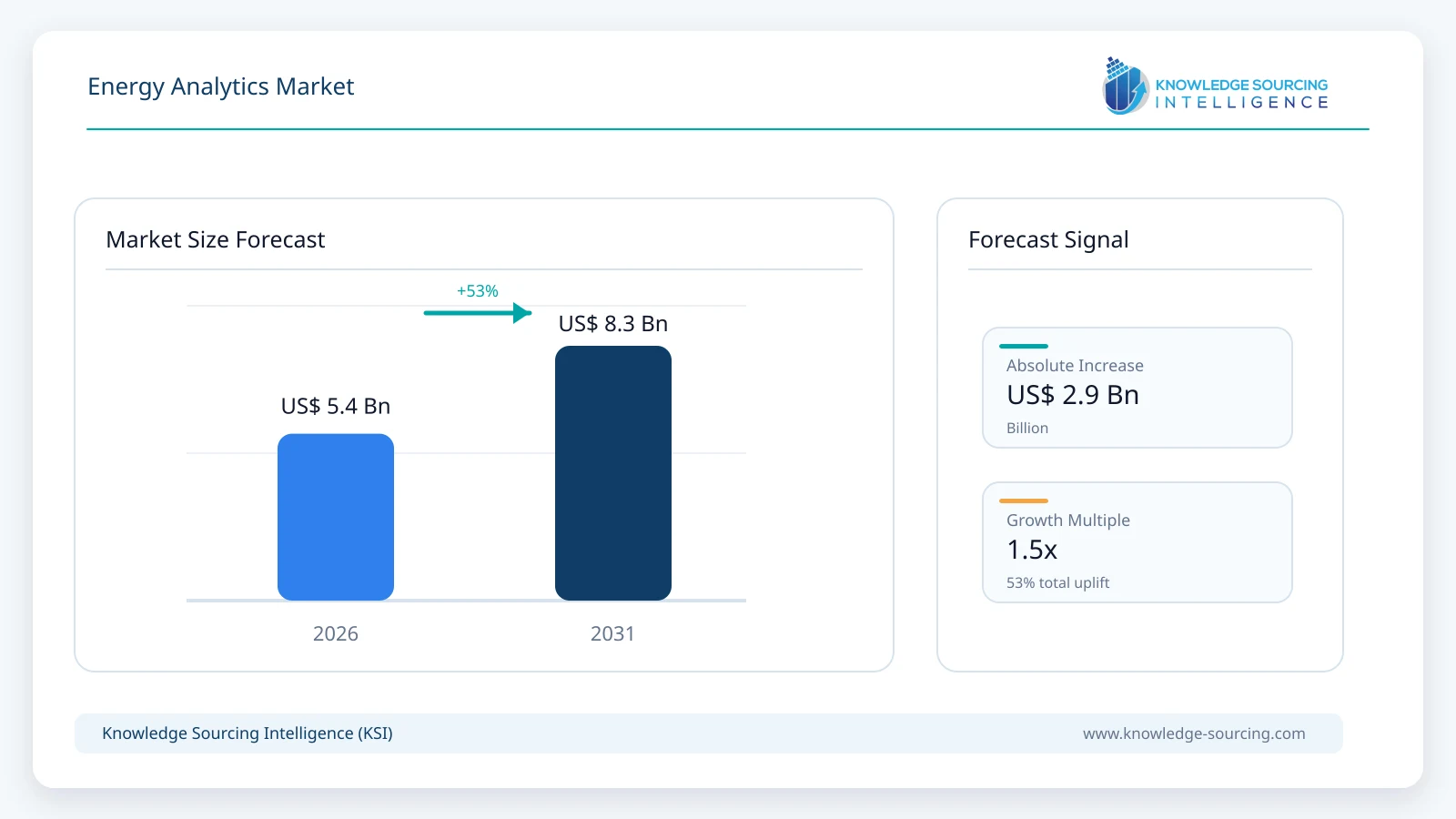
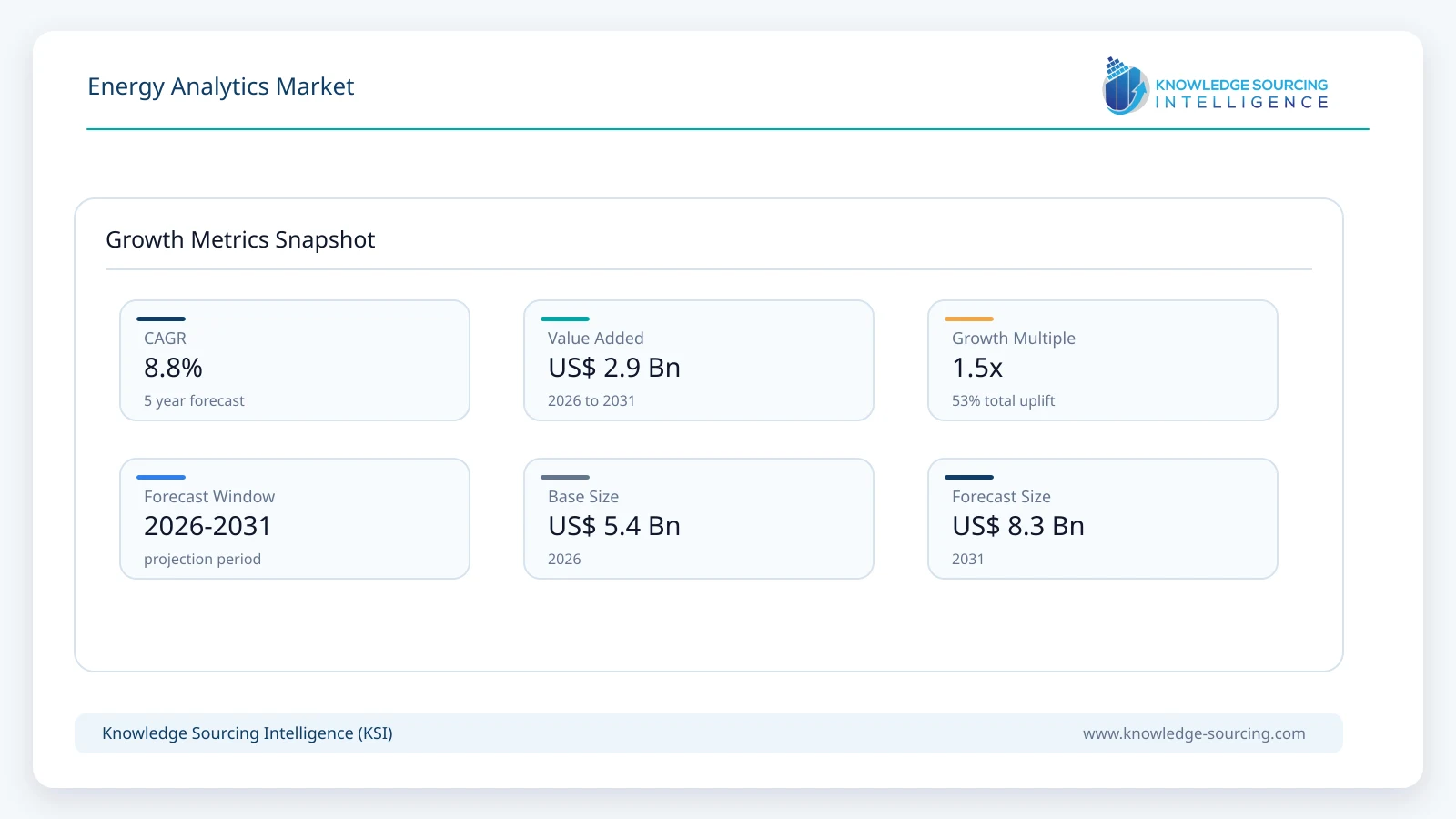
The Energy Analytics Market is forecast to grow at a CAGR of 8.8%, reaching USD 8.29 billion in 2031 from USD 5.43 billion in 2026.
Highlights:
- 1Energy organizations are moving away from traditional reporting and towards predictive models for equipment failures, forecasting demand, predicting renewable generation, or abnormal consumption.
- 2Increasing demand for electricity forecasting, grid planning, congestion analysis, and asset optimization as a result of changing load profiles all over the world.
- 3Smart Meter and AMI expansion is generating high-frequency consumption data which can be mined for load forecasting, customer segmentation, non-technical-loss analysis, revenue assurance, and demand response.
- 4Energy analytics is increasingly being integrated as part of larger grid-management platforms, not as stand-alone reporting software.
The Energy Analytics Market is shifting energy management from periodic reporting to continuous insights that drive data-driven decision-making. Past energy-management processes typically tracked consumption in hindsight, based on records kept over time and outdated, manually prepared reports, while a modern analytics platform connects real-time operational data with historical data, machine-learning statistics, asset-health data, weather information, input and output characteristics, market prices, and customer behavior.
Electricity demand growth is boosting this transition. According to the IEA, global electricity consumption rose 3% in 2025, with electricity demand growing more than twice as fast as total energy demand. Data centers, electric vehicles, buildings, and industrial electrification have changed demand patterns that utilities and energy companies increasingly have to grasp on a near-real-time basis.
Energy analytics platforms are deployed across transmission and distribution networks, generation facilities, substations, renewable plants, industrial sites, and commercial properties through customer management systems. The data sources are also becoming more diverse, such as smart meters, AMI, IoT sensors, IEDs, weather stations, DERs, building-management systems, and market data.
The use of artificial intelligence and machine learning is also growing within the tech ecosystem. For instance, GE Vernova recently consolidated numerous functionalities from grid data, network modeling, real-time operations, DER management, field execution, and visual intelligence on a single platform as part of GridOS for Distribution.
Additionally, the market is experiencing an existential change, wherein descriptive analytics continues to be key to reporting and visualization, but diagnostic and forecasting functions gain prominence for grid reliability, asset optimization, as well as demand management and renewable-energy enrollment.
Market Dynamics
Market Drivers
Growing Demand for Electricity and Increasing Grid Complexity: With increasing demand for electricity consumption, utilities will then need to understand demand patterns and optimize infrastructure. With industrial production, electrification, and air conditioning driving electricity-demand growth to 2027, the IEA sees these factors as driving it. Energy analytics allow utilities to work with larger and larger sets of data, which they convert into demand forecasts, insights on how their networks are performing, indications of asset health, and recommendations for operational action. This need is reinforced by the increasing penetration of variable renewable generation as grid operators face the need to forecast both supply and load.
Smart Meters, IoT and Grid Sensors Expansion: Smart meters, sensors, intelligent substations, distributed energy resources, and connected equipment are generating significantly more data for energy networks. Moreover, utilities are seeking analytic platforms that can integrate data across disparate systems. For instance, Itron's smart-grid analytics platform is focused solely on using smart-meter intelligence to assist utilities in achieving further value from their AMI investments.
Rising Demand for Predictive Asset Maintenance: Power transformers, turbines and generators, substations, transmission devices like switches, pipelines, and other energy property generally need to be monitored continuously, as unexpected failure rates can lead to high costs in repairs or loss of service. Using analytics, operators can transition from fixed maintenance schedules to condition-based and predictive maintenance. Through asset-performance models and predictive capabilities, Hitachi Energy's Lumada APM enables utilities to pinpoint failures potentially on the horizon and be given a priority for maintenance measures.
Integration of Renewable Energy and Distributed Energy Resources: With solar PV, wind generation, batteries, EVs, and a range of other distributed resources making electricity networks more dynamic. Analytics provides operators with the physical forecasts of renewable generation, MW-level congestion alerts, distributed resource optimization opportunities, and integration-level voltage and frequency control. GE Vernova's GridOS for distribution combines DER management and real-time operations capabilities with network modeling and visual intelligence, pointing to how analytics is becoming embedded within larger grid-orchestration systems.
Market Restraints & Opportunities
The data on which energy analytics platforms rely needs to be of good quality and in the right context. Utilities often operate heterogeneous environments with a variety of legacy SCADA systems, AMI platforms, GIS systems, enterprise applications, and equipment from different vendors.
Analytics platforms that bridge operational technology with enterprise IT and cloud environments will need to extend cybersecurity as a top priority. As an example, GE Vernova has GridOS Data Fabric to govern and harmonize distributed grid data before its use by applications.
A huge opportunity lies in shifting from descriptive reporting to predictive and prescriptive analytics. Utilities want analytics platforms that can find anomalies and also predict failure and maintenance priorities, demand forecasts, or operational response.
New and concentrated electricity loads are growing in data centers, EV charging, industrial electrification, and heat pumps. This provides avenues for load forecasting, capacity planning, demand-response analytics, energy procurement optimization, and grid-congestion management.
Key Developments
June 2026: GE Vernova GridOS for Distribution was positioned as an integrated grid-intelligence platform of popular network modeling, real-time operation, DER management, field execution, and visual intelligence solutions on a governed data foundation.
March 2026: Hitachi Energy introduced HMAX Energy, an AI-based services and solutions offering for critical energy infrastructure. It integrates asset-lifecycle planning, condition monitoring, predictive analytics, simulation, and preventive maintenance of utilities, renewables, and industrial assets, as well as data centre and substation-level DC links and power-quality systems.
Market Segmentation
The market is segmented by analytics type, component, application, end user, and geography.
By Analytics Type: Predictive Analytics
Predictive analytics is one of the most strategically important analytics categories in the energy sector because energy companies are shifting their focus from reporting historical information to predicting future events such as demand, equipment failures, renewable-generation variability, and abnormal operating conditions.
The predictive models consist of historical operational data, real-time sensor measurements, weather information, consumption patterns, and other market variables and asset-health indicators. Such models have been recently applied for predicting electricity load, transformers and turbine failures, renewable generation estimation, abnormal consumption detection, and predictive maintenance.
For instance, Hitachi Energy's Lumada APM, which uses one or more asset-performance models enhanced with analysis and prediction. This platform aims to detect asset roadblocks with risk and advises the corresponding action. Thus, as utilities continue to focus on and invest in early-warning systems, failure prediction, demand forecasting, and operational optimization, this segment is growing.
By Application: Grid & Network Analytics
Grid and network analytics take a leading role as an application segment, with utilities needing data for the growing visibility, reliability, planning, and operational efficiency of overcomplex electricity networks.
Modern grid analytics utilizes data from sources such as meters, SCADA systems, substation-supply sensors, and GIS platforms, distributed energy resources, weather systems, along with customer data. The derived information facilitates network-state estimation, congestion detection, outage localization, voltage and reactive power control, DER integration, and planning for the grid
GE Vernova GridOS for Distribution combines network modeling, operations, DER, Digital Field Execution, and Digital Operations Center visual intelligence on one platform. There is an additional boost in demand for network analytics as utilities have to cope with bidirectional flows and changing load patterns with the growth of distributed solar, batteries, EVs, and flexible loads. GE Vernova's Grid Data Fabric provides a common language, governance model, and user access strategy to unify disparate grid data for consumption across grid applications.
By End User: Power Utilities
The power utilities segment is the main end-user segment because these utility companies own and operate generation, transmission, and distribution networks, as well as customer networks that produce a great deal of operational and consumption data.
Utilities are deploying analytics to enhance the reliability of their assets, forecast demand, identify non-technical losses, monitor power quality, schedule renewable integration, and facilitate network planning.
EnergyIP Analytics Suite is designed analytics application for utilities. Likewise, Siemens' EnergyIP Analytics Suite is designed to manage application pricing by utility needs, which include load forecasting, hierarchical breakdown, revenue protection, grid-loss detection, equipment-load management, and power-quality analysis.
Itron includes a similar use of smart-grid analytics to derive more value from smart-meter data for utility operations. The segment is changing from separate analytical silos and toward integrated analytics environments leveraging AMI, GIS, SCADA, ADMS, DERMS, and asset-management and customer data.
Regional Analysis
North America Market Analysis
North America is a mature energy-analytics market that benefits from high smart-meter penetration, utility digitalization, distributed energy resources, and growing demand for electricity by data centers. According to the US International Energy Agency (IEA), electricity demand growth is rising in the USA, with data centers amongst the largest drivers for the growing demand.
South America Market Analysis
South America is developing as an emerging energy-analytics market. The emerging energy-analytics is witnessed with distribution networks being modernized, renewable-generation capacity expanded, and utilities facing the need to reduce technical and commercial losses.
Europe Market Analysis
Europe reflects an advanced market for energy analytics supported by smart-meter deployment, renewable-energy integration, as well as liberalized energy markets and more digitalized distribution networks. This is driving demand for forecasting and congestion management, balancing, asset optimisation, and network planning as wind and solar generation expands.
Middle East and Africa Market Analysis
The market in the Middle East & Africa is progressing in terms of utility digitalization, renewable-energy growth, smart-city projects, and rising power consumption. Gulf countries are starting to increase investments in solar generation, smart-city infrastructure, and digitally managed electricity networks.
Asia Pacific Market Analysis
Asia Pacific is one of the fastest-growing and long-term markets for Energy Analytics because this region has a rapid growth in energy demand, heavy industrialization, significant investments in smart grids, expansion of renewable energy projects, and a fast digitalization process. In China, India, Japan, South Korea, and Australia, new demand forecasting, smart-meter analytics, renewable forecasting, asset-performance management, and grid optimization opportunities are opening channels.
List of Companies
Hitachi Energy
GE Vernova
Itron
Ameresco, Inc.
Siemens AG
Schneider Electric SE
Trane
Resource Innovations
Honeywell
Oracle
Hitachi Energy
Hitachi Energy enhances its presence in energy analytics platforms with Lumada Asset Performance Management Energy APM. It integrates asset data, assesses asset health, predicts potential failures, prescribes remediation actions, and monitors results. It is intended for other asset-heavy enterprises, similar to the energy technology and utility framework.
GE Vernova
GE Vernova is working on a software portfolio called GridOS with energy analytics applications. GridOS for Distribution aggregates network modeling with real-time operations, DER management, field execution, and visual intelligence backed by a common data foundation.
Itron
Itron provides energy analytics by drawing higher value from smart-meter data through its Active Smart Grid Analytics portfolio. The platform helps users utilize AMI data both in smart-grid applications as well as operational decision-making designed for utility applications.
Analyst View
The growing complexity of the supply and demand side of electricity grids, including increasing electricity consumption due to projected global population growth with rising energy expectations per capita, distributed generation resources integration, the intermittent nature of renewable plants, repeated natural disasters impacting critical infrastructure resilience, and aging physical assets, is resulting in multiple challenges for electric utilities. Additionally, predictive asset management, grid analytics, load forecasting, and AMI analytics are some of the major growth areas. Vendors that combine new-generation analytics with AI, Data governance, OT integration, and a well-developed cloud platform are in the growing position in the coming years.
Energy Analytics Market Scope:
| Report Metric | Details |
|---|---|
| Total Market Size in 2026 | USD 5.43 billion |
| Total Market Size in 2031 | USD 8.29 billion |
| Forecast Unit | USD Billion |
| Growth Rate | 8.8% |
| Study Period | 2021 to 2031 |
| Historical Data | 2021 to 2024 |
| Base Year | 2025 |
| Forecast Period | 2026 – 2031 |
| Segmentation | Component, Analytics Type, Application, End User, Geography |
| Companies |
|
Market Segmentation
By Component
Software & Platform
Services
By Analytics Type
Descriptive Analytics
Diagnostic Analytics
Predictive Analytics
Others
By Application
Grid & Network Analytics
Asset & Operations Analytics
Load & Demand Forecasting
Smart Meter & AMI Analytics
Others
By End User
Power Utilities
Oil & Gas Companies
Water & Wastewater Utilities
Others
By Geography
North America
USA
Canada
Mexico
South America
Brazil
Argentina
Others
Europe
United Kingdom
Germany
France
Others
Middle East and Africa
Saudi Arabia
UAE
Others
Asia Pacific
China
Japan
India
South Korea
Others
Table of Contents
1. EXECUTIVE SUMMARY
2. MARKET SNAPSHOT
2.1. Market Overview
2.2. Market Definition
2.3. Scope of the Study
2.4. Market Segmentation
3. MARKET DYNAMIC
3.1. Market Drivers
3.2. Market Restraints
3.3. Market Opportunities
3.4. Porter’s Five Forces Analysis
3.5. Industry Value Chain Analysis
4. BUSINESS LANDSCAPE
4.1. Regulatory and Standards Landscape
4.2. Energy Data Infrastructure, Smart Meter and Data Management Analysis
4.3. Energy Analytics Deployment, Pricing and Investment Analysis
4.4. Energy Analytics Supply Chain, Vendor Ecosystem and Integration Analysis
4.5. Strategic Recommendations
5. TECHNOLOGICAL OUTLOOK
5.1. Predictive Analytics and Statistical Modeling Technologies
5.2. Artificial Intelligence and Machine Learning Technologies
5.3. Real-Time and Streaming Energy Analytics Technologies
5.4. Cloud-Based Energy Analytics Technologies
6. ENERGY ANALYTICS MARKET BY COMPONENT
6.1. Introduction
6.2. Software & Platform
6.3. Services
7. ENERGY ANALYTICS MARKET BY ANALYTICS TYPE
7.1. Introduction
7.2. Descriptive Analytics
7.3.Diagnostic Analytics
7.4. Predictive Analytics
7.5. Others
8. ENERGY ANALYTICS MARKET BY APPLICATION
8.1. Introduction
8.2. Grid & Network Analytics
8.3. Asset & Operations Analytics
8.4. Load & Demand Forecasting
8.5. Smart Meter & AMI Analytics
8.6. Others
9. ENERGY ANALYTICS MARKET BY END USER
9.1. Introduction
9.2. Power Utilities
9.3. Oil & Gas Companies
9.4. Water & Wastewater Utilities
9.5. Others
10. ENERGY ANALYTICS MARKET BY GEOGRAPHY
10.1. Introduction
10.2. North America
10.2.1. USA
10.2.2. Canada
10.2.3. Mexico
10.3. South America
10.3.1. Brazil
10.3.2. Argentina
10.3.3. Others
10.4. Europe
10.4.1. United Kingdom
10.4.2. Germany
10.4.3. France
10.4.4. Others
10.5. Middle East and Africa
10.5.1. Saudi Arabia
10.5.2. UAE
10.5.3. Others
10.6. Asia Pacific
10.6.1. China
10.6.2. Japan
10.6.3. India
10.6.4. South Korea
10.6.5. Others
11. COMPETITIVE ENVIRONMENT AND ANALYSIS
11.1. Major Players and Strategy Analysis
11.2. Market Share Analysis
11.3. Mergers, Acquisitions, Agreements, and Collaborations
11.4. Competitive Dashboard
12. COMPANY PROFILES
12.1. Hitachi Energy
12.2. GE Vernova
12.3. Itron
12.4. Ameresco, Inc.
12.5. Siemens AG
12.6. Schneider Electric SE
12.7. Trane
12.8. Resource Innovations
12.9. Honeywell
12.10. Oracle
13. APPENDIX
13.1. Currency
13.2. Assumptions
13.3. Base and Forecast Years Timeline
13.4. Key benefits for the stakeholders
13.5. Research Methodology
13.6. Abbreviations
Navigate
Trusted by the world's leading organizations











