
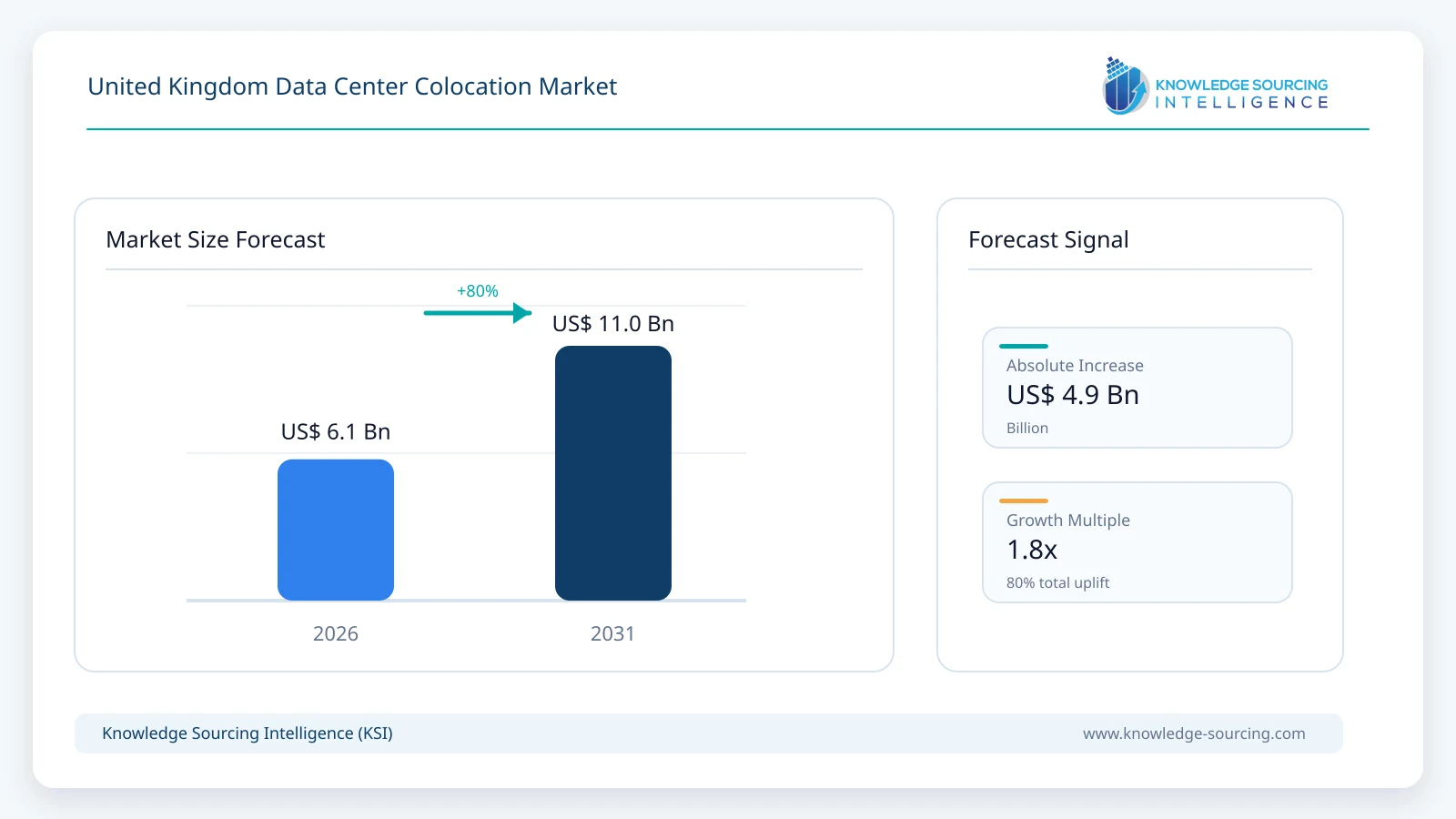
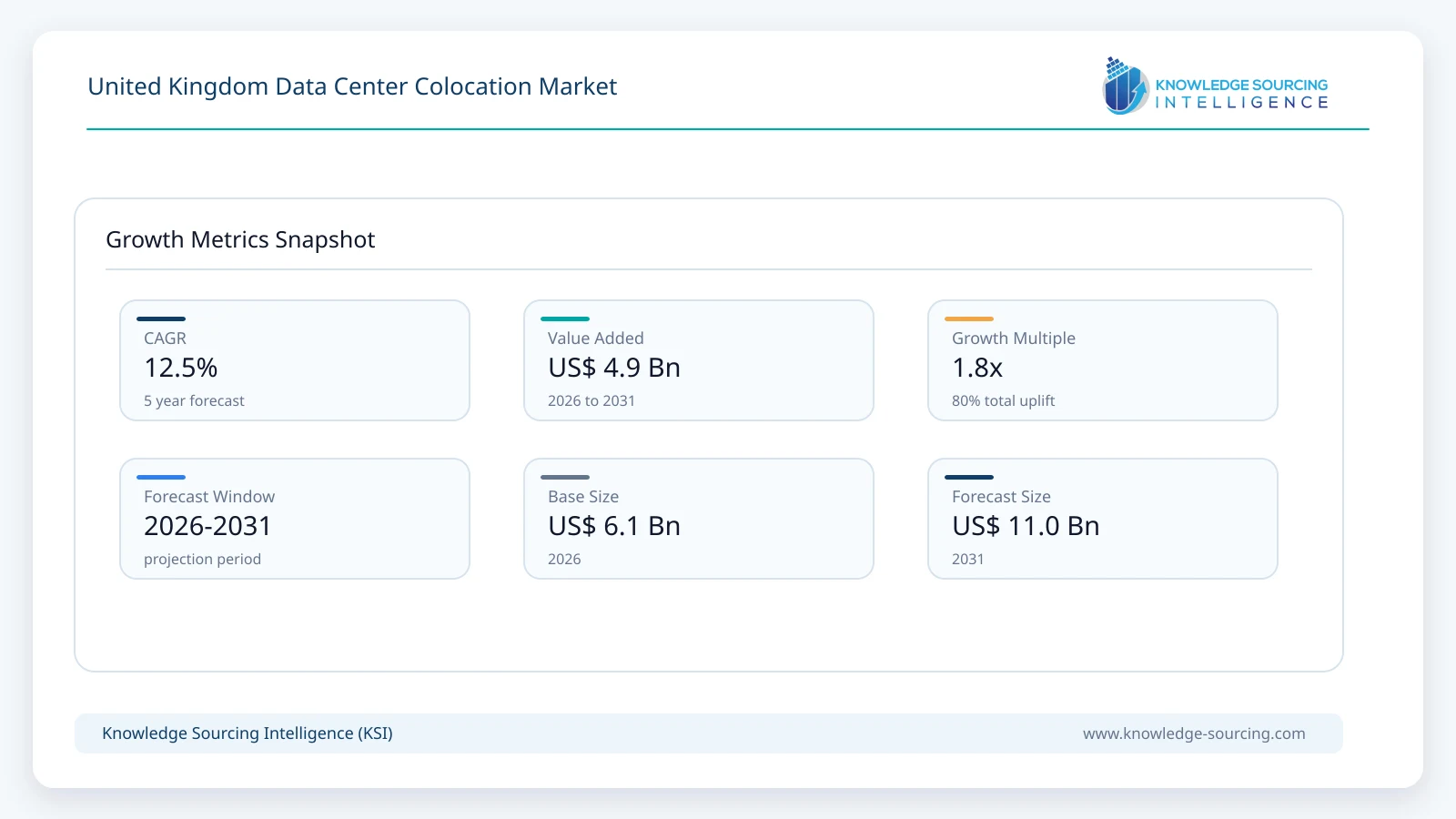
The United Kingdom data center colocation market is forecast to grow at a CAGR of approximately 12.5%, increasing from USD 6.1 billion in 2026 to USD 11.0 billion in 2031.
Highlights:
- 1Wholesale colocation accounts for approximately 57% of United Kingdom colocation market value in 2026 as hyperscale cloud and AI customers increasingly lease large blocks of dedicated capacity.
- 2Large enterprises represent approximately 62% of market value in 2026, supported by financial services, telecommunications, digital media and increasingly compute-intensive enterprise workloads.
- 3Communication and technology accounts for approximately 33% of market value in 2026 as cloud platforms, software companies, AI providers and network operators remain the principal users of leased infrastructure.
- 4London and the surrounding South East remain the principal UK colocation cluster, with government estimates previously indicating more than 1 GW of rated colocation IT capacity in London alone.
- 5UK data center electricity consumption increased approximately 41% between 2020 and 2024 to 4.5 TWh, demonstrating the rapid growth in operational computing capacity.
Colocation providers supply secure data-hall space, power, cooling, physical security, connectivity and increasingly high-density infrastructure to enterprises, cloud providers and AI companies that prefer to lease data center capacity rather than develop dedicated facilities. The market includes retail and wholesale colocation services and excludes enterprise-owned facilities used solely by their owner. Official data confirm the increasing physical scale of the underlying industry: the number of operational UK data centers serving external organizations increased from 221 in 2020 to 239 in 2024, while electricity consumption increased 41% over the same period to approximately 4.5 TWh, equivalent to 2% of Great Britain’s grid electricity consumption in 2024.
The United Kingdom is one of Europe’s most established colocation markets because London combines international fibre connectivity, financial-market infrastructure, cloud on-ramps and a large enterprise customer base. Equinix currently operates ten London data center campuses and provides direct connectivity to major cloud platforms and a customer ecosystem that includes financial institutions, insurers, payment companies, network providers and technology businesses. NTT DATA similarly describes London as one of the world’s most active colocation ecosystems and continues expanding across Dagenham, Slough and Hemel Hempstead. Existing concentration around Greater London provides strong network effects because customers can interconnect with carriers, exchanges and cloud providers within a dense infrastructure cluster, but demand is increasingly spreading beyond established West London and Slough locations as power availability becomes more constrained. New investment is therefore emerging in Hertfordshire, Harlow, Stockport and other regional locations while the government uses AI Growth Zones to encourage additional compute infrastructure in areas with available land and electricity-system capacity.
Investment momentum is substantial. The Office for National Statistics estimates that UK market-sector investment in its expanded definition of digital infrastructure reached £11.2 billion in 2025, with £5.6 billion invested in other buildings and structures, a category that includes data center buildings. ONS also notes that 171 data center construction projects had either started during the latest year or were expected to begin during the following five years. Separately, the UK Compute Roadmap references £44 billion of private-sector investment in AI data centers announced over a twelve-month period, indicating that the industry is moving beyond conventional enterprise hosting toward much larger AI and cloud infrastructure programmes. This investment is supporting expansion by Equinix, VIRTUS, NTT DATA, Telehouse, Kao Data and other operators while also increasing competition for electricity connections, construction capacity and suitable sites.
Market Trends
AI Workloads Are Increasing Rack Density and Changing Facility Design
Artificial intelligence is changing the physical design requirements of colocation facilities because GPU-based computing generates substantially greater power and heat densities than conventional enterprise servers. New facilities increasingly incorporate direct-to-chip liquid cooling, larger electrical distribution systems and flexible data halls capable of supporting both traditional and high-density deployments. VIRTUS announced LONDON19 in June 2026 with 32.5 MW of IT load and infrastructure designed specifically for resilient, AI-ready environments, taking its UK operational and committed estate above 300 MW. Kao Data is developing a similar high-density strategy: its 17.6 MW KLON-03 facility at Harlow is designed for GPU-accelerated computing with hybrid air and direct-to-chip liquid cooling, while a June 2026 ten-year agreement with Nebius brought a multi-megawatt AI cloud deployment to the Harlow campus. Digital Realty has also introduced a London Innovation Lab where customers can test AI and hybrid-cloud infrastructure before commercial-scale deployment.
Capacity Development Is Beginning to Spread Beyond the Traditional London Core
London and Slough remain the country’s principal data center locations, but power and land constraints are encouraging developers and policymakers to consider a broader geographic footprint. The UK government’s AI Growth Zone programme aims to accelerate data-center investment by improving planning support and access to electricity, while the government’s reformed national electricity-pricing plan proposes lower electricity-system charges for qualifying data centers in regions where large loads can reduce network constraints. From April 2027, eligible AI Growth Zone developments could receive discounts of up to £24/MWh in Scotland, £16/MWh in Cumbria and £14/MWh in the North East. Private investment is moving in the same direction. Kao Data is investing approximately £350 million in a Stockport facility scheduled to become operational in 2028, while national compute initiatives are increasing investment in Scotland. Regional development will not displace London but should gradually create secondary clusters capable of supporting AI, cloud and sovereign-compute workloads.
Colocation Is Becoming More Closely Integrated with Cloud and Network Ecosystems
Customers increasingly evaluate colocation facilities according to the digital ecosystems available around the physical rack rather than space and power alone. Direct cloud connectivity, internet exchanges, network fabrics and software-defined interconnection allow enterprises to maintain private infrastructure while connecting rapidly to multiple public clouds and AI services. Equinix’s London estate provides access to AWS, Microsoft Azure, Google Cloud and other major providers alongside one of Europe’s largest financial and network ecosystems. Telehouse expanded this model in February 2026 by adding Console Connect’s Network-as-a-Service platform to its London facilities, giving customers on-demand connectivity to more than 150 cloud locations and over 1,000 data center and network locations globally. The trend strengthens the position of established carrier-neutral facilities because enterprises can use colocation as the physical core of hybrid infrastructure rather than migrating every workload directly into public cloud environments.
Market Drivers
Rapid Growth in AI, Cloud and Data Infrastructure Investment
Artificial intelligence and cloud computing are generating a new investment cycle across UK digital infrastructure. ONS estimates that market-sector digital infrastructure investment reached £11.2 billion in 2025, while investment in buildings and structures associated partly with data center expansion reached £5.6 billion. AI adoption is simultaneously broadening among UK enterprises, with ONS reporting that the share of businesses with ten or more employees using AI increased from approximately 12% in late 2023 to 35% in 2026, while 69% of firms surveyed used cloud-based computing systems and applications in 2023. These adoption rates increase requirements for computing, storage and network infrastructure even when customers do not operate their own facilities. The government’s UK Compute Roadmap separately identifies £44 billion of private AI data-center investment announced within twelve months, demonstrating that demand is progressing from incremental enterprise hosting toward large-scale AI infrastructure requiring significant leased capacity, interconnection and high-density power.
Expanding Data Center Electricity Consumption and Operating Capacity
The physical expansion of the UK data center industry is visible in official electricity statistics. DESNZ and ONS estimate that externally operated facilities increased from 221 in 2020 to 239 in 2024, while electricity consumption rose from approximately 3.2 TWh to 4.5 TWh, an increase of around 41%. Data centers consequently accounted for approximately 2% of the 249.2 TWh of grid electricity consumed in Great Britain during 2024. This increase reflects both new facilities and capacity expansion within existing campuses, which is particularly relevant to the colocation market because operators frequently develop sites in several phases as customer commitments increase. Investment pipelines indicate further expansion: Equinix plans a 250+ MW Hertfordshire campus backed by £3.9 billion of planned investment, while NTT DATA has secured a 26.3-acre London site for its eighth facility in the market and is continuing expansion under its broader USD 10 billion global data center investment programme.
Enterprise Demand for Outsourced Resilient Infrastructure
Colocation adoption is supported by enterprises that require high availability and cloud connectivity but do not want to finance and operate dedicated data center buildings. This is particularly relevant in financial services, media, technology and other sectors where uptime, low latency, physical security and access to multiple carriers are critical. Future Publishing’s May 2026 decision to select Telehouse South as its colocation partner illustrates this requirement: the company sought resilient infrastructure capable of supporting more than 200 digital brands and continuous online interactions. Equinix’s London ecosystem includes more than 4,900 enterprises and access to over 2,000 network service providers across its broader platform, demonstrating the network effect that established colocation facilities can offer enterprise customers. Outsourcing becomes more attractive as power density, cooling technology, cybersecurity and infrastructure resilience grow more complex, because specialist operators can spread investment in these capabilities across many customers rather than requiring each enterprise to develop them independently.
Market Restraints
Electricity-Connection Constraints Are Limiting the Pace of New Development
Power availability has become the most immediate physical constraint on UK data center development. Ofgem reported in July 2026 that demand-connection applications on Britain’s transmission network had surged from 41 GW to 125 GW in less than one year, with data center projects accounting for at least 80 GW of the queue. The scale of speculative applications has prompted Ofgem to propose a dedicated Data Centre Commitment Fee and project-development milestones to remove non-viable schemes and prioritize facilities capable of progressing. Grid constraints can delay projects for several years even where land, planning and financing are available, particularly in established London and South East clusters. Operators are consequently investing in new substations, exploring alternative locations and increasingly considering power availability during site selection. The problem is sufficiently significant that government reforms now identify strategically important data centers for accelerated connection treatment while AI Growth Zones are being used to direct investment toward areas with greater electricity-system capacity.
Cybersecurity and Operational-Resilience Requirements Are Increasing Compliance Costs
The strategic importance of data centers is increasing the regulatory obligations placed on operators. The UK designated data centers as Critical National Infrastructure in 2024, and government plans now bring qualifying facilities within the Network and Information Systems regulatory framework as essential services, with Ofcom acting as the operational regulator. Operators will be expected to implement proportionate measures to manage cyber and operational risks and comply with strengthened incident-management and resilience requirements. These obligations support customer confidence but also increase the cost and complexity of facility operations, particularly for smaller providers competing against large international operators with established security, compliance and redundancy programmes. Colocation companies must maintain physical security, cybersecurity controls, backup power, network diversity, incident response and customer-specific compliance while also investing in new cooling and high-density infrastructure. Regulatory requirements therefore reinforce scale advantages and may increase the capital required for smaller operators to remain competitive in enterprise and regulated-industry accounts.
Segment Analysis
By Colocation Model: Wholesale Colocation
Wholesale colocation is becoming the principal value pool as hyperscalers, AI companies and large digital enterprises lease complete data halls or multi-megawatt capacity blocks rather than individual racks. The segment is projected to reach approximately USD 6.8 billion by 2031, representing growth of around 14.3% annually from 2026. Expansion is being driven by customers that require dedicated high-density environments but want to avoid the time and capital required to develop their own sites. The scale of current projects illustrates this shift: Equinix’s planned Hertfordshire campus will provide more than 250 MW of compute capacity, VIRTUS already has more than 300 MW of operational and committed UK capacity, and NTT DATA is adding another London site to support future large-scale demand. Wholesale agreements offer operators stronger visibility over occupancy and future cash flows, but they also require substantially larger capital commitments and access to electricity, making power procurement and phased campus development increasingly important competitive capabilities.
By Enterprise Size: Large Enterprises
Large enterprises remain the principal customer category because financial institutions, telecommunications providers, media companies and multinational businesses require resilient infrastructure, connectivity to multiple cloud platforms and extensive compliance capabilities. The segment is projected to reach approximately USD 7.1 billion by 2031, with growth of around 13.4% annually from 2026. London is particularly attractive to large enterprises because its colocation campuses provide direct access to financial markets, international fibre networks, internet exchanges and major cloud providers. NTT DATA’s London facilities are positioned specifically around multinational enterprises, while Equinix’s London network supports one of Europe’s largest capital-markets ecosystems. Large organizations are also increasingly using colocation to support hybrid infrastructure in which sensitive or latency-dependent workloads remain on dedicated equipment while scalable computing is accessed through public clouds. AI adoption strengthens this model because enterprises may require direct access to specialized GPU or AI infrastructure without building dedicated high-density data halls internally.
By Industry Vertical: Communication and Technology
Communication and technology represents the largest industry vertical because cloud providers, network operators, software companies, content platforms and AI businesses require large quantities of highly connected compute capacity. The segment is projected to reach approximately USD 3.8 billion by 2031, supported by continued migration toward cloud infrastructure and the development of AI-optimized computing environments. The relationship between AI providers and colocation operators is becoming increasingly visible in the UK: Kao Data signed a ten-year agreement with Nebius in June 2026 for a multi-megawatt AI infrastructure deployment at Harlow, while Digital Realty’s London Innovation Lab provides a dedicated environment in which customers can validate AI and hybrid-cloud architectures before deploying them commercially. Technology customers generally require higher rack densities and more advanced cooling than traditional enterprise workloads, increasing revenue per unit of occupied floor space but also raising operator capital requirements for electrical and thermal infrastructure.
Competitive Environment and Analysis
The UK market contains large global colocation platforms, major European operators and specialist domestic infrastructure providers. Equinix has one of the broadest connected ecosystems and currently operates ten London campuses while planning its £3.9 billion, 250+ MW Hertfordshire development. Digital Realty combines colocation with its PlatformDIGITAL interconnection ecosystem and is expanding AI-focused capabilities in London. NTT DATA operates multiple facilities across Dagenham, Slough and Hemel Hempstead and has secured a new London site for further expansion. VIRTUS has developed one of the largest UK capacity pipelines, exceeding 300 MW of operational and committed capacity following the announcement of LONDON19, while Telehouse remains deeply established in the Docklands interconnection ecosystem. Kao Data specializes increasingly in high-density AI and advanced-computing deployments, while Ark Data Centres, CyrusOne, Colt Data Centre Services, Global Switch, Iron Mountain and other operators compete for hyperscale and enterprise requirements. Competitive differentiation increasingly depends on available power, speed to deployment, high-density cooling, carrier ecosystems and access to renewable electricity.
Market Share Analysis
The UK colocation market is concentrated among a group of large operators but remains competitive because individual providers hold different strengths across retail interconnection, hyperscale wholesale capacity, enterprise hosting and AI infrastructure. Equinix holds a particularly strong position in retail colocation and network-dense London facilities, while Digital Realty and NTT DATA maintain substantial enterprise and large-scale footprints. VIRTUS has rapidly increased its position through a UK estate exceeding 300 MW of operational and committed capacity, and Telehouse retains an important position around London’s Docklands connectivity ecosystem. Market share is increasingly shifting toward operators that can secure large power allocations because future capacity additions are becoming more important than existing floor space alone. Equinix’s 250+ MW Hertfordshire campus, CyrusOne’s proposed 90 MW LON6 development, NTT DATA’s additional London site and VIRTUS LONDON19 demonstrate the scale of new capacity under development. Operators unable to secure grid connections or support liquid-cooled high-density computing risk losing share as AI and cloud customers account for a larger proportion of incremental demand.
Recent Developments
June 2026: VIRTUS announced LONDON19 at Slough Trading Estate, adding 32.5 MW of IT capacity and taking its UK operational and committed estate above 300 MW.
June 2026: Kao Data signed a ten-year agreement with Nebius for a multi-megawatt AI infrastructure deployment at its Harlow campus using renewable power and direct-to-chip liquid cooling.
May 2026: Kao Data acquired a 4.7-acre site at Park Royal in West London for redevelopment into a new data center targeted for service in 2029.
February 2026: Digital Realty expanded its Innovation Lab programme to London, providing a dedicated environment for customers to test AI and hybrid-cloud deployments before scaling them into production.
October 2025: Equinix announced £3.9 billion of planned investment in a new 250+ MW Hertfordshire campus after completing acquisition of an 85-acre development site.
October 2025: Telehouse broke ground on the £275 million West Two data center in London Docklands, with 22 MW of planned IT capacity and completion scheduled for 2028.
Market Outlook
The United Kingdom data center colocation market is forecast to expand from approximately USD 6.1 billion in 2026 to USD 11.0 billion in 2031 at a CAGR of around 12.5%. Growth is increasingly tied to the amount of electrical capacity operators can bring online rather than simple additions of conventional rack space. AI and cloud workloads require multi-megawatt deployments, higher rack densities and liquid-cooling capability, favoring large operators that can develop phased campuses with substantial power allocations. Wholesale colocation consequently grows faster than traditional retail capacity, although network-dense retail facilities remain strategically important for financial services, cloud connectivity and enterprise interconnection. Large enterprises continue to represent the largest customer category, while communication and technology companies account for the largest industry-specific demand pool as AI infrastructure, software platforms and cloud services expand.
Power availability becomes the most important constraint on the pace and geographic distribution of growth through 2031. The transmission connection queue already includes at least 80 GW of proposed data-center demand, pushing regulators to differentiate viable developments from speculative applications and encouraging government support for capacity outside the existing London core. London and the South East remain the country’s most important colocation ecosystem, but AI Growth Zones and targeted electricity-pricing measures should support gradual development of secondary clusters in Scotland, the North West and other regions with available power. Competitive advantage increasingly depends on the combination of secured electricity capacity, high-density facility design, liquid cooling, cloud and network interconnection, cybersecurity compliance and the financial resources required to develop large campuses several years before full customer occupancy.
United Kingdom Data Center Colocation Market Scope
| Report Metric | Details |
|---|---|
| Total Market Size in 2026 | USD 6.1 billion |
| Total Market Size in 2031 | USD 11.0 billion |
| Forecast Unit | Billion |
| Growth Rate | 12.5% |
| Study Period | 2021 to 2031 |
| Historical Data | 2021 to 2024 |
| Base Year | 2025 |
| Forecast Period | 2026 – 2031 |
| Segmentation | Colocation Model, Enterprise Size, Industry Vertical |
| Companies |
|
Market Segmentation
By Colocation Model
Wholesale
Retail
By Enterprise Size
Small
Medium
Large
By Industry Vertical
Communication and Technology
BFSI
Government
Healthcare
Manufacturing
Media and Entertainment
Others
Table of Contents
1. INTRODUCTION
1.1. Market Overview
1.2. Market Definition
1.3. Scope of the Study
1.4. Market Segmentation
1.5. Currency
1.6. Assumptions
1.7. Base and Forecast Years
1.8. Key Benefits to Stakeholders
2. RESEARCH METHODOLOGY
2.1. Research Design
2.2. Secondary Research
2.3. Primary Research
2.4. Market Estimation
2.5. Segment Modelling
2.6. Data Triangulation and Validation
3. EXECUTIVE SUMMARY
3.1. Key Findings
3.2. United Kingdom Data Center Colocation Market Size, 2026-2031
3.3. Colocation Model Outlook
3.4. Enterprise Size Outlook
3.5. Industry Vertical Outlook
4. MARKET DYNAMICS
4.1. Market Drivers
4.1.1. Rapid Growth in AI, Cloud and Digital Infrastructure Investment
4.1.2. Expanding Data Center Electricity Consumption and Operating Capacity
4.1.3. Enterprise Demand for Outsourced Resilient Infrastructure
4.2. Market Restraints
4.2.1. Electricity-Connection Constraints
4.2.2. Cybersecurity and Operational-Resilience Requirements
4.3. Porter’s Five Forces Analysis
4.4. Industry Value Chain Analysis
4.5. Regulatory Environment
4.6. Power Availability and Grid Connections
5. TECHNOLOGICAL OUTLOOK
5.1. High-Density AI Infrastructure
5.2. Direct-to-Chip Liquid Cooling
5.3. Software-Defined Interconnection
5.4. Renewable Power and Energy Efficiency
5.5. Data Center Infrastructure Management
6. UNITED KINGDOM DATA CENTER COLOCATION MARKET BY COLOCATION MODEL
6.1. Introduction
6.2. Wholesale
6.3. Retail
7. UNITED KINGDOM DATA CENTER COLOCATION MARKET BY ENTERPRISE SIZE
7.1. Introduction
7.2. Small
7.3. Medium
7.4. Large
8. UNITED KINGDOM DATA CENTER COLOCATION MARKET BY INDUSTRY VERTICAL
8.1. Introduction
8.2. Communication and Technology
8.3. BFSI
8.4. Government
8.5. Healthcare
8.6. Manufacturing
8.7. Media and Entertainment
8.8. Others
9. COMPETITIVE ENVIRONMENT AND ANALYSIS
9.1. Major Players and Strategy Analysis
9.2. Market Share Analysis
9.3. Mergers, Acquisitions, Agreements, and Collaborations
9.4. Competitive Dashboard
10. COMPANY PROFILES
10.1. Equinix, Inc.
10.2. Digital Realty Trust, Inc.
10.3. NTT DATA Global Data Centers
10.4. VIRTUS Data Centres
10.5. Telehouse International Corporation of Europe
10.6. Ark Data Centres
10.7. Kao Data
10.8. CyrusOne
10.9. Colt Data Centre Services
10.10. Global Switch
10.11. Iron Mountain Data Centers
10.12. Vantage Data Centers
10.13. Pulsant
10.14. Datum Datacentres
10.15. Serverfarm
11. APPENDIX
Navigate
Trusted by the world's leading organizations











