
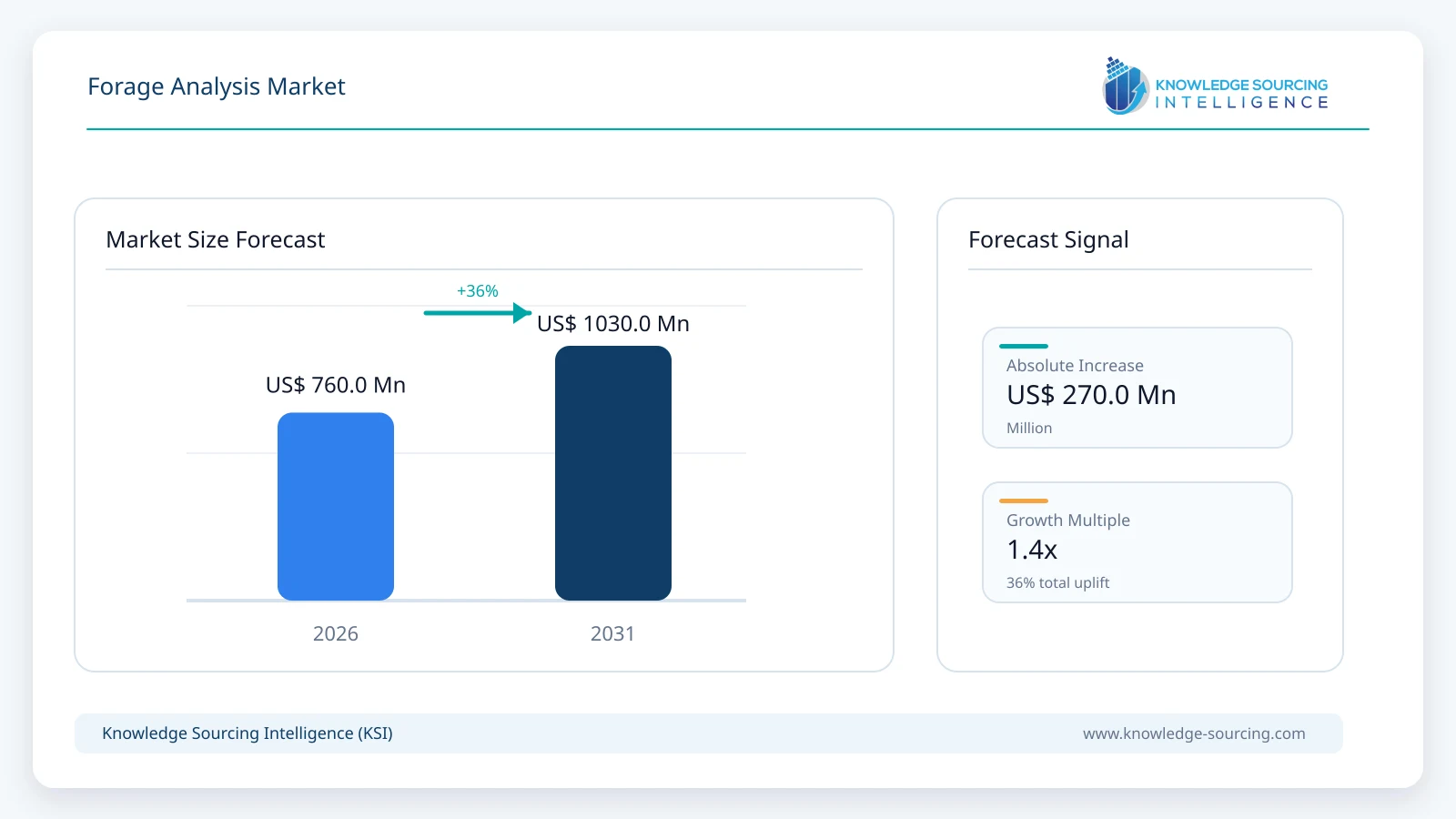
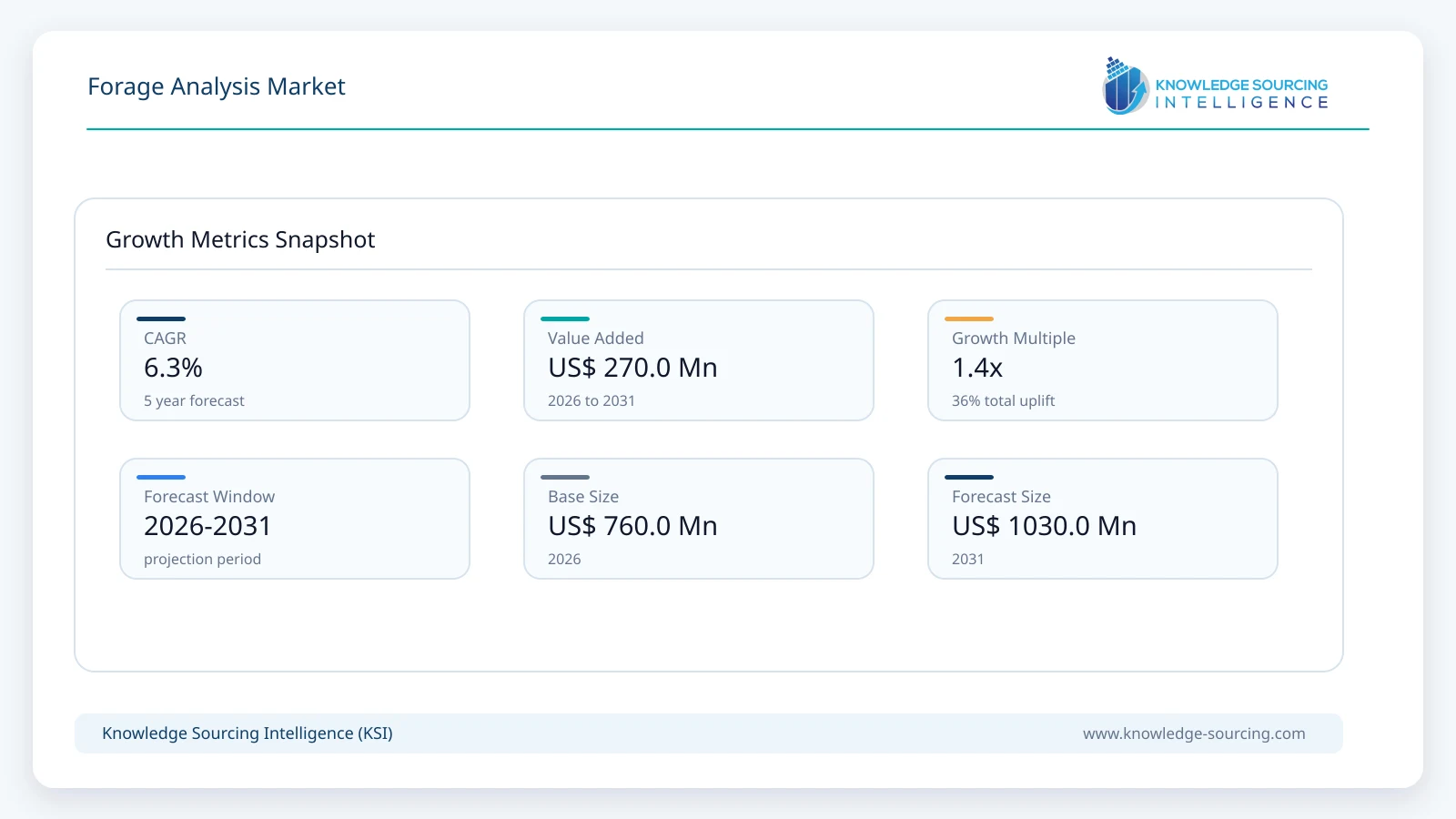
The global Forage Analysis Market is forecast to grow at a CAGR of 6.3%, reaching USD 1,030.0 million in 2031 from USD 760.0 million in 2026.
Highlights:
- 1Silage and haylage account for approximately 42% of global forage analysis market value in 2026, supported by frequent testing requirements for moisture, fermentation, and ration formulation.
- 2Near-infrared spectroscopy accounts for approximately 61% of market value in 2026, reflecting its rapid turnaround and suitability for routine analysis of commonly tested forages.
- 3Dairy cattle account for approximately 49% of global forage analysis demand in 2026, owing to the close relationship between forage composition, ration formulation, and milk production.
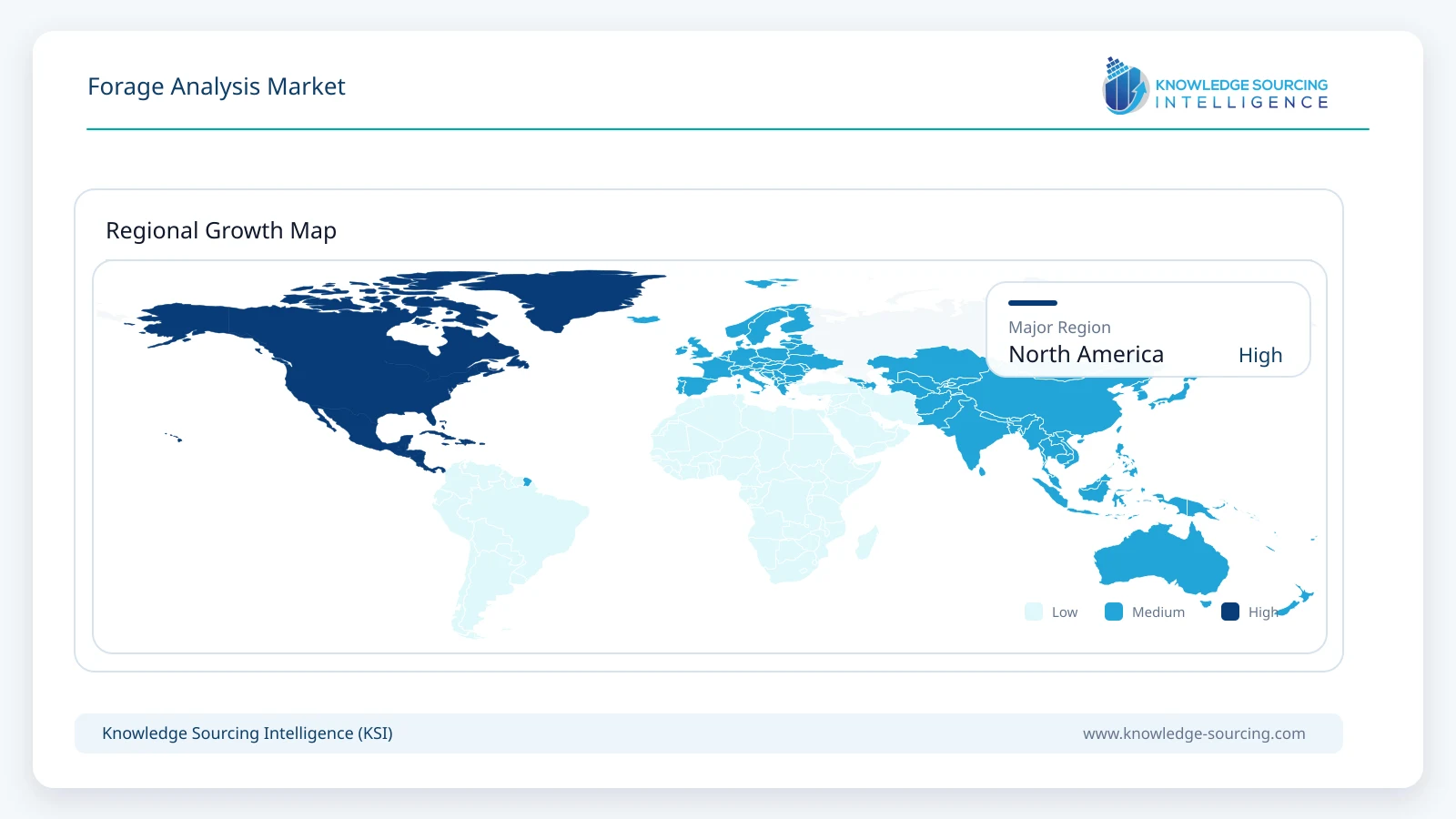
- 4North America accounts for approximately 36% of the global forage analysis market in 2026, supported by established commercial laboratories and intensive dairy and beef production.
- 5The United States accounts for approximately 27% of global market value in 2026, with a developed network of commercial, university, and cooperative forage laboratories.
Forage analysis includes commercial laboratory and analytical services used to determine the nutritional quality, digestibility, fermentation characteristics, and safety of hay, silage, haylage, pasture, and other forage materials intended primarily for livestock feeding. Common measurements include dry matter, crude protein, neutral detergent fiber, acid detergent fiber, starch, sugars, minerals, digestibility and fermentation parameters.
The market includes laboratory-based near-infrared spectroscopy and reference chemistry, together with commercial portable or on-site analysis where the analytical service, calibration and interpretation form part of the offering. It excludes the broader animal feed testing market where testing is unrelated to forage, standalone laboratory instrument sales and routine soil, water or plant-tissue testing.
Forage testing is increasingly integrated into ration management rather than being used only when feed-quality problems emerge. Utah State University Extension notes that forage growers, buyers and livestock producers increasingly rely on analytical forage quality rather than visual assessment, particularly when balancing dairy and beef total mixed rations. Both NIR and wet chemistry remain established analytical approaches, with NIR providing faster and less expensive routine analysis while reference chemistry remains necessary for parameters and forage types where predictive calibrations are less reliable.
Commercial laboratories are consequently expanding from basic protein and fiber measurements into digestibility, fermentation, mycotoxin, mineral, and nutritional modeling services. Dairyland Laboratories and Cumberland Valley Analytical Services, for example, provide multiple NDF digestibility time points, starch digestibility and advanced forage characterization alongside routine NIR testing.
Market Trends
NIR and Reference Chemistry Are Increasingly Used Together
Near-infrared spectroscopy has become central to routine commercial forage testing because it can predict multiple nutritional parameters rapidly from a single prepared sample. Laboratories can process high sample volumes with substantially faster turnaround than conventional chemistry, making NIR particularly suitable for frequently tested materials such as corn silage, haylage and alfalfa hay.
The technology does not eliminate reference chemistry. NIR predictions depend on calibration datasets created from samples previously characterized by laboratory methods, while minerals, unusual feed materials and some specialized measurements still require direct chemical analysis. Commercial laboratories therefore increasingly combine both approaches. Cumberland Valley Analytical Services offers packages in which NIR nutrient analysis is combined with wet-chemistry minerals or selected reference measurements, while Dairy One similarly combines NIR packages with chemistry add-ons.
This hybrid model allows laboratories to provide rapid routine results while retaining analytical precision for parameters where predictive spectroscopy is less appropriate.
Advanced Digestibility Testing Is Increasing the Value of Each Sample
Forage analysis is moving beyond basic measurements of moisture, protein, and fiber. Dairy nutrition increasingly uses measurements such as NDF digestibility, undigested NDF, starch digestibility and fermentation profiles to understand how forage behaves inside the animal rather than only its chemical composition.
Commercial laboratories have responded by expanding their analytical packages. Dairyland Laboratories provides multiple NDF digestibility and undigested NDF time points designed around current dairy formulation systems, while CVAS offers in-vitro digestibility, fermentation analysis, and extended NIR evaluations.
These services increase the amount of nutritional information generated from each sample and allow nutritionists to distinguish between forages with similar basic nutrient concentrations but different feeding values. Growth in advanced analysis therefore increases market revenue without requiring equivalent growth in total sample numbers.
Portable NIR Is Moving Analysis Closer to the Farm
Portable spectroscopy is reducing the time between forage sampling and nutritional decision-making. Instead of shipping every sample to a central laboratory, handheld systems can provide rapid measurements directly at farms, feed businesses, or advisory locations when suitable calibrations are available.
In January 2026, Eurofins Agro and trinamiX expanded their mobile NIR collaboration into equine nutrition using the handheld PAL Two spectrometer. The system analyzes fresh grass, hay and haylage and provides nutritional results within seconds using Eurofins-developed calibration models.
Portable analysis is particularly useful for parameters that change frequently, including forage dry matter. Central laboratories remain important for reference chemistry, calibration development and more complex analytical work, meaning portable NIR is extending the forage-testing ecosystem rather than eliminating conventional laboratories.
Laboratory Results Are Becoming More Connected to Feed-Management Systems
Forage laboratories increasingly provide digital reporting, data export, and integration with ration-formulation systems rather than delivering standalone analytical reports. This is particularly important for dairy nutritionists and feed companies managing repeated samples across multiple farms or forage inventories.
Dairyland's NIR affiliate system supports electronic data handling, standardized reports, and data formats that can be imported into formulation software, while CVAS provides online access and data-management services alongside analytical testing.
The value proposition consequently shifts from simply measuring a sample toward converting laboratory information into feeding decisions. Providers with extensive historical databases can also improve NIR calibration quality as new samples are incorporated across different forage types, growing conditions, and geographic regions.
Market Drivers
Feed-Cost Optimization Is Increasing the Importance of Accurate Forage Data
Forage is a major component of dairy and ruminant diets, making inaccurate assumptions about nutrient content costly when repeated across a herd. Testing allows nutritionists to formulate diets around actual dry matter, protein, fiber, digestibility, and energy characteristics rather than relying on standard reference values.
University of Wisconsin Extension identifies more economical ration formulation and improved milk production among the primary reasons for forage testing. The institution also notes that forage testing is relatively inexpensive compared with the potential economic consequences of incorrectly formulated diets.
The commercial value of analysis therefore increases as producers focus more closely on income over feed cost and feed efficiency. Testing can help determine whether additional concentrates are necessary, which forage lots should be allocated to higher-producing animals, and when ration adjustments are required.
Variability Between Forage Lots Requires Repeated Analysis
Forage nutritional characteristics vary according to crop maturity, weather, variety, soil conditions, harvest timing, fermentation and storage. Consequently, published nutrient averages cannot accurately represent every hay or silage lot.
The requirement becomes more significant where farms use forage harvested from multiple fields or stored in separate bunkers, bags, or bale groups. University of Minnesota Extension recommends frequent moisture monitoring because changes in forage dry matter can alter ration consistency, while Utah State University emphasizes representative sampling of individual forage lots when developing total mixed rations.
Climate variability further increases the value of testing because rainfall, temperature, and harvest conditions can materially affect fiber, protein, and moisture characteristics between growing seasons. Repeated sampling therefore creates recurring rather than one-time demand for analytical services.
Increasing Attention to Silage Quality Supports More Detailed Testing
Silage analysis provides information not only on nutritional content but also on fermentation and preservation quality. Measurements such as pH, ammonia, and fermentation acids help producers identify whether ensiling conditions created stable, usable forage.
Teagasc recommends laboratory silage analysis because visual inspection alone cannot accurately determine nutritive value or preservation quality. Commercial laboratories increasingly provide fermentation packages alongside traditional nutrient measurements, allowing producers to evaluate both feeding value and the effectiveness of the ensiling process.
The growing use of corn silage, grass silage and haylage in intensive dairy and beef production consequently supports demand for more comprehensive analytical packages.
Market Restraints and Challenges
Poor Sampling Can Reduce the Value of Laboratory Analysis
Laboratory precision cannot compensate for an unrepresentative forage sample. Hay bales, silage bunkers and pasture fields may contain substantial variation, meaning samples collected from too few locations can produce results that do not accurately represent the forage being fed or sold.
Utah State University's 2025 forage sampling guidance emphasizes that representative sampling is fundamental to reliable analytical results and recommends multiple subsamples across each forage lot. Teagasc similarly warns that poorly collected silage samples can produce inaccurate results.
Sampling requirements can reduce adoption among smaller livestock producers because analysis adds operational steps beyond the laboratory fee itself. Laboratories and agricultural advisers therefore need to provide clear sampling procedures alongside analytical services.
NIR Accuracy Depends on Calibration Quality and Sample Type
NIR provides significant speed and cost advantages but cannot predict every sample equally well. Reliable analysis requires calibration models developed from sufficiently diverse samples characterized using reference methods.
Alternative or unusual forage types may have weaker calibration datasets than conventional corn silage, grass silage or alfalfa hay. University of Wisconsin Extension therefore recommends reference chemistry when appropriate calibration is unavailable, while Dairyland Laboratories continuously expands its global sample datasets to improve NIR systems.
The requirement for extensive chemistry-backed calibration creates a competitive advantage for laboratories with large historical databases but can limit smaller providers and portable systems targeting less frequently tested forage types.
Segment Analysis
By Forage Type: Silage and Haylage
Silage and haylage analysis is projected to generate approximately USD 444 million by 2031, remaining the largest forage-type segment. Ensiled forage requires analysis of both nutritional composition and preservation characteristics, making testing more extensive than routine evaluation of some dry forages.
Dry matter is particularly important because changing moisture alters the actual quantity of nutrients delivered when diets are mixed on an as-fed basis. Silage testing can also include pH, ammonia, and organic acids to evaluate fermentation, alongside protein, fiber, starch, and digestibility measurements. Commercial laboratories therefore offer dedicated fermentation and silage packages rather than treating all forage samples identically.
Demand remains particularly strong in dairy systems where corn silage and haylage account for substantial proportions of total mixed rations and where relatively small nutritional changes can affect ration balance.
By Method: Near-Infrared Spectroscopy
Near-infrared spectroscopy is projected to generate approximately USD 656 million by 2031, remaining the largest analytical method used in commercial forage analysis. NIR can rapidly predict numerous nutritional properties using the interaction between infrared light and a prepared forage sample, enabling laboratories to process large numbers of samples economically.
CVAS notes that NIR can evaluate substantially more constituents in a sample without a proportionate increase in analytical time, while Dairyland operates an affiliate network covering more than 75 laboratories using shared calibrations, data systems, and quality procedures.
Reference chemistry remains essential for calibration and specialized parameters, preventing NIR from becoming a complete replacement. Nevertheless, its speed and suitability for high-frequency routine testing allow it to maintain the leading market position through 2031.
By Livestock: Dairy Cattle
Dairy cattle applications are projected to generate approximately USD 510 million by 2031, remaining the largest livestock segment. Dairy diets require precise coordination between forage, concentrates, protein sources and minerals to support milk production while maintaining rumen function. Forage testing enables nutritionists to distinguish between different silage and hay lots and allocate them according to production requirements. Measurements including dry matter, NDF, NDF digestibility, starch digestibility and fermentation quality have become increasingly important within modern dairy-formulation systems.
CVAS describes dairy nutrition as the core focus of its forage and feed analytical operations, while Dairyland's most comprehensive NIR packages are specifically designed around dairy formulation models. Beef cattle, equine and small-ruminant testing continue to expand, but the frequency and analytical complexity associated with intensive dairy feeding maintain dairy cattle as the largest commercial application.
Major Region: North America
North America is projected to generate approximately USD 363 million in forage analysis revenue by 2031, remaining the largest regional market. The region combines extensive dairy, beef, hay and silage production with an established commercial forage-testing infrastructure. Specialist laboratories including Dairyland Laboratories, Cumberland Valley Analytical Services, Dairy One, Rock River Laboratory and Ward Laboratories provide routine NIR analysis alongside advanced chemistry, digestibility, fermentation and contamination testing. National Forage Testing Association certification also provides a structured proficiency framework for participating laboratories.
The region is increasingly adopting more detailed forage characterization rather than relying only on basic protein and fiber testing. Portable analysis and digital data integration also expand the frequency with which analytical information can be incorporated into day-to-day ration management.
Major Country: United States
The United States is projected to generate approximately USD 271 million in forage analysis revenue by 2031, remaining the largest individual national market. Commercial testing is supported by the scale of the country's dairy and beef industries, substantial hay and silage production and a mature network of independent and university laboratories. Testing capacity continues to expand geographically. CVAS opened an additional laboratory in Fort Loramie, Ohio, in late 2024, while university programs in Kentucky and Ohio introduced or expanded forage-testing services during 2025-2026.
Commercial laboratories are also moving toward more advanced analysis of digestibility, fermentation and feed dynamics. The United States consequently remains central to both routine forage testing and development of analytical practices used more broadly across the international livestock industry.
Competitive Environment and Analysis
The forage analysis market includes specialist agricultural laboratories, large international testing companies, agricultural cooperatives and regional feed laboratories. Specialist providers such as Dairyland Laboratories, Cumberland Valley Analytical Services, Dairy One and Rock River Laboratory compete primarily through forage-specific expertise, calibration databases, turnaround time and relationships with nutritionists and livestock producers. Large testing groups including SGS, Eurofins Scientific and Intertek participate through broader feed, agricultural and laboratory networks. SGS provides both NIR and wet-chemistry analysis for feed and forage, while Intertek offers nutritional and compositional testing across animal-feed materials.
Competitive advantage increasingly depends on the depth of analytical capability rather than basic nutrient testing alone. Laboratories capable of combining routine NIR with digestibility, fermentation, minerals, mycotoxin analysis and digital data services can serve a larger proportion of a customer's feed-testing requirements. Extensive chemistry databases also improve NIR calibration quality, creating a scale advantage for established providers.
Portable NIR introduces another competitive dimension by shifting selected measurements onto farms and into advisory networks. However, central laboratories continue to provide the reference data and calibration development required to maintain these systems, creating opportunities for laboratory providers to participate in both centralized and decentralized testing.
Recent Developments
January 2026: Eurofins Agro and trinamiX launched a mobile forage-analysis solution for equine nutrition using the handheld PAL Two NIR spectrometer to analyze grass, hay and haylage on site.
2026: The University of Kentucky Division of Regulatory Services made its new forage-testing program fully operational, expanding access to nutritional forage analysis for livestock and hay producers.
April 2025: Ohio State University's Sustainable Agroecosystems Lab updated its forage-analysis packages using NIR technology and added options including digestible-energy calculations for equine applications.
November 2024: Cumberland Valley Analytical Services opened a new laboratory in Fort Loramie, Ohio, expanding its regional sample-processing and pickup network.
2025: Utah State University published updated forage-sampling guidance reflecting the increasing use of laboratory forage analysis for pricing, ration formulation and livestock nutritional management.
Market Outlook
The global forage analysis market is supported by increasing demand for nutritional testing, alongside growing adoption of higher-value digestibility, fermentation, and safety analysis. These applications help improve feed quality, support livestock productivity, and enable more informed decisions across forage production and management.
NIR remains central to routine analysis because of its speed and ability to measure multiple characteristics from a single sample, while wet chemistry retains an essential role as the reference method for calibration and specialized measurements. Portable spectroscopy extends the use of NIR closer to farms, but commercial laboratories remain critical to calibration, quality assurance and advanced testing.
Dairy cattle continue to generate the greatest demand because ration performance is highly sensitive to forage composition and digestibility. North America remains the largest regional market, although improving livestock productivity, commercial dairy development, and greater use of analytical feed management support longer-term testing opportunities across Asia Pacific and other developing regions.
Forage Analysis Market Scope:
| Report Metric | Details |
|---|---|
| Total Market Size in 2026 | USD 760.0 million |
| Total Market Size in 2031 | USD 1,030.0 million |
| Forecast Unit | Million |
| Growth Rate | 6.3% |
| Study Period | 2021 to 2031 |
| Historical Data | 2021 to 2024 |
| Base Year | 2025 |
| Forecast Period | 2026 – 2031 |
| Segmentation | Forage Type, Method, Livestock, Geography |
| Companies |
|
Market Segmentation
By Forage Type
Hay
Silage and Haylage
Pasture and Fresh Forage
Other Forages
By Method
Near-Infrared Spectroscopy
Wet Chemistry and Reference Analysis
By Livestock
Dairy Cattle
Beef Cattle
Equine
Sheep and Goats
Others
By Geography
North America
United States
Canada
Mexico
South America
Brazil
Argentina
Others
Europe
United Kingdom
Germany
France
Italy
Spain
Netherlands
Ireland
Others
Middle East and Africa
Saudi Arabia
UAE
South Africa
Others
Asia Pacific
China
India
Japan
South Korea
Australia
New Zealand
Others
Table of Contents
1. EXECUTIVE SUMMARY
2. MARKET SNAPSHOT
2.1. Market Overview
2.2. Market Definition
2.3. Scope of the Study
2.4. Market Segmentation
3. BUSINESS LANDSCAPE
3.1. Market Drivers
3.2. Market Restraints
3.3. Market Opportunities
3.4. Porter's Five Forces Analysis
3.5. Industry Value Chain Analysis
3.6. NIR and Reference Chemistry Outlook
3.7. Forage Digestibility and Fermentation Testing
3.8. Portable and On-Farm Analysis
3.9. Laboratory Accreditation and Proficiency Testing
3.10. Digital Reporting and Ration-Formulation Integration
3.11. Strategic Recommendations
4. FORAGE ANALYSIS MARKET BY FORAGE TYPE
4.1. Introduction
4.2. Hay
4.3. Silage and Haylage
4.4. Pasture and Fresh Forage
4.5. Other Forages
5. FORAGE ANALYSIS MARKET BY METHOD
5.1. Introduction
5.2. Near-Infrared Spectroscopy
5.3. Wet Chemistry and Reference Analysis
6. FORAGE ANALYSIS MARKET BY LIVESTOCK
6.1. Introduction
6.2. Dairy Cattle
6.3. Beef Cattle
6.4. Equine
6.5. Sheep and Goats
6.6. Others
7. FORAGE ANALYSIS MARKET BY GEOGRAPHY
7.1. Introduction
7.2. North America
7.2.1. By Forage Type
7.2.2. By Method
7.2.3. By Livestock
7.2.4. By Country
7.2.4.1. United States
7.2.4.2. Canada
7.2.4.3. Mexico
7.3. South America
7.3.1. By Forage Type
7.3.2. By Method
7.3.3. By Livestock
7.3.4. By Country
7.3.4.1. Brazil
7.3.4.2. Argentina
7.3.4.3. Others
7.4. Europe
7.4.1. By Forage Type
7.4.2. By Method
7.4.3. By Livestock
7.4.4. By Country
7.4.4.1. United Kingdom
7.4.4.2. Germany
7.4.4.3. France
7.4.4.4. Italy
7.4.4.5. Spain
7.4.4.6. Netherlands
7.4.4.7. Ireland
7.4.4.8. Others
7.5. Middle East and Africa
7.5.1. By Forage Type
7.5.2. By Method
7.5.3. By Livestock
7.5.4. By Country
7.5.4.1. Saudi Arabia
7.5.4.2. UAE
7.5.4.3. South Africa
7.5.4.4. Others
7.6. Asia Pacific
7.6.1. By Forage Type
7.6.2. By Method
7.6.3. By Livestock
7.6.4. By Country
7.6.4.1. China
7.6.4.2. India
7.6.4.3. Japan
7.6.4.4. South Korea
7.6.4.5. Australia
7.6.4.6. New Zealand
7.6.4.7. Others
8. COMPETITIVE ENVIRONMENT AND ANALYSIS
8.1. Major Players and Strategy Analysis
8.2. Market Share Analysis
8.3. Laboratory Network and Service Positioning
8.4. Technology and Analytical Capability
8.5. Mergers, Acquisitions, Agreements, and Collaborations
8.6. Competitive Dashboard
9. COMPANY PROFILES
9.1. SGS SA
9.2. Eurofins Scientific SE
9.3. Dairyland Laboratories, Inc.
9.4. Cumberland Valley Analytical Services, Inc.
9.5. Dairy One Cooperative, Inc.
9.6. Rock River Laboratory, Inc.
9.7. Ward Laboratories, Inc.
9.8. ServiTech, Inc.
9.9. Intertek Group plc
9.10. Cawood Scientific Ltd.
9.11. Sciantec Analytical Services Ltd.
9.12. Mérieux NutriSciences
9.13. ALS Limited
9.14. Hill Labs
9.15. FeedTest
10. APPENDIX
10.1. Market Definition and Scope
10.2. Currency
10.3. Assumptions
10.4. Base and Forecast Years
10.5. Research Methodology
10.6. Segment Modelling
10.7. Data Triangulation and Validation
10.8. Abbreviations
Navigate
Trusted by the world's leading organizations











