
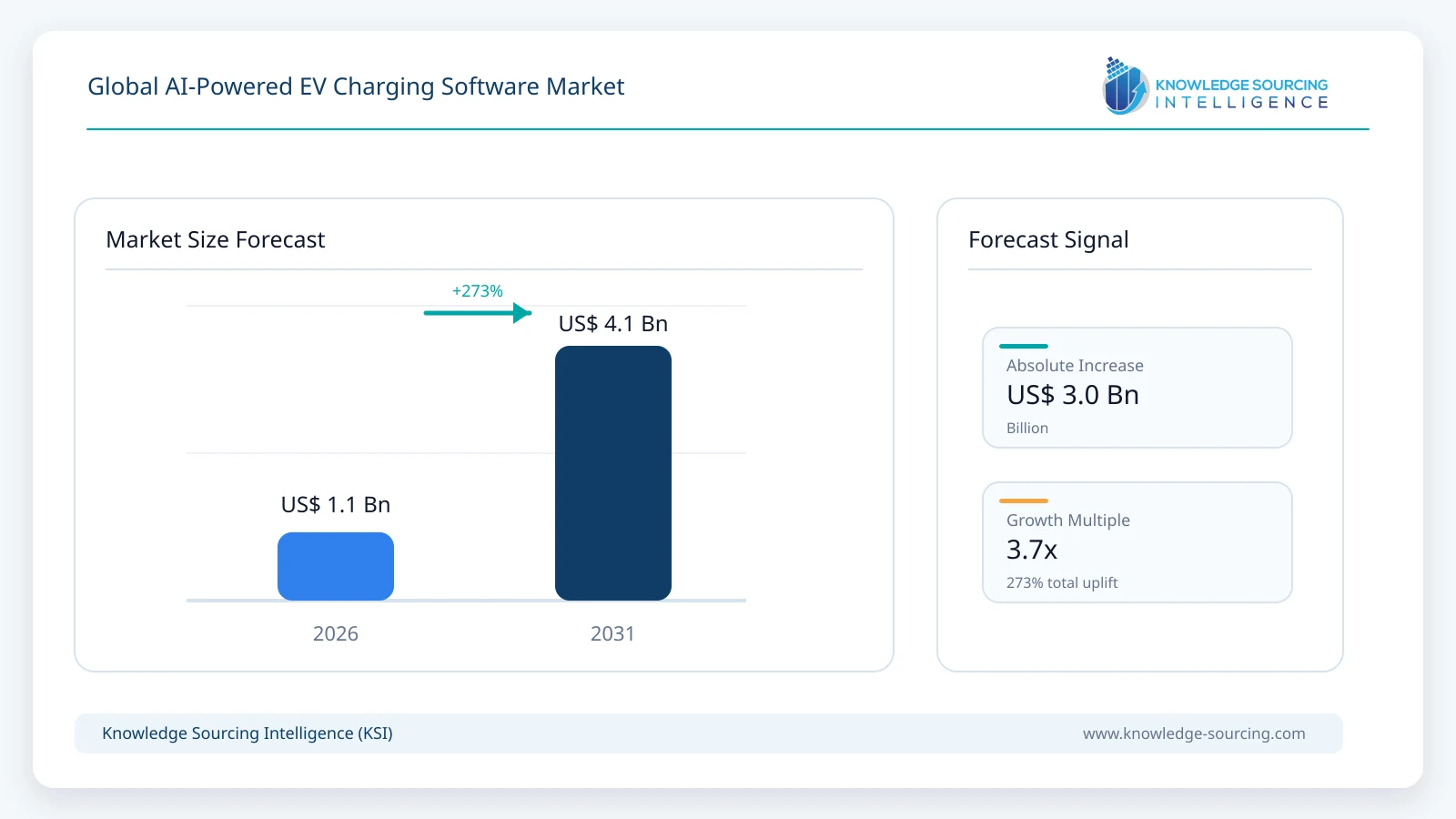
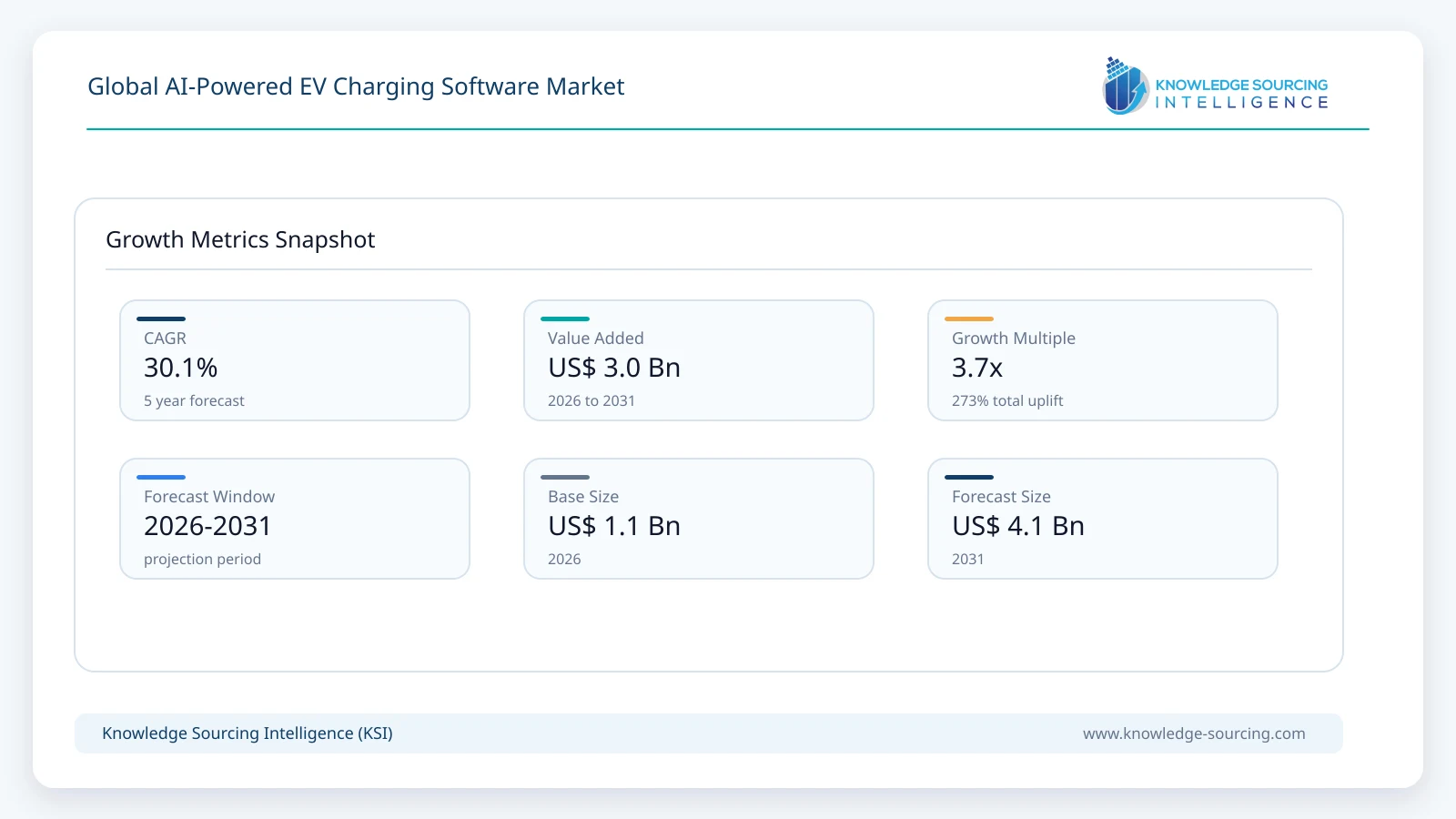
The global AI-powered EV charging software market is projected to grow from USD 1.10 billion in 2026 to USD 4.10 billion by 2031, at a CAGR of 30.1% over the forecast period.
Highlights:
- 1More than 7 million public charging points were operating globally at the end of 2025, creating a growing data base for AI-led optimization.
- 2AI is increasingly used for predictive maintenance, anomaly detection, demand forecasting, charging schedules and energy-cost optimization.
- 3Driivz reported in May 2026 that 67% of surveyed charging-network operators viewed AI as very important or critical to company growth.
- 4AI-powered fleet charging is gaining traction where vehicle departure times, grid limits and electricity tariffs must be optimized simultaneously.
- 5Utilities are using managed charging and AI-based orchestration to aggregate EVs as flexible grid resources.
- 6Dynamic pricing and utilization forecasting are emerging as revenue-management tools for public charging operators.
- 7Agentic AI is beginning to move charging software from dashboards and recommendations toward semi-autonomous network operations.
- 8North America and Europe lead utility-managed charging adoption, while Asia Pacific offers the largest long-term charging-data scale.
EV charging software traditionally focused on charger connectivity, session management, billing and driver access. The AI-powered layer uses operational data to make or recommend decisions that would otherwise require manual analysis. These decisions include when a vehicle should charge, how much power each charger should receive, whether a station is likely to fail, when electricity should be purchased, how prices should change and which new charging sites are most likely to achieve sufficient utilization.
The market is particularly relevant to operators managing large and heterogeneous networks. Public charge point operators need to improve uptime and charger utilization while controlling demand charges. Fleet operators must guarantee that vehicles are ready for departure without exceeding depot power limits. Utilities need to shift charging away from constrained periods and increasingly treat EVs as flexible distributed energy resources. These use cases create software value beyond conventional charging management.
The market does not include the full revenue of EV charging management platforms. Only the AI-enabled optimization, forecasting, predictive, autonomous and intelligent decision-support functions are included. This creates a narrower software category than general charger management and prevents overlap with standard billing, roaming and network-management platforms.
AI Charging Software Capability Comparison
AI Capability | Primary User | Operational Objective | Typical Data Inputs |
Smart Charging and Schedule Optimization | Fleet operators, utilities, workplaces | Shift charging to the lowest-cost or least-constrained time while meeting readiness targets | State of charge, departure time, tariffs, grid limits, charger power |
Dynamic Load Balancing | Fleet depots, commercial sites, CPOs | Allocate limited site power across multiple chargers in real time | Site demand, charger status, transformer capacity, vehicle priority |
Predictive Maintenance and Anomaly Detection | Charge point operators | Identify likely charger faults before they cause failed sessions | Error codes, session history, component telemetry, utilization |
Demand and Utilization Forecasting | CPOs, site developers | Forecast charging demand and improve site economics | Traffic, historical sessions, EV adoption, dwell time, local demand |
Dynamic Pricing and Revenue Optimization | Public charging operators | Increase utilization and margin while managing peak demand | Tariffs, utilization, time of day, energy prices, customer behavior |
Grid and V2G Orchestration | Utilities, aggregators | Coordinate EV load and flexibility with grid conditions | Grid signals, wholesale prices, EV availability, DER data |
Market Dynamics
Charging Networks Are Moving from Deployment to Operational Optimization
The installed charging base is becoming large enough that operational performance matters as much as network expansion. Driivz's 2026 survey of 300 senior charging professionals found that reliability and stability had become the industry's leading operational challenge, while charger utilization was the most frequently cited profitability driver. As operators focus on making existing assets more productive, AI becomes useful for prioritizing maintenance, identifying underperforming locations and improving charging success rates.
Fleet Electrification Creates a Strong Optimization Use Case
Fleet charging requires coordination across vehicles, chargers and energy infrastructure. A depot may have dozens or hundreds of vehicles with different arrival times, route schedules and state-of-charge requirements but a fixed grid connection. AI software can continuously reschedule charging to minimize peak power, reduce energy cost and ensure vehicle availability. Ampcontrol, Driivz, ChargePoint and other platforms are commercializing these capabilities for buses, trucks, delivery fleets and commercial depots.
Utilities Are Treating EV Charging as a Flexible Grid Resource
Managed charging programs are expanding from simple off-peak incentives toward aggregated control of thousands of vehicles. ev.energy's Eve platform coordinates EVs, batteries, solar and other flexible loads as dispatchable resources and was already deployed across more than 55 programs and 300,000 customers at its June 2026 launch. AI and optimization tools can help utilities forecast available flexibility, determine dispatch schedules and integrate EV charging with virtual power plant and distributed energy resource management systems.
Data Quality, Explainability and Integration Limit AI Performance
AI models are only as useful as the operational data available from chargers, vehicles, energy systems and tariffs. Inconsistent charger telemetry, incomplete OCPP implementations and limited vehicle data can reduce model accuracy. Operators also need confidence that automated actions will not conflict with driver requirements, grid constraints or billing rules. This makes interoperability, auditability and human approval important for higher-risk AI functions.
Technology Outlook
Agentic Operations
Charging software is beginning to move from AI-assisted analytics toward agents that can investigate problems and take predefined actions. AMPECO's CoOperator combines information retrieval, analysis and operator-confirmed actions inside its charging-management platform, while Driivz's Network Optimization Agent is designed to convert network data into operational decisions. The technology can reduce the time required to diagnose faults, adjust configurations and respond to network conditions.
Predictive Reliability
Predictive maintenance uses charger telemetry, fault codes, historical sessions and component behavior to identify likely failures before a driver encounters them. AI can also detect unusual patterns that indicate connector, communication, payment or power-delivery problems. Improving first-time charging success has become a key commercial objective because poor reliability directly reduces utilization and customer trust.
AI-Based Energy Optimization
Energy-management algorithms forecast site load and electricity cost, then schedule chargers within power constraints. The value increases at high-power fleet depots and fast-charging hubs where demand charges or grid limits can materially affect operating economics. AI can also coordinate onsite solar generation and battery storage with EV charging demand.
Conversational Analytics and Decision Support
Natural-language interfaces are emerging as a practical way for operators to query complex charging data. ChargePoint offers an AI-powered Data Assistant, AMPECO's CoOperator allows operators to ask questions and initiate workflows, and ev.energy's Eve Insight provides a conversational planning interface for utilities. These tools lower the barrier to using large operational datasets without requiring specialist data teams.
Global AI-Powered EV Charging Software Market Segment Analysis
By AI Function
Charging optimization and energy management represent core commercial use cases because they directly affect electricity cost and grid capacity. Predictive maintenance is becoming increasingly important as public networks mature and operators focus on uptime. Demand forecasting and dynamic pricing support utilization and profitability, while conversational and agentic tools are newer categories that can reduce the operational effort required to manage large networks.
By End User
Charge point operators use AI primarily to improve reliability, utilization, pricing and maintenance. Fleet operators emphasize energy cost, vehicle readiness and depot power constraints. Utilities use managed charging software to shift load and aggregate flexible capacity, while commercial property operators focus on load balancing and electricity-cost control across workplace, retail and multifamily charging.
By Deployment
Cloud-based deployment dominates large charging networks because AI models require centralized access to operational data across multiple sites. Edge controllers remain important where rapid local decisions are required or cloud connectivity is unreliable. Fleet depots increasingly use hybrid architectures in which local controllers enforce site-level power limits while cloud software performs forecasting, optimization and reporting.
By Charging Environment
Public charging networks generate rich utilization and reliability data, making them suitable for predictive maintenance and pricing optimization. Fleet depots offer more structured schedules and therefore stronger charging-optimization economics. Workplace and multifamily sites benefit from automated load balancing, while residential managed charging is increasingly aggregated through utilities and energy-service providers.
By Business Model
AI functionality is sold through software subscriptions, per-port fees, enterprise licensing and energy-management service contracts. Some providers embed AI within broader charging-management subscriptions, while others offer specialist optimization modules or utility-managed charging programs. Over time, performance-linked pricing may expand where software providers can demonstrate measurable savings in energy cost, uptime or utilization.
Market and Demand Indicators
Indicator | Latest Development | Market Impact |
Global charger base | IEA reported more than 7 million public and more than 43 million private LDV charging points at the end of 2025. | Provides a rapidly expanding operational-data base for optimization and predictive software. |
Operator AI adoption | Driivz reported on May 31, 2026 that 67% of surveyed operators considered AI very important or critical to company growth. | Shows AI is moving into core charging-network strategy rather than remaining experimental. |
Utility orchestration | ev.energy launched Eve on June 4, 2026 after deployment across 55+ programs and 300,000+ customers. | Demonstrates commercial scale for intelligent managed charging and grid-edge orchestration. |
AI charging operations | AMPECO launched CoOperator on March 16, 2026 as an AI agent for charging-network information, analysis and operator-confirmed actions. | Shows agentic AI entering day-to-day charging operations. |
AI platform integration | ChargePoint launched its next-generation platform on November 13, 2025 with AI-based scheduling, predictive maintenance and pricing optimization. | Confirms established charging platforms are embedding AI as a core software function. |
Fleet optimization economics | Ampcontrol reported that customers use its AI platform to reduce energy cost and charger downtime across electric fleets. | Supports a direct software ROI case in depot charging. |
North America Market Analysis
North America is one of the strongest early markets for AI-powered EV charging software because public charging, fleet electrification and utility-managed charging are developing simultaneously. ChargePoint, Ampcontrol, EV Connect, ChargeLab and several utility-focused software providers have significant operations in the region. Large school-bus, transit, delivery and truck fleets create high-value optimization problems because depot charging must be coordinated around route schedules and often constrained electrical capacity.
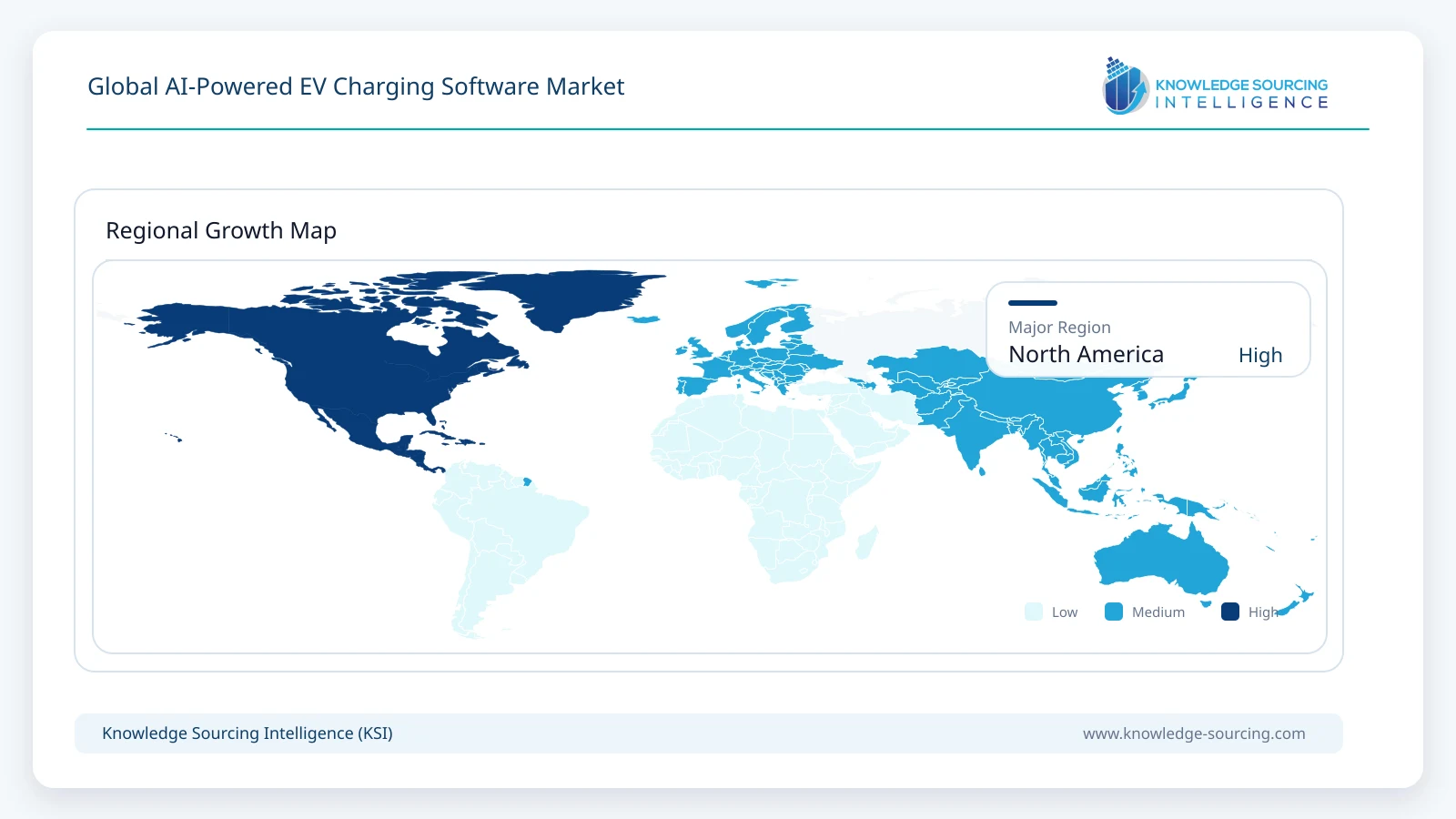
Utility participation is particularly important. Managed charging programs can shift residential EV load away from peak hours without requiring drivers to manually change behavior. ev.energy has expanded utility programs in the United States, including managed charging and virtual power plant applications. AI-based forecasting and orchestration can also improve the ability of utilities to treat EV load as a predictable flexible resource.
The region also benefits from rapid software adoption among charging operators. ChargePoint's November 2025 platform release brought AI-based scheduling, maintenance and pricing functions into a large commercial charging ecosystem. Ampcontrol's fleet software is used across North American electric bus and truck operations, while AMPECO and Driivz are expanding software deployments with U.S. charging networks. Growth through 2031 is expected to be driven by larger fleets, greater charger density and stronger integration between charging software and utility systems.
Competitive Landscape
Competition spans charging-management platforms, fleet-optimization specialists, utility managed-charging providers and energy-management software companies. ChargePoint, Driivz and AMPECO are embedding AI directly into broader charging-network platforms. Ampcontrol focuses strongly on fleet and depot optimization, while ev.energy concentrates on managed charging, distributed energy resources and utility orchestration. ChargeLab, GreenFlux, Monta, Wevo Energy, EV Connect and Noodoe also provide software capabilities around charging operations, load management and energy optimization.
Competitive advantage depends increasingly on access to high-quality operational data, integration breadth and the ability to demonstrate measurable outcomes. Providers with large charger fleets can train models on fault patterns and utilization behavior, while utility-focused companies gain value from grid and tariff data. Hardware-agnostic OCPP support remains important because AI software must operate across mixed charger estates rather than only within a single hardware ecosystem.
Recent Developments
September 2026: Driivz introduced its Network Optimization Agent at ICNC26, positioning the product as an AI-powered assistant for EV charging operations and autonomous decision support.
June 2026: ev.energy launched Eve, an AI-native multi-distributed-energy-resource orchestration platform, with Eve Insight entering beta for selected utility customers.
May 2026: Driivz published its 2026 State of EV Charging Network Operators findings, reporting that 67% of respondents viewed AI as very important or critical to company growth.
March 2026: AMPECO launched CoOperator, an AI operations agent that combines charging-network information, analysis and operator-confirmed actions.
November 2025: ChargePoint released its next-generation ChargePoint Platform with AI-driven charging optimization, predictive maintenance, dynamic pricing and data-assistant capabilities.
March 2025: First Student selected Ampcontrol's AI-powered charging platform to optimize electric school-bus charging operations across North America.
Global AI-Powered EV Charging Software Market Scope:
| Report Metric | Details |
|---|---|
| Total Market Size in 2026 | USD 1.10 billion |
| Total Market Size in 2031 | USD 4.10 billion |
| Forecast Unit | USD Billion |
| Growth Rate | 30.1% |
| Study Period | 2021 to 2031 |
| Historical Data | 2021 to 2024 |
| Base Year | 2025 |
| Forecast Period | 2026 – 2031 |
| Segmentation | AI Function, End User, Deployment, Charging Environment, Business Model, Geography |
| Companies |
|
Market Segmentation
By AI Function
Smart Charging and Schedule Optimization
Dynamic Load Balancing
Predictive Maintenance and Anomaly Detection
Demand and Utilization Forecasting
Dynamic Pricing and Revenue Optimization
Grid and V2G Orchestration
By End User
Charge Point Operators
Fleet Operators
Utilities and Energy Providers
Commercial and Real Estate Operators
Other End Users
By Deployment
Cloud
Edge / On-Site
Hybrid
By Charging Environment
Public Charging Networks
Fleet and Depot Charging
Workplace and Commercial Charging
Residential Managed Charging
By Business Model
Subscription / SaaS
Per-Port Licensing
Enterprise Licensing
Managed Energy and Optimization Services
By Geography
North America
United States
Canada
Mexico
South America
Brazil
Argentina
Rest of South America
Europe
United Kingdom
Germany
France
Netherlands
Rest of Europe
Middle East and Africa
United Arab Emirates
Saudi Arabia
South Africa
Rest of Middle East and Africa
Asia Pacific
China
Japan
India
South Korea
Australia
Rest of Asia Pacific
Table of Contents
1. EXECUTIVE SUMMARY
2. MARKET SNAPSHOT
2.1. Market Overview
2.2. Market Segmentation
3. BUSINESS LANDSCAPE
3.1. Market Drivers
3.1.1. Charging Networks Are Moving from Deployment to Operational Optimization
3.1.2. Fleet Electrification Creates a Strong Optimization Use Case
3.1.3. Utilities Are Treating EV Charging as a Flexible Grid Resource
3.2. Market Restraints
3.2.1. Data Quality, Explainability and Integration Limit AI Performance
3.3. Market Opportunities
3.4. Porter's Five Forces Analysis
3.5. Industry Value Chain Analysis
3.6. Data Privacy, Cybersecurity and AI Governance
4. TECHNOLOGICAL OUTLOOK
4.1. Agentic Operations
4.2. Predictive Reliability
4.3. AI-Based Energy Optimization
4.4. Conversational Analytics and Decision Support
5. GLOBAL AI-POWERED EV CHARGING SOFTWARE MARKET BY AI FUNCTION
5.1. Smart Charging and Schedule Optimization
5.2. Dynamic Load Balancing
5.3. Predictive Maintenance and Anomaly Detection
5.4. Demand and Utilization Forecasting
5.5. Dynamic Pricing and Revenue Optimization
5.6. Grid and V2G Orchestration
6. GLOBAL AI-POWERED EV CHARGING SOFTWARE MARKET BY END USER
6.1. Charge Point Operators
6.2. Fleet Operators
6.3. Utilities and Energy Providers
6.4. Commercial and Real Estate Operators
6.5. Other End Users
7. GLOBAL AI-POWERED EV CHARGING SOFTWARE MARKET BY DEPLOYMENT
7.1. Cloud
7.2. Edge / On-Site
7.3. Hybrid
8. GLOBAL AI-POWERED EV CHARGING SOFTWARE MARKET BY CHARGING ENVIRONMENT
8.1. Public Charging Networks
8.2. Fleet and Depot Charging
8.3. Workplace and Commercial Charging
8.4. Residential Managed Charging
9. GLOBAL AI-POWERED EV CHARGING SOFTWARE MARKET BY BUSINESS MODEL
9.1. Subscription / SaaS
9.2. Per-Port Licensing
9.3. Enterprise Licensing
9.4. Managed Energy and Optimization Services
10. GLOBAL AI-POWERED EV CHARGING SOFTWARE MARKET BY GEOGRAPHY
10.1. North America
10.1.1. United States
10.1.2. Canada
10.1.3. Mexico
10.2. South America
10.2.1. Brazil
10.2.2. Argentina
10.2.3. Rest of South America
10.3. Europe
10.3.1. United Kingdom
10.3.2. Germany
10.3.3. France
10.3.4. Netherlands
10.3.5. Rest of Europe
10.4. Middle East and Africa
10.4.1. United Arab Emirates
10.4.2. Saudi Arabia
10.4.3. South Africa
10.4.4. Rest of Middle East and Africa
10.5. Asia Pacific
10.5.1. China
10.5.2. Japan
10.5.3. India
10.5.4. South Korea
10.5.5. Australia
10.5.6. Rest of Asia Pacific
11. COMPETITIVE ENVIRONMENT AND ANALYSIS
11.1. Major Players and Strategy Analysis
11.2. Market Share Analysis
11.3. Product Development, Partnerships and Platform Expansion
11.4. Competitive Dashboard
12. COMPANY PROFILES
12.1. ChargePoint Holdings, Inc.
12.2. Driivz Ltd.
12.3. AMPECO Ltd.
12.4. Ampcontrol Technologies, Inc.
12.5. ev.energy
12.6. ChargeLab Inc.
12.7. EV Connect, Inc.
12.8. GreenFlux Assets B.V.
12.9. Monta ApS
12.10. Wevo Energy Ltd.
12.11. Noodoe Corporation
12.12. Gaadin AI
12.13. Siemens AG
12.14. Schneider Electric SE
12.15. ABB Ltd.
12.16. Jedlix B.V.
12.17. Kaluza Ltd.
12.18. Volue ASA
13. RECENT DEVELOPMENTS
14. APPENDIX
14.1. Currency
14.2. Assumptions
14.3. Base and Forecast Years Timeline
14.4. Abbreviations
Navigate
Trusted by the world's leading organizations











