
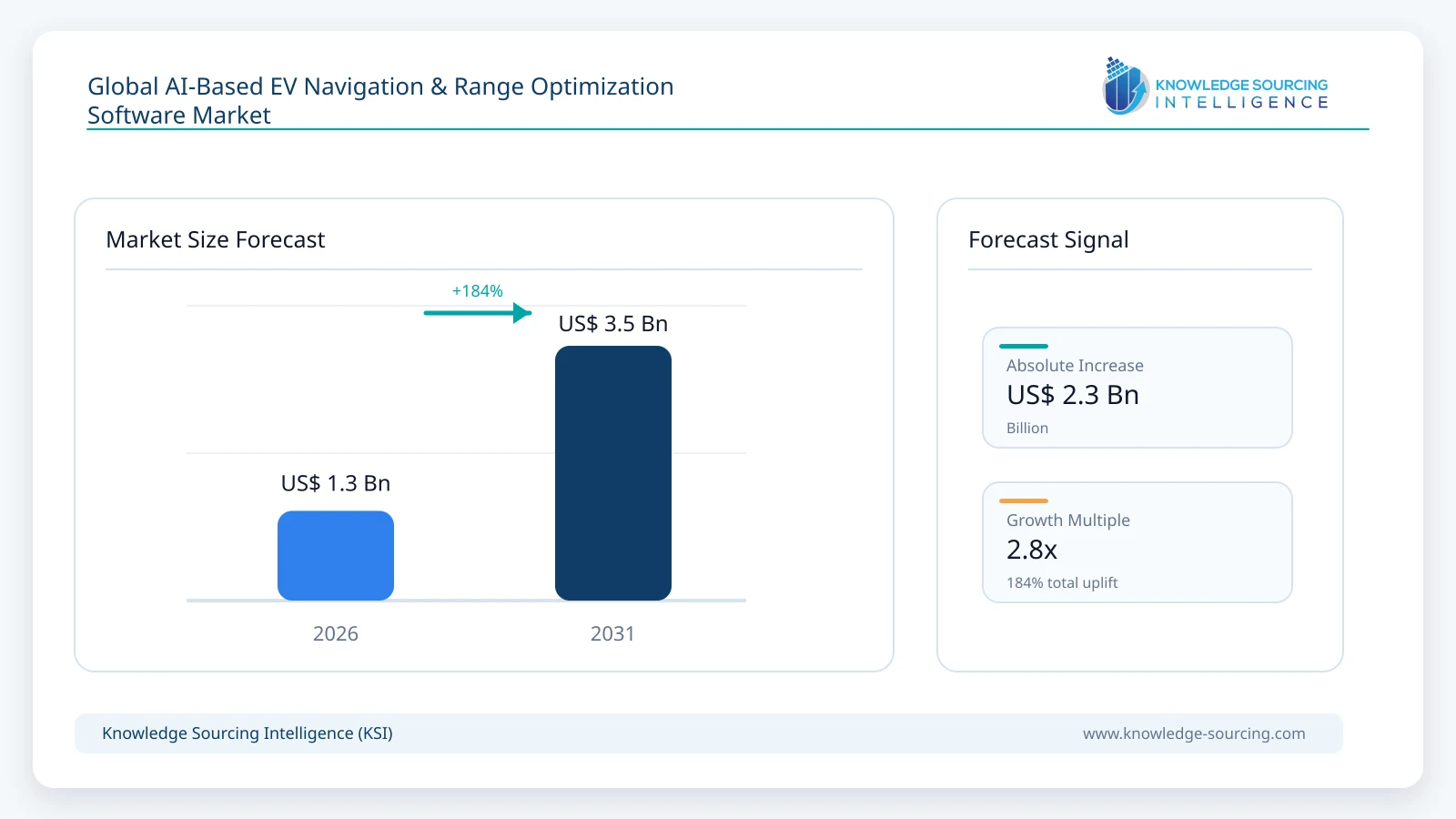
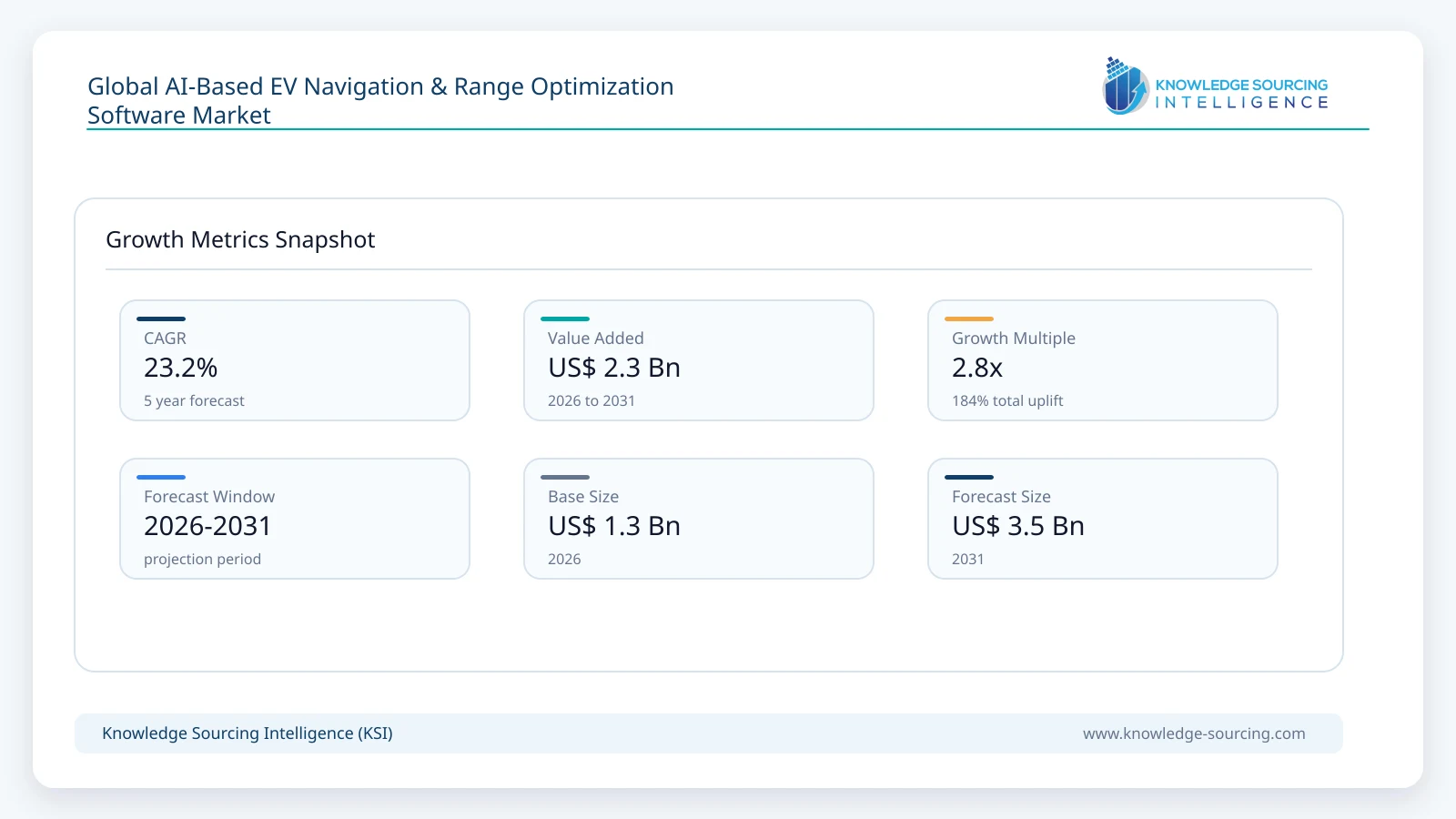
The global AI-based EV navigation and range optimization software market is forecast to grow from USD 1.25 billion to USD 3.55 billion at a CAGR of 23.2% during 2026–2031.
Highlights:
- 1AI-powered routing increasingly predicts battery state at arrival rather than relying on static distance-based range estimates.
- 2Google expanded AI-based EV charging and battery predictions to more than 350 Android Auto EV models in March 2026.
- 3Traffic, road elevation and weather are becoming direct inputs into route-level EV energy-consumption models.
- 4Dynamic charging-stop selection is moving toward optimization of total journey time rather than simply locating the nearest charger.
- 5Live charger compatibility, power output and charging duration are increasingly integrated into route decisions.
- 6Conversational AI allows drivers to modify EV routes and charging plans through natural-language commands.
- 7Software-defined vehicle platforms allow route models to use deeper vehicle-state data and receive over-the-air improvements.
- 8Range prediction accuracy and charging-data quality remain critical differentiators for OEM and navigation-platform adoption.
Electric vehicles make navigation a vehicle-energy problem as well as a mapping problem. A route that is shortest by distance may not be optimal if it requires high-speed driving, steep elevation gain or a charging stop with low power availability. AI-enabled EV navigation therefore combines route geometry with an energy-consumption model and charging strategy. The software continually estimates how much battery will remain at intermediate points and at the destination, then adjusts the route or charging plan when conditions change.
Google Maps' 2026 expansion illustrates this transition. Its EV trip-planning system uses AI together with advanced energy models that consider vehicle details such as weight and battery size alongside traffic, elevation and weather. The system can recommend where to charge, predict arrival battery level and update estimated arrival time to include charging. HERE Routing similarly supports EV-specific routing that adds charging stops when needed and optimizes total travel plus charging time rather than treating chargers as simple points of interest.
The category is also becoming more deeply integrated with the vehicle. Embedded navigation can use live state-of-charge data, vehicle-specific charging curves and real-time route conditions. This allows more accurate predictions than smartphone navigation that lacks direct access to vehicle energy information. Over time, software-defined vehicle architectures are expected to improve model calibration by giving routing software access to richer vehicle telemetry and enabling continuous updates.
AI Navigation Capability Comparison
Capability | Primary Inputs | Driver Outcome | AI / Optimization Role |
Battery-on-Arrival Prediction | State of charge, battery size, vehicle mass, traffic, elevation, weather | More reliable remaining-range estimate | Predict energy consumption along the route |
Charging-Stop Optimization | Charging curve, charger power, compatibility, route and reserve target | Lower total journey time | Select charging locations and target charge duration |
Dynamic Re-Routing | Traffic, charger availability, weather, changing vehicle state | Adjust trip plan when conditions change | Recalculate route and energy plan continuously |
Charger Quality and Availability Intelligence | Live status, historical reliability, charging speed, user data | Reduce failed or inefficient charging stops | Rank charging options by expected trip impact |
Route Energy Optimization | Road speed, gradient, traffic and driving model | Choose lower-energy route when useful | Balance travel time against expected energy consumption |
Conversational EV Trip Planning | Natural-language request, navigation context and charger data | Simpler route and charging-plan changes | Translate driver intent into navigation actions |
Market Dynamics
EV Scale Is Turning Range-Aware Routing into a Mainstream Navigation Requirement
The International Energy Agency expects global electric-car sales to reach approximately 23 million units in 2026. As electric vehicles move into mainstream segments, route planning has to work for drivers who may not want to manually compare charger networks, battery percentages and charging curves. Embedded software that automatically calculates whether charging is required and chooses suitable stops therefore becomes part of the expected navigation experience rather than a specialist feature.
More Accurate Energy Models Improve Driver Trust
Range prediction errors can lead to unnecessary charging stops or, in the opposite direction, insufficient battery reserve. AI allows navigation systems to learn from real-world energy use and combine more variables than fixed consumption assumptions. Google now uses traffic, elevation and weather in its EV battery predictions, while HERE supports empirical and physical consumption models and state-of-charge calculation across route sections. Better models can reduce both range anxiety and excess charging time.
Charging Data Quality Is Becoming as Important as Map Quality
EV routing depends on whether a charger is compatible, operational and capable of delivering the expected power. Incorrect or stale charging data can make an otherwise accurate route unusable. Navigation platforms therefore need live or frequently updated information about connectors, power levels, network access and charger status. Reliability and charging-performance data can increasingly be incorporated into AI ranking rather than selecting stations solely by location.
OEM Integration and Data Access Create Barriers for Independent Navigation Providers
The most accurate range-aware routing benefits from direct access to state of charge, battery capacity, charging curve, vehicle mass and live energy consumption. Automakers and deeply integrated navigation suppliers therefore have an advantage over standalone applications that depend on user-entered data or limited vehicle APIs. Independent providers must secure OEM integrations, telematics access or standardized data interfaces to reach comparable prediction accuracy.
Technology Outlook
AI-Based Energy Consumption Prediction
Energy prediction models can account for vehicle configuration, traffic speed, road gradient, ambient conditions and historical driving patterns. Machine learning can improve the estimate as more trips are completed, while physical models provide a stable baseline for new vehicles or unfamiliar routes. Hybrid approaches are likely to remain important because purely data-driven systems can struggle when operating conditions move outside their training range.
Charging-Aware Route Optimization
Charging-aware routing jointly evaluates road travel and charging time. HERE's routing tools can add charging stops required for reachability and optimize the combined journey. Advanced systems also account for state of charge on arrival, charging curves and minimum destination reserve. This is more useful than routing to a charger after range becomes low because the software can select the charging strategy before the journey begins.
Live Charger Intelligence
Navigation systems increasingly incorporate compatibility, charging speed and live availability. AI can use historical charger performance and current network status to reduce the probability of selecting an unavailable or underperforming station. As public charging networks become denser, ranking quality becomes more important because several technically reachable chargers may be available along the same route.
Conversational and Context-Aware Navigation
Natural-language interfaces allow drivers to request charging stops, change route preferences or search for compatible infrastructure without navigating several menus. Google Maps supports Gemini-based interaction for in-vehicle navigation, while HERE and Amazon demonstrated conversational AI navigation for automakers at CES 2026. The technology can improve usability when the driver needs to change charging strategy while already on the road.
Global AI-Based EV Navigation & Range Optimization Software Market Segment Analysis
By AI Function
Battery and range prediction forms the analytical foundation because charging-stop decisions depend on expected energy use. Charging optimization adds station selection and duration planning, while live re-routing responds to changes in traffic, weather, charger condition and vehicle state. Conversational navigation is newer but can become an important interface layer as in-vehicle assistants gain access to navigation and charging functions.
By Deployment
Embedded OEM navigation has the strongest access to vehicle-state data and can therefore produce highly integrated range and charging predictions. Smartphone and projected-phone systems benefit from broader user reach but may have less detailed vehicle telemetry. Cloud services provide map, traffic and charging intelligence, while the in-vehicle system can execute local calculations and present the route.
By Vehicle Type
Passenger battery-electric vehicles provide the largest addressable user base. Commercial EVs can create greater economic value per vehicle because route delays and charging decisions directly affect utilization. Plug-in hybrids have less dependence on charging-aware navigation because an internal-combustion engine can extend range, although route-level energy optimization can still improve electric driving share.
By Navigation Environment
Long-distance travel is the strongest use case for charging-stop optimization because insufficient charging infrastructure or poor station selection can materially increase travel time. Urban driving emphasizes range prediction, traffic and destination charging. Fleet and commercial routing adds scheduling, depot constraints and operational cost considerations.
By Data Source
Vehicle telemetry supplies state of charge, battery characteristics and real-time consumption. Map and traffic platforms provide route speed and geometry, while weather and charging-network data improve energy and charging predictions. AI value increases when these data sources are combined rather than analyzed independently.
Market and Demand Indicators
Indicator | Latest Development | Market Relevance |
AI EV routing scale | Google announced on March 30, 2026 that AI-powered EV trip planning was expanding to more than 350 Android Auto vehicle models. | Demonstrates AI range and charging prediction moving into mass-market vehicle navigation. |
Route-energy inputs | Google's 2026 model combines vehicle characteristics with traffic, road elevation and weather. | Shows the transition from static range estimates toward context-aware energy prediction. |
AI-powered automotive mapping | HERE launched an AI-powered software-defined vehicle portfolio on January 6, 2026. | Supports OEM adoption of AI navigation and location intelligence. |
Integrated EV navigation | HERE and Lucid announced on January 5, 2026 that Lucid uses HERE Navigation SDK for in-vehicle and mobile/web trip planning. | Confirms OEM demand for integrated EV trip-planning software. |
Navigation plus automated driving | HERE and Lotus launched an integrated navigation and Highway NOA solution on April 24, 2026 across Lotus EVs. | Shows navigation becoming a shared intelligence layer for cockpit and automated-driving functions. |
EV-specific routing engines | HERE Routing API optimizes EV routes for travel and charging time and can automatically add required charging stops. | Provides infrastructure for OEM and third-party EV route optimization. |
North America Market Analysis
North America is an important early market for AI-based EV navigation because a large and geographically dispersed road network makes charging-stop quality and route-energy prediction commercially relevant. Google began rolling out AI-powered EV battery predictions to more than 350 Android Auto EV models in the United States in March 2026, covering more than 15 vehicle brands. The system combines vehicle and real-time route data to predict energy use and recommend charging stops.
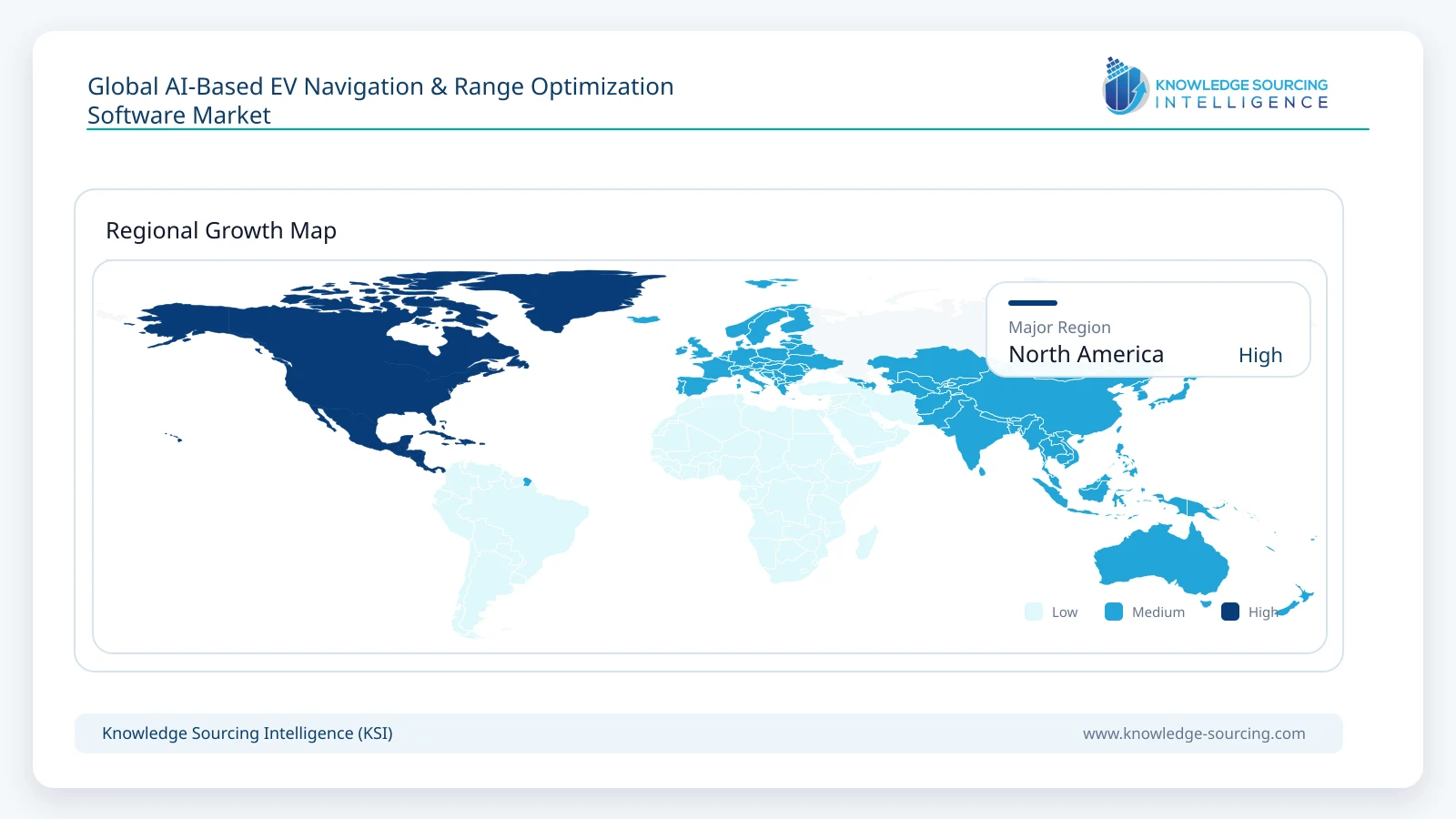
The region also has a strong ecosystem of OEM-integrated and independent EV route-planning platforms. Rivian owns A Better Routeplanner, which is widely used for model-specific EV trip planning. Lucid integrates HERE Navigation SDK for in-car and mobile/web route planning, while Google Maps embedded in compatible vehicles can use live state of charge and automatically add charging stops. These approaches illustrate competition between automaker-owned, mapping-platform and independent software models.
Growth through 2031 will depend on better charger-status data, expansion of fast-charging coverage and deeper vehicle integration. As North American Charging System infrastructure broadens across automakers, navigation software will increasingly need to optimize across charger network, availability, charging speed and vehicle-specific charging curves rather than merely identify compatible connectors.
Competitive Landscape
The market includes global mapping platforms, automotive navigation suppliers, OEM-owned EV routing services and specialist route-planning companies. Google combines Maps, Android Automotive and Gemini capabilities. HERE provides navigation SDKs, EV routing APIs, live maps and software-defined vehicle solutions to automakers. TomTom competes through automotive navigation and location technology, while Mapbox and Elektrobit provide customizable navigation and software platforms.
Specialist and OEM-linked providers include A Better Routeplanner, now owned by Rivian, and vehicle manufacturers that develop proprietary energy-aware route planners. Competitive differentiation increasingly depends on energy-model accuracy, charger data quality, OEM vehicle integration, live availability, charging-curve support, global map coverage and the ability to personalize routes without excessive driver input.
Recent Developments
April 2026: HERE Technologies and Lotus debuted an integrated navigation and Highway Navigation on Autopilot solution for international markets across the Lotus electric-vehicle portfolio.
March 2026: Google announced AI-powered EV battery prediction and charging-stop recommendations for more than 350 Android Auto EV models across over 15 brands in the United States.
January 2026: HERE Technologies introduced an AI-powered software-defined vehicle portfolio at CES 2026 combining live maps, navigation and advanced vehicle software.
January 2026: HERE Technologies announced that Lucid was using the HERE Navigation SDK for connected in-vehicle navigation and mobile/web trip planning across the Lucid Air and Lucid Gravity.
January 2026: HERE and Amazon announced a CES 2026 collaboration demonstrating conversational AI navigation for automakers.
January 2026: HERE and Hyundai AutoEver expanded their online navigation partnership for intelligent digital-cockpit experiences.
Global AI-Based EV Navigation & Range Optimization Software Market Scope:
| Report Metric | Details |
|---|---|
| Total Market Size in 2026 | USD 1.25 billion |
| Total Market Size in 2031 | USD 3.55 billion |
| Forecast Unit | USD Billion |
| Growth Rate | 23.2% |
| Study Period | 2021 to 2031 |
| Historical Data | 2021 to 2024 |
| Base Year | 2025 |
| Forecast Period | 2026 – 2031 |
| Segmentation | AI Function, Deployment, Vehicle Type, Navigation Environment, Data Source, Geography |
| Companies |
|
Market Segmentation
By AI Function
Battery and Range Prediction
Charging-Stop Optimization
Dynamic Re-Routing
Charger Intelligence and Ranking
Route Energy Optimization
Conversational EV Trip Planning
By Deployment
Embedded OEM Navigation
Smartphone / Projected Navigation
Cloud Navigation Services
By Vehicle Type
Passenger Battery Electric Vehicles
Plug-in Hybrid Electric Vehicles
Commercial Electric Vehicles
By Navigation Environment
Long-Distance / Intercity
Urban and Commuter
Fleet and Commercial Routing
By Data Source
Vehicle Telemetry
Map and Traffic Data
Charging Network Data
Weather and Environmental Data
By Geography
North America
United States
Canada
Mexico
South America
Brazil
Argentina
Rest of South America
Europe
Germany
United Kingdom
France
Italy
Rest of Europe
Middle East and Africa
Saudi Arabia
United Arab Emirates
South Africa
Rest of Middle East and Africa
Asia Pacific
China
Japan
India
South Korea
Rest of Asia Pacific
Table of Contents
1. EXECUTIVE SUMMARY
2. MARKET SNAPSHOT
2.1. Market Overview
2.2. Market Segmentation
3. BUSINESS LANDSCAPE
3.1. Market Drivers
3.1.1. EV Scale Is Turning Range-Aware Routing into a Mainstream Navigation Requirement
3.1.2. More Accurate Energy Models Improve Driver Trust
3.1.3. Charging Data Quality Is Becoming as Important as Map Quality
3.2. Market Restraints
3.2.1. OEM Integration and Data Access Create Barriers for Independent Navigation Providers
3.3. Market Opportunities
3.4. Porter's Five Forces Analysis
3.5. Industry Value Chain Analysis
3.6. Data Privacy and Vehicle Integration Requirements
4. TECHNOLOGICAL OUTLOOK
4.1. AI-Based Energy Consumption Prediction
4.2. Charging-Aware Route Optimization
4.3. Live Charger Intelligence
4.4. Conversational and Context-Aware Navigation
5. GLOBAL AI-BASED EV NAVIGATION & RANGE OPTIMIZATION SOFTWARE MARKET BY AI FUNCTION
5.1. Battery and Range Prediction
5.2. Charging-Stop Optimization
5.3. Dynamic Re-Routing
5.4. Charger Intelligence and Ranking
5.5. Route Energy Optimization
5.6. Conversational EV Trip Planning
6. GLOBAL AI-BASED EV NAVIGATION & RANGE OPTIMIZATION SOFTWARE MARKET BY DEPLOYMENT
6.1. Embedded OEM Navigation
6.2. Smartphone / Projected Navigation
6.3. Cloud Navigation Services
7. GLOBAL AI-BASED EV NAVIGATION & RANGE OPTIMIZATION SOFTWARE MARKET BY VEHICLE TYPE
7.1. Passenger Battery Electric Vehicles
7.2. Plug-in Hybrid Electric Vehicles
7.3. Commercial Electric Vehicles
8. GLOBAL AI-BASED EV NAVIGATION & RANGE OPTIMIZATION SOFTWARE MARKET BY NAVIGATION ENVIRONMENT
8.1. Long-Distance / Intercity
8.2. Urban and Commuter
8.3. Fleet and Commercial Routing
9. GLOBAL AI-BASED EV NAVIGATION & RANGE OPTIMIZATION SOFTWARE MARKET BY DATA SOURCE
9.1. Vehicle Telemetry
9.2. Map and Traffic Data
9.3. Charging Network Data
9.4. Weather and Environmental Data
10. GLOBAL AI-BASED EV NAVIGATION & RANGE OPTIMIZATION SOFTWARE MARKET BY GEOGRAPHY
10.1. North America
10.1.1. United States
10.1.2. Canada
10.1.3. Mexico
10.2. South America
10.2.1. Brazil
10.2.2. Argentina
10.2.3. Rest of South America
10.3. Europe
10.3.1. Germany
10.3.2. United Kingdom
10.3.3. France
10.3.4. Italy
10.3.5. Rest of Europe
10.4. Middle East and Africa
10.4.1. Saudi Arabia
10.4.2. United Arab Emirates
10.4.3. South Africa
10.4.4. Rest of Middle East and Africa
10.5. Asia Pacific
10.5.1. China
10.5.2. Japan
10.5.3. India
10.5.4. South Korea
10.5.5. Rest of Asia Pacific
11. COMPETITIVE ENVIRONMENT AND ANALYSIS
11.1. Major Players and Strategy Analysis
11.2. Market Share Analysis
11.3. Product Development, OEM Integration and Partnerships
11.4. Competitive Dashboard
12. COMPANY PROFILES
12.1. Google LLC
12.2. HERE Technologies
12.3. TomTom N.V.
12.4. Rivian Automotive, Inc. / A Better Routeplanner
12.5. Mapbox, Inc.
12.6. Elektrobit Automotive GmbH
12.7. Garmin Ltd.
12.8. Telenav, Inc.
12.9. Mireo d.d.
12.10. Intellias
12.11. Luxoft
12.12. AISIN Corporation
12.13. Hyundai AutoEver Corporation
12.14. Lucid Group, Inc.
12.15. Tesla, Inc.
12.16. Mercedes-Benz Group AG
12.17. BMW Group
12.18. Geely Automobile Holdings Limited
13. RECENT DEVELOPMENTS
14. APPENDIX
14.1. Currency
14.2. Assumptions
14.3. Base and Forecast Years Timeline
14.4. Abbreviations
Navigate
Trusted by the world's leading organizations











