
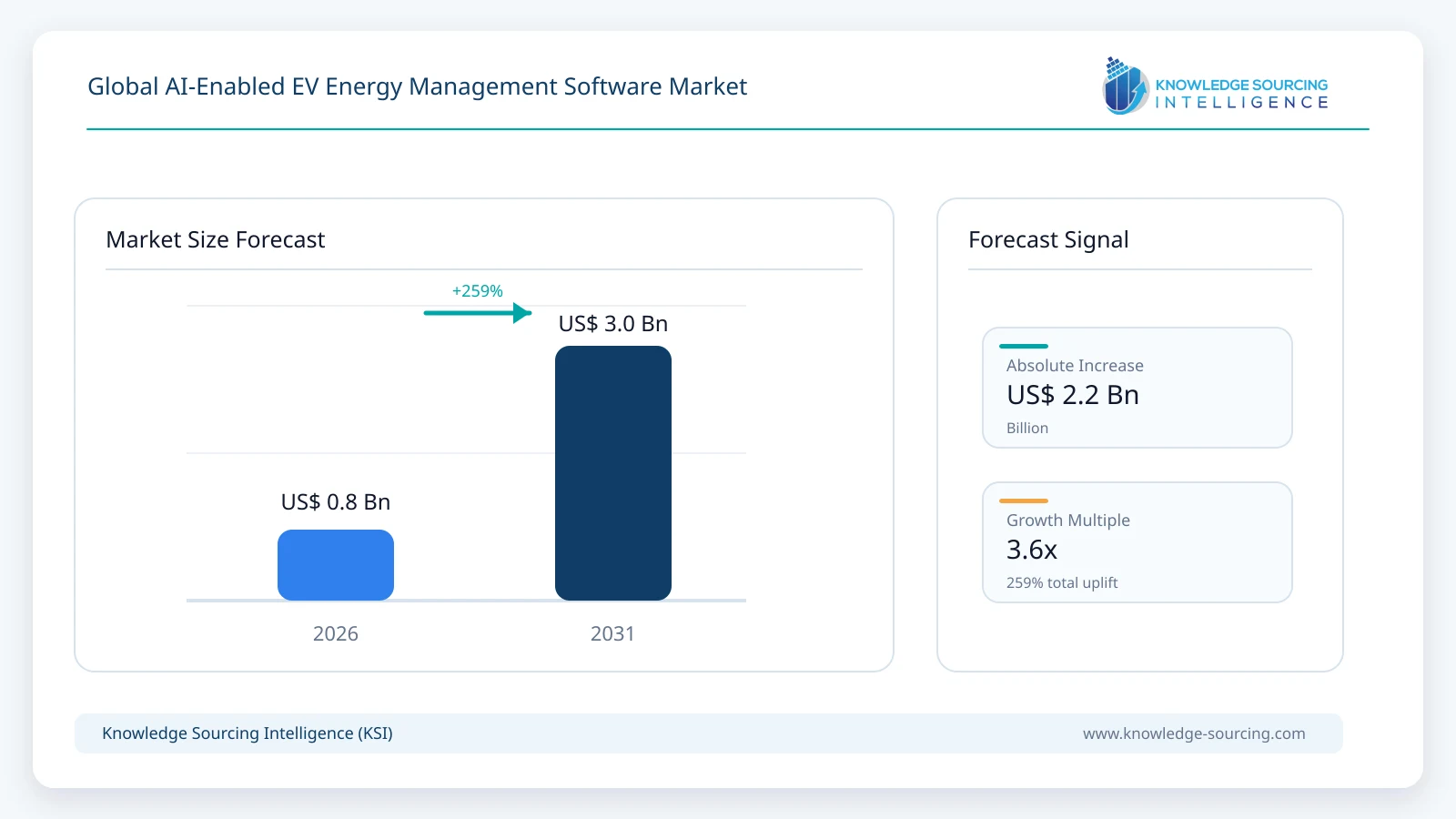
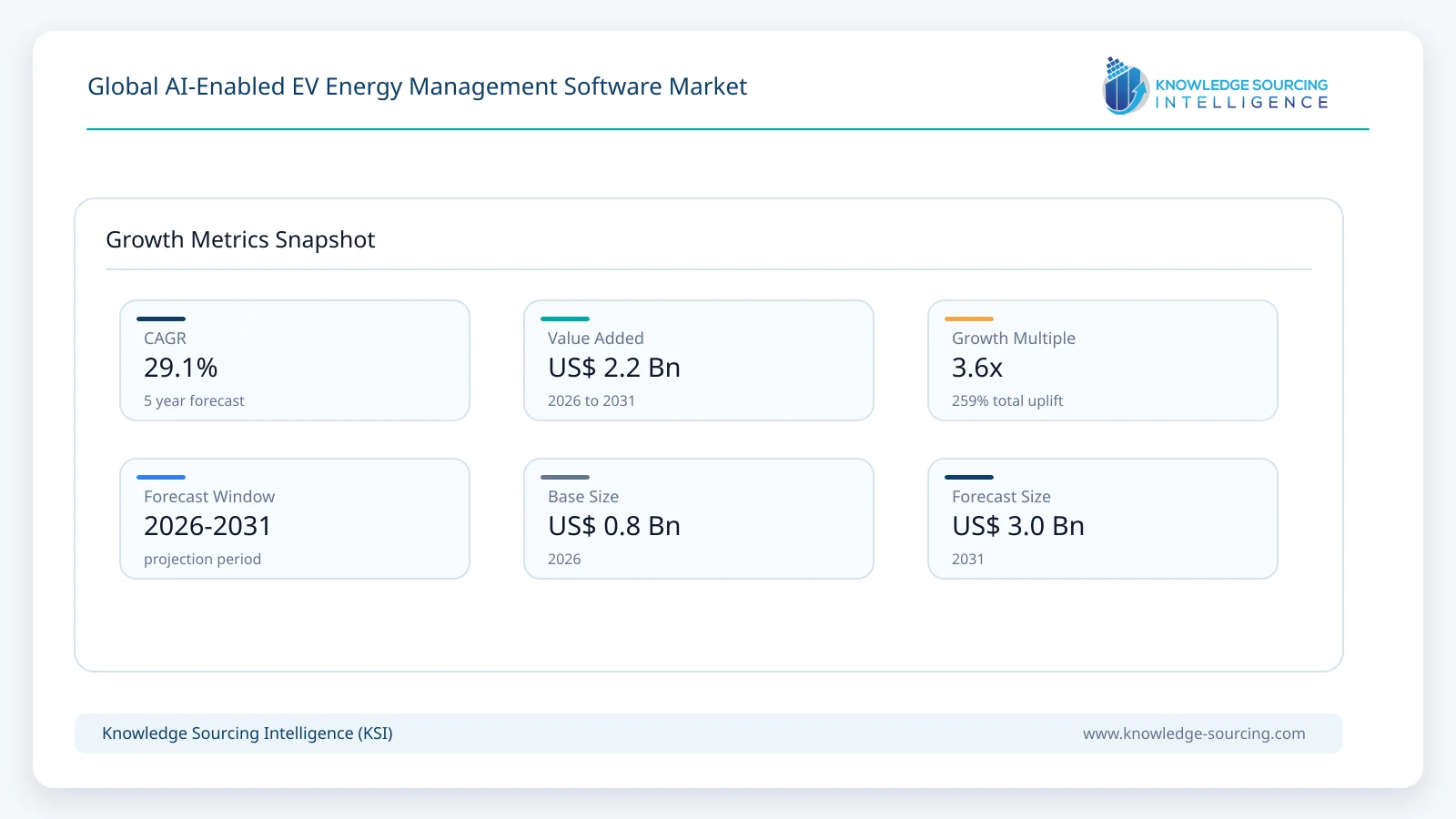
The Global AI-Enabled EV Energy Management Software Market is expected to increase from USD 0.85 billion in 2026 to USD 3.05 billion by 2031, growing at a CAGR of 29.1% over the forecast period.
Highlights:
- 1AI is extending EV energy management beyond fixed rules toward predictive and adaptive vehicle-level control.
- 2Battery health, route, weather and thermal data are increasingly combined to improve real-world range and energy efficiency.
- 3Software-defined vehicle architectures make vehicle-wide energy optimization easier by centralizing data and compute resources.
- 4Edge AI enables energy-management decisions inside the vehicle without depending on continuous cloud connectivity.
- 5AI-supported thermal control can coordinate cabin comfort and battery temperature with available energy and predicted driving conditions.
- 6Battery state-of-charge, state-of-health and remaining useful life are becoming active inputs to energy-management decisions.
- 7Digital twins and reinforcement learning are emerging as tools for health-aware and route-aware EV energy optimization.
- 8Asia Pacific offers the largest deployment base, while Europe is building a strong research and software-defined vehicle ecosystem.
Conventional vehicle energy management relies on calibrated control maps, physical models and predefined operating rules. These approaches remain essential for safety-critical control but can be limited when operating conditions vary widely. Artificial intelligence adds a prediction and adaptation layer that can learn relationships among traffic, ambient temperature, battery health, driver behaviour, accessory loads and vehicle performance. The resulting forecasts can be used by supervisory software to adjust thermal setpoints, energy reserves, charging strategies and auxiliary-load priorities.
The strongest value proposition is vehicle-wide coordination. An EV battery may simultaneously supply propulsion, cabin heating or cooling, battery thermal management, infotainment, compute platforms and other electrical loads. Decisions made independently by each subsystem can reduce overall efficiency. AI-enabled energy management can use shared vehicle data to balance those demands against range, comfort, battery ageing and performance targets.
The commercial category is closely linked to software-defined vehicles because centralized and zonal architectures make it easier to access signals across domains and deploy new algorithms after vehicle launch. Automotive-specific edge AI and model lifecycle tools are also becoming important because energy-management models may need to be updated as batteries age, software changes or new operating data becomes available.
Market Dynamics
Software-Defined Vehicles Create the Data Foundation for Adaptive Energy Management
AI-based energy management requires access to information that historically sat inside separate electronic control units. Software-defined architectures provide centralized compute, high-speed networks and vehicle-wide data services that allow software to combine battery, thermal, navigation and driver information. Sonatus and Schaeffler stated in June 2026 that their edge-AI collaboration can run and continuously improve energy-management functions directly on vehicle control units, illustrating how centralized architectures can support lifecycle optimization.
Battery Intelligence Is Moving into Supervisory Energy Decisions
Battery management systems estimate state of charge, state of health and other safety-related parameters. AI-enabled energy management can use these estimates as inputs to broader vehicle decisions rather than treating them as battery-only information. Research published in Applied Energy in July 2026 highlighted the increasing coordination between battery intelligence and energy-management systems, including degradation-aware scheduling, thermal-risk mitigation and remaining-useful-life-sensitive control.
Thermal Loads Make Energy Optimization More Valuable in Extreme Conditions
Heating and cooling can materially reduce usable EV range, particularly in very hot or cold weather. AI-supported systems can use weather, route and passenger information to forecast thermal demand and coordinate cabin comfort with battery-temperature requirements. The Horizon Europe AETHER project, beginning in June 2026, specifically targets AI-supported energy management and personalized thermal comfort for battery-electric vehicles, including light-duty and light-commercial platforms.
Safety, Explainability and Real-Time Constraints Limit Unrestricted AI Control
Vehicle energy management influences battery current, thermal conditions, available propulsion power and driver comfort. AI decisions therefore cannot be treated as unrestricted black-box outputs. Production systems require deterministic safety envelopes, validation across rare operating conditions and fallback logic when model confidence is low. Compute cost and model-update governance also remain important, particularly for edge deployment.
Technology Outlook
Edge AI for Vehicle-Level Energy Management
Running AI at the vehicle edge reduces dependence on cloud connectivity and can improve response time. Sonatus identifies adaptive energy management as an in-vehicle edge-AI use case, while its collaboration with Schaeffler places AI deployment and data-collection tools directly into automotive control units. Edge execution is particularly relevant for energy management because decisions may need to respond continuously to battery temperature, propulsion demand and route changes.
Digital Twins and Reinforcement Learning
Digital twins can maintain a continuously updated virtual representation of battery and vehicle behaviour. Reinforcement learning can then test and refine control strategies against the model before applying decisions to the physical vehicle. A Scientific Reports study published in August 2026 demonstrated a digital-twin-driven reinforcement-learning framework combining energy management, predictive health monitoring and powertrain control for software-defined EVs.
Predictive Battery Energy Management
AI models can improve state estimation, degradation prediction and charge-balancing decisions by learning from operational data. A July 2026 Scientific Reports study proposed a multi-timescale predictive energy-management framework that combines fast electro-thermal control with slower battery-health adaptation. Similar approaches aim to reduce battery stress while maintaining traction demand and thermal safety.
Route- and Weather-Aware Energy Optimization
Navigation data allows energy-management software to anticipate hills, traffic, speed changes and destination charging opportunities. Weather forecasts provide additional information about cabin and battery thermal demand. Combining these signals with vehicle state allows software to reserve energy, adjust thermal preconditioning and improve remaining-range estimates before high-load conditions occur.
Global AI-Enabled EV Energy Management Software Market Segment Analysis
By AI Function
Predictive energy optimization covers trip-level power-demand forecasting, energy budgeting and range improvement. Battery-health-aware control uses state-of-health and degradation models to adjust energy use and charging decisions. Thermal optimization coordinates battery and cabin temperature, while adaptive auxiliary-load management controls non-propulsion electricity use. Digital-twin and reinforcement-learning applications remain newer but are becoming more relevant in software-defined vehicles.
By Vehicle Energy Domain
Battery and thermal systems provide the most direct inputs to vehicle-level energy management because they determine available energy, safety limits and thermal losses. Propulsion-energy forecasting is relevant for route planning but remains distinct from low-level motor and inverter control. Cabin and auxiliary loads create another opportunity because their consumption can be adjusted without directly changing traction hardware.
By Deployment
Edge deployment supports low-latency decisions and keeps sensitive vehicle data local. Cloud systems can train models, compare fleet behaviour and distribute updated parameters or software. Hybrid architectures are expected to remain common, with real-time decisions executed in the vehicle while large-scale learning and model management occur in the cloud.
By Vehicle Type
Passenger battery-electric vehicles provide the largest deployment base. Plug-in hybrids also use AI-assisted energy management, particularly to coordinate electric and combustion power sources, but this report emphasizes electric-energy optimization. Commercial EVs can create strong value because range, payload and route schedules are closely linked to operating economics, making predictive energy budgeting particularly useful.
By Software Architecture
Standalone energy-management applications can be integrated into existing domain controllers, while software-defined platforms can coordinate energy use across several vehicle domains. Centralized architectures offer stronger cross-domain visibility but require more complex functional-safety separation and software lifecycle management.
Market and Demand Indicators
Indicator | Latest Development | Market Impact |
AI and EV control | IEA stated on May 20, 2026 that AI-enabled energy management is increasingly used in vehicle control and battery management. | Confirms energy management as a recognized automotive AI application. |
Edge-AI deployment | Schaeffler and Sonatus announced on June 10, 2026 that their control-unit collaboration supports continuously improvable energy-management functions. | Shows a production-oriented path for in-vehicle AI energy software. |
AI power-domain control | Geely launched Xingrui AI Cloud Power 2.0 on June 13, 2025 for AI-based power-domain optimization and health management. | Demonstrates OEM deployment of AI-based energy and powertrain intelligence. |
AI thermal-energy program | SODA.Auto joined the AETHER project on May 15, 2026; the project started June 1, 2026 and combines AI-supported energy management with EV thermal comfort. | Supports cross-domain energy and thermal optimization development. |
Battery-health-aware EMS | Applied Energy published a review on July 15, 2026 covering AI-driven battery intelligence for EMS-BMS coordination. | Shows growing integration of battery ageing information into energy decisions. |
Software-defined vehicle research | Scientific Reports published a digital-twin and reinforcement-learning EV energy-management framework on August 10, 2026. | Supports continued movement toward adaptive closed-loop energy optimization. |
Asia Pacific Market Analysis
Asia Pacific is the largest commercialization opportunity for AI-enabled EV energy management because the region contains the world's largest electric-vehicle production base and a rapidly expanding software-defined vehicle ecosystem. China is particularly important as manufacturers integrate AI into battery, cockpit, chassis and power-domain functions rather than treating them as isolated features. Geely's Xingrui AI Cloud Power 2.0 is a prominent example of AI being used to optimize power-domain operation and component health across new-energy vehicles.
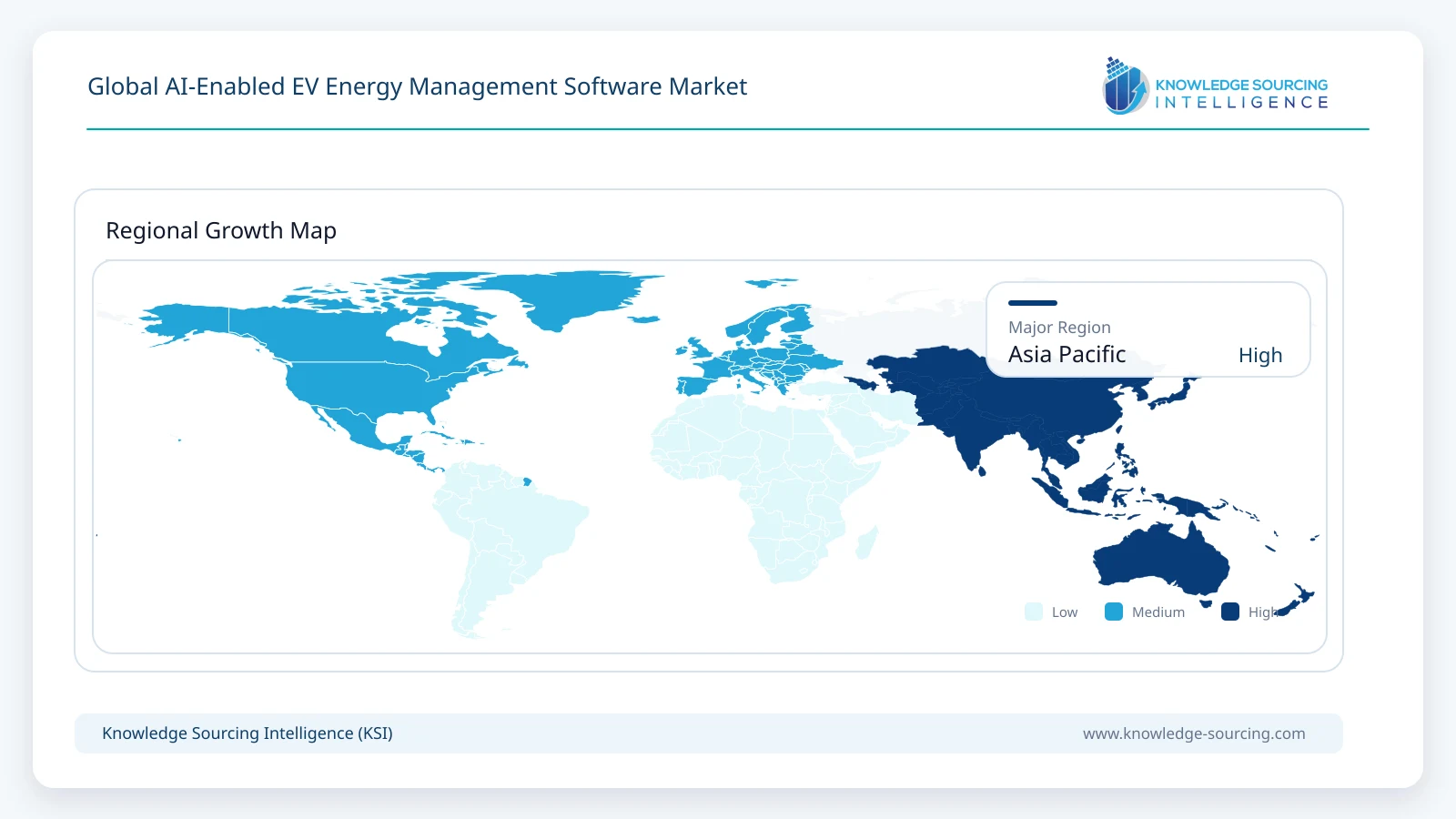
Regional scale also provides a large real-world data base for training and validating energy-management models. High EV production volumes allow manufacturers to learn from diverse climates, traffic conditions, charging behaviour and battery ageing patterns. Japan and South Korea contribute strong battery, semiconductor and automotive software capabilities, while India is increasingly active in EV software engineering, embedded AI and battery-management research.
Through 2031, the region is expected to remain important for commercial deployment, particularly in vehicles built around centralized compute and over-the-air software updates. Competition will center on measurable range improvement, battery durability, thermal efficiency and the ability to deploy updates across multiple vehicle platforms without extensive recalibration.
Competitive Landscape
The competitive environment includes automotive software-platform companies, Tier 1 suppliers, semiconductor vendors, engineering-services providers and vertically integrated vehicle manufacturers. Sonatus provides edge-AI deployment and data infrastructure for software-defined vehicles. Schaeffler is integrating these capabilities into vehicle and battery control units, while Geely has developed AI power-domain intelligence internally. Bosch, ZF, Valeo, Continental and Astemo bring powertrain, thermal and vehicle-control expertise that can support broader energy-management functions.
Semiconductor and software-platform suppliers such as Qualcomm, NXP Semiconductors and Renesas are also important because AI energy management depends on central compute, real-time control and vehicle-wide data access. SODA.Auto, Elektrobit, ETAS, Vector Informatik, KPIT and Tata Elxsi contribute software-defined vehicle platforms, middleware, engineering and validation capabilities. Competitive advantage will depend on cross-domain data access, automotive functional safety, model lifecycle management and demonstrable energy savings rather than AI capability alone.
Recent Developments
August 2026: Scientific Reports published a digital-twin-enabled reinforcement-learning framework combining adaptive EV energy management with predictive health monitoring and vehicle reliability.
July 2026: Applied Energy published a review focused on AI-driven battery intelligence for coordinated EV energy-management and battery-management decisions.
June 2026: Schaeffler and Sonatus announced a global partnership to bring edge AI into software-defined vehicle control units, including continuously improvable energy-management functions.
May 2026: The International Energy Agency published its Artificial Intelligence and EVs analysis, identifying AI-enabled energy management and AI-enhanced battery management as growing EV applications.
May 2026: SODA.Auto announced its participation in the Horizon Europe AETHER project for AI-supported energy management and thermal comfort in next-generation battery-electric vehicles.
February 2026: The German-funded DiEMS project began work on AI-supported battery and energy management for electric vehicles, with EUR 2 million in public funding.
June 2025: Geely launched Xingrui AI Cloud Power 2.0, an AI power-domain intelligent system for energy optimization, health management and dynamic vehicle control.
Global AI-Enabled EV Energy Management Software Market Scope:
| Report Metric | Details |
|---|---|
| Total Market Size in 2026 | USD 0.85 billion |
| Total Market Size in 2031 | USD 3.05 billion |
| Forecast Unit | USD Billion |
| Growth Rate | 29.1% |
| Study Period | 2021 to 2031 |
| Historical Data | 2021 to 2024 |
| Base Year | 2025 |
| Forecast Period | 2026 – 2031 |
| Segmentation | AI Function, Vehicle Energy Domain, Deployment, Vehicle Type, Software Architecture, Geography |
| Companies |
|
Market Segmentation
By AI Function
Predictive Energy Optimization
Battery-Health-Aware Energy Management
Thermal and HVAC Optimization
Auxiliary Load Management
Digital-Twin and Reinforcement-Learning Control
By Vehicle Energy Domain
Battery Energy Management
Thermal and HVAC Energy Management
Propulsion Energy Forecasting
Auxiliary and Electrical Load Management
Cross-Domain Vehicle Energy Management
By Deployment
Edge / In-Vehicle
Cloud-Assisted
Hybrid
By Vehicle Type
Passenger Battery Electric Vehicles
Plug-in Hybrid Electric Vehicles
Commercial Electric Vehicles
Other Electric Vehicles
By Software Architecture
Domain-Based Energy Management
Centralized / Cross-Domain Energy Management
By Geography
North America
United States
Canada
Mexico
South America
Brazil
Argentina
Rest of South America
Europe
Germany
United Kingdom
France
Italy
Rest of Europe
Middle East and Africa
Saudi Arabia
United Arab Emirates
South Africa
Rest of Middle East and Africa
Asia Pacific
China
Japan
India
South Korea
Rest of Asia Pacific
Table of Contents
1. EXECUTIVE SUMMARY
2. MARKET SNAPSHOT
2.1. Market Overview
2.2. Market Segmentation
3. BUSINESS LANDSCAPE
3.1. Market Drivers
3.1.1. Software-Defined Vehicles Create the Data Foundation for Adaptive Energy Management
3.1.2. Battery Intelligence Is Moving into Supervisory Energy Decisions
3.1.3. Thermal Loads Make Energy Optimization More Valuable in Extreme Conditions
3.2. Market Restraints
3.2.1. Safety, Explainability and Real-Time Constraints Limit Unrestricted AI Control
3.3. Market Opportunities
3.4. Porter's Five Forces Analysis
3.5. Industry Value Chain Analysis
3.6. Functional Safety, Data and Software Governance
4. TECHNOLOGICAL OUTLOOK
4.1. Edge AI for Vehicle-Level Energy Management
4.2. Digital Twins and Reinforcement Learning
4.3. Predictive Battery Energy Management
4.4. Route- and Weather-Aware Energy Optimization
5. GLOBAL AI-ENABLED EV ENERGY MANAGEMENT SOFTWARE MARKET BY AI FUNCTION
5.1. Predictive Energy Optimization
5.2. Battery-Health-Aware Energy Management
5.3. Thermal and HVAC Optimization
5.4. Auxiliary Load Management
5.5. Digital-Twin and Reinforcement-Learning Control
6. GLOBAL AI-ENABLED EV ENERGY MANAGEMENT SOFTWARE MARKET BY VEHICLE ENERGY DOMAIN
6.1. Battery Energy Management
6.2. Thermal and HVAC Energy Management
6.3. Propulsion Energy Forecasting
6.4. Auxiliary and Electrical Load Management
6.5. Cross-Domain Vehicle Energy Management
7. GLOBAL AI-ENABLED EV ENERGY MANAGEMENT SOFTWARE MARKET BY DEPLOYMENT
7.1. Edge / In-Vehicle
7.2. Cloud-Assisted
7.3. Hybrid
8. GLOBAL AI-ENABLED EV ENERGY MANAGEMENT SOFTWARE MARKET BY VEHICLE TYPE
8.1. Passenger Battery Electric Vehicles
8.2. Plug-in Hybrid Electric Vehicles
8.3. Commercial Electric Vehicles
8.4. Other Electric Vehicles
9. GLOBAL AI-ENABLED EV ENERGY MANAGEMENT SOFTWARE MARKET BY SOFTWARE ARCHITECTURE
9.1. Domain-Based Energy Management
9.2. Centralized / Cross-Domain Energy Management
10. GLOBAL AI-ENABLED EV ENERGY MANAGEMENT SOFTWARE MARKET BY GEOGRAPHY
10.1. North America
10.1.1. United States
10.1.2. Canada
10.1.3. Mexico
10.2. South America
10.2.1. Brazil
10.2.2. Argentina
10.2.3. Rest of South America
10.3. Europe
10.3.1. Germany
10.3.2. United Kingdom
10.3.3. France
10.3.4. Italy
10.3.5. Rest of Europe
10.4. Middle East and Africa
10.4.1. Saudi Arabia
10.4.2. United Arab Emirates
10.4.3. South Africa
10.4.4. Rest of Middle East and Africa
10.5. Asia Pacific
10.5.1. China
10.5.2. Japan
10.5.3. India
10.5.4. South Korea
10.5.5. Rest of Asia Pacific
11. COMPETITIVE ENVIRONMENT AND ANALYSIS
11.1. Major Players and Strategy Analysis
11.2. Market Share Analysis
11.3. Software Platforms, Partnerships and AI Deployment
11.4. Competitive Dashboard
12. COMPANY PROFILES
12.1. Sonatus, Inc.
12.2. Schaeffler AG
12.3. Geely Automobile Holdings Limited
12.4. Robert Bosch GmbH
12.5. ZF Friedrichshafen AG
12.6. Valeo SE
12.7. Continental AG
12.8. Astemo, Ltd.
12.9. Qualcomm Technologies, Inc.
12.10. NXP Semiconductors N.V.
12.11. Renesas Electronics Corporation
12.12. Elektrobit Automotive GmbH
12.13. ETAS GmbH
12.14. Vector Informatik GmbH
12.15. KPIT Technologies Limited
12.16. Tata Elxsi Limited
12.17. SODA.Auto
12.18. EngineCAL
13. RECENT DEVELOPMENTS
14. APPENDIX
14.1. Currency
14.2. Assumptions
14.3. Base and Forecast Years Timeline
14.4. Abbreviations
Navigate
Trusted by the world's leading organizations











